
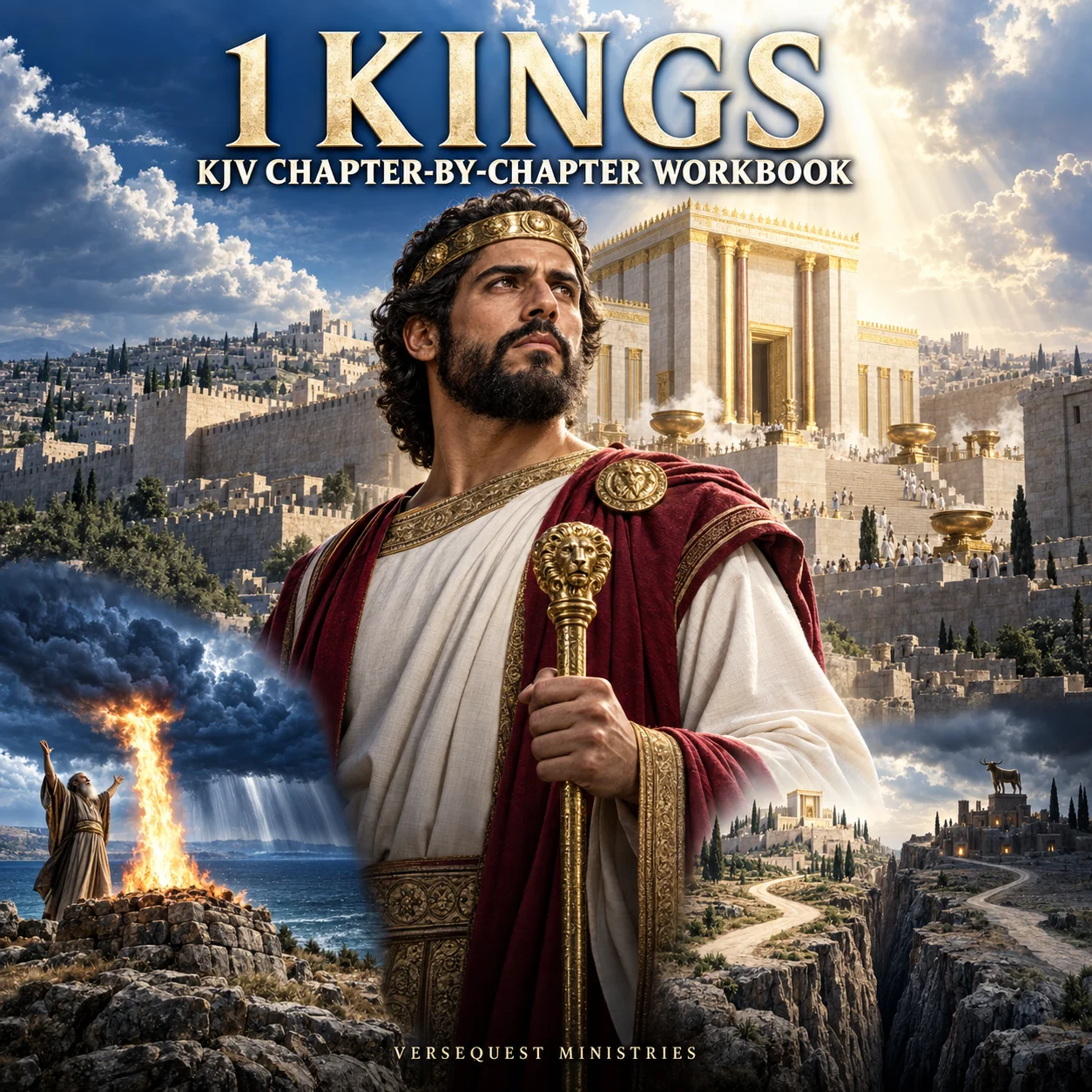
1 Kings KJV Chapter-by-Chapter Workbook
The 1 Kings KJV Chapter-by-Chapter Workbook is a complete 405-page downloadable Bible curriculum covering all 22 chapters of First Kings from a Bible-believing, King James Bible-centered, rightly divided perspective.
Every chapter contains twelve coordinated pages covering close reading, exposition, chapter structure, people and motives, KJV vocabulary, doctrine, cross-references, difficult passages, error correction, special studies, written review, teach-back preparation, teacher guidance, suggested answers, and a model summary.
Students will examine Solomon’s succession and wisdom, the construction and dedication of the temple, the king’s compromise and apostasy, the division of the kingdom, Jeroboam’s counterfeit worship, the competing royal lines, Elijah’s ministry, Mount Carmel, Naboth’s vineyard, Micaiah’s witness, and Ahab’s judgment.
The workbook also includes three learning tracks, 22-week and 11-week schedules, a 44-lesson classroom plan, five cumulative reviews, 22 advanced studies with worksheets, ten master charts with analysis, a four-part final assessment, answer guide, KJV glossary, subject and Scripture indexes, teaching project, evaluation rubric, bookmarks, and a certificate of completion.
It can be printed for handwritten work or studied digitally using compatible PDF software. It is ideal for personal study, homeschool, Sunday school, church classes, Bible institutes, discipleship groups, pastors, preachers, teachers, and ministry training.
$19.99
Description
The 1 Kings KJV Chapter-by-Chapter Workbook is a complete 405-page downloadable Bible curriculum designed to lead students carefully through all 22 chapters of First Kings. Beginning with the contested succession to David’s throne and concluding with the death of Ahab, the workbook follows Israel from the height of Solomon’s kingdom into division, counterfeit worship, political instability, prophetic confrontation, and judgment.
First Kings opens during David’s final days, when Adonijah attempts to seize the throne but Solomon is publicly anointed king according to David’s oath. Students will examine David’s final charge, the establishment of Solomon’s kingdom, Solomon’s request for an understanding heart, the administration and prosperity of Israel, and the wisdom that brought rulers from distant nations to Jerusalem.
The workbook gives extensive attention to the preparation, construction, furnishing, and dedication of the temple. Students trace the work of Solomon and Hiram, study the temple’s measurements and furnishings, follow the ark into the completed house, examine the glory cloud that fills the sanctuary, and work carefully through Solomon’s prayer of dedication. The temple is studied within Israel’s covenant history without transferring Israel’s sanctuary, land, kingdom, or promises to the Body of Christ.
Solomon’s greatness is examined beside the commandments governing Israel’s kings. His wisdom, wealth, international influence, building projects, horses, gold, political alliances, and many wives must be read in the light of Deuteronomy 17. The workbook shows that extraordinary knowledge cannot protect an unguarded heart and that outward splendour cannot compensate for disobedience to the word of God.
The division of the kingdom receives careful historical and doctrinal treatment. Rehoboam’s harsh answer, the revolt of the ten tribes, and Jeroboam’s politically motivated religion introduce two separate royal lines. Students learn to distinguish Judah’s Davidic dynasty from the changing northern dynasties and to recognize when the name Israel refers particularly to the northern kingdom.
Jeroboam’s counterfeit worship is examined as a deliberate corruption of God’s revealed order. His calves, unauthorized priests, rival worship centers, self-devised feast, and altered altar demonstrate how fear and political convenience can turn religious activity into organized rebellion. The workbook also studies the man of God from Judah, the lying prophet, the judgment pronounced upon Bethel, and the eventual fulfillment connected with Josiah.
The later chapters introduce Elijah’s powerful prophetic ministry during the reign of Ahab and Jezebel. Students follow Elijah to the brook Cherith and the widow’s house at Zarephath, examine the restoration of the widow’s son, study the contest on Mount Carmel, and trace the return of rain after the drought. Elijah’s exhaustion and discouragement at Horeb are treated alongside the LORD’s care, correction, preserved remnant, and recommissioning of His servant.
Ahab’s wars, Naboth’s vineyard, Jezebel’s corrupted use of civil authority, and Micaiah’s confrontation with four hundred approved prophets bring the book toward its judicial conclusion. Special care is given to difficult passages, including the man of God and the lying prophet, Elijah’s judgment upon the prophets of Baal, the still small voice, and the lying spirit in First Kings 22. The workbook distinguishes what Scripture states explicitly from inference, speculative typology, and careless application.
Every biblical chapter receives twelve coordinated pages. These include the chapter focus and principal movements, close-reading assignments, exposition, character and motive studies, KJV vocabulary, doctrine and right division, cross-reference workshops, difficult-passage correction, special studies, written reviews, personal applications, teach-back preparation, a Teacher and Leader Guide, suggested answers, and a model chapter summary.
The course-preparation material provides three learning tracks: Core, Standard, and Ministry Training. It also includes interpretive principles, course outcomes, a nine-division structural outline, chronologies of Solomon’s reign and the divided kingdom, geographical studies, royal-line comparisons, a survey of the prophets, recurring biblical formulas, one-sentence chapter summaries, a 22-week schedule, an 11-week intensive schedule, and a 44-lesson classroom plan.
Beyond the chapter units, the workbook contains five cumulative reviews with answer guides, 22 advanced verse-and-doctrine studies with coordinated student worksheets, and ten master charts with analysis pages. These charts compare the kings of Judah, the kings and dynasties of Israel, the prophets and kings they confronted, Solomon’s administration, temple measurements and furnishings, Solomon’s conduct under Deuteronomy 17, Jeroboam’s religion, Elijah’s movements and miracles, selected fulfilled prophecies, and recurring standards and formulas.
The final course assessment covers chapter mastery, book structure, key-passage exegesis, doctrine, right division, difficult passages, error correction, and a teaching demonstration. An answer guide, eight-part KJV glossary, selected subject index, selected Scripture index, final teaching project, evaluation rubric, final challenge, and certificate of completion support both independent study and organized classroom use.
This searchable, bookmarked PDF is formatted on letter-size pages. It may be printed for handwritten study or used on a computer or tablet with compatible PDF software. The 1 Kings KJV Chapter-by-Chapter Workbook is suitable for personal Bible study, homeschool families, Sunday school classes, church Bible studies, discipleship groups, Bible institutes, prison and recovery ministries, pastors, preachers, teachers, and ministry-training programs.
This is not merely a historical survey of Israel’s kings. It is a working Bible curriculum that teaches students to read the words, follow the movements, compare Scripture with Scripture, distinguish the kingdoms, examine the prophets, test religious claims, preserve dispensational distinctions, and recognize that the word of the LORD governs the throne, the temple, the prophet, the nation, and the judgment.
The certainty of the Davidic promise — Solomon’s succession rests within God’s covenant dealings with David and literal Israel. Contested succession and self-exaltation — Adonijah’s private attempt to seize the throne collapses when the rightful king is publicly established. The king’s accountability to Scripture — Israel’s ruler remains responsible to the written law regardless of wisdom, wealth, or political power. Wisdom from God — Solomon’s request demonstrates the value of an understanding heart capable of judging God’s people. Wisdom and obedience distinguished — Great knowledge does not automatically produce lifelong faithfulness. Ordered administration — Solomon’s officers, districts, provisions, and organization show the practical responsibilities behind national prosperity. The height of Israel’s earthly kingdom — First Kings records peace, abundance, influence, wealth, and international recognition under Solomon. The construction of the temple — The house is built according to deliberate measurements, materials, craftsmanship, and preparation. The temple within Israel’s covenant history — The sanctuary belongs to Jerusalem, the tribes of Israel, the priesthood, and the LORD’s chosen name. The glory cloud — The LORD visibly marks the dedication of the temple with His presence. Solomon’s prayer of dedication — The prayer addresses sin, defeat, drought, famine, strangers, war, captivity, repentance, and divine mercy. Privilege joined to responsibility — Temple possession does not protect a rebellious nation from judgment. The Queen of Sheba — A foreign ruler hears of Solomon’s fame, tests his wisdom, witnesses his ordered kingdom, and blesses the LORD. Solomon under Deuteronomy 17 — Horses, wealth, wives, foreign alliances, and multiplied splendour expose the king’s movement away from the law. A divided heart — Solomon’s outward accomplishments cannot cancel the inward departure that brings national consequences. The division of the kingdom — Rehoboam’s pride and Solomon’s earlier apostasy converge within the LORD’s announced judgment. Judah and Israel distinguished — The Davidic kingdom in the south must be separated from the northern kingdom and its changing dynasties. Jeroboam’s counterfeit religion — Political fear produces calves, rival sanctuaries, unauthorized priests, an altered feast, and worship devised from the human heart. Institutional influence — The repeated statement that Jeroboam “made Israel to sin” reveals the far-reaching consequences of corrupt leadership. The authority of the word of the LORD — God’s word governs succession, worship, weather, war, kings, prophets, and judgment. Prophecy and fulfillment — Predictions concerning royal houses, Jericho, Bethel, Ahab, and Jezebel demonstrate the certainty of divine revelation. Faithfulness after victory — The man of God’s failure shows that yesterday’s courage does not remove today’s duty to obey. Political success versus divine approval — Powerful rulers and durable institutions may still stand under God’s condemnation. Elijah and the drought — The LORD demonstrates authority over the rain in direct confrontation with Baal worship. Divine provision — Ravens, a brook, a widow, meal, oil, and restored life display the LORD’s care during judgment. The contest on Mount Carmel — Fire from heaven exposes powerless idols and brings Israel to confess that the LORD is God. Discouragement and recommissioning — Elijah’s flight reveals human weakness, while Horeb reveals divine care, correction, and continued purpose. The preserved remnant — Elijah is not alone; the LORD has reserved seven thousand who have not bowed to Baal. Corrupted civil authority — Naboth’s murder shows law, witnesses, letters, and royal power being weaponized to serve covetousness. Micaiah’s faithful minority witness — One prophet speaking the word of the LORD stands against four hundred voices approved by the royal court. Judicial deception and divine holiness — First Kings 22 records judgment upon a ruler committed to falsehood without making God the author of lies. Israel and the Body of Christ distinguished — Israel’s throne, land, temple, covenants, priesthood, and national judgments must retain their biblical identity.
- Central argument: First Kings records how the LORD established Solomon upon David’s throne, gave him wisdom, permitted him to build the temple, and brought Israel to extraordinary earthly glory; Solomon’s compromise then prepared the division of the kingdom, after which the word of the LORD confronted apostate kings and brought certain judgment.
- Controlling movement: Succession leads to wisdom, wisdom to ordered prosperity, prosperity to temple glory, glory to warning, warning to compromise, compromise to apostasy, apostasy to division, division to counterfeit worship, and counterfeit worship to prophetic confrontation and judgment.
- Book scope: First Kings contains 22 chapters and begins during David’s final days. It ends after Ahab’s death, with Jehoshaphat reigning in Judah and Ahaziah reigning in Israel.
- Nine major divisions: Chapters 1–2 establish Solomon; 3–4 present wisdom and order; 5–7 describe temple preparation and construction; 8–9 record dedication, glory, and warning; 10–11 reveal height and decline; 12–14 record division and counterfeit worship; 15–16 trace kings and dynastic collapse; 17–19 center upon Elijah; and 20–22 bring Ahab to judgment.
- Redemptive-historical setting: The book concerns literal Israel, the Davidic throne, Jerusalem, the temple, the tribes, and the divided monarchy.
- Solomon’s succession: God’s revealed purpose is not overturned by Adonijah’s self-promotion or private political feast.
- David’s final charge: Solomon is commanded to be strong, act responsibly, and govern according to the law of Moses.
- Solomon’s request: The king asks for an understanding heart rather than long life, riches, or the death of his enemies.
- Wisdom displayed: The judgment between the two women makes Solomon’s God-given discernment publicly visible.
- Administration matters: The kingdom’s prosperity depends upon organized officers, provisions, districts, labor, and accountability as well as royal wisdom.
- Temple preparation: David’s preparation, Solomon’s organization, Hiram’s materials, skilled craftsmen, stonework, cedar, and labor all contribute to the construction.
- The building interruption: First Kings 6 interrupts architectural description with a covenant reminder, showing that obedient walking matters more than impressive construction.
- Dedication prayer: Solomon repeatedly asks the LORD to hear from heaven; the temple does not imprison or contain the God of heaven.
- Conditional warning: The accepted temple may become a byword and astonishment if Israel turns to other gods.
- Deuteronomy interprets Solomon: The record of gold, horses, chariots, wives, and foreign alliances must be compared with Deuteronomy 17.
- The danger of a divided heart: Solomon’s wisdom does not prevent apostasy when his affections and loyalties turn from the LORD.
- The kingdom’s division: Rehoboam’s foolish harshness is a real human decision operating within judgment already pronounced because of Solomon’s sin.
- Reading after chapter 12: Students must identify which kingdom is intended whenever the text speaks of Israel, Judah, Jerusalem, or the house of David.
- Two royal systems: Judah retains the Davidic line, while the north experiences several dynasties established and destroyed through conspiracy, murder, and judgment.
- Jeroboam’s motive: Fear of losing political control leads him to redesign worship for convenience and royal security.
- Counterfeit religion: Familiar language and religious symbols do not make unauthorized worship acceptable.
- The man of God: A servant may resist a king successfully and still fall through later disobedience to a contradictory religious claim.
- Prophetic authority: The recurring phrase “the word of the LORD” interprets events more accurately than royal announcements, popular opinion, or political strength.
- Elijah’s opening: Elijah appears before Ahab with a word concerning drought, immediately challenging Baal’s supposed authority over fertility and rain.
- Cherith and Zarephath: Divine provision may come through unexpected means and in places outside ordinary expectations.
- Mount Carmel: Elijah repairs the altar, saturates the sacrifice, prays according to God’s purpose, and leaves no room for counterfeit explanation when the fire falls.
- Horeb: Elijah’s exhaustion is met with food, rest, questions, revelation, correction, and renewed assignment.
- The remnant: Visible loneliness does not prove that God has no other faithful servants.
- Ahab and Ben-hadad: Victory received through divine mercy does not authorize the king to disregard God’s declared judgment.
- Naboth’s vineyard: Naboth’s refusal concerns family inheritance under Israel’s law, not stubbornness or unwillingness to cooperate with the king.
- Ahab’s responsibility: A ruler cannot escape guilt merely because another person arranged the crime from which he knowingly benefits.
- Micaiah’s stand: Truth is not determined by the number of speakers, the approval of government, or the comfort of the message.
- Ahab’s disguise: Human strategy cannot prevent the fulfillment of the word of the LORD.
- Important distinction: Moral instruction may be applied to present believers without transferring Israel’s covenants, temple, throne, or national identity to the Body of Christ.
- Question for further study: How does First Kings distinguish wisdom as a gift from wisdom practiced through obedience?
- Question for further study: Which features of Solomon’s reign anticipate the greater Son of David, and where does Solomon’s failure prevent a complete identification?
- Question for further study: How do the inspired records in Kings and Chronicles complement one another?
- Question for further study: What recurring steps turn private compromise into national false worship?
- Question for further study: How does fulfilled prophecy demonstrate that God’s word governs rulers who attempt to ignore it?
- Memorable teaching point: Solomon possessed enough wisdom to instruct a nation but still needed enough obedience to guard his own heart.
- Memorable teaching point: The temple reached upward in glory while compromise worked downward in the king’s heart.
- Memorable teaching point: Jeroboam built a religion to protect his throne and built the very system that condemned his house.
- Memorable teaching point: Micaiah stood alone before the court, but a man speaking the word of the LORD is never outnumbered.
For personal Bible study, the workbook supplies a disciplined method for reading all 22 chapters with an open King James Bible. Students can mark key movements, study difficult words, trace cross-references, distinguish doctrine from inference, complete written reviews, and prepare summaries before consulting the suggested answers.
For homeschool families, the workbook can function as a complete Old Testament Bible course. Families may use the 22-week schedule, the 11-week intensive plan, or divide the material into the provided 44 classroom lessons. The chapter exercises, vocabulary studies, reviews, charts, assessment, teaching project, rubric, and certificate provide substantial curriculum components.
For Sunday school and church Bible classes, teachers can assign selected workbook pages before each lesson and use the Teacher and Leader Guides to organize classroom instruction. The material supports lessons on Solomon, wisdom, the temple, the divided kingdom, counterfeit worship, Elijah, Ahab, Jezebel, Naboth, and Micaiah.
For small groups and discipleship, the chapter units offer focused discussion concerning leadership, obedience, compromise, worship, courage, discouragement, covetousness, false teaching, political pressure, and faithfulness to the word of God. Participants can compare written observations and work through the error-correction sections together.
For pastors, preachers, and Bible teachers, the nine major divisions, chapter movements, advanced studies, master charts, vocabulary, doctrinal distinctions, and cross-reference workshops provide an organized foundation for sermons, teaching series, character studies, leadership lessons, and Old Testament surveys.
For Bible institutes and ministry training, students can complete the Ministry Training Track, all 22 advanced studies, all ten master charts, five cumulative reviews, the final assessment, and the 20–30-minute teaching project. The course trains students to establish historical meaning, defend right division, correct interpretive errors, and teach a passage from First Kings faithfully.
For prison, recovery, counseling, and care ministries, selected chapters can support studies concerning consequences, compromised judgment, discouragement, restored purpose, courage before authority, covetousness, corrupted power, personal responsibility, and the certainty of God’s word.
A King James Bible with clear reference formatting
An exhaustive concordance keyed to the King James Bible
A reliable KJV Bible dictionary for royal offices, temple objects, ancient measurements, geographical terms, and older English words
A cross-reference Bible or treasury of Scripture cross-references
A map of the united and divided kingdoms showing Jerusalem, Shechem, Bethel, Dan, Samaria, Cherith, Zarephath, Carmel, Jezreel, Horeb, and Ramoth-gilead
A timeline comparing the kings of Judah with the kings and dynasties of Israel
A temple floor plan based upon First Kings 5–8 and Second Chronicles 2–7
A study of Israel’s kingship laws from Deuteronomy 17
A study of authorized worship using Deuteronomy 12 and First Kings 8, 12, and 13
A comparison of Solomon’s reign in First Kings and Second Chronicles
A study of the Davidic covenant using Second Samuel 7, First Kings, the Psalms, the Prophets, and the New Testament
A study of Elijah using First Kings 17–19, 21–22, Second Kings 1–2, Luke 4, Romans 11, and James 5
A study of fulfilled prophecy using First Kings, Second Kings, and Second Chronicles
Psalms, Proverbs, Ecclesiastes, and Song of Solomon as distinct inspired books connected with Israel’s united monarchy
Through the Bible with VerseQuest for a broader survey of all 66 books of the King James Bible
Related products
-
Chart Collections
-
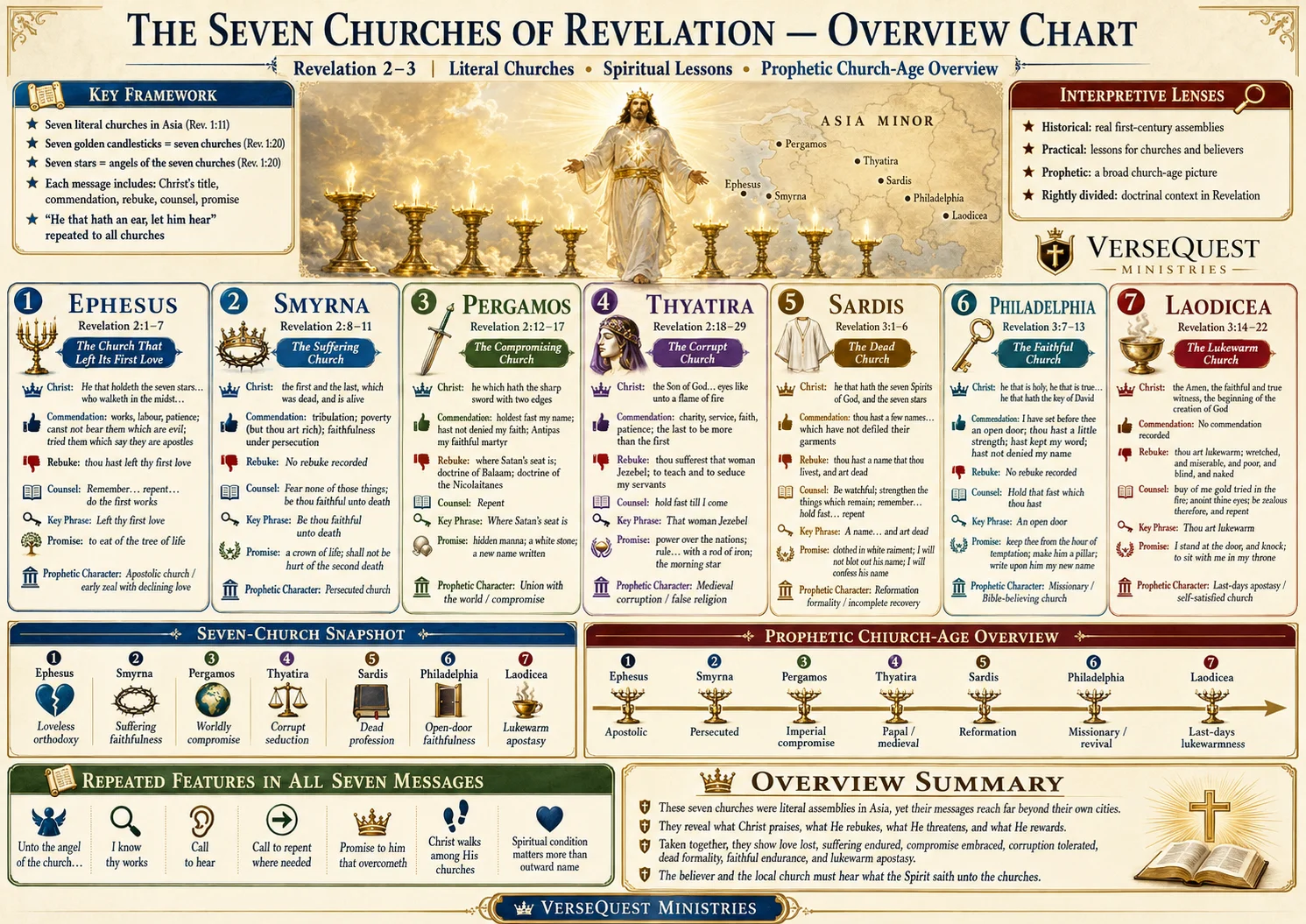
- The Seven Churches of Revelation Chart Collection – Christ Walking Among the Candlesticks
- A premium VerseQuest Ministries™ PDF chart collection covering the Seven Churches of Revelation in Revelation 2–3. Includes one overview chart plus individual KJV Bible study charts for Ephesus, Smyrna, Pergamos,…
- $12.99
- Add to cart
-
-
The Rapture
-
-67%
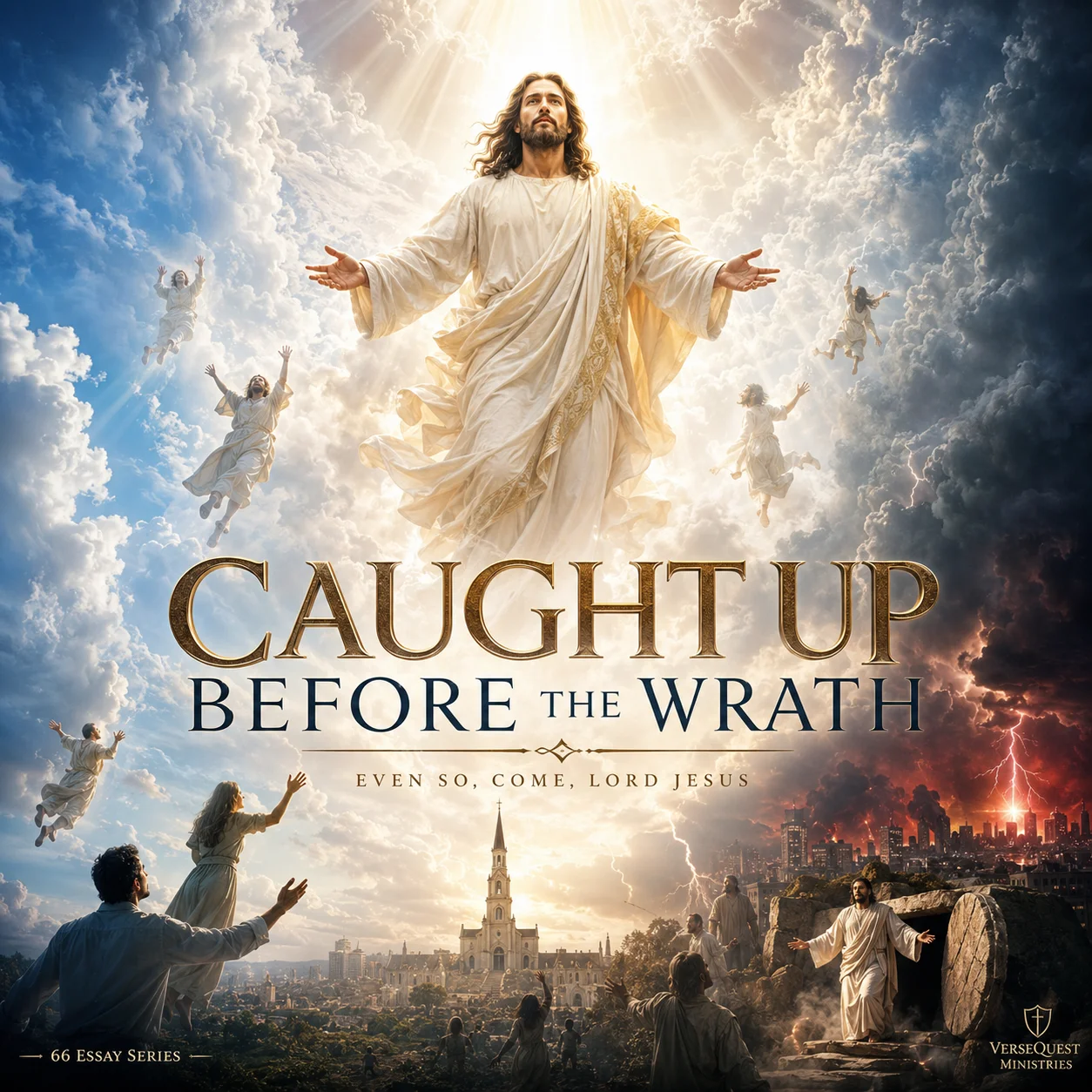
- Caught Up Before the Wrath – 66-Essay KJV Rapture Study
- Caught Up Before the Wrath is a 430-page premium KJV Bible study defending the pre-tribulation Rapture of the Church from a rightly divided, dispensational perspective. This 66-essay VerseQuest Ministries book…
- Original price was: $29.99.$9.99Current price is: $9.99.
- Add to cart
-
-67%
-
KJV Studies
-
-67%
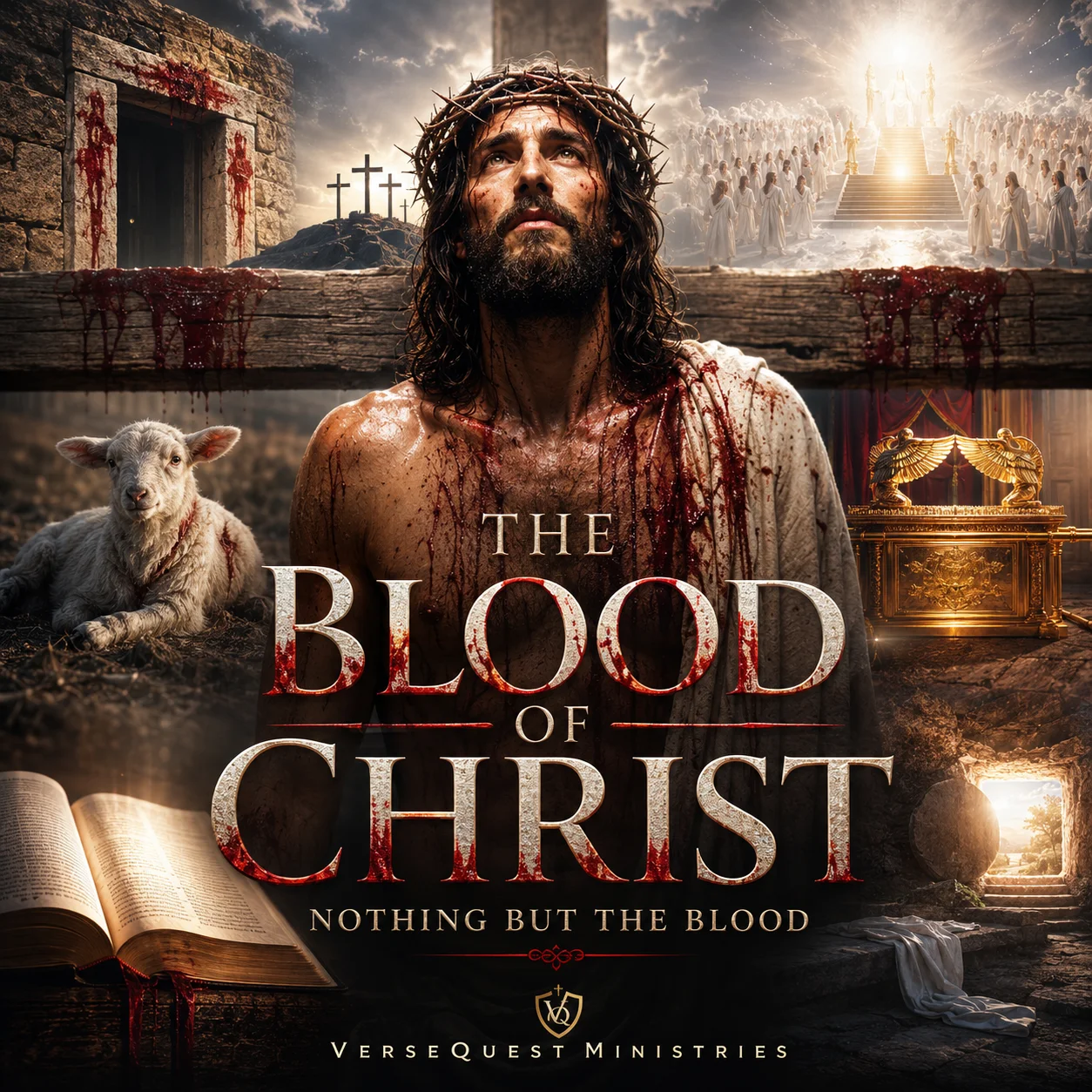
- The Blood of Christ – 66-Study KJV Bible Doctrine PDF
- A 441-page premium VerseQuest PDF featuring 66 detailed KJV Bible studies on the blood of Jesus Christ. This powerful doctrinal resource covers redemption, justification, propitiation, cleansing, access to God, eternal…
- Original price was: $29.99.$9.99Current price is: $9.99.
- Add to cart
-
-67%
-
Prophecy Studies
-
- The Resurrection of Jesus Christ Made Plain – 501-Page KJV Bible Study
- A massive 501-page VerseQuest Ministries PDF Bible study defending and explaining the bodily resurrection of Jesus Christ from a KJV, rightly divided perspective. This 80-essay study covers the empty tomb,…
- $34.99
- Add to cart
-
-
Doctrine Series
-
-14%
- Judas Iscariot and the Coming Antichrist – Premium KJV Prophecy Study
- A massive 459-page premium KJV prophecy study tracing the biblical connection between Judas Iscariot, the son of perdition, and the coming Antichrist. This detailed VerseQuest Ministries PDF examines Judas’ betrayal,…
- Original price was: $34.99.$29.99Current price is: $29.99.
- Add to cart
-
-14%