
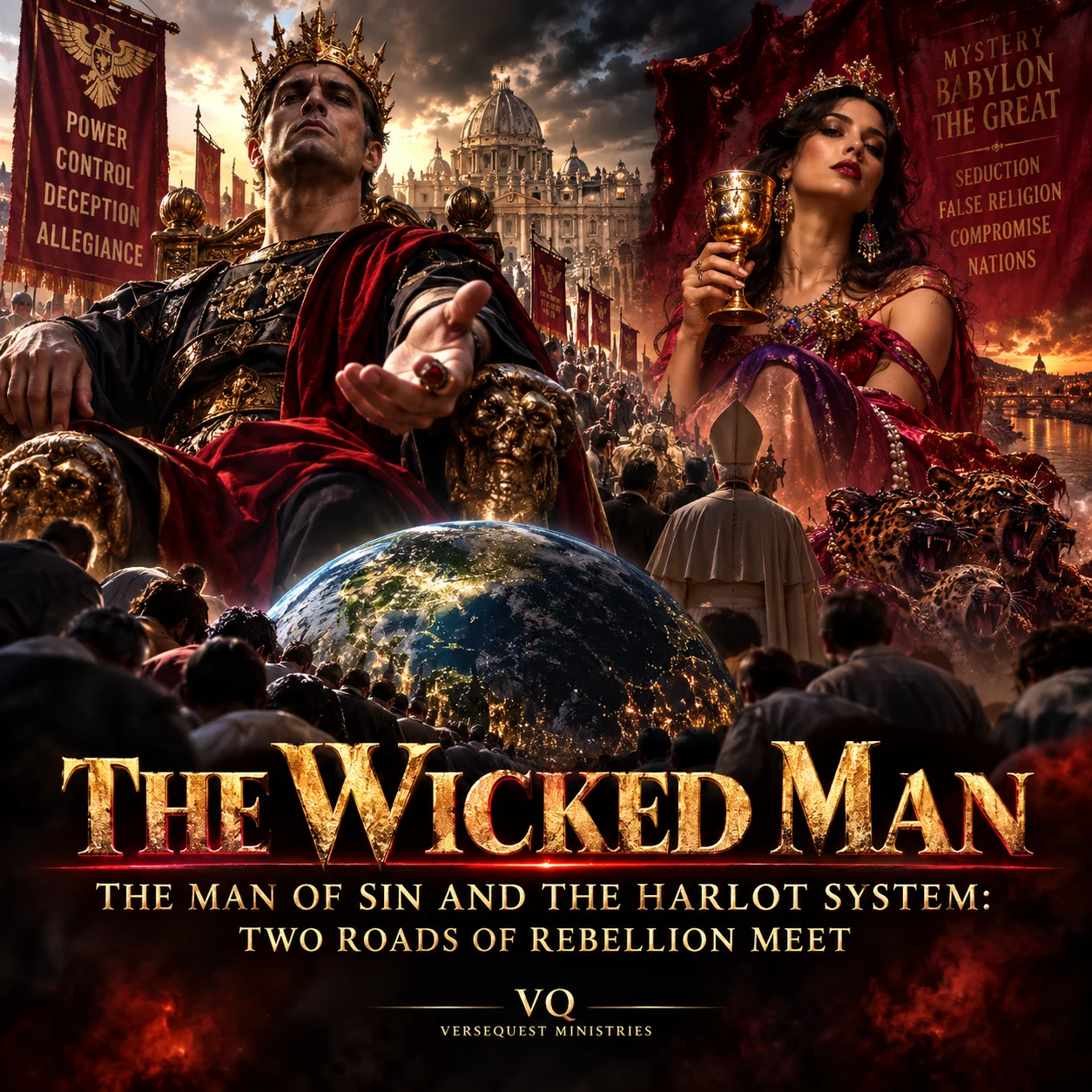
The Antichrist – His Names, Characteristics, Rise, Seven-Year Tribulation Reign, Defeat, and Eternal Doom (KJV Bible Study Chart)
Understand the Antichrist with this detailed KJV chart covering his biblical names and titles, defining characteristics, political rise, covenant with Israel, satanic deception, seven-year Tribulation timeline, abomination of desolation, mark of the beast, defeat by Jesus Christ, and eternal doom.
$3.99
Description
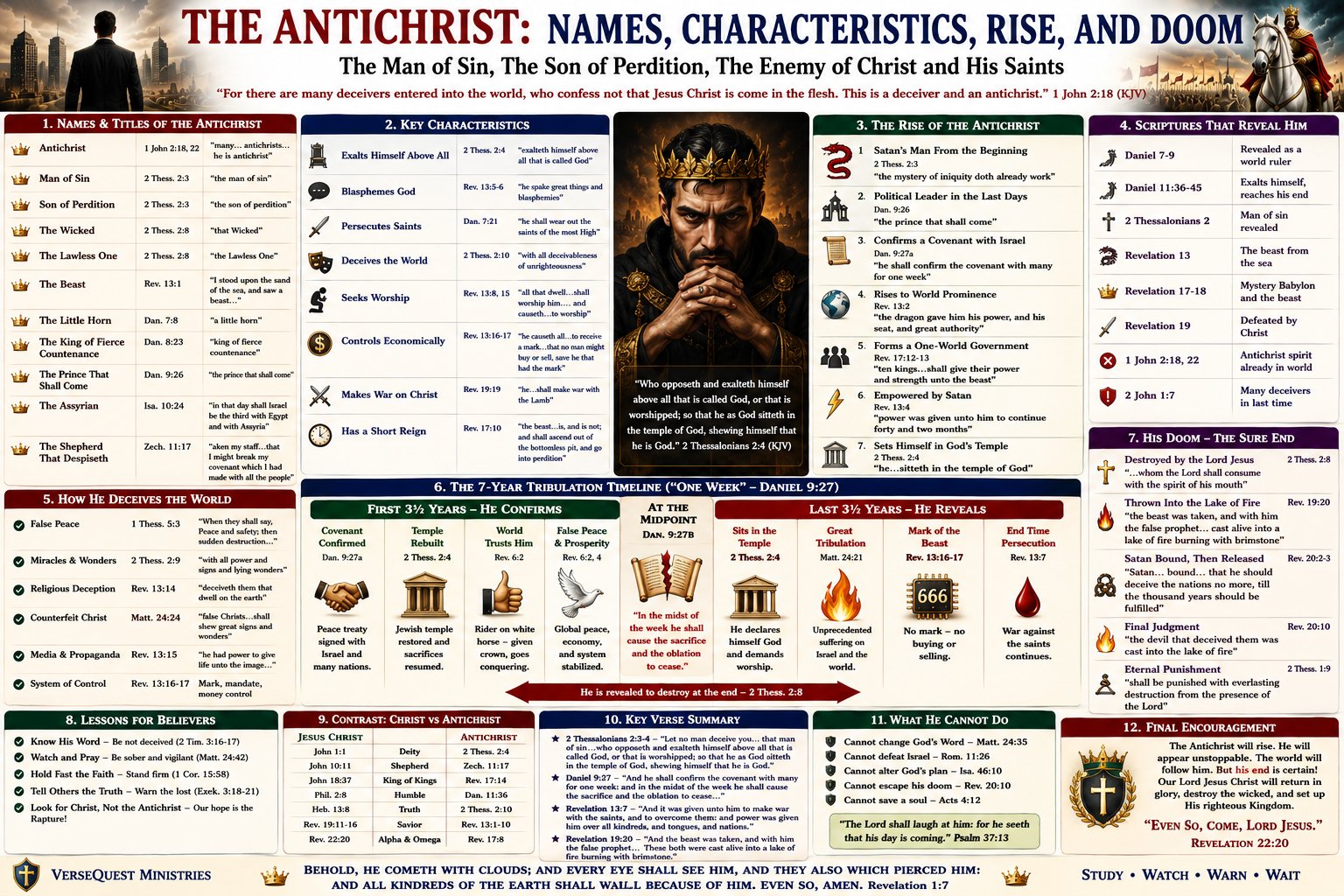
The Antichrist: Names, Characteristics, Rise, and Doom is a comprehensive, rightly divided KJV Bible study chart examining the final satanic ruler revealed throughout Daniel, Isaiah, Zechariah, Second Thessalonians, First and Second John, and the book of Revelation. It brings together the Antichrist’s principal biblical names and titles, defining characteristics, political ascent, deceptive methods, covenant with Israel, blasphemous self-exaltation, control of the beast system, persecution of the saints, defeat at the glorious return of Jesus Christ, and final punishment in the lake of fire.
Built around Daniel 7–9, Daniel 8:23–25, Daniel 11:36–45, 2 Thessalonians 2:1–12, Revelation 13, Revelation 17–19, 1 John 2:18–22, and 2 John 7, this chart distinguishes the personal future Antichrist from the broader antichrist spirit already operating in the world. Many deceivers have appeared throughout history, but Scripture also points toward a final ruler who will embody satanic rebellion, dominate the last beast kingdom, demand worship, persecute God’s people, and make war against the returning Lord Jesus Christ.
The word Antichrist expresses both opposition to Christ and counterfeit substitution for Christ. The final ruler will not merely insult Christianity from a distance. He will present himself as the answer the world has been waiting for, offering political order, religious unity, economic stability, supernatural confirmation, and apparent peace while leading humanity into its greatest rebellion against God.
First John teaches that many antichrists were already present in the apostolic period and that the spirit of antichrist denies the biblical identity of Jesus Christ. Second John identifies the deceiver and antichrist as one who refuses the truth that Jesus Christ is come in the flesh. These passages reveal the spiritual preparation for the final counterfeit: false doctrine weakens the world’s ability to recognize the true Christ and makes another christ easier to receive.
The chart gathers the Antichrist’s major biblical names and titles. He is called Antichrist, the man of sin, the son of perdition, that Wicked, the lawless one, the beast, the little horn, the king of fierce countenance, and the prince that shall come. Dispensational prophecy studies also connect his final character and programme with the Assyrian adversary and the foolish or despised shepherd foretold in the prophets.
Each title reveals a different dimension of the same final enemy. The man of sin emphasizes the embodiment and open expression of human rebellion. The son of perdition identifies his character and doomed destination. That Wicked presents him as the lawless adversary whom Jesus Christ destroys. The beast reveals his cruel, blasphemous, political, and satanically empowered kingdom. The little horn pictures his rise among other rulers and his eventual domination over them.
The title king of fierce countenance emphasizes intelligence, deception, hardness, and destructive skill. The prince that shall come connects him with the people who destroyed Jerusalem and the sanctuary and with the future covenant described in Daniel 9:27. The varied titles do not require several unrelated end-time rulers. They contribute to the composite biblical portrait of the final Antichrist and his system.
The Antichrist’s defining characteristic is self-exaltation. Second Thessalonians 2:4 declares that he “opposeth and exalteth himself above all that is called God, or that is worshipped.” Daniel likewise presents a king who does according to his own will, exalts himself above every god, and speaks marvellous things against the God of gods.
His ambition is not satisfied with political office. He wants worship. Satan’s desire from the beginning has been to imitate, oppose, and usurp the authority belonging to God. The final Antichrist becomes Satan’s chosen human ruler, presenting the Dragon’s counterfeit kingdom against the Kingdom promised to Jesus Christ.
The Antichrist blasphemes God openly. Revelation 13 describes the beast speaking great things and blasphemies against God, His name, His tabernacle, and those dwelling in heaven. His government is not spiritually neutral. It is an organized revolt against the authority and honour of the Lord.
He persecutes saints and makes war against God’s people. Daniel sees the little horn making war with the saints and prevailing temporarily. Revelation 13 gives the beast authority to make war with the saints and overcome them. His political system will not tolerate those who refuse his worship, reject his mark, or remain faithful to God’s testimony.
The Antichrist deceives the world through unrighteousness, religious propaganda, false peace, supernatural displays, and the ministry of the false prophet. Second Thessalonians 2 connects his coming with the working of Satan, power, signs, lying wonders, and deceivableness of unrighteousness. Revelation 13 describes signs so persuasive that the earth-dwellers are deceived into creating and worshipping the image of the beast.
His deception succeeds because the world has already rejected the love of the truth. God does not send strong delusion upon people who humbly desire biblical truth. The people in view refuse the truth, delight in unrighteousness, and become judicially abandoned to the lie they preferred.
The Antichrist also controls commerce. Revelation 13 reveals a system in which no man may buy or sell without the mark, name, or number of the beast. Economic participation becomes inseparable from political allegiance and religious worship. The system does not merely track transactions; it tests loyalty to the beast.
The mark belongs to the future Tribulation setting and must not be identified recklessly with every modern financial instrument, medical procedure, identification programme, electronic device, or technological innovation. The mark is connected directly with the beast, his image, his worship, the false prophet, the number 666, and the final satanic kingdom.
The Antichrist ultimately makes war against Jesus Christ. Revelation 19 shows the beast, the kings of the earth, and their armies gathered to fight against the Rider upon the white horse. The world’s final political order ends not in lasting peace but in an organized military and spiritual revolt against the returning King.
His reign is short. Revelation 13 speaks of authority continuing for forty-two months, while Revelation 17 presents the beast’s brief ascent and destruction. His apparent triumph is temporary, limited by God, and moving toward a judgment already written.
The chart traces the rise of the Antichrist. The mystery of iniquity already works within the present world, preparing religious, political, moral, and social conditions for the final lawless ruler. The antichrist spirit denies the true Christ, corrupts the gospel, resists Scripture, celebrates lawlessness, and teaches mankind to seek unity without truth.
The future Antichrist rises as a political leader from the prophetic beast system. Daniel describes the coming prince, the little horn emerging among other powers, and the fierce ruler who gains influence through policy and deception. Revelation presents the beast rising from the sea, a picture connected with the turbulent nations and Gentile world power.
He confirms a covenant with many for one week. Daniel 9:27 places this covenant at the beginning of the future seventieth week, a seven-year period determined within Israel’s prophetic programme. The covenant involves Israel and many others and appears to provide stability, protection, political agreement, or a settlement connected with Jerusalem and Temple worship.
The Antichrist’s opening strategy is not unrestricted terror. He rises through diplomacy, promises, alliances, calculated policy, and counterfeit peace. First Thessalonians 5 warns that while the world says “Peace and safety,” sudden destruction comes. The final dictator may arrive holding a treaty before he reveals the sword hidden behind it.
His prominence expands until the beast system possesses worldwide influence. Revelation 13 states that the Dragon gives the beast his power, seat, and great authority. Revelation 17 describes ten kings giving their power and strength unto the beast. The Antichrist becomes the central ruler of an international political order.
The chart describes this as a one-world government, not because every local administrative distinction must disappear instantly, but because the kings surrender decisive authority to the beast. His system exercises extraordinary influence over nations, warfare, religion, economics, communication, and public allegiance.
Satan empowers him directly. The Antichrist may possess natural intelligence, charisma, political instinct, military strength, and persuasive ability, but the true force behind his rise is the Dragon. He is Satan’s man, carrying out the Devil’s imitation of divine rule.
The Antichrist eventually sits in the Temple of God, presenting himself as God and demanding worship. Second Thessalonians 2 describes his self-exaltation, while Matthew 24 and Daniel 9 connect the midpoint crisis with the abomination of desolation and the cessation of sacrifice.
The chart’s seven-year Tribulation timeline divides Daniel’s final week into two halves. During the first three and a half years, the covenant is confirmed, Temple worship is restored, apparent peace increases, and the beast’s system gains the confidence of the world. The rider upon the first-seal white horse goes forth conquering under the appearance of legitimacy, peace, and successful leadership.
At the midpoint, the covenant is broken. Daniel states that sacrifice and oblation cease. The ruler who promised protection reveals himself as the blasphemous enemy of God and Israel. The abomination of desolation stands in the holy place, and the Great Tribulation begins.
The final three and a half years reveal the beast in his full character. He occupies the Temple, exalts himself as God, demands worship, persecutes Israel and the saints, imposes the mark, controls buying and selling, and continues his war against truth.
Matthew 24 describes unparalleled Tribulation. Revelation’s trumpet and vial judgments intensify, Satan’s wrath against Israel increases, and the beast’s government becomes openly murderous. What began with a covenant and an appearance of peace ends in worship enforced by terror.
The Antichrist deceives the world through false peace. He offers political solutions while concealing satanic intentions. Humanity receives him because it desires order without Christ, peace without righteousness, unity without truth, and salvation without repentance.
He uses miracles and wonders. Second Thessalonians 2 warns of satanic power, signs, and lying wonders. Revelation 13 describes the false prophet performing great signs before the beast. Supernatural activity cannot prove that a teacher, prophet, ruler, or religion comes from God. Every sign must be judged by Scripture.
He advances through religious deception. The false prophet causes the earth to worship the beast and gives apparent life to the beast’s image. The final political order possesses a religious priesthood, counterfeit miracles, and a compulsory system of worship.
He appears as a counterfeit Christ. Matthew 24 warns of false Christs showing great signs and wonders. The Antichrist offers the crown without the cross, worldly unity without biblical holiness, material prosperity without spiritual truth, and human glory without submission to God.
He controls media and propaganda through the image of the beast and the false prophet’s influence. Revelation’s language anticipates a system capable of projecting the beast’s presence, commands, image, and worship across the world. The issue is not technology itself but its use within a satanic programme of deception and enforced allegiance.
He establishes a system of control involving the mark, economic mandates, worship, identification, and punishment. Those refusing submission face exclusion and death. The beast demands what belongs only to God: unquestioned loyalty, worship, and obedience.
The chart compares Jesus Christ with Antichrist. Jesus Christ is God manifested in the flesh; Antichrist exalts himself as though he were God. Christ is the good Shepherd who gives His life for the sheep; Antichrist is the foolish shepherd who exploits and destroys.
Jesus Christ is the true King of kings; Antichrist is the temporary ruler receiving authority from the Dragon. Christ humbled Himself and became obedient unto death; Antichrist magnifies himself and demands that others die for his glory.
Christ is the Truth; Antichrist advances through deceit. Christ is the Saviour; Antichrist becomes the destroyer. Jesus Christ is the Alpha and Omega, eternal and sovereign; the beast ascends briefly and goes into perdition.
The contrast exposes the counterfeit. Antichrist does not reproduce the true character of Jesus Christ. He imitates selected elements of authority, resurrection imagery, public wonder, kingdom, and worship while reversing Christ’s holiness, humility, truth, mercy, and righteousness.
The Antichrist may appear unstoppable, but the chart emphasizes what he cannot do. He cannot change God’s Word. Jesus Christ declared that heaven and earth will pass away, but His words will not pass away. Antichrist may outlaw, corrupt, mock, or suppress Scripture, but he cannot make one prophecy fail.
He cannot defeat Israel or cancel the covenants of God. He may persecute the nation, occupy Jerusalem, profane the Temple, and attempt to destroy the remnant, but Romans 11 declares that God’s gifts and calling remain without repentance.
He cannot alter God’s prophetic plan. Isaiah, Daniel, Zechariah, Second Thessalonians, and Revelation have already written his ending. His every apparent victory moves him closer to the judgment God declared beforehand.
He cannot escape his doom. Revelation 19 records his capture, and Revelation 20 shows him still suffering in the lake of fire after the thousand-year Kingdom. No bunker, army, treaty, technology, miracle, spiritual power, or satanic alliance can shield him from Jesus Christ.
He cannot save a soul. Acts 4:12 declares that salvation is found in Jesus Christ alone. The beast may promise order, prosperity, survival, peace, and earthly belonging, but his system leads worshippers into divine wrath and eternal destruction.
The doom of Antichrist is certain. Second Thessalonians 2:8 declares that the Lord will consume that Wicked with the spirit of His mouth and destroy him with the brightness of His coming. The final battle is not a close contest between equally powerful rivals.
Jesus Christ does not struggle desperately to overcome the beast. The spoken Word and brightness of the returning Lord end the counterfeit ruler’s authority. The Antichrist’s global kingdom falls before the rightful King as darkness vanishes before daylight.
Revelation 19 states that the beast and false prophet are taken and cast alive into the lake of fire burning with brimstone. Their judgment occurs before the thousand-year reign, distinguishing their punishment from the final judgment of the unsaved dead at the Great White Throne.
Satan is bound during the Millennium and later released briefly. After his final rebellion, he is cast into the lake of fire, where the beast and false prophet already are. Their continued presence demonstrates conscious and enduring punishment rather than annihilation.
The Antichrist’s final destiny is everlasting destruction from the presence of the Lord. The ruler who demanded universal worship receives everlasting shame. The one who promised life and prosperity leads his followers toward death and judgment.
The chart provides practical lessons for believers. Christians must know God’s Word so they are not carried about by deception. Prophecy should not become entertainment or speculative obsession; it should strengthen confidence in Scripture and Jesus Christ.
Believers should watch and pray. Watchfulness means spiritual sobriety, doctrinal readiness, holy living, and discernment. It does not mean panic over every political speech or internet rumour.
Christians must hold fast the faith. First Corinthians 15:58 calls believers to remain steadfast and unmovable. The coming counterfeit should increase commitment to the true Christ, true gospel, true Scriptures, and true Christian hope.
Believers should warn the lost. The prophetic system of control, deception, wrath, and judgment is coming, but the present gospel invitation remains open. Jesus Christ died for our sins, was buried, and rose again. The sinner may be saved by grace through faith before the future judgments arrive.
The Church should look for Jesus Christ rather than fixate upon Antichrist as its hope. Titus 2:13 directs believers toward the blessed hope, while First Thessalonians 4 promises the catching away of the Body of Christ.
From the pre-Tribulation perspective presented in the chart, the Church is removed before the Antichrist’s covenant begins Daniel’s seventieth week. The Body of Christ is not appointed to Tribulation wrath but to obtain salvation through the Lord Jesus Christ.
The Rapture and the revelation of Antichrist should not be confused. The mystery of iniquity already works, but the man of sin is fully revealed within the future prophetic programme after the present restraining arrangement is removed.
This does not mean the Holy Spirit ceases to exist or work upon the earth. God remains omnipresent, and people will be saved during the Tribulation. The present Spirit-indwelt Body and restraining order, however, no longer operate in the same dispensational setting.
The chart’s final encouragement is not despair but certainty. The Antichrist will rise, appear unstoppable, receive global admiration, and gain temporary authority. Yet his end has already been written.
Jesus Christ will return in glory, defeat the wicked ruler, preserve His promises, judge the nations, deliver Israel’s remnant, and establish His righteous Kingdom. Satan’s man receives forty-two months; God’s King possesses everlasting dominion.
The believer therefore studies, watches, warns, waits, and refuses fear. The Church’s future does not depend upon the strength of Antichrist but upon the promise of Christ. “Even so, come, Lord Jesus.”
This resource is ideal for personal Bible study, Antichrist prophecy teaching, Daniel studies, Second Thessalonians classes, Revelation instruction, Tribulation timelines, Church-and-Israel distinctions, mark-of-the-beast lessons, false-prophet studies, spiritual-deception warnings, prophecy conferences, Sunday school, homeschool Bible curriculum, Christian schools, Bible institutes, pastoral training, and sermon preparation.
The Antichrist, man of sin, son of perdition, that Wicked, lawless one, beast from the sea, little horn, king of fierce countenance, prince that shall come, Assyrian adversary, foolish shepherd, Antichrist spirit, mystery of iniquity, satanic deception, covenant with Israel, Daniel’s seventieth week, abomination of desolation, one-world government, mark of the beast, number 666, false prophet, Great Tribulation, Second Coming of Christ, lake of fire
The term Antichrist refers broadly to the spirit and teachers who oppose or counterfeit Jesus Christ and specifically to the final satanic ruler revealed in Daniel, Second Thessalonians, and Revelation. First John states that many antichrists already existed, while the larger prophetic record reveals a future individual who becomes the central ruler of the beast kingdom.
Scripture identifies this ruler through numerous names and titles, including Antichrist, man of sin, son of perdition, that Wicked, lawless one, beast, little horn, king of fierce countenance, and prince that shall come. Each title emphasizes a different aspect of his character, authority, deception, lawlessness, cruelty, or doomed destination.
The Antichrist exalts himself above God, blasphemes divine authority, persecutes saints, deceives the world, demands worship, controls commerce, makes war against Jesus Christ, and reigns only for a limited period. His authority is great but temporary, satanic but permitted, global in influence but incapable of overthrowing God’s plan.
The mystery of iniquity already works during the present age through false doctrine, denial of Christ, lawlessness, spiritual deception, apostasy, and rebellion against Scripture. These conditions prepare the world to receive the final counterfeit ruler. The Church should recognize the spirit of antichrist without identifying every political enemy as the personal Antichrist.
The final ruler rises from the Gentile beast system as a political leader skilled in deception and policy. He confirms a covenant with many for one seven-year week, rises to worldwide prominence, receives authority from Satan, gains the support of ten kings, and becomes the controlling figure within the final international order.
Daniel’s seventieth week concerns Israel and Jerusalem rather than the Body of Christ. During the first three and a half years, the covenant remains in force, Temple sacrifice resumes, deceptive peace increases, and the beast’s political system gains acceptance. The first-seal white horse represents counterfeit conquest rather than the true Christ.
At the midpoint, the Antichrist breaks the covenant, stops sacrifice, establishes the abomination of desolation, occupies the Temple, and exalts himself as God. The final three and a half years bring Great Tribulation, intensified persecution, beast worship, the mark, economic control, and the escalating judgments of Revelation.
The Antichrist deceives through false peace, lying wonders, religious propaganda, counterfeit messianic claims, media influence, and economic coercion. Supernatural signs do not prove divine approval, because Satan and the false prophet can produce lying wonders designed to mislead those who reject Scripture.
The mark of the beast belongs to the future Tribulation setting and is inseparable from allegiance to the beast, worship of his image, the false prophet, economic control, and the number 666. Present technologies may prepare mechanisms of control but should not be declared the completed mark without the biblical Tribulation context.
Jesus Christ and Antichrist stand in complete contrast. Christ is God, Shepherd, King, humble Servant, Truth, Saviour, and eternal Lord. Antichrist is self-exalting, deceitful, tyrannical, destructive, temporary, and doomed. He imitates Christ’s authority while rejecting Christ’s character.
The Antichrist cannot change Scripture, defeat God’s covenant purposes for Israel, alter the prophetic plan, escape judgment, or save a soul. His apparent successes occur only within the boundaries God permits and move him toward the destruction already revealed.
Second Thessalonians teaches that Jesus Christ destroys the lawless one with the spirit of His mouth and the brightness of His coming. Revelation 19 records the beast and false prophet being cast alive into the lake of fire. Their punishment continues beyond the thousand-year Kingdom, proving the certainty and permanence of their doom.
The Church’s hope is not the Antichrist but Jesus Christ. From the pre-Tribulation perspective presented by the chart, the Body of Christ is caught away before Daniel’s seventieth week begins. Believers should know Scripture, watch and pray, hold fast sound doctrine, warn the lost, preach the gospel, and look for the blessed hope.
Antichrist Bible studies, names of the Antichrist, Daniel 7–9 teaching, Daniel 11 instruction, Second Thessalonians 2 studies, Revelation 13 lessons, beast-system teaching, mark-of-the-beast studies, false-prophet instruction, Tribulation timelines, abomination-of-desolation lessons, Church-and-Israel distinctions, spiritual-deception warnings, pre-Tribulation Rapture studies, Second Coming teaching, prophecy conferences, Sunday school lessons, homeschool Bible curriculum, Christian school instruction, Bible institute classes, pastoral training, sermon preparation
King James Bible, Strong’s Concordance, Thompson Chain-Reference Bible, Treasury of Scripture Knowledge, Nave’s Topical Bible, Daniel prophecy outlines, Daniel’s seventy-weeks charts, Second Thessalonians 2 study notes, Revelation 12–13 commentary materials, Antichrist names and titles worksheets, beast-system comparison charts, mark-of-the-beast studies, false-prophet resources, Tribulation timelines, Church-versus-Israel charts, Rapture-versus-Second-Coming studies, spiritual-deception Scripture chains, VerseQuest prophecy and right-division charts
Related products
-
Bible Prophecy Charts
-
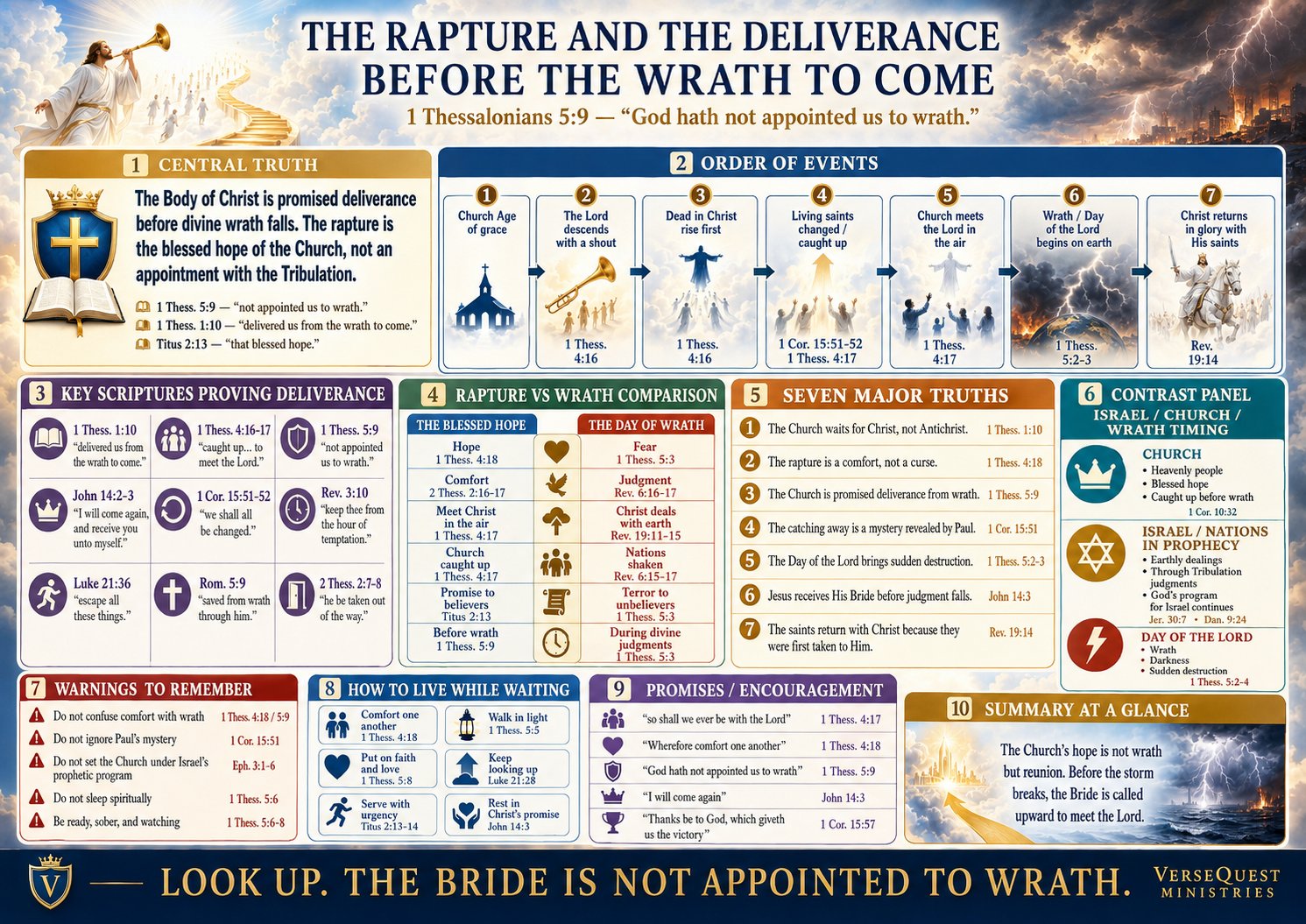
- The Rapture and the Deliverance Before the Wrath to Come – Printable Bible Study Chart
- Printable KJV Bible study chart on The Rapture and the Deliverance Before the Wrath to Come, showing from 1 Thessalonians 5:9 that the Church is not appointed to wrath. This…
- $4.99
- Add to cart
-
-
Study Books (PDF)
-
-25%
- The Mysteries of God Revealed for the Church Age – Premium Essay Series PDF
- A premium 404-page VerseQuest Ministries digital PDF study book featuring 54 detailed KJV-only essays on the mysteries of God revealed for the Church Age. This rightly divided study covers the…
- Original price was: $39.99.$29.99Current price is: $29.99.
- Add to cart
-
-25%
-
Jesus Christ Studies
-
-67%
- Jesus Christ Prophet Priest and King – 441-Page PDF Study
- A 441-page premium KJV PDF study on Jesus Christ as Prophet, Priest, and King. This detailed VerseQuest book covers Christ’s prophetic ministry to Israel, His finished sacrifice and present intercession…
- Original price was: $29.99.$9.99Current price is: $9.99.
- Add to cart
-
-67%
-
KJV Bible Study Resources
-
-60%
- Practical Christianity for Daily Battles – 329-Page KJV Study PDF
- A premium 329-page KJV study PDF with 40 full essays applying sound, rightly divided Bible doctrine to real daily Christian battles. Topics include temptation, anxiety, marriage, parenting, pornography, grief, church…
- Original price was: $24.99.$9.99Current price is: $9.99.
- Add to cart
-
-60%
-
Jesus Christ / Christology
-
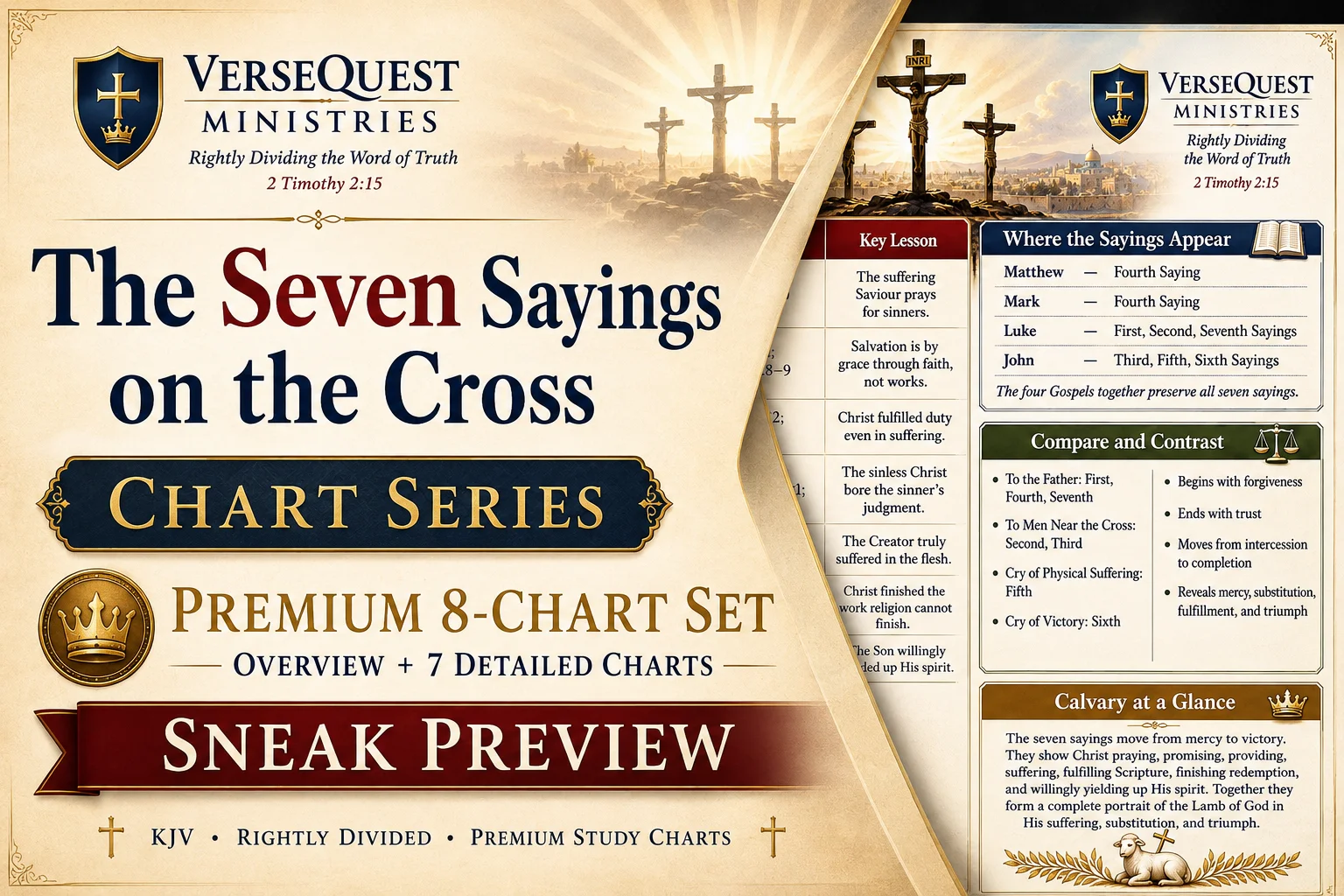
- The Seven Sayings on the Cross – Premium 8-Chart KJV Study Set
- A premium VerseQuest Ministries digital PDF study set on The Seven Sayings on the Cross, featuring an overview chart plus seven detailed KJV Bible study charts. This resource examines Calvary,…
- $12.99
- Add to cart
-