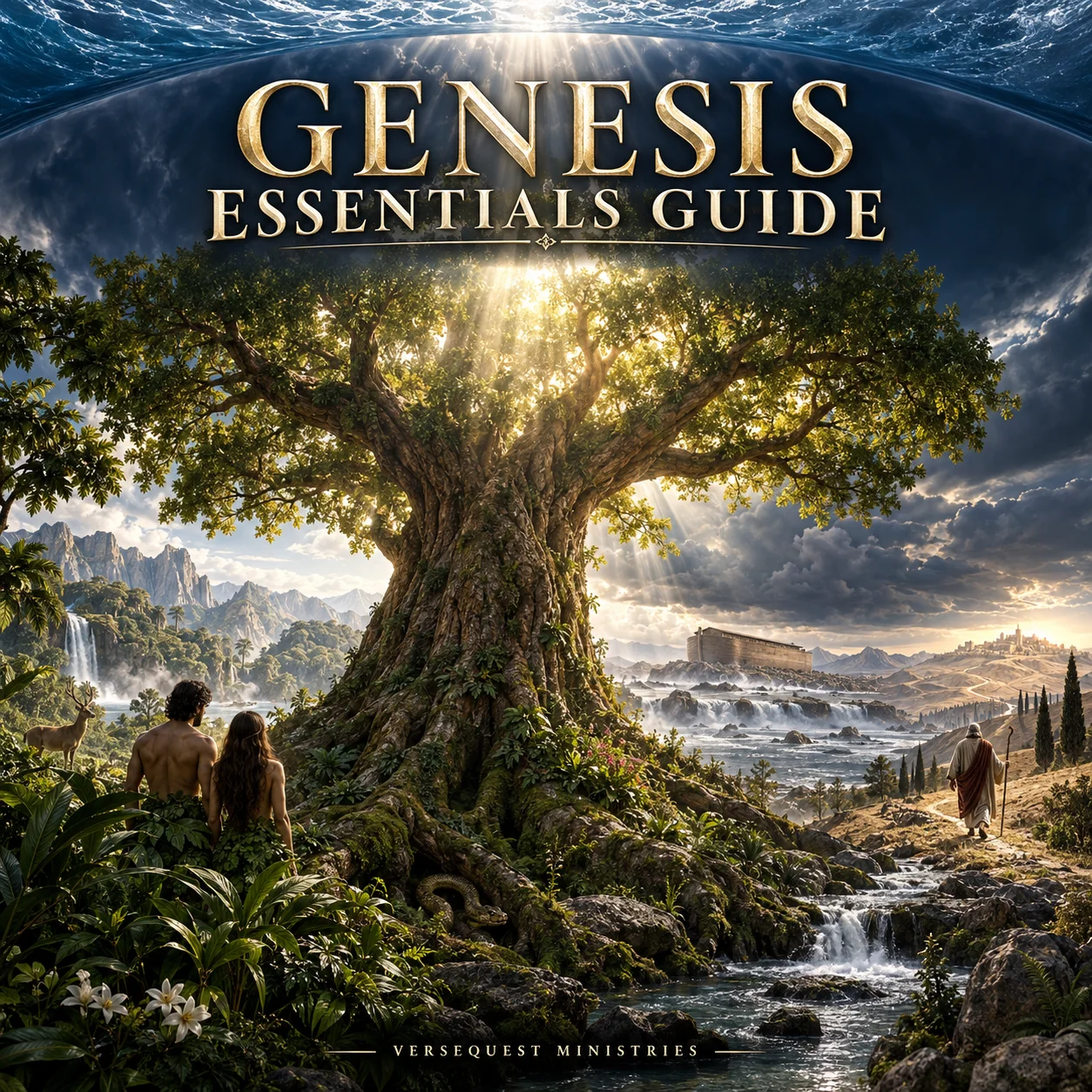
Genesis Essentials Guide: A Beginner’s KJV Guide to Creation, the Fall, the Flood, the Covenants, and the Birth of Israel
The Genesis Essentials Guide is a 72-page downloadable and printable KJV study that gives beginners a clear foundation for understanding the first book of the Bible. It covers creation and restoration, the firmament, Adam and Eve, the Fall, Cain and Abel, the sons of God and giants, Noah’s Flood, Babel, Abraham’s covenant, Isaac, Jacob, Israel, Joseph, and the family’s entrance into Egypt.
The guide includes a complete fifty-chapter map, important definitions, sixty full KJV Scripture panels, concise explanations, doctrinal distinctions, practical applications, review statements, common questions, a Scripture index, and a five-minute summary. It is ideal for newly saved believers, personal study, discipleship, family reading, Sunday school, homeschool instruction, and anyone who wants the essentials of Genesis without reading a lengthy commentary.
Downloadable and printable PDF — 72 pages — $14.99
$14.99
Description
The Genesis Essentials Guide is a 72-page downloadable and printable PDF study designed to give new believers, busy readers, and beginning Bible students a clear foundational understanding of the first book of the Bible. Priced at $14.99, this concise resource presents the essential history, doctrines, people, covenants, and prophetic patterns of Genesis without requiring the reader to work through a lengthy commentary.
Genesis is the Bible’s book of beginnings. It introduces the creation of the heaven and the earth, the formation of man, marriage, sin, death, sacrifice, judgment, nations, covenants, and the family that would become Israel. Without Genesis, the remainder of Scripture loses its historical and doctrinal foundation. This guide shows how Genesis supplies the people, promises, conflicts, and vocabulary developed throughout the rest of the King James Bible.
The study begins with the original creation, the ruined condition described in Genesis 1:2, and God’s six-day restoration and ordering of the earth for Adam. It examines the firmament, the waters above, the placement of the sun, moon, and stars, man’s creation in God’s image, and the institution of marriage. The guide allows the King James Bible to define its own terms and describe the created world according to its own wording.
The reader is then taken through the serpent’s attack upon God’s word, the fall of man, the promised Seed, the coats of skins, Cain and Abel, the two developing family lines, and Enoch’s translation. The guide carefully explains the sons of God, the giants, the corruption preceding the Flood, Noah’s ark, the worldwide judgment, the Noahic covenant, human government, the development of nations, Nimrod, and the rebellion at Babel.
The second major portion follows Abraham, Isaac, Jacob, and Joseph. Readers learn about the Abrahamic covenant, justification by faith, the literal land promise, Ishmael and Isaac, the offering of the promised son, Jacob’s birthright and blessing, Jacob’s new name of Israel, the beginning of the twelve tribes, Joseph’s rejection and exaltation, and God’s providential preservation of the covenant family in Egypt.
The guide contains a complete fifty-chapter map, important Bible definitions, sixty full KJV Scripture panels, plain explanations, doctrinal conclusions, practical applications, memorable review statements, comparison tables, common questions, essential distinctions, a Scripture-panel index, ten final checkpoints, and a five-minute summary of Genesis. The primary teaching passages are printed in full so readers can examine the words directly without continually stopping to look them up.
This resource is especially useful for personal Bible study, new-believer discipleship, family reading, Sunday school preparation, small groups, homeschool Bible instruction, ministry training, and witnessing follow-up. It provides the foundation needed before moving into deeper Genesis commentaries, biblical cosmology, gap-theory studies, prophecy, typology, and the Book of Exodus.
Genesis as the book of beginnings — The origins of the created order, mankind, marriage, sin, sacrifice, judgment, nations, covenants, and Israel. Original creation, ruin, and restoration — The distinction between Genesis 1:1, the ruined condition of Genesis 1:2, and the six-day ordering that begins in Genesis 1:3. The biblical created world — The firmament, waters above, earth below, and the sun, moon, and stars appointed to serve the earth. Man created in God’s image — Human dignity, accountability, dominion, sex, work, and responsibility under the Creator. Marriage established by God — The creation of woman and the one-flesh union established before the fall. Satan’s attack upon God’s word — The progression from questioning God’s statement to altering and openly denying it. The entrance and consequences of sin — Shame, hiding, blame, sorrow, cursed ground, death, and expulsion from Eden. The promised Seed — God’s first promise of the coming Deliverer who would defeat the serpent. Blood sacrifice and acceptable worship — The coats of skins, Abel’s sacrifice, and Cain’s rejected approach. The two spiritual lines — Cain’s self-directed civilization contrasted with the line that called upon the name of the LORD. Angelic corruption and giants — The sons of God, daughters of men, mighty men, and supernatural corruption preceding the Flood. Grace and judgment in Noah’s day — Noah finding grace, obeying God, entering the ark, and being preserved through worldwide judgment. Human government — The post-Flood authority to punish murder because man bears God’s image. The Noahic covenant — God’s universal promise concerning the earth and the covenant meaning of the bow. Nations and Babel — Nimrod, centralized rebellion, the confusion of languages, and God’s division of the nations. The Abrahamic covenant — The literal promises of seed, land, nationhood, protection, kings, and worldwide blessing. Justification by faith — Abraham counted righteous before circumcision and centuries before the Mosaic law. Israel and the Church distinguished — Israel’s national and territorial promises are not transferred to or replaced by the Church. The patriarchal family — Isaac, Jacob, Esau, the twelve sons, and Jacob’s new covenant name of Israel. Types of Jesus Christ — Abel, the ark, Melchizedek, Isaac, Judah, and Joseph as historical people or objects that also foreshadow Christ. God’s providence in Joseph’s life — Rejection, temptation, suffering, exaltation, reconciliation, and preservation. Genesis preparing the way for Exodus — The covenant family enters Egypt in fulfillment of prophecy and awaits God’s promised visitation.
Central Argument
Genesis records the beginnings of the ordered world, the entrance and spread of sin, the preservation of the promised Seed, and the formation of the covenant family through whom God would bless the nations.
Major Observations
- Genesis begins with God and treats creation as revealed history.
- Genesis 1:1, 1:2, and 1:3 should be kept distinct rather than blended into one event.
- The firmament divides waters from waters and contains the lights appointed for the earth.
- The serpent’s first strategy is to question, alter, and deny God’s words.
- God announces the promised Seed before Adam and Eve leave Eden.
- Abel approaches God through the sacrifice God accepts; Cain approaches through the work he chooses.
- Enoch’s translation occurs before worldwide judgment, while Noah is preserved through that judgment.
- The sons of God, daughters of men, and resulting giants must all be accounted for when interpreting Genesis 6.
- Noah finds grace before the record emphasizes his obedience.
- The Flood is described as covering every high hill under the whole heaven.
- Babel demonstrates that unity can be wicked when mankind unites against God’s command.
- Abraham is counted righteous by faith before circumcision and long before the law of Moses.
- The promises to Abraham include literal descendants, literal nationhood, and literal land.
- Isaac is the covenant son even though God also gives promises concerning Ishmael.
- Jacob receives the name Israel before his descendants become the nation of Israel.
- Joseph’s rejection and exaltation provide one of Scripture’s clearest historical pictures of Christ.
- God’s providence overrules evil without approving the evil or removing human responsibility.
- Genesis ends with Joseph’s coffin in Egypt but with faith looking toward the promised land.
Important Distinctions
- Original creation versus restoration
- Pre-Adamic judgment versus Noah’s Flood
- Six literal days versus evolutionary ages
- Literal history versus spiritual application
- Historical event versus prophetic type
- Noahic covenant versus Abrahamic covenant
- Abrahamic promise versus Mosaic law
- Ishmael’s blessings versus Isaac’s covenant position
- Israel versus the Church
- God’s providence versus approval of evil
Doctrinal Conclusions
Genesis must be accepted as the historical and doctrinal foundation of Scripture. Man is a direct creation of God, sin entered through disobedience, judgment is real, and redemption proceeds through God’s promised provision. Abraham demonstrates justification by faith, while the covenants establish God’s continuing purposes for Israel. The book points toward Jesus Christ through the promised Seed and through numerous historical types without erasing the literal events.
Memorable Teaching Points
- The Bible begins with a Creator, not an argument for one.
- The Devil’s first recorded sentence places a question mark after God’s statement.
- Man’s fig leaves cannot replace God’s covering.
- Cain built a city for his name; Seth’s line called upon the name of the LORD.
- Noah did not redesign the refuge; he entered the provision God specified.
- Unity against God is organized rebellion, not righteousness.
- Before circumcision and Sinai, Abraham was counted righteous by faith.
- Isaac left the altar because a substitute died in his place.
- Esau priced his birthright at one meal.
- Joseph lost his coat rather than lose his character.
- The coffin closes Genesis, but the promise opens the door to Exodus.
Subjects for Further Study
- The gap between Genesis 1:1 and Genesis 1:2
- The firmament and the biblical created world
- Stars and their association with angels
- The sons of God and giants
- The worldwide effects of Noah’s Flood
- Nimrod, Babel, and later Babylon
- The covenants introduced in Genesis
- The promised Seed throughout Scripture
- Melchizedek’s priesthood
- The types of Christ in Isaac and Joseph
- Judah, the sceptre, and Shiloh
- Genesis and Revelation as the opening and closing counterparts of Scripture
For personal Bible study, the guide provides a manageable path through all fifty chapters of Genesis. A reader can study one subject or Scripture panel at a time, underline important words, review the “Remember This” statements, and use the final checkpoints to retain the book’s central movement.
For new-believer discipleship, it establishes the doctrines that must be understood before moving deeper into Scripture. It explains who God is as Creator, what sin did to mankind, why sacrifice matters, how faith is counted for righteousness, why Israel begins with Abraham’s covenant family, and how Genesis prepares the reader for Christ and the gospel.
Pastors, preachers, and Sunday school teachers can use the guide to prepare introductory lessons, sermon series, new-member classes, or overview studies. The fifty-chapter map and individual teaching pages make it easy to locate a subject and develop it further from an open King James Bible.
Small groups and families can read one section together and discuss what the passage says, what it establishes doctrinally, and why it matters. Because the main passages are printed in full, the guide also works well where participants may not all have a Bible immediately available.
Homeschool families and Christian classrooms can use the resource as a concise Genesis reference book. It provides substantial teaching without becoming a formal graded curriculum, leaving parents or teachers free to add discussion, memory work, maps, timelines, or written assignments according to the student’s level.
For witnessing and follow-up, the guide introduces creation, sin, judgment, grace, sacrifice, faith, and the promised Seed in their original biblical setting. It is especially valuable for newly saved readers who want to understand how the Bible’s redemptive message begins.
The King James Bible, especially Genesis 1-50, Exodus 1-20, Romans 4, Galatians 3, Hebrews 7 and 11, and Revelation 20-22.
A complete KJV concordance for tracing words such as creation, firmament, seed, covenant, land, promise, blessing, nation, and Israel.
A reliable Bible dictionary for ancient names, places, customs, measurements, and family relationships.
A Bible atlas showing Ur, Haran, Canaan, Egypt, Shinar, Sodom, Beersheba, Bethel, Hebron, and the journeys of the patriarchs.
A Genesis timeline covering creation, Adam’s descendants, Noah’s Flood, Babel, Abraham, Isaac, Jacob, and Joseph.
Peter S. Ruckman’s commentary on Genesis for deeper verse-by-verse study.
The Scofield Reference Bible for dispensational divisions, covenants, and cross-references.
Bullinger’s Companion Bible for structural observations, repeated expressions, and cross-reference study.
Dake’s study notes for additional outlines, lists, genealogical information, and topical connections.
Genesis Rightly Divided for deeper VerseQuest treatment of Genesis doctrine, prophecy, typology, and biblical cosmology.
Genesis KJV Chapter-by-Chapter Workbook for structured study through all fifty chapters.
Exodus Essentials Guide for continuing the story from Israel’s entrance into Egypt to redemption, Sinai, the law, and the tabernacle.
Dispensational Truth Essentials Guide for understanding how God’s instructions, covenants, peoples, and promises must be placed in their proper biblical setting.
Revelation Essentials Guide for comparing the Bible’s beginnings in Genesis with its final restoration and fulfillment in Revelation.
Related products
-
The Rapture
-
-67%
- Caught Up Before the Wrath – 66-Essay KJV Rapture Study
- Caught Up Before the Wrath is a 430-page premium KJV Bible study defending the pre-tribulation Rapture of the Church from a rightly divided, dispensational perspective. This 66-essay VerseQuest Ministries book…
- Original price was: $29.99.$9.99Current price is: $9.99.
- Add to cart
-
-67%
-
Study Books (PDF)
-
-25%
- The Mysteries of God Revealed for the Church Age – Premium Essay Series PDF
- A premium 404-page VerseQuest Ministries digital PDF study book featuring 54 detailed KJV-only essays on the mysteries of God revealed for the Church Age. This rightly divided study covers the…
- Original price was: $39.99.$29.99Current price is: $29.99.
- Add to cart
-
-25%
-
Revelation
-
-71%
- Moses and Elijah: The Two Witnesses Made Plain
- Moses and Elijah: The Two Witnesses Made Plain is a 636-page premium VerseQuest PDF study proving from Scripture that the Two Witnesses of Revelation 11 are Moses and Elijah. This…
- Original price was: $34.99.$9.99Current price is: $9.99.
- Add to cart
-
-71%
-
Doctrine Series
-
Kingdom Hall
-
-71%
- Jehovah’s Witnesses Made Plain – 574-Page KJV Watchtower Study
- A massive 574-page VerseQuest study exposing the Watchtower system from the King James Bible. This detailed 100-essay book covers the false Christ, false gospel, New World Translation, failed prophecy, 144,000,…
- Original price was: $34.99.$9.99Current price is: $9.99.
- Add to cart
-
-71%