
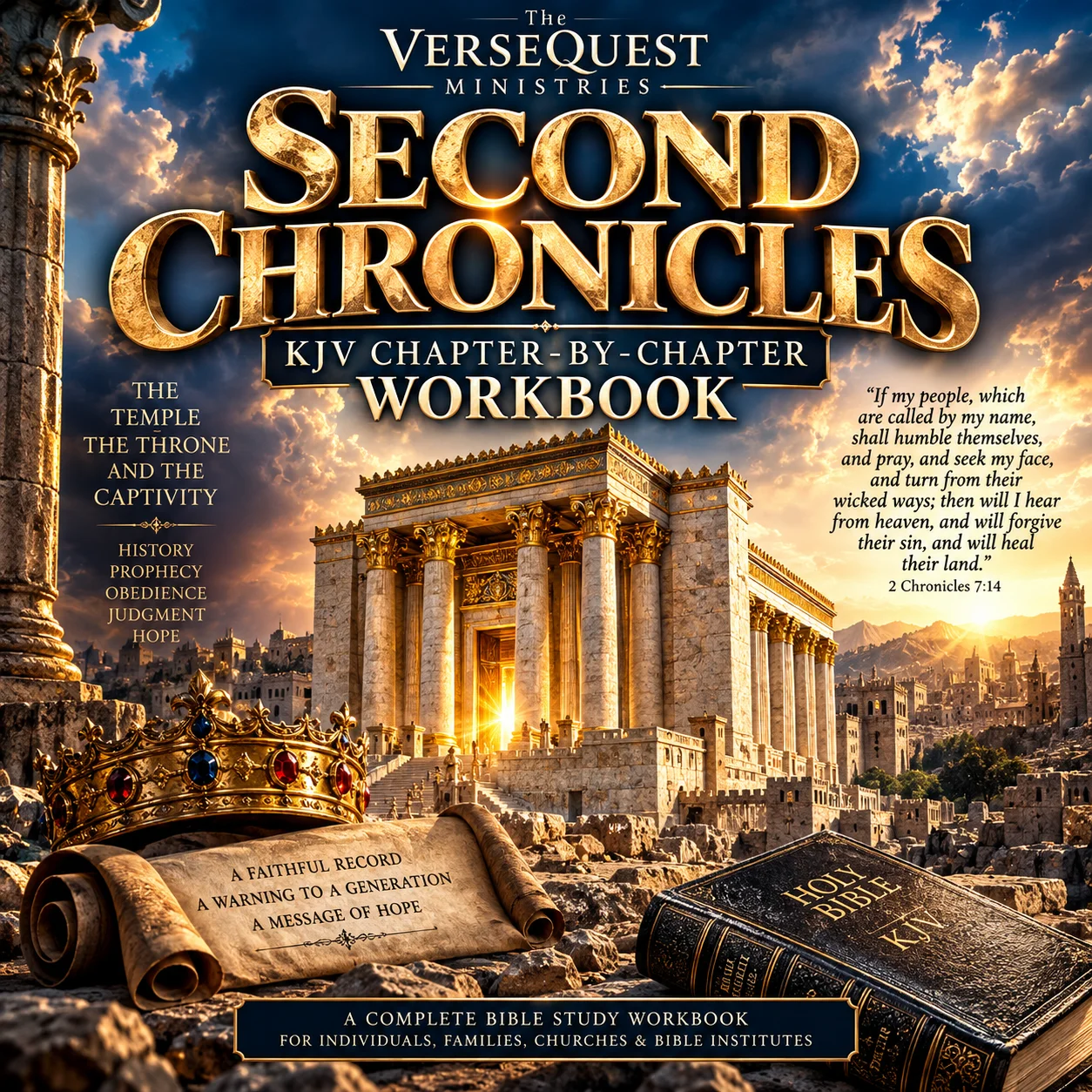
2 Chronicles KJV Chapter-by-Chapter Workbook
The 2 Chronicles KJV Chapter-by-Chapter Workbook is a 630-page downloadable PDF Bible-study resource designed to guide you carefully through all 36 chapters of Second Chronicles with your King James Bible open beside you.
Work through Solomon, the Temple, Judah’s kings, revival, apostasy, prophetic warning, national judgment, Hezekiah, Josiah, the Babylonian captivity, and Cyrus’s decree while recording your own observations, tracing principal movements, studying key passages and words in context, following cross-references, and developing chapter conclusions.
This is not merely a book to read—it is a workbook designed to help you study Second Chronicles for yourself and make the material your own. Ideal for personal study, homeschool Bible instruction, Sunday school, Bible classes, sermon preparation, and serious KJV students.
Digital PDF — 630 pages — $34.99
$34.99
Description
The 2 Chronicles KJV Chapter-by-Chapter Workbook is a comprehensive 630-page downloadable PDF Bible-study workbook designed to take the student carefully through all 36 chapters of Second Chronicles. Rather than simply telling the reader what the book says, this workbook is built to teach the reader how to study it: read the text carefully, identify the principal movements, trace important words and themes, compare Scripture with Scripture, record observations, answer guided questions, and make the material his own.
Second Chronicles is far more than a repetition of Israel’s history. Its emphasis falls heavily upon the Davidic line, Solomon, the Temple, the kingdom of Judah, the priesthood, worship, apostasy, judgment, repentance, revival, and the eventual destruction of Jerusalem followed by the decree of Cyrus. The workbook follows those movements chapter by chapter and helps the student see how individual events fit into the larger biblical record.
The opening chapters examine Solomon’s establishment as king, his request for wisdom, the building and dedication of the Temple, the glory of the LORD filling the house, and God’s covenant dealings with Solomon. From there the study traces the division of the kingdom, the succession of Judah’s kings, periods of spiritual recovery and decline, foreign invasions, prophetic warnings, national judgment, and the extraordinary reforms under kings such as Asa, Jehoshaphat, Hezekiah, and Josiah.
Particular attention is given to important passages, principal movements within each chapter, words in context, doctrinal observations, historical connections, cross-references, and the distinctions necessary for sound KJV Bible study. Passages concerning Judah, Israel, the Temple, the Davidic throne, the Mosaic covenant, and future kingdom truth are allowed to remain in their proper biblical setting rather than being indiscriminately transferred to the New Testament church.
Each chapter section is designed to make the student interact with the text. Guided areas allow the reader to identify a chapter thesis, record initial observations, summarize important movements, work through key passages, trace words and ideas, and write personal study notes. The goal is not passive reading but deliberate Bible study—the kind in which a student marks the passage, follows the references, asks questions, writes conclusions, and gradually learns to mine Scripture independently.
Because of its depth and interactive design, this workbook can serve several purposes at once. It can function as a personal Bible-study course, a homeschool Bible curriculum resource, a Sunday school teaching aid, a small-group workbook, a ministry-training tool, or a structured study guide for pastors and teachers working through Second Chronicles.
The 2 Chronicles KJV Chapter-by-Chapter Workbook is supplied as a 630-page digital PDF and is priced at $34.99. It is designed for serious Bible students who want more than an outline or devotional overview and who are willing to work through the biblical text carefully with the King James Bible open beside them.
The Davidic Covenant and Royal Line — Second Chronicles follows the kings of Judah in relation to God's promises to David. Solomon and the Temple — The construction, dedication, worship, glory, decline, cleansing, and eventual destruction of the Temple dominate the book. The Kingdom of Judah — Chronicles concentrates upon Judah and Jerusalem rather than treating both kingdoms equally. Seeking the LORD — Kings and people repeatedly rise or fall according to whether they seek God or forsake Him. The Word of God — Prophets, priests, kings, and people are repeatedly confronted by what God has spoken. Prophetic Warning — God repeatedly sends messengers before bringing judgment. Obedience and Consequences — National blessing and chastisement repeatedly follow Judah's response to God's covenant requirements. Pride and Spiritual Collapse — Several kings begin well but are damaged by pride, self-reliance, or compromise. Repentance and Humbling — Repeated examples demonstrate the importance of responding correctly when God reproves sin. Revival and Reformation — Asa, Jehoshaphat, Hezekiah, Josiah, and others provide important studies in biblical reform. Worship and the Priesthood — Priests, Levites, singers, sacrifices, Temple service, and holy things remain central. Jerusalem — Jerusalem functions as the political and religious center of Judah's national history. The House of God — The Temple's condition repeatedly reflects the spiritual condition of the nation. The Arm of Flesh Versus Trust in God — Political alliances and human strength repeatedly prove inferior to dependence upon the LORD. Judgment After Rejected Light — Second Chronicles demonstrates that repeated rejection of God's warnings ultimately produces judgment. Preservation of the Davidic Line — Despite apostasy, attack, and judgment, God preserves the line connected with His covenant promises. Captivity and Restoration — The book ends in judgment but also points immediately toward restoration through Cyrus. Israel and the Church Distinguished — Historical and covenant promises concerning Judah, Israel, Jerusalem, and the land should remain in their biblical setting. Kingdom Truth — The Davidic throne, Jerusalem, Judah, and God's kingdom program provide important background for later prophetic Scripture.
The central movement of Second Chronicles runs from Solomon’s throne and Temple to Jerusalem’s destruction and Cyrus’s decree. The book begins with national strength, glory, worship, and divine blessing but demonstrates how continued apostasy eventually brings covenant judgment.
The Temple is one of the book’s principal measuring points. Solomon builds it, God’s glory fills it, later generations neglect or corrupt its worship, reforming kings cleanse it, and Babylon eventually destroys it. The condition of the Temple repeatedly parallels the spiritual condition of Judah.
Second Chronicles emphasizes the Davidic royal line. The narrative is not simply a general political history of Israel. It deliberately follows Judah and the descendants of David.
The expression and concept of seeking the LORD should be traced carefully. Kings who seek God repeatedly experience divine help, while turning away from Him produces decline.
Several kings demonstrate that starting well does not guarantee finishing well. Success itself becomes a test, and pride frequently enters after victory, prosperity, or strength.
The student should distinguish historical interpretation from spiritual application. Passages addressing Judah under the Mosaic covenant should first be interpreted in their own setting before applications are made to believers today.
Second Chronicles 7:14 is a prime example. The passage belongs within God’s covenant dealings with Solomon, Israel, the land, Jerusalem, and the Temple. Valuable spiritual principles may be drawn from it without replacing Israel with the church.
Another repeated lesson is the danger of trusting the arm of flesh. Military alliances, foreign kings, numbers, wealth, and political calculation repeatedly fail when substituted for dependence upon God.
Prophetic preaching occupies a major role. God repeatedly warns before He judges. Second Chronicles 36 emphasizes that the nation was not destroyed without warning; the people repeatedly rejected God’s messengers until judgment could no longer be postponed.
The great reforms under Asa, Jehoshaphat, Hezekiah, and Josiah should be compared. Each demonstrates different elements of biblical reform: seeking God, destroying idolatry, restoring worship, teaching the law, cleansing the Temple, renewing covenant responsibility, and responding to Scripture.
Questions worthy of continued study include: Why does Chronicles emphasize Judah more than the northern kingdom? How does the Temple function throughout the book? Why are some events recorded differently or with different emphasis than Kings? What does Second Chronicles reveal about God’s faithfulness to the Davidic covenant? How do pride and compromise repeatedly affect otherwise good kings? Why does the book conclude with Cyrus rather than ending only with Jerusalem’s destruction?
The workbook is especially suited to personal Bible study because each chapter encourages the student to read directly from the King James Bible, identify the chapter's central truth, trace its movements, compare references, and record personal observations rather than merely reading someone else's conclusions.
For homeschool Bible instruction, it can provide a structured course through one complete Old Testament book. Parents can assign readings, written responses, chapter summaries, word studies, cross-reference exercises, and review material while allowing the student to build a permanent record of his study.
For Sunday school and church Bible classes, teachers can use individual chapter sections as ready-made lesson preparation frameworks. The principal movements, key passages, doctrinal observations, and study questions can be developed into multiple lessons rather than trying to compress an entire chapter into a brief overview.
Pastors and preachers can use the workbook for sermon preparation by identifying historical context, major movements, repeated themes, important contrasts, and cross-references before developing a preaching outline.
Small groups can work through the book sequentially, reading assigned portions beforehand and using the workbook material to guide discussion.
The workbook can also support discipleship and ministry training by teaching students how to observe the text, distinguish historical setting from present-day application, compare Scripture with Scripture, and formulate conclusions from the Bible itself.
A King James Bible should remain the primary companion resource throughout the workbook. A Bible with good center-column or marginal cross-references will allow the student to trace the numerous connections between Chronicles, Samuel, Kings, Psalms, the Prophets, Ezra, and later prophetic Scripture.
A Strong's Exhaustive Concordance or another concordance keyed to the King James Bible can assist with tracing important recurring words, names, places, and phrases.
A reliable Bible dictionary can help with unfamiliar kings, priests, cities, nations, Temple terminology, political offices, measurements, and historical customs.
Bible maps and Old Testament timelines are especially valuable for following Judah's kings, surrounding nations, invasions, Jerusalem, Assyria, Egypt, Babylon, and the movement toward captivity.
A chronological chart of the kings of Judah and Israel can help the student place individual reigns within the larger historical record.
The books of 1 Chronicles, 1 Kings, and 2 Kings should frequently be studied alongside Second Chronicles because they contain important parallel accounts and complementary historical information.
The Ezra KJV Chapter-by-Chapter Workbook is a natural companion study because Ezra begins where Second Chronicles ends, with Cyrus's decree and the return from captivity.
Related products
-
Jesus Christ / Christology
-
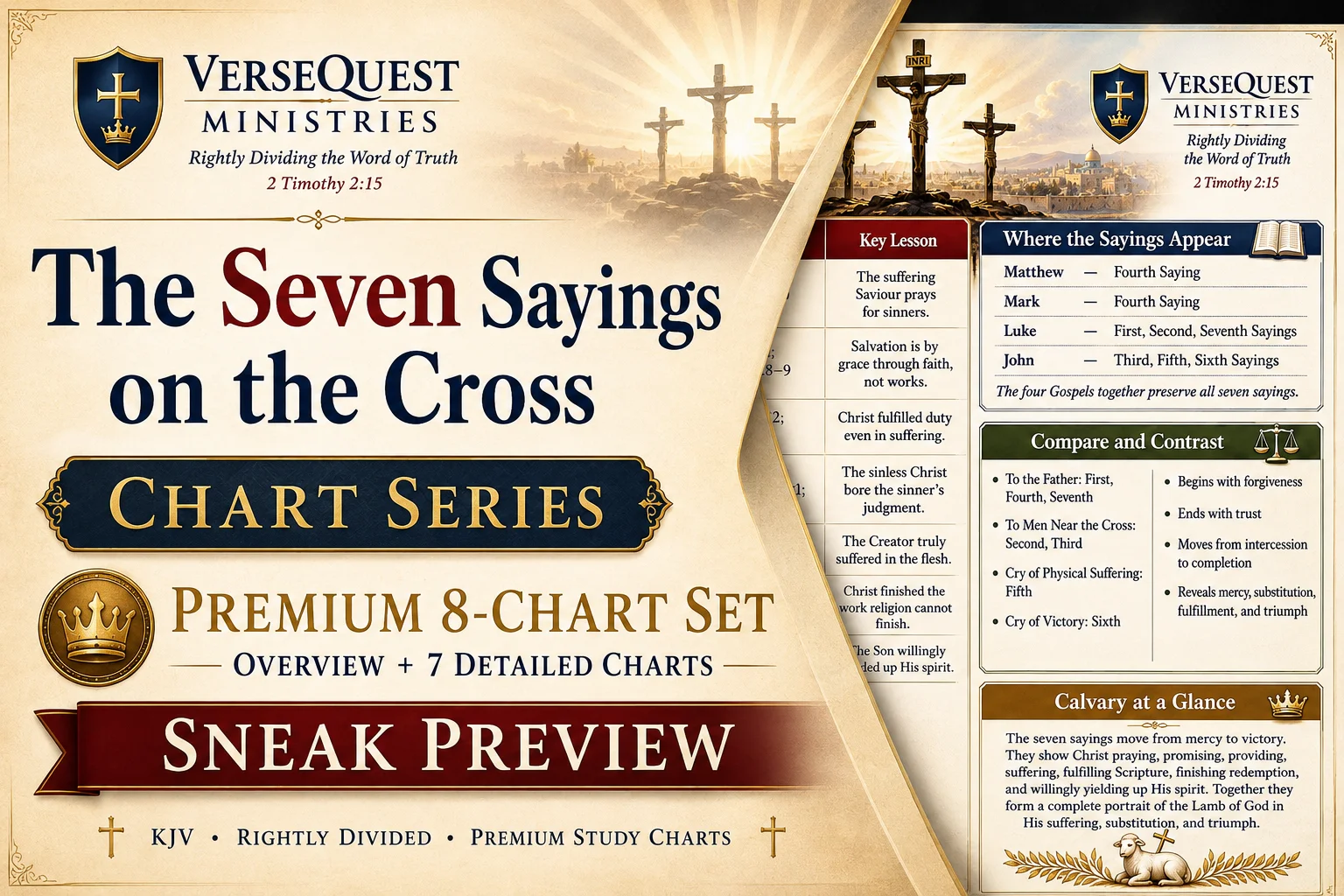
- The Seven Sayings on the Cross – Premium 8-Chart KJV Study Set
- A premium VerseQuest Ministries digital PDF study set on The Seven Sayings on the Cross, featuring an overview chart plus seven detailed KJV Bible study charts. This resource examines Calvary,…
- $12.99
- Add to cart
-
-
The Rapture
-
-67%
- Caught Up Before the Wrath – 66-Essay KJV Rapture Study
- Caught Up Before the Wrath is a 430-page premium KJV Bible study defending the pre-tribulation Rapture of the Church from a rightly divided, dispensational perspective. This 66-essay VerseQuest Ministries book…
- Original price was: $29.99.$9.99Current price is: $9.99.
- Add to cart
-
-67%
-
Study Books (PDF)
-
-25%
- The Mysteries of God Revealed for the Church Age – Premium Essay Series PDF
- A premium 404-page VerseQuest Ministries digital PDF study book featuring 54 detailed KJV-only essays on the mysteries of God revealed for the Church Age. This rightly divided study covers the…
- Original price was: $39.99.$29.99Current price is: $29.99.
- Add to cart
-
-25%
-
Chart Collections
-
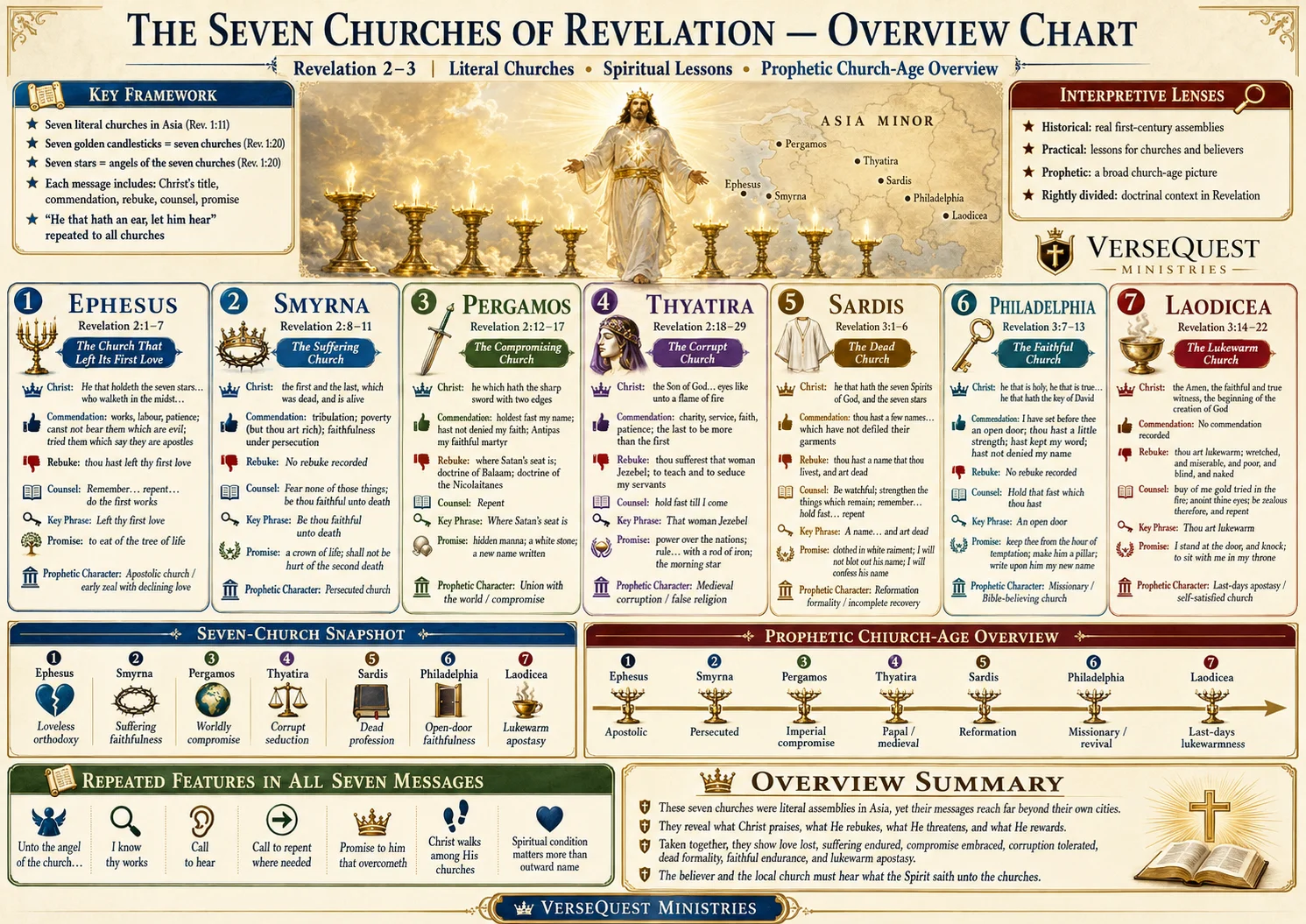
- The Seven Churches of Revelation Chart Collection – Christ Walking Among the Candlesticks
- A premium VerseQuest Ministries™ PDF chart collection covering the Seven Churches of Revelation in Revelation 2–3. Includes one overview chart plus individual KJV Bible study charts for Ephesus, Smyrna, Pergamos,…
- $12.99
- Add to cart
-
-
Heaven
-
- The Doctrine of Heaven Made Plain — 599-Page KJV Bible Study PDF
- A massive 599-page KJV, rightly divided study on heaven, covering the present heaven, resurrection body, Rapture, Millennium, New Jerusalem, eternal state, hard questions, funeral lies, and cult errors.
- $34.99
- Add to cart
-