
Deuteronomy KJV Chapter-by-Chapter Workbook
The Deuteronomy KJV Chapter-by-Chapter Workbook is a complete 476-page downloadable Bible curriculum covering all 34 chapters of Deuteronomy from a King James Bible-believing, rightly divided perspective.
Every chapter follows a twelve-page format consisting of ten student-study pages and two coordinated teacher pages. Students will examine Moses’ final addresses, Israel’s wilderness history, the restated law, the great commandment, worship, justice, leadership, the Prophet like unto Moses, blessings and curses, Israel’s future restoration, the Song of Moses, Joshua’s succession, and the death of Moses.
The workbook also includes core and enrichment study tracks, a final assessment and challenge, Scripture indexes, a subject and doctrine index, further-study direction, a final teaching-presentation assignment, and a certificate of completion. The searchable, printable PDF is suitable for personal study, homeschool, Sunday school, church classes, Bible-study groups, and ministry training.
Price: $39.99
$39.99
Description
The Deuteronomy KJV Chapter-by-Chapter Workbook is a complete 476-page downloadable Bible curriculum designed to lead students carefully through all 34 chapters of Deuteronomy. Built around the theme “A Nation Remembered, Warned, and Prepared,” this substantial workbook helps the student examine Moses’ final words to Israel as the nation stands on the border of the Promised Land.
Deuteronomy is far more than a repetition of laws already recorded in Exodus, Leviticus, and Numbers. Moses reviews Israel’s history, explains the consequences of unbelief, restates the covenant responsibilities of the nation, prepares a new generation to enter Canaan, and solemnly sets before Israel the alternatives of obedience and rebellion, blessing and cursing, life and death. The book combines history, law, prophecy, warning, worship, national instruction, and personal responsibility.
The workbook begins with Moses’ review of Israel’s failure at Kadesh-barnea and the wilderness years that followed. It then follows Israel’s victories east of Jordan, Moses’ earnest appeals for obedience, the restatement of the Ten Commandments, the great declaration concerning the one true God, and Israel’s responsibility to love the LORD with all the heart, soul, and might.
Students will examine the dangers of forgetting the LORD after receiving prosperity, the destruction of Canaanite idolatry, the requirement to worship at the place God appointed, the warning against false prophets, Israel’s dietary and ceremonial distinctions, the appointed feasts, the responsibilities of judges, priests, Levites, kings, and prophets, and the promise of a Prophet like unto Moses.
Later chapters address cities of refuge, laws governing witnesses and warfare, family and social responsibilities, restitution, justice, purity, care for the poor, the firstfruits confession, the covenant ceremony connected with mounts Ebal and Gerizim, the blessings and curses, Israel’s future scattering and restoration, Joshua’s commission, the Song of Moses, the blessing of the tribes, and the death of Moses.
Every chapter receives a consistent twelve-page treatment. Ten student-study pages guide the reader through chapter overview, structure, exposition, doctrinal distinctions, KJV vocabulary, cross-references, written exercises, important questions, review, and teach-back preparation. Two coordinated teacher pages provide teaching help and guidance for presenting the chapter faithfully.
The workbook approaches Deuteronomy from a Bible-believing, King James Bible-centered, rightly divided perspective. Literal Israel remains Israel, the land remains the land promised to the fathers, and the Mosaic covenant is not reassigned to the Body of Christ. The student is taught to distinguish the historical and doctrinal address of the book while still recognizing its inspired instruction, warnings, examples, and practical applications.
Special care is given to Israel’s national position under the law. The workbook distinguishes the Mosaic covenant from the gospel of the grace of God and explains why Israel’s conditional blessings, national curses, ceremonial requirements, dietary laws, Sabbaths, sacrifices, appointed feasts, and land promises must be interpreted in their proper biblical setting.
At the same time, Deuteronomy contains truths that reach throughout the remainder of Scripture. Its language is repeatedly used by the prophets, by the Lord Jesus Christ, and by the apostles. Christ answered Satan from Deuteronomy, identified love for God as the great commandment, and fulfilled the promise of the Prophet like unto Moses. Later Scripture also draws upon Deuteronomy when explaining the law, righteousness, faith, chastening, testimony, judgment, and Israel’s prophetic future.
The additional course material turns the workbook into a complete and flexible curriculum. The 476-page PDF includes ownership and title pages, instructions for using the workbook, core and enrichment study tracks, a final assessment and challenge, Scripture indexes, a subject and doctrine index, a “Where to Go From Here” section, a certificate of completion, and a final teaching-presentation assignment.
The PDF is printable and searchable, making it suitable for handwritten study or digital use with a compatible PDF reader. Students may complete the workbook independently, families may use it as a homeschool Bible course, and teachers may adapt the material for Sunday school, church classes, Bible-study groups, discipleship, classroom instruction, or Bible-institute training.
The Deuteronomy KJV Chapter-by-Chapter Workbook is not merely a commentary to be read passively. It is a working Bible curriculum that encourages students to read every chapter, trace its movements, define its words, compare Scripture with Scripture, write their own conclusions, preserve important doctrinal distinctions, and develop the ability to explain and teach Deuteronomy faithfully.
Moses’ final addresses — Deuteronomy preserves Moses’ last extensive instruction to Israel before his death. A new generation prepared — The generation entering Canaan must learn from the failures of those who died in the wilderness. Remembering and forgetting — Moses repeatedly commands Israel to remember the LORD’s works and warns against forgetting Him in prosperity. The failure at Kadesh-barnea — Israel’s refusal to enter the land demonstrates the destructive consequences of unbelief. The wilderness as divine instruction — Israel’s years in the wilderness humble, prove, correct, and reveal the nation’s heart. The faithfulness of the LORD — God remains faithful to His covenant and promises despite Israel’s repeated rebellion. The land promised to the fathers — Canaan is a literal inheritance promised to Abraham, Isaac, Jacob, and their physical descendants. The Mosaic covenant — Deuteronomy renews and explains Israel’s national covenant responsibilities before entry into the land. Hear, learn, keep, and do — These repeated commands summarize Israel’s required response to the word of God. The one true God — Israel is called to reject every idol and confess that the LORD alone is God. Wholehearted love for the LORD — Israel’s covenant obedience must involve the heart, soul, and might rather than outward ritual alone. Teaching the next generation — Parents are commanded to speak of God’s words continually and teach them diligently to their children. The Ten Commandments — The covenant words are restated to the generation preparing to possess Canaan. The Sabbath and Israel — The Sabbath is addressed to Israel within the Mosaic covenant and connected with the nation’s deliverance from Egypt. The danger of prosperity — Houses, crops, wealth, and security can lead Israel to pride and forgetfulness. Separation from idolatry — Israel must destroy Canaanite worship and refuse religious mixture. The appointed place of worship — Israel may not invent its own approach but must bring sacrifices to the place chosen by God. False prophets and religious deception — Miraculous signs do not excuse teaching that turns people away from the LORD. National holiness — Israel’s food, feasts, worship, government, family life, and social conduct reflect its covenant separation. Justice and righteous judgment — Judges and witnesses are held accountable to protect truth and prevent corruption. Care for the poor and vulnerable — The law addresses debt, release, wages, gleaning, strangers, widows, and fatherless children. The responsibilities of leadership — Judges, priests, Levites, kings, prophets, elders, officers, and military leaders serve under revealed law. The law of the king — Israel’s future king must not multiply horses, wives, or silver and gold, but must read and obey the law. The Prophet like unto Moses — Deuteronomy anticipates a coming Prophet ultimately identified in the New Testament as Jesus Christ. Occult practices forbidden — Divination, enchantment, witchcraft, familiar spirits, and necromancy are condemned as abominations. Cities of refuge — The law distinguishes accidental killing from murder while maintaining justice and protection. Warfare under divine command — Israel’s wars in Canaan belong to a specific historical and judicial commission. Witnesses and testimony — Matters of judgment require established testimony, and false witnesses receive serious punishment. Family and social order — Deuteronomy applies covenant responsibility to marriage, inheritance, labour, property, purity, and neighbourly conduct. Blessing and cursing — Israel’s national experience in the land is directly connected with covenant obedience or rebellion. Scattering among the nations — Moses foretells national defeat, captivity, dispersion, suffering, and astonishment for covenant disobedience. Israel’s future restoration — Deuteronomy looks beyond scattering to Israel’s return, regathering, and renewed blessing. Life and death set before Israel — The nation is solemnly called to choose obedience and life rather than rebellion and destruction. The Song of Moses — The song serves as a prophetic witness concerning Israel’s origins, corruption, chastening, preservation, and latter end. The blessing of the tribes — Moses closes his ministry by pronouncing blessings upon Israel’s tribes. The succession of Joshua — Leadership passes from Moses to Joshua under God’s command. Moses the servant of the LORD — Moses finishes his ministry faithfully but remains unable to bring Israel into the inheritance. Moses and Christ distinguished — Moses is a faithful servant and prophetic type, while Christ is the sinless Son and the greater Prophet. Israel and the Body of Christ distinguished — Israel’s law, land, covenant, blessings, curses, and national prophecies must not be reassigned to the Church. Instruction for present believers — Although Deuteronomy is addressed doctrinally to Israel, its history and principles provide inspired learning and warnings.
- Central argument: Deuteronomy records Moses preparing Israel’s new generation to enter the Promised Land by reviewing the nation’s history, restating its covenant responsibilities, warning of the consequences of rebellion, and setting life and death before the people.
- Historical setting: Moses speaks in the plains of Moab, east of Jordan, after the victories over Sihon and Og and shortly before his death.
- Meaning of the book’s movement: Israel is no longer standing at Sinai immediately after the Exodus. The nation is preparing to exchange wilderness wandering for responsibility within the land.
- Major divisions: Chapters 1–4 review Israel’s history; chapters 5–26 explain covenant responsibilities; chapters 27–30 present covenant confirmation, blessing, cursing, and restoration; chapters 31–34 record the transition from Moses to Joshua.
- Deuteronomy and earlier law: The book repeats, applies, explains, and reinforces earlier commandments for the generation about to enter Canaan.
- The importance of memory: Israel must remember Egypt, Sinai, the wilderness, its rebellions, God’s judgments, God’s provision, and the covenant promises.
- The danger of forgetting: Forgetfulness produces pride, self-sufficiency, idolatry, disobedience, and eventual national judgment.
- Kadesh-barnea: The wilderness years are traced to a definite act of unbelief in which Israel refused to enter the land at God’s command.
- Unbelief and presumption: Israel first refuses to go when commanded and then attempts to go after God has pronounced judgment. Both actions reject the word of the LORD.
- God’s faithfulness: Israel does not receive the land because of national righteousness but because of God’s promise and His judgment upon the wicked nations.
- The covenant audience: Moses addresses literal Israel, including its tribes, rulers, families, children, strangers, and future generations.
- The land: The Promised Land is a literal geographical inheritance and should not be reduced to a symbol of heaven or transferred to the Body of Christ.
- The law’s function: The law reveals God’s holiness, governs Israel’s covenant life, identifies transgression, and pronounces judgment, but it cannot change sinful flesh.
- The great commandment: Love for the LORD is expressed through hearing, keeping, teaching, and obeying His revealed words.
- Teaching children: Deuteronomy places substantial responsibility upon parents to keep Scripture continually before the household.
- The Sabbath: Deuteronomy 5 places the Sabbath within God’s covenant dealings with Israel and connects it with deliverance from Egyptian bondage.
- Prosperity as a test: Israel may be tempted to forget God more readily in settled prosperity than during visible wilderness need.
- No religious mixture: Israel is not permitted to adopt Canaanite forms of worship and redirect them toward the LORD.
- False signs: A sign or wonder does not validate a messenger who encourages disobedience or idolatry.
- The appointed place: Sincerity does not authorize self-chosen worship. God determines the acceptable place and manner of Israel’s approach.
- The king under the Book: Israel’s king is not above Scripture. He must possess, read, and obey the law throughout his reign.
- The promised Prophet: The Prophet like unto Moses comes from among Israel’s brethren and speaks God’s words with divine authority. Acts identifies this promise with Jesus Christ.
- Justice and mercy: Cities of refuge protect the innocent manslayer, while the law refuses to excuse deliberate murder.
- National warfare: The commands concerning Canaan are specific acts of divine judgment entrusted to Israel and are not authorization for the Church to conduct religious warfare.
- Social responsibility: Covenant obedience touches wages, property, lending, harvests, marriage, family, testimony, restitution, and care for vulnerable people.
- Blessings and curses: Deuteronomy 28 concerns Israel’s national experience under the Mosaic covenant rather than a guarantee of material wealth for every present-day believer.
- Prophetic importance: The curses anticipate siege, captivity, dispersion, persecution, and suffering among the nations.
- Restoration after scattering: Deuteronomy 30 anticipates Israel’s return and restoration, demonstrating that judgment does not cancel God’s covenant purpose.
- Things revealed and secret: Deuteronomy 29:29 distinguishes what belongs to God’s unrevealed counsel from what He has revealed for obedient response.
- Life and death: Moses does not present Israel with an abstract philosophical choice but with the concrete covenant consequences of obedience and rebellion.
- Public reading: The law is to be read before the nation so that men, women, children, and strangers may hear, learn, fear, and obey.
- The Song of Moses: The song is both historical and prophetic, serving as a witness against Israel in later generations.
- Joshua’s succession: God’s work continues after the death of a great leader. Joshua must receive his commission, act courageously, and remain subject to God’s word.
- Moses’ limitation: Moses can view the land but cannot enter it because of his disobedience at Meribah.
- Moses’ uniqueness: Deuteronomy closes by emphasizing Moses’ exceptional prophetic ministry, his signs in Egypt, and his face-to-face relationship with the LORD.
- Christ greater than Moses: Moses delivers the law and prepares Israel for the land, but Jesus Christ supplies what Moses and the law could never accomplish.
- Right division: Deuteronomy contains instruction for all Scripture readers, but its Mosaic covenant, national conditions, land promises, and prophetic judgments must remain addressed to Israel.
- Question for further study: How does the wording of the Ten Commandments in Deuteronomy 5 compare with Exodus 20?
- Question for further study: Which passages from Deuteronomy are quoted or applied by the Lord Jesus Christ?
- Question for further study: How do Leviticus 26 and Deuteronomy 28–30 complement one another?
- Question for further study: How is the Prophet like unto Moses explained in Acts 3 and Acts 7?
- Question for further study: How do the prophets develop Deuteronomy’s predictions of scattering and restoration?
- Memorable teaching point: Deuteronomy teaches Israel to remember the past, obey in the present, and prepare for the future.
- Memorable teaching point: An eleven-day journey became forty years of wandering because a redeemed nation refused to believe the word of God.
- Memorable teaching point: Moses could bring the law to Israel and lead Israel to the border, but he could not bring the nation into its inheritance.
- Memorable teaching point: The book places the word in Israel’s hearing, the choice before Israel’s heart, and the consequences within Israel’s history.
For personal Bible study, the workbook provides a disciplined course through all 34 chapters. Students can examine each chapter’s structure, define important King James Bible words, trace cross-references, answer written questions, and prepare a summary before consulting the teacher material.
For homeschool families, the 476-page workbook can serve as a substantial Old Testament or Pentateuch Bible course. Parents may select the core track for essential assignments or use the enrichment material for deeper study. The final assessment, indexes, teaching presentation, and certificate of completion supply useful curriculum components.
For Sunday school and church Bible classes, teachers can assign selected pages before class and use the coordinated teacher material to organize discussion and instruction. The twelve-page chapter structure allows each chapter to be taught as one extended lesson or divided into shorter sessions.
For small groups and discipleship, participants can compare written observations, examine Israel’s history, discuss the consequences of unbelief, trace important doctrines, and learn how to distinguish direct doctrinal address from legitimate spiritual application.
For pastors, preachers, and Bible teachers, the workbook supplies organized chapter movements, doctrinal distinctions, cross-reference studies, teaching questions, and memorable themes that can support sermon preparation, Bible conferences, teaching series, and topical messages.
For Bible institutes and ministry training, the workbook can function as a dedicated Pentateuch course in Deuteronomy. Students can be required to complete the enrichment track, explain the book’s covenant structure, defend the distinction between Israel and the Body of Christ, complete the final assessment, and deliver the final teaching presentation.
For family Bible study, parents can use the material to teach children the importance of remembering God’s words and works, learning from previous generations, resisting idolatry, respecting revealed authority, and passing biblical truth faithfully to the next generation.
For prison, recovery, counseling, and care ministries, selected lessons can address consequences, responsibility, remembrance, repeated failure, correction, obedience, leadership transition, and the danger of returning to destructive patterns. These applications should be made without removing the passages from their historical and doctrinal setting.
A King James Bible with readable reference formatting
An exhaustive concordance keyed to the King James Bible
A reliable KJV Bible dictionary for historical terms, offices, customs, measurements, and older English words
A cross-reference Bible or treasury of Scripture cross-references
A map showing Sinai, Kadesh-barnea, Edom, Moab, Ammon, Bashan, the Jordan River, and Canaan
A timeline covering Israel’s journey from Egypt to the plains of Moab
A comparison of the Ten Commandments in Exodus 20 and Deuteronomy 5
A chart of Moses’ principal addresses in Deuteronomy
A chart comparing the blessings and curses of Leviticus 26 and Deuteronomy 28
A study of Israel’s appointed feasts using Leviticus 23, Numbers 28–29, and Deuteronomy 16
A study of the Prophet like unto Moses using Deuteronomy 18, Acts 3, and Acts 7
A study of the passages from Deuteronomy quoted by the Lord Jesus Christ
A study of mounts Ebal and Gerizim using Deuteronomy 11, Deuteronomy 27, and Joshua 8
A study of the Song of Moses using Deuteronomy 32 and Revelation 15
A study of Israel’s scattering and restoration using Deuteronomy 28–30 and the Old Testament prophets
Genesis KJV Chapter-by-Chapter Workbook for the origins of the patriarchs and the covenant promises
Exodus KJV Chapter-by-Chapter Workbook for Israel’s redemption, Sinai covenant, and original giving of the law
Leviticus KJV Chapter-by-Chapter Workbook for Israel’s sacrifices, priesthood, holiness, and worship
Numbers KJV Chapter-by-Chapter Workbook for the wilderness history reviewed by Moses in Deuteronomy
Through the Bible with VerseQuest for a broader survey of all 66 books of the King James Bible
Related products
-
Kingdom Hall
-
-71%

- Jehovah’s Witnesses Made Plain – 574-Page KJV Watchtower Study
- A massive 574-page VerseQuest study exposing the Watchtower system from the King James Bible. This detailed 100-essay book covers the false Christ, false gospel, New World Translation, failed prophecy, 144,000,…
- Original price was: $34.99.$9.99Current price is: $9.99.
- Add to cart
-
-71%
-
The Rapture
-
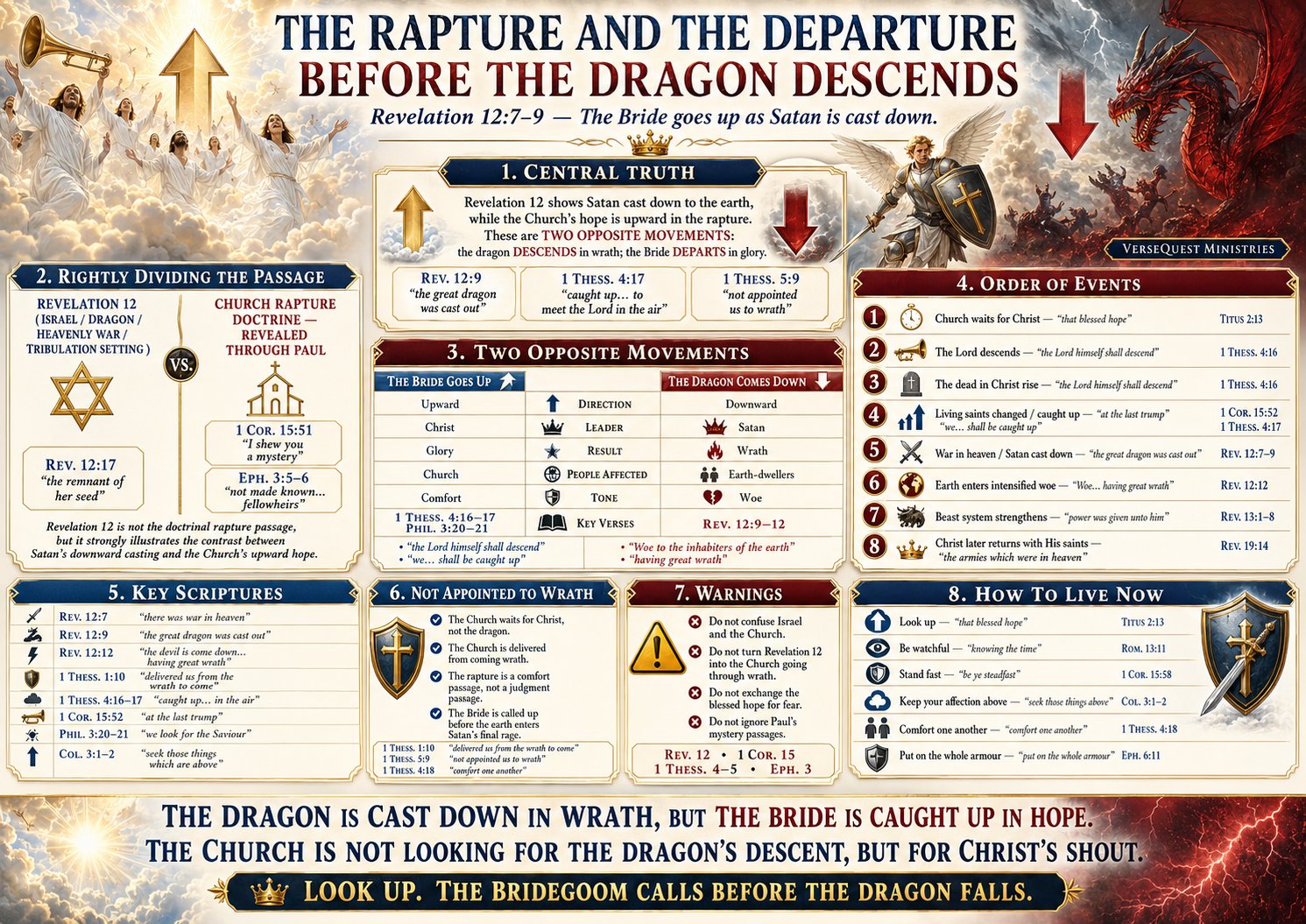
- The Rapture and the Departure Before the Dragon Descends – Printable Bible Study Chart
- Printable KJV Bible study chart on The Rapture and the Departure Before the Dragon Descends, showing the Bride caught up before Satan is cast down in wrath. This premium VerseQuest…
- $4.99
- Add to cart
-
-
Revelation
-
-71%
- Moses and Elijah: The Two Witnesses Made Plain
- Moses and Elijah: The Two Witnesses Made Plain is a 636-page premium VerseQuest PDF study proving from Scripture that the Two Witnesses of Revelation 11 are Moses and Elijah. This…
- Original price was: $34.99.$9.99Current price is: $9.99.
- Add to cart
-
-71%
-
Prophecy Studies
-

- The Resurrection of Jesus Christ Made Plain – 501-Page KJV Bible Study
- A massive 501-page VerseQuest Ministries PDF Bible study defending and explaining the bodily resurrection of Jesus Christ from a KJV, rightly divided perspective. This 80-essay study covers the empty tomb,…
- $34.99
- Add to cart
-
-
Doctrine Series
-
- The Lost Tribes Myth Exposed (213-Page Premium Study)
- A 213-page premium KJV study exposing the Lost Tribes myth, tribal identity errors, prophecy abuse, race theories, and false Israel claims through 35 detailed essays.
- $24.99
- Add to cart
-