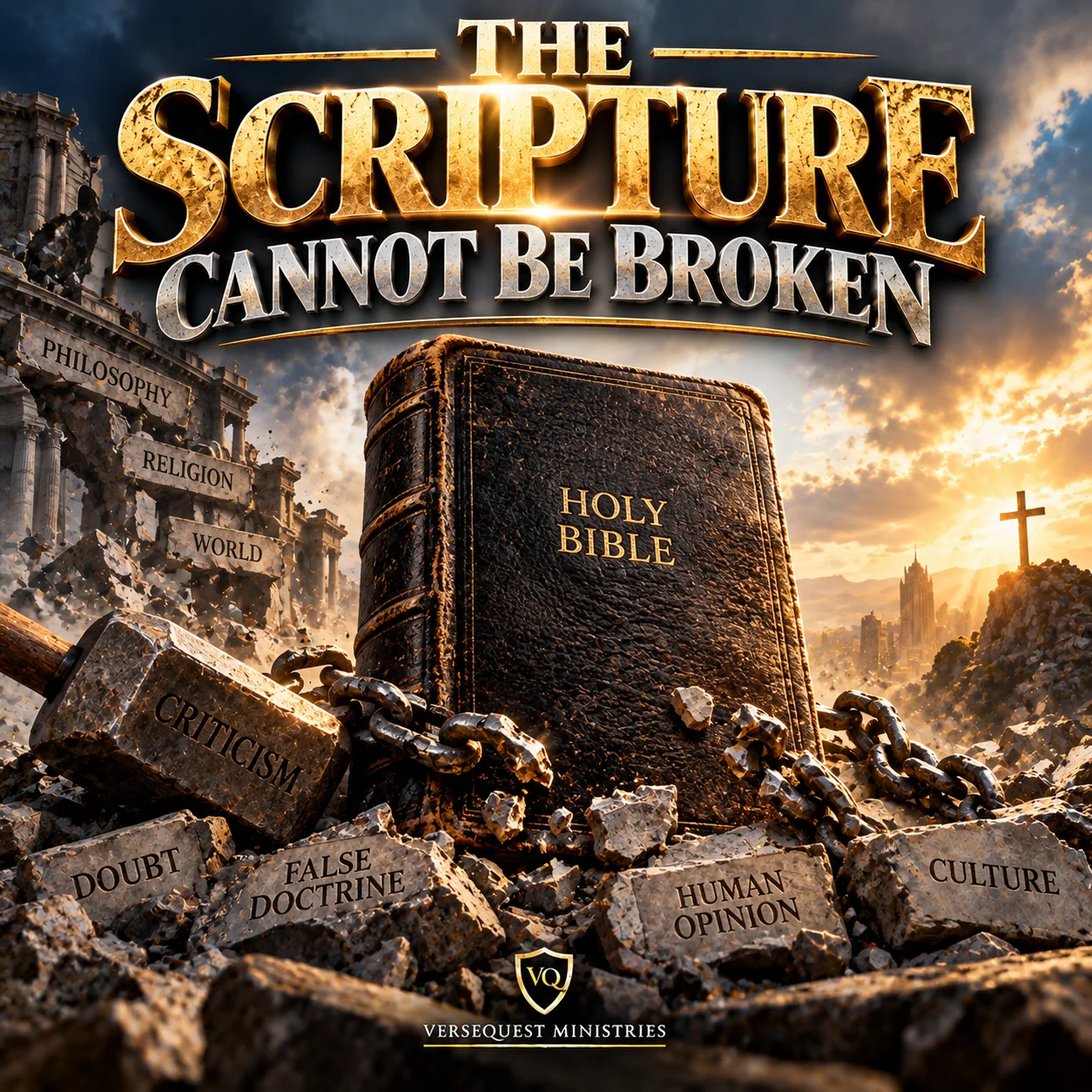
Sermon Title:
The Scripture Cannot Be Broken
Key Passage:
John 10:35
“If he called them gods, unto whom the word of God came, and the scripture cannot be broken;” (John 10:35)
Series:
The Book God Gave
Topic:
The Unbreakable Authority, Accuracy, and Permanence of Scripture
Book:
John
Speaker:
Paul Tackett
Suggested Sermon Text:
John 10:30–36; Psalm 82:1–8; Psalm 12:6–7; Psalm 119:89, 140, 152, 160; Proverbs 30:5–6; Isaiah 40:8; Matthew 4:4; Matthew 5:17–18; Matthew 24:35; Luke 16:17; 2 Timothy 2:15; 2 Timothy 3:15–17; 1 Peter 1:23–25
Short Sermon Description:
John 10:35 contains one of Jesus Christ’s strongest declarations concerning the absolute authority of the written word of God: “the scripture cannot be broken.” In its immediate context, Christ appeals to the precise wording of Psalm 82 while answering accusations from His opponents, demonstrating His complete confidence in Scripture down to the argument carried by a single biblical expression. This sermon examines what it means for Scripture to be unbreakable, why God’s words cannot be annulled by human disagreement, how Christ Himself treated the written word as final authority, and why inspiration, preservation, right division, and obedience belong together. It also exposes the inconsistency of claiming to honor Jesus while correcting the Book Jesus trusted. The VerseQuest master standard calls for a KJV-only, rightly divided, dispensational, detailed, sermon-ready treatment useful for pastors, teachers, Bible students, and believers. Sermon Outline Prompt – VerseQu…
THE SCRIPTURE CANNOT BE BROKEN
Introduction
There are few statements in the Bible more absolute than the words of Jesus Christ in John 10:35: “the scripture cannot be broken.” Christ does not say Scripture is generally dependable, spiritually valuable, historically impressive, or mostly accurate. He says it cannot be broken. Men may reject it, criticize it, burn it, mistranslate it, twist it, mock it, neglect it, and disobey it, but none of those actions break the authority of what God said. The Book does not become less true because the reader becomes more rebellious.
The immediate context makes the statement even stronger. Jesus has declared, “I and my Father are one” (John 10:30). His opponents understand the force of His words and take up stones, accusing Him of blasphemy because, as they put it, “thou, being a man, makest thyself God” (John 10:33). Christ answers them by quoting Psalm 82:6: “I said, Ye are gods.” His argument turns upon what Scripture actually calls certain men in that passage. Then He adds the parenthetical declaration that settles the authority behind His argument: “the scripture cannot be broken.” Christ was willing to rest a doctrinal argument on the exact wording of written Scripture.
That should settle the Christian’s attitude toward the Bible. The Lord Jesus Christ never approached Scripture as though it were an unreliable religious record requiring correction from enlightened scholars. He quoted it against Satan. He appealed to it in controversy. He referred to its history as factual. He treated its words as authoritative. He said not one jot or tittle would fail. He said His own words would outlast heaven and earth. If the Christian claims to follow Christ while treating the Scriptures Christ trusted as defective, somebody’s position is inconsistent—and it is not Christ’s.
I. JESUS CHRIST TREATED THE WRITTEN SCRIPTURE AS FINAL AUTHORITY
Key Text: John 10:34–35
Supporting Texts: Matthew 4:4, 7, 10; Matthew 19:4–5; Matthew 22:31–32; Luke 24:27
When challenged by His enemies, Jesus says, “Is it not written in your law” (John 10:34). His appeal is to what stands written. This was Christ’s consistent pattern. In the wilderness He answered Satan three times with “It is written.” When questioned about marriage, He appealed to Genesis. When arguing resurrection with the Sadducees, He appealed to the tense of God’s words to Moses. After His resurrection, He expounded the things concerning Himself “in all the scriptures” (Luke 24:27).
Christ did not appeal to evolving religious opinion. He did not say, “The rabbis currently believe.” He did not ask which interpretation was culturally acceptable. He went to the Book. The written Scripture functioned as the final court of appeal because its authority came from God.
A Christian who follows Christ should therefore have the same instinct. When doctrine is disputed, ask, “What saith the scripture?” When culture objects, ask what God wrote. When tradition collides with Scripture, tradition must move. When personal experience appears to contradict the Book, the experience must be reexamined. Christ did not bring Scripture under man’s judgment; He brought man under Scripture’s judgment.
Main Truth: Jesus Christ consistently treated the written Scripture as the final and unquestionable authority in matters of truth and doctrine.
II. THE SCRIPTURE CANNOT BE BROKEN BECAUSE GOD CANNOT LIE
Key Text: John 10:35
Supporting Texts: Numbers 23:19; Titus 1:2; Hebrews 6:18; Psalm 119:160
The Bible is unbreakable because its ultimate Author is unbreakably truthful. Titus 1:2 speaks of “God, that cannot lie.” Hebrews 6:18 says “it was impossible for God to lie.” Scripture does not possess authority because paper is sacred or ink is miraculous. It possesses authority because the words came from the God whose nature makes falsehood impossible.
Human words break constantly. Promises are abandoned. Contracts are violated. Predictions fail. Scholars revise conclusions. Governments reverse policies. Textbooks are replaced. Human speech is unstable because human beings are limited, sinful, forgetful, and mortal. God is none of those things.
Psalm 119:160 says, “Thy word is true from the beginning: and every one of thy righteous judgments endureth for ever.” God does not need centuries to discover whether His original statement was accurate. His word begins true and remains true. Time cannot expose an error in omniscience.
Main Truth: Scripture cannot fail because the God who gave it cannot lie, forget, misunderstand, or speak falsely.
III. CHRIST’S ARGUMENT SHOWS THAT THE WORDS THEMSELVES MATTER
Key Text: John 10:34–35
Supporting Texts: Psalm 82:6; Matthew 4:4; Matthew 5:18; 1 Corinthians 2:13; Proverbs 30:5
Jesus bases His answer upon the wording of Psalm 82:6: “I have said, Ye are gods.” Whatever difficulties interpreters may raise concerning that Psalm, Christ’s argument assumes the wording is authoritative. He does not say the general thought cannot be broken. He says “the scripture cannot be broken.”
Matthew 4:4 reinforces the point: “Man shall not live by bread alone, but by every word that proceedeth out of the mouth of God.” First Corinthians 2:13 speaks of “words…which the Holy Ghost teacheth.” Proverbs 30:5 says, “Every word of God is pure.” Biblical revelation repeatedly moves from broad truth down to actual words.
This is why careless attitudes toward wording eventually produce careless doctrine. Change enough words and meaning changes. Remove distinctions and doctrine blurs. Rewrite expressions according to current preference and the reader begins becoming master of the text. Christ’s reverence for Scripture reaches the words because truth is communicated through words.
Main Truth: The unbreakable authority of Scripture extends to its words, because God chose words as the vehicle of divine revelation.
IV. WHAT CANNOT BE BROKEN CANNOT BE OVERTURNED BY HUMAN OPINION
Key Text: John 10:35
Supporting Texts: Romans 3:4; Psalm 2:1–4; Isaiah 40:8; Matthew 24:35
The religious leaders in John 10 strongly disagreed with Jesus. They disagreed enough to pick up stones. Their emotional intensity did not break the Scripture He quoted. Human opposition changes nothing about divine truth.
Romans 3:4 states the principle: “Let God be true, but every man a liar.” Imagine every professor, court, government, denomination, religious institution, media organization, and cultural authority agreeing against one plain verse. The vote would be impressive numerically and worthless doctrinally. Truth is not established by majority rule.
Jesus says, “Heaven and earth shall pass away, but my words shall not pass away” (Matthew 24:35). Human opinion is more temporary than the earth beneath our feet. Culture changes while Scripture remains. The foolishness comes when Christians rewrite the permanent Book in order to keep pace with temporary men.
Main Truth: No amount of human disagreement, popularity, scholarship, or cultural pressure can overturn what God has established in Scripture.
V. THE UNBREAKABLE SCRIPTURE MUST ALSO BE PRESERVED
Key Text: Psalm 12:6–7
Supporting Texts: Psalm 119:89, 152; Isaiah 40:8; Matthew 24:35; 1 Peter 1:23–25
If Scripture cannot be broken, the doctrine naturally raises another question: has God preserved what He gave? Psalm 12 answers with confidence: “The words of the LORD are pure words,” followed by, “Thou shalt keep them, O LORD, thou shalt preserve them from this generation for ever.”
Preservation does not mean every manuscript copy, printer, scribe, publisher, or translator in history was individually infallible. It means God did not allow His words to vanish from the earth. The God who commanded men to read, preach, believe, obey, study, and live by His words was capable of ensuring that those words remained available.
Peter speaks of “the word of God, which liveth and abideth for ever” and then says, “this is the word which by the gospel is preached unto you” (1 Peter 1:23, 25). The enduring word was not merely theoretical. It was available for preaching. For the English-speaking Bible believer, confidence in preservation means approaching the King James Bible as the authoritative word of God rather than as a religious artifact perpetually awaiting reconstruction.
Main Truth: The God who gave unbreakable Scripture also preserves His words so succeeding generations can possess, preach, and obey them.
VI. RIGHTLY DIVIDING SCRIPTURE DOES NOT BREAK SCRIPTURE
Key Text: 2 Timothy 2:15
Supporting Texts: 1 Corinthians 10:32; Ephesians 2:11–16; Romans 11:25–29; 2 Timothy 3:16
Some people imagine that rightly dividing Scripture somehow diminishes biblical authority. The opposite is true. Paul commands the workman to be “rightly dividing the word of truth.” The whole Book is true, but the whole Book is not addressed doctrinally to the same people under the same administration.
The Bible distinguishes Jew, Gentile, and Church. It distinguishes law and grace, prophecy and mystery, Israel and the body of Christ, earthly promises and heavenly calling. Noah was commanded to build an ark. Israel was commanded to observe ordinances under Moses. The apostles preached kingdom truth in Israel. Paul received revelation concerning the mystery and the body of Christ. Every word belongs in the Book; not every command is directed to the Church.
Wrong division can make true Scripture appear contradictory. Right division allows every passage to stand exactly where God placed it. The solution to apparent contradiction is not breaking verses, correcting God, or discarding Scripture. It is studying carefully enough to discover the distinctions the Author built into His Book.
Main Truth: Right division protects the authority of every passage by allowing Scripture to mean what God intended in its proper doctrinal setting.
VII. AN UNBREAKABLE BIBLE MUST BREAK OUR PRIDE, TRADITIONS, AND DISOBEDIENCE
Key Text: Hebrews 4:12
Supporting Texts: James 1:22–25; Jeremiah 23:29; Psalm 119:105; 2 Timothy 3:16–17
If Scripture cannot be broken, then when there is a collision between the Bible and the believer, the believer is the thing that must break. Hebrews says, “the word of God is quick, and powerful, and sharper than any twoedged sword.” Jeremiah compares God’s word to a hammer “that breaketh the rock in pieces” (Jeremiah 23:29).
That is where the doctrine becomes practical. It is easy to proclaim biblical authority when the Bible agrees with us. The test comes when Scripture attacks a cherished tradition, exposes a private sin, overturns a theological assumption, rebukes our conduct, or tells us something we do not want to hear.
James warns against hearing without doing. If Scripture is final authority, then authority must produce submission. We do not honor an unbreakable Bible by defending it publicly and ignoring it privately. The same Book we refuse to let critics break must be allowed to break our stubbornness.
Main Truth: Because Scripture cannot be broken, believers must allow Scripture to break whatever in their thinking or conduct stands against God.
Conclusion
“The scripture cannot be broken.” Five words settle more than shelves of modern uncertainty. Scripture cannot be annulled. It cannot be overturned. It cannot be defeated by criticism, rewritten by culture, neutralized by opposition, or invalidated by disbelief. Christ Himself placed that testimony inside His argument.
The same Jesus who said Scripture cannot be broken also said man lives by every word, that not one jot or tittle would pass, and that His words would outlast heaven and earth. His doctrine of Scripture was not loose, embarrassed, or apologetic. If Christ trusted the Book that completely, the believer claiming His name has no reason to approach it with less confidence.
Take the King James Bible and let it stand. Study it. Rightly divide it. Compare Scripture with Scripture. Believe its history, doctrine, promises, warnings, prophecy, and gospel. Stop treating God’s Book like a defendant in man’s courtroom. Scripture cannot be broken—but it can break false doctrine, human pride, religious tradition, satanic deception, sinful excuses, and every argument raised against the knowledge of God.
Final Call
If you are lost, the unbreakable Scripture gives you an unchanging gospel. “Christ died for our sins according to the scriptures; And that he was buried, and that he rose again the third day according to the scriptures” (1 Corinthians 15:3–4). Your works cannot replace His work. Religion cannot replace His blood. Baptism cannot replace faith in Christ. Believe on the Lord Jesus Christ and be saved.
If you are saved, quit treating biblical certainty like an embarrassment. Open the Book. Believe the Book. Rightly divide the Book. Preach the Book. Obey the Book. When your opinion and Scripture collide, do not try to break the verse. Let the verse break your opinion.
Closing Verse:
“Heaven and earth shall pass away, but my words shall not pass away.” (Matthew 24:35)
Closing Statement:
Men have spent centuries trying to break the Bible, but the only things that keep breaking are the arguments raised against it.