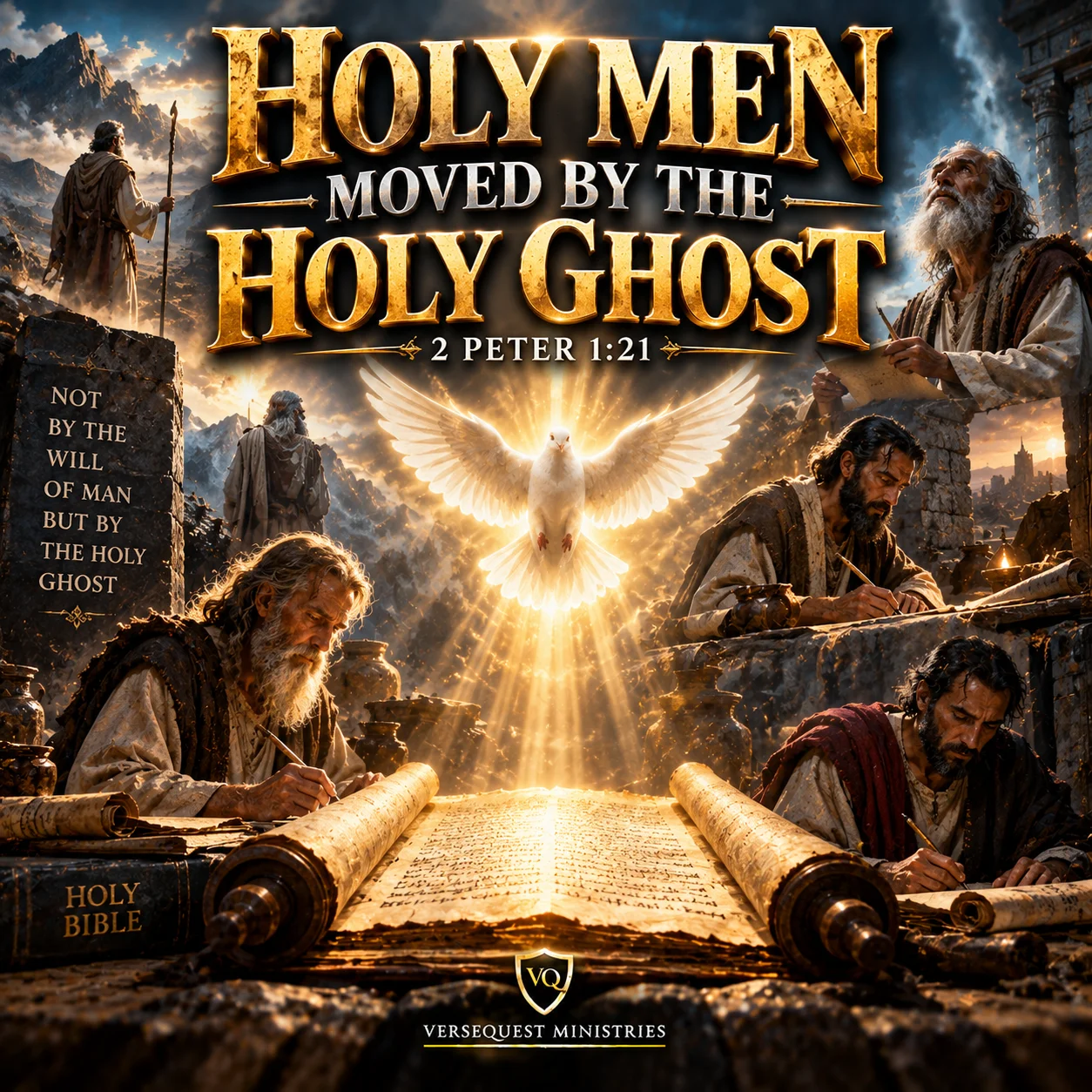
Sermon Title:
Holy Men Moved by the Holy Ghost
Key Passage:
2 Peter 1:21
“For the prophecy came not in old time by the will of man: but holy men of God spake as they were moved by the Holy Ghost.” (2 Peter 1:21)
Series:
The Book God Gave
Topic:
The Holy Ghost, Divine Inspiration, and the Human Writers of Scripture
Book:
2 Peter
Speaker:
Paul Tackett
Suggested Sermon Text:
2 Peter 1:16–21; 2 Timothy 3:15–17; 1 Corinthians 2:9–13; 2 Samuel 23:1–2; Jeremiah 1:4–9; Ezekiel 2:1–3:4; Matthew 4:4; John 10:35; Acts 1:16; Acts 28:25; Hebrews 1:1–2; Psalm 12:6–7; Psalm 119:89, 160; 1 Peter 1:23–25
Short Sermon Description:
Second Peter 1:21 explains the supernatural origin of Scripture by declaring that prophecy “came not in old time by the will of man,” but that “holy men of God spake as they were moved by the Holy Ghost.” This sermon examines the relationship between the divine Author and the human writers of Scripture, showing that the Bible did not originate in human imagination, religious genius, philosophical reflection, or private interpretation. It explains what it means for men to be “moved” by the Holy Ghost, why their personalities and historical settings did not make Scripture merely human, how verbal inspiration reaches the words themselves, and why the inspired Scriptures carry divine authority. The message also distinguishes inspiration from illumination, explains why inspired writers were not personally infallible in everything they ever said or did, and connects inspiration with preservation and the believer’s responsibility to receive, study, rightly divide, preach, and obey the Book God gave. The governing VerseQuest standard calls for a KJV-only, rightly divided, detailed, sermon-ready treatment. Sermon Outline Prompt – VerseQu…
HOLY MEN MOVED BY THE HOLY GHOST
Introduction
The Bible is either a book from God or it is merely another book about God. There is an enormous difference between those two statements. If Scripture is simply the religious reflections of sincere men, then every generation is free to revise it, correct it, modernize it, and place its own wisdom above it. But if the words came from God through men moved by the Holy Ghost, then the reader is no longer sitting over the Book as judge. The Book sits over the reader. Second Peter 1:21 settles the source: “the prophecy came not in old time by the will of man.” Scripture did not begin because Moses, David, Isaiah, Jeremiah, Peter, John, or Paul woke up one morning and decided humanity needed a religious library.
Peter is writing in a context where he has just contrasted apostolic eyewitness with something even “more sure.” He had personally stood on the mount of transfiguration. He had seen Christ’s majesty. He had heard the voice from heaven. Yet in 2 Peter 1:19 he says, “We have also a more sure word of prophecy.” That is remarkable. Peter does not teach believers to chase spiritual experiences because he once had a spectacular one. He points them to the written word. Experiences can be remembered imperfectly, interpreted badly, exaggerated, counterfeited, or forgotten. The word God gave stands.
Then Peter explains why that prophetic word is sure. “Knowing this first, that no prophecy of the scripture is of any private interpretation” (2 Peter 1:20). Verse 21 explains the reason: prophecy did not originate in man’s will; men spoke as they were moved by the Holy Ghost. The authority of Scripture therefore rests not in the brilliance of the human writer but in the divine Spirit who carried him along. God used men without surrendering authorship. The men wrote; the Holy Ghost moved. Human hands held the pen, but heaven supplied the message.
I. SCRIPTURE DID NOT ORIGINATE IN THE WILL OF MAN
Key Text: 2 Peter 1:21
Supporting Texts: Jeremiah 1:4–9; Ezekiel 2:1–3:4; Galatians 1:11–12; 1 Corinthians 2:9–13
Peter begins negatively: “For the prophecy came not in old time by the will of man.” That statement destroys the idea that Scripture arose merely from human religious impulse. Biblical prophets did not create revelation because they were spiritually creative. They did not decide the doctrines, manufacture the prophecies, or invent the messages according to personal preference.
Jeremiah provides a clear example. God told him, “Before I formed thee in the belly I knew thee,” and then commissioned him to speak (Jeremiah 1:5). Jeremiah objected that he was a child, but the LORD answered, “whatsoever I command thee thou shalt speak” (Jeremiah 1:7). Then Scripture says, “the LORD put forth his hand, and touched my mouth. And the LORD said unto me, Behold, I have put my words in thy mouth” (Jeremiah 1:9). The message originated with God.
Paul makes the same distinction concerning his gospel and apostolic revelation. “The gospel which was preached of me is not after man. For I neither received it of man, neither was I taught it, but by the revelation of Jesus Christ” (Galatians 1:11–12). Divine revelation comes downward. Man does not climb upward through intellect and discover what God forgot to reveal.
Main Truth: Scripture originated in God’s will and revelation, not in the imagination, philosophy, or religious creativity of men.
II. GOD USED REAL MEN WITHOUT MAKING THE BIBLE MERELY HUMAN
Key Text: 2 Peter 1:21
Supporting Texts: 2 Samuel 23:1–2; Amos 7:14–15; Luke 1:1–4; Romans 16:22
Peter says “holy men of God spake.” God did not drop a completed leather-bound Bible from heaven. He chose human instruments. Moses had one background, David another, Amos another, Luke another, Paul another. Kings, shepherds, prophets, fishermen, physicians, and apostles appear among the biblical writers. Their vocabulary, historical setting, personality, education, experience, and circumstances are visible in what they wrote.
Yet human involvement does not make the final product merely human. David could say, “The Spirit of the LORD spake by me, and his word was in my tongue” (2 Samuel 23:2). That verse contains both elements. David’s tongue was involved, but the Spirit spoke. God did not erase David’s humanity; He governed the process so that what was written communicated exactly what He intended.
This guards us against two errors. One error treats the Bible as though the writers were mindless mechanical machines with no personality. The other treats Scripture as merely inspired religious literature where God supplied broad ideas and fallible men supplied defective language. The biblical position is stronger: God used real men in real history while ensuring that the Scriptures they gave were His words.
Main Truth: God used the personalities and circumstances of human writers without surrendering His authorship or allowing human weakness to corrupt the inspired Scripture.
III. THE HOLY GHOST “MOVED” THE HUMAN WRITERS
Key Text: 2 Peter 1:21
Supporting Texts: Acts 27:15, 17; Acts 1:16; Acts 28:25; 2 Samuel 23:2
Peter says the writers “were moved by the Holy Ghost.” The wording pictures men being carried or borne along under the controlling direction of the Spirit. The human authors were not the originating force. The Holy Ghost was.
A useful biblical picture appears in Acts 27. When the ship was caught by the wind and could not bear up into it, Luke writes, “we let her drive” (Acts 27:15). The ship remained a real ship with real sailors aboard it, but a power greater than those sailors carried it along. In inspiration, the writers were not unconscious objects, yet the controlling source behind the revelation was the Holy Ghost.
The New Testament repeatedly attributes Old Testament speech directly to the Spirit. Peter said, “this scripture must needs have been fulfilled, which the Holy Ghost by the mouth of David spake” (Acts 1:16). Paul told the Jews in Rome, “Well spake the Holy Ghost by Esaias the prophet unto our fathers” (Acts 28:25). David spoke. Isaiah spoke. Yet Scripture says the Holy Ghost spoke through them.
Main Truth: Inspiration means the Holy Ghost superintended the human writers so that the message they gave was truly the word of God.
IV. THE HOLY GHOST GAVE WORDS, NOT MERELY RELIGIOUS CONCEPTS
Key Text: 1 Corinthians 2:13
Supporting Texts: Matthew 4:4; Proverbs 30:5; Psalm 12:6; Jeremiah 1:9; 2 Timothy 3:16
Paul says, “Which things also we speak, not in the words which man’s wisdom teacheth, but which the Holy Ghost teacheth” (1 Corinthians 2:13). Notice the emphasis: words. God did not merely inspire general concepts and then leave fallible men to express them however they wished.
Jesus said, “Man shall not live by bread alone, but by every word that proceedeth out of the mouth of God” (Matthew 4:4). Proverbs says, “Every word of God is pure” (Proverbs 30:5). Psalm 12 says, “The words of the LORD are pure words” (Psalm 12:6). Jeremiah was told that God had put His words in the prophet’s mouth. The biblical doctrine of inspiration continually reaches down to actual words.
This is why wording matters in Bible doctrine. Singulars matter. Plurals matter. Names matter. Tenses matter. Distinctions matter. Christ Himself could build an argument upon the wording of Psalm 82 and then declare, “the scripture cannot be broken” (John 10:35). A Christianity that says it believes divine ideas while treating biblical words casually does not follow the Bible’s own doctrine of revelation.
Main Truth: The Holy Ghost inspired Scripture verbally, communicating divine truth through the very words God intended His people to receive.
V. INSPIRATION BELONGS TO SCRIPTURE, NOT TO EVERYTHING A BIBLE WRITER EVER DID
Key Text: 2 Timothy 3:16
Supporting Texts: Galatians 2:11–14; 2 Samuel 11:1–17; Psalm 51:1–4; Romans 7:18
Second Timothy 3:16 says, “All scripture is given by inspiration of God.” Inspiration is attached to Scripture. This is important because the phrase “holy men” in 2 Peter 1:21 does not mean every biblical writer was personally sinless, omniscient, or incapable of error in ordinary life.
David wrote inspired Scripture, yet David sinned grievously concerning Bathsheba and Uriah. Peter wrote inspired Scripture, yet Paul records rebuking Peter publicly at Antioch because “he was to be blamed” (Galatians 2:11). The supernatural perfection belonged to what God gave through them as Scripture, not to every private decision those men ever made.
That fact actually strengthens the doctrine of inspiration. The Bible does not depend upon the natural infallibility of its writers. Its reliability rests upon God. A fallible Peter could be moved by an infallible Holy Ghost to write infallible Scripture. A sinful David could write words that remain eternally true because the source behind those words was greater than David.
Main Truth: Biblical inspiration guarantees the truth of Scripture without requiring the human writers to have been personally sinless or infallible in every area of life.
VI. INSPIRATION MUST BE DISTINGUISHED FROM ILLUMINATION
Key Text: 2 Timothy 3:16–17
Supporting Texts: 1 Corinthians 2:12–14; Ephesians 1:17–18; Psalm 119:18; John 16:13–15
The prophets and apostles were moved by the Holy Ghost to give revelation. Believers today are helped by the Holy Ghost to understand the revelation already given. Those ministries are related, but they are not identical.
Illumination means the Spirit opens the believer’s understanding to truth already written. A Christian may read a familiar passage and suddenly see a connection he had previously missed. That does not mean a new verse appeared in the Bible. The revelation was already present; the believer’s understanding increased.
Confusing inspiration with illumination produces dangerous claims. A man studies Scripture, forms an interpretation, and then says, “God gave me this revelation,” as though his explanation carries the same authority as the biblical text. It does not. Every teacher’s interpretation must remain testable by Scripture. The Book judges the teacher; the teacher does not become another inspired writer.
Main Truth: The Holy Ghost inspired the biblical writers to give Scripture and illuminates believers today to understand Scripture, but illumination never creates new inspired revelation.
VII. THE GOD WHO INSPIRED HIS WORDS IS ABLE TO PRESERVE THEM
Key Text: Psalm 12:6–7
Supporting Texts: Psalm 119:89, 152, 160; Isaiah 40:8; Matthew 24:35; 1 Peter 1:23–25
If the Holy Ghost moved men to give God’s words, it would be strange to imagine that God then allowed those words to disappear beyond recovery. Psalm 12 connects the purity of God’s words with His keeping power: “The words of the LORD are pure words,” followed by, “Thou shalt keep them, O LORD, thou shalt preserve them from this generation for ever.”
Jesus said, “Heaven and earth shall pass away, but my words shall not pass away” (Matthew 24:35). Peter speaks of “the word of God, which liveth and abideth for ever” (1 Peter 1:23). Inspiration explains how the words came from God. Preservation explains why God’s people are not left without those words generations later.
For the English-speaking Bible believer, this doctrine produces confidence in the King James Bible rather than perpetual uncertainty about whether God’s words remain available. The same God powerful enough to move Moses, David, Isaiah, Peter, John, and Paul was powerful enough to preserve the words He intended His people to possess.
Main Truth: Divine inspiration and divine preservation belong together: the God who gave His words is faithful and powerful enough to keep them.
Conclusion
Second Peter 1:21 gives us the Bible’s answer to the question of origin: “holy men of God spake as they were moved by the Holy Ghost.” The men were real. Their personalities were real. Their historical settings were real. Their pens were real. But the source behind the revelation was supernatural. Scripture did not rise from earth toward heaven; it came from heaven through men to earth.
That doctrine explains why the Bible speaks with an authority unlike every other book. Philosophers give opinions. Historians record events. Scientists report observations. Preachers explain doctrine. But Scripture says, “Thus saith the LORD.” Its authority does not rest upon the genius of Moses, the poetry of David, the eloquence of Isaiah, the education of Paul, or the eyewitness testimony of Peter alone. Behind the men stood the Holy Ghost.
So take the King James Bible seriously. Read it as more than religious literature. Study it as the words God gave. Rightly divide it. Compare Scripture with Scripture. Believe its doctrine. Trust its promises. Tremble at its warnings. Preach its gospel. Do not treat the Book as though it were man reaching after God. It is God speaking through men so that later generations can know exactly what He wanted said.
Final Call
If you are lost, the same Holy Ghost who moved men to record Scripture has preserved the gospel you need to hear. “Christ died for our sins according to the scriptures; And that he was buried, and that he rose again the third day according to the scriptures” (1 Corinthians 15:3–4). Salvation does not come through your works, church membership, baptism, morality, tradition, or spiritual experience. Believe on the Lord Jesus Christ and trust His finished work.
If you are saved, treat the Book according to its source. Stop approaching Scripture as though its words were merely suggestions from religious men. The Holy Ghost moved those men. The Holy Ghost taught the words. The Holy Ghost gave Scripture for doctrine, reproof, correction, and instruction in righteousness. Study it, believe it, rightly divide it, defend it, preach it, and obey it.
Closing Verse:
“All scripture is given by inspiration of God, and is profitable for doctrine, for reproof, for correction, for instruction in righteousness.” (2 Timothy 3:16)
Closing Statement:
Men held the pens, but the Holy Ghost moved the writers—and that is why the words they gave carry the authority of God.