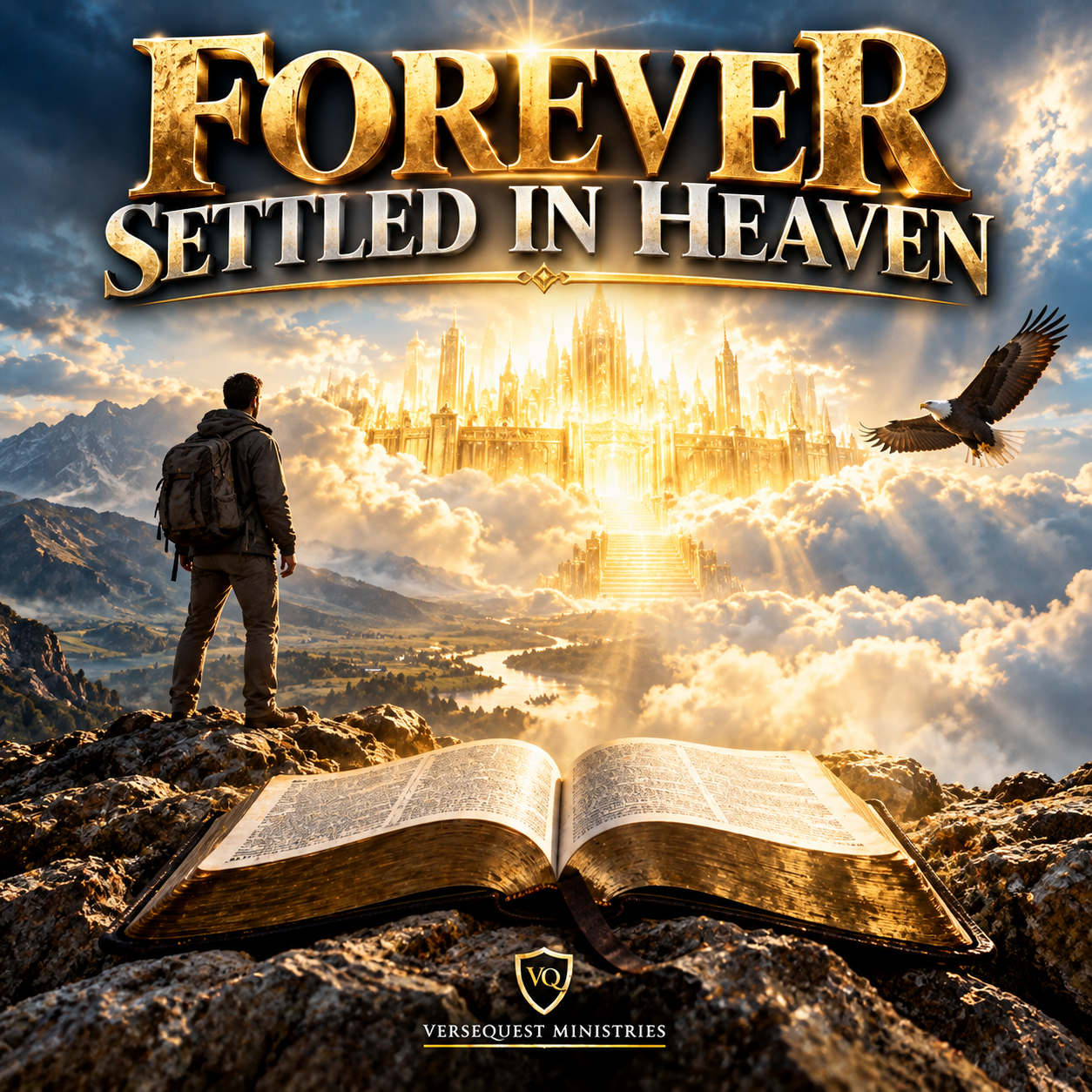
Sermon Title:
Forever Settled in Heaven
Key Passage:
Psalm 119:89
“For ever, O LORD, thy word is settled in heaven.” (Psalm 119:89)
Series:
The Book God Gave
Topic:
The Eternal Authority, Stability, and Preservation of the Word of God
Book:
Psalms
Speaker:
Paul Tackett
Suggested Sermon Text:
Psalm 119:89–96, 152, 160; Psalm 12:6–7; Psalm 33:11; Proverbs 30:5–6; Isaiah 40:8; Matthew 5:17–18; Matthew 24:35; John 10:35; John 17:17; 2 Timothy 2:15; 2 Timothy 3:15–17; 1 Peter 1:23–25
Short Sermon Description:
Psalm 119:89 gives one of Scripture’s strongest declarations concerning the permanence and authority of God’s word: “For ever, O LORD, thy word is settled in heaven.” This sermon examines what it means for the word of God to be settled—not provisional, negotiable, evolving, or dependent upon human approval, but fixed forever by the God who spoke it. The message contrasts the permanence of Scripture with changing cultures, religious traditions, scholarly opinions, personal feelings, and human philosophies; connects the heavenly stability of God’s word with His promises of preservation; shows why rightly dividing Scripture honors rather than weakens biblical authority; and calls believers to stop treating God’s Book as though it were awaiting correction from the age. Preachers, teachers, and Bible students will gain a sermon-ready treatment of biblical authority, preservation, doctrinal certainty, and practical submission to the written word of God. The supplied VerseQuest standard calls for a KJV-only, rightly divided, detailed, sermon-ready format. Sermon Outline Prompt – VerseQu…
FOREVER SETTLED IN HEAVEN
Introduction
The modern world loves unsettled things. Morality is unsettled. Truth is unsettled. Definitions are unsettled. History is rewritten, standards are revised, convictions are negotiated, and yesterday’s certainty becomes today’s embarrassment. Men speak as though truth were wet cement waiting for every generation to leave its fingerprints in it. Psalm 119:89 walks into that confusion with one sentence that does not ask permission from the twenty-first century: “For ever, O LORD, thy word is settled in heaven.” God did not say His word was being reviewed, reconstructed, updated, reconsidered, or submitted to committee. It is settled.
That single word settled is a problem for every philosophy that requires God’s revelation to remain flexible enough to bow before changing human opinion. Settled means fixed. Established. Standing. Determined. The word of God does not wake up every morning wondering whether modern culture still approves of it. Heaven is not issuing revised doctrinal statements because earth has changed its preferences. What God called sin remains sin. What God called righteousness remains righteousness. What God revealed concerning Christ remains true. What God said about salvation remains true. What God promised remains true. The earth may move; the Book does not.
And notice where it is settled: “in heaven.” Its final authority was never established by a denomination, university, council, seminary, scholar, government, publisher, preacher, or church tradition. Men can recognize the authority of Scripture, submit to it, preach it, preserve copies of it, translate it, study it, or rebel against it—but they do not manufacture its authority. Heaven settled the question before earth began arguing about it. The Christian therefore does not approach Scripture as a critic waiting to decide whether God has spoken acceptably. He approaches it as a servant opening the words of a King whose decree already stands.
I. GOD’S WORD IS SETTLED BECAUSE THE GOD WHO SPOKE IT DOES NOT CHANGE
Key Text: Psalm 119:89
Supporting Texts: Malachi 3:6; Numbers 23:19; Hebrews 13:8; Titus 1:2
“For ever, O LORD, thy word is settled in heaven.” The stability of the word rests first upon the stability of its Author. Men change because men learn, forget, misunderstand, repent of bad decisions, discover new information, grow old, and die. God does none of those things. “For I am the LORD, I change not” (Malachi 3:6). He does not issue corrections because He discovered facts unavailable when He first spoke.
Numbers 23:19 says, “God is not a man, that he should lie; neither the son of man, that he should repent.” His word therefore possesses a quality human speech can never possess independently: absolute reliability. A politician may reverse himself. A scholar may retract a paper. A scientist may revise a theory. A preacher may correct a sermon. God never has to say, “I spoke too soon.”
That truth should give enormous confidence to the believer. Your faith is not resting upon a divine experiment. God’s promises are not provisional. His gospel is not in beta testing. His prophecies are not educated guesses. The God who knows the end from the beginning spoke words consistent with His own perfect nature.
Main Truth: The word of God is permanently settled because its Author is eternally truthful, omniscient, and unchanging.
II. THE WORD WAS SETTLED IN HEAVEN BEFORE MEN EVER VOTED ON IT
Key Text: Psalm 119:89
Supporting Texts: Psalm 33:11; Isaiah 46:9–10; John 17:17; Romans 3:4
The verse does not say the word became settled when men accepted it. It says it is settled “in heaven.” The authority came from above before the debates began below. “The counsel of the LORD standeth for ever, the thoughts of his heart to all generations” (Psalm 33:11).
This removes human institutions from the throne. No council made Scripture true. No denomination made Scripture authoritative. No professor made Scripture inspired. No archaeological discovery made Scripture reliable. Evidence may confirm truth, but confirmation does not create truth. If every university on earth voted against Genesis tomorrow morning, Genesis would not lose one ounce of divine authority by lunchtime.
Romans 3:4 states the principle plainly: “Let God be true, but every man a liar.” That is not intellectual laziness. It is recognition of authority. Human reasoning has value when it operates beneath revelation. The trouble begins when the creature drags the Creator into court and demands that God defend Himself before man’s changing standards.
Main Truth: Scripture possesses divine authority because heaven established it, not because human institutions approved it.
III. WHAT IS SETTLED FOREVER OUTLASTS EVERY TEMPORARY HUMAN STANDARD
Key Text: Isaiah 40:8
Supporting Texts: Psalm 119:89, 152; Matthew 24:35; 1 Peter 1:23–25
Isaiah says, “The grass withereth, the flower fadeth: but the word of our God shall stand for ever” (Isaiah 40:8). Peter repeats the truth centuries later: “the word of the Lord endureth for ever” (1 Peter 1:25). Generations come and go; God’s word stays where God put it.
Every age thinks itself permanent while it is passing away. Empires looked permanent until ruins replaced palaces. Philosophical systems dominated universities until another philosophy buried them. Cultural movements arrive loudly, demand submission, and eventually become footnotes. Scripture has watched them all come and go.
Jesus made the contrast even sharper: “Heaven and earth shall pass away, but my words shall not pass away” (Matthew 24:35). The material universe has an expiration date before Christ’s words do. When a Christian modifies Scripture to keep pace with culture, he is fastening eternal truth to something already dying.
Main Truth: Human philosophies and cultures pass away, but the settled word of God survives every generation unchanged in authority.
IV. A SETTLED WORD CANNOT BE BROKEN BY HUMAN DISAGREEMENT
Key Text: John 10:35
Supporting Texts: Matthew 5:18; John 17:17; Psalm 119:160; Proverbs 30:5
Jesus said, “the scripture cannot be broken” (John 10:35). That statement reveals Christ’s attitude toward Scripture. He did not treat the Bible as a collection of generally helpful religious thoughts containing occasional defects that enlightened men needed to repair. Scripture cannot be broken.
Matthew 5:18 goes down to the smallest written details: “one jot or one tittle shall in no wise pass from the law.” Christ’s confidence extends beyond vague themes. He treats God’s revelation as precise. Psalm 119:160 says, “Thy word is true from the beginning: and every one of thy righteous judgments endureth for ever.”
Men can disagree with Scripture, but disagreement does not fracture Scripture. They can mock it, ban it, burn it, rewrite it, misquote it, or ignore it. None of those actions touches its settled authority. A criminal’s hatred of the law does not repeal the statute. Man’s rebellion against God’s word does not revise heaven’s decree.
Main Truth: Scripture remains unbroken and authoritative regardless of how fiercely men oppose, reinterpret, or reject it.
V. THE SETTLED WORD IN HEAVEN IS PRESERVED FOR GOD’S PEOPLE ON EARTH
Key Text: Psalm 12:6–7
Supporting Texts: Psalm 119:89, 152, 160; Isaiah 40:8; Matthew 24:35; 1 Peter 1:25
Psalm 119:89 establishes the eternal stability of the word. Psalm 12 speaks of its preservation: “The words of the LORD are pure words… Thou shalt keep them, O LORD, thou shalt preserve them from this generation for ever” (Psalm 12:6–7). The God who settled His word did not lose it on the trip from heaven to earth.
Preservation matters because an authoritative Bible that nobody can possess is of little practical value. God repeatedly commands men to read, preach, study, obey, remember, teach, and live by His words. Those commands assume accessibility. Peter says the enduring word is “the word which by the gospel is preached unto you” (1 Peter 1:25). The preserved word was not locked in an unreachable vault. It was preached.
For the English-speaking Bible believer, this provides confidence rather than perpetual uncertainty. The King James Bible is not approached as a pile of religious suggestions awaiting reconstruction by each new generation of experts. It is received, read, studied, rightly divided, preached, and believed as the word of God.
Main Truth: The God who settled His word forever also preserves His words so His people can possess and obey them.
VI. RIGHT DIVISION HONORS THE SETTLED WORD INSTEAD OF ALTERING IT
Key Text: 2 Timothy 2:15
Supporting Texts: 1 Corinthians 10:32; Ephesians 2:11–16; Romans 11:25–29; 2 Timothy 3:16
If every word is settled, then every word must be handled correctly. Paul commands, “rightly dividing the word of truth” (2 Timothy 2:15). Notice the balance. It is all truth, yet it must be divided rightly.
Right division never means throwing verses away. It means recognizing distinctions God Himself placed in Scripture. Israel is not the Church. The Church is not Israel. Law is not grace. Prophecy is not mystery. The earthly kingdom promises given to Israel are not identical to the heavenly position of the body of Christ. Noah’s instructions, Israel’s ordinances, Christ’s earthly kingdom ministry, and Pauline revelation all belong in the inspired Bible, but they must be located correctly.
A Bible can be believed completely and still mishandled terribly. Satan quoted Scripture to Jesus in Matthew 4. The problem was not the verse; the problem was the use of the verse. Right division protects the settled Book from unsettled interpreters who turn inspired truth into doctrinal confusion.
Main Truth: Because every word is settled and true, every word deserves to be interpreted according to the distinctions and context God gave it.
VII. A SETTLED BIBLE DEMANDS AN UNSETTLED MAN CHANGE HIS MIND
Key Text: Psalm 119:89
Supporting Texts: Romans 12:2; James 1:22–25; Psalm 119:105; Hebrews 4:12
If the word is settled, the believer is the one who must move. Modern Christianity often reverses that order. Man forms an opinion, approaches Scripture, finds a verse that contradicts him, and begins looking for a way to adjust the verse. But a settled Bible is not the patient on the operating table. We are.
Hebrews 4:12 says the word of God is “quick, and powerful,” discerning “the thoughts and intents of the heart.” The Bible reads the reader. It exposes motives, traditions, excuses, pride, lust, unbelief, bitterness, and doctrinal error. That can be uncomfortable, but a Bible incapable of correcting us would be worthless as final authority.
James therefore warns against being “hearers only.” The settled word must become the governing word. When Scripture contradicts your feelings, the feelings move. When Scripture contradicts tradition, tradition moves. When Scripture contradicts your favorite preacher, the preacher moves. When Scripture contradicts you, you move. That is what authority means.
Main Truth: Because God’s word is settled forever, the believer must allow his opinions, conduct, doctrine, and traditions to be corrected by it.
Conclusion
“For ever, O LORD, thy word is settled in heaven.” Few verses say more with fewer words. For ever establishes duration. O LORD identifies the Author. Thy word identifies the subject. Settled establishes stability. In heaven identifies the court whose decision cannot be appealed. Nothing essential is missing.
That truth provides rest in an age of endless uncertainty. The Christian does not need to awaken every morning wondering whether God’s definition of truth changed overnight. The gospel remains settled. Christ’s deity remains settled. His bodily resurrection remains settled. Salvation by grace remains settled. Israel’s promises remain settled. The believer’s position in Christ remains settled. Sin remains what God called it. Righteousness remains what God called it. Heaven’s throne does not wobble because earth’s opinions do.
So take the King James Bible and treat it like a settled Book. Read it without apology. Study it carefully. Rightly divide it. Compare Scripture with Scripture. Believe its promises. Tremble at its warnings. Preach its gospel. Submit to its corrections. You do not need to improve what heaven settled. You need to understand it and obey it. The Book does not need to catch up with the century; the century needs to catch up with the Book.
Final Call
If you are lost, God has already settled the message you need to hear. Jesus Christ “died for our sins according to the scriptures; And that he was buried, and that he rose again the third day according to the scriptures” (1 Corinthians 15:3–4). You cannot revise the gospel into salvation by works, religion, baptism, church membership, morality, or human merit. Believe on the Lord Jesus Christ and receive the salvation God offers freely by grace.
If you are saved, stop treating settled truth as negotiable. Do not let culture rewrite your doctrine. Do not let feelings overrule verses. Do not let traditions silence Scripture. Do not let religious experts persuade you that certainty is arrogance when God spoke with certainty. Open the Book, believe what it says, rightly divide what it says, and stand where heaven already settled the matter.
Closing Verse:
“The grass withereth, the flower fadeth: but the word of our God shall stand for ever.” (Isaiah 40:8)
Closing Statement:
Earth can argue with the Book until earth passes away, but it will never move one word that heaven has already settled.