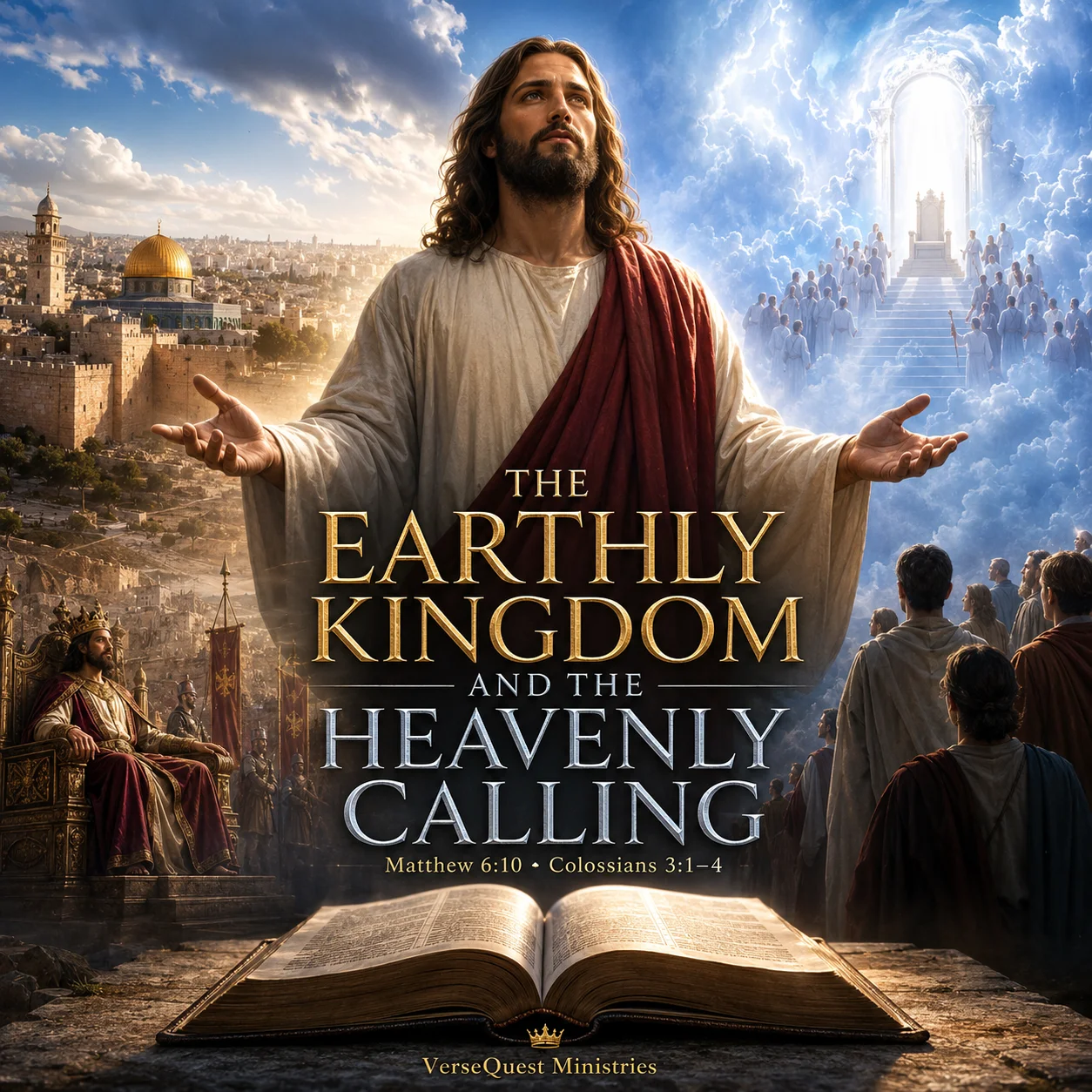
Sermon Title:
When Heaven Comes Down and the Church Goes Up: The Earthly Kingdom and the Heavenly Calling
Key Passage:
Matthew 6:10 — “Thy kingdom come. Thy will be done in earth, as it is in heaven.”
Colossians 3:1–4 — “If ye then be risen with Christ, seek those things which are above, where Christ sitteth on the right hand of God. Set your affection on things above, not on things on the earth. For ye are dead, and your life is hid with Christ in God. When Christ, who is our life, shall appear, then shall ye also appear with him in glory.”
Series:
Foundations of Right Division
Topic:
The Difference Between Israel’s Earthly Kingdom Hope and the Church’s Heavenly Calling
Book:
Matthew, Colossians, Genesis, Isaiah, Daniel, Zechariah, Romans, Ephesians, Philippians, 1 Thessalonians, Revelation
Speaker:
Paul Tackett
Suggested Sermon Text:
Matthew 6:9–13; Colossians 3:1–4; Genesis 12:1–3; 2 Samuel 7:12–16; Isaiah 2:1–4; Daniel 2:44; Luke 1:32–33; Acts 1:6–8; Romans 11:25–29; Ephesians 1:3; Ephesians 1:22–23; Ephesians 2:6; Philippians 3:20–21; 1 Thessalonians 4:13–18; Zechariah 14:4–9; Revelation 19:11–16; 2 Timothy 2:15
Short Sermon Description:
This sermon outline explains the biblical distinction between Israel’s earthly kingdom hope and the Church’s heavenly calling in Christ. Matthew 6:10 presents the kingdom prayer that God’s rule will come to earth and His will be done here as perfectly as it is in heaven. That kingdom is connected to Israel, David’s throne, Jerusalem, the promised land, the judgment of the nations, and the visible reign of Jesus Christ. Colossians 3:1–4, however, directs the Body of Christ to seek those things which are above, where Christ sits at God’s right hand. The Church is seated in heavenly places, blessed with spiritual blessings, and waiting for the Saviour from heaven. This study exposes the confusion caused when men turn the Church into Israel’s kingdom, replace Israel with the Church, or attempt to establish Christ’s kingdom through politics, culture, or religious power. It shows how the earthly kingdom and heavenly calling remain distinct while both are united beneath the glory of the Lord Jesus Christ.
When Heaven Comes Down and the Church Goes Up
The Earthly Kingdom and the Heavenly Calling
Introduction
Matthew 6:10 and Colossians 3:1–4 point in two different directions. In Matthew, the prayer is, “Thy kingdom come.” Heaven’s government is being requested to come down to earth. In Colossians, the command is, “seek those things which are above.” The believer’s affection is directed upward to Christ at the right hand of God. In one passage, the kingdom comes to earth. In the other, the Church’s life and calling are found in heaven. Both truths belong to God’s inspired word, but they must not be thrown into the same theological bucket until their differences disappear.
The average religious system has mixed the earthly kingdom with the heavenly Body so thoroughly that many Christians cannot tell whether they are supposed to be waiting for Christ or building His kingdom, looking for the Rapture or preparing for the Tribulation, seeking things above or conquering earthly governments. Some teach that the Church is the kingdom and must Christianize the world. Others claim the promises to Israel have been transferred to Gentile Christianity. Still others drag the Church under the Sermon on the Mount as though Christ’s kingdom constitution were identical to Paul’s doctrine for the Body of Christ. The result is a Christianity obsessed with earthly power while neglecting its heavenly position.
Right division does not set Christ against Christ. The Jesus who will sit upon David’s throne is the same Jesus who is now Head of the Body. The Lord who will reign from Jerusalem is the same Lord who will catch away His Church. The King of Israel is also the Saviour of sinners. The distinction lies not in two Christs, but in two aspects of God’s purpose: His prophetic program for the earth through Israel and His mystery program for heavenly places through the Church. When these are kept in order, Israel retains her kingdom, the Church retains her calling, and Jesus Christ receives all the glory in heaven and earth.
I. The Earthly Kingdom Is Something God Has Promised to Bring
Key Text: Matthew 6:10
Supporting Texts: Daniel 2:44; Isaiah 9:6–7; Matthew 4:17
The prayer “Thy kingdom come” assumes that the kingdom being requested had not yet arrived in its final visible form. John the Baptist preached, “Repent ye: for the kingdom of heaven is at hand.” Jesus Christ preached the same message. The King was present, the kingdom was near, and Israel was being called to receive her Messiah. The kingdom was not merely a feeling in the heart, a charitable institution, or a collection of religious people. It was the promised rule of God through His anointed King.
Daniel 2:44 says, “the God of heaven” shall set up a kingdom which shall never be destroyed. That kingdom will break in pieces and consume the kingdoms of this world. It is not established by gradual moral improvement, Christian voting blocs, denominational coalitions, or political compromise. God establishes it. Jesus Christ takes the kingdoms of this world by divine authority and judgment. The stone smites the image before filling the whole earth.
Isaiah 9 says the government shall be upon Christ’s shoulder and that He will sit upon David’s throne. This kingdom has a government, a King, a throne, a people, laws, judgments, and territory. “Thy kingdom come” is therefore a prayer for heaven’s righteous King to establish heaven’s authority upon the earth. The Church may long for Christ’s righteous reign, but it must not pretend that the kingdom has already arrived simply because churches exist.
Main Truth:
The earthly kingdom is a literal divine government that God will establish under Jesus Christ rather than a religious system men gradually build.
II. The Earthly Kingdom Is Connected to Israel and David’s Throne
Key Text: Luke 1:32–33
Supporting Texts: 2 Samuel 7:12–16; Jeremiah 23:5–6; Acts 1:6
The angel told Mary that Jesus “shall be great,” shall be called the Son of the Highest, and shall receive “the throne of his father David.” He will reign “over the house of Jacob for ever.” Those words are precise. David’s throne is not a Gentile pulpit. The house of Jacob is not Roman Catholicism, Protestantism, or the Body of Christ. The throne, house, and kingdom retain the meanings God gave them.
The Davidic covenant promised an everlasting throne and kingdom through David’s seed. Israel’s failure did not cancel God’s oath. The kings of Judah fell, Jerusalem was judged, and the nation was scattered, but God’s promise did not evaporate. Jesus Christ is the rightful Son of David, and He will occupy the throne God promised. Replacement theology turns God’s plain speech into smoke because it cannot allow Israel to remain Israel.
In Acts 1:6, the apostles asked the risen Christ, “Lord, wilt thou at this time restore again the kingdom to Israel?” The Lord did not correct the noun “kingdom,” the verb “restore,” or the people “Israel.” He corrected their concern about timing. The times and seasons remained in the Father’s power. The kingdom was postponed, not cancelled; delayed, not redefined; awaiting God’s time, not transferred to a Gentile church system.
Main Truth:
The earthly kingdom belongs to Israel’s prophetic program and will be ruled by Jesus Christ from David’s literal throne.
III. The Earthly Kingdom Will Bring Heaven’s Righteous Rule to Earth
Key Text: Isaiah 2:2–4
Supporting Texts: Zechariah 14:4–9; Psalm 72:1–11; Revelation 11:15
“Thy will be done in earth, as it is in heaven” describes the character of the coming kingdom. Today, the earth is filled with rebellion, violence, corruption, false religion, war, injustice, and death. Human governments speak of peace while manufacturing weapons. Courts promise justice while protecting wickedness. Nations claim sovereignty while rejecting their Creator. The will of God is not presently being carried out universally upon earth as it is in heaven.
Isaiah 2 says the Lord will judge among the nations, rebuke many people, and cause men to beat their swords into plowshares. The law will go forth from Zion and the word of the Lord from Jerusalem. This is not the United Nations accomplishing world peace. It is the Lord Jesus Christ ruling the nations with perfect authority. Men will not merely debate His truth; the King will enforce righteousness.
Zechariah 14 says Christ’s feet will stand upon the mount of Olives. He will be King over all the earth. Jerusalem will be central to His reign, the nations will be brought under His government, and the Lord’s authority will be visible. Heaven’s will shall be carried out upon the earth because heaven’s King will be physically present upon the earth. The prayer of Matthew 6 will receive its full answer under Messiah’s reign.
Main Truth:
The earthly kingdom brings the righteous will and government of heaven visibly to the earth under the personal reign of Jesus Christ.
IV. The Church Is a Heavenly Body, Not the Earthly Kingdom
Key Text: Ephesians 1:22–23
Supporting Texts: Ephesians 2:15–16; 1 Corinthians 12:13; Colossians 1:18
The Church is not identified in Paul’s epistles as Israel’s earthly kingdom. It is called “his body.” Christ is its Head. Believers are members. The Holy Ghost baptizes saved Jews and Gentiles into one Body. The Church is therefore a living spiritual organism joined to a risen Head in heaven, not a political kingdom attempting to occupy David’s throne before David’s Son returns.
Ephesians 2 says Christ made of believing Jews and Gentiles “one new man.” He did not make Gentiles into Israel. He did not transform Israel into a Gentile church. He created something new in Himself. This one new man belongs to the revelation of the mystery, not the prophetic promises concerning Israel’s kingdom. The Body has a heavenly Head and a spiritual unity unknown to Israel’s national covenant structure.
Confusing the Church with the kingdom produces endless errors. It gives the Church Israel’s land, Israel’s covenants, Israel’s throne, Israel’s priesthood, and Israel’s prophetic judgments. It also leads religious organizations to pursue political power as though gaining earthly control were the same as advancing the gospel. The Church’s commission is to preach reconciliation and the gospel of grace, not to seize Caesar’s throne and call it Christ’s kingdom.
Main Truth:
The Church is the spiritual Body of Christ under a heavenly Head, not Israel’s earthly kingdom under another name.
V. The Church Is Seated With Christ in Heavenly Places
Key Text: Ephesians 2:6
Supporting Texts: Ephesians 1:3; Ephesians 1:20–21; Colossians 2:10
Ephesians 2:6 says God “hath raised us up together, and made us sit together in heavenly places in Christ Jesus.” That is present positional truth. The believer’s physical body remains upon earth, but his spiritual standing is already connected to Christ’s exaltation. Christ sits above principality, power, might, dominion, and every name that is named. Because the believer is in Christ, his position is identified with the risen Head.
Ephesians 1:3 says the Church is blessed “with all spiritual blessings in heavenly places in Christ.” Israel was promised a land upon earth. The Church is blessed in heavenly places. Israel awaits Messiah upon David’s throne. The Church is joined to Christ at the Father’s right hand. Israel’s inheritance concerns tribes and territory. The Church’s inheritance is secured in the One who is Head over all things.
The believer is therefore complete in Christ. He does not need earthly kingdom status to become spiritually rich. He does not need Israel’s land, feasts, priesthood, temple, or throne. The Body possesses a calling far above the present world’s political struggles. The Church’s authority does not come from dominating earthly governments but from union with the risen Lord Jesus Christ.
Main Truth:
The Church’s position, blessings, identity, and completeness are found with the risen Christ in heavenly places.
VI. The Church Must Seek Those Things Which Are Above
Key Text: Colossians 3:1–2
Supporting Texts: Matthew 6:19–21; Philippians 3:20; 2 Corinthians 4:17–18
Colossians 3 says, “If ye then be risen with Christ, seek those things which are above.” The word “if” carries the sense of “since.” Since believers are risen with Christ, their affections should correspond to their position. The Christian should not live as though the present world were his permanent home, final inheritance, or supreme treasure. He is called to look above where Christ sits.
“Set your affection on things above, not on things on the earth.” This does not mean neglecting family, work, civil responsibilities, or practical service. It means earthly things must never become the center of the believer’s identity and hope. Political victories fade. Nations rise and fall. Wealth disappears. Bodies age. Human applause dies with the crowd. Christ remains at the right hand of God.
The Church becomes weak when it exchanges heavenly affection for earthly ambition. It starts measuring success by influence, buildings, votes, money, celebrity, and cultural control. It forgets that the present world is evil and passing away. The answer is not retreat from all responsibility but a redirected affection. The believer serves faithfully on earth because his heart belongs to Christ above.
Main Truth:
Because believers are risen and seated with Christ, their supreme affection must be fixed upon heavenly realities rather than earthly power and possession.
VII. The Church’s Hope Is to Be Caught Up, Not to Establish the Kingdom
Key Text: 1 Thessalonians 4:16–17
Supporting Texts: Philippians 3:20–21; Titus 2:13; 1 Corinthians 15:51–53
The Church is waiting for the Saviour from heaven. Philippians 3 says He will change our vile body and fashion it like unto His glorious body. First Thessalonians 4 says the Lord will descend from heaven, the dead in Christ will rise first, and living believers will be caught up to meet Him in the air. This is the Body’s blessed hope.
The Church is not instructed to conquer the nations and hand Jesus a Christianized planet. It is not told to occupy David’s throne, rebuild Israel’s temple, or impose kingdom law before the King returns. The Church preaches the gospel of grace, builds up the Body, suffers with Christ, watches for Christ, and waits to be gathered unto Christ. Its departure precedes the resumption of Israel’s final prophetic dealings.
The kingdom comes when the King comes. Christ does not return because the Church finally conquers the culture. He returns according to the Father’s prophetic timetable. The Body goes up to meet the Lord in the air; afterward Christ comes down in judgment and kingdom glory. When men confuse these movements, they turn the blessed hope into a political project and the earthly kingdom into a Church achievement.
Main Truth:
The Church awaits its catching away to Christ in the air rather than attempting to establish Israel’s promised kingdom before the King returns.
VIII. The Second Advent Establishes the Earthly Kingdom
Key Text: Revelation 19:11–16
Supporting Texts: Zechariah 14:4; Matthew 24:29–31; Revelation 20:1–6
Revelation 19 presents Jesus Christ coming from heaven upon a white horse. His eyes are as a flame of fire. He judges and makes war in righteousness. The armies of heaven follow Him. A sharp sword proceeds from His mouth, and He smites the nations. He comes as “KING OF KINGS, AND LORD OF LORDS.” This is not the quiet conversion of society through Christian influence. It is the forceful intervention of the rightful King.
Zechariah says His feet will stand upon the mount of Olives. Matthew 24 says the tribes of the earth will mourn when they see the Son of man coming in power and great glory. Revelation 20 then describes His thousand-year reign. The kingdom is established through Christ’s visible return, judgment of His enemies, binding of Satan, restoration of Israel, and righteous government.
The Rapture and Second Advent must therefore remain distinct. At the Rapture, the saints meet Christ in the air. At the Second Advent, Christ comes with His saints to earth. At the Rapture, the Body receives glorified bodies. At the Second Advent, the nations face judgment and the kingdom begins. One concerns the Church’s heavenly hope; the other fulfills Israel’s earthly hope.
Main Truth:
Jesus Christ establishes the earthly kingdom through His visible Second Advent in judgment, power, and royal authority.
IX. Earthly and Heavenly Purposes Are United in Christ Without Being Confused
Key Text: Ephesians 1:10
Supporting Texts: Colossians 1:16–20; Romans 11:25–29; Revelation 21:1–3
Ephesians 1:10 says God will gather together in Christ “all things, both which are in heaven, and which are on earth.” Christ is the center of both purposes. He is Israel’s Messiah and the Church’s Head. He is the promised Seed of Abraham and the glorified Saviour of the Body. He is the Son of David who will reign upon earth and the risen Lord who now sits above all heavenly powers.
The distinction between Israel and the Church does not imply rivalry. God’s earthly purpose does not compete with His heavenly purpose. Both reveal different glories of the same Christ. Israel displays God’s covenant faithfulness upon the earth. The Church displays the exceeding riches of His grace in heavenly places. The kingdom vindicates prophecy. The Body reveals the mystery.
In the fullness of God’s purpose, heaven and earth will openly acknowledge the supremacy of Jesus Christ. Israel’s promises will be fulfilled. The Church’s glory will be revealed. The nations will be judged. Creation will be renewed. God will dwell with men. The distinctions remain meaningful while the whole universe comes beneath the One who created it, redeemed it, and will reign over it.
Main Truth:
God’s earthly kingdom purpose and the Church’s heavenly calling are distinct glories ultimately gathered beneath the supremacy of Jesus Christ.
Conclusion
The earthly kingdom and the heavenly calling must not be blended. Matthew 6 looks toward the kingdom coming to earth. Colossians 3 directs the Church to seek those things above. Israel’s hope concerns the promised land, David’s throne, Jerusalem, national restoration, and Messiah’s reign over the nations. The Church’s calling concerns union with Christ, heavenly blessings, spiritual position, the revelation of the mystery, and the blessed hope of being caught up to meet the Lord.
Confusing these truths harms both programs. It steals Israel’s kingdom and drags the Church into earthly ambition. It replaces the gospel of grace with social conquest, turns the Body into a political institution, and makes religious power appear to be the reign of Christ. But no election, denomination, empire, or Christian movement can establish the kingdom promised in Scripture. The kingdom requires the King, and the King has not yet returned to take His throne.
The believer should serve faithfully upon earth while living for heaven. He should pray, preach, work, raise his family, help others, oppose evil, and testify of Christ—but his affection must remain above. The Church is not called to abandon the world, nor is it called to possess the world. It is called to represent the absent Christ, preach His finished gospel, build up His Body, and wait for His return. Heaven will come down under the King, but first the Church will go up to meet its Head.
Final Call
The sinner’s problem is not that he has failed to build God’s kingdom. His problem is that he is dead in trespasses and sins, condemned under God’s righteousness, and separated from Christ. No political movement, religious institution, moral reform, or kingdom effort can save the soul.
Jesus Christ died for our sins according to the Scriptures. He was buried. He rose again the third day according to the Scriptures. Believe on the Lord Jesus Christ, and thou shalt be saved. Trust His blood, burial, and resurrection. Do not trust religion, baptism, works, law, feelings, church membership, or national identity.
Believer, remember where your life is hidden. Seek those things above. Set your affection upon Christ. Do not exchange your heavenly calling for earthly applause. Preach the gospel of grace, rightly divide the word of truth, preserve Israel’s kingdom promises, and look for the Saviour who will gather His Church before returning to rule the earth.
Closing Verse:
Colossians 3:4 — “When Christ, who is our life, shall appear, then shall ye also appear with him in glory.”
Closing Statement:
The kingdom will come to earth when the King returns, but the Church’s life, calling, affection, and hope are already above with Christ.