Sermon Title:
Sent Far Hence: Paul, the Apostle of the Gentiles
Key Passage:
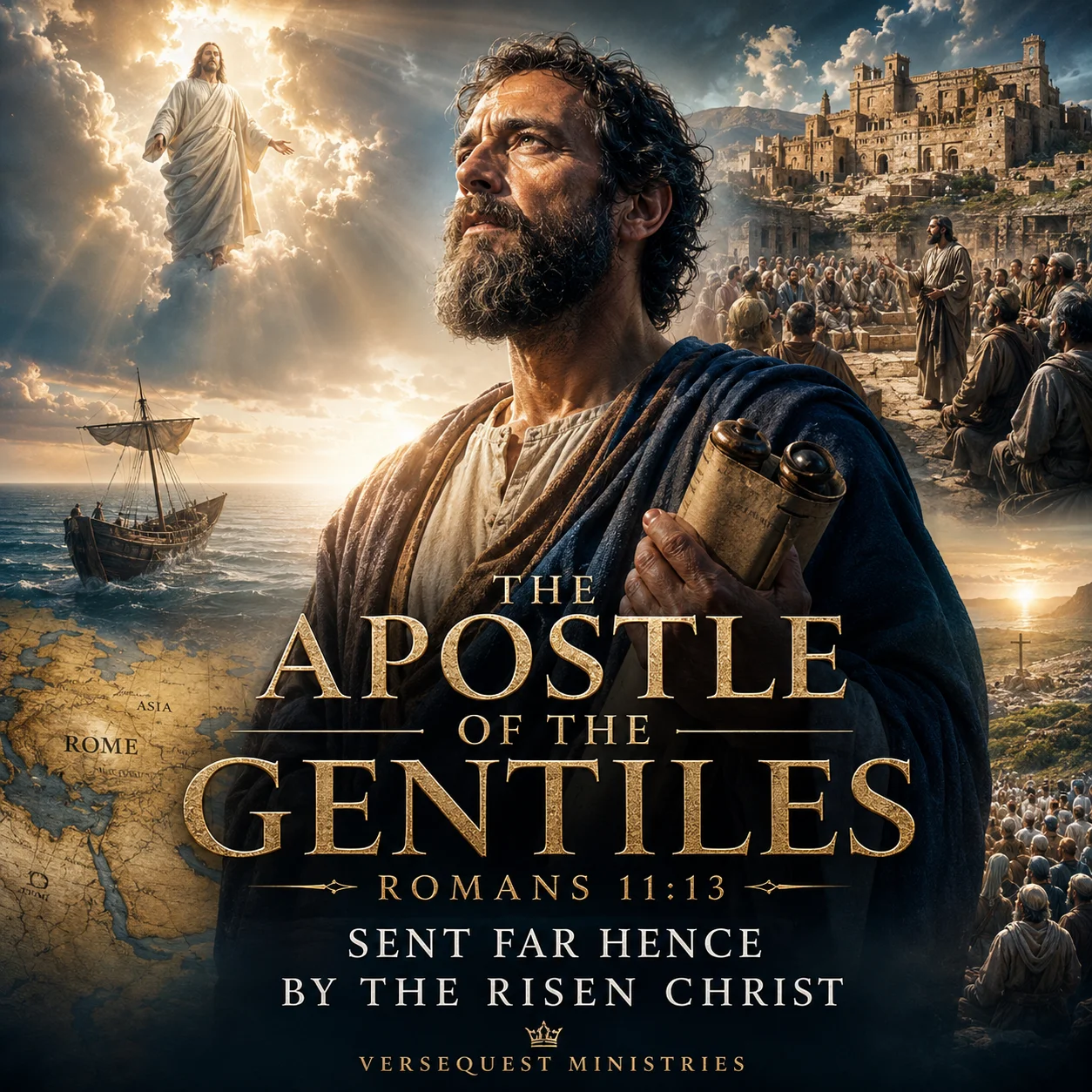
Romans 11:13 — “For I speak to you Gentiles, inasmuch as I am the apostle of the Gentiles, I magnify mine office.”
Series:
Foundations of Right Division
Topic:
Paul’s Distinct Apostleship to the Gentiles and His Ministry for the Body of Christ
Book:
Romans, Acts, Galatians, Ephesians, 1 Corinthians, Colossians, 1 Timothy, 2 Timothy
Speaker:
Paul Tackett
Suggested Sermon Text:
Romans 11:13; Acts 9:1–16; Acts 13:38–48; Acts 22:17–21; Acts 26:13–18; Galatians 1:11–17; Galatians 2:7–9; Ephesians 3:1–9; Romans 16:25–26; 1 Corinthians 15:1–4; 1 Timothy 1:12–16; 2 Timothy 2:7–15
Short Sermon Description:
This sermon outline explains why Paul identifies himself as “the apostle of the Gentiles” in Romans 11:13 and why that office is essential to understanding the present dispensation of grace. Paul was not one of the Twelve, did not receive his gospel from Jerusalem, and was not sent merely to repeat Peter’s kingdom commission. He was saved and commissioned by the risen Lord Jesus Christ, sent far hence unto the Gentiles, entrusted with the gospel of grace, and given the revelation of the mystery concerning the Body of Christ. This study also shows that Paul’s Gentile apostleship does not cancel Israel’s future, exalt Paul above Christ, or create another Saviour. It magnifies the grace and wisdom of Christ while providing the doctrinal foundation by which Church-age believers are saved, established, instructed, and prepared for the blessed hope.
Sent Far Hence
Paul, the Apostle of the Gentiles
Introduction
Romans 11:13 contains one of the clearest declarations of apostolic office in the New Testament: “For I speak to you Gentiles, inasmuch as I am the apostle of the Gentiles, I magnify mine office.” Paul did not say that he was merely an apostle who happened to preach occasionally to Gentiles. He said, “I am the apostle of the Gentiles.” That office was not invented by Paul, assigned by a denomination, approved by a Jerusalem committee, or inherited through apostolic succession. The risen Lord Jesus Christ called Paul, revealed Himself to Paul, commissioned Paul, and sent Paul far hence unto the Gentiles. The man who had persecuted the followers of Christ became the chief human vessel through whom God revealed the doctrine of grace for the Body of Christ.
The religious world frequently minimizes Paul’s office while freely borrowing comforting verses from his epistles. Men quote Romans 8, Ephesians 2:8–9, Philippians 4:13, and Colossians 2:10, yet resist the dispensational framework in which those truths were revealed. They want Paul’s promises without Paul’s apostleship, Paul’s comfort without Paul’s doctrine, Paul’s salvation verses without Paul’s gospel, and Paul’s Church language without Paul’s revelation of the mystery. They treat him as one voice among many rather than believing the inspired description God gave him: “the apostle of the Gentiles.” The result is a Christianity that continually mixes Peter with Paul, Israel with the Church, law with grace, prophecy with mystery, the kingdom with the Body, and tribulation endurance with the finished gospel of Christ.
Magnifying Paul’s office does not mean worshipping Paul. Paul did not die for our sins. Paul did not shed sinless blood. Paul did not rise from the dead for our justification. Jesus Christ alone is the Saviour, Lord, Head, Mediator, and Redeemer. But the same Jesus Christ who chose the Twelve during His earthly ministry later chose Paul from heavenly glory. To honor Paul’s God-given office is to honor the Lord who appointed him. To receive Paul’s doctrine is to receive truth revealed by Christ. To consider what Paul says is not to diminish Jesus; it is to obey Jesus Christ according to the order of revelation He established for the present dispensation.
I. Paul’s Office Is Clearly Named in Scripture
Key Text: Romans 11:13
Supporting Texts: Romans 15:15–16; 1 Timothy 2:7; 2 Timothy 1:11
Paul says, “I am the apostle of the Gentiles.” That statement is not hidden in an obscure footnote. It appears in one of the greatest doctrinal chapters in Romans, where Paul discusses Israel’s fall, Gentile blessing, Israel’s partial blindness, and Israel’s future restoration. Paul knows exactly whom he is addressing: “For I speak to you Gentiles.” He then identifies the authority behind his speech by naming his office. He was not offering a private theological opinion. He was speaking as the apostle Christ had appointed for the Gentiles.
Romans 15:16 says Paul was made “the minister of Jesus Christ to the Gentiles.” First Timothy 2:7 says he was ordained “a preacher, and an apostle… a teacher of the Gentiles in faith and verity.” Second Timothy 1:11 repeats that Paul was appointed “a preacher, and an apostle, and a teacher of the Gentiles.” God states the matter repeatedly. Paul’s Gentile ministry is not a minor theme attached to his personal biography. It is central to his God-given office.
Paul says he magnifies his office, not himself. There is a difference. A man may boast in his flesh, education, influence, or popularity, but Paul repeatedly glories in the Lord and confesses his personal unworthiness. Yet he refuses to minimize the office Christ gave him. The office must be magnified because the message committed to that office must be heard. When the Church disregards Paul’s apostleship, it does not become more humble; it becomes less obedient to the Scriptures.
Main Truth:
Paul’s position as the apostle of the Gentiles is explicitly named and repeatedly confirmed by the word of God.
II. Paul Was Not One of the Twelve Apostles of Israel
Key Text: 1 Corinthians 15:8
Supporting Texts: Matthew 10:1–7; Matthew 19:28; Acts 1:21–26
The Twelve were chosen during Christ’s earthly ministry and connected directly to Israel’s kingdom program. In Matthew 10, Christ instructed them not to go into the way of the Gentiles but to go to “the lost sheep of the house of Israel,” preaching that the kingdom of heaven was at hand. Matthew 19:28 promises them twelve thrones from which they will judge the twelve tribes of Israel. Their number, audience, commission, and future governmental role were tied to Israel.
Paul did not meet the qualifications for replacing Judas in Acts 1. The replacement had to have accompanied the disciples from the baptism of John through Christ’s ascension and to have witnessed the resurrection in that apostolic company. Matthias met those requirements and was numbered with the eleven. Paul was not present during Christ’s earthly ministry as a faithful disciple. He was still an unbelieving Pharisee and later became a persecutor of the followers of Christ. Paul did not occupy Judas’ empty throne, and Scripture never calls him one of the Twelve.
First Corinthians 15 distinguishes Paul from the Twelve. Christ was seen of Cephas, then of the Twelve, and later “last of all” was seen by Paul “as of one born out of due time.” Paul’s calling was later, unusual, and heavenly in character. He did not join the Twelve by walking backward into their earthly commission. Christ appeared to him from glory and gave him a distinct apostleship. The Twelve remain connected to Israel and the twelve tribes; Paul stands as the apostle of the Gentiles.
Main Truth:
Paul was not one of the Twelve but was called later by the risen Christ for a distinct Gentile apostleship.
III. Paul Was Called Directly by the Risen and Glorified Christ
Key Text: Acts 9:15
Supporting Texts: Acts 9:3–6; Acts 22:14–15; Acts 26:16–18
Saul of Tarsus was not seeking appointment to Christian ministry. He was travelling to Damascus with authority to bind the disciples of the Lord. He breathed out threatenings and slaughter. Yet a light from heaven shone around him, and the risen Lord confronted him: “Saul, Saul, why persecutest thou me?” That confrontation reveals the grace and sovereignty of Christ. The enemy was not merely defeated; he was saved, transformed, and appointed to serve the One he had opposed.
Acts 9:15 records the Lord’s words concerning Saul: “he is a chosen vessel unto me, to bear my name before the Gentiles, and kings, and the children of Israel.” Paul was Christ’s chosen vessel. His appointment did not originate with Ananias, although Ananias ministered to him. It did not originate with Peter, although Paul later met Peter. It did not originate with the church at Antioch, although that assembly sent Paul and Barnabas on missionary work. The source of Paul’s apostleship was the risen Lord Jesus Christ.
In Acts 26, Christ tells Paul that He appeared to make him a minister and witness of things already seen and of further things in which He would appear to him. Paul’s ministry therefore involved progressive revelation from the risen Christ. The Twelve had followed the earthly Messiah through Galilee and Judaea; Paul was arrested and commissioned by the glorified Christ from heaven. His doctrine carries authority because its source is not human tradition but the Lord Jesus Christ Himself.
Main Truth:
Paul’s apostleship came directly from the risen Christ, who chose, saved, and commissioned him from heavenly glory.
IV. Paul Was Sent Far Hence Unto the Gentiles
Key Text: Acts 22:21
Supporting Texts: Acts 13:46–48; Acts 18:6; Acts 28:28
Acts 22:21 records Christ’s command to Paul: “Depart: for I will send thee far hence unto the Gentiles.” Paul did not choose the Gentile mission because it promised easier converts, larger crowds, financial support, or political influence. In fact, his ministry brought persecution, imprisonment, beatings, rejection, hunger, shipwreck, and eventual martyrdom. He went to the Gentiles because Christ sent him. The authority of his mission rests in the Sender.
The book of Acts repeatedly records the outward movement of Paul’s ministry. In Acts 13, Jewish opposition leads Paul and Barnabas to declare, “lo, we turn to the Gentiles.” In Acts 18, Paul again says, “from henceforth I will go unto the Gentiles.” Acts 28 concludes with the announcement that “the salvation of God is sent unto the Gentiles, and that they will hear it.” This repeated movement is not accidental. It follows the transitional pattern of Acts from Jerusalem-centered ministry toward the broader Gentile world.
Being the apostle of the Gentiles did not mean Paul hated Israel or never preached to Jews. He went to synagogues, reasoned from Scripture, and carried a deep burden for his kinsmen according to the flesh. But his distinctive office concerned God’s present work among the Gentiles. The nation that had been far off, without Christ, strangers from the covenants, and without hope was now hearing the gospel of grace through the apostle Christ sent far hence.
Main Truth:
Paul’s Gentile mission was commanded by Christ and unfolded throughout Acts as salvation moved outward to the nations.
V. Paul Received His Gospel by Revelation, Not From Jerusalem
Key Text: Galatians 1:11–12
Supporting Texts: Galatians 1:15–18; Romans 2:16; 1 Corinthians 15:1–4
Galatians 1:11–12 says, “the gospel which was preached of me is not after man. For I neither received it of man, neither was I taught it, but by the revelation of Jesus Christ.” Paul could not have stated the source more clearly. His gospel did not come from human instruction, denominational development, rabbinical revision, or a Jerusalem apostolic seminar. The Lord Jesus Christ revealed it to him.
Paul emphasizes that after God revealed His Son in him, he did not immediately confer with flesh and blood or go up to Jerusalem to those who were apostles before him. Instead, he went into Arabia and later returned to Damascus. This does not mean Paul despised the Jerusalem apostles. It means his gospel authority did not depend on them. When he eventually met Peter and James, he did not receive the origin of his message from them. He brought a revelation already committed to him by Christ.
Paul calls this message “my gospel” in Romans 2:16, Romans 16:25, and 2 Timothy 2:8. He defines its saving content in 1 Corinthians 15:1–4: Christ died for our sins according to the Scriptures, was buried, and rose again the third day according to the Scriptures. Paul did not invent a new Saviour. He preached the finished work of the same Jesus Christ, but according to revelation given for this present dispensation.
Main Truth:
Paul received the gospel committed to him directly by revelation from Jesus Christ, not from men or the Jerusalem apostles.
VI. Paul Was Entrusted With the Gospel of the Grace of God
Key Text: Acts 20:24
Supporting Texts: Ephesians 2:8–9; Romans 3:24–28; 1 Corinthians 15:3–4
Paul described his ministry as testifying “the gospel of the grace of God.” That phrase defines the character of the message committed to the apostle of the Gentiles. Grace is not God pretending sin does not matter. Grace is God saving guilty sinners righteously because Jesus Christ paid the full price. The cross satisfied justice. The blood secured redemption. The resurrection declared victory. Grace offers freely what no sinner could earn.
Ephesians 2:8–9 says salvation is by grace through faith, “not of works, lest any man should boast.” Romans 3:24 says believers are “justified freely by his grace through the redemption that is in Christ Jesus.” Romans 3:28 concludes that a man is justified by faith without the deeds of the law. These are not isolated motivational sayings. They form the doctrinal foundation of the gospel Paul was commissioned to preach.
Paul’s gospel centers on Christ’s death for our sins, burial, and resurrection. It does not direct the sinner to Moses, religious ordinances, Sabbath keeping, sacramental systems, endurance through the tribulation, or membership in a religious institution. It directs the sinner to the finished work of Christ. Paul’s Gentile apostleship therefore protects the clarity of salvation in this dispensation: grace alone, through faith alone, in Christ and His completed work.
Main Truth:
The apostle of the Gentiles was entrusted with the gospel of grace, proclaiming salvation through Christ’s finished work apart from human merit.
VII. Paul Was Given the Dispensation of the Grace of God
Key Text: Ephesians 3:2
Supporting Texts: 1 Corinthians 9:17; Colossians 1:25; Ephesians 3:7–8
Ephesians 3:2 says, “If ye have heard of the dispensation of the grace of God which is given me to you-ward.” A dispensation is a stewardship or administration entrusted by God. Paul did not merely preach that God is gracious; he was given a specific stewardship of grace directed toward those to whom Christ sent him. The administration was given to Paul “to you-ward,” especially concerning the Gentiles.
First Corinthians 9:17 says “a dispensation of the gospel is committed unto me.” Colossians 1:25 says Paul was made a minister according to “the dispensation of God” given to him “to fulfil the word of God.” Paul therefore saw himself as a steward. The truth did not originate in him, belong to him privately, or exist for his personal glory. It was divine treasure committed to his trust for proclamation, preservation, and instruction.
Paul calls himself “less than the least of all saints,” yet says grace was given to him to preach among the Gentiles “the unsearchable riches of Christ.” The greatness of the office magnified the greatness of grace, not the greatness of Paul’s flesh. Christ chose the chief persecutor to administer a message of unsearchable riches to Gentiles who had been far off. That arrangement leaves no room for human boasting. It places all glory upon the grace of God.
Main Truth:
Paul was entrusted with the dispensation of grace as a divine stewardship for the benefit of the Gentiles and the Body of Christ.
VIII. Paul Revealed the Mystery of the Body of Christ
Key Text: Ephesians 3:3–6
Supporting Texts: Romans 16:25; Colossians 1:25–27; 1 Corinthians 12:13
Paul’s apostleship is inseparably connected to “the revelation of the mystery.” Ephesians 3:3 says the mystery was made known to him by revelation. Romans 16:25 calls it a mystery “which was kept secret since the world began.” Colossians 1:26 says it had been hid from ages and generations but was now made manifest to the saints. This language distinguishes mystery truth from prophecy spoken by the prophets since the world began.
Ephesians 3:6 explains that Gentiles should be fellowheirs, “and of the same body,” and partakers of God’s promise in Christ by the gospel. Under Israel’s prophetic kingdom program, Gentiles could be blessed through Israel and come to Israel’s light. In the mystery, saved Jews and Gentiles are placed on equal standing in one new man, one spiritual Body, joined to a risen Head in heaven. This is not Gentiles becoming Israel or the Church replacing Israel. It is a new creation in Christ.
First Corinthians 12:13 says believers are baptized by one Spirit into one Body. Colossians 1:27 speaks of “Christ in you, the hope of glory.” Ephesians reveals believers seated together in heavenly places in Christ. These truths belong to the doctrinal revelation associated with Paul’s ministry. Ignoring the apostle of the Gentiles therefore causes men to misunderstand the identity, calling, unity, and hope of the Church which is Christ’s Body.
Main Truth:
Through Paul’s ministry, Christ revealed the mystery of saved Jews and Gentiles united in one heavenly Body.
IX. Paul’s Apostleship Does Not Cancel Israel’s Future
Key Text: Romans 11:25–29
Supporting Texts: Romans 11:1–2; Romans 11:11–15; Jeremiah 31:35–37
Romans 11 is the chapter in which Paul identifies himself as the apostle of the Gentiles, and that context is significant. Paul magnifies his Gentile office while warning Gentiles not to become proud against Israel. He asks, “Hath God cast away his people?” and answers, “God forbid.” Israel has stumbled, blindness in part has happened to the nation, and Gentile blessing has resulted, but Israel’s fall is neither total nor permanent.
Romans 11:25 says Israel’s blindness continues “until the fulness of the Gentiles be come in.” The word “until” places a limit upon the present condition. Verse 26 says, “And so all Israel shall be saved.” Verse 28 says Israel remains beloved for the fathers’ sakes. Verse 29 declares, “For the gifts and calling of God are without repentance.” Paul’s Gentile apostleship therefore does not support replacement theology; it directly opposes Gentile boasting.
The present dispensation of grace concerns God’s formation of the Body of Christ through the gospel going among the Gentiles. Yet the mystery program does not erase the prophetic program. When the Body’s present course is completed, God will fulfill His covenants with Israel. Paul preserves both truths. He explains the Church’s distinct calling while defending Israel’s future. The apostle of the Gentiles teaches Gentiles to stand in grace, not to steal Jacob’s identity.
Main Truth:
Paul’s Gentile apostleship explains the present dispensation without cancelling God’s future covenant program for Israel.
Conclusion
Paul is the apostle of the Gentiles because the risen Lord Jesus Christ appointed him to that office. He was not one of the Twelve, did not replace Matthias, and did not receive his message from Jerusalem. Christ appeared to him from heaven, saved him by grace, sent him far hence unto the Gentiles, and revealed through him the gospel of grace, the dispensation of grace, and the mystery of the Body of Christ. These truths are not optional footnotes for advanced students. They are foundational to understanding what God is doing today.
When Paul’s office is ignored, confusion spreads everywhere. Peter’s kingdom commission is mixed with Paul’s Gentile commission. Acts 2 is blended with 1 Corinthians 15. Israel becomes the Church. The Church is dragged under Mosaic law. Prophecy is confused with mystery. The rapture is merged with the Second Advent. Tribulation endurance is added to salvation by grace. Water, works, signs, sacraments, and religious performance are mixed into the finished gospel of Christ. The remedy is not less Bible, but the whole Bible rightly divided.
The Church should magnify the office Christ gave Paul without turning Paul into an object of worship. We follow Paul as he followed Christ. We receive Paul’s doctrine because Christ revealed it. We preach Paul’s gospel because it magnifies Christ’s finished work. We study Paul’s epistles because they establish the Body of Christ in sound doctrine. Paul’s office points beyond Paul to the wisdom, grace, and glory of the risen Lord who chose the chief persecutor and made him the apostle of the Gentiles.
Final Call
The sinner today does not need to become a Jew, enter Israel’s kingdom program, keep Moses, seek apostolic signs, receive a sacrament, or earn religious standing. He needs the gospel of the grace of God. Christ died for our sins according to the Scriptures. He was buried. He rose again the third day according to the Scriptures. The debt is paid, the tomb is empty, and the Saviour lives.
Believe on the Lord Jesus Christ, and thou shalt be saved. Do not trust your morality, baptism, church, works, emotions, law-keeping, or religious history. Trust the crucified, buried, and risen Christ alone.
Believer, consider what Paul says. Learn the doctrine Christ revealed through the apostle of the Gentiles. Stand in grace. Understand the mystery. Recognize the Body of Christ. Preserve Israel’s future. Preach the gospel clearly. Study to shew thyself approved unto God, rightly dividing the word of truth.
Closing Verse:
2 Timothy 2:7 — “Consider what I say; and the Lord give thee understanding in all things.”
Closing Statement:
To recognize Paul as the apostle of the Gentiles is not to exalt a man above Christ, but to honor the office, message, and mystery that the risen Christ entrusted to him for us.