Sermon Title:
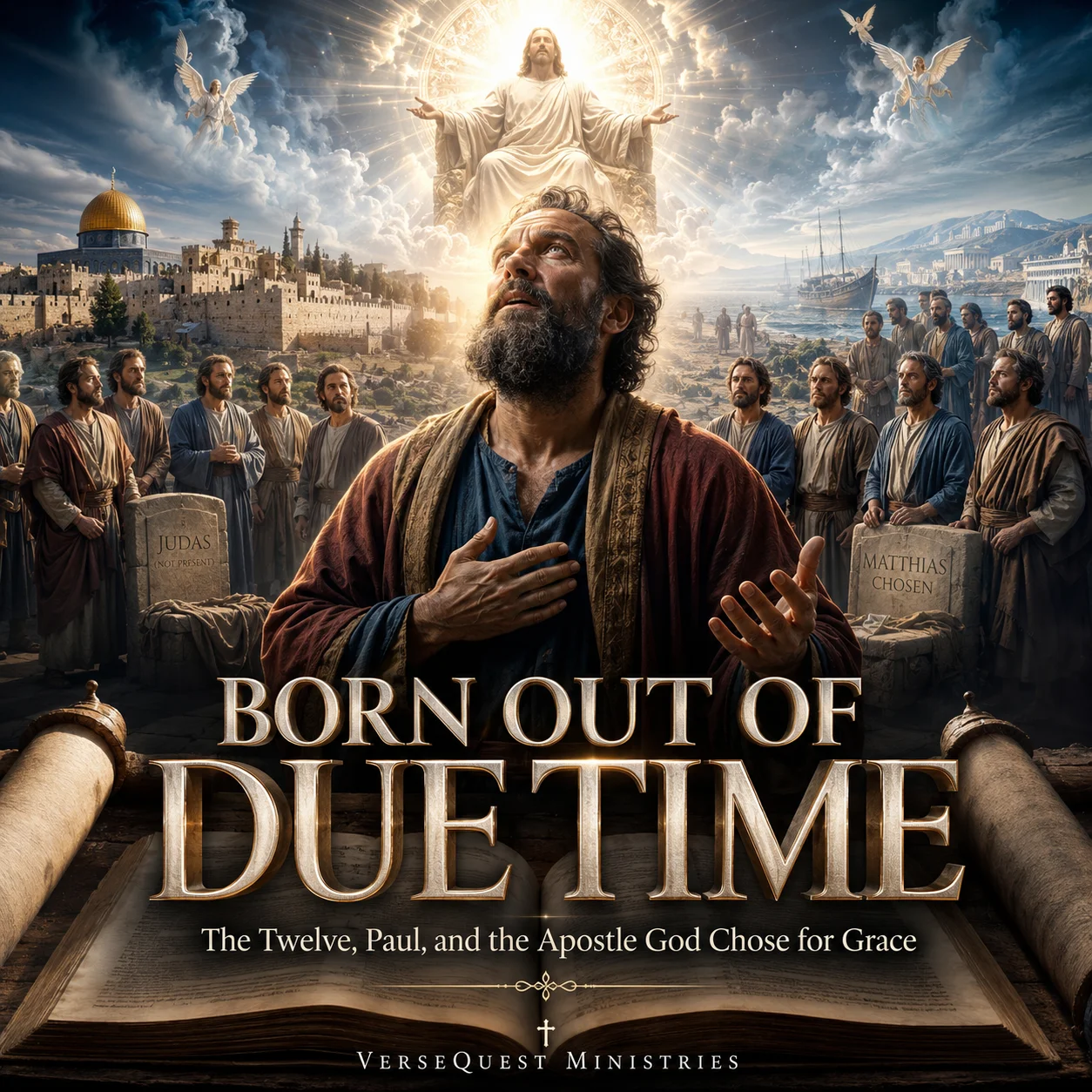
Born Out of Due Time: The Twelve, Paul, and the Apostle God Chose for Grace
Key Passage:
1 Corinthians 15:8 — “And last of all he was seen of me also, as of one born out of due time.”
Series:
Foundations of Right Division
Topic:
The Twelve Apostles and Paul’s Distinct Apostleship
Book:
1 Corinthians, Acts, Galatians, Romans, Ephesians, Matthew, 2 Timothy
Speaker:
Paul Tackett
Suggested Sermon Text:
1 Corinthians 15:1–10; Matthew 10:1–7; Matthew 19:28; Acts 1:15–26; Acts 9:1–16; Acts 22:14–21; Acts 26:13–18; Galatians 1:11–17; Galatians 2:7–9; Romans 11:13; Ephesians 3:1–9; 2 Timothy 2:7; 2 Timothy 2:15
Short Sermon Description:
This sermon outline explains the biblical difference between the twelve apostles of Israel and the apostle Paul, whom Scripture describes as “one born out of due time” in 1 Corinthians 15:8. The twelve were chosen during Christ’s earthly ministry, connected to Israel, the twelve tribes, the kingdom commission, and the apostleship of the circumcision. Paul was saved later by the risen and glorified Christ from heaven and was made the apostle of the Gentiles, connected to the gospel of grace, the dispensation of grace, the revelation of the mystery, and the Body of Christ. This study shows why Paul was not one of the twelve, why Matthias was the proper replacement for Judas, why Paul’s apostleship is distinct, and why confusing the twelve with Paul produces doctrinal confusion about Acts, salvation, baptism, Israel, the Church, prophecy, mystery, and the gospel of grace.
Born Out of Due Time
The Twelve, Paul, and the Apostle God Chose for Grace
Introduction
First Corinthians 15:8 is one of those verses that opens a major door in Bible study if a man will slow down and believe the words. Paul writes, “And last of all he was seen of me also, as of one born out of due time.” Paul is listing resurrection appearances of the Lord Jesus Christ. Christ was seen of Cephas, then of the twelve, then of above five hundred brethren at once, then of James, then of all the apostles, and last of all by Paul. That “last of all” matters. Paul does not present himself as one of the twelve. He does not say he filled Judas’ place. He says Christ was seen of him last, as of one born out of due time. His apostleship came in an unusual, unexpected, out-of-order manner by the appearing of the risen Christ from heaven.
Much confusion in the Church comes from failing to distinguish the twelve from Paul. The twelve apostles were chosen by Christ in His earthly ministry to Israel. They were sent to the lost sheep of the house of Israel. They were promised twelve thrones judging the twelve tribes of Israel. They were connected to the gospel of the kingdom, the circumcision, and Israel’s prophetic program. Paul, on the other hand, was saved after the cross, after the resurrection, after the ascension, after Israel’s continued resistance in early Acts, and after Stephen was stoned. He was called from heaven by the glorified Christ and sent far hence unto the Gentiles. Romans 11:13 calls him “the apostle of the Gentiles.” That is not the same office as the twelve.
Right division does not make Paul the Saviour. Jesus Christ is the Saviour. It does not make the twelve false. God used them mightily. It does not divide the Bible into pieces to be thrown away. It simply lets God’s words stand where God placed them. If a man makes Paul one of the twelve, he will miss Paul’s distinct apostleship. If he makes the twelve and Paul identical in commission, he will confuse Peter’s kingdom ministry with Paul’s gospel of grace. If he treats Acts as though nothing changes from chapter 1 to chapter 28, he will mix Israel and the Church, prophecy and mystery, law and grace, baptism and salvation, the kingdom and the Body of Christ. The Bible becomes clear when the twelve remain the twelve and Paul remains the apostle born out of due time.
I. The Twelve Were Chosen During Christ’s Earthly Ministry to Israel
Key Text: Matthew 10:1–6
Supporting Texts: Luke 6:13–16; Matthew 15:24; John 1:11
The twelve apostles were chosen during the earthly ministry of the Lord Jesus Christ. Matthew 10:1 says He called unto Him His twelve disciples and gave them power against unclean spirits and to heal all manner of sickness and disease. Their names are then listed, and Judas Iscariot is included before his betrayal. These men were not chosen after the ascension. They were not chosen from among Gentile converts. They were selected while Christ ministered in the land of Israel.
Matthew 10:5–6 gives their original commission: “Go not into the way of the Gentiles,” and “go rather to the lost sheep of the house of Israel.” That is plain. The twelve were not initially sent with Paul’s later Gentile commission. Their early ministry was restricted. They preached to Israel that the kingdom of heaven was at hand. They were tied to the King’s earthly presentation to His covenant nation. Matthew 15:24 says Christ was sent “unto the lost sheep of the house of Israel.” The twelve fit that ministry.
This does not mean Gentiles were worthless to God. It means the earthly ministry of Christ had a defined prophetic and covenant setting. Christ came unto His own. The King was presenting Himself to Israel. The twelve were kingdom apostles in connection with Israel’s prophetic program. That setting must be honored, or the Bible student will import Paul’s later Gentile apostleship back into a commission where Christ explicitly told the twelve not to go to Gentiles.
Main Truth:
The twelve apostles were chosen during Christ’s earthly ministry and were first sent to Israel in connection with the kingdom.
II. The Twelve Are Connected to the Twelve Tribes of Israel
Key Text: Matthew 19:28
Supporting Texts: Luke 22:29–30; Revelation 21:14; James 1:1
Matthew 19:28 gives a crucial promise to the twelve. Jesus said that in the regeneration, when the Son of man shall sit in the throne of His glory, “ye also shall sit upon twelve thrones, judging the twelve tribes of Israel.” That promise is not vague. There are twelve apostles, twelve thrones, and twelve tribes. The twelve have a future governmental connection to Israel in the kingdom. That is not the Body of Christ seated in heavenly places. That is Israel’s kingdom hope.
Luke 22:29–30 gives the same kind of promise. The apostles are promised that they will eat and drink at Christ’s table in His kingdom and sit on thrones judging the twelve tribes of Israel. That is kingdom language. It is Jewish. It is national. It is prophetic. The twelve are connected to Israel’s future restoration, not the revelation of the mystery of the Body of Christ later committed to Paul.
Revelation 21:14 says the wall of New Jerusalem has twelve foundations, and in them the names of the twelve apostles of the Lamb. Again, the number twelve matters. It is not thirteen. It is not the twelve plus Paul as a replacement for Matthias. The twelve occupy a distinct place in God’s program connected to Israel and the kingdom. Paul’s apostleship is glorious, but it is different. He is not one of the twelve thrones judging the twelve tribes.
Main Truth:
The twelve apostles have a distinct connection to the twelve tribes of Israel and the future kingdom.
III. Matthias Was Chosen to Fill Judas’ Place Among the Twelve
Key Text: Acts 1:24–26
Supporting Texts: Acts 1:16–22; Psalm 109:8; Acts 2:14
Some teach that Peter and the apostles made a mistake in Acts 1 when Matthias was chosen to replace Judas, and that Paul was God’s real choice for the twelfth apostle. That idea creates more problems than it solves. Acts 1 shows the apostles acting according to Scripture. Peter quotes the Psalms concerning Judas and says, “his bishoprick let another take.” The qualifications are given: the replacement had to have companied with them all the time the Lord Jesus went in and out among them, beginning from the baptism of John unto the day He was taken up, to be a witness with them of His resurrection.
Paul did not meet those qualifications. Paul was not with the twelve from John’s baptism through the ascension. He was not a companion of Christ’s earthly ministry. He was not present in the upper room as a faithful disciple awaiting Pentecost. He was an enemy and persecutor. Matthias, not Paul, fit the stated qualifications in Acts 1. The apostles prayed, cast lots, and Matthias was numbered with the eleven apostles.
Acts 2:14 then says, “But Peter, standing up with the eleven.” That includes Matthias. The Holy Ghost does not correct the record and say, “Peter stood up with the ten and one mistake.” Matthias is accepted in the narrative. Paul’s apostleship was not created to repair a mistake in Acts 1. Paul’s apostleship is distinct, later, heavenly in calling, and connected to the revelation of grace and mystery. Matthias belongs with the twelve. Paul belongs as the apostle born out of due time.
Main Truth:
Matthias properly filled Judas’ place among the twelve, while Paul’s apostleship was later and distinct.
IV. Paul Was Saved and Called After Israel’s Continued Rejection
Key Text: Acts 9:1–6
Supporting Texts: Acts 7:51–60; Acts 8:1–3; 1 Timothy 1:13–16
Paul’s salvation in Acts 9 comes after major events in Israel’s continued rejection. Acts 7 records Stephen indicting Israel’s leaders for resisting the Holy Ghost and betraying and murdering the Just One. They respond by stoning him. Saul is present, consenting unto his death. Acts 8 shows Saul making havoc of the church, entering houses and committing men and women to prison. Acts 9 begins with Saul still breathing out threatenings and slaughter.
This timing matters. Paul is not called during Christ’s earthly ministry. He is not called before Pentecost. He is not called as part of the twelve. He is saved after Israel’s leaders reject the Spirit’s witness through Stephen. The risen Christ appears to Saul from heaven and arrests the persecutor. The man who deserved judgment receives mercy. That is grace on display. Paul later says he obtained mercy because he did it ignorantly in unbelief.
First Timothy 1:16 says Paul obtained mercy so that in him first Jesus Christ might shew forth all longsuffering “for a pattern to them which should hereafter believe on him to life everlasting.” Paul is a pattern of grace. His conversion marks a major dispensational turning point. The persecutor of the kingdom believers becomes the apostle of the Gentiles. That is not the continuation of the twelve. That is the introduction of a distinct ministry.
Main Truth:
Paul was saved after Israel’s continued rejection and became a pattern of grace for those who would believe thereafter.
V. Paul Was Called by the Risen Christ From Heaven
Key Text: Acts 26:16–18
Supporting Texts: Acts 9:15; Acts 22:14–21; Galatians 1:11–12
Paul’s apostleship came from the risen and glorified Christ. In Acts 26, Christ tells Paul that He appeared to him to make him a minister and a witness, both of what he had seen and of the things in which Christ would appear unto him. Paul’s commission was not merely based on what Christ had said on earth. It included further revelations from the risen Lord in glory. That is a different pattern from the twelve.
Acts 9:15 says Paul is a chosen vessel to bear Christ’s name before the Gentiles, kings, and the children of Israel. Acts 22:21 says Christ told him, “Depart: for I will send thee far hence unto the Gentiles.” Galatians 1:11–12 says the gospel Paul preached was not after man, nor did he receive it from man, but by revelation of Jesus Christ. Paul’s apostleship was not derived from Peter, Jerusalem, or the twelve.
This is one reason Paul’s authority must not be minimized. If Paul received his gospel and commission by revelation from Jesus Christ, then rejecting Paul’s distinctive ministry is not spiritual humility. It is resistance to Christ’s heavenly revelation. The same Lord who sent the twelve to Israel later sent Paul to the Gentiles. A Bible believer honors Christ by recognizing both commissions where God placed them.
Main Truth:
Paul was called by the risen Christ from heaven and received his gospel by revelation, not from the twelve or from man.
VI. Paul Was the Apostle of the Gentiles
Key Text: Romans 11:13
Supporting Texts: Galatians 2:7–9; Acts 13:46–48; Ephesians 3:1–2
Romans 11:13 says plainly, “For I speak to you Gentiles, inasmuch as I am the apostle of the Gentiles.” That statement is not hard. Paul did not say he was one of the twelve apostles to the twelve tribes. He said he was the apostle of the Gentiles. That office is essential for understanding Church-age doctrine. The Church ignores Paul’s apostleship to its own confusion.
Galatians 2:7–9 distinguishes Paul’s commission from Peter’s. The gospel of the uncircumcision was committed unto Paul, as the gospel of the circumcision was unto Peter. God wrought effectually in Peter to the apostleship of the circumcision, and the same God was mighty in Paul toward the Gentiles. James, Cephas, and John gave Paul and Barnabas the right hands of fellowship, that they should go unto the heathen and they unto the circumcision. That is a God-given distinction.
Ephesians 3:1–2 says Paul was “the prisoner of Jesus Christ for you Gentiles” and had been given “the dispensation of the grace of God” to them. Paul’s ministry is therefore connected to Gentiles, grace, and the mystery. That does not mean Jews cannot be saved under Paul’s gospel. They can. But Paul’s apostleship is the Gentile apostleship for the present dispensation of grace.
Main Truth:
Paul was the apostle of the Gentiles, given a distinct ministry connected to grace, mystery, and the Body of Christ.
VII. Paul Was Born Out of Due Time
Key Text: 1 Corinthians 15:8
Supporting Texts: 1 Corinthians 15:9–10; Acts 9:3–6; Galatians 1:15–16
Paul says, “And last of all he was seen of me also, as of one born out of due time.” The phrase points to the unusual nature of Paul’s apostleship. He was not born into apostleship in the normal sequence with the twelve. He did not walk with Christ from John’s baptism. He was not commissioned in Matthew 10. He was not part of the twelve thrones. Christ appeared to him after the resurrection and ascension, from heavenly glory, while Paul was still an enemy.
Paul immediately adds, “For I am the least of the apostles, that am not meet to be called an apostle, because I persecuted the church of God.” He knew he did not deserve the office. But he says, “By the grace of God I am what I am.” That is Paul’s ministry in one sentence. He was what he was by grace. The persecutor became an apostle. The enemy became a preacher. The man born out of due time became the chief human vessel for revealing Church-age doctrine.
Being born out of due time does not make Paul inferior in authority. It marks the distinct and gracious nature of his calling. He was last, unusual, unexpected, and chosen by the risen Christ for a special ministry. Paul’s apostleship is not less because it came later. It is distinct because God had a distinct dispensation to reveal through him.
Main Truth:
Paul was born out of due time, called unusually and graciously by the risen Christ for a distinct apostolic ministry.
VIII. Paul’s Message Revealed the Mystery of the Body of Christ
Key Text: Ephesians 3:3–6
Supporting Texts: Colossians 1:25–27; Romans 16:25; 1 Corinthians 12:13
Paul’s distinct apostleship is connected to the revelation of the mystery. Ephesians 3:3 says, “How that by revelation he made known unto me the mystery.” Ephesians 3:6 identifies part of that mystery: Gentiles are fellowheirs, of the same Body, and partakers of God’s promise in Christ by the gospel. This is not the twelve judging the twelve tribes. This is Jew and Gentile in one Body in Christ.
Colossians 1:25–27 says Paul was made a minister according to a dispensation given to him to fulfil the word of God, even the mystery hid from ages and generations but now made manifest. Romans 16:25 says this mystery was kept secret since the world began. That cannot be the same as things spoken by the prophets since the world began. Paul’s ministry reveals truth that had been hid in God.
First Corinthians 12:13 says believers are baptized by one Spirit into one Body. That Body is the Church which is His Body. It is not Israel renamed. It is not Gentiles becoming spiritual Jews. It is not the twelve tribes under another label. It is the mystery Body of Christ, revealed through Paul’s doctrine. If Paul is made one of the twelve, that mystery truth is easily blurred into Israel’s kingdom program.
Main Truth:
Paul’s distinct apostleship revealed the mystery of the Body of Christ, where saved Jews and Gentiles are one in Christ.
IX. Confusing the Twelve With Paul Corrupts Right Division
Key Text: 2 Timothy 2:15
Supporting Texts: 2 Timothy 2:7; Galatians 1:6–9; 1 Corinthians 15:1–4
Second Timothy 2:15 commands the workman to rightly divide the word of truth. One major division that must be maintained is the difference between the twelve and Paul. The twelve belong to Israel’s kingdom framework. Paul belongs to the Gentile grace ministry and revelation of the mystery. If those are confused, doctrine becomes confused. Peter’s Acts 2 message gets turned into the Church-age gospel. Matthew 24 endurance gets applied to the Body of Christ. Israel’s kingdom promises get stolen by the Church. Paul’s gospel gets mixed with water, law, signs, and works.
Second Timothy 2:7 says, “Consider what I say; and the Lord give thee understanding in all things.” Understanding for the Church age comes by considering what Paul says. That does not mean ignoring the rest of Scripture. All Scripture is profitable. But all Scripture must be rightly divided. Paul’s epistles give the doctrinal foundation for the Body of Christ in this present dispensation.
The gospel that saves today is plainly stated in 1 Corinthians 15:1–4: Christ died for our sins, was buried, and rose again the third day according to the Scriptures. Galatians 1 warns against another gospel. If men confuse the twelve and Paul, they often end up adding kingdom elements, baptismal formulas, Jewish signs, ordinances, or law to the gospel of grace. Right division protects the gospel and magnifies Christ’s finished work.
Main Truth:
Confusing the twelve with Paul corrupts right division and endangers the clarity of the gospel of grace.
Conclusion
The twelve and Paul must be kept where God put them. The twelve were chosen during Christ’s earthly ministry, sent first to Israel, connected to the twelve tribes, and promised twelve thrones in the kingdom. Matthias properly replaced Judas according to the qualifications in Acts 1. Paul was not one of the twelve. He was saved later, after Israel’s continued rejection, by the risen Christ from heaven. He was born out of due time and made the apostle of the Gentiles.
This distinction is not an attack on Peter or the twelve. It is respect for the Bible. Peter had a real apostleship. Paul had a real apostleship. The twelve had a real kingdom connection. Paul had a real Gentile and mystery connection. The same Christ commissioned both, but He did not give them identical offices. The twelve are connected to Israel’s prophetic program; Paul is connected to the dispensation of grace and the revelation of the Body of Christ.
When the twelve and Paul are rightly divided, the Bible becomes clearer. Acts makes sense as a transition book. Israel keeps her promises. The Church keeps her heavenly calling. The gospel of grace remains free from law and ordinances. Peter’s ministry to Israel is honored. Paul’s ministry to the Gentiles is honored. Christ receives glory as Israel’s Messiah, the Saviour of sinners, and the Head of the Body. The man born out of due time was not a mistake. He was God’s chosen apostle for grace.
Final Call
The sinner today is not saved by becoming part of Israel’s kingdom program, following the twelve, keeping law, performing ordinances, or trusting religious works. He is saved by the gospel of the grace of God revealed with clarity through Paul: Christ died for our sins according to the Scriptures, He was buried, and He rose again the third day according to the Scriptures.
Believe on the Lord Jesus Christ, and thou shalt be saved. Do not trust water, works, sacraments, law, church membership, feelings, or religion. Trust the crucified, buried, and risen Saviour.
Believer, learn the difference between the twelve and Paul. Do not make Paul one of the twelve. Do not erase the twelve to exalt Paul. Let each stand where God placed him. Study to shew thyself approved unto God. Consider what Paul says. Rightly divide the Book, and preach the gospel of grace without mixture.
Closing Verse:
1 Corinthians 15:10 — “But by the grace of God I am what I am: and his grace which was bestowed upon me was not in vain.”
Closing Statement:
The twelve point to Israel’s kingdom hope, but Paul, born out of due time, reveals the grace and mystery doctrine by which the Church is established today.