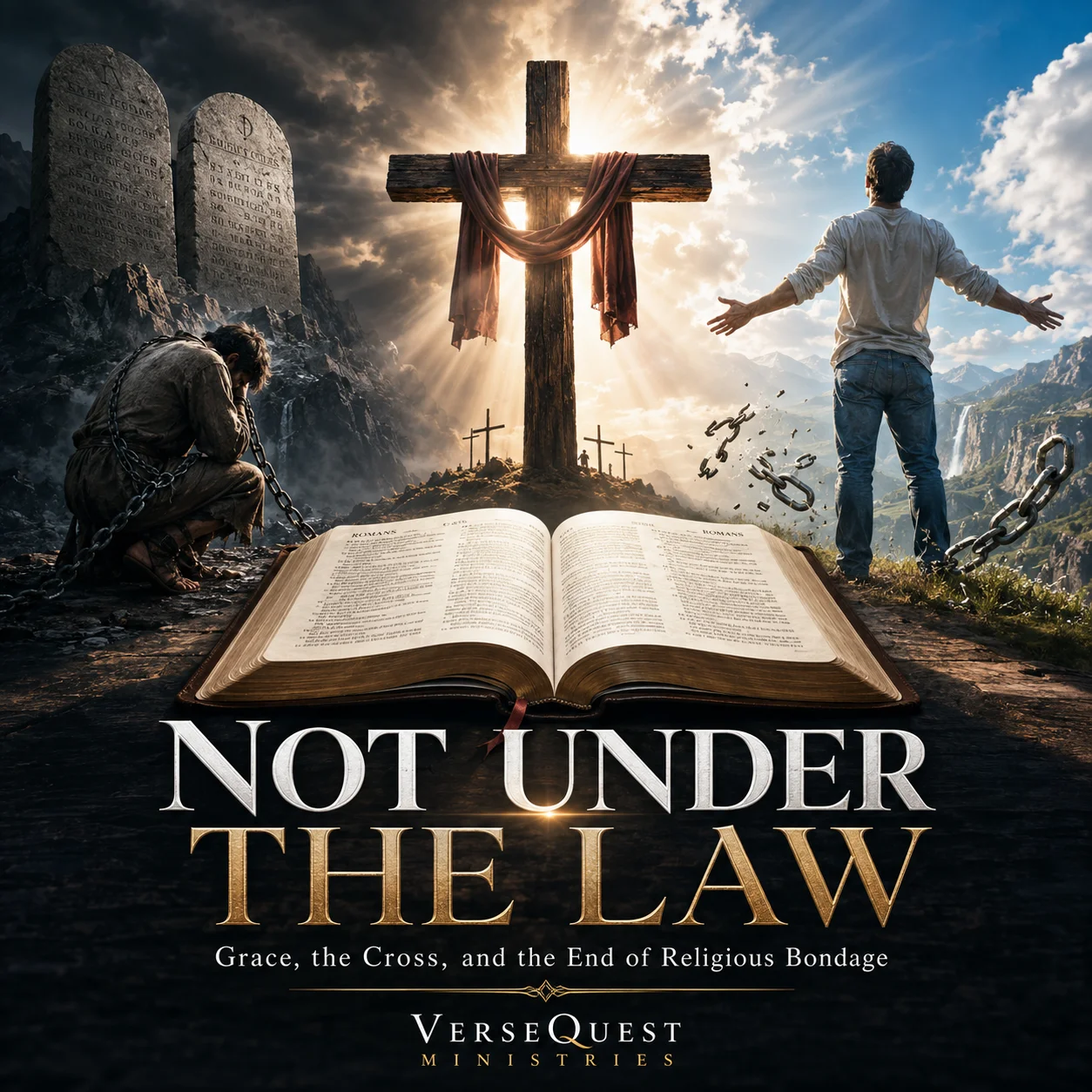
Not Under the Law
Grace, the Cross, and the End of Religious Bondage
Introduction
Romans 6:14 is one of the clearest statements in the New Testament concerning the believer’s relationship to the law: “For sin shall not have dominion over you: for ye are not under the law, but under grace.” That verse does not need to be improved, corrected, softened, or explained away by religious tradition. It says what it says. The saved man in the Body of Christ is not under the law as his covenant system. He is under grace. That does not mean he is free to sin, live carelessly, mock holiness, or despise righteousness. It means his standing before God is not based on Moses, ordinances, commandments written against him, Sabbath signs, meats, drinks, holy days, temple service, priesthood, or religious performance. His standing is in Jesus Christ.
The religious world has a hard time believing Romans 6:14 because religion needs people under bondage. If a man is complete in Christ, the religious machine loses control over him. If a sinner is saved by grace through faith apart from works, the priest loses power, the system loses leverage, and the traditions of men lose their throne. So men take the law given to Israel, mix it with grace given through Paul, and create a confused Christianity where sinners are told Christ died for them, but they must help finish the job. They are told salvation is by grace, but then they must maintain it by law. They are told the cross is finished, but then they are dragged back under ordinances Christ nailed to the cross.
The Bible does not teach that grace is lawlessness. Grace is not permission to sin. Grace is not spiritual laziness. Grace is not rebellion wearing a Bible verse. Titus 2 says the grace of God teaches us to deny ungodliness and worldly lusts. But grace teaches from a different ground than the law. The law demands righteousness from man and condemns him when he fails. Grace gives righteousness in Christ and teaches the believer to walk worthy of what God has made him. Law says, “Do and live.” Grace says, “Christ died, you live in Him, now walk as a new man.” The finished cross is the great dividing line between religious bondage and Christian liberty.
I. The Law Was Given by Moses, but Grace and Truth Came by Jesus Christ
Key Text: John 1:17
Supporting Texts: Exodus 19:5–8; Romans 5:20–21; Galatians 3:19
John 1:17 says, “For the law was given by Moses, but grace and truth came by Jesus Christ.” That verse does not say the law was evil. It does not say Moses was wrong. It does not say God made a mistake at Sinai. It simply distinguishes what God gave through Moses from what came by Jesus Christ. The law was holy, just, and good, but it was never able to justify a sinner or give life to dead flesh. The law demanded righteousness from a people who could not produce it.
Exodus 19 shows Israel entering a covenant relationship at Sinai. The nation said, “All that the LORD hath spoken we will do.” That was Israel under law. It was national, covenantal, earthly, and conditional. The law was given to Israel, not to the Gentile nations and not to the Body of Christ. Romans 9:4 says the giving of the law pertained to Israel. That matters. A Bible believer must not take what God gave to Israel under Moses and place the Body of Christ back under it as a covenant system.
Galatians 3:19 asks, “Wherefore then serveth the law?” and answers that it “was added because of transgressions.” The law exposed sin. It revealed guilt. It shut mouths. It showed man what he was. But John 1:17 points beyond Moses to Jesus Christ. Grace and truth came by Him. Not grace without truth. Not truth without grace. Grace and truth together came by the Lord Jesus Christ, and the cross reveals both: God’s truth about sin and God’s grace toward sinners.
Main Truth:
The law was given by Moses to expose sin, but grace and truth came by Jesus Christ to save sinners and establish believers in Him.
II. The Law Stops Every Mouth and Makes the Whole World Guilty
Key Text: Romans 3:19
Supporting Texts: Romans 3:20; Galatians 3:10; James 2:10
Romans 3:19 says, “that every mouth may be stopped, and all the world may become guilty before God.” That is one of the great purposes of the law. The law was not given so sinners could congratulate themselves. It was given to shut their mouths. Man naturally wants to argue with God. He wants to justify himself. He wants to compare himself with worse sinners. He wants to present his religious effort, moral improvements, family background, and good intentions. The law walks into the courtroom and silences him.
Romans 3:20 says, “for by the law is the knowledge of sin.” The law can diagnose, but it cannot cure. It can point at the disease, but it cannot give life. It can reveal the stain, but it cannot wash the soul clean. The law is like a mirror that shows a man his dirty face, but the mirror cannot wash him. A sinner who tries to be justified by law is trying to make a mirror into a fountain. It was never given for that purpose.
Galatians 3:10 says those under the works of the law are under the curse, because the law demands continued obedience in all things written in it. James 2:10 says whosoever keeps the whole law and offends in one point is guilty of all. The law does not grade on a curve. It does not say, “Try hard and God will understand.” It demands righteousness and condemns failure. That is why the sinner must flee from law-keeping as a ground of justification and run to Jesus Christ.
Main Truth:
The law exposes sin, stops man’s boasting, and proves the whole world guilty before God.
III. The Law Cannot Justify the Sinner
Key Text: Romans 3:28
Supporting Texts: Galatians 2:16; Acts 13:38–39; Titus 3:5
Romans 3:28 says, “Therefore we conclude that a man is justified by faith without the deeds of the law.” That is not a denominational opinion. That is the Holy Ghost’s conclusion through Paul. A man is justified by faith without the deeds of the law. The law cannot justify because the law can only condemn the guilty. It cannot remove guilt, change the heart, give the Spirit, or place a sinner into Christ.
Galatians 2:16 repeats the truth three times in one verse: “a man is not justified by the works of the law,” “by the faith of Jesus Christ,” and “by the works of the law shall no flesh be justified.” God did not leave room for confusion. No flesh means no flesh. Not Jewish flesh. Not Gentile flesh. Not religious flesh. Not sincere flesh. Not reformed flesh. Not baptized flesh. No flesh shall be justified by the works of the law.
Acts 13:38–39 says that through Jesus Christ is preached forgiveness of sins, and by Him “all that believe are justified from all things, from which ye could not be justified by the law of Moses.” That is plain. What Moses could not do, Christ did. What the law could not provide, the gospel announces. What religion cannot finish, Christ finished. The sinner is not justified by joining law to grace. He is justified by faith in Jesus Christ.
Main Truth:
The law cannot justify the sinner; justification comes by faith in Jesus Christ apart from the deeds of the law.
IV. The Cross Redeemed Us From the Curse of the Law
Key Text: Galatians 3:13
Supporting Texts: Colossians 2:14; 2 Corinthians 5:21; 1 Peter 2:24
Galatians 3:13 says, “Christ hath redeemed us from the curse of the law, being made a curse for us.” The law pronounced the curse. Christ bore the curse. The sinner broke God’s righteousness. Christ satisfied God’s righteousness. The law said guilty. The cross says paid. The law exposed the debt. Christ paid the debt in His own blood.
Colossians 2:14 says Christ blotted out “the handwriting of ordinances that was against us,” taking it out of the way and nailing it to His cross. That is a finished transaction. The ordinances that condemned were not placed in the believer’s pocket for him to carry around the rest of his life. They were nailed to Christ’s cross. Religion keeps trying to pull those ordinances down from the cross and put them back on the saint’s neck, but God says Christ took them out of the way.
Second Corinthians 5:21 says God made Christ “to be sin for us, who knew no sin; that we might be made the righteousness of God in him.” That is substitution. Christ took what we deserved so that we could receive what we could never earn. The cross is not merely an example of love. It is the place where Christ bore sin, satisfied justice, redeemed from the curse, and opened the way for grace to reign through righteousness.
Main Truth:
The cross redeemed the believer from the curse of the law because Christ bore the curse in the sinner’s place.
V. The Believer Is Dead to the Law by the Body of Christ
Key Text: Romans 7:4
Supporting Texts: Romans 7:6; Galatians 2:19–20; Colossians 3:3
Romans 7:4 says, “Wherefore, my brethren, ye also are become dead to the law by the body of Christ.” That is stronger than saying the believer is merely helped by grace while still married to the law. Paul says the believer is dead to the law. Death ends the relationship. The law has no more claim over the believer as a covenant master because the believer’s identity is now bound up with Christ’s death and resurrection.
Romans 7:6 says, “But now we are delivered from the law.” The phrase “but now” is important in Paul’s doctrine. It marks the present standing of the believer in this dispensation. We are not trying to earn deliverance from the law. We are delivered. We are to serve “in newness of spirit, and not in the oldness of the letter.” Christian service is not Moses warmed over. It is life in Christ through the Spirit.
Galatians 2:19–20 says, “For I through the law am dead to the law, that I might live unto God.” Then Paul says, “I am crucified with Christ.” The believer’s life is not the old man trying harder under law. It is the life of Christ in him. The law demanded life from a man in Adam and found only death. Grace gives the believer life in Christ and teaches him to live from that position. Dead to the law does not mean dead to God. It means alive unto God in Christ.
Main Truth:
The believer is dead to the law by the body of Christ and now lives unto God in resurrection life.
VI. The Believer Is Not Under the Law, but Under Grace
Key Text: Romans 6:14
Supporting Texts: Galatians 5:1; Galatians 5:4; Ephesians 2:8–9
Romans 6:14 declares, “ye are not under the law, but under grace.” The verse is not ambiguous. The believer in the Body of Christ is not under the law as his covenant system, rule of justification, or source of standing. He is under grace. That is why sin shall not have dominion over him. The law can reveal sin, but it cannot break sin’s dominion. Grace brings the believer into union with Christ, where sin’s old authority has been broken.
Galatians 5:1 says, “Stand fast therefore in the liberty wherewith Christ hath made us free.” The believer must stand fast because religion constantly tries to bring him back into bondage. Galatians 5:4 warns that those who seek to be justified by the law are fallen from grace. That does not mean a saved man loses salvation every time he is confused. It means law-justification and grace-standing are incompatible systems. You cannot stand in grace while seeking justification by law.
Ephesians 2:8–9 says salvation is by grace through faith, not of works. Grace is not God lowering His standards so man can sneak in. Grace is God saving sinners on the basis of Christ’s finished work. The believer is not under grace because God stopped caring about holiness. He is under grace because Christ fulfilled what the sinner could not, died for what the sinner had done, and gives what the sinner could never earn.
Main Truth:
The believer is not under the law but under grace, standing in Christ by a finished work rather than human performance.
VII. Grace Is Not License to Sin
Key Text: Romans 6:1–2
Supporting Texts: Titus 2:11–14; Romans 6:15; Galatians 5:13
Whenever grace is preached plainly, someone will accuse it of promoting sin. Paul faced the same charge. Romans 6:1 asks, “What shall we say then? Shall we continue in sin, that grace may abound?” Paul answers, “God forbid.” Grace does not teach the believer to sin. Grace teaches the believer that he is dead to sin and alive unto God through Jesus Christ our Lord.
Titus 2:11–12 says, “For the grace of God that bringeth salvation hath appeared to all men, teaching us…” Notice what teaches the believer. Grace teaches. It teaches us to deny ungodliness and worldly lusts and to live soberly, righteously, and godly in this present world. The law commands from outside and condemns failure. Grace works from the believer’s standing in Christ and teaches him to live as one redeemed.
Galatians 5:13 says believers have been called unto liberty, but they must not use liberty for an occasion to the flesh. Christian liberty is not permission to feed the old man. It is freedom to serve God without bondage, fear, condemnation, or religious slavery. The man who uses grace as an excuse for sin has not understood grace. The man who uses law to control sin has not understood the cross. Grace delivers and teaches.
Main Truth:
Grace is not license to sin; it is God’s saving and teaching power that trains the believer to live godly in Christ.
VIII. Mixing Law and Grace Corrupts the Gospel
Key Text: Galatians 1:6–9
Supporting Texts: Galatians 3:1–3; Colossians 2:16–23; 2 Corinthians 11:3–4
Galatians 1:6–9 shows how serious gospel corruption is. Paul pronounces a curse on any man or angel who preaches another gospel. The Galatians were not being tempted to reject God, morality, or the Bible. They were being tempted to add law to grace. That is how subtle false doctrine works. It does not always deny Christ openly. Sometimes it says Christ is necessary, but not enough. It says grace begins the work, but law must finish it.
Galatians 3:3 asks, “Are ye so foolish? having begun in the Spirit, are ye now made perfect by the flesh?” That is the error of legalism. It begins with grace language but ends with fleshly performance. It acts as though the Spirit can save a man, but Moses must sanctify him. It says the cross can get you started, but commandments and ordinances must keep you accepted. Paul calls that foolish.
Colossians 2 warns against being judged in meats, drinks, holy days, new moons, and sabbath days. Those things were shadows, but the body is of Christ. Religion loves shadows because shadows can be managed by men. Christ is the substance. The believer is complete in Him. Mixing law and grace does not make grace stronger. It corrupts the gospel, confuses the saint, and dishonors the finished work of Christ.
Main Truth:
Mixing law and grace corrupts the gospel by adding religious performance to the finished work of Christ.
IX. The Finished Cross Is the Believer’s Liberty and Boast
Key Text: John 19:30
Supporting Texts: Galatians 6:14; Colossians 2:10; Hebrews 10:14
John 19:30 records the victorious words of the Lord Jesus Christ: “It is finished.” The cross was not a down payment. It was not the first installment in a religious payment plan. It was not Christ doing His part so man could do the rest. It was finished. The sin debt was paid. The sacrifice was complete. The work of redemption was accomplished. The veil would be rent. The tomb would be emptied. The risen Christ would reveal the gospel of grace through Paul with perfect clarity.
Galatians 6:14 says, “But God forbid that I should glory, save in the cross of our Lord Jesus Christ.” Paul did not glory in law-keeping, circumcision, religious heritage, ceremonies, ordinances, or fleshly achievement. He gloried in the cross. The cross ended the old ground of boasting. If salvation is by grace through faith, no man can boast in himself. If Christ finished the work, all glory belongs to Him.
Colossians 2:10 says, “And ye are complete in him.” Hebrews 10:14 says, “For by one offering he hath perfected for ever them that are sanctified.” The believer’s liberty rests in a finished offering, a complete Saviour, and a settled standing. The cross is not merely where the sinner begins. It is where the believer’s boast remains. The finished cross is the answer to law, guilt, fear, condemnation, religion, and every system that says Christ is not enough.
Main Truth:
The finished cross is the believer’s liberty, standing, and only boast before God.
Conclusion
Romans 6:14 is not a verse to fear. It is a verse to believe. The believer is not under the law, but under grace. The law exposed sin, stopped every mouth, cursed the guilty, and proved man’s inability. It could not justify. It could not give life. It could not make the sinner righteous. But Jesus Christ came, bore the curse, shed His blood, nailed the ordinances to His cross, and finished the work. Now the saved man stands in grace, dead to the law, alive unto God, complete in Christ, and free to serve God in newness of spirit.
This doctrine must be rightly divided. The law was given to Israel. Grace is now revealed with fullness through Paul’s gospel in the present dispensation. Israel’s law program and the Church’s grace standing must not be mixed. Moses and Paul must not be blended into a religious system that leaves sinners unsure and saints in bondage. Sinai and Calvary are not the same ground. The schoolmaster and the Saviour are not the same office. The shadow and the substance are not the same thing. Christ is the end of the law for righteousness to every one that believeth.
The answer to legalism is not lawlessness. The answer to legalism is grace. Real grace saves, teaches, corrects, strengthens, and establishes. It points the sinner to Christ alone and teaches the saint to walk worthy of Christ. It gives assurance without arrogance, liberty without license, holiness without bondage, and service without fear. The Church needs to stop dragging believers back under a yoke Christ broke and start preaching the grace of God in truth. The finished cross is enough.
Final Call
The sinner does not need to try harder under law. The law has already exposed him as guilty. He does not need ordinances, sacraments, ceremonies, priestcraft, Sabbath keeping, moral improvement, or religious effort to help save him. He needs Jesus Christ. Christ died for our sins according to the scriptures. He was buried. He rose again the third day according to the scriptures.
Believe on the Lord Jesus Christ, and thou shalt be saved. Trust the finished work. Trust the blood. Trust the risen Saviour. Stop trying to pay a debt Christ already paid. Stop trying to earn a righteousness God gives freely in Christ.
Believer, stand fast in grace. Do not let religion put you back under bondage. Do not use liberty for the flesh. Walk in the Spirit. Serve in love. Study Paul’s doctrine. Rightly divide the Book. Glory in the cross, and let grace teach you to live for the One who finished the work.
Closing Verse:
Galatians 6:14 — “But God forbid that I should glory, save in the cross of our Lord Jesus Christ, by whom the world is crucified unto me, and I unto the world.”
Closing Statement:
The law exposed the debt, but the cross paid it in full; therefore the believer stands not under bondage, but under grace.