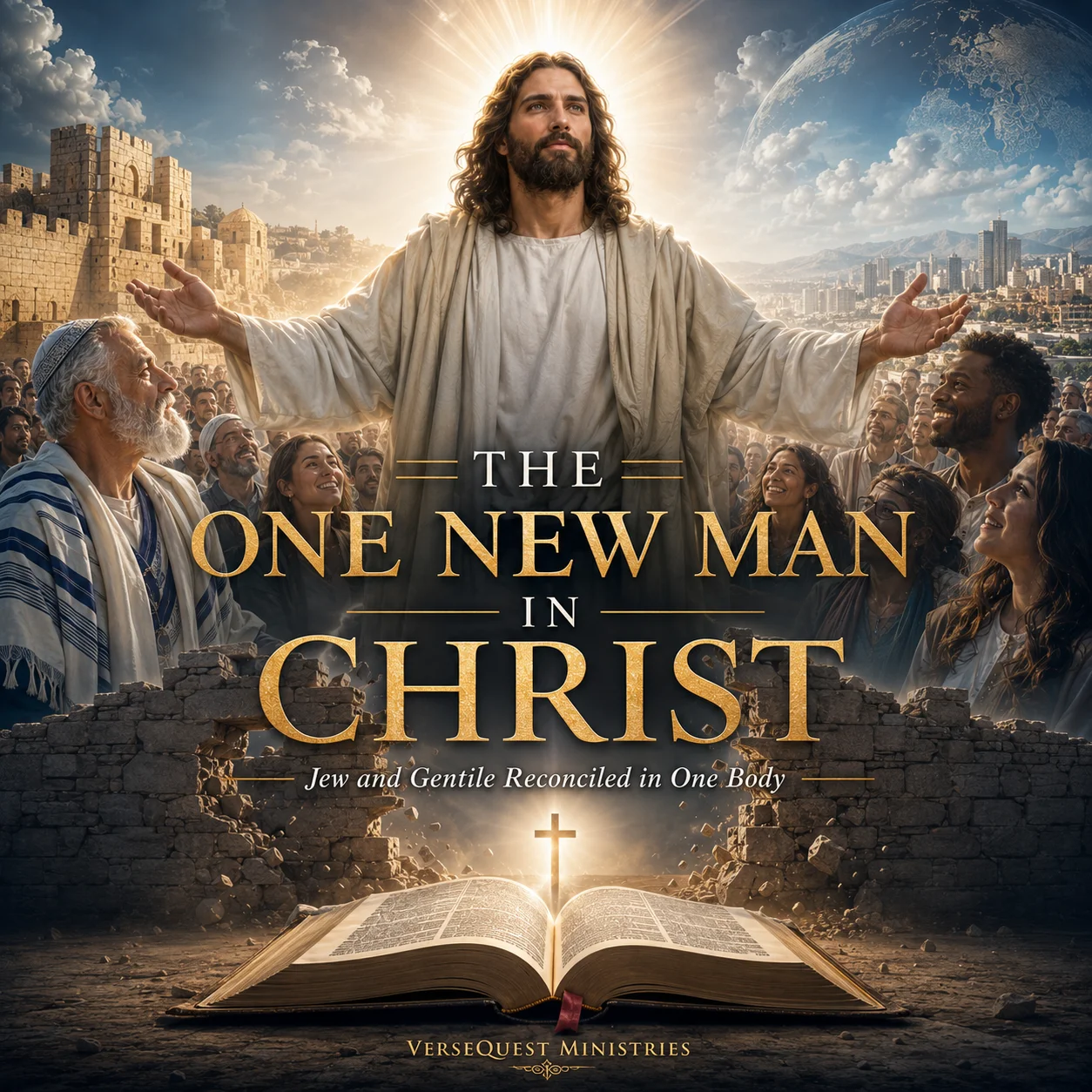
The One New Man in Christ
Jew and Gentile Reconciled in One Body
Introduction
Ephesians 2:15 is one of the great mystery-truth verses in Paul’s epistles. Paul says that Christ abolished in His flesh the enmity, even the law of commandments contained in ordinances, “for to make in himself of twain one new man, so making peace.” That verse is not describing a denominational peace treaty. It is not describing the improvement of the old man. It is not describing Gentiles becoming Israel, or Israel being erased by the Church. It is describing a new spiritual creation in Christ during the present dispensation of grace. God took believing Jews and believing Gentiles, reconciled both unto Himself by the cross, and made them one new man in Christ.
The religious world has badly mishandled this truth. Some teach that the Church has replaced Israel. Others teach that saved Gentiles become spiritual Jews. Others drag the Body of Christ back under the law and ordinances God says were abolished as a wall of enmity. Others act as if every distinction in the Bible disappears because saved people are one in Christ. But right division is not confusion. First Corinthians 10:32 still tells us to recognize the Jews, the Gentiles, and the Church of God. Romans 11 still says Israel’s blindness is partial and temporary. Ephesians 2 still says believing Jews and Gentiles are made one new man in Christ. Those truths are not enemies. They fit perfectly when the Bible is rightly divided.
The one new man is part of the mystery revealed through Paul. The Old Testament prophets spoke of Gentiles being blessed through Israel and nations coming to Israel’s light in the kingdom. But they did not reveal the Body of Christ as Paul reveals it: saved Jews and Gentiles joined together on equal standing in one Body, seated in heavenly places in Christ, under one Head, and made complete in Him. The one new man is not Israel’s earthly kingdom program. It is the Church’s present heavenly calling in Christ. This sermon will show what the one new man is, what Christ abolished to make it, how the cross reconciles both Jew and Gentile, why this does not cancel Israel’s promises, and how believers should walk in the unity God has already made.
I. The One New Man Begins With the Gentile’s Former Distance
Key Text: Ephesians 2:11–12
Supporting Texts: Romans 9:4–5; Acts 14:16; Romans 1:21–25
Before Paul explains the one new man, he reminds Gentiles where they stood “in time past.” Ephesians 2:11–12 says Gentiles were “called Uncircumcision” by the circumcision, were “without Christ,” “aliens from the commonwealth of Israel,” “strangers from the covenants of promise,” having “no hope,” and “without God in the world.” That is not flattering language. It is the Holy Ghost giving Gentiles a truthful history lesson. The Gentile nations were not the covenant people. They were not given the law at Sinai. They were not given the temple service. They were not promised David’s throne. They were outside Israel’s covenants.
Romans 9:4–5 says that to Israel pertained “the adoption, and the glory, and the covenants, and the giving of the law, and the service of God, and the promises.” Paul does not say those things pertained to the Gentiles. They belonged to Israel. Gentile pride has no place in Bible doctrine. Before grace brought Gentiles nigh, they were far off. Before Christ reconciled them, they were strangers. Before the gospel of grace went to the nations, they had no covenant claim, no national hope, and no standing in Israel’s program.
This matters because modern Gentile religion often acts like it has always been the center of God’s dealings. It steals Israel’s promises, spiritualizes Israel’s kingdom, and then despises Israel’s future. But Ephesians 2 starts by humbling the Gentile. The one new man does not begin with Gentile superiority. It begins with Gentile distance, helplessness, and need. Gentiles were brought in, not because they deserved Israel’s blessings, but because the blood of Christ brought them nigh by grace.
Main Truth:
The one new man cannot be understood until the Gentile’s former distance from Israel’s covenants and promises is recognized.
II. The One New Man Is Made Possible by the Blood of Christ
Key Text: Ephesians 2:13
Supporting Texts: Colossians 1:20–22; Romans 5:9; Ephesians 1:7
Ephesians 2:13 says, “But now in Christ Jesus ye who sometimes were far off are made nigh by the blood of Christ.” The great change from “time past” to “but now” is not accomplished by Gentile merit, religious reform, moral improvement, circumcision, law-keeping, or church membership. It is accomplished by the blood of Christ. The Gentiles who were far off are brought nigh, not by becoming Israel, but by being placed in Christ.
Ephesians 1:7 says, “In whom we have redemption through his blood, the forgiveness of sins, according to the riches of his grace.” The blood of Christ does what no ordinance could do. It redeems. It forgives. It brings sinners nigh. It makes peace. It reconciles. It opens access. Romans 5:9 says we are “justified by his blood.” The one new man rests on a finished blood-bought redemption, not on human attempts to repair division through religion, politics, culture, or denominational unity.
Colossians 1:20 says Christ made peace “through the blood of his cross.” That is where the one new man must be grounded. Men talk about unity while avoiding the cross, but God’s unity is made in Christ through blood. The cross does not merely inspire men to be nicer to each other. The cross judicially removes the barrier, deals with sin, satisfies God’s righteousness, and makes reconciliation possible. The one new man is not built on social friendliness. It is built on Calvary.
Main Truth:
The one new man is made possible only by the blood of Jesus Christ, which brings far-off sinners nigh to God.
III. Christ Is Our Peace
Key Text: Ephesians 2:14
Supporting Texts: Colossians 3:15; Romans 5:1; John 14:27
Ephesians 2:14 says, “For he is our peace.” Paul does not say Christ merely offers peace, teaches peace, encourages peace, or symbolizes peace. He is our peace. Between Jew and Gentile, between sinner and God, between hostility and reconciliation, Christ Himself is the peace. Peace is not found in religious compromise. Peace is not found in pretending doctrine does not matter. Peace is not found in erasing every distinction God made. Peace is found in the Person and finished work of the Lord Jesus Christ.
Romans 5:1 says, “Therefore being justified by faith, we have peace with God through our Lord Jesus Christ.” Peace with God comes first. Men cannot have true spiritual peace with one another while remaining enemies of God. The cross settles the sinner’s guilt before God, and then brings saved sinners into one Body under one Head. Christ’s peace is not sentimental. It is doctrinal, judicial, spiritual, and practical.
Colossians 3:15 says, “And let the peace of God rule in your hearts, to the which also ye are called in one body.” The one Body is called to peace because Christ has made peace. Believers are not trying to create spiritual unity by fleshly effort. They are commanded to walk in the unity God has already created. The one new man does not ask believers to manufacture peace through compromise. It calls them to live in the peace Christ has already made.
Main Truth:
Christ Himself is the peace of the one new man, reconciling sinners to God and saved Jews and Gentiles to one another in Him.
IV. Christ Broke Down the Middle Wall of Partition
Key Text: Ephesians 2:14
Supporting Texts: Acts 10:28; Acts 15:8–11; Galatians 2:11–16
Ephesians 2:14 says Christ “hath broken down the middle wall of partition between us.” That wall represented the separation between Jew and Gentile under the former order. Israel had covenant privileges, law, circumcision, ordinances, temple service, and national separation from the nations. The Gentiles were outside. But in Christ, the wall that separated believing Jews and Gentiles has been broken down. They now stand together in one Body.
In Acts 10:28, Peter acknowledged how unlawful it was for a Jewish man to keep company or come unto one of another nation, yet God showed him that he should not call any man common or unclean. Acts 15 later wrestles with whether Gentile believers must be brought under circumcision and the law of Moses. Peter says, “But we believe that through the grace of the Lord Jesus Christ we shall be saved, even as they.” The transition was not easy for Jewish believers, but God was making clear that Gentile salvation in this age was not based on becoming Jewish under law.
Galatians 2 shows Paul rebuking Peter when Peter’s behavior compromised the truth of the gospel. Peter withdrew from Gentile fellowship out of fear of the circumcision, and Paul withstood him to the face. Why? Because the gospel of grace and the truth of the one Body were at stake. If God broke down the wall, no preacher has the right to build it again. If Christ made believing Jews and Gentiles one in Himself, no religious pressure group may divide them again by law, custom, or tradition.
Main Truth:
Christ broke down the wall that separated Jew and Gentile so both could stand together in one Body by grace.
V. Christ Abolished the Enmity in His Flesh
Key Text: Ephesians 2:15
Supporting Texts: Colossians 2:14–17; Romans 7:4–6; Galatians 3:24–25
Ephesians 2:15 says Christ abolished “in his flesh the enmity, even the law of commandments contained in ordinances.” This is one of the strongest verses in the Bible against putting the Body of Christ back under the Mosaic law as a covenant system. The law of commandments contained in ordinances stood as a barrier, a system of separation, and a witness against man’s guilt. Christ, through His flesh and His cross, abolished that enmity for the purpose of making one new man.
Colossians 2:14 says Christ blotted out “the handwriting of ordinances that was against us,” taking it out of the way, nailing it to His cross. Then Paul says, “Let no man therefore judge you in meat, or in drink, or in respect of an holyday, or of the new moon, or of the sabbath days.” That is Church-age liberty. The believer is not made complete by ordinances. He is complete in Christ. The one new man cannot be placed back under the ordinances Christ nailed to the cross.
Galatians 3:24–25 says the law was a schoolmaster to bring men unto Christ, but “after that faith is come, we are no longer under a schoolmaster.” The law had a purpose, but it was never the life of the Body of Christ. Religion continually tries to restore what Christ abolished. It wants saved men under days, meats, ordinances, ceremonies, priestcraft, and religious bondage. But the Bible says Christ abolished the enmity so He might make one new man.
Main Truth:
Christ abolished the law of commandments contained in ordinances as the dividing enmity so the one new man could be made in Himself.
VI. The One New Man Is Not Israel and Not Gentile Religion
Key Text: Ephesians 2:15
Supporting Texts: 1 Corinthians 10:32; Galatians 3:28; Romans 11:25–29
Ephesians 2:15 does not say Christ made Gentiles into Israel. It does not say Christ made Israel into Gentiles. It says He made “of twain one new man.” The word “new” matters. The one new man is not the old nation with a new name. It is not Gentile religion wearing Jewish clothing. It is not replacement theology. It is a new creation in Christ, made up of saved Jews and Gentiles reconciled in one Body.
First Corinthians 10:32 still names three groups: Jews, Gentiles, and the Church of God. If the Church were simply Israel, the verse would not make that distinction. If saved Gentiles simply became Jews, the verse would not preserve the categories. Inside the Body, Galatians 3:28 says there is neither Jew nor Greek in terms of spiritual standing. But in God’s prophetic program, Romans 11 still says Israel’s blindness is partial and temporary, and that all Israel shall be saved. Those truths are not contradictory when rightly divided.
This protects the believer from two opposite errors. One error says the Church replaced Israel and inherited Israel’s promises. The other error tries to put the Church under Israel’s law, ordinances, feasts, Sabbath signs, and covenant identity. Both miss the one new man. The Body of Christ is not Israel replaced or Israel revived. It is a new man in Christ, revealed in connection with the mystery through Paul.
Main Truth:
The one new man is not Israel renamed or Gentile religion improved, but a new creation in Christ made of saved Jews and Gentiles.
VII. The One New Man Is Reconciled Unto God in One Body
Key Text: Ephesians 2:16
Supporting Texts: 2 Corinthians 5:18–21; Colossians 1:21–22; Romans 12:5
Ephesians 2:16 says Christ reconciled both unto God “in one body by the cross, having slain the enmity thereby.” The reconciliation is not merely between Jew and Gentile. It is first and foremost unto God. Both Jew and Gentile were sinners. The Jew had law and covenant privilege but still needed redemption. The Gentile was far off and without hope but still could be brought nigh by the blood. Both needed the cross. Both are reconciled in one Body.
Second Corinthians 5:18–19 says God has given believers the ministry of reconciliation and that God was in Christ, reconciling the world unto Himself. The message today is not, “Become Jewish.” It is not, “Join a religious system.” It is not, “Keep ordinances to maintain standing.” It is reconciliation through Christ. God has made peace by the cross, and sinners are called to be reconciled to God through the finished work of Jesus Christ.
Romans 12:5 says believers, being many, “are one body in Christ, and every one members one of another.” The one Body is not a theory. It affects how believers live, serve, forgive, worship, and labor. If God reconciled us in one Body, we should not live like rivals, strangers, or religious tribes. We are members one of another. That does not mean doctrine should be compromised. It means saved people should recognize the unity God made in Christ.
Main Truth:
The one new man is reconciled unto God in one Body by the cross, where the enmity has been slain.
VIII. The One New Man Has Access by One Spirit Unto the Father
Key Text: Ephesians 2:18
Supporting Texts: Romans 8:15–16; Galatians 4:6; Ephesians 3:12
Ephesians 2:18 says, “For through him we both have access by one Spirit unto the Father.” That is one of the most beautiful results of the one new man. Saved Jews and Gentiles do not come to God through separate doors. They do not need a Levitical priesthood, temple system, sacramental priest, denominational mediator, or religious hierarchy. Through Christ, both have access by one Spirit unto the Father.
Ephesians 3:12 says, “In whom we have boldness and access with confidence by the faith of him.” That is grace-age access. The believer does not approach God as a stranger outside the gate. He comes as one accepted in the Beloved. Romans 8:15 says believers have received the Spirit of adoption, whereby they cry, “Abba, Father.” Galatians 4:6 says God has sent forth the Spirit of His Son into our hearts, crying, “Abba, Father.”
This access should humble the believer and strengthen his prayer life. The one new man does not need religious middlemen to reach God. Christ is enough. The Spirit gives access. The Father receives His children through the Son. This does not produce careless familiarity. It produces reverent confidence. Saved Jews and saved Gentiles stand together with access to God because of Christ.
Main Truth:
The one new man has equal access to the Father through Christ by one Spirit.
IX. The One New Man Is Built Upon Christ as the Chief Corner Stone
Key Text: Ephesians 2:20–22
Supporting Texts: 1 Corinthians 3:11; Colossians 1:18; 1 Peter 2:6
Ephesians 2:20–22 says believers are built upon the foundation of the apostles and prophets, Jesus Christ Himself being the chief corner stone. The one new man is not built on Jewish tradition, Gentile philosophy, denominational systems, church councils, popes, priests, or modern religious movements. It is built on Christ. First Corinthians 3:11 says, “For other foundation can no man lay than that is laid, which is Jesus Christ.”
Christ is the chief corner stone because everything in the Body takes its alignment from Him. Doctrine, fellowship, service, worship, ministry, and unity must line up with Christ. If the corner stone is rejected, the whole structure becomes crooked. A church may have numbers, money, influence, buildings, music, programs, and reputation, but if it is not aligned with Christ and His word, it is not functioning properly as part of the Body.
Ephesians 2:22 says believers are builded together “for an habitation of God through the Spirit.” That is far greater than a temple made with hands. God now dwells in believers by His Spirit and forms them together in Christ. The one new man is not a human project. It is God’s workmanship. The Body is built by God, indwelt by the Spirit, founded on Christ, and revealed through the doctrine committed to the apostles, especially Paul’s ministry to the Gentiles.
Main Truth:
The one new man is built upon Christ as the chief corner stone and becomes a habitation of God through the Spirit.
Conclusion
The one new man in Christ is one of the clearest doctrines of the present dispensation of grace. Ephesians 2:15 does not teach replacement theology, Gentile superiority, Jewish erasure, or law-keeping Christianity. It teaches that Christ, by His cross, abolished the enmity, broke down the middle wall of partition, reconciled saved Jews and Gentiles unto God in one Body, and made peace. That one new man is the Body of Christ, revealed in connection with the mystery through Paul.
This truth protects the Bible believer from many errors. It keeps Israel from being replaced by the Church. It keeps the Church from being dragged back under Israel’s ordinances. It keeps the gospel of grace free from law. It keeps prophecy and mystery in their proper places. It keeps the believer from building identity on race, nation, religious background, or earthly covenant claims. The saved man’s identity in this age is in Christ. He is part of the one new man, joined to a risen Head, and given access by one Spirit unto the Father.
The Church needs to recover this doctrine. Not as a slogan, but as a working truth. If we are one Body in Christ, we should walk worthy of that calling. If Christ broke down the wall, we should not rebuild it. If the ordinances were abolished as enmity, we should not put saints back under bondage. If both Jew and Gentile have access by one Spirit, no religious system should stand between the believer and the Father. If Christ is the chief corner stone, every doctrine and ministry must line up with Him. The one new man is God’s workmanship, and it exists for His glory.
Final Call
The sinner does not need to become Jewish, join a Gentile religion, keep ordinances, or climb through a church system to reach God. He needs Jesus Christ. Jew and Gentile alike are guilty before God. Both need the cross. Both need the blood. Both need the risen Saviour. Christ died for our sins according to the Scriptures, He was buried, and He rose again the third day according to the Scriptures.
Believe on the Lord Jesus Christ, and thou shalt be saved. The moment a sinner trusts Christ, he is brought nigh by the blood, sealed by the Spirit, and placed into Christ. He is no longer far off. He is accepted in the Beloved.
Believer, learn who you are in Christ. You are not standing outside the promises of grace. You are not under the ordinances Christ abolished. You are not a spiritual orphan trying to earn access. You are part of the one new man in Christ. Walk in that truth, stand in grace, serve the Body, hold the Head, and rightly divide the word of truth.
Closing Verse:
Ephesians 2:18 — “For through him we both have access by one Spirit unto the Father.”
Closing Statement:
The one new man is God’s answer to distance, division, law, enmity, and sin: saved Jews and Gentiles reconciled by the cross, joined in Christ, and given access to the Father by one Spirit.