Topic: Christian Perseverance
-
November 18, 2026
Speaker: Paul Tackett
Topic: Acts 16 sermon outline, Acts 16:25, Acts 16:31, baptism and salvation, Believe on the Lord Jesus Christ, biblical Christian testimony, Christian Perseverance, faithful witness during persecution, KJV Sermon Outline, Lydia of Philippi, midnight prayer and praise, Paul and Silas in prison, Philippian jailer salvation, praising God during suffering, Praising God in the Night Season, prison earthquake miracle, rightly divided Bible study, salvation by grace through faith, singing praises in adversity, spirit of divination
Book: Acts
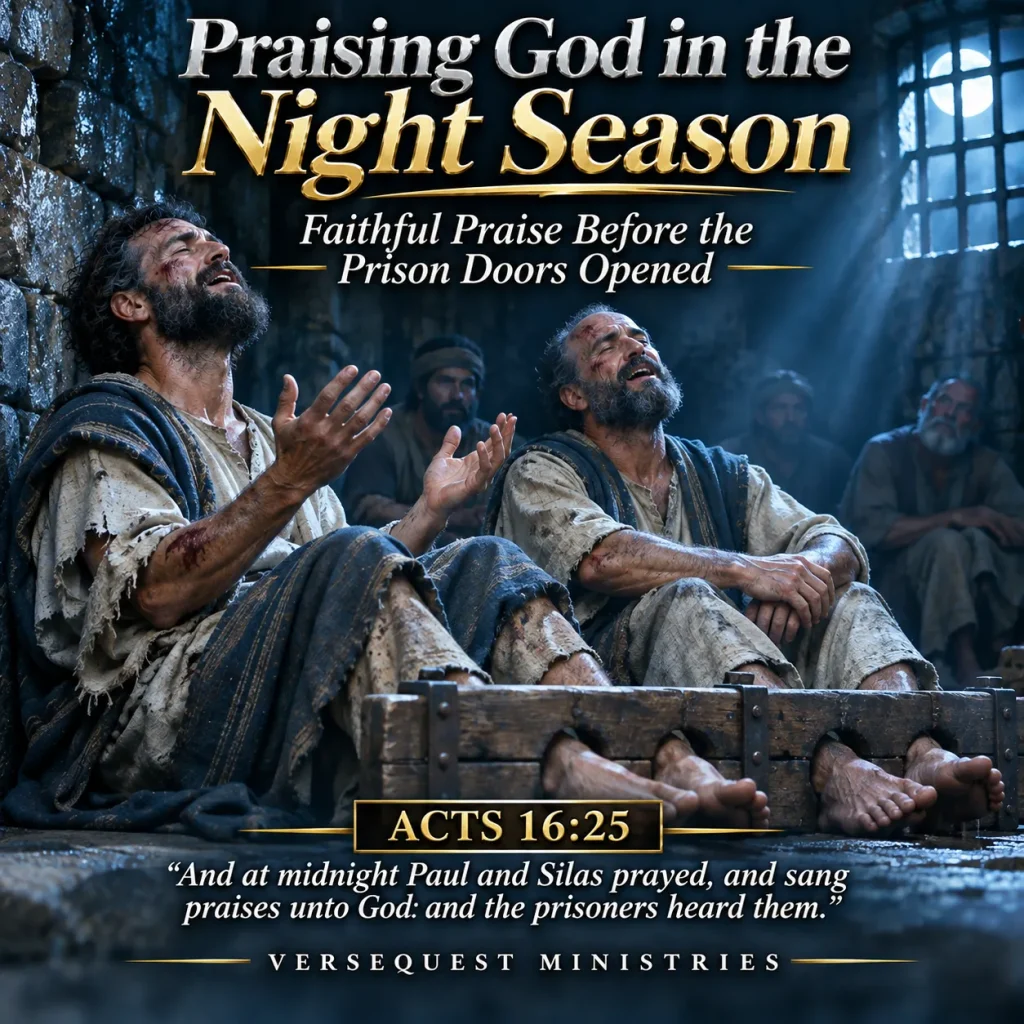
This detailed sermon outline examines Acts 16:25 and the extraordinary testimony of the Apostle Paul and Silas, “And at midnight Paul and Silas prayed, and sang praises unto God: and the prisoners heard them,” revealing the believer’s responsibility to remain faithful in prayer, praise, and Christian testimony even when suffering, persecution, and difficult earthly circumstances have not been removed. The message carefully establishes the historical and doctrinal setting of Acts 16, beginning with Paul’s Macedonian call, the missionaries’ arrival in Philippi, the conversion of Lydia, and the deliverance of a young woman possessed with a spirit of divination whose masters had profited financially from her bondage. Special attention is given to the violent opposition that followed when the woman’s masters discovered their financial gain had disappeared, resulting in Paul and Silas being publicly beaten, imprisoned without proper proceedings, and placed in the inner prison with their feet fastened in stocks. The sermon examines the significance of the midnight hour, the physical suffering endured by the missionaries, and the remarkable fact that they prayed and sang praises unto God before any miraculous deliverance had occurred. It explores why genuine biblical praise must be grounded in the unchanging worthiness of Jesus Christ rather than favorable circumstances, immediate answers to prayer, or the promise that every earthly difficulty will disappear. Drawing upon Acts 16:25–40, Romans 8, 2 Corinthians 4 and 12, Philippians 1 and 4, Colossians 3, and other supporting passages, the outline examines the relationship between prayer, thanksgiving, spiritual perseverance, Christian suffering, and the sufficiency of divine grace. Particular emphasis is placed upon the statement “and the prisoners heard them,” demonstrating how faithful conduct during adversity can become a powerful testimony before people who might otherwise never hear the gospel. The message also examines the miraculous earthquake that shook the prison, opened its doors, and loosed the prisoners’ bands, carefully distinguishing this extraordinary apostolic event from the false teaching that sufficient prayer or praise guarantees immediate deliverance from every illness, persecution, financial hardship, or personal difficulty. The sermon follows the Philippian jailer’s response to the earthquake, Paul’s urgent intervention when the jailer prepared to take his own life, and the jailer’s life-changing question, “Sirs, what must I do to be saved?” Special consideration is given to the apostolic answer, “Believe on the Lord Jesus Christ, and thou shalt be saved, and thy house,” explaining salvation by grace through faith, the necessity of personally believing the gospel, and why baptism and the faith of another household member cannot substitute for an individual’s trust in Jesus Christ. The outline further examines Paul’s assertion of his Roman citizenship, the magistrates’ improper treatment of the missionaries, and why faithful Christian endurance does not require surrendering legitimate legal protections or pretending that injustice is righteous. Finally, the message considers Paul and Silas returning to Lydia’s house to comfort the brethren, demonstrating why faithful service must continue after extraordinary circumstances have passed. Preachers, pastors, teachers, and Bible students will gain a comprehensive, KJV-based, rightly divided, sermon-ready framework for teaching praise during suffering, midnight prayer, Christian perseverance, apostolic miracles, the Philippian jailer’s salvation, biblical faith, the witness of faithful believers, and the importance of glorifying Jesus Christ before, during, and after life’s darkest seasons.
-

November 6, 2026
Series: 1 John 5:4, Victory Over the World
Speaker: Paul Tackett
Topic: 1 John 2:15–17, 1 John 5 sermon outline, 1 John 5:4, biblical spiritual warfare, Christ has overcome the world, Christian Perseverance, Christian victory over sin, eternal security in Christ, faith that overcomes the world, Jesus Christ the Son of God, KJV Sermon Outline, new birth in Christ, overcoming the world by faith, rightly divided Bible study, salvation by grace through faith, sound doctrine and discernment, Victory Over the World, Walking in the Spirit, whatsoever is born of God, worldly lusts and pride
Book: 1 John
This detailed sermon outline examines 1 John 5:4 and the Apostle John’s remarkable declaration, “For whatsoever is born of God overcometh the world: and this is the victory that overcometh the world, even our faith,” revealing the spiritual victory possessed by those who have been born of God through faith in Jesus Christ. The message establishes the passage’s immediate context within 1 John 5:1–5, where the new birth, faith in Jesus as the Christ and Son of God, love for fellow believers, obedience to God’s commandments, and overcoming the world are inseparably connected. It explains why biblical victory does not originate in human determination, religious performance, moral improvement, or the reforming of fallen flesh, but rests upon the saving work of Jesus Christ and the new spiritual life received through faith in Him. Special attention is given to 1 John 2:15–17, where believers are commanded not to love the world, and to the distinction between the physical creation, the lost people whom God desires to save, and the present fallen system characterized by the lust of the flesh, the lust of the eyes, and the pride of life. The sermon examines how worldly values, personal ambition, covetousness, false doctrine, fleshly desires, and the pursuit of human approval can hinder practical Christian faithfulness. Drawing upon Romans 6–8, Galatians 5, Ephesians 6, Colossians 3, and other Pauline passages, the outline explains why believers must walk in the Spirit, renew their minds through Scripture, refuse provision for the flesh, maintain sound doctrine, and exercise biblical discernment. It also examines why genuine spiritual victory should produce love, obedience, holiness, and perseverance without confusing those works with the requirements for obtaining or maintaining eternal salvation. The message further explores John 16:33, where Jesus Christ declares that He has overcome the world, demonstrating why biblical victory does not promise freedom from tribulation, suffering, persecution, or physical death. Finally, the outline emphasizes the assurance of eternal life in 1 John 5:11–13, the believer’s future bodily redemption, and the eternal significance of faithful Christian service. Preachers, pastors, teachers, and Bible students will gain a comprehensive, KJV-based, rightly divided, sermon-ready framework for teaching the new birth, saving faith, victory over worldly influences, practical sanctification, spiritual discernment, eternal security, Christian perseverance, and the everlasting triumph believers possess through the Lord Jesus Christ.
-

November 4, 2026
Series: Hebrews 2:1, The Danger of Spiritual Drift
Speaker: Paul Tackett
Topic: apostolic signs and wonders, Christian Perseverance, Christian spiritual growth, Eternal Security, give the more earnest heed, Hebrews 2 sermon outline, Hebrews 2:1, holding fast to Scripture, importance of Bible study, King James Bible preaching, KJV Sermon Outline, lest we let them slip, neglecting so great salvation, rightly divided Bible study, Sound Doctrine, spiritual negligence, spiritual watchfulness, superiority of Jesus Christ, The Danger of Spiritual Drift, warning against unbelief
Book: Hebrews
This detailed sermon outline examines Hebrews 2:1 and the solemn biblical warning, “Therefore we ought to give the more earnest heed to the things which we have heard, lest at any time we should let them slip,” revealing the danger of spiritual negligence, doctrinal instability, and gradually losing careful attention to divine revelation. The message establishes the passage’s original context within the Book of Hebrews, where the writer has demonstrated the supremacy of Jesus Christ over the angels, His divine authority, His finished work of purging sins, and His exaltation at the right hand of God. It explains why the opening word “Therefore” connects the warning directly to Christ’s superiority, why believers must give earnest attention to God’s revealed truth, and how spiritual drift can develop through continued indifference, neglected biblical instruction, worldly distractions, and increasing susceptibility to false doctrine. Special attention is given to Hebrews 2:1–4, including the warning against neglecting so great salvation, the difference between hearing the gospel and personally believing it, and the divine confirmation of Christ’s message through apostolic witnesses, signs, wonders, and miracles. The sermon carefully distinguishes the historical and doctrinal setting of Hebrews and its warnings concerning unbelief from the Church-Age believer’s eternal security through faith in Jesus Christ, avoiding the erroneous teaching that ordinary spiritual weakness or inconsistent Christian performance can undo the Saviour’s finished work. Drawing upon Hebrews 3–6, Hebrews 12, Ephesians 4, Colossians 2, 2 Timothy 2–3, and other New Testament passages, the outline develops the practical importance of sound doctrine, Scripture rightly divided, spiritual watchfulness, Christian perseverance, renewed thinking, and faithful obedience. It also examines why spiritual negligence can damage Christian growth, weaken biblical discernment, compromise one’s testimony, and waste valuable opportunities for service without invalidating the sufficiency of Christ’s redemption. Preachers, pastors, teachers, and Bible students will gain a comprehensive, KJV-based, rightly divided, sermon-ready framework for teaching the danger of spiritual drift, the authority of God’s Word, the seriousness of neglecting salvation, the preservation of sound doctrine, eternal security, and the importance of remaining firmly established in Jesus Christ rather than being carried away by the changing influences of the world.
-

November 3, 2026
Speaker: Paul Tackett
Topic: 1 Corinthians 4 sermon outline, 1 Corinthians 4:2, biblical faithfulness, Christian Perseverance, faithful Christian stewardship, faithful servants of Christ, faithfulness in ministry, faithfulness over popularity, humility in Christian ministry, Judgment Seat of Christ, King James Bible study, KJV Sermon Outline, quiet Christian service, rewards for faithful service, rightly dividing the word, Salvation by Grace, serving God without recognition, sound doctrine and stewardship, stewards of the mysteries of God, The Quiet Strength of Faithfulness
Book: 1 Corinthians
This detailed sermon outline examines 1 Corinthians 4:2 and the Apostle Paul’s declaration, “Moreover it is required in stewards, that a man be found faithful,” revealing the quiet but indispensable strength of Christian faithfulness and the believer’s responsibility to serve Jesus Christ without seeking worldly recognition or human applause. The message carefully establishes the passage’s original context within Paul’s correction of the Corinthian church, where divisions, carnality, religious personalities, and comparisons between ministers had distracted believers from the true purpose of Christian stewardship. Beginning with 1 Corinthians 4:1–5, the sermon explains why ministers are servants of Christ and stewards of the mysteries of God, emphasizing the responsibility to preserve sound doctrine, rightly divide Scripture, and faithfully handle divine revelation rather than altering biblical truth to attract popularity. It examines why faithfulness is a requirement rather than an optional quality, how the Lord measures stewardship differently from the world, and why public recognition, ministry size, natural ability, religious influence, and impressive accomplishments cannot substitute for humble obedience. Special attention is given to the often-overlooked faithfulness of ordinary Christians, including parents, Bible teachers, church helpers, gospel witnesses, and believers who continue serving faithfully through difficult circumstances without receiving public recognition. Drawing upon 1 Corinthians 3–4, 2 Corinthians 5, Colossians 3, Galatians 6, and other Pauline passages, the outline explores perseverance, humility, freedom from religious competition, faithful service in everyday responsibilities, and the danger of allowing personal ambition to corrupt Christian ministry. The sermon also examines the Judgment Seat of Christ, where the Lord will reveal the hidden motives of the heart and evaluate the quality of Christian service, carefully distinguishing salvation by grace through faith from the rewards or losses associated with the believer’s stewardship. Preachers, pastors, teachers, and Bible students will gain a comprehensive, KJV-based, rightly divided, sermon-ready framework for teaching Christian faithfulness, biblical stewardship, sound doctrine, perseverance, humility, eternal rewards, and the lasting spiritual value of serving Jesus Christ faithfully whether anybody notices or not.
-

August 29, 2026
Speaker: Paul Tackett
Topic: Assurance in Christ, Bible Study Resources, Christian Perseverance, Christian Sanctification, Day of Jesus Christ, Eternal Security, Finished Work of Christ, God Finishes What He Starts, God’s Faithfulness, Good Work in the Believer, Gospel of Grace, Grace That Finishes What It Starts, He Will Perform It, Holy Spirit Seal, KJV Sermon Outline, Philippians 1:6, Philippians 1:6 Sermon Outline, Redemption Day, Rightly Dividing, Spiritual Growth
Book: Philippians
This VerseQuest Ministries sermon outline on Philippians 1:6 explains Paul’s confidence that “he which hath begun a good work in you will perform it until the day of Jesus Christ.” The outline shows that salvation begins with God’s grace, rests upon the death, burial, and resurrection of Jesus Christ, and moves toward the future completion God has promised His blood-bought people. It examines the believer’s fellowship in the gospel, the sealing and earnest of the Holy Spirit, practical spiritual growth, God’s work through trials, the coming day of Jesus Christ, Christian accountability, and the distinction between God’s preserving faithfulness and the believer’s responsibility to obey and serve. Preachers, teachers, and Bible students will gain a strong KJV-based framework for teaching assurance without passivity, sanctification without legalism, and the comforting truth that the God who begins His saving work does not abandon it before redemption is complete.