Sermon Title:
Praising God in the Night Season
Key Passage:
Acts 16:25
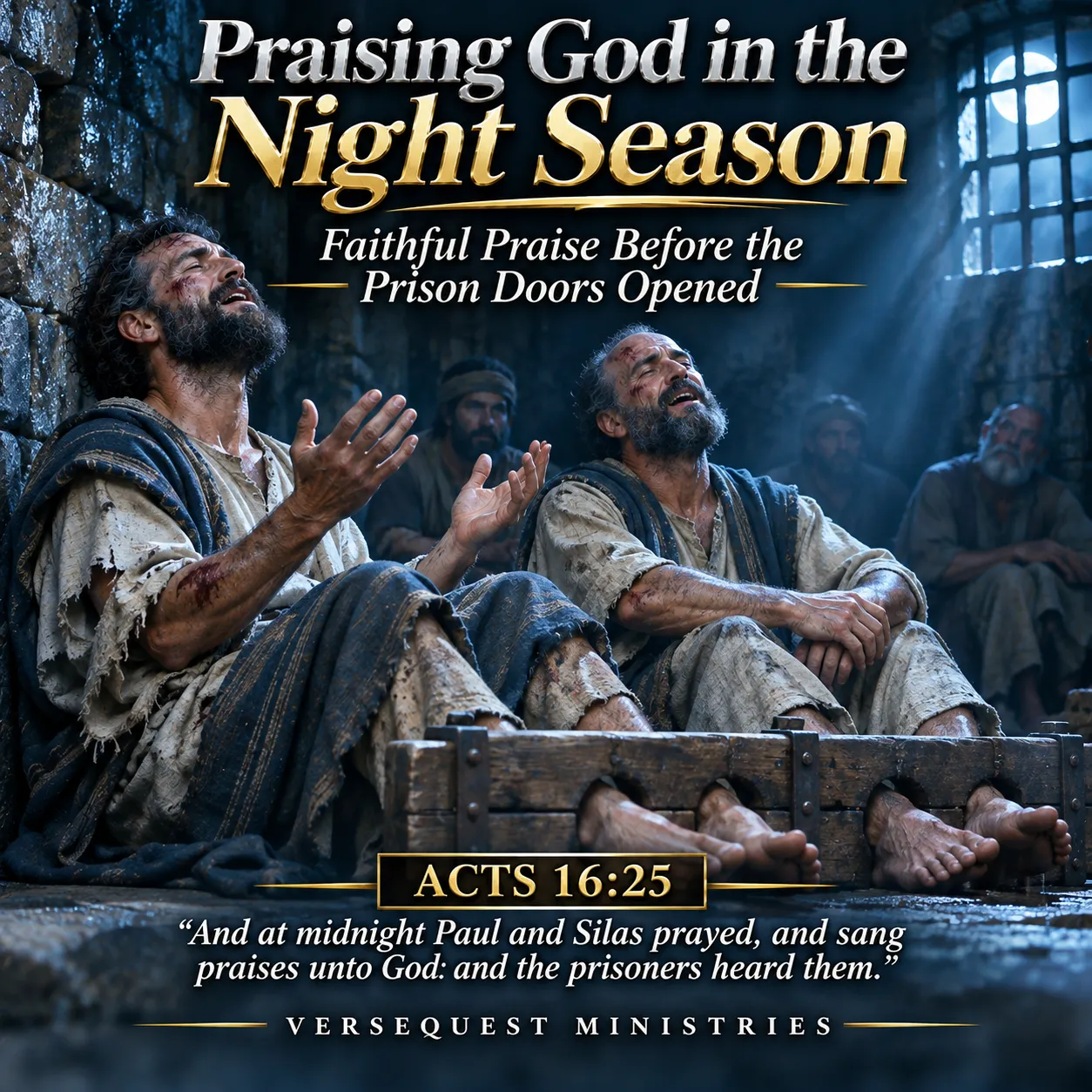
“And at midnight Paul and Silas prayed, and sang praises unto God: and the prisoners heard them.” (Acts 16:25)
Series:
The Book God Gave
Topic:
The Believer’s Responsibility to Praise God Through Suffering, the Midnight Prayers of Paul and Silas, Faithfulness Under Unjust Persecution, the Power of Christian Testimony, the Miraculous Deliverance at Philippi, and the Salvation of the Philippian Jailer Through Faith in the Lord Jesus Christ
Book:
Acts
Speaker:
Paul Tackett
Suggested Sermon Text:
Acts 1:1–11; Acts 2:22–42; Acts 4:13–31; Acts 5:17–42; Acts 7:54–60; Acts 8:1–8; Acts 9:1–31; Acts 12:1–19; Acts 13:1–52; Acts 14:1–28; Acts 15:1–41; Acts 16:1–40; Acts 17:1–34; Acts 18:1–11; Acts 20:17–38; Acts 21:27–40; Acts 22:1–30; Acts 23:1–35; Acts 24:1–27; Acts 25:1–27; Acts 26:1–32; Acts 27:1–44; Acts 28:1–31; Romans 3:21–28; Romans 4:4–8; Romans 5:1–11; Romans 8:1–39; Romans 10:9–17; Romans 12:9–21; Romans 15:30–33; 1 Corinthians 1:18–31; 1 Corinthians 2:1–5; 1 Corinthians 10:13; 1 Corinthians 15:1–4; 2 Corinthians 1:3–11; 2 Corinthians 4:7–18; 2 Corinthians 6:1–10; 2 Corinthians 11:23–33; 2 Corinthians 12:7–10; Galatians 2:20; Galatians 5:16–26; Ephesians 2:8–18; Ephesians 5:18–21; Ephesians 6:10–20; Philippians 1:12–21; Philippians 2:5–11; Philippians 3:7–14; Philippians 4:4–13; Colossians 3:12–17; Colossians 4:2–6; 1 Thessalonians 1:2–10; 1 Thessalonians 5:16–24; 2 Thessalonians 1:3–12; 2 Thessalonians 3:1–5; 1 Timothy 2:1–8; 2 Timothy 1:7–14; 2 Timothy 2:1–15; 2 Timothy 3:10–17; 2 Timothy 4:6–18; Hebrews 4:14–16; Hebrews 11:32–40; Hebrews 12:1–3; James 1:2–8; James 5:13; 1 Peter 1:3–9; 1 Peter 4:12–16; 1 John 5:11–15; Psalm 13:1–6; Psalm 22:1–31; Psalm 27:1–14; Psalm 34:1–22; Psalm 42:1–11; Psalm 46:1–11; Psalm 63:1–11; Psalm 77:1–20; Psalm 92:1–15; Psalm 100:1–5; Psalm 119:49–56, 61–62; Psalm 142:1–7; Isaiah 26:3–4; Isaiah 43:1–7; Habakkuk 3:17–19; Job 1:20–22; Job 2:7–10; Daniel 3:1–30; Matthew 5:10–12; Luke 6:22–23; John 16:33.
Short Sermon Description:
Acts 16:25 records one of the most remarkable demonstrations of prayer, praise, and spiritual faithfulness in the entire Book of Acts: “And at midnight Paul and Silas prayed, and sang praises unto God: and the prisoners heard them.” This sermon examines the extraordinary events surrounding the Apostle Paul’s ministry in Philippi, beginning with the Macedonian call, the conversion of Lydia, the deliverance of a young woman from a spirit of divination, and the violent opposition that followed when her masters realized their financial gain had disappeared. The message establishes why Paul and Silas were publicly beaten, imprisoned, and placed in the inner prison with their feet fastened in stocks, even though they had committed no crime deserving such punishment. Special attention is given to the significance of midnight, the prisoners’ response to hearing Paul and Silas pray and sing praises, and the remarkable fact that these servants of Jesus Christ continued glorifying God while suffering the consequences of faithful gospel ministry. The sermon examines the difference between biblical praise and emotional denial, demonstrating why genuine rejoicing in the Lord does not require believers to pretend that suffering is pleasant or that unjust treatment is acceptable. Drawing upon Acts 16:25–34, the outline explores the miraculous earthquake that shook the prison, opened the doors, and loosed the prisoners’ bands, while distinguishing this extraordinary apostolic event from the false teaching that prayer and praise guarantee immediate deliverance from every earthly affliction. The message also develops the powerful testimony of Paul and Silas before the other prisoners and the Philippian jailer, including Paul’s urgent intervention when the jailer prepared to take his own life. Particular emphasis is placed upon the jailer’s question, “Sirs, what must I do to be saved?” and the apostolic answer, “Believe on the Lord Jesus Christ, and thou shalt be saved, and thy house.” The sermon carefully explains salvation by grace through faith, distinguishing the jailer’s personal belief and the preaching of the word to his household from baptismal regeneration, inherited salvation, and religious works. Additional attention is given to Paul’s lawful assertion of his Roman citizenship, the encouragement of the brethren at Lydia’s house, and the necessity of faithfully serving Christ when the extraordinary circumstances have passed. The outline further connects this historical account with Pauline teaching concerning rejoicing through affliction, sufficient grace, spiritual contentment, and the Christian’s responsibility to pray and give thanks in every circumstance. Preachers, pastors, teachers, and Bible students will gain a comprehensive, KJV-based, rightly divided, sermon-ready framework for teaching praise during suffering, Christian perseverance, divine deliverance, the witness of faithful believers, salvation through Jesus Christ, the proper interpretation of miracles in Acts, and the importance of remaining faithful when the night season has not yet ended.
PRAISING GOD IN THE NIGHT SEASON
Introduction
There is something remarkable about the difference between a Christian who praises God when everything is going well and a Christian who still knows how to praise Him when everything seems to have gone wrong. Give a man a comfortable home, a healthy body, a steady income, a peaceful family, and a congregation that appreciates everything he does, and it may not require a tremendous amount of spiritual maturity for him to announce that the Lord is good. He may sing enthusiastically when the music sounds beautiful, smile broadly when other people encourage him, and offer a public testimony concerning God’s blessings when every earthly circumstance appears favorable. But remove some of those comforts. Allow opposition to arrive. Let an unexpected burden interrupt his plans. Let a difficult season continue beyond the point where he expected relief. Suddenly the question becomes far more serious: Does the Lord remain worthy of praise when the circumstances that made praising Him easy are no longer present? Acts 16:25 places that question before us through one of the most extraordinary scenes in the ministry of the Apostle Paul. The Bible declares, “And at midnight Paul and Silas prayed, and sang praises unto God: and the prisoners heard them.” Consider where these men were. They were not standing in a magnificent sanctuary before an appreciative congregation. They were not enjoying a comfortable evening surrounded by friends. They were prisoners in Philippi, their bodies having been beaten and their feet fastened in stocks. Yet the inspired record does not describe them spending the midnight hour complaining that God had treated them unfairly. It says they prayed and sang praises unto God. The true test of a man’s praise is not merely what comes from his mouth when the blessings are abundant, but whether he still recognizes the worthiness of Jesus Christ when the night becomes dark and the burden has not been removed.
But this account must be examined according to its historical setting rather than reduced to an inspirational story about maintaining a cheerful attitude. Paul and Silas had entered Philippi during the advancement of the gospel into Macedonia. Their arrival followed the remarkable vision recorded in Acts 16, where Paul saw a man of Macedonia requesting help. The missionaries concluded that the Lord had called them to preach the gospel there. In Philippi, Lydia heard the word and received the message, and her household became associated with the growing work. Then a young woman possessing a spirit of divination began following the missionaries. Paul eventually commanded the spirit to come out of her in the name of Jesus Christ. Her masters were not pleased because her condition had been the source of their financial gain. When they realized their profits had disappeared, they seized Paul and Silas, brought them before the authorities, and stirred up accusations against them. The magistrates ordered them beaten with rods and cast into prison. The keeper placed them in the inner prison and fastened their feet in the stocks. That is the road by which Paul and Silas arrived at midnight. They had not been arrested for stealing, violence, or drunkenness. They were suffering because the truth of Jesus Christ had confronted a profitable form of spiritual bondage. The men who were obeying the Lord found themselves in prison, while the men profiting from another person’s bondage were free to accuse them before the magistrates. That should permanently correct the assumption that faithful obedience always produces comfortable earthly circumstances.
There is also a serious danger in the way this passage is often preached. Some religious teachers present the midnight praise of Paul and Silas as though it were a guaranteed formula for escaping every difficulty. According to their reasoning, if the believer sings loudly enough, prays confidently enough, and refuses to acknowledge the seriousness of his circumstances, God must send an earthquake, break his chains, open his doors, and restore everything he has lost. But Acts 16 does not establish that promise. It records an actual miracle that occurred during the apostolic ministry as the gospel advanced into Philippi. The earthquake was real. The prison doors opened. The prisoners’ bands were loosed. Yet the event must not be converted into a mechanical system that requires God to repeat the identical miracle every time a Christian experiences suffering. Paul himself would endure further imprisonments, continued persecution, and eventually the conclusion of his earthly course. His praise did not guarantee the permanent absence of difficulty. Nor should the account become an excuse to tell suffering Christians that their hardships continue because they have not sung enough hymns. The lesson is deeper. Paul and Silas praised God before the earthquake occurred. Their worship was not dependent upon knowing that the doors would open. Their confidence belonged to the Lord, not to the promise of immediate release. And while they were praising, other prisoners were listening. The most important thing about the midnight praise was not that Paul and Silas had discovered a way to make prison doors open. It was that Jesus Christ remained worthy of praise even while those doors were still locked. That is the truth we must examine in Acts 16:25.
I. THE ROAD TO THE MIDNIGHT PRISON BEGAN WITH OBEDIENCE TO THE LORD’S CALL
Key Text: Acts 16:6–15
Supporting Texts: Acts 13:1–4; Acts 14:19–23; Acts 15:36–41; Acts 16:1–15; Romans 10:13–17; 2 Corinthians 5:18–21; Philippians 1:12–21; 2 Timothy 3:10–12
The events of Acts 16 began long before Paul and Silas found themselves singing in prison. The chapter records the apostolic company traveling through various regions while seeking opportunities to proclaim the gospel. They were forbidden of the Holy Ghost to preach the word in Asia at that particular time, and when they attempted to go into Bithynia, the Spirit suffered them not. Then Paul received a vision during the night. Acts 16:9 declares, “There stood a man of Macedonia, and prayed him, saying, Come over into Macedonia, and help us.” The following verse explains that after the vision, the company endeavored to go into Macedonia, concluding that the Lord had called them to preach the gospel there. That historical detail matters because the difficulties they later experienced in Philippi did not arise from abandoning their commission. They had gone where the Lord directed them within the circumstances of that extraordinary apostolic ministry. The gospel was being carried into another region, and the truth of Jesus Christ was about to confront both willing hearers and determined opposition. Sometimes the road of faithful obedience leads through places the flesh would never have chosen, and the presence of difficulty does not prove that the servant has taken a wrong turn.
When the missionaries arrived in Philippi, they did not immediately begin demanding public recognition or seeking positions of earthly influence. Acts 16:13 records them going outside the city by a riverside on the sabbath, where prayer was customarily made. They spoke to the women gathered there, and Lydia, a seller of purple from Thyatira who worshiped God, heard their message. Verse 14 declares that “the Lord opened” her heart, and she attended unto the things spoken by Paul. She and her household were baptized, and she extended hospitality to the missionaries. The chapter therefore introduces Philippi through the hearing of God’s word and the response of those receiving the message. This is important because the later imprisonment did not erase what had already occurred. Before the magistrates ordered the beating, the gospel had been proclaimed, Lydia had responded, and the work was developing. The Christian should recognize that ministry cannot be measured exclusively by its most difficult moment. A servant may encounter fierce opposition while the Lord’s word is also bearing fruit in the lives of hearers. The same city that would imprison Paul and Silas had already become a place where people were receiving the truth of Jesus Christ.
We must also preserve the historical distinction between the extraordinary guidance associated with the apostolic mission and the ordinary responsibilities of believers today. Paul received a vision directing him toward Macedonia, but the Church has not been instructed to expect a comparable vision before every missionary journey, employment decision, or opportunity to serve. The Christian possesses the completed Scriptures and is commanded to study and rightly divide the word of truth. He should pray, seek wisdom, examine circumstances, exercise sound judgment, and obey the instructions God has revealed. Nor should a believer imagine that choosing the correct place of service guarantees freedom from persecution. The commission to preach the gospel does not contain a promise that every hearer will become friendly or every government will treat faithful witnesses fairly. Jesus Christ is worthy of obedience whether opposition comes or not. The Christian who follows the Lord only while the road remains comfortable has made comfort the condition of obedience, and the history of Paul and Silas demonstrates how unreliable that condition can become.
Main Truth: Paul and Silas entered Philippi in obedience to the Lord’s direction, demonstrating that faithful gospel ministry may encounter serious opposition without that opposition proving divine abandonment or disobedience.
II. THE TROUBLE BEGAN WHEN THE TRUTH THREATENED THE PROFITS OF MEN WHO BENEFITED FROM SPIRITUAL BONDAGE
Key Text: Acts 16:16–21
Supporting Texts: Acts 8:9–24; Acts 16:16–24; Acts 19:18–27; Romans 1:16–25; 2 Corinthians 4:1–6; Ephesians 5:11; 1 Timothy 6:6–10; 2 Timothy 4:1–5
Acts 16:16 introduces a young woman whose condition became the immediate occasion for the persecution of Paul and Silas. The Bible declares that she was “possessed with a spirit of divination” and “brought her masters much gain by soothsaying.” Those expressions should not be overlooked. The young woman was experiencing genuine spiritual bondage, while other people were benefiting financially from her condition. She followed Paul and the missionaries, crying out that they were servants of the most high God who showed the way of salvation. Her words contained language that might have sounded favorable to the casual observer, but the source was a spirit of divination. After this continued for many days, Paul was grieved and addressed the spirit directly: “I command thee in the name of Jesus Christ to come out of her” (Acts 16:18). The spirit came out the same hour. That was an extraordinary exercise of apostolic authority in the name of Jesus Christ, and it must be understood as part of the actual historical record. The event was not simply a disagreement between two religious opinions. The power of Jesus Christ confronted an unclean spirit that had held a woman in bondage.
The response of her masters reveals the moral condition of those profiting from her affliction. Acts 16:19 declares, “And when her masters saw that the hope of their gains was gone, they caught Paul and Silas, and drew them into the marketplace unto the rulers.” Notice what finally provoked their action. The passage does not describe the masters rejoicing that the young woman had been delivered from the spirit of divination. It describes them recognizing that their financial gain had disappeared. The deliverance of another human being represented the destruction of their profitable enterprise. They then brought Paul and Silas before the magistrates and accused them of troubling the city and teaching customs unlawful for Romans to receive or observe. Their accusations emphasized public order and Roman identity, while the narrative exposes the financial motive that had triggered their opposition. The men were not outraged because Paul and Silas had injured the woman. They were outraged because the power of Jesus Christ had destroyed the source of income they obtained from her bondage. That distinction should concern anybody who has watched religious and commercial interests become more important than the welfare of the people supposedly being served.
The practical lesson is substantial. Sin often becomes more deeply defended when somebody discovers how to profit from it. A man may tolerate destructive behavior because it produces revenue. A religious organization may refuse correction because acknowledging the truth would threaten its reputation or financial arrangements. A false teacher may continue proclaiming error because people are willing to pay for the promises he makes. But the gospel of Jesus Christ is not a commercial product designed to preserve every profitable arrangement of fallen society. The truth confronts sin, exposes falsehood, and directs sinners toward the Saviour. At the same time, Christians must not claim that every financial dispute or commercial disagreement proves satanic activity. Acts 16 records a specific case involving an actual spirit of divination and apostolic deliverance. It does not authorize believers to invent invisible spiritual explanations for ordinary business difficulties. The Church should remain governed by Scripture, not speculation. When the truth of God threatens the profits of those who exploit deception, we should not be surprised when the defenders of those profits suddenly discover reasons to oppose the truth.
Main Truth: The persecution in Philippi arose after Jesus Christ’s power ended a profitable form of spiritual bondage, revealing how financial self-interest can provoke opposition to the gospel and the deliverance it proclaims.
III. THE BEATING, INNER PRISON, AND STOCKS PROVE THAT FAITHFUL SERVANTS ARE NOT PROMISED FREEDOM FROM UNJUST SUFFERING
Key Text: Acts 16:22–24
Supporting Texts: Acts 5:40–42; Acts 14:19–22; Acts 16:22–24, 35–40; 2 Corinthians 4:7–18; 2 Corinthians 6:4–10; 2 Corinthians 11:23–27; Philippians 1:12–21; 2 Timothy 3:10–12; 1 Peter 4:12–16
The persecution quickly became physical. Acts 16:22 declares, “And the multitude rose up together against them: and the magistrates rent off their clothes, and commanded to beat them.” Verse 23 continues, “And when they had laid many stripes upon them, they cast them into prison, charging the jailor to keep them safely.” These were not minor inconveniences. Paul and Silas had been stripped, beaten, and imprisoned by the authorities. Their suffering was real, and the narrative provides no reason to pretend that the wounds were painless or the humiliation insignificant. The same men who had been proclaiming the gospel were now being punished before the public. Then the jailer, having received his charge, thrust them into the inner prison and made their feet fast in the stocks. The circumstances were designed to restrain their movement and ensure confinement. They were not enjoying the comforts of a private room with a convenient opportunity for devotional reflection. They were wounded prisoners under the authority of men who had treated them unjustly. There was nothing comfortable about the place where Paul and Silas would soon begin praising God, and the Bible does not require us to pretend otherwise in order to recognize their faithfulness.
That detail challenges the idea that spiritual obedience always produces earthly protection from harm. Some religious teachers have convinced believers that a person who truly trusts God will never experience serious persecution, physical suffering, financial difficulty, or public injustice. But the Apostle Paul experienced all of those things while faithfully serving the Lord. In 2 Corinthians 11, he would later describe repeated beatings, imprisonments, dangers, and hardships associated with his ministry. His suffering did not prove that the gospel was powerless. His imprisonment did not mean Jesus Christ had ceased being the risen Saviour. Nor did the injustice of the magistrates demonstrate that the Lord approved their actions. Evil remains evil even when God sustains His servants through its consequences. The Christian should also recognize that suffering does not automatically establish righteousness. A man may experience punishment because of genuine wrongdoing, and Scripture does not authorize him to claim persecution merely because the consequences are unpleasant. But Paul and Silas were suffering in connection with faithful gospel ministry, and their example demonstrates that obedience does not eliminate every earthly danger. The servant who measures God’s faithfulness by whether he has escaped every difficult circumstance will find it impossible to explain much of the Apostle Paul’s ministry.
There is another important detail that should not be forgotten. Paul would later reveal that he and Silas had been beaten publicly and uncondemned, although they were Romans. Acts 16:37 records his objection to that treatment. The legal significance of their citizenship becomes clear near the end of the account, but the immediate circumstances were already unjust. Their later assertion of lawful rights demonstrates that Christian endurance does not require pretending wrongful treatment was acceptable. A saved man may respond faithfully under persecution while also seeking appropriate legal protection, accountability, or relief. The Christian is not commanded to become a willing participant in every abuse of human authority. Nor does prayer require him to refuse legitimate assistance. Paul and Silas could praise God in prison without thereby approving the actions of the magistrates who placed them there. Praising God in the night season is not declaring that the men who caused the suffering were righteous. It is declaring that the Lord remains worthy of praise even when unrighteous men have caused genuine harm.
Main Truth: Paul and Silas suffered unjust beating and imprisonment while faithfully serving Jesus Christ, demonstrating that godliness does not guarantee earthly comfort and that praise through suffering does not excuse or approve the injustice that caused it.
IV. “AT MIDNIGHT PAUL AND SILAS PRAYED, AND SANG PRAISES UNTO GOD” REVEALS WORSHIP THAT WAS NOT DEPENDENT UPON DELIVERANCE
Key Text: Acts 16:25
Supporting Texts: Psalm 34:1–8; Psalm 42:5–11; Psalm 77:1–20; Psalm 119:61–62; Habakkuk 3:17–19; Acts 5:40–42; Romans 12:12; Ephesians 5:18–20; Colossians 3:16–17; Philippians 4:4–9; 1 Thessalonians 5:16–18
Then comes the verse that gives this sermon its title: “And at midnight Paul and Silas prayed, and sang praises unto God: and the prisoners heard them.” The first words are important: “And at midnight.” The day had already brought unjust accusations, public humiliation, physical beating, and imprisonment. Now the night had arrived, and the two missionaries remained confined with their feet in the stocks. The passage does not tell us that they knew an earthquake was coming. It does not record an angel visiting them beforehand to announce that their imprisonment would end before morning. Neither does it say they had received a private promise that they would be released if they sang long enough. Their praise arose while the doors were still locked. Their prayers were offered while the wounds of their beating remained. That is what makes the account so remarkable. They were not praising God because the deliverance had already occurred. They were praising God while they were still suffering. There is a tremendous difference between praising God because the prison doors have opened and praising Him because He remains worthy even while those doors are closed.
Notice also that Luke records two activities: they “prayed, and sang praises unto God.” Prayer expresses dependence upon the Lord, while praise acknowledges His worthiness, character, and works. The two belong together, especially when the believer is experiencing genuine hardship. The Bible does not identify the particular words Paul and Silas prayed or the exact hymns they sang. We should not invent a detailed conversation between them or pretend to know which psalm they selected. The inspired record gives us what is necessary: they prayed, and they praised God. Their worship was not directed toward the magistrates who had beaten them or the prisoners who would hear them. It was directed toward the Lord. The experience also illustrates a principle found throughout Scripture. Psalm 119:62 declares, “At midnight I will rise to give thanks unto thee because of thy righteous judgments.” Habakkuk 3:17–18 describes the failure of ordinary agricultural provision and then declares, “Yet I will rejoice in the LORD, I will joy in the God of my salvation.” Those passages belong to their particular Old Testament settings, but they reveal that praise need not depend upon prosperity. The Christian may recognize a genuine burden while remaining thankful for the Saviour whose finished work and eternal promises have not changed.
This does not mean the believer must manufacture happiness or pretend suffering is pleasant. Scripture never commands Christians to call cruelty righteous, declare that sickness is enjoyable, or suppress every expression of grief. The Apostle Paul himself described sorrow, distress, infirmity, and the burdens associated with ministry. In 2 Corinthians 12, he asked the Lord three times to remove his thorn in the flesh. Yet Christ answered, “My grace is sufficient for thee: for my strength is made perfect in weakness.” The believer’s praise should therefore be grounded in the Lord’s character and promises rather than the denial of reality. A Christian may be grieving and still remember the resurrection. He may be financially burdened while remaining grateful for salvation. He may experience opposition while trusting that the gospel remains true. He may lack understanding concerning tomorrow while knowing that Jesus Christ is alive. Praising God in the night season does not mean the night has stopped being dark. It means the Christian has remembered that the darkness has not changed the God he worships.
Main Truth: Paul and Silas prayed and praised God before their deliverance occurred, demonstrating that genuine Christian worship rests upon the Lord’s unchanging worthiness rather than the immediate removal of suffering.
V. “THE PRISONERS HEARD THEM” SHOWS THAT FAITHFUL PRAISE BECOMES A TESTIMONY BEFORE AN UNEXPECTED AUDIENCE
Key Text: Acts 16:25
Supporting Texts: Acts 16:25–34; Matthew 5:14–16; Romans 12:9–21; 2 Corinthians 4:7–12; Philippians 1:12–18; Colossians 4:2–6; 1 Thessalonians 1:6–8; 1 Peter 3:14–16
The closing words of Acts 16:25 contain a detail that deserves far more attention than it often receives: “and the prisoners heard them.” Luke does not merely tell us that Paul and Silas prayed privately. He specifically identifies the other prisoners as listeners. These men were not attending a scheduled worship service. They had not purchased tickets to hear Christian musicians or entered a church building because they wanted religious instruction. They were confined in prison. Yet during the midnight hour, they heard two men who had been beaten and imprisoned praying and singing praises unto God. That is a remarkable testimony. The prisoners knew something of the circumstances because the two missionaries had been brought into the prison under punishment. Now they were hearing worship from the very men who had suffered it. The contrast would have been difficult to ignore. Their fellow prisoners were not celebrating personal prosperity. They were acknowledging God from within the same place of confinement. Sometimes the strongest testimony a Christian gives is heard by people he never intended to address, at a moment when his circumstances make faithfulness far more noticeable than comfortable words ever could.
We must not read more into the verse than it actually states. The text says the prisoners heard Paul and Silas. It does not tell us that every prisoner believed the gospel that night. It does not provide their names, spiritual histories, or eventual destinations. The miraculous earthquake would shortly affect all of them, but we should not transform that event into an invented account of universal conversion. Nevertheless, the statement demonstrates that their praise was audible to others and became part of the extraordinary circumstances surrounding the jailer’s later encounter with the gospel. This should cause Christians to recognize that their conduct under difficulty may communicate something important about the truth they profess. A man can preach confidently concerning grace while circumstances are comfortable. The question becomes more searching when he experiences opposition, loss, or disappointment. Does he abandon every principle he previously proclaimed? Does bitterness become the substance of his speech? Does he begin denying the promises of God because earthly events have become unfavorable? Or does he continue trusting the Lord without pretending that the hardship is imaginary? The world does not merely hear what Christians say about their faith. It also observes what happens to their profession when faithfulness becomes costly.
There is also a warning against converting public testimony into religious performance. Paul and Silas were singing “praises unto God.” The prisoners heard them, but the Lord remained the object of their worship. That distinction matters because a man may become so interested in appearing courageous that his testimony becomes another opportunity for personal exaltation. He may begin arranging every hardship into an impressive public story designed to increase his reputation. But faithful testimony does not require exaggerated accounts, manufactured persecution, or emotional performances. It requires truth. A Christian facing difficulty should pray sincerely, speak honestly, maintain sound doctrine, and obey Scripture according to the responsibilities before him. Others may observe that faithfulness, but their observation is not supposed to become the ultimate purpose of his devotion. Philippians 1 reveals that even Paul’s bonds contributed to the furtherance of the gospel. His imprisonment did not silence every opportunity for witness. The Christian should never make human admiration the reason for his praise, but he should remember that other people may be listening when he chooses either to glorify the Lord or surrender his testimony to the flesh.
Main Truth: The prisoners’ hearing of Paul and Silas demonstrates that faithful worship during suffering can become a powerful testimony before others, while praise must remain directed toward God rather than performed for human recognition.
VI. THE MIDNIGHT EARTHQUAKE WAS A GENUINE MIRACLE, NOT A UNIVERSAL FORMULA FOR ESCAPING EVERY EARTHLY PRISON
Key Text: Acts 16:26
Supporting Texts: Acts 5:17–21; Acts 12:1–19; Acts 16:25–34; Acts 19:11–12; 2 Corinthians 4:7–18; 2 Corinthians 11:23–33; 2 Corinthians 12:7–10; Philippians 1:12–21; Hebrews 11:32–40
Acts 16:26 records the extraordinary intervention that followed the midnight prayer and praise: “And suddenly there was a great earthquake, so that the foundations of the prison were shaken: and immediately all the doors were opened, and every one’s bands were loosed.” The language describes an actual miracle, not merely a poetic illustration of emotional freedom. The prison was shaken. The doors opened. The prisoners’ restraints were released. The event occurred during the historical apostolic ministry in Philippi and became the occasion for the extraordinary events that followed. The Christian should not attempt to explain away the miracle simply because it exceeds ordinary human experience. The God who created all things possesses power over His creation. Scripture records the event plainly, and the proper response is to believe what God has written. But notice something else. The miracle affected more than Paul and Silas. Luke declares that “every one’s bands were loosed.” The other prisoners experienced the physical consequences of the earthquake even though the passage does not establish that they had all become believers. The event was extraordinary in its scope and circumstances, and the inspired record directs our attention toward what happened next.
Yet the preacher must distinguish a historical event from an unconditional promise addressed to every believer in every generation. Acts records a period in which the gospel was advancing through the ministry of the apostles and extraordinary signs accompanied that ministry. Not every event in Acts establishes a permanent pattern requiring identical circumstances to occur in the Church today. Peter was delivered from prison in Acts 12, but the same chapter records the death of James, the brother of John, by the sword. Paul and Silas were released from the stocks at Philippi, yet Paul would experience additional imprisonments afterward. Hebrews 11 records faithful servants who experienced remarkable deliverance alongside others who endured persecution, imprisonment, and death. The existence of divine miracles does not establish that every faithful Christian must receive the same earthly outcome. If singing praises automatically required God to open prison doors, the Apostle Paul would never have experienced another imprisonment after Philippi. Scripture itself disproves the formula some preachers have invented from this account.
This distinction also protects suffering believers from cruel and unbiblical accusations. A Christian may pray faithfully and remain ill. Another may praise God through financial hardship while the difficulty continues. A missionary may remain imprisoned despite the prayers of many saints. A family may endure grief that no amount of religious enthusiasm can immediately remove. Those circumstances do not automatically prove defective faith. The Lord may deliver His people from a particular danger, supply help through ordinary means, or provide sufficient grace while the burden remains. We have no authority to promise a miraculous earthquake whenever a person sings in adversity. Neither should we deny that God is able to intervene according to His will. The believer may ask for deliverance while submitting the outcome to the Lord’s wisdom. Paul himself would later learn that Christ’s grace could remain sufficient even when a thorn was not removed. God’s power is not limited to opening the prison door, and His faithfulness is not disproved when He supplies strength to remain faithful behind a door that has not yet opened.
Main Truth: The earthquake at Philippi was a genuine and extraordinary divine intervention, but it must not be distorted into a guarantee that every Christian who prays and praises God will receive immediate physical deliverance from suffering.
VII. THE JAILER’S CRISIS REVEALS THAT GOD’S DELIVERANCE WAS LEADING TOWARD SOMETHING GREATER THAN AN OPEN PRISON DOOR
Key Text: Acts 16:27–30
Supporting Texts: Acts 16:25–34; Acts 4:10–12; Romans 3:21–28; Romans 5:1–11; Romans 10:9–17; 2 Corinthians 5:18–21; Philippians 1:12–21; 1 Timothy 2:3–6
The earthquake produced an immediate crisis for the Philippian jailer. Acts 16:27 declares, “And the keeper of the prison awaking out of his sleep, and seeing the prison doors open, he drew out his sword, and would have killed himself, supposing that the prisoners had been fled.” The man had been entrusted with the custody of prisoners, and the opened doors caused him to assume they had escaped. His fear was so great that he prepared to take his own life. But Paul intervened. Verse 28 records him crying with a loud voice, “Do thyself no harm: for we are all here.” That statement is extraordinary for several reasons. Paul had been beaten, unjustly imprisoned, and placed in the stocks under the jailer’s custody. Yet when the opportunity arose to prevent the man from killing himself, Paul did not remain silent. He did not celebrate the jailer’s distress or announce that the man deserved whatever happened to him. He urgently called upon him to do himself no harm. The same apostle who had suffered unjustly now exercised concern for the life of the man responsible for guarding him. The Christian who truly understands grace should not become so consumed with the wrongs committed against him that he loses every concern for the spiritual and physical welfare of those involved.
There is another detail that deserves attention: Paul declared, “we are all here.” The doors had opened, and the bands had been loosed, but the prisoners had not fled. The text does not explain every individual’s reason for remaining, and we should not invent private conversations or motives that Luke never records. Nevertheless, the fact is unmistakable. The jailer expected the prisoners to be gone, but they were still present. The man who had prepared to die discovered that the feared escape had not occurred. He then called for a light, sprang in, came trembling, and fell down before Paul and Silas. The narrative moves from opened prison doors toward a frightened man’s encounter with the servants of Jesus Christ. The earthquake was impressive, but the resulting question was more important than the physical disturbance itself. Acts 16:30 records the jailer bringing them out and asking, “Sirs, what must I do to be saved?” The apostolic response would direct him toward salvation through the Lord Jesus Christ. The historical narrative therefore moves from the confinement of missionaries to the proclamation of the gospel within the jailer’s own household.
We should not misuse this event by telling Christians that every crisis involving another person is secretly a guaranteed opportunity for that person to become saved. Not every individual who experiences a miracle believes the gospel, and not every frightened person responds to suffering with genuine faith. But Acts 16 demonstrates how the Lord used these extraordinary circumstances in the advancement of His word. Paul and Silas had entered prison as men being punished for gospel ministry. They had prayed and praised God while confined. Other prisoners had heard them. Then the earthquake occurred, and the jailer found himself confronting a crisis that brought him before the missionaries with the most important question he could ask. This also demonstrates why the Christian should be prepared to communicate the gospel when an opportunity appears, rather than becoming so preoccupied with his own suffering that he refuses to consider the spiritual needs of others. The prison doors opened, but the greatest event of the night was not the movement of stone and iron. It was that a man who had been facing death was about to hear how to receive eternal life through Jesus Christ.
Main Truth: The earthquake brought the jailer into a crisis that led him to ask about salvation, while Paul’s intervention demonstrated compassion and created the occasion for a clear proclamation of the gospel.
VIII. “BELIEVE ON THE LORD JESUS CHRIST” ESTABLISHES THAT SALVATION IS THROUGH FAITH, NOT THROUGH SUFFERING, MIRACLES, OR BAPTISM
Key Text: Acts 16:30–34
Supporting Texts: Acts 4:10–12; Acts 13:38–39; Acts 16:30–34; Romans 3:21–28; Romans 4:4–8; Romans 5:1–2; Romans 10:9–13; 1 Corinthians 1:17; 1 Corinthians 15:1–4; Ephesians 2:8–10; Titus 3:4–7
The jailer’s question deserves careful attention: “Sirs, what must I do to be saved?” The Apostle Paul and Silas did not respond by telling him to improve his character until he became worthy of salvation. They did not instruct him to join a religious organization, complete an elaborate ceremony, purchase forgiveness through charitable works, or obtain another mediator to stand between him and God. Acts 16:31 records the answer: “Believe on the Lord Jesus Christ, and thou shalt be saved, and thy house.” That declaration should be read with the simplicity and authority of Scripture. The necessary object of faith is the Lord Jesus Christ. Salvation does not come from the jailer’s fear, the earthquake, the prayers of Paul and Silas, or the extraordinary circumstances that brought him before the missionaries. It comes through the Saviour whom they proclaimed. The gospel revealed for the present dispensation declares that Christ died for our sins according to the Scriptures, was buried, and rose again the third day according to the Scriptures. The sinner who believes on the Lord Jesus Christ receives salvation through His finished work. The apostolic answer was not, “Perform enough religious works to make yourself acceptable.” It was, “Believe on the Lord Jesus Christ, and thou shalt be saved.”
But we must also examine the phrase “and thy house” without inventing a doctrine of automatic household salvation. Paul was not teaching that the jailer’s personal faith would regenerate every member of his household regardless of their own response to the gospel. Verse 32 immediately explains, “And they spake unto him the word of the Lord, and to all that were in his house.” The message was proclaimed to those in the household. Verse 34 later describes the rejoicing associated with believing in God with all his house. The household was not saved because one man’s faith could be transferred automatically to other people. The same Saviour was available to them, and the word of the Lord was spoken to them. This distinction is important because salvation is not inherited through family relationships. A child does not become saved simply because his father is a Christian. A wife does not automatically possess eternal life because her husband believes the gospel. A family may attend the same congregation and participate in the same religious customs while individuals within it remain in need of personal faith in Jesus Christ. The jailer was told how he could be saved, his household heard the word of the Lord, and the passage gives no permission to replace individual belief with the religious standing of another family member.
Acts 16:33 also records that the jailer washed the missionaries’ stripes and was baptized, he and all his, straightway. That sequence must not be reversed into baptismal regeneration. The apostolic answer concerning salvation had already been given: “Believe on the Lord Jesus Christ.” The word was preached, and baptism followed in the narrative. Romans 4:5 declares that God justifies the ungodly who believe on Him. Ephesians 2:8–9 explains salvation by grace through faith, not of works. First Corinthians 1:17 records Paul saying, “For Christ sent me not to baptize, but to preach the gospel.” That statement would be inexplicable if water baptism were the indispensable act by which the sinner obtained eternal life. Baptism has its proper place in biblical history and Christian obedience, but it must not be confused with the blood of Jesus Christ or made a substitute for faith in His finished work. Likewise, the jailer’s washing of Paul and Silas did not purchase his salvation. It was a response demonstrating concern for men who had suffered. The earthquake could open a prison door, and baptism could place a man beneath water, but neither could accomplish what the blood of Jesus Christ accomplished for the salvation of sinners.
Main Truth: The Philippian jailer and his household were directed toward salvation through faith in the Lord Jesus Christ, while baptism and subsequent acts of kindness must remain distinguished from the finished work through which eternal life is received.
IX. WHEN MORNING CAME, PAUL REMAINED FAITHFUL TO THE TRUTH AND COMFORTED THE BRETHREN BEFORE DEPARTING
Key Text: Acts 16:35–40
Supporting Texts: Acts 16:22–40; Acts 22:22–30; Acts 25:10–12; Romans 12:17–21; 2 Corinthians 4:1–18; Philippians 1:3–30; Philippians 4:4–13; 2 Timothy 4:1–8
The final portion of the narrative is frequently overlooked because the earthquake and the jailer’s salvation receive so much attention. But Acts 16 does not end at midnight. When day came, the magistrates sent officers instructing the keeper to release Paul and Silas. The jailer communicated the order, and it appeared that the matter might conclude quietly. But Paul refused to permit the authorities to dismiss their unlawful treatment without acknowledgment. Acts 16:37 records his response: “They have beaten us openly uncondemned, being Romans, and have cast us into prison; and now do they thrust us out privily? nay verily; but let them come themselves and fetch us out.” Paul was asserting a legitimate legal distinction concerning his Roman citizenship and the punishment inflicted without proper proceedings. The magistrates became afraid when they learned that the men were Romans. They came, besought them, brought them out, and desired them to depart from the city. This is important because the apostle who praised God under unjust treatment did not thereby surrender every lawful protection available to him. Christian patience does not require calling injustice righteous, and praising God through persecution does not mean a believer must pretend the wrongdoing never occurred.
There is a practical balance here that deserves careful preaching. Some Christians interpret endurance under suffering as though it required complete passivity toward every form of mistreatment. Others react to injustice by immediately abandoning charity, making personal vengeance their principal objective, and forgetting every biblical instruction concerning honesty and self-control. Paul’s conduct provides a useful historical example of a different approach. He endured unjust punishment without surrendering his faith. He praised the Lord while imprisoned. He intervened to prevent the jailer from harming himself. He proclaimed salvation through Jesus Christ. And when the proper occasion arrived, he asserted his lawful citizenship before the authorities responsible for the beating. There is no contradiction between these actions. The Christian may pray for those who mistreat him while seeking lawful accountability. He may refuse personal vengeance while exercising legitimate protections. He may endure a difficult situation faithfully without pretending that the person responsible has acted honorably. A believer does not have to choose between praising God and telling the truth about an injustice. Scripture requires him to remain faithful in both.
Then Acts 16:40 records the conclusion: “And they went out of the prison, and entered into the house of Lydia: and when they had seen the brethren, they comforted them, and departed.” That verse brings the narrative back to the developing fellowship of believers in Philippi. Before the imprisonment, Lydia had received the word and welcomed the missionaries. After the extraordinary events of the night, Paul and Silas returned to her house, saw the brethren, and comforted them. Consider that final detail. The men who had been beaten and imprisoned did not become so occupied with celebrating their own deliverance that they forgot the needs of the other believers. They continued their ministry. They encouraged the saints and then departed. The gospel had been proclaimed, opposition had occurred, the jailer and his household had heard the word, and the work continued. The record does not say that every hardship in Philippi permanently disappeared or that the new believers would never encounter opposition. The Church would need instruction, perseverance, and faithfulness in the days ahead. The night season had produced an extraordinary testimony, but the following morning still contained the ordinary responsibilities of Christian service. The believer who praises God during a crisis must also be willing to obey Him when the crisis has passed.
Main Truth: Paul’s lawful response to unjust treatment and his continued encouragement of the brethren demonstrate that faithful endurance includes truthful accountability, practical wisdom, Christian fellowship, and continuing service after deliverance occurs.
Conclusion
Acts 16:25 records a testimony that ought to remain in the memory of every Christian who has ever experienced suffering while attempting to serve the Lord faithfully: “And at midnight Paul and Silas prayed, and sang praises unto God: and the prisoners heard them.” The circumstances surrounding that verse were anything but comfortable. Paul and Silas had entered Macedonia following the Lord’s extraordinary direction during their apostolic ministry. They had proclaimed the gospel in Philippi, witnessed the response of Lydia, and encountered a young woman possessed with a spirit of divination whose condition had become a source of financial profit for her masters. When Paul commanded that spirit to come out in the name of Jesus Christ, those who benefited financially from her bondage became furious. They seized the missionaries, stirred up accusations, and brought them before authorities who ordered them beaten and imprisoned. The two servants of Christ were placed in the inner prison with their feet fastened in stocks. Yet at midnight they prayed and sang praises unto God. The Bible does not describe them receiving advance knowledge of the earthquake. Their praise came before the miracle. Their worship was offered before the prison doors opened. Their confidence rested upon the Lord while their circumstances remained painful and uncertain. Then the earthquake occurred, the prison was shaken, and the events that followed brought the Philippian jailer to the question of salvation. The great lesson of the midnight prison is not that Christians can sing loudly enough to force God to change their circumstances. It is that Jesus Christ remains worthy of praise before the circumstances have changed at all.
The account must also be interpreted according to its historical and dispensational setting. Acts records the advancement of the gospel through the ministry of the apostles, including extraordinary signs and miracles that accompanied that period. The earthquake at Philippi was a genuine divine intervention, but Scripture does not establish it as a promise that every suffering Christian will receive the identical form of deliverance. Some believers have been released from prisons, while others have remained confined. Some have experienced healing, while others have endured prolonged weakness. Some have escaped persecution, while others have suffered death because of their faithful testimony. These differing outcomes do not determine whether Jesus Christ remains the Saviour or whether His grace is sufficient. The Apostle Paul himself would experience further imprisonment and suffering after Philippi. He would also testify that the Lord’s strength was made perfect through weakness. Yet the miracle in Acts 16 served a greater purpose than the physical release of two missionaries. The jailer confronted his own need for salvation and asked, “Sirs, what must I do to be saved?” Paul and Silas answered, “Believe on the Lord Jesus Christ, and thou shalt be saved, and thy house.” The word of the Lord was then proclaimed to his household. Salvation was not purchased through the earthquake, the prisoners’ praise, the jailer’s hospitality, or the baptism that followed. It came through faith in Jesus Christ. The prison doors opened by a miraculous act of God, but the message proclaimed inside that prison concerned the eternal salvation accomplished through the death, burial, and resurrection of the Lord Jesus Christ.
So take the King James Bible and examine what happens to your praise when the night season arrives. Do you continue recognizing the goodness of God when the circumstances that once made thanksgiving easy have disappeared? Have you allowed suffering to convince you that the Lord has abandoned you, even though His word records faithful servants enduring tremendous hardship? Are you seeking the Father through prayer while bringing your burdens before Him with thanksgiving, or have you become so occupied with what you want changed that you rarely remember the blessings already received? Have you allowed religious teachers to persuade you that every unanswered request proves defective faith? Are you demanding a miraculous earthquake before you will acknowledge the worthiness of Jesus Christ? And when other people observe your conduct under difficulty, do they hear the truth of the gospel and recognize your continuing dependence upon the Lord, or do they encounter a Christian whose entire profession disappears whenever life becomes unpleasant? These questions are not intended to suggest that suffering is imaginary or that believers must never grieve. Paul and Silas had real wounds. They had suffered genuine injustice. They possessed legitimate reasons to seek relief and accountability. Yet their circumstances did not silence their praise. Return to the Book. Study Acts 16 in its complete setting. Examine the apostolic ministry, the salvation of the jailer, and the later teaching of Paul concerning sufficient grace, prayer, thanksgiving, and contentment. Rightly divide the word of truth. Pray faithfully. Praise God sincerely. Seek appropriate assistance when it is needed. Continue serving Christ through the opportunities that remain available. And remember that the Lord’s worthiness is not determined by the ease of your circumstances. The Christian who has learned to praise God in the night season has discovered that the darkness may limit what he can see, but it cannot diminish the glory of the Saviour who redeemed him.
Final Call
If you are lost, the most important lesson of Acts 16 is not that two prisoners experienced a miraculous earthquake. It is the answer given to the man who asked, “Sirs, what must I do to be saved?” You may be suffering through circumstances that other people do not understand. You may be afraid of death, uncertain about eternity, or burdened by the consequences of decisions made long ago. But your greatest need before Almighty God is salvation through Jesus Christ. You cannot obtain eternal life through singing religious songs, repeating prayers, church membership, baptism, charitable works, moral improvement, or the amount of suffering you have endured. Romans 3:23 declares, “For all have sinned, and come short of the glory of God.” The sinner needs redemption, and Jesus Christ has accomplished that redemption through His own blood. First Corinthians 15:3–4 declares “that Christ died for our sins according to the scriptures; And that he was buried, and that he rose again the third day according to the scriptures.” The sinless Son of God died for sinners and rose again victorious over death. Romans 4:5 declares that God justifies the ungodly who believe on Him. Ephesians 2:8–9 teaches salvation by grace through faith, not of works. And Acts 16:31 declares, “Believe on the Lord Jesus Christ, and thou shalt be saved, and thy house.” Do not mistake the experience of an extraordinary event for personal faith in the Saviour. Do not imagine that the faith of another family member can substitute for your own need to believe the gospel. The Philippian jailer was directed toward Jesus Christ, and the word of the Lord was proclaimed to his household. You need that same Saviour. Believe the gospel. Trust the finished work of Jesus Christ. Receive eternal life through faith in the risen Lord. The greatest prison from which a lost sinner needs deliverance is not a building made of stone and iron, but the condemnation of sin—and the only Saviour who can provide that deliverance is Jesus Christ.
If you are saved, remember that the Lord has already redeemed you through His blood, justified you through faith, sealed you with the Holy Spirit, and provided access to the Father through Jesus Christ. Your eternal salvation does not depend upon whether every earthly difficulty has disappeared. Neither does it depend upon maintaining an uninterrupted feeling of happiness through every painful circumstance. But the Lord has instructed you to rejoice in Him, pray without ceasing, give thanks in every thing, and remain faithful through the responsibilities entrusted to you. Stop measuring God’s faithfulness exclusively by whether the prison doors have opened. Stop imagining that the presence of suffering automatically proves the absence of divine help. Stop treating prayer and praise as religious techniques through which you can require the Lord to grant every outcome the flesh desires. Read the Scriptures. Study them. Rightly divide the word of truth. Remember that Paul and Silas praised God before they knew an earthquake was coming. Remember that the other prisoners heard their testimony. Remember that the jailer needed more than an open prison door; he needed salvation through Jesus Christ. Pray for your family, fellow believers, pastors, missionaries, and lost sinners who need to hear the gospel. Praise the Lord for His redemption and promises. Speak the truth with charity. Seek legitimate help when circumstances require it. Exercise lawful protections without surrendering to personal vengeance. Continue faithful Christian service when relief comes, and remain dependent upon the Lord when the burden continues. You may never experience an earthquake that shakes your prison walls, and you may never witness an extraordinary deliverance like the one recorded at Philippi. But you possess the same risen Saviour, the same sufficient grace, and the same gospel of salvation through which Jesus Christ continues saving sinners today. The night season may be long, but the worthiness of the Lord has never depended upon the arrival of morning.
Closing Verse:
“I will bless the LORD at all times: his praise shall continually be in my mouth.” (Psalm 34:1)
Closing Statement:
Paul and Silas did not wait for the prison doors to open before they began praising God—they praised Him while the doors were still locked, the wounds were still painful, and the night was still dark; because the greatest reason for Christian praise is not that every earthly burden has disappeared, but that Jesus Christ remains worthy, His redemption remains complete, and His faithfulness has never depended upon the circumstances surrounding those who belong to Him.