



VerseQuest Daily — February 2027: Love, Family, Fellowship, and the Local Church
VerseQuest Daily — February 2027 is a 61-page downloadable devotional PDF containing twenty-eight KJV studies on biblical love, marriage, family, fellowship, and the local church. Each day includes an assigned Scripture passage, a developed rightly divided devotional, Seven Things to Learn, and a memorable Thought for the Day.
The month progresses from love, kindness, friendship, service, and family responsibility into marriage roles, reconciliation, church unity, spiritual gifts, discipline, separation, restoration, leadership, and counterfeit religious unity. Use it throughout February or begin on any date as a practical twenty-eight-day discipleship study for individuals, couples, families, and churches.
$6.99
Description
VerseQuest Daily — February 2027 is a 61-page downloadable KJV devotional PDF containing twenty-eight daily studies on biblical love, marriage, family responsibility, Christian fellowship, and the local church. This is Month Six of VerseQuest Daily Discipleship Level One: Foundations and Growth. The first five months established the gospel, the believer’s position and walk, prayer and stewardship, the Person and work of Jesus Christ, and confidence in the Bible. February now brings those truths into the believer’s closest relationships and life within the assembly.
Rather than treating love as an undefined religious feeling, these studies present love as truth expressed through devotion, sacrifice, kindness, service, forgiveness, responsibility, order, correction, and restoration. The opening readings address wholehearted love for God, love for one’s neighbor, the Golden Rule, faithful friendship, kindness, honoring parents, and humble service. These foundational lessons expose the difference between sentimental language and love that acts faithfully toward God and others.
The month then examines God’s design for marriage, the sacrificial responsibility of the husband, the wife’s ordered partnership, parental nurture, control of the tongue, bearing burdens, reconciliation, the practices of the first church, humility in fellowship, and Christian hospitality. These readings bring biblical doctrine directly into the home and show that healthy relationships require more than good intentions. They require truth, self-government, responsibility, patience, forgiveness, and obedience to the word of God.
The Meat readings turn toward the Body of Christ and the local assembly. Readers study the interdependence of many members, Christ’s headship over His Body, order within the local church, the purpose of pastors and teachers, church discipline, separation from disorderly believers, unequal yokes, and the meek restoration of fallen Christians. The final Strong Meat studies distinguish the Church from kingdom truth, examine God’s order for pastoral and teaching authority, and contrast biblical unity with the rebellious religious unity represented by Babel.
Each daily portion begins with an assigned passage from the King James Bible and a clearly identified topic. The devotional explains the passage in its proper setting, establishes its doctrine, identifies necessary dispensational distinctions, and applies its truth to Christian life. Every entry concludes with Seven Things to Learn and a memorable Thought for the Day. The month progresses through seven Milk readings, ten Bread readings, eight Meat readings, and three Strong Meat readings.
The PDF may be read on a computer, tablet, or mobile device or printed for regular use. It may be followed throughout February 2027 or begun on any date as a twenty-eight-day discipleship study. It is suited to personal devotions, couples, families, church groups, Sunday school classes, premarital instruction, ministry training, one-to-one discipleship, and small-group Bible study. Its aim is to make love doctrinal, relationships responsible, fellowship truthful, and church life ordered beneath the word of God.
Wholehearted love for God — Biblical love directs the heart, soul, mind, strength, will, and loyalty toward the true God revealed in Scripture. Active love for one’s neighbor — Neighbor-love moves beyond admiration and becomes practical help offered to those God places within reach. The Golden Rule — The believer should measure his conduct toward others by the consideration he would desire to receive. Faithful friendship — Genuine friendship remains present during adversity instead of disappearing when the relationship becomes costly. Mercy, kindness, and forbearance — Christian love is expressed through patient conduct toward imperfect people. Honor within the home — Children are taught to obey and honor parents as part of God’s order for family life. Humble service — Christ’s example places the towel of service before the desire for recognition or title. God’s design for marriage — Marriage originates in creation rather than culture, government, convenience, or personal reinvention. Sacrificial responsibility of husbands — Biblical headship is joined to costly, protective, nourishing, and self-giving love. The wife’s ordered partnership — Biblical submission establishes order without teaching personal worthlessness or competition. Parental nurture and admonition — Fathers bear responsibility to raise children under biblical instruction without provoking them through injustice or inconsistency. Government of the tongue — Words can ignite conflict, damage fellowship, and expose the true condition of the heart. Bearing burdens — Mature believers help carry the spiritual and practical loads of others without encouraging irresponsibility. Reconciliation — Religious activity cannot excuse a stubborn refusal to address known offenses. Practices of the early church — Doctrine, fellowship, prayer, breaking of bread, generosity, and steadfast participation shaped the first assembly. Unity grounded in humility and truth — Biblical unity is preserved through meekness, patience, and sound doctrine rather than manufactured through compromise. Christian hospitality — Believers should welcome and serve others without limiting kindness to familiar or advantageous relationships. Many members in one Body — Every member has a place and function while remaining dependent upon Christ and connected to other believers. Christ as Head of the Church — No human leader or institution may occupy the position belonging exclusively to Jesus Christ. Order in the local assembly — Spiritual zeal does not justify confusion, disorder, self-promotion, or disregard for biblical authority. Pastors and teachers — Ministry leadership is intended to perfect the saints, strengthen the Body, and protect believers from doctrinal instability. Church discipline — Serious public sin cannot be ignored without affecting the health and testimony of the assembly. Biblical separation — Fellowship and binding partnerships must remain governed by truth, holiness, and obedience. Restoration of fallen believers — Correction should seek repentance and recovery while being performed in meekness and self-examination. Church and kingdom distinctions — Related biblical truths must not be confused merely because they appear near one another in Scripture. God’s order in church leadership — The pastoral and authoritative teaching offices are governed by revealed biblical order rather than changing cultural pressure. Counterfeit unity — Agreement, organization, and a common religious voice are not virtuous when united against God’s truth.
- Central argument: Biblical love is not sentimental approval. It is truth expressed through devotion, sacrifice, service, responsibility, correction, forgiveness, separation, and restoration.
- Daily structure: Every entry contains an assigned KJV passage, a defined topic, a developed devotional exposition, Seven Things to Learn, and a Thought for the Day.
- Progressive design: The month contains seven Milk readings, ten Bread readings, eight Meat readings, and three Strong Meat readings.
- Love for God requires truth: A person cannot love the true God while rejecting how He has revealed Himself in Scripture.
- Neighbor-love becomes action: The need beside the road matters more than a carefully protected reputation for compassion.
- The law exposes human failure: No sinner has loved God and neighbor perfectly. Charitable deeds cannot replace salvation through Christ.
- Grace produces service: Salvation is not earned by loving others, but the saved believer has every reason to demonstrate the love received through Christ.
- Friendship is tested by adversity: A friend who remains only while the relationship is convenient has not displayed the faithfulness described in Proverbs.
- Marriage began with God: Genesis 2 establishes marriage before civil government, national law, or human religious systems.
- Marriage roles are complementary: Biblical headship and submission establish order without declaring one spouse more valuable before God.
- Headship requires sacrifice: A husband cannot appeal to authority while ignoring Christ’s example of self-giving love.
- Submission is not servile inferiority: The wife’s ordered partnership should not be distorted into personal worthlessness, abuse, or silence in the face of sin.
- Parents teach by conduct and instruction: Children notice whether biblical correction is consistent with parental example.
- Fathers must not provoke: Authority exercised through humiliation, favoritism, inconsistency, or uncontrolled anger undermines nurture.
- The tongue reveals the heart: Religious speech does not excuse destructive words spoken against people made by God.
- Burden-bearing differs from enabling: Helping another believer does not require protecting him from every consequence of irresponsible conduct.
- Reconciliation requires action: Known offenses should not be hidden behind worship, service, gifts, or public spirituality.
- Acts 2 must be read in context: The practices of doctrine, fellowship, prayer, and steadfast participation remain instructive without forcing every transitional detail upon the Church as an identical command.
- Unity must be preserved, not manufactured: Ephesians 4 speaks of the unity of the Spirit, not unity produced by surrendering doctrine.
- Hospitality serves without guaranteed return: Biblical hospitality reaches beyond friends who can repay the invitation.
- The Body requires many members: No spiritual gift makes one believer the entire Body, and no member should despise his God-given function.
- The universal Body and local assembly are related but distinct: Every saved believer belongs to Christ’s Body, while local churches function as visible assemblies with order and responsibility.
- Christ alone is Head: Pastors lead under Christ; they do not replace Him.
- Spiritual gifts serve maturity: Gifts were not given to create celebrities but to strengthen saints and build the Body.
- Church discipline protects the assembly: Tolerated public sin spreads like leaven and weakens both doctrine and testimony.
- Discipline must not become revenge: Its purposes include purity, warning, repentance, and possible restoration.
- Disorderly believers remain brethren: Second Thessalonians 3 commands withdrawal while forbidding treatment of the offender as an enemy.
- The unequal yoke concerns binding partnerships: Separation does not require refusing all contact with unbelievers, but it forbids unions that place obedience beneath spiritual compromise.
- Restoration requires meekness: The correcting believer must consider his own vulnerability to temptation.
- Church and kingdom terminology must be distinguished: Matthew 16 places related truths together without making the Church and the promised kingdom identical in every respect.
- Church leadership is governed by Scripture: Biblical order is not rewritten by popularity, pressure, cultural fashion, or personal ambition.
- Babel demonstrates counterfeit unity: A common language, shared project, and organized vision can still produce collective rebellion.
- Further study question: How should believers distinguish biblical submission from sinful control or abuse?
- Further study question: What sins require private correction, and what conduct requires formal local church discipline?
- Further study question: How can a church preserve unity without compromising sound doctrine?
- Further study question: What is the relationship between spiritual gifts, pastoral leadership, and the ministry of ordinary church members?
- Memorable teaching point: Love without truth becomes indulgence, while truth without love becomes a weapon in careless hands.
- Memorable teaching point: Biblical unity is not everyone facing the same direction while walking away from God.
- Memorable teaching point: Restoration does not pretend the fall never happened; it helps the fallen believer rise and walk rightly again.
Personal Bible study — Read each assigned KJV passage, complete the devotional, review the seven lessons, and apply the Thought for the Day to present relationships.
Twenty-eight-day discipleship — Use the volume to train believers in biblical love, family responsibility, fellowship, church order, discipline, and restoration.
Marriage study — Work through the readings on Genesis 2 and Ephesians 5 to discuss God’s design, sacrificial love, headship, partnership, and responsibility.
Premarital instruction — Use the marriage and communication studies to establish biblical expectations before marriage.
Family devotions — Read and discuss the entries concerning honor, parental nurture, kindness, service, speech, reconciliation, and forgiveness.
Sunday school lessons — Develop individual devotionals into lessons on friendship, marriage, the tongue, hospitality, spiritual gifts, or church discipline.
Small groups — Assign daily readings and use the Seven Things to Learn to guide discussion about relationships and church fellowship.
Local church instruction — Teach members the purposes of fellowship, ministry gifts, pastoral leadership, assembly order, discipline, and restoration.
Sermon preparation — Use the passages and doctrinal distinctions as foundations for preaching on love, marriage, family, unity, or church life.
One-to-one mentoring — Help believers address conflict, unhealthy partnerships, disorderly conduct, or the restoration of a fallen Christian.
Ministry training — Prepare pastors, teachers, and church workers to balance love with truth, unity with doctrine, and discipline with restoration.
Independent study outside February — Begin on any date and use the PDF as a self-contained twenty-eight-day study of relationships and the local church.
A King James Bible for reading each assigned passage within its complete chapter and doctrinal context.
A Strong’s Exhaustive Concordance for tracing love, marriage, fellowship, unity, service, discipline, separation, restoration, and church order.
A reliable King James Bible dictionary for studying biblical family terms, church offices, Jewish customs, fellowship, hospitality, and marriage practices.
The Treasury of Scripture Knowledge or another KJV-compatible cross-reference resource for comparing related passages.
A dispensational Bible timeline for distinguishing Israel’s law and kingdom teaching from present doctrine concerning the Body of Christ.
A topical study of biblical love using John 3:16, John 13:34–35, Romans 5:8, Romans 12:9–21, 1 Corinthians 13, Ephesians 5:1–2, and 1 John 3:16–18.
A marriage study using Genesis 2:18–24, Proverbs 5:15–19, Matthew 19:4–6, 1 Corinthians 7, Ephesians 5:22–33, Colossians 3:18–19, and 1 Peter 3:1–7.
A local church study using Acts 2:41–47, Acts 20:17–35, 1 Corinthians 5, 1 Corinthians 12–14, Ephesians 4:1–16, 1 Timothy 3, and Titus 1.
A study of church discipline and restoration using Matthew 18:15–17, 1 Corinthians 5, 2 Corinthians 2:6–8, Galatians 6:1–2, and 2 Thessalonians 3:6–15.
A study distinguishing Israel, the kingdom, and the Church using Matthew 16:18–19, Acts 1:6–8, 1 Corinthians 10:32, Ephesians 1:22–23, and Ephesians 3:1–9.
VerseQuest Daily — September 2026 for foundational studies concerning Scripture, salvation, assurance, and the believer’s standing in Christ.
VerseQuest Daily — October 2026 for studies concerning identity in Christ and the daily Christian walk.
VerseQuest Daily — November 2026 for studies of prayer, worship, gratitude, and stewardship.
VerseQuest Daily — December 2026 for studies concerning the Person and work of Jesus Christ.
VerseQuest Daily — January 2027 for studies of biblical authority, interpretation, doctrine, and right division.
Related products
-
The Rapture
-
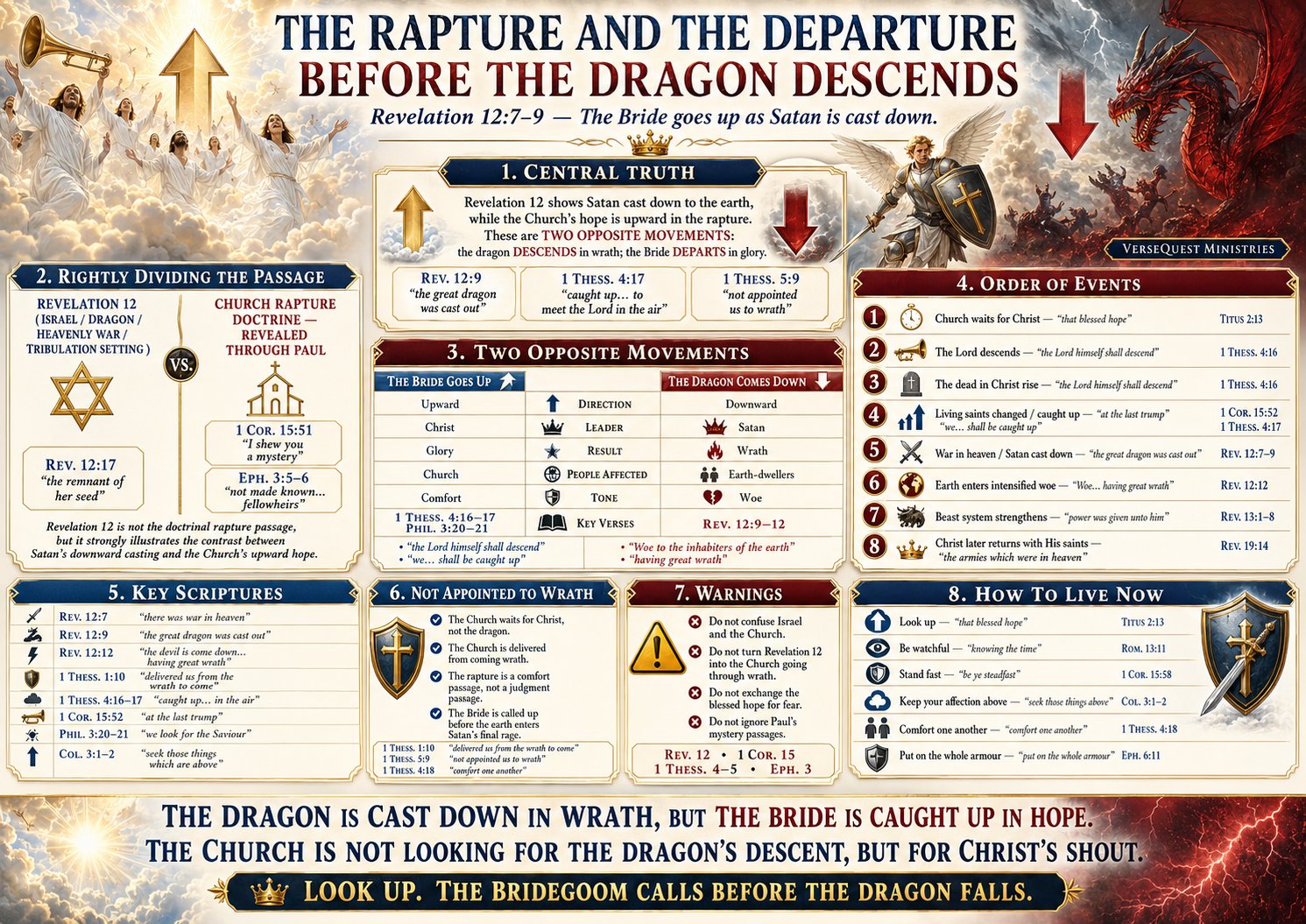
- The Rapture and the Departure Before the Dragon Descends – Printable Bible Study Chart
- Printable KJV Bible study chart on The Rapture and the Departure Before the Dragon Descends, showing the Bride caught up before Satan is cast down in wrath. This premium VerseQuest…
- $4.99
- Add to cart
-
-
The Church Age vs The Tribulation
-
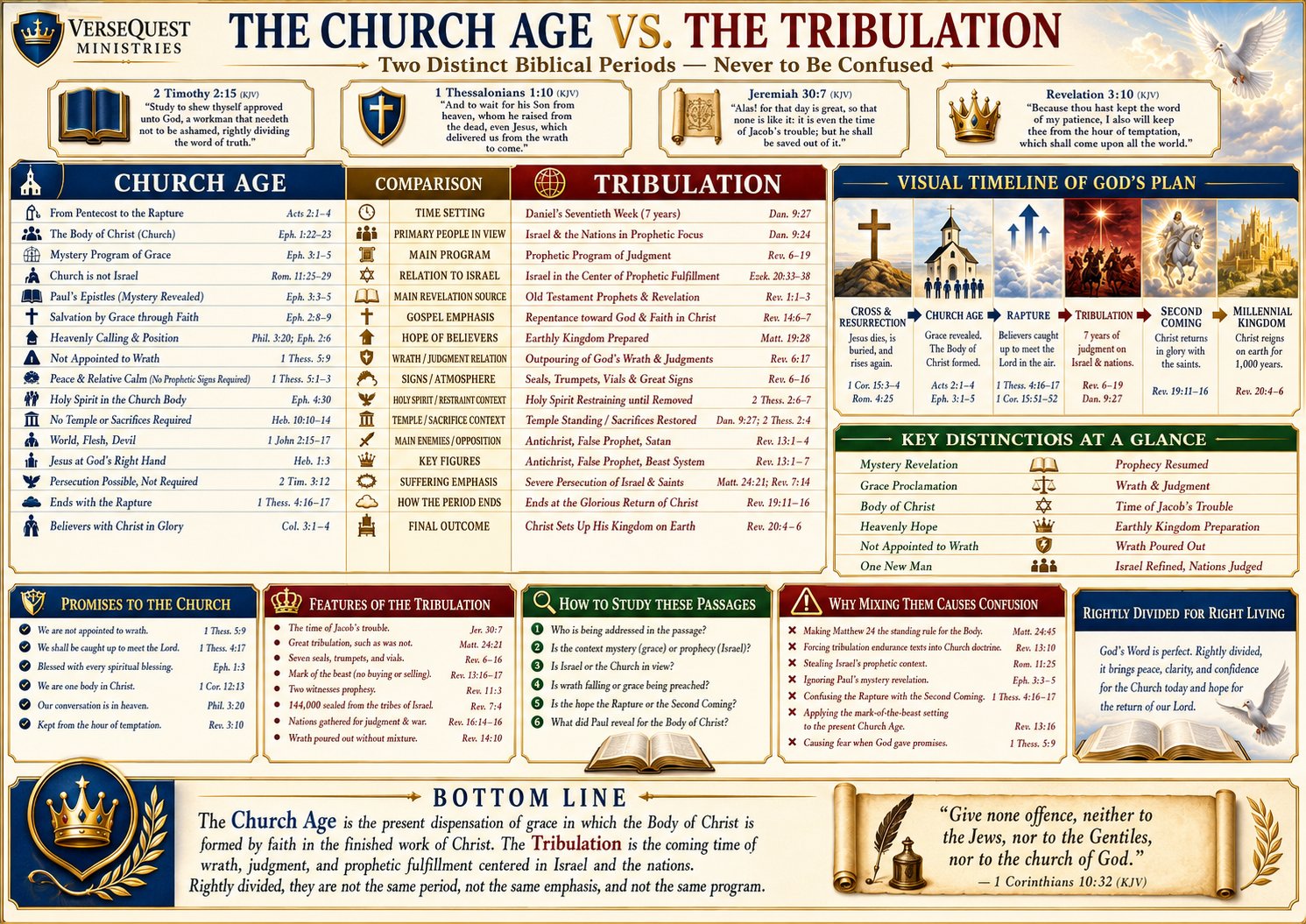
- The Church Age vs. the Tribulation – Two Distinct Biblical Periods KJV Bible Study Chart
- Compare the Church Age and the Tribulation with this detailed KJV chart covering the Body of Christ, Israel, grace, wrath, the Rapture, Antichrist, the Second Coming, and the millennial Kingdom.
- $3.99
- Add to cart
-
-
Law vs Grace
-
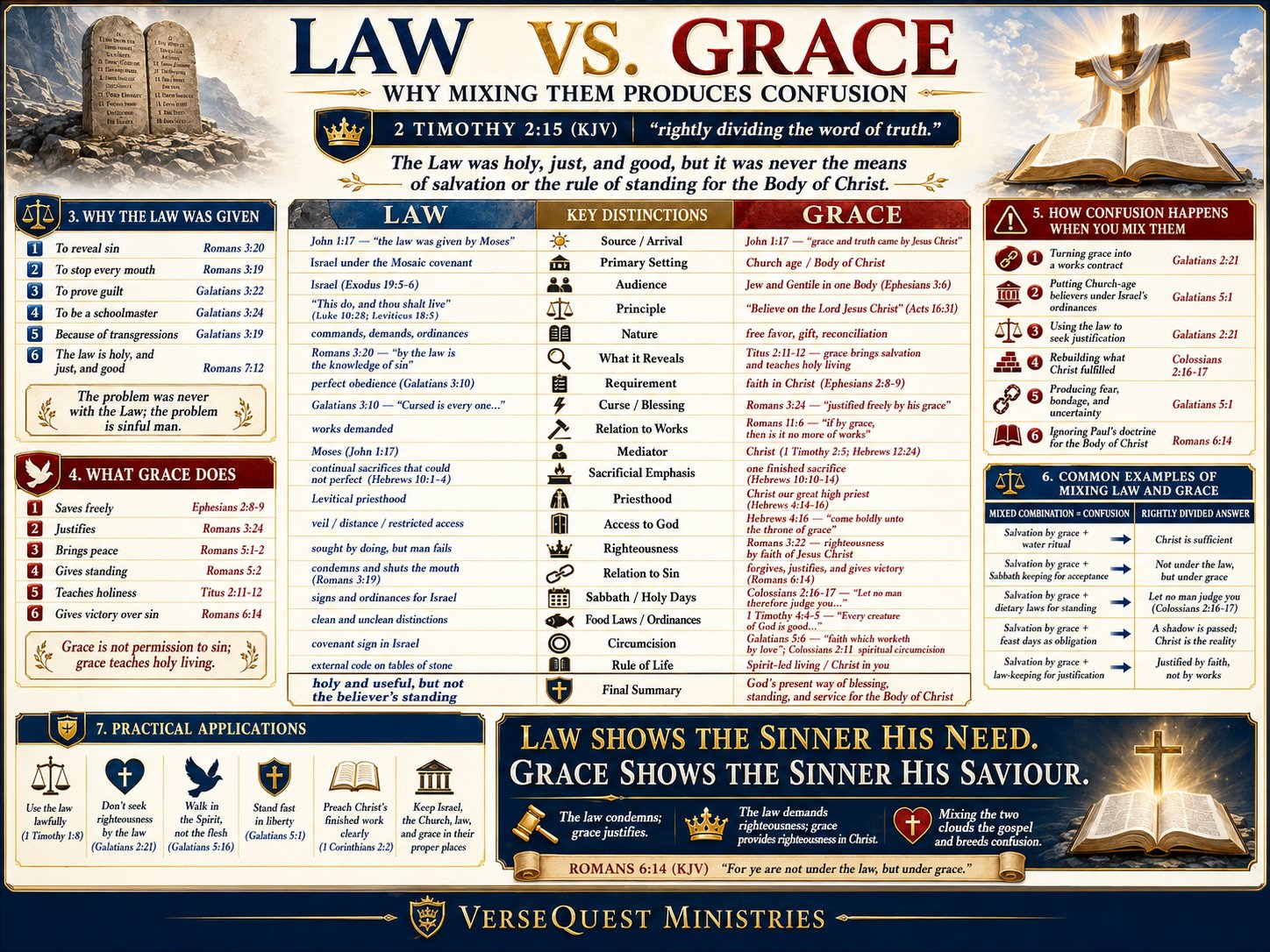
- Law vs. Grace Bible Study Chart – Why Mixing Them Produces Confusion (KJV)
- Compare law and grace with this detailed KJV Bible study chart explaining salvation, justification, holiness, Israel’s Mosaic covenant, Christian liberty, and the danger of mixing law with the gospel.
- $3.99
- Add to cart
-
-
Heavenly Program
-
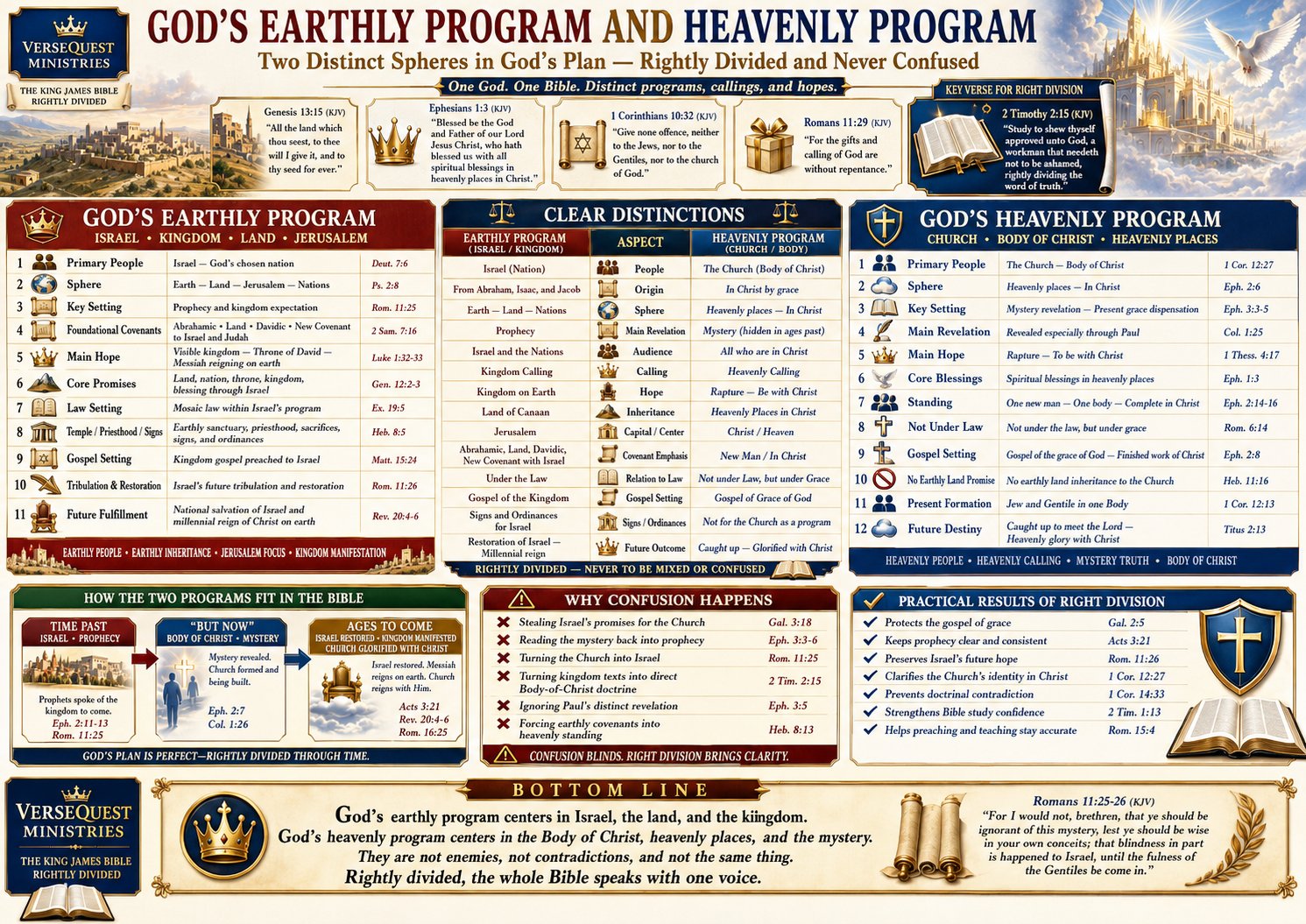
- Israel and the Church: Earthly and Heavenly Callings – KJV Bible Study Chart
- Printable digital KJV Bible study chart comparing Israel’s earthly promises and kingdom hope with the Church’s heavenly calling in Christ. Covers prophecy and mystery, biblical covenants, law and grace, the…
- $3.99
- Add to cart
-
-
Doctrine
-
-50%
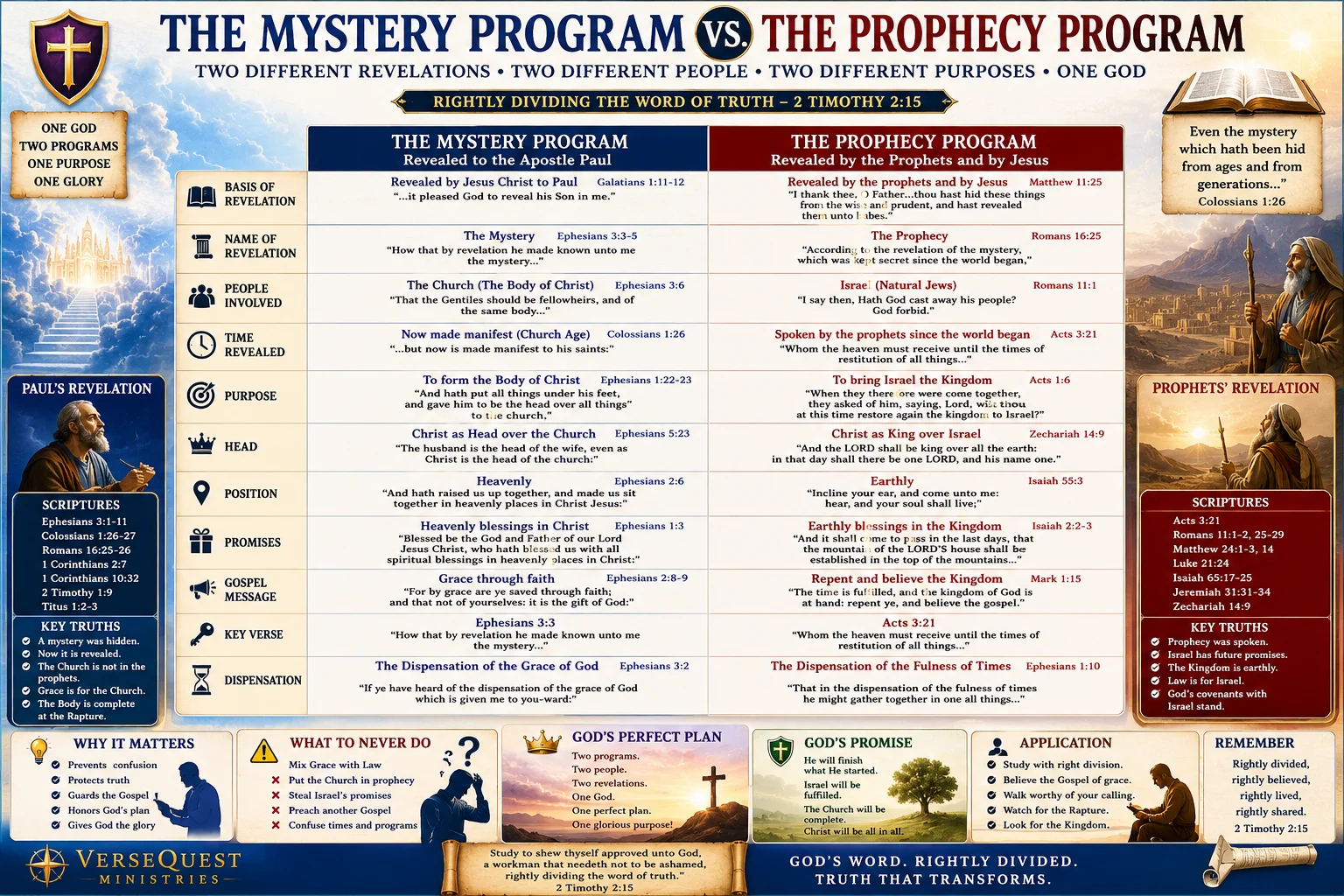
- The Mystery Program vs. Prophecy Program Chart — KJV Rightly Divided
- Premium printable KJV Bible study chart comparing the mystery program revealed through Paul with the prophecy program spoken by the prophets. Rightly divided and designed for teaching and personal study.
- Original price was: $10.00.$4.99Current price is: $4.99.
- Add to cart
-
-50%