


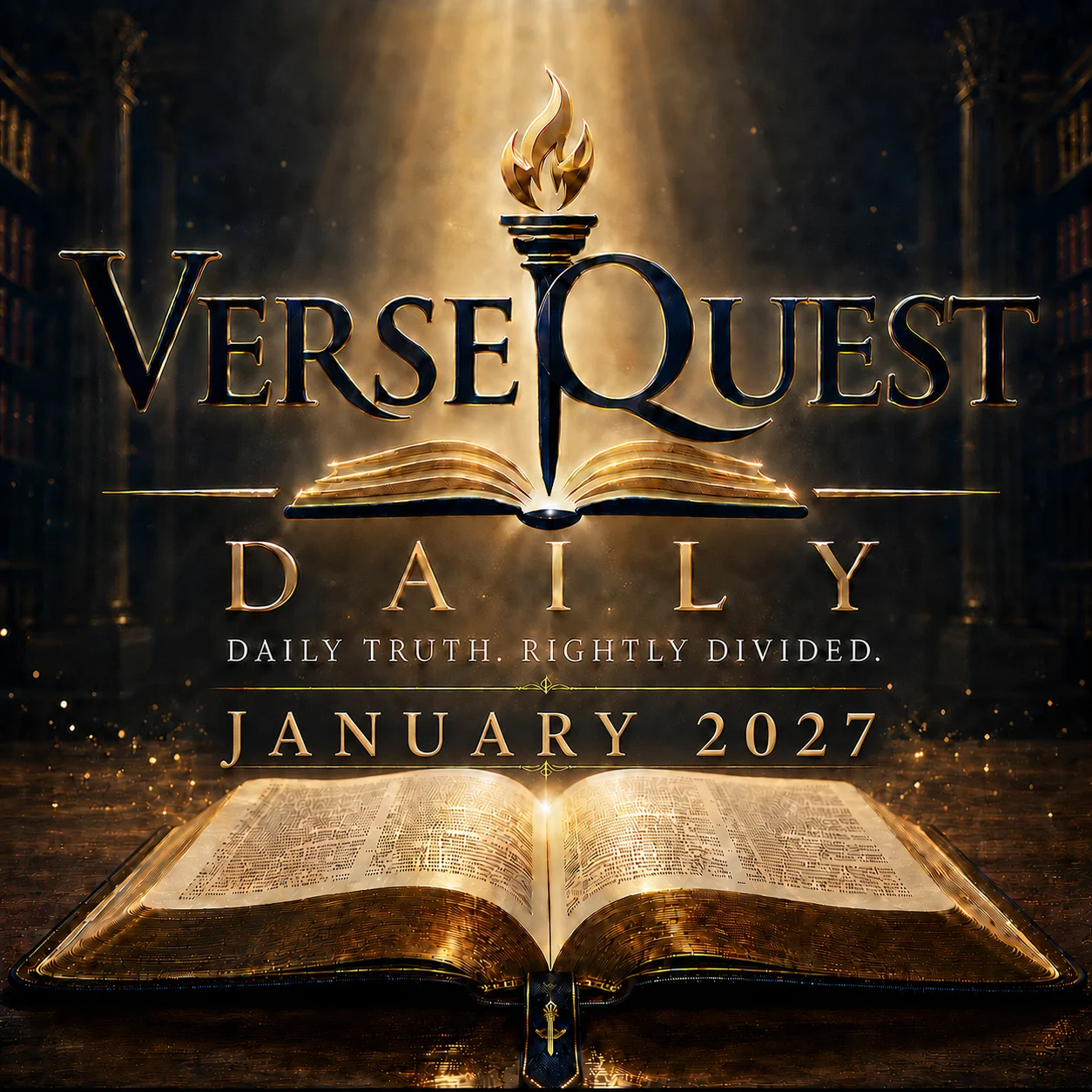
VerseQuest Daily — January 2027: The Bible in the Believer’s Hands
VerseQuest Daily — January 2027 is a 67-page downloadable devotional PDF containing thirty-one KJV studies on Bible reading, inspiration, preservation, interpretation, doctrine, typology, and right division. Each day includes an assigned Scripture passage, a developed devotional, Seven Things to Learn, and a memorable Thought for the Day.
The month progresses from foundational habits such as reading, meditation, memorization, and family instruction into deeper studies of verbal precision, biblical figures, dispensational order, doctrinal protection, and warnings against corrupting God’s words. Use it throughout January or begin on any date as a focused thirty-one-day Bible-study and discipleship course.
$6.99
Description
VerseQuest Daily — January 2027 is a 67-page downloadable KJV devotional PDF containing thirty-one daily studies designed to establish confidence in the words of God and develop sound habits of Bible reading, meditation, interpretation, and teaching. This is Month Five of VerseQuest Daily Discipleship Level One: Foundations and Growth. The first four months established the gospel, the believer’s position and walk, prayer and stewardship, and the Person and work of Jesus Christ. January now places the Bible firmly in the believer’s hands and teaches him how to read, believe, study, obey, preserve, and faithfully communicate its truth.
The opening studies address daily Bible reading, the purity and preservation of Scripture, understanding through God’s words, faith produced by hearing, comfort from the Scriptures, testing teaching by the Bible, and meditation upon the word of God. These foundational readings show that spiritual growth cannot be sustained by occasional religious inspiration. The believer requires regular contact with the Book God inspired and preserved.
The month then advances into responsible Bible interpretation. Readers learn the importance of reading and giving the sense, comparing spiritual things with spiritual, recognizing context, purpose, and audience, receiving the whole counsel of God, finding Christ in Scripture without forcing Him into every detail, memorizing Scripture, teaching children, obeying what is read, preserving truth within the family, and giving attention to the public reading of God’s word. The studies consistently join careful interpretation with practical obedience.
The later Meat and Strong Meat readings examine verbal inspiration, the precision of every jot and tittle, the proper order of study, obedience, and teaching, the foundation of revealed truth, the instructional purpose of Old Testament history, doctrinal vigilance, inspired allegory, biblical types and shadows, and God’s dispensational administration of history. The final studies warn against corrupting the word of God, reducing prophecy to private human invention, and adding to or removing from God’s words.
Each daily portion begins with an assigned passage from the King James Bible and a clearly identified subject. The devotional explains the passage in its biblical setting, establishes its doctrine, identifies important distinctions, and applies its truth to Christian life. Every reading concludes with Seven Things to Learn and a memorable Thought for the Day. The month progresses through eight Milk readings, eleven Bread readings, nine Meat readings, and three Strong Meat readings, leading readers from consistent Bible reading into mature doctrinal handling of Scripture.
The PDF may be read on a computer, tablet, or mobile device or printed for regular use. It may be followed throughout January 2027 or begun on any date as a thirty-one-day discipleship study. It is suitable for personal devotions, family Bible reading, church groups, Sunday school classes, Bible-study training, one-to-one discipleship, homeschool instruction, and ministry preparation.
Daily Bible reading — Scripture must become a settled part of life rather than an occasional response to trouble. The authority of the written word — Every believer, teacher, leader, and minister remains beneath the authority of Scripture. The purity of every word — Inspiration extends beyond general religious ideas to the actual words God gave. Divine preservation — God did not inspire His words only to abandon them to disappearance or corruption. Scripture as the source of faith — Biblical faith is produced and strengthened through hearing the word of God. Understanding for the simple — Spiritual understanding is not restricted to an intellectual class but comes through the entrance of God’s words. Meditation upon Scripture — Biblical meditation fills the mind with revealed truth rather than emptying it of thought. Scripture interpreting Scripture — Difficult passages should be studied through comparison with other biblical passages. Context, purpose, and audience — Sound interpretation asks who is speaking, to whom, when, why, and under what conditions. The whole counsel of God — Mature Bible study refuses to build doctrine from favorite passages while ignoring inconvenient ones. Christ throughout Scripture — The Bible testifies of Jesus Christ without requiring interpreters to force Him into every incidental detail. Scripture memorization — Hiding the word in the heart provides truth that can guide thought and resist temptation. Family transmission of truth — Parents and teachers bear responsibility to pass biblical truth to the next generation. Hearing joined with obedience — Bible knowledge reaches its proper purpose when the reader responds to what God has said. Public reading of Scripture — The open reading of God’s word belongs in the life and ministry of the local church. Honest Bible teaching — Teachers must refuse manipulation, selective quotation, private agendas, and deceitful handling of the text. Verbal inspiration — Every word matters because doctrine and meaning are carried through words. The precision of Scripture — Jots, tittles, names, tenses, pronouns, and distinctions cannot be dismissed as meaningless details. Study before teaching — The biblical order is to seek the truth, obey it personally, and then teach it faithfully. Doctrine as protection — Sound doctrine guards believers against deception, instability, and religious corruption. Literal truth and inspired figures — Figures, allegories, shadows, and types must be recognized where Scripture authorizes them without dissolving history into symbolism. Dispensational order — God administers His purposes through identifiable periods, audiences, covenants, and revealed responsibilities. Warnings against corruption — Religious motives, financial gain, tradition, and intellectual pride can tempt men to alter or misuse God’s words. The Holy Ghost’s authorship — Biblical prophecy originated with God rather than the private invention or will of man. The finality of revelation — Human beings possess no authority to add to, subtract from, or rewrite what God has spoken.
- Central argument: God gave His words to be read, believed, studied, obeyed, preserved, and taught accurately. Spiritual growth requires more than possessing a Bible; it requires living consciously under its authority.
- Daily structure: Every entry contains an assigned KJV passage, a defined topic, a developed devotional exposition, Seven Things to Learn, and a Thought for the Day.
- Progressive design: The month contains eight Milk readings, eleven Bread readings, nine Meat readings, and three Strong Meat readings.
- The Book must remain above the reader: Israel’s king possessed great authority, but Deuteronomy 17 placed him beneath the written word.
- Purity applies to every word: Proverbs 30:5 does not limit inspiration to general themes, religious ideas, or an undefined original message.
- Purity and preservation are related but distinct: Purity describes the character of God’s words; preservation describes God’s continued care for those words.
- Reading must become regular: A Bible admired, carried, displayed, or defended cannot feed the believer while remaining unopened.
- Biblical meditation is active: It involves recalling, repeating, comparing, and considering Scripture until its truth shapes the mind and conduct.
- Faith requires an object: Romans 10:17 connects faith with hearing the word of God, not with creating confidence through positive thinking.
- Earlier Scripture remains profitable: Passages written under different covenants may teach, comfort, warn, and instruct without being directly addressed to the Church.
- Testing teaching is a noble practice: The Bereans respected preaching while refusing to exempt any teacher from biblical examination.
- Context guards meaning: The interpreter should identify the speaker, audience, historical setting, purpose, covenant, and stage of revelation.
- Scripture should interpret Scripture: Clear passages help illuminate difficult ones, while no doctrine should rest upon an isolated phrase removed from context.
- The whole counsel prevents imbalance: Selective study can produce distorted doctrine even when every quoted verse is genuine.
- Christ must be found faithfully: Scripture testifies of Christ, but responsible interpretation does not turn every object, number, or incidental detail into an unauthorized symbol.
- Memorization prepares truth for use: Scripture hidden in the heart is available during temptation, prayer, witness, suffering, decision, and teaching.
- Truth must be passed forward: Psalm 78 and Deuteronomy 6 place responsibility upon one generation to teach the next.
- The mirror requires a response: James 1 warns that hearing without doing produces self-deception.
- Public reading still matters: A church should not allow announcements, performances, and commentary to displace the actual reading of Scripture.
- Honesty is essential in teaching: A preacher must not hide context, omit inconvenient words, or make a passage say what it does not say.
- Man lives by every word: Christ’s answer in Matthew 4:4 demonstrates the necessity and authority of precise verbal revelation.
- Jots and tittles matter: The smallest meaningful details of the text remain beneath God’s authority and care.
- Ezra supplies the proper order: Prepare the heart, seek the truth, do what is learned, and then teach others.
- Old Testament events are historical and instructional: Their application to believers does not require denying their literal occurrence or original setting.
- Doctrine protects both teacher and hearer: First Timothy 4:16 joins personal vigilance with doctrinal vigilance.
- Inspired allegory is controlled by Scripture: Galatians 4 identifies its own allegory. The interpreter is not granted permission to turn the entire Bible into private symbolism.
- Types and shadows point beyond themselves: Their fulfillment must be established through biblical revelation rather than imaginative resemblance.
- Dispensational study recognizes divine order: Right division does not deny biblical unity; it prevents the theft, confusion, or misapplication of instructions given to different audiences.
- Corruption may carry a religious label: Second Corinthians 2:17 warns that men may handle God’s word for profit while appearing to serve it.
- Private interpretation concerns origin and authority: Prophecy did not arise from the prophet’s independent will but from men moved by the Holy Ghost.
- The Bible closes with a warning: Revelation 22 demonstrates that God takes the adding, removing, and alteration of His words seriously.
- Further study question: What is the difference between a passage written for our learning and a command written directly to the Body of Christ?
- Further study question: How do context and right division protect believers from claiming promises or instructions given to another biblical audience?
- Further study question: Which biblical types are identified by Scripture, and which commonly taught types depend mainly upon human imagination?
- Further study question: How should a teacher distinguish literal history, figures of speech, parables, allegories, shadows, and prophetic symbols?
- Memorable teaching point: The Bible does not need the reader to correct it; the reader needs the Bible to correct him.
- Memorable teaching point: A verse removed from its context may retain its words while losing its intended meaning.
- Memorable teaching point: Right division does not cut truth out of the Bible; it places truth where God placed it.
Personal Bible study — Read the assigned KJV passage, complete the devotional, review the seven lessons, and carry the Thought for the Day into practical obedience.
Thirty-one-day discipleship — Use the volume to establish a believer in daily reading before advancing into interpretation, doctrine, typology, and right division.
Bible-study training — Teach readers how to examine context, audience, purpose, cross-references, dispensational setting, figures, and doctrinal distinctions.
Family devotions — Read one study daily and use the Seven Things to Learn to discuss Scripture with children and other family members.
Homeschool instruction — Use the entries as introductory lessons in biblical literacy, interpretation, memorization, doctrine, and responsible research.
Sunday school lessons — Develop individual studies into lessons on inspiration, preservation, meditation, obedience, context, typology, or doctrinal fidelity.
Small-group study — Assign readings during the week and use the closing lessons and study questions to guide group discussion.
Sermon preparation — Use the biblical passages and interpretive principles to strengthen expository preaching and prevent careless handling of Scripture.
One-to-one mentoring — Help a newer believer develop a consistent reading plan and learn how to test teachings by the Bible.
Teacher and ministry training — Emphasize Ezra’s order of study, obedience, and teaching while warning against corrupting or manipulating the word.
Church reading programs — Use the volume to encourage a congregation to read, memorize, discuss, and apply Scripture together.
Independent study outside January — Begin on any date and use the PDF as a self-contained thirty-one-day course on understanding and handling the Bible.
A King James Bible for reading every assigned passage in its complete chapter and biblical setting.
A Strong’s Exhaustive Concordance for tracing words, expressions, and related passages throughout Scripture.
A reliable King James Bible dictionary for studying biblical terms, people, customs, offices, covenants, and historical settings.
The Treasury of Scripture Knowledge or another KJV-compatible cross-reference resource for comparing spiritual things with spiritual.
A dispensational Bible timeline for locating biblical events, covenants, audiences, kingdoms, and revealed administrations in their proper order.
A chronological Bible chart for placing historical books, prophets, kings, captivities, Gospel events, and apostolic ministries within their time periods.
A notebook or Bible-study journal for recording context, repeated words, cross-references, doctrinal observations, dispensational distinctions, and personal applications.
A study of inspiration and preservation using Psalm 12:6–7, Psalm 119:89, Proverbs 30:5–6, Isaiah 40:8, Matthew 5:18, Matthew 24:35, 2 Timothy 3:16–17, and 1 Peter 1:23–25.
A study of right division using Romans 15:4, 1 Corinthians 10:32, Galatians 2:7–9, Ephesians 3:1–9, and 2 Timothy 2:15.
A study of biblical meditation using Joshua 1:8, Psalm 1:1–3, Psalm 63:5–6, Psalm 119:15–16, and 1 Timothy 4:15.
VerseQuest Daily — September 2026 for foundational studies concerning Scripture, the gospel, assurance, and the believer’s standing in Christ.
VerseQuest Daily — October 2026 for studies concerning identity in Christ and the daily Christian walk.
VerseQuest Daily — November 2026 for studies of prayer, worship, gratitude, and stewardship.
VerseQuest Daily — December 2026 for studies concerning the Person and work of Jesus Christ.
Related products
-
The Word of God
-
- Spiritual Warfare by the Word of God — 50-Study KJV Bible Book
- A 380-page, 50-study KJV guide showing how believers resist Satan, defeat deception, guard the mind, test false teaching, and stand through the written Word of God.
- $9.99
- Add to cart
-
-
Attributes of God
-

- God Is Love, But Love Is Not God: A KJV Study of the Love That Sacrifices, Speaks Truth, Chastens, Judges, and Never Lets Go
- God Is Love, But Love Is Not God is a substantial 214-page downloadable PDF book containing an introduction, 25 detailed KJV-based essays, a comprehensive conclusion, and an extensive Bible-study chart.…
- $19.99
- Add to cart
-
-
Angels
-
-67%
- The Doctrine of Angels Made Plain – 620-Page KJV Bible Study PDF
- The Doctrine of Angels Made Plain is a 620-page KJV Bible study that traces angels from Genesis to Revelation. This premium VerseQuest PDF explains holy angels, Christ’s supremacy over angels,…
- Original price was: $29.99.$9.99Current price is: $9.99.
- Add to cart
-
-67%
-
KJV Studies
-
-67%
- The Blood of Christ – 66-Study KJV Bible Doctrine PDF
- A 441-page premium VerseQuest PDF featuring 66 detailed KJV Bible studies on the blood of Jesus Christ. This powerful doctrinal resource covers redemption, justification, propitiation, cleansing, access to God, eternal…
- Original price was: $29.99.$9.99Current price is: $9.99.
- Add to cart
-
-67%
-
Rightly Dividing the Bible
-
- Dispensational Truth – Essentials Guide: How to Rightly Divide the Word of Truth and Understand God’s Plan Through the Ages
- Dispensational Truth – Essentials Guide is a 59-page downloadable and printable KJV Bible-study PDF created to make right division understandable for beginners. It explains dispensations, covenants, Israel and the Church,…
- $14.99
- Add to cart
-