
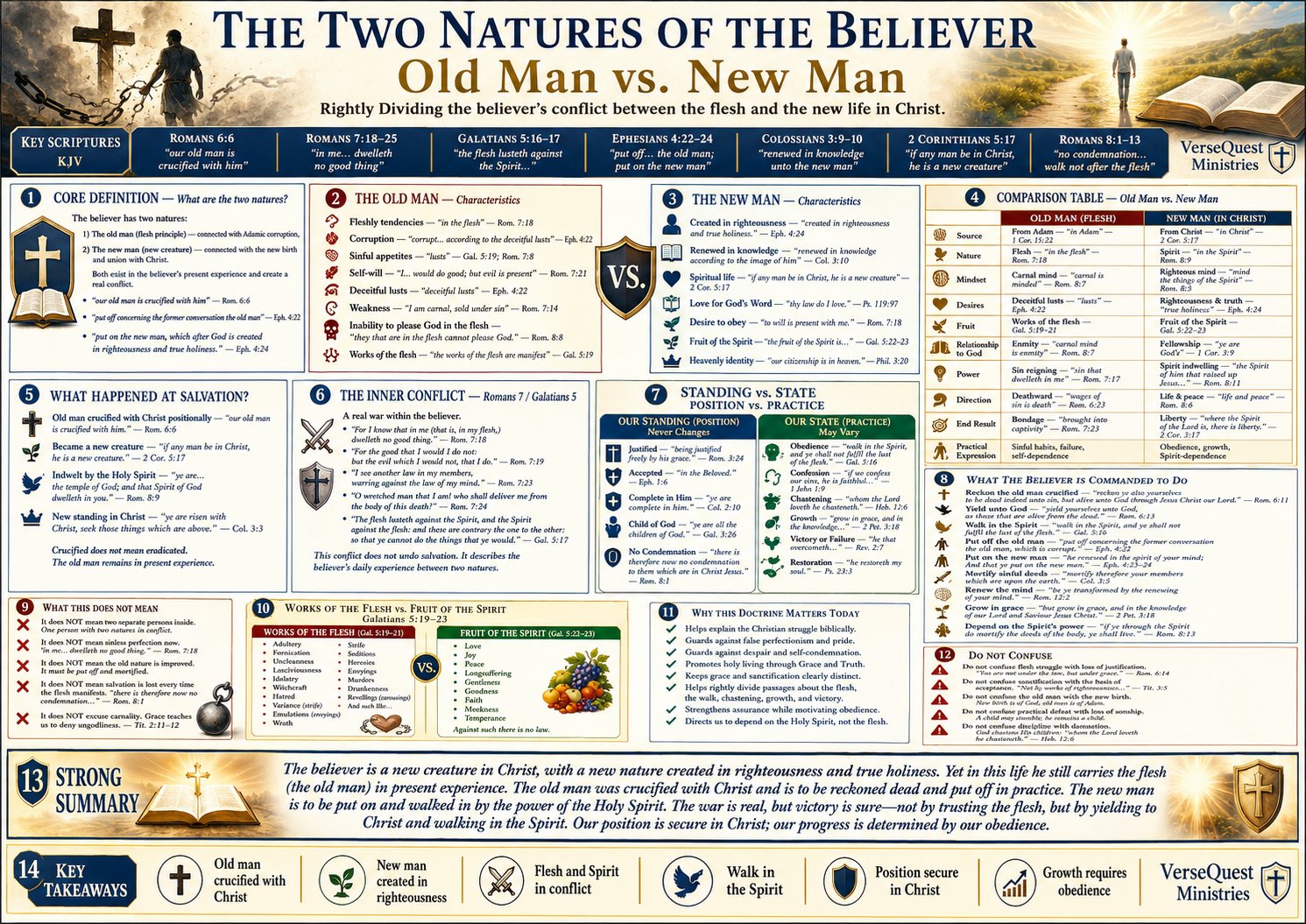
The Two Natures of the Believer – The Old Man, the New Man, and the Christian’s Conflict Between Flesh and Spirit (KJV Bible Study Chart)
Understand the believer’s conflict between the old man and new man with this detailed KJV chart covering the flesh, indwelling Spirit, Romans 7, Galatians 5, standing versus state, practical sanctification, spiritual fruit, and Christian victory.
$3.99
Description
The Two Natures of the Believer: Old Man vs. New Man is a detailed KJV Bible study chart explaining the continuing conflict between the flesh and the new life God creates in every person who trusts Jesus Christ.
Built around Romans 6:6, Romans 7:18–25, Galatians 5:16–17, Ephesians 4:22–24, Colossians 3:9–10, 2 Corinthians 5:17, and Romans 8:1–13, this chart distinguishes the believer’s permanent standing in Christ from his changing daily condition, his old Adamic nature from the new man created in righteousness, and justification from practical sanctification.
The believer is a new creature in Jesus Christ, but he has not yet received a glorified body. Until the resurrection or Rapture, he continues to carry the flesh and experiences a genuine internal conflict between the old sinful principle and the new life produced by God.
This conflict does not mean the believer possesses two separate persons, two souls, or two independent identities living inside him. It describes two opposing principles operating within his present experience: the flesh inherited through Adam and the new man created through spiritual union with Jesus Christ.
The chart begins by defining the old man. The old man is connected with Adamic corruption, the sinful flesh, self-will, deceitful lusts, weakness, rebellion, and the natural inability of fallen man to please God.
Romans 7:18 states, “For I know that in me (that is, in my flesh,) dwelleth no good thing.” Paul did not say there was no good thing in Christ or in the Holy Spirit dwelling within him. He specifically identified the problem as the flesh.
The flesh is not merely the physical body. The body itself may be presented to God as an instrument of righteousness. The flesh refers to fallen human nature operating independently of God and seeking to satisfy its own desires.
The old man carries sinful appetites, self-centred ambitions, corrupt desires, natural pride, resentment, fear, unbelief, and resistance to divine authority. Ephesians 4 connects the old conversation with “deceitful lusts.”
Sin deceives by promising pleasure without presenting the final cost. It promises liberty while producing bondage, satisfaction while deepening appetite, and independence while bringing spiritual weakness.
The old man is also characterized by self-will. Romans 7 describes the believer recognizing what is right while discovering another principle resisting obedience. The flesh does not naturally submit to God merely because the mind understands a command.
The old man is weak. Human resolution, religious enthusiasm, emotional promises, and personal discipline cannot transform the sinful nature into something holy.
Romans 8:8 declares, “So then they that are in the flesh cannot please God.” The flesh may imitate religion, produce outward morality, and perform visible service, but it cannot become the source of spiritual righteousness.
Galatians 5 lists the works of the flesh, including adultery, fornication, uncleanness, lasciviousness, idolatry, witchcraft, hatred, variance, emulations, wrath, strife, seditions, heresies, envyings, murders, drunkenness, revellings, and similar sins.
These works reveal what fallen human nature produces when given opportunity and control. Culture may change, but the flesh remains the flesh.
The chart then presents the new man. The new man is not the old nature repaired, educated, baptized, religiously dressed, or disciplined into respectability. It is new spiritual life created by God through Jesus Christ.
Second Corinthians 5:17 declares, “Therefore if any man be in Christ, he is a new creature.” Salvation does not merely improve a sinner’s circumstances. God places the believer into Christ and gives him a new identity.
Ephesians 4:24 describes the new man as “created in righteousness and true holiness.” Its source is Christ rather than Adam, and its spiritual character agrees with the holiness of God.
Colossians 3:10 teaches that the new man is “renewed in knowledge after the image of him that created him.” The Christian’s mind is gradually renewed as the written Word corrects old thinking and teaches him to see life according to God’s truth.
The new man loves God’s Word. Psalm 119 expresses the heart of a person who delights in divine truth. The flesh resists Scripture when it interferes with desire, but the new life welcomes the Word’s light, correction, promises, and commands.
The new man desires obedience. Romans 7 contains the confession, “to will is present with me.” The believer may struggle to perform perfectly, but the new life produces a genuine desire to please God.
The new man also produces the fruit of the Spirit. Galatians 5 identifies this fruit as love, joy, peace, longsuffering, gentleness, goodness, faith, meekness, and temperance.
These qualities are not generated by the old nature becoming cooperative. They are produced by the Holy Spirit as the believer yields to His truth and power.
The chart provides a direct comparison between the old man and the new man. The old man’s source is Adam; the new man’s source is Christ. The old man belongs to the flesh; the new man belongs to the Spirit.
The old man possesses a carnal mind that is enmity against God. The new man develops a righteous mind through the renewal of Scripture and the indwelling Holy Spirit.
The old man’s desires are deceitful lusts. The new man desires righteousness, truth, holiness, obedience, fellowship, and the glory of Christ.
The old man produces the works of the flesh. The new man produces the fruit of the Spirit.
The old man seeks fellowship with the world and independence from God. The new man seeks fellowship with Christ and submission to His Word.
The power operating through the old man is sin dwelling in the flesh. The power operating through the new life is the indwelling Holy Spirit.
The old man’s direction is deathward. Romans 6 teaches that the wages of sin is death. The new man’s direction is life, peace, liberty, growth, and conformity to Christ.
The chart explains what happened at salvation. First, the old man was crucified with Christ positionally. Romans 6:6 declares, “Knowing this, that our old man is crucified with him.”
The crucifixion of the old man means that the believer’s former identity and standing in Adam were judged with Jesus Christ. Sin’s legal claim and dominion have been broken.
However, crucified does not mean eradicated from present experience. The flesh remains active and must be reckoned dead, denied, resisted, and refused.
Second, the believer became a new creature. God did not merely pardon the old man and leave the sinner spiritually unchanged. He gave new life in Jesus Christ.
Third, the believer was indwelt by the Holy Spirit. Romans 8:9 teaches that the Spirit of God dwells in everyone who belongs to Christ.
The Christian is therefore not left to battle the flesh through human power. He possesses the indwelling Spirit, the written Word, access to God in prayer, fellowship with believers, and the grace necessary for obedience.
Fourth, the believer received a new standing in Christ. Colossians 3 teaches that believers are risen with Christ and should seek those things which are above.
The Christian’s citizenship, identity, acceptance, and destiny are now connected with Jesus Christ rather than the condemned world system.
The chart emphasizes that crucifixion is not eradication. Some teachings imply that a believer may reach a point where the sinful nature disappears entirely. Scripture does not support that conclusion.
Paul described an ongoing conflict. Galatians warns Christians about the flesh. First John warns believers against claiming they have no sin. The repeated commands to mortify, put off, reckon dead, and walk in the Spirit would be unnecessary if the flesh had already vanished.
The believer’s old man was crucified positionally, but the flesh remains part of his earthly experience until glorification. This explains why genuine Christians may still face temptation, selfish impulses, sinful thoughts, fear, anger, lust, pride, and spiritual weariness.
The presence of conflict does not automatically prove the absence of salvation. In many cases, the conflict exists precisely because new spiritual life now opposes what the person once followed without resistance.
An unsaved person may experience conscience, restraint, fear of consequences, and moral conflict, but the saved believer possesses a new divine life and the indwelling Holy Spirit who actively oppose the flesh.
Romans 7 provides one of Scripture’s clearest descriptions of the inner conflict. Paul says, “For that which I do I allow not: for what I would, that do I not.”
He recognizes that evil remains present in the flesh while his inward man delights in the law of God. He sees another law in his members warring against the law of his mind.
This is not Paul excusing sin. It is Paul identifying the enemy accurately. He does not conclude that victory is impossible, nor does he claim that religious effort can reform the flesh.
He cries, “O wretched man that I am! who shall deliver me from the body of this death?” The answer is not another rule, ceremony, promise, or system of self-improvement. He answers, “I thank God through Jesus Christ our Lord.”
Victory begins with recognizing that deliverance comes through Jesus Christ rather than trusting the flesh to conquer itself.
Galatians 5 describes the same conflict: “the flesh lusteth against the Spirit, and the Spirit against the flesh: and these are contrary the one to the other.”
The flesh and Spirit do not negotiate a peaceful agreement. They are contrary. One must be yielded to while the other is denied.
A believer cannot feed the flesh continually and expect the fruit of the Spirit to dominate his life. What is nourished grows stronger in practical influence.
The chart distinguishes standing from state, or position from practice. The believer’s standing in Jesus Christ never changes. He is justified, accepted in the Beloved, complete in Christ, a child of God, and free from eternal condemnation.
Romans 8:1 declares, “There is therefore now no condemnation to them which are in Christ Jesus.” The believer’s standing rests upon Christ’s righteousness rather than his success in daily spiritual conflict.
His daily state may vary. He may obey or disobey, walk in fellowship or grieve the Spirit, grow or become stagnant, confess sin or hide it, serve faithfully or waste opportunities.
Daily failure may bring chastening, lost joy, weakened testimony, damaged fellowship, and loss of reward. It does not reverse spiritual birth or remove the believer from Christ.
This distinction protects the believer from despair without excusing sin. Position is secure, but progress requires obedience.
The chart compares standing in Christ with daily practice. Standing includes justification by faith, acceptance, completeness, sonship, and no condemnation.
Practice includes obedience, confession, growth, chastening, victory, failure, restoration, usefulness, and testimony.
First John 1:9 provides cleansing and restored fellowship when believers confess sin. Hebrews 12 explains fatherly chastening. Second Peter commands continued growth in grace.
A Christian who fails does not need to become born again repeatedly. He needs to agree with God about his sin, confess it, forsake it, receive correction, and resume walking in the Spirit.
The chart then presents what the believer is commanded to do. First, he must reckon the old man crucified. Romans 6 teaches believers to consider themselves dead indeed unto sin but alive unto God through Jesus Christ.
Reckoning is not pretending temptation does not exist. It means accepting God’s verdict concerning the old identity and refusing to let sin claim authority it no longer possesses.
Second, the believer must yield to God. Romans 6 commands Christians to present themselves to God and their members as instruments of righteousness.
The body can become an instrument of sin or service. The eyes, hands, feet, tongue, mind, time, abilities, and resources should be surrendered to God.
Third, the believer must walk in the Spirit. Galatians 5:16 promises, “Walk in the Spirit, and ye shall not fulfil the lust of the flesh.”
Walking in the Spirit is a daily pattern of dependence, truth, obedience, prayer, and submission. It is not a brief emotional experience or dramatic religious performance.
Fourth, the believer must put off the old man. Ephesians and Colossians connect this with rejecting former conduct, deceitful lusts, lying, anger, corrupt communication, bitterness, malice, and other expressions of the old life.
Fifth, the believer must put on the new man. This includes righteous thinking, holiness, mercy, kindness, humility, meekness, longsuffering, forgiveness, charity, and obedience.
Sixth, the believer must mortify sinful members. Colossians 3 commands Christians to put to death practical expressions of the flesh.
Mortification does not mean physically injuring oneself. It means refusing sinful desires, removing opportunities for disobedience, and denying the flesh the fulfilment it demands.
Seventh, the believer must renew the mind. Romans 12 teaches transformation through the renewing of the mind.
The old man thinks according to the world, experience, emotion, appetite, pride, and self-interest. The renewed mind learns to judge everything through Scripture.
Eighth, the believer must grow in grace. Spiritual maturity is not automatic. It develops through the Word, prayer, fellowship, service, correction, perseverance, and faithful obedience.
Ninth, the believer must depend upon the Spirit’s power. Romans 8 declares that believers mortify the deeds of the body through the Spirit.
Self-confidence invites defeat. The flesh cannot defeat the flesh. Victory comes as the believer relies upon the Spirit and obeys the Word.
A major section explains what this doctrine does not mean. It does not mean there are two separate persons inside the believer.
The believer remains one responsible person. He cannot blame the old man as though another individual committed the sin without his consent.
The doctrine does not teach immediate sinless perfection. Paul openly acknowledged the continuing presence of the flesh.
It does not mean the good part of the believer is immune to deception or that spiritual growth can be neglected. The believer must remain vigilant, teachable, and dependent upon Scripture.
It does not mean the old nature is improved. The flesh must be put off and mortified, not rehabilitated into righteousness.
Religion may restrain the flesh outwardly, but it cannot transform its nature. The old man remains corrupt according to deceitful lusts.
The doctrine does not teach that salvation is lost whenever the flesh gains a temporary victory. Romans 8 still declares no condemnation.
It also does not excuse carnality. Titus teaches that grace instructs believers to deny ungodliness and worldly lusts.
Security in Christ should strengthen holiness rather than produce carelessness. The believer has been freed from sin’s dominion so that he may serve righteousness.
The chart compares the works of the flesh with the fruit of the Spirit. The works of the flesh include sexual sin, idolatry, hatred, division, jealousy, wrath, drunkenness, and other corruptions.
The fruit of the Spirit includes love, joy, peace, longsuffering, gentleness, goodness, faith, meekness, and temperance.
The word works is plural, revealing the many corrupt expressions of fallen nature. The word fruit is singular, presenting one unified spiritual harvest produced by the Holy Spirit.
The Spirit’s fruit cannot be manufactured through personality, emotional excitement, polished behaviour, or public image. It grows as the believer abides in Christ, learns Scripture, and yields to God.
This doctrine matters because it helps explain the Christian struggle biblically. A believer may love Christ and still experience powerful temptation. Understanding the two natures prevents confusion and despair.
It guards against false perfectionism. Christians should pursue holiness, but they should not claim that the flesh has disappeared.
It guards against self-condemnation. A sinful impulse should be judged and resisted, but its presence does not automatically mean the believer was never saved.
It promotes holy living through grace and truth. Victory is not produced by denying the conflict but by understanding it and applying God’s remedy.
It keeps grace and sanctification properly distinguished. The believer is justified once through faith but grows practically throughout his earthly life.
It helps divide passages concerning standing, walk, chastening, growth, obedience, and victory. These categories must not be blended into a works-based system of salvation.
The doctrine also strengthens assurance while motivating obedience. The believer’s position is secure, but his progress is determined by his response to Scripture and the Holy Spirit.
The chart warns against several common confusions. The fleshly struggle should not be confused with loss of justification.
The flesh should not be used as an excuse for disobedience. Saying, “That is simply my old nature,” does not remove personal responsibility.
Victory should not be confused with the absence of temptation. A believer may experience intense temptation while faithfully refusing it.
The old man should not be confused with the new birth. The new birth creates new life; it does not sanctify the old sinful nature.
Conflict should not be confused with loss of sonship. A struggling child of God remains His child but may require confession, correction, and restoration.
Discipline should not be confused with condemnation. God chastens those He loves, while eternal condemnation has been removed through Jesus Christ.
The strong summary is clear: the believer is a new creature in Christ with a new man created in righteousness and true holiness. Yet during this earthly life he continues to carry the flesh.
The old man was crucified with Christ and must be reckoned dead and put off in daily practice. The new man must be put on and strengthened through the written Word, prayer, obedience, and the power of the Holy Spirit.
The conflict is real, but victory is available. The answer is not trusting the flesh, excusing the flesh, or pretending the flesh has disappeared. The answer is yielding to Jesus Christ and walking in the Spirit.
The believer’s position is secure in Christ, but progress requires faithful obedience. Grace saves, the Spirit empowers, Scripture directs, and the Christian must choose daily which nature will govern his walk.
This resource is ideal for personal Bible study, Christian-growth classes, sanctification teaching, Romans 6–8 studies, Galatians 5 instruction, new-believer discipleship, pastoral counseling, recovery from spiritual failure, Sunday school, homeschool Bible curriculum, Christian schools, Bible institutes, sermon preparation, and believers seeking to understand the internal struggle between flesh and Spirit.
Two natures of the believer, old man versus new man, flesh versus Spirit, old man crucified with Christ, new creature in Christ, created in righteousness, Adamic nature, indwelling Holy Spirit, inner Christian conflict, Romans 7 struggle, Galatians 5 conflict, works of the flesh, fruit of the Spirit, standing versus state, position versus practice, practical sanctification, walking in the Spirit, mortifying the flesh, renewing the mind, Christian victory
The believer is one responsible person who experiences two opposing principles: the old fleshly nature and the new man created in Christ.
The two-natures doctrine does not teach two souls, two separate personalities, or two independent persons living in one body.
The old man is connected with Adam, the flesh, corruption, deceitful lusts, self-will, and rebellion.
The new man is connected with Jesus Christ, spiritual life, righteousness, holiness, truth, and the indwelling Holy Spirit.
Romans 6:6 teaches that the old man was crucified with Christ positionally.
Crucified does not mean eradicated from present experience. The flesh remains until glorification.
The believer is commanded to reckon himself dead to sin because sin’s legal dominion has been broken.
Romans 7 identifies no good thing dwelling in the flesh.
The flesh cannot be educated, baptized, disciplined, or religiously improved into spiritual righteousness.
Romans 8 teaches that the carnal mind is enmity against God and cannot submit to His law.
The believer became a new creature at salvation. The new man is not a repaired version of the old man.
Ephesians 4 describes the new man as created in righteousness and true holiness.
Colossians 3 teaches that the new man is renewed in knowledge after the image of his Creator.
The Holy Spirit indwells every genuine believer and provides divine power for Christian living.
Romans 7 describes a genuine conflict between the desire to obey and the sinful principle operating in the flesh.
Galatians 5 teaches that the flesh and Spirit are contrary to one another.
The presence of conflict does not automatically mean the believer is unsaved.
A new hatred of sin and desire for holiness may be evidence that spiritual life is actively opposing the flesh.
The believer’s standing in Christ includes justification, acceptance, completeness, sonship, and no condemnation.
The believer’s daily state includes obedience, confession, growth, fellowship, chastening, usefulness, victory, and failure.
Daily condition may change without altering the believer’s permanent standing in Christ.
Sin may damage fellowship, joy, testimony, service, and reward without reversing the new birth.
The believer should confess known sin and return to fellowship rather than attempting to become justified repeatedly.
Walking in the Spirit is the biblical answer to fulfilling the lust of the flesh.
Walking describes a continuing daily pattern rather than a single emotional experience.
The believer must put off the conduct of the old man and put on the character of the new man.
Mortification means denying sinful desires and refusing the flesh practical expression.
Renewing the mind through Scripture changes the believer’s patterns of thought and judgment.
The works of the flesh reveal what fallen human nature produces when it governs the life.
The fruit of the Spirit reveals what God produces through a yielded believer.
The flesh cannot produce the fruit of the Spirit through imitation or religious performance.
Grace does not excuse the flesh. Grace teaches believers to deny ungodliness.
Eternal security does not remove accountability for Christian conduct.
Sinless perfection should not be claimed while the believer remains in an unglorified body.
The believer should not use the old nature as an excuse. He remains personally responsible for yielding his members to God.
Temptation is not identical to sin. The believer may experience temptation while refusing to consent or obey.
Chastening is not condemnation. God corrects His children because they belong to Him.
Christian growth requires Scripture, prayer, fellowship, obedience, correction, and dependence upon the Holy Spirit.
The final victory over the presence of sin will come through glorification and the redemption of the body.
Until then, the Christian must reckon the old man dead, put on the new man, and walk in the Spirit.
Two-natures Bible studies, Romans 6–8 teaching, Galatians 5 instruction, Christian sanctification, new-believer discipleship, explaining internal spiritual conflict, overcoming temptation, walking in the Spirit, standing-versus-state studies, assurance-of-salvation counseling, recovery from Christian failure, refuting sinless perfectionism, teaching spiritual fruit, practical holiness, pastoral counseling, Sunday school lessons, homeschool Bible curriculum, Christian school instruction, Bible institute classes, sermon preparation
King James Bible, Strong’s Concordance, Thompson Chain-Reference Bible, Treasury of Scripture Knowledge, Nave’s Topical Bible, Romans 6–8 study notes, Galatians 5 commentary materials, Ephesians 4 worksheets, Colossians 3 studies, standing-versus-state charts, walking-in-the-Spirit resources, fruit-of-the-Spirit studies, sanctification workbooks, eternal-security materials, Scripture-memory cards for temptation, Pauline epistle outlines, VerseQuest Christian Living and doctrine charts
Related products
-
The Rapture
-
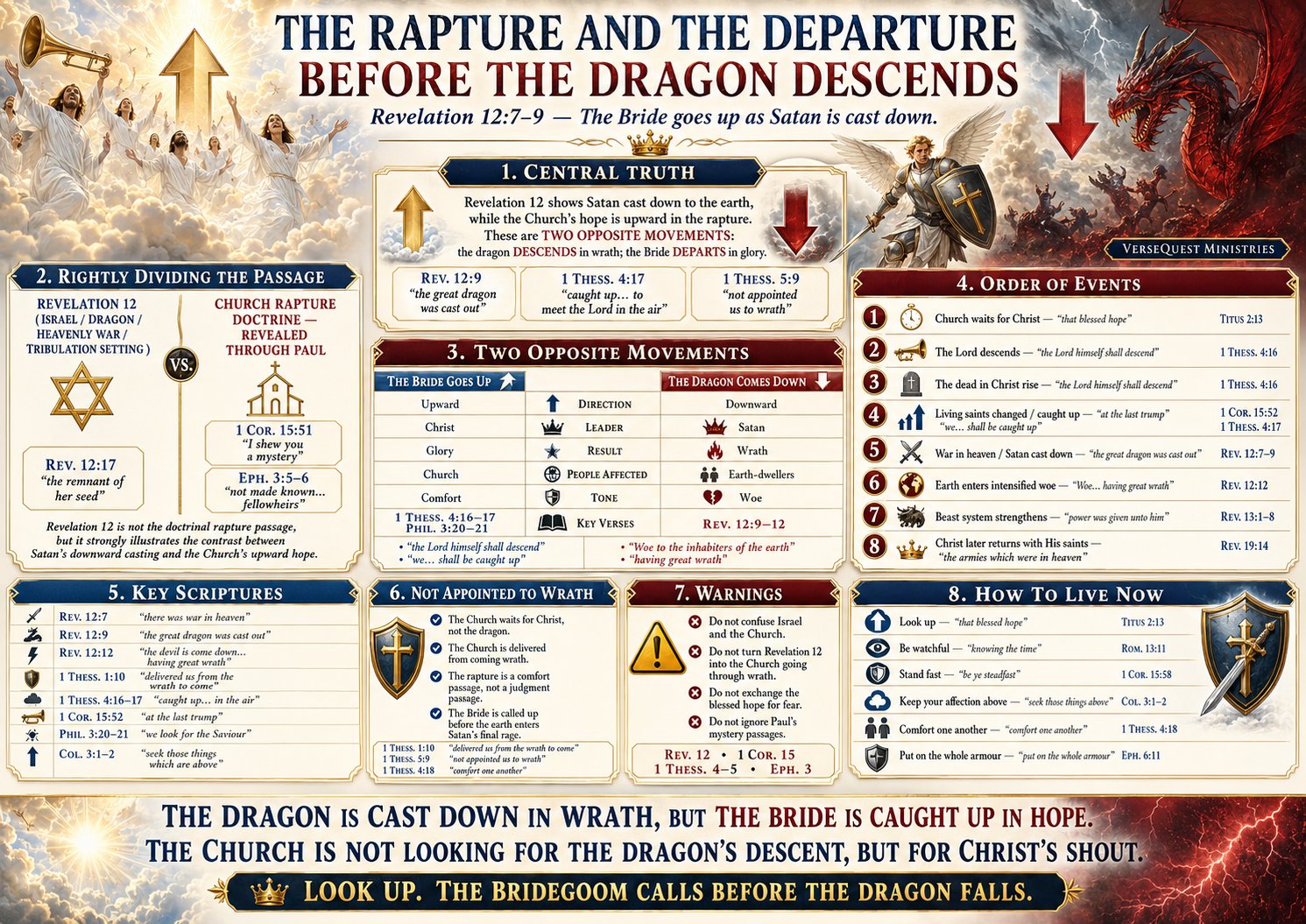
- The Rapture and the Departure Before the Dragon Descends – Printable Bible Study Chart
- Printable KJV Bible study chart on The Rapture and the Departure Before the Dragon Descends, showing the Bride caught up before Satan is cast down in wrath. This premium VerseQuest…
- $4.99
- Add to cart
-
-
Revelation
-
-71%
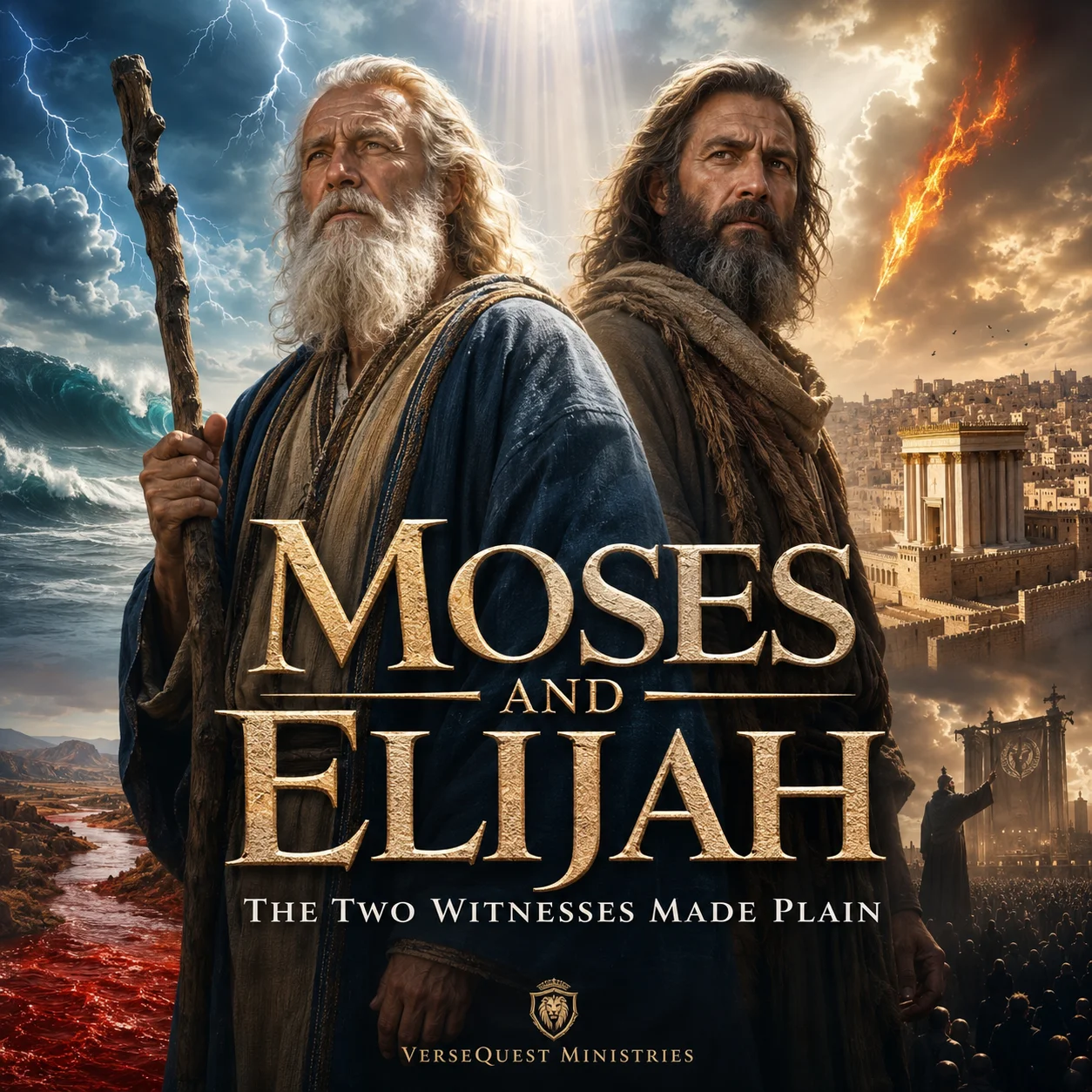
- Moses and Elijah: The Two Witnesses Made Plain
- Moses and Elijah: The Two Witnesses Made Plain is a 636-page premium VerseQuest PDF study proving from Scripture that the Two Witnesses of Revelation 11 are Moses and Elijah. This…
- Original price was: $34.99.$9.99Current price is: $9.99.
- Add to cart
-
-71%
-
Chart Collections
-
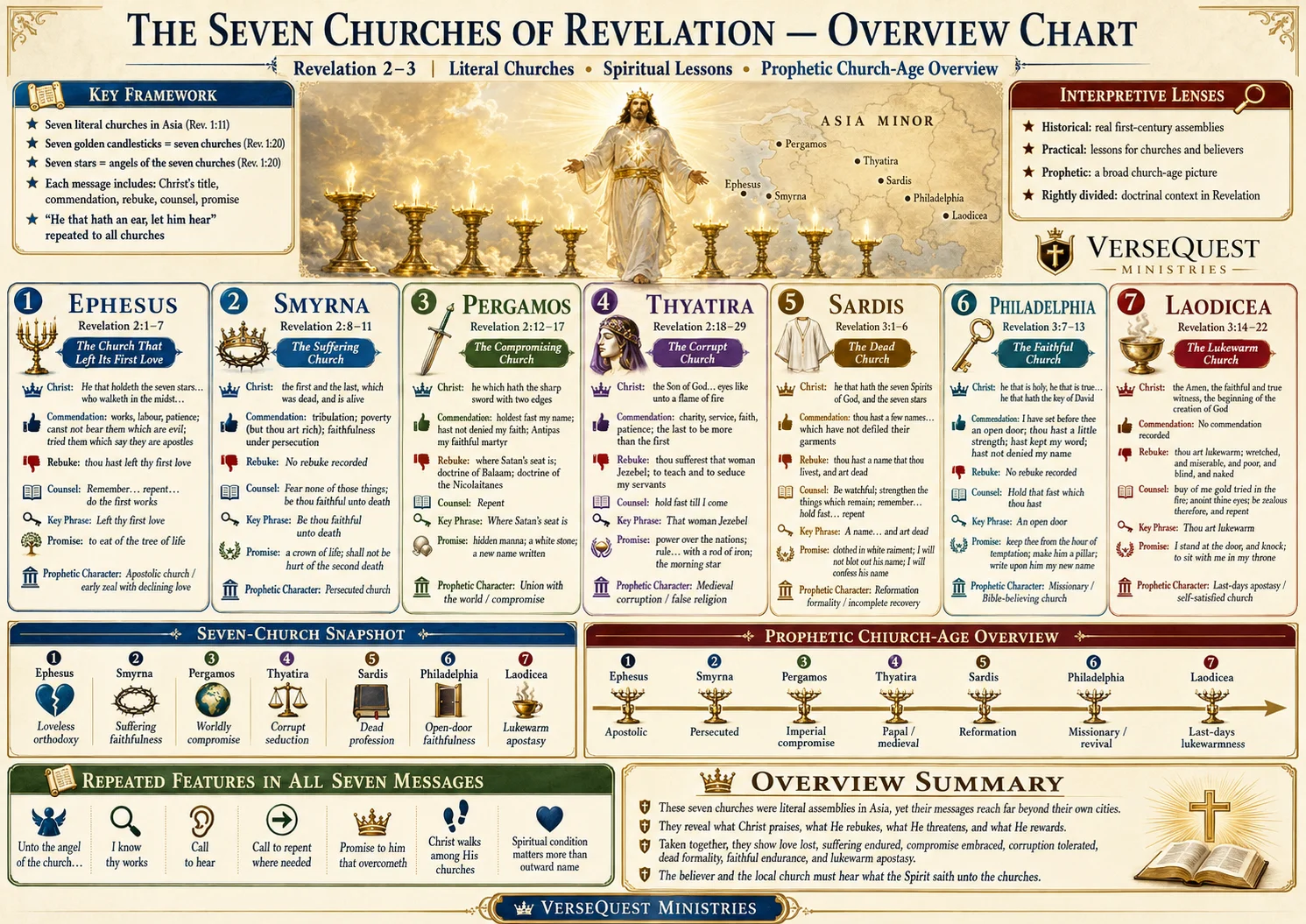
- The Seven Churches of Revelation Chart Collection – Christ Walking Among the Candlesticks
- A premium VerseQuest Ministries™ PDF chart collection covering the Seven Churches of Revelation in Revelation 2–3. Includes one overview chart plus individual KJV Bible study charts for Ephesus, Smyrna, Pergamos,…
- $12.99
- Add to cart
-
-
Prophecy Studies
-
- The Resurrection of Jesus Christ Made Plain – 501-Page KJV Bible Study
- A massive 501-page VerseQuest Ministries PDF Bible study defending and explaining the bodily resurrection of Jesus Christ from a KJV, rightly divided perspective. This 80-essay study covers the empty tomb,…
- $34.99
- Add to cart
-
-
Jesus Christ
-
-10%
- The Lord Jesus Christ Made Plain – 637-Page KJV Bible Study
- A massive 637-page, 100-part KJV Bible study on the Person and work of the Lord Jesus Christ. This premium VerseQuest resource covers His deity, incarnation, blood, cross, resurrection, present ministry,…
- Original price was: $39.00.$34.99Current price is: $34.99.
- Add to cart
-
-10%