The Signs of the Last Days – Apostasy, Moral Decline, Israel’s Prophetic Clock, Tribulation Signs, and the Believer’s Blessed Hope (KJV Bible Study Chart)
Understand the signs of the last days with this detailed KJV chart covering perilous times, apostasy, moral decline, false teachers, religious deception, world conditions, Israel’s prophetic clock, Tribulation-specific signs, the Rapture, and what believers should do.
$3.99
Description
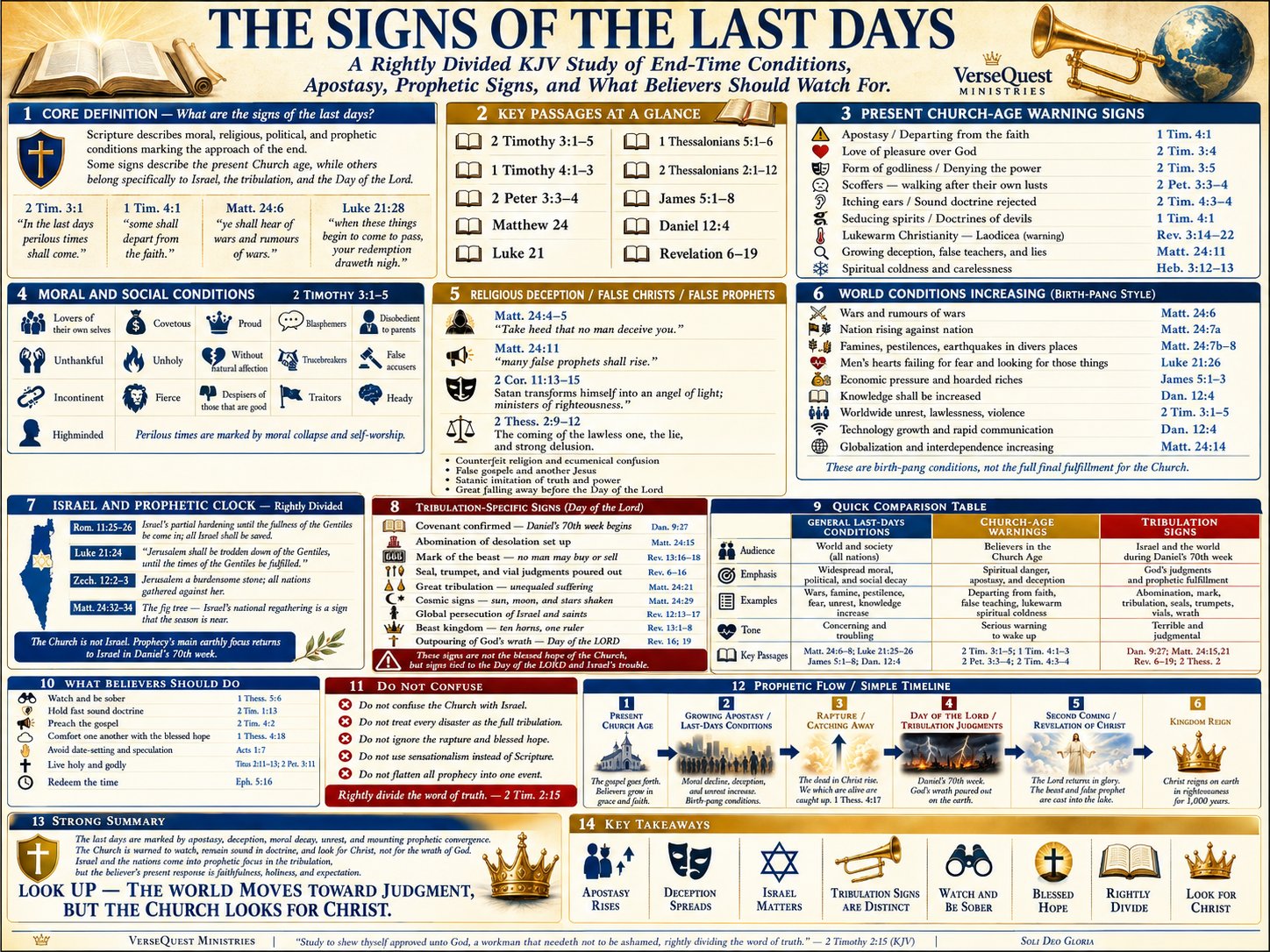
The Signs of the Last Days is a comprehensive, rightly divided KJV Bible study chart explaining the moral, religious, social, political, and prophetic conditions associated with the closing days of the present age. It carefully distinguishes current Church-age warnings from Israel’s prophetic signs and the specific events belonging to Daniel’s seventieth week, the Great Tribulation, and the Day of the Lord.
Built around 2 Timothy 3:1–5, 1 Timothy 4:1–3, 2 Thessalonians 2:1–12, 2 Peter 3:3–4, Matthew 24, Luke 21, Daniel 12:4, Romans 11:25–26, and Revelation 6–19, this chart provides a balanced biblical answer to a subject frequently distorted by sensationalism, date-setting, newspaper interpretation, and the failure to distinguish the Church from Israel.
Scripture describes the last days through several related but distinct categories. Some passages warn of spiritual apostasy, false teaching, moral collapse, self-worship, religious hypocrisy, and growing deception during the present Church Age. Other passages concern Israel, Jerusalem, the Tribulation, the rise of Antichrist, the abomination of desolation, cosmic disturbances, the mark of the beast, and the visible return of Jesus Christ.
These passages should not be carelessly thrown into one prophetic sack. Every difficult headline is not the Great Tribulation, every earthquake is not the sixth seal, every new technology is not the mark of the beast, and every political leader is not the Antichrist. Right division identifies the audience, setting, timing, program, and purpose of each passage before announcing its fulfillment.
Second Timothy 3:1 states, “This know also, that in the last days perilous times shall come.” Paul does not begin with earthquakes, armies, blood moons, or financial systems. He begins with the spiritual and moral condition of human beings. The danger of the last days is not merely what happens around men but what sin produces within them.
Paul describes people as lovers of their own selves, covetous, boasters, proud, blasphemers, disobedient to parents, unthankful, unholy, without natural affection, trucebreakers, false accusers, incontinent, fierce, and despisers of those that are good. He continues with traitors, heady, highminded, and lovers of pleasures more than lovers of God.
This list presents more than isolated acts of bad behaviour. It describes an entire culture increasingly governed by self-love, appetite, pride, rebellion, ingratitude, uncontrolled desire, and contempt for goodness. The sinner makes himself the centre, his feelings the standard, his pleasure the goal, and his will the final authority.
The phrase “lovers of their own selves” explains much of the passage. When self becomes the god, covetousness, boasting, pride, rebellion, false accusation, broken relationships, uncontrolled lust, and hatred of righteousness naturally follow. The last-days religion does not necessarily deny spirituality; it simply rearranges spirituality so that man remains upon the throne.
Second Timothy 3:5 warns of those “having a form of godliness, but denying the power thereof.” The religious appearance remains while the transforming truth is rejected. Churches, ministries, institutions, and individuals may retain Christian language, songs, symbols, ceremonies, titles, and public respectability while denying the authority of Scripture and the saving gospel of Jesus Christ.
This form without power produces religion that can entertain but not convict, soothe but not convert, inspire but not expose sin, and gather crowds without producing devotion to truth. It retains the vocabulary of Christianity while redefining its doctrines until the words no longer mean what the Bible says.
First Timothy 4:1 gives another major last-days warning: “Now the Spirit speaketh expressly, that in the latter times some shall depart from the faith.” Apostasy is not merely ignorance of biblical truth. It is departure from truth once professed, recognized, or placed before the apostate.
Paul connects this departure with “seducing spirits, and doctrines of devils.” False doctrine is not always harmless religious disagreement. Behind the corruption of the gospel, denial of Christ, replacement of Scripture, exaltation of man, and celebration of sin stands a spiritual warfare involving deception from the unseen realm.
The devil does not need every false teacher to wear a black robe and announce allegiance to Satan. Second Corinthians 11 warns that Satan transforms himself into an angel of light and that his ministers appear as ministers of righteousness. The most effective religious deception often arrives carrying a Bible, speaking warmly of Jesus, and carefully avoiding the doctrines that would expose the counterfeit.
The chart identifies love of pleasure over love for God as another Church-age warning. Pleasure itself is not automatically sinful. God gives lawful blessings to be received with thanksgiving. The danger comes when entertainment, comfort, appetite, recreation, sensuality, and personal satisfaction become more important than God, Scripture, worship, obedience, service, and holiness.
A pleasure-driven Christianity eventually reshapes doctrine around the desires of the audience. Hard truths disappear, repentance is treated as negativity, separation is called extremism, and biblical authority is softened to protect attendance, donations, popularity, or social acceptance.
The form of godliness without power also produces lukewarm Christianity. Revelation 3:14–22 describes Laodicea as materially rich, self-satisfied, and convinced that it needed nothing, while Christ called it wretched, miserable, poor, blind, and naked.
Lukewarmness is not spiritual balance. It is a useless religious condition that possesses enough Christianity to maintain an image but not enough conviction to submit fully to Christ. The final result is a church comfortable with itself while Jesus Christ stands outside the door.
Second Peter 3:3–4 warns that scoffers will come in the last days, walking after their own lusts and mocking the promise of Christ’s coming. Their unbelief is not presented as a purely intellectual conclusion. It is connected with lust, because denying future judgment makes present rebellion easier to defend.
The scoffer argues that all things continue as they were and treats the promise of Christ’s return as religious mythology. Peter answers that the same Word which brought judgment in Noah’s day preserves the present heavens and earth for future judgment by fire. Divine delay is not divine forgetfulness.
Paul also warns of people possessing itching ears. Second Timothy 4:3–4 states that the time will come when men will not endure sound doctrine but will gather teachers according to their own lusts. They turn their ears away from truth and toward fables.
The itching ear does not seek a teacher who will challenge sin, correct error, and exalt Christ. It seeks a teacher who will sanctify existing desires. The false teacher succeeds by telling the audience what it already wants to believe.
Growing deception, false teachers, spiritual coldness, and doctrinal compromise therefore belong among the strongest present Church-age warning signs. Christ and the apostles repeatedly warned that the approach of the end would not produce universal revival, doctrinal unity, or gradual Christian conquest of the world.
The chart also examines the broad moral and social conditions of the last days. Disobedience to parents weakens the first human structure of authority encountered by a child. Ingratitude erases the memory of blessing. Unholiness removes shame from sin. The loss of natural affection attacks family bonds and basic human loyalty.
Trucebreakers refuse lasting agreement, while false accusers weaponize words and destroy reputations. Incontinence describes the absence of self-control. Fierceness reveals a culture increasingly ruled by cruelty, rage, intimidation, and delight in destruction.
Those who despise good people resent the existence of a standard that exposes their behaviour. Traitors sell loyalty for advantage. The heady person rushes forward under impulse, while the highminded person is inflated with self-importance. These characteristics create the perilous atmosphere Paul foretold.
The chart then turns to religious deception, false Christs, and false prophets. Matthew 24 repeatedly warns, “Take heed that no man deceive you.” Deception is one of the dominant features of the prophetic period.
False Christs claim authority, power, revelation, or messianic identity that belongs only to Jesus Christ. False prophets use religious language to guide people away from the written Word. Some employ miraculous claims, emotional manipulation, secret knowledge, political promises, or counterfeit spirituality.
Second Thessalonians 2 describes the coming lawless one whose arrival is connected with satanic power, signs, lying wonders, and strong delusion. The Antichrist system will not rest upon military force alone. It will include supernatural deception persuasive enough to capture a world that rejected the love of the truth.
Present religious counterfeits prepare the spiritual atmosphere for that final deception. Ecumenical unity without truth, a generic Jesus without biblical identity, spiritual experience without doctrinal testing, and a gospel without Christ’s finished work all weaken resistance to the coming lie.
The chart also recognizes broad world conditions that resemble intensifying birth pangs. Jesus spoke of wars, rumours of wars, nation rising against nation, kingdom against kingdom, famines, pestilences, and earthquakes in various places. Yet He also warned, “see that ye be not troubled,” and stated that these things must occur while the end was not yet.
Wars and disasters have existed throughout human history. Their existence alone does not prove that a particular newspaper headline fulfills the complete prophetic passage. They form part of the troubled condition of a fallen world and may increase as history approaches its prophetic climax, but their full setting must remain connected with Matthew 24 and Israel’s Tribulation program.
The language of birth pangs communicates increasing frequency, intensity, and convergence. A single contraction does not complete the birth, but a recognizable progression announces that the appointed hour is approaching.
The chart includes wars and rumours of wars, national conflict, famines, pestilences, earthquakes, economic pressure, fear, social unrest, lawlessness, violence, increasing knowledge, rapid communication, globalization, and growing international interdependence.
These developments may prepare the stage upon which future prophetic events occur. They should be observed soberly but never used to manufacture dates, identify every crisis as final fulfillment, or replace Bible study with speculation.
Daniel 12:4 speaks of knowledge increasing and people running to and fro. The passage belongs within Daniel’s end-time prophetic setting. Modern transportation, digital communication, instant information, and technological expansion may illustrate how rapidly conditions can develop, but the verse should remain connected with Daniel’s prophecy rather than used as a slogan for every invention.
Economic pressure and concentrated wealth also appear among present warning conditions. James 5 warns wealthy oppressors who store treasure for the last days, withhold wages, live in pleasure, and condemn the just.
This does not mean every wealthy person is wicked or that possessing savings fulfills prophecy. The warning concerns riches obtained, hoarded, trusted, or used through injustice while the Day of accountability approaches.
Increasing globalization and interdependence may prepare political and economic systems capable of the worldwide control described in Revelation 13. Yet present global systems are not automatically the final beast system. The mark of the beast belongs to a particular future ruler, worship system, image, economic command, and Tribulation context.
The chart gives special attention to Israel and the prophetic clock. Romans 11:25–26 teaches that blindness in part has happened to Israel until the fulness of the Gentiles comes in and that God still possesses a future purpose for the nation.
Israel’s preservation, regathering, Jerusalem, the surrounding nations, and the future Temple setting all matter because much of end-time prophecy is centred upon the land, city, people, covenants, and Kingdom promises of Israel.
Luke 21:24 speaks of Jerusalem being trodden down by the Gentiles until the times of the Gentiles are fulfilled. Zechariah 12 foretells Jerusalem becoming a burdensome stone to the surrounding peoples and nations.
Matthew 24 uses the fig-tree illustration to teach recognition of the prophetic season. The passage should not be manipulated into unsupported date calculations, but Israel’s national existence and Jerusalem’s central place in world affairs demonstrate that the people and city named by the prophets remain relevant.
The Church is not Israel. The Body of Christ should not claim Israel’s identity, steal her prophetic promises, or declare that God has permanently finished with the descendants of Jacob. Romans 11 rejects that conclusion.
Israel’s present unbelief does not nullify God’s promises. The same nation that remains partially blinded will one day look upon the Messiah whom it pierced. Israel will be refined through Jacob’s trouble and restored beneath the reign of Jesus Christ.
The chart separates these broad last-days conditions from Tribulation-specific signs. Daniel 9:27 presents the covenant confirmed by the coming prince for one week. That covenant begins Daniel’s final seven-year period.
At the midpoint, Antichrist breaks the covenant, stops sacrifice, and establishes the abomination of desolation. Matthew 24 connects this event with the holy place, Judea, and the beginning of the Great Tribulation.
The mark of the beast belongs to Revelation 13 and the final beast system. It is connected with worship, allegiance, economic control, the image, the false prophet, and the number 666.
The seals, trumpets, and vials are direct judgments during the Day of the Lord. They include conquest, warfare, famine, death, cosmic disturbance, demonic torment, poisoned waters, darkness, sores, scorching heat, earthquake, and hail.
The Great Tribulation is unequalled suffering associated especially with the final three and a half years of Daniel’s seventieth week. It is not merely another name for every period of Christian persecution.
Global persecution of Israel and Tribulation saints intensifies during this future period. Revelation 12 describes satanic fury against the woman and her remnant, while Revelation 13 presents the beast making war with the saints.
The beast system continues only until Jesus Christ returns. Revelation 19 presents the Lord descending visibly in glory, destroying the gathered armies and casting the beast and false prophet into the lake of fire.
The chart’s quick comparison table separates general last-days conditions, Church-age warnings, and Tribulation signs. General conditions may involve worldwide moral, political, and social decay. Church-age warnings focus particularly upon believers, churches, apostasy, false teaching, spiritual coldness, and departure from the faith.
Tribulation signs concern Israel and the world during Daniel’s seventieth week. They include the covenant, abomination, beast, mark, judgments, cosmic signs, persecution, and divine wrath.
The tone also differs. General conditions warn that the world is moving toward judgment. Church-age warnings call believers and churches to wake up, hold fast, and maintain sound doctrine. Tribulation passages describe terror, wrath, national crisis, judgment, and the visible approach of Christ’s Kingdom.
The prophetic order shown on the chart begins with the present Church Age. The gospel of grace goes forth while moral decline, deception, apostasy, and international conditions prepare the world for future developments.
The Rapture or catching away follows. The dead in Christ rise first, living believers are changed, and the Church meets the Lord in the air. The Church’s hope is Jesus Christ, not Tribulation signs.
Daniel’s seventieth week and the Day-of-the-Lord judgments then unfold upon the earth. Israel returns to the centre of prophecy, Antichrist rises, the covenant is broken, and God’s wrath falls upon rebellious earth-dwellers.
Jesus Christ returns visibly in the Second Coming, defeats the beast and false prophet, judges the nations, delivers Israel’s remnant, and establishes His Kingdom upon the earth.
The chart therefore warns against date-setting. Jesus Christ commanded watchfulness, not calendar inventions. Repeated date predictions bring reproach upon biblical prophecy and train people to scoff when the predictions fail.
Believers must not use sensationalism instead of Scripture. Dramatic claims may gather attention, but truth is not measured by clicks, fear, excitement, or viral headlines.
The Rapture and blessed hope must not be ignored. A believer who watches only for Antichrist, disaster, persecution, and economic collapse may possess much anxiety while missing the Church’s appointed expectation.
The Church must not be confused with Israel, and prophecy must not be flattened into one event. The Rapture, Tribulation, Second Coming, and Kingdom remain related but distinct.
The chart gives several practical responsibilities for believers. Christians should watch and remain sober, holding fast the form of sound words. Watchfulness is spiritual readiness, not obsession with rumours.
Believers should preach the gospel while the present day of grace remains open. The approaching judgment should increase urgency in pointing sinners to the death, burial, and resurrection of Jesus Christ.
Christians should comfort one another with the blessed hope. The dead in Christ will rise, living believers will be changed, and the Church will be forever with the Lord.
Believers should live holy and godly lives. Prophecy is not merely information about tomorrow; it is motivation for obedience today. The expectation of Christ should purify the walk, strengthen service, and loosen the believer’s grip upon the world.
Christians should redeem the time. The nearness of eternity exposes the foolishness of wasting life upon bitterness, endless controversy, worldly ambition, entertainment, and spiritual delay.
The strong summary is clear: the last days are marked by apostasy, deception, moral decline, religious counterfeit, self-love, pleasure worship, spiritual coldness, and increasing prophetic convergence.
The Church is warned to watch, remain sound in doctrine, reject false teaching, preach the gospel, live soberly, comfort one another, and look for Jesus Christ.
Israel and the nations move toward the fulfillment of the prophetic program, Daniel’s final week, the Day of the Lord, and the visible return of the King. The world moves toward judgment, but the Church looks for Christ.
This resource is ideal for personal Bible study, last-days teaching, apostasy studies, Church-age warning lessons, Israel-and-Church distinctions, Tribulation instruction, prophecy timelines, new-believer discipleship, youth ministry, pastoral training, Sunday school, homeschool Bible curriculum, Christian schools, Bible institutes, prophecy conferences, and sermon preparation.
Signs of the last days, last-days prophecy, perilous times, apostasy in the Church, departure from the faith, doctrines of devils, lovers of pleasure, form of godliness, itching ears, scoffers in the last days, false Christs, false prophets, moral decline, social collapse, wars and rumours of wars, increasing knowledge, Israel’s prophetic clock, Jerusalem in prophecy, Daniel’s seventieth week, Tribulation signs, mark of the beast, blessed hope, Rapture of the Church
The last days are described through several related but distinct scriptural settings. Some passages address moral and religious conditions within the present Church Age, while others concern Israel, Daniel’s seventieth week, the Tribulation, the Day of the Lord, and the visible return of Jesus Christ. Right division prevents every modern crisis from being announced as the full fulfillment of a passage belonging to another audience or prophetic period.
Second Timothy 3 emphasizes the moral character of the last days. Self-love produces covetousness, pride, blasphemy, rebellion, ingratitude, unholiness, broken affection, false accusation, lack of self-control, cruelty, betrayal, rashness, and highmindedness. These conditions become especially perilous when joined with a form of godliness that denies the transforming power of biblical truth.
First Timothy 4 warns of departure from the faith through seducing spirits and doctrines of devils. Apostasy involves more than ordinary ignorance; it is movement away from revealed truth. Religious deception often retains Christian terminology while changing the identity of Christ, the gospel, the authority of Scripture, or the nature of salvation.
Second Timothy 4 warns that people will reject sound doctrine and gather teachers who satisfy their itching ears. The false teacher succeeds by agreeing with the audience’s lusts rather than confronting them with God’s Word. Last-days religion increasingly values comfort, entertainment, emotion, popularity, and affirmation over truth, repentance, holiness, and obedience.
Second Peter 3 identifies scoffing at Christ’s return as another last-days condition. The scoffer argues that all things continue unchanged and treats future judgment as a myth. Scripture answers that God’s delay demonstrates longsuffering rather than inability or forgetfulness, and the present creation remains reserved for judgment.
Wars, rumours of wars, famines, pestilences, earthquakes, lawlessness, fear, economic pressure, rapid communication, increasing knowledge, and international instability may resemble intensifying birth-pang conditions. However, Jesus warned that wars alone do not prove the end has arrived. These conditions must not be used for reckless date-setting or for announcing every disaster as the completed fulfillment of Matthew 24.
Israel remains central to the prophetic clock. Romans 11 teaches that Israel’s blindness is partial and temporary, while Luke 21 and Zechariah maintain Jerusalem’s future importance. The Church has not replaced Israel, and the continued existence of the Jewish people demonstrates that God has not abandoned His covenants or future Kingdom purposes.
Tribulation-specific signs include Antichrist’s covenant, the abomination of desolation, stopped sacrifices, the mark of the beast, seal judgments, trumpet judgments, vial judgments, Great Tribulation, persecution of Israel and Tribulation saints, cosmic disturbances, and the gathering of the nations. These belong to Daniel’s seventieth week and should not be treated as ordinary Church-age signs.
The Rapture is distinct from the Tribulation and Second Coming. The Church’s hope is to be caught up to meet Jesus Christ in the air before prophetic wrath is poured upon the earth. At the Second Coming, Christ returns visibly with His saints to judge His enemies and establish His Kingdom.
The doctrine of the last days should produce watchfulness, sober living, sound doctrine, gospel preaching, holiness, comfort, and faithful service. It should not produce fear-driven speculation, sensationalism, date-setting, or obsession with every rumour. The world moves toward judgment, but the Church looks for Jesus Christ.
Signs-of-the-last-days studies, apostasy teaching, Second Timothy 3 lessons, First Timothy 4 instruction, false-teacher warnings, moral-and-social decline studies, Matthew 24 teaching, Israel-and-Church distinctions, Daniel’s seventieth-week studies, Tribulation-sign instruction, Rapture teaching, prophecy timelines, Christian watchfulness, sound-doctrine classes, youth discipleship, pastoral training, prophecy conferences, Sunday school lessons, homeschool Bible curriculum, Christian school teaching, Bible institute classes, sermon preparation
King James Bible, Strong’s Concordance, Thompson Chain-Reference Bible, Treasury of Scripture Knowledge, Nave’s Topical Bible, Second Timothy 3 study notes, First Timothy 4 outlines, Second Thessalonians 2 commentary materials, Matthew 24 comparison charts, Daniel 9 seventy-weeks studies, Revelation 6–19 timelines, apostasy and false-teacher studies, Church-versus-Israel charts, Rapture-versus-Second-Coming resources, seals-trumpets-vials charts, biblical watchfulness lessons, Pauline mystery outlines, VerseQuest prophecy and right-division charts
Related products
-
Jesus Christ / Christology
-
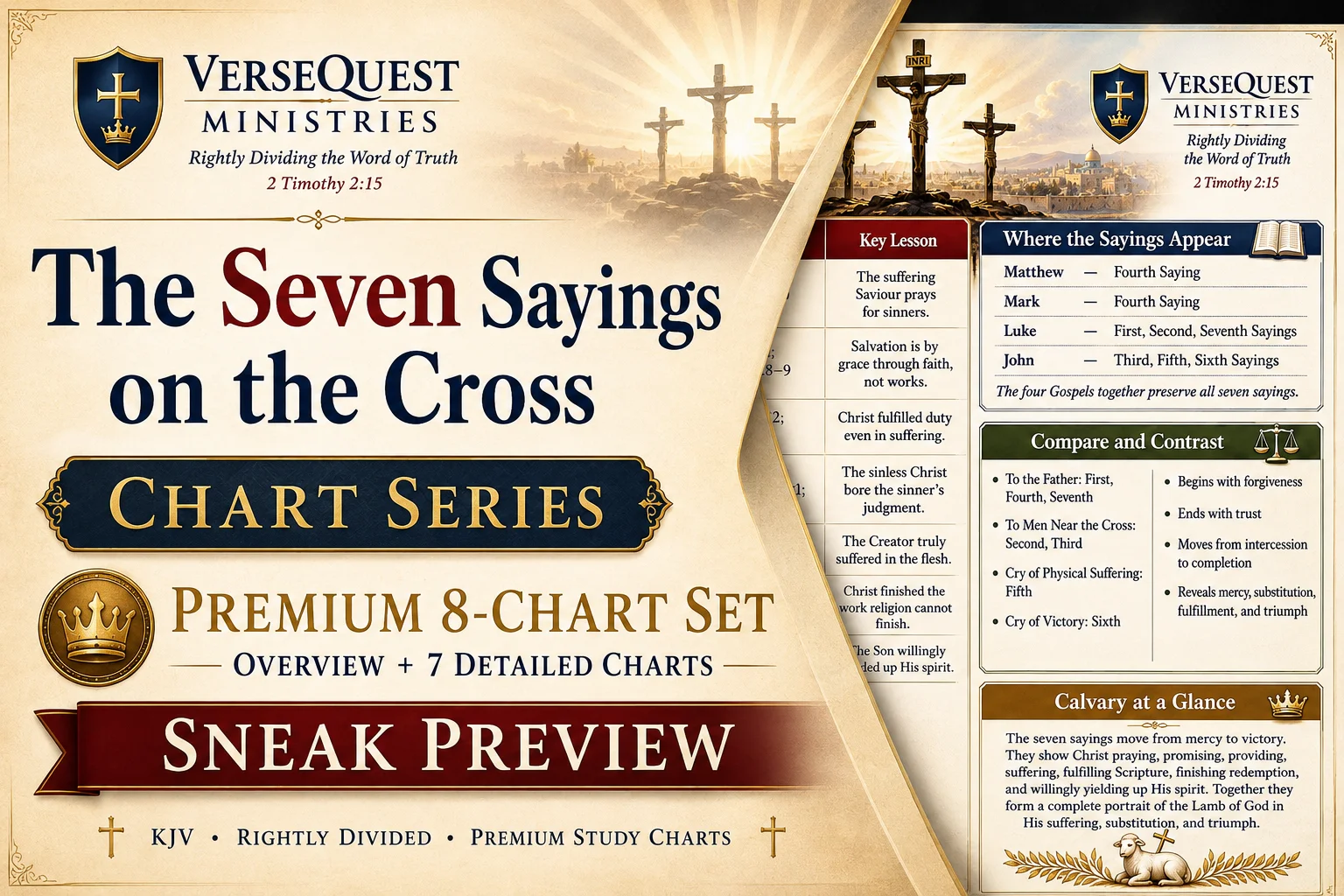
- The Seven Sayings on the Cross – Premium 8-Chart KJV Study Set
- A premium VerseQuest Ministries digital PDF study set on The Seven Sayings on the Cross, featuring an overview chart plus seven detailed KJV Bible study charts. This resource examines Calvary,…
- $12.99
- Add to cart
-
-
Prophecy Studies
-
- The Resurrection of Jesus Christ Made Plain – 501-Page KJV Bible Study
- A massive 501-page VerseQuest Ministries PDF Bible study defending and explaining the bodily resurrection of Jesus Christ from a KJV, rightly divided perspective. This 80-essay study covers the empty tomb,…
- $34.99
- Add to cart
-
-
Kingdom Hall
-
-71%
- Jehovah’s Witnesses Made Plain – 574-Page KJV Watchtower Study
- A massive 574-page VerseQuest study exposing the Watchtower system from the King James Bible. This detailed 100-essay book covers the false Christ, false gospel, New World Translation, failed prophecy, 144,000,…
- Original price was: $34.99.$9.99Current price is: $9.99.
- Add to cart
-
-71%
-
Doctrine Series
-
Bible Prophecy Charts
-
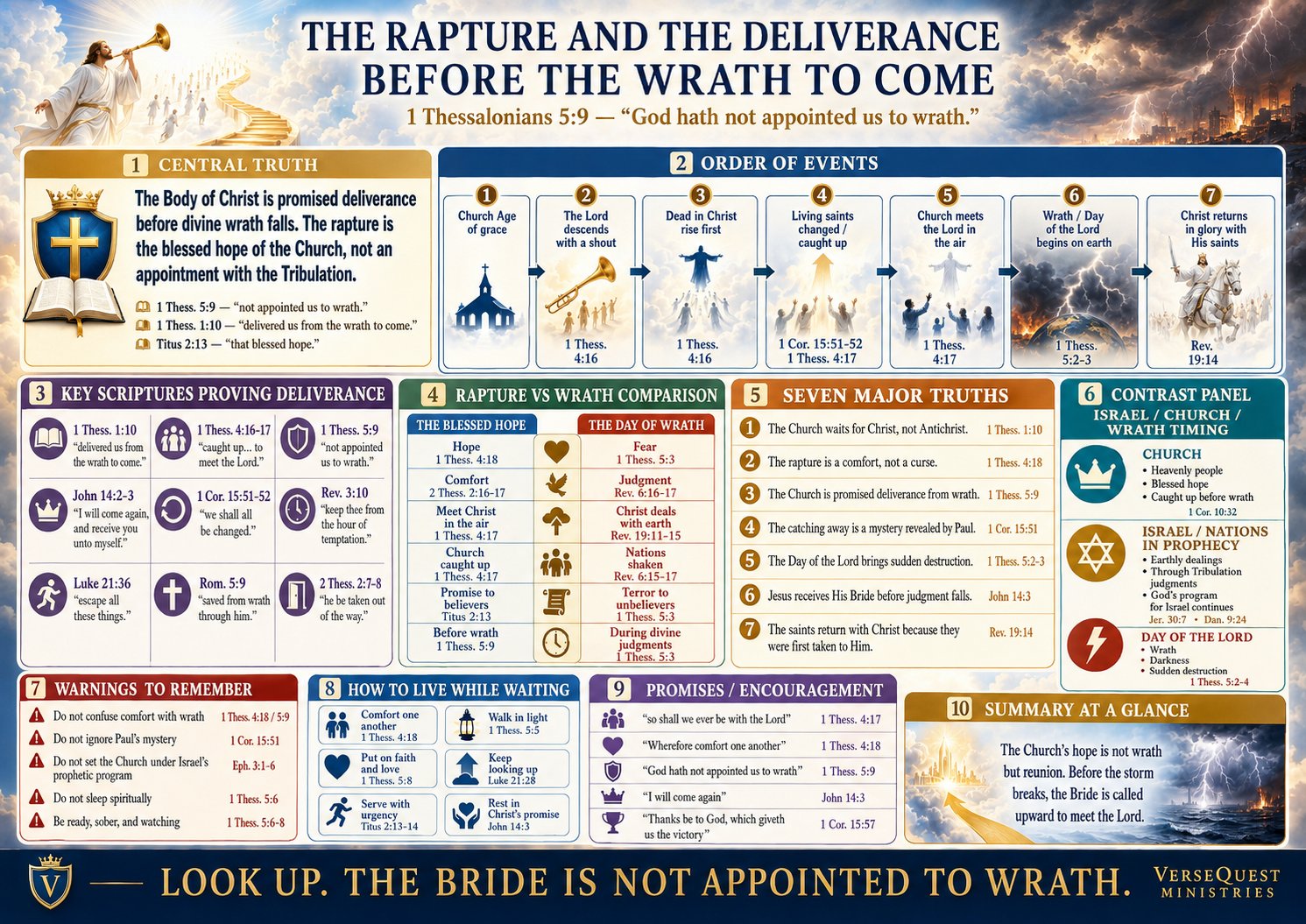
- The Rapture and the Deliverance Before the Wrath to Come – Printable Bible Study Chart
- Printable KJV Bible study chart on The Rapture and the Deliverance Before the Wrath to Come, showing from 1 Thessalonians 5:9 that the Church is not appointed to wrath. This…
- $4.99
- Add to cart
-