
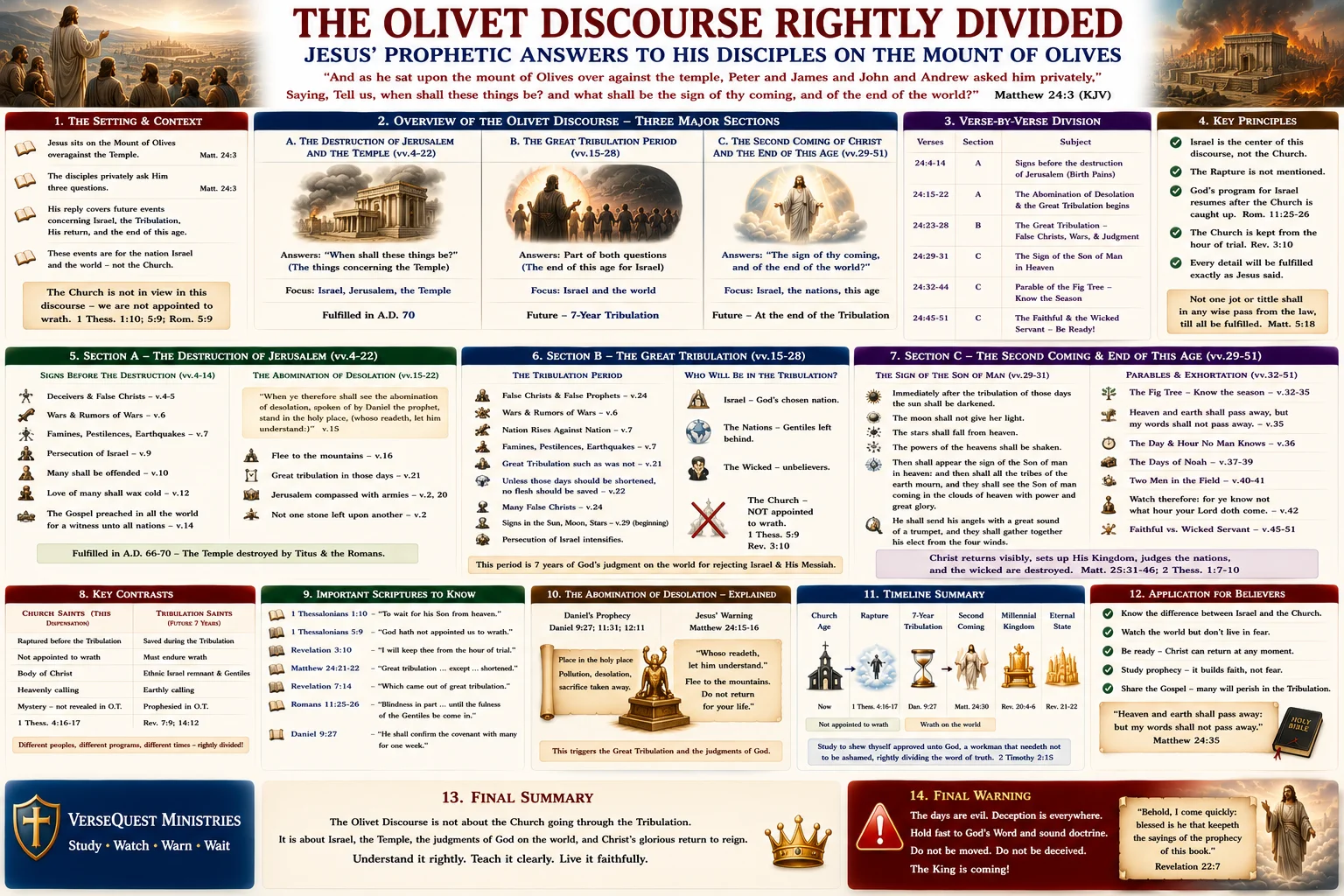
The Olivet Discourse Rightly Divided – Matthew 24, Israel, the Great Tribulation, and the Second Coming of Jesus Christ (KJV Bible Study Chart)
Understand the Olivet Discourse with this detailed KJV chart covering Matthew 24’s setting, Israel and the Temple, beginning sorrows, Daniel’s abomination of desolation, Great Tribulation, false Christs, cosmic signs, the visible Second Coming, days of Noah, and the crucial distinction between the Rapture and Christ’s return to earth.
$4.99
Description
The Olivet Discourse Rightly Divided is a comprehensive KJV Bible study chart examining Jesus Christ’s prophetic teaching on the Mount of Olives in Matthew 24 and explaining its relationship to Israel, Jerusalem, the Temple, Daniel’s seventieth week, the abomination of desolation, the Great Tribulation, the visible Second Coming, and the end of the age. Rather than forcing the present Church into every prophetic statement, this chart follows the audience, setting, terminology, geography, and Old Testament connections of Christ’s discourse so that each passage remains in its proper biblical context.
The discourse begins with Jesus leaving the Temple after confronting Israel’s religious leaders in Matthew 23. The disciples point out the buildings of the Temple, and Christ answers with the startling prophecy that not one stone will be left upon another. Later, while He sits upon the Mount of Olives, Peter, James, John, and Andrew ask privately about the timing of these things, the sign of His coming, and the end of the age. The questions therefore arise directly from Israel’s Temple, Jerusalem, Messiah’s return, and the prophetic future rather than from a discussion of the mystery Body of Christ.
Matthew 24:3 records the disciples asking, “Tell us, when shall these things be? and what shall be the sign of thy coming, and of the end of the world?” The King James wording “world” carries the sense of the age in this context. Jesus answers with a broad prophetic description moving through deception, international conflict, persecution, apostasy, the abomination of desolation, unparalleled Tribulation, cosmic signs, His visible return, the gathering associated with that return, and solemn exhortations to watchfulness.
A rightly divided approach begins by asking who is speaking, to whom He is speaking, what questions are being answered, and what biblical programme supplies the vocabulary. Jesus is speaking as Israel’s Messiah to Jewish disciples while discussing Israel’s Temple and a prophetic future already revealed through Daniel and the prophets. This does not mean Christians cannot learn from the passage. All Scripture is profitable. It does mean that profitable application must not erase doctrinal context.
The present Church, the Body of Christ, had not yet been revealed in the Pauline sense in Matthew 24. Ephesians 3 later identifies the one Body composed of believing Jews and Gentiles as mystery truth previously hidden in God. Paul’s revelation concerning the catching away in First Thessalonians 4 and the mystery transformation in First Corinthians 15 therefore must not be read backward into every gathering, trumpet, elect, or coming mentioned in Israel’s prophetic discourse.
The chart distinguishes the Rapture from the Second Coming. At the Rapture, Christ comes for the members of His Body, the dead in Christ rise first, living saints are changed, and both groups are caught up to meet the Lord in the air. The Rapture is the Church’s blessed hope and is presented as an imminent expectation.
Matthew 24, by contrast, gives numerous identifiable events preceding Christ’s visible return. The abomination of desolation must occur, the Great Tribulation unfolds, false Christs and false prophets operate, cosmic signs shake the heavens, and then the sign of the Son of Man appears. These characteristics fit the Second Coming after Daniel’s seventieth week rather than the mystery catching away of the Church.
This distinction is essential. If the Rapture and Second Coming are merged, the Church’s blessed hope becomes dependent upon the appearance of Antichrist, the rebuilding and desecration of the Temple, the mark of the beast, the Great Tribulation, and the cosmic signs Jesus places before His visible revelation. Right division keeps the imminent hope given to the Body of Christ distinct from Israel’s sign-filled prophetic programme.
Matthew 24:4–14 describes conditions leading into the prophetic crisis. Jesus first warns, “Take heed that no man deceive you.” Deception dominates the discourse because the final period will include counterfeit messiahs, false prophets, religious claims, political promises, and supernatural signs designed to mislead.
Christ warns that false Christs will arise claiming messianic authority. This prepares the reader for the final Antichrist, the counterfeit ruler who receives worldwide admiration and eventually demands worship. The world that rejects the true Messiah becomes increasingly susceptible to false messiahs.
Wars and rumours of wars also appear, but Jesus immediately cautions against premature conclusions: “see that ye be not troubled: for all these things must come to pass, but the end is not yet.” Every war therefore cannot be announced as the final fulfillment of Matthew 24. The passage itself warns against that kind of sensationalism.
Nation rises against nation and kingdom against kingdom. Famines, pestilences, and earthquakes occur in various places. Christ calls these “the beginning of sorrows,” language resembling birth pains. They signal movement toward the prophetic climax without themselves constituting the entire Tribulation.
Persecution then intensifies. Those faithful to Christ are afflicted, hated, betrayed, and killed. False prophets rise, iniquity abounds, and the love of many grows cold. The prophetic period therefore involves both outward turmoil and inward spiritual apostasy.
Matthew 24:13 declares, “But he that shall endure unto the end, the same shall be saved.” This verse must remain within the prophetic setting Jesus is describing. It should not be used to overturn the Church-age doctrine of salvation by grace through faith, eternal security, or the sealing ministry of the Holy Spirit revealed through Paul’s epistles.
The “end” in the discourse belongs to the end of the Tribulation period and the arrival of Messiah’s Kingdom. Those living under Antichrist’s persecution must remain faithful rather than surrendering to false worship, receiving the mark, or abandoning God’s truth.
Matthew 24:14 states that “this gospel of the kingdom shall be preached in all the world for a witness unto all nations; and then shall the end come.” The terminology matters. Jesus specifically calls it “the gospel of the kingdom.” It belongs naturally to the prophetic announcement that the King and Kingdom are approaching.
The gospel of the grace of God preached during the present Church Age centres upon Christ’s death for our sins, burial, resurrection, and salvation by grace through faith. Right division should not force every use of the word gospel into one identical proclamation without examining the accompanying kingdom, audience, and dispensational setting.
The discourse reaches its great prophetic turning point in Matthew 24:15: “When ye therefore shall see the abomination of desolation, spoken of by Daniel the prophet, stand in the holy place.” Jesus explicitly sends the reader back to Daniel.
Daniel 9:27 places this crisis in the middle of the future seventieth week. The coming prince confirms a covenant with many for one week and then causes sacrifice and oblation to cease in the midst of that week. Daniel 11 and Daniel 12 likewise connect the abomination with the cessation of sacrifice and the final prophetic trouble.
Christ’s reference to Daniel demonstrates that Matthew 24 cannot be interpreted correctly while ignoring Israel’s seventy-week programme. Daniel 9:24 says the seventy weeks are determined upon Daniel’s people and holy city—Israel and Jerusalem.
The abomination stands “in the holy place.” This implies a future Temple environment in which Jewish worship and sacrifice have resumed. The prophecy therefore involves a literal Jewish setting rather than a merely symbolic apostasy within Christianity.
Jesus’ instruction following the abomination is unmistakably geographical: “Then let them which be in Judaea flee into the mountains.” The person on the housetop should not return for possessions. The person in the field should not turn back. Christ warns regarding pregnancy, winter conditions, and the Sabbath day.
These details are difficult to explain if the discourse is merely a symbolic description of Church history. Judea, the holy place, Daniel’s prophecy, Sabbath considerations, Temple worship, and national Israel all point toward the future Jewish prophetic programme.
Matthew 24:21 then declares, “For then shall be great tribulation, such as was not since the beginning of the world to this time, no, nor ever shall be.” Jesus describes an unparalleled period, not merely another difficult era in human history.
The word “then” links the Great Tribulation directly with the abomination of desolation. The midpoint desecration triggers the intensified latter portion of Daniel’s final week.
This final three-and-one-half-year period corresponds with the forty-two months, 1,260 days, and time-times-and-half-a-time references appearing throughout Daniel and Revelation. Antichrist’s open blasphemy intensifies, Israel is persecuted, saints suffer, beast worship spreads, and divine judgments accelerate.
The days are shortened for the elect’s sake. The term elect does not automatically mean the Church every time it appears. Israel itself is called God’s elect in Old Testament prophecy, and context must determine which group is in view.
False Christs and false prophets become especially dangerous during this period. They display “great signs and wonders” capable of extraordinary deception. Christ warns His followers beforehand so that spectacular supernatural phenomena will not automatically be accepted as divine.
This warning agrees with Second Thessalonians 2 and Revelation 13. Antichrist’s final system is accompanied by lying signs and wonders, while the False Prophet performs great miracles and directs the world toward beast worship.
The biblical test of truth therefore cannot be experience alone. Fire from heaven, supernatural signs, apparitions, miraculous claims, emotional experiences, and religious spectacles must all be judged by Scripture.
Jesus specifically warns against claims that Christ has appeared secretly in the desert or private chambers. His true Second Coming will not require a television expert, prophet, denomination, or internet personality to convince the world that He has returned.
Matthew 24:27 states, “For as the lightning cometh out of the east, and shineth even unto the west; so shall also the coming of the Son of man be.” His return is unmistakable, visible, dramatic, and worldwide in significance.
Matthew 24:29 places the next events “Immediately after the tribulation of those days.” This timing statement is one of the strongest reasons the passage should not be identified with the pre-Tribulation Rapture.
The sun is darkened, the moon fails to give her light, the stars fall from heaven, and the powers of the heavens are shaken. Cosmic disturbances accompany the end of the Tribulation.
Then appears “the sign of the Son of man in heaven.” The tribes of the earth mourn as they see Jesus Christ coming in the clouds of heaven with power and great glory.
This is not Christ coming secretly for His Church. It is the public Revelation of the rejected Messiah before the nations of the world.
Zechariah 12, Zechariah 14, Revelation 1, Revelation 19, and other prophetic passages supply the wider setting. Israel sees the One whom it pierced, nations mourn, armies gather, and Messiah returns to establish His rightful Kingdom.
Matthew 24:31 describes angels sent with a great sound of a trumpet to gather the elect. This gathering must not automatically be equated with First Thessalonians 4 merely because both passages contain a trumpet and a gathering.
The surrounding circumstances differ dramatically. First Thessalonians describes the dead in Christ rising, living Church saints being caught up, and both groups meeting the Lord in the air. Matthew 24 occurs after the Tribulation, involves angels, the four winds, Israel’s prophetic discourse, cosmic signs, and the visible appearing of the Son of Man.
Right division examines more than isolated vocabulary. Two events may contain clouds, trumpets, angels, or gathering without being identical in every doctrinal detail.
The chart then moves into Christ’s parabolic exhortations beginning with the fig tree. Jesus instructs His future hearers to recognize the prophetic season as events unfold. The lesson is watchfulness and recognition rather than arbitrary date-setting.
The precise interpretation of the fig tree has generated extensive debate, but it should not be turned into a mathematical device for predicting the year of Christ’s return. Christ provides signs for people living within the prophetic period, not permission for repeated failed prophetic calendars.
Jesus emphasizes the permanence of His Word: “Heaven and earth shall pass away, but my words shall not pass away.” Prophecy rests upon divine certainty rather than human speculation.
The discourse then discusses the day and hour and compares conditions with the days of Noah. Humanity continues ordinary life—eating, drinking, marrying, and conducting daily affairs—until judgment suddenly arrives.
The Noah comparison emphasizes unexpected judgment upon an unprepared world. Noah and his household knew judgment was coming because God had spoken, while the surrounding population continued ordinary life until the Flood took them away.
This background is important when interpreting the familiar statements “one shall be taken, and the other left.” Within the immediate Noah comparison, being “taken” should not automatically be assumed to mean being raptured to heaven. In Noah’s day, those taken by judgment were the wicked, while Noah remained to inherit the post-judgment earth.
That contextual observation is especially important in a rightly divided study because it prevents a popular Rapture slogan from overturning the larger prophetic setting of Matthew 24.
The command remains, “Watch therefore: for ye know not what hour your Lord doth come.” Those living during the period must remain alert, faithful, and obedient because complacency carries severe consequences.
Jesus then contrasts the faithful and evil servants. The faithful servant continues fulfilling his responsibility while waiting for the Master. The evil servant assumes the Lord delays His coming and uses the delay as an opportunity for self-indulgence and abuse.
The lesson transcends dispensations even while remaining in its prophetic context: belief in Christ’s coming should produce faithfulness rather than speculation.
The chart’s Church Saints versus Tribulation Saints comparison helps distinguish two groups. Church saints belong to the present mystery Body, are caught up before the Tribulation within the chart’s pre-Tribulation framework, possess a heavenly calling, and are not appointed to prophetic wrath.
Tribulation saints believe during Daniel’s final week, remain upon the earth amid Antichrist’s kingdom and divine judgments, and face severe demands for endurance and faithfulness. Revelation repeatedly presents saints being persecuted and martyred while refusing beast worship.
Both groups depend upon God and Jesus Christ, but their different prophetic settings should not be erased. The existence of saints after the Rapture does not prove that the present Church remains upon earth any more than Old Testament saints prove that the Church existed in Genesis.
The chart connects the Olivet Discourse with several key passages. First Thessalonians 1:10 teaches that Jesus delivers the Church from the wrath to come. First Thessalonians 5:9 declares that God has not appointed the Church to wrath.
Revelation 3:10 promises preservation from the worldwide hour of temptation within the chart’s pre-Tribulation interpretation. Matthew 24:21–22 describes the Great Tribulation. Revelation 7:14 identifies the great multitude coming out of great Tribulation.
Romans 11:25–26 maintains Israel’s future place in God’s programme, while Daniel 9:27 provides the seven-year framework and midpoint covenant crisis.
These passages work together when rightly divided rather than competing with one another. Paul explains the mystery Church; Daniel explains Israel’s seventy weeks; Jesus explains Israel’s future Tribulation and His visible return; Revelation fills in the details of the final prophetic judgments.
The chart’s prophetic timeline therefore proceeds from the present Church Age to the Rapture, followed by Daniel’s seven-year Tribulation, the Second Coming of Jesus Christ, the millennial Kingdom, and ultimately the eternal state.
This timeline keeps the Rapture distinct from Matthew 24’s visible post-Tribulation coming. The Church is gathered before wrath; Christ later returns publicly to judge His enemies and establish the Kingdom.
The millennial Kingdom fulfills the earthly promises made through Israel’s prophets. Revelation 20 states repeatedly that Christ reigns for one thousand years. Satan is bound, Messiah rules, and the righteous Kingdom rejected at the First Advent becomes visible upon the earth.
The Olivet Discourse therefore points not merely toward destruction but toward enthronement. The Temple is desecrated, Israel suffers, the nations rage, Antichrist exalts himself, and cosmic signs shake creation—but the final movement is the return of Jesus Christ.
The prophecy ultimately belongs to the King.
The chart also protects against several interpretive errors. One is confusing Israel with the Church. Israel possesses covenants, land promises, Jerusalem, Temple prophecy, tribal identity, and an earthly Kingdom programme that must not be absorbed into the Body of Christ.
Another error is merging the Rapture and Second Coming. One is the Church’s mystery hope; the other fulfills Israel’s prophetic expectation and occurs after identifiable Tribulation signs.
A third error is placing the Body of Christ under Daniel’s seventieth week. Daniel 9 explicitly determines the seventy weeks upon Daniel’s people and holy city, not upon the mystery Church later revealed through Paul.
A fourth error is flattening every gathering or trumpet into the same event. Scripture must be compared carefully according to audience, timing, direction, participants, and result.
A fifth error is sensationalizing prophecy. Wars, earthquakes, eclipses, political developments, Middle Eastern conflicts, and technological changes should not be declared fulfillment merely because they resemble part of a prophetic description.
Bible prophecy is too precise to require sensationalism. When Daniel’s seventieth week begins, the prophetic markers will not need to be manufactured by manipulating headlines.
The chart’s practical applications for present believers remain strong. Christians should understand the difference between Israel and the Church, because doctrinal confusion weakens assurance and distorts prophecy.
Believers should watch the world without living in fear. The same Bible that predicts Tribulation also promises the Church a blessed hope.
Christians should be ready because Christ’s catching away is presented as imminent within this framework. The Church is not instructed to wait for the beast, mark, abomination, or rebuilt Temple before expecting Jesus Christ.
Believers should study prophecy because prophecy builds faith when handled correctly. Fulfilled prophecy demonstrates God’s control of history, while future prophecy confirms that the rebellious world does not write the final chapter.
Christians should share the gospel because the present dispensation of grace will not continue indefinitely. Sinners today need the clear gospel that Christ died for our sins, was buried, rose again, and saves those who trust Him.
The Church should also resist deception. Christ’s first warning in Matthew 24 is “Take heed that no man deceive you.” Religious deception increases wherever Christians neglect Scripture and substitute personalities, experiences, institutions, traditions, or viral claims for biblical authority.
The doctrine should produce faithfulness. Prophecy is not given merely to satisfy curiosity concerning the future. It should change present conduct.
Knowing that Jesus Christ will return should make believers more serious about truth, holiness, witness, service, prayer, and eternal priorities.
The final summary is clear: the Olivet Discourse is a major prophetic passage concerning Israel, Jerusalem, the Temple, Daniel’s seventieth week, the abomination of desolation, Great Tribulation, the visible Second Coming, and the end of the age.
It should not be used to place the present Body of Christ inside Israel’s Tribulation programme or to erase the mystery Rapture revealed through Paul.
Jesus Christ will fulfill every word He spoke. The abomination will occur, Tribulation will come, deception will intensify, the heavens will be shaken, and the Son of Man will appear in power and great glory.
Israel’s rejected Messiah will return as King.
The nations that resisted Him will face judgment. His Kingdom will be established. His Word will stand after heaven and earth themselves have passed away.
The Olivet Discourse therefore ends exactly where prophecy should end—not with Antichrist, fear, destruction, or speculation, but with confidence that Jesus Christ is coming and God’s Word cannot fail.
This resource is ideal for personal Bible study, Matthew 24 teaching, Olivet Discourse studies, Israel-and-Church distinctions, pre-Tribulation Rapture instruction, Daniel’s seventieth-week studies, abomination-of-desolation teaching, Great Tribulation studies, Second Coming instruction, prophecy timelines, Tribulation-saints studies, homeschool Bible curriculum, Sunday school, Christian schools, Bible institutes, prophecy conferences, pastoral training, and sermon preparation.
Olivet Discourse, Matthew 24, Matthew 24 rightly divided, Mount of Olives prophecy, destruction of Jerusalem, Israel in prophecy, Jerusalem and the Temple, Daniel’s seventieth week, abomination of desolation, Great Tribulation, false Christs, false prophets, gospel of the kingdom, signs of Christ’s coming, Son of Man, days of Noah, fig tree prophecy, Church versus Israel, Rapture versus Second Coming, Tribulation saints, Second Coming of Christ, millennial Kingdom
The Olivet Discourse begins with Jesus leaving the Temple and predicting its destruction. The disciples later ask Him privately on the Mount of Olives about the timing of these things, the sign of His coming, and the end of the age. The setting is therefore Israelite and prophetic from the beginning: Jerusalem, the Temple, Messiah, and future judgment supply the context.
Matthew 24 should not be divided in a way that labels verses 4–22 entirely fulfilled in A.D. 70 while simultaneously treating verses 15–22 as the future abomination of desolation and Great Tribulation. Jerusalem’s Roman destruction can function as an important historical foreshadowing, but Christ’s reference to Daniel and His description of unparalleled Tribulation point beyond A.D. 70 within the prophetic framework used by this chart.
Matthew 24:4–14 describes deception, false Christs, wars, famines, pestilences, earthquakes, persecution, apostasy, abounding iniquity, and the preaching of the gospel of the Kingdom. Jesus calls the opening conditions the beginning of sorrows and warns that war by itself does not mean the end has arrived.
Matthew 24:15 marks the great prophetic turning point. Jesus identifies the abomination of desolation spoken of by Daniel standing in the holy place. Daniel 9 places the crisis in the middle of the seventieth week, tying Matthew 24 directly to Israel’s prophetic calendar.
The instructions following the abomination are specifically connected with Judea, the mountains, the holy place, Sabbath considerations, and immediate physical flight. These features point toward Israel’s future Tribulation programme rather than the ordinary doctrinal instructions governing the present Body of Christ.
The Great Tribulation follows the abomination. Jesus calls it unparalleled suffering, and the surrounding prophetic passages associate the latter half of Daniel’s week with Antichrist’s open blasphemy, persecution, beast worship, the mark system, and escalating divine judgments.
False Christs and false prophets perform great signs and wonders during the period. Miraculous activity must therefore never become the final test of truth. Scripture, Christ’s identity, and God’s revealed Word remain the proper standard.
Matthew 24:29 explicitly places the cosmic disturbances and visible appearance of the Son of Man after the Tribulation. This distinguishes Christ’s Second Coming in Matthew 24 from the pre-Tribulation catching away of the Body of Christ taught in First Thessalonians 4 within the chart’s dispensational framework.
The Rapture and Second Coming should not be merged merely because both include Christ, clouds, trumpets, saints, or gathering. The Rapture gathers the dead and living members of the Body of Christ to meet the Lord in the air. Matthew 24 presents a visible post-Tribulation coming surrounded by cosmic signs, angels, Israel’s prophetic setting, and judgment of the world.
The gathering of the elect in Matthew 24:31 should therefore be interpreted from its own prophetic setting rather than automatically equated with First Thessalonians 4. Similar vocabulary does not eliminate differences in audience, timing, participants, direction, and purpose.
The fig-tree lesson teaches recognition of the prophetic season but should not be turned into a mathematical device for date-setting. Jesus directs future hearers to watch the signs He supplied, while His declaration that no man knows the day and hour guards against speculative prophetic calendars.
The comparison with Noah emphasizes sudden judgment upon an unprepared world. Because those taken by the Flood were taken in judgment, the nearby statements about one being taken and another left should not automatically be treated as a description of the Church’s Rapture without considering the immediate context.
The faithful-servant material emphasizes readiness and obedience. Prophecy should produce faithful service rather than curiosity alone. The person genuinely expecting the Master lives differently from the servant who assumes His coming has been indefinitely delayed.
The Church, Israel, and Tribulation saints must remain distinct. The present Church is the mystery Body revealed especially through Paul and possesses the blessed hope of the catching away. Israel remains the central national subject of Daniel’s final week, while saved people appearing during that future Tribulation operate within its prophetic setting.
Matthew 24:13 and Revelation 14:12 should not be used to overturn clear Church-age passages concerning salvation by grace through faith and eternal security. They belong to future Tribulation contexts in which endurance and rejection of beast worship become critical features of faithfulness.
The prophetic order presented by the chart is the present Church Age, Rapture, Daniel’s seven-year Tribulation, visible Second Coming of Jesus Christ, and millennial Kingdom. This sequence keeps mystery truth distinct from Israel’s prophecy while allowing all of Scripture to remain literally true.
The Olivet Discourse ultimately magnifies Jesus Christ. The Temple may fall, Antichrist may rise, the holy place may be desecrated, saints may suffer, and the heavens may shake, but Christ’s Word cannot fail. The rejected Messiah will return visibly in power and great glory and establish His rightful Kingdom.
Olivet-Discourse Bible studies, Matthew 24 teaching, Israel-and-Church distinctions, Rapture-versus-Second-Coming studies, pre-Tribulation Rapture instruction, Daniel’s seventieth-week teaching, abomination-of-desolation lessons, Great Tribulation studies, gospel-of-the-Kingdom instruction, days-of-Noah teaching, fig-tree studies, false-Christ warnings, Tribulation-saints instruction, Second Coming prophecy, Kingdom teaching, prophecy timelines, Sunday school lessons, homeschool Bible curriculum, Christian school teaching, Bible institute classes, prophecy conferences, pastoral training, sermon preparation
King James Bible, Strong’s Concordance, Thompson Chain-Reference Bible, Treasury of Scripture Knowledge, Nave’s Topical Bible, Matthew 24 study notes, parallel studies of Mark 13 and Luke 21, Daniel 9 seventy-weeks charts, Daniel 11–12 prophecy materials, abomination-of-desolation studies, Church-versus-Israel charts, Rapture-versus-Second-Coming resources, Tribulation timelines, Revelation 6–19 outlines, Tribulation-saints studies, Second Coming charts, millennial Kingdom resources, Pauline mystery outlines, VerseQuest prophecy and right-division charts
Related products
-
The Rapture
-
-67%
- Caught Up Before the Wrath – 66-Essay KJV Rapture Study
- Caught Up Before the Wrath is a 430-page premium KJV Bible study defending the pre-tribulation Rapture of the Church from a rightly divided, dispensational perspective. This 66-essay VerseQuest Ministries book…
- Original price was: $29.99.$9.99Current price is: $9.99.
- Add to cart
-
-67%
-
Premium Studies
-
-25%
- The Doctrine of Hell — Premium Essay Series PDF
- A 383-page premium VerseQuest PDF study book containing 54 KJV essays on hell, fire, darkness, judgment, the lake of fire, the second death, and Jesus Christ as the only escape.
- Original price was: $39.99.$29.99Current price is: $29.99.
- Add to cart
-
-25%
-
The Rapture
-
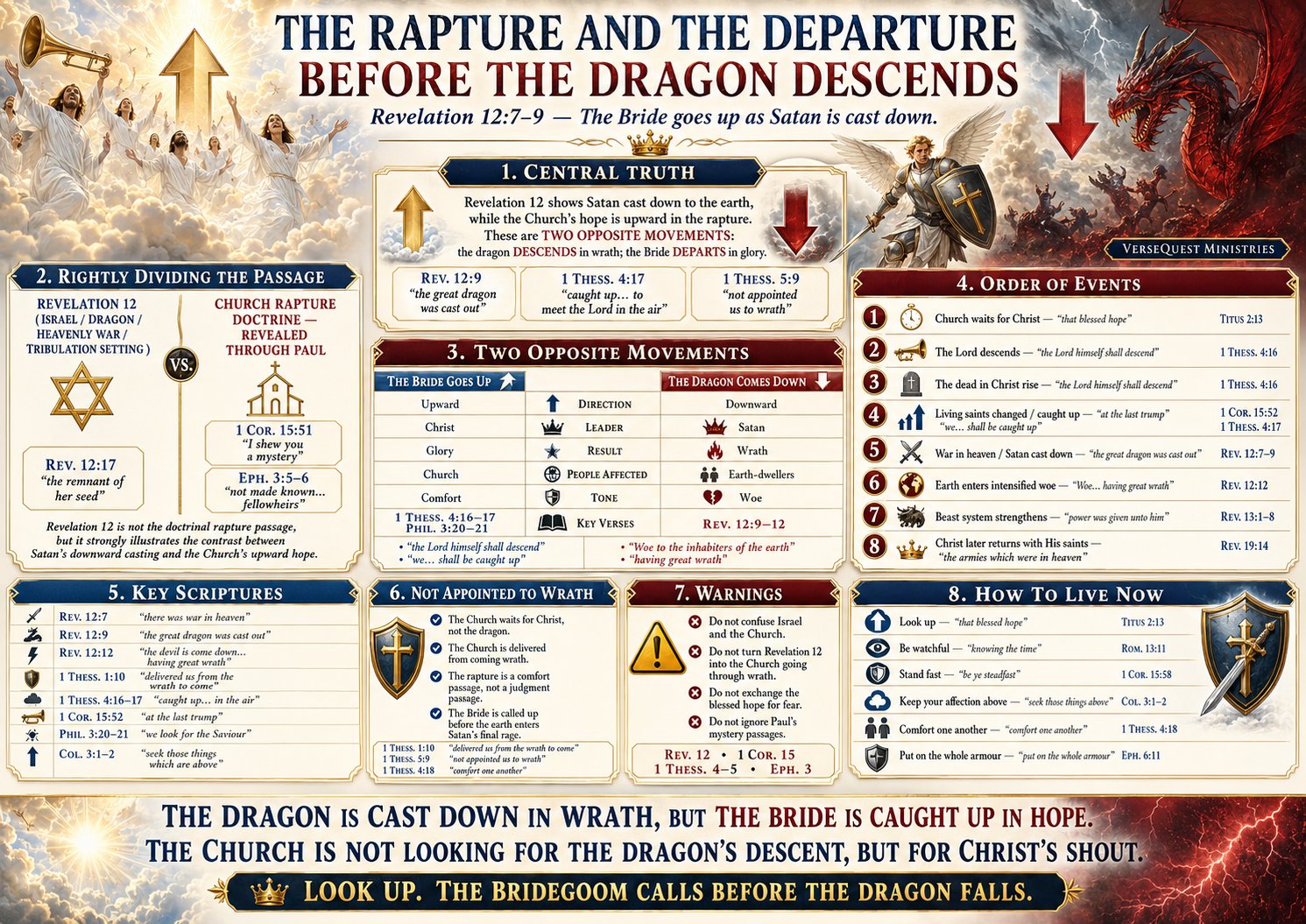
- The Rapture and the Departure Before the Dragon Descends – Printable Bible Study Chart
- Printable KJV Bible study chart on The Rapture and the Departure Before the Dragon Descends, showing the Bride caught up before Satan is cast down in wrath. This premium VerseQuest…
- $4.99
- Add to cart
-
-
Doctrine Series
-
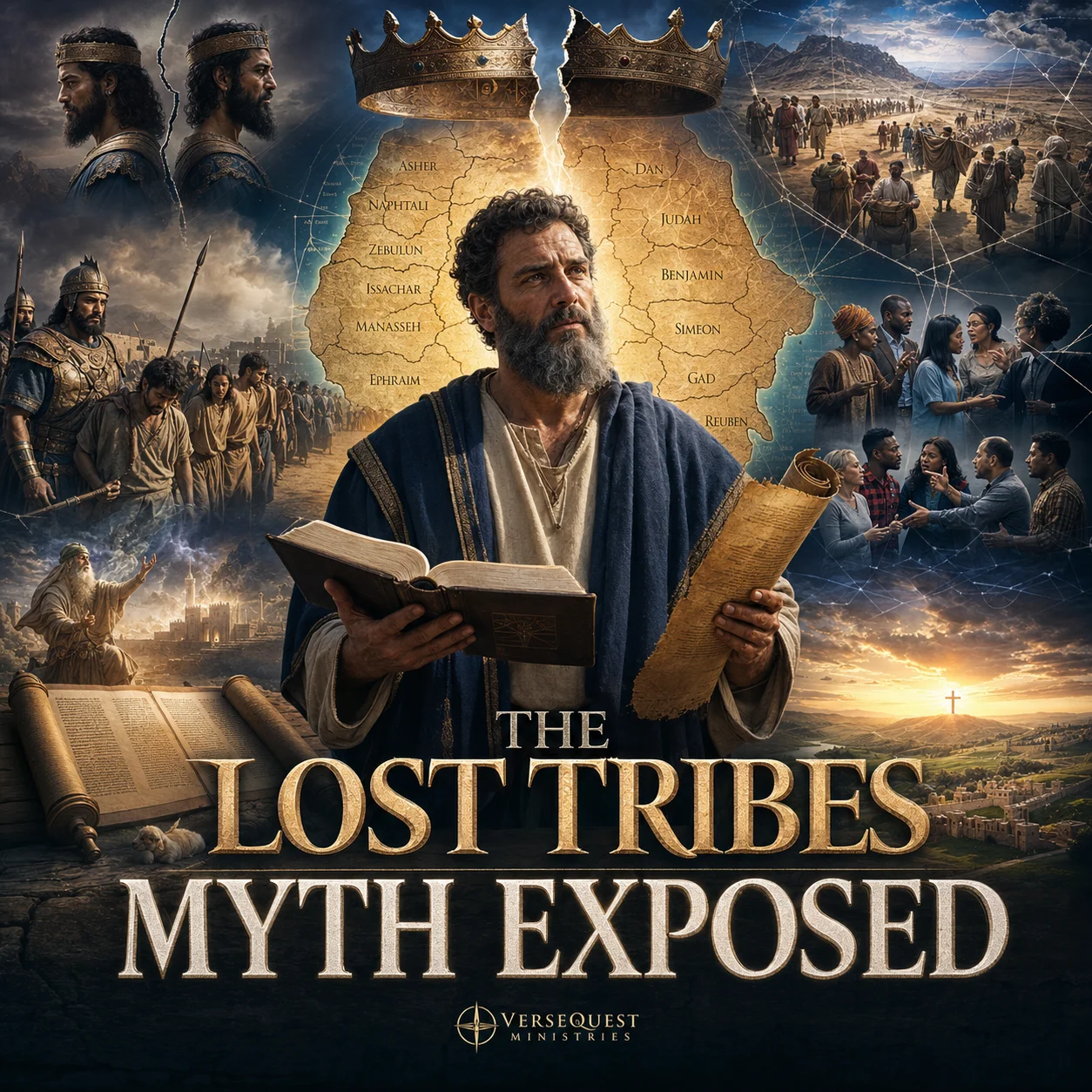
- The Lost Tribes Myth Exposed (213-Page Premium Study)
- A 213-page premium KJV study exposing the Lost Tribes myth, tribal identity errors, prophecy abuse, race theories, and false Israel claims through 35 detailed essays.
- $24.99
- Add to cart
-
-
KJV Bible Study Resources
-
-60%
- Practical Christianity for Daily Battles – 329-Page KJV Study PDF
- A premium 329-page KJV study PDF with 40 full essays applying sound, rightly divided Bible doctrine to real daily Christian battles. Topics include temptation, anxiety, marriage, parenting, pornography, grief, church…
- Original price was: $24.99.$9.99Current price is: $9.99.
- Add to cart
-
-60%