
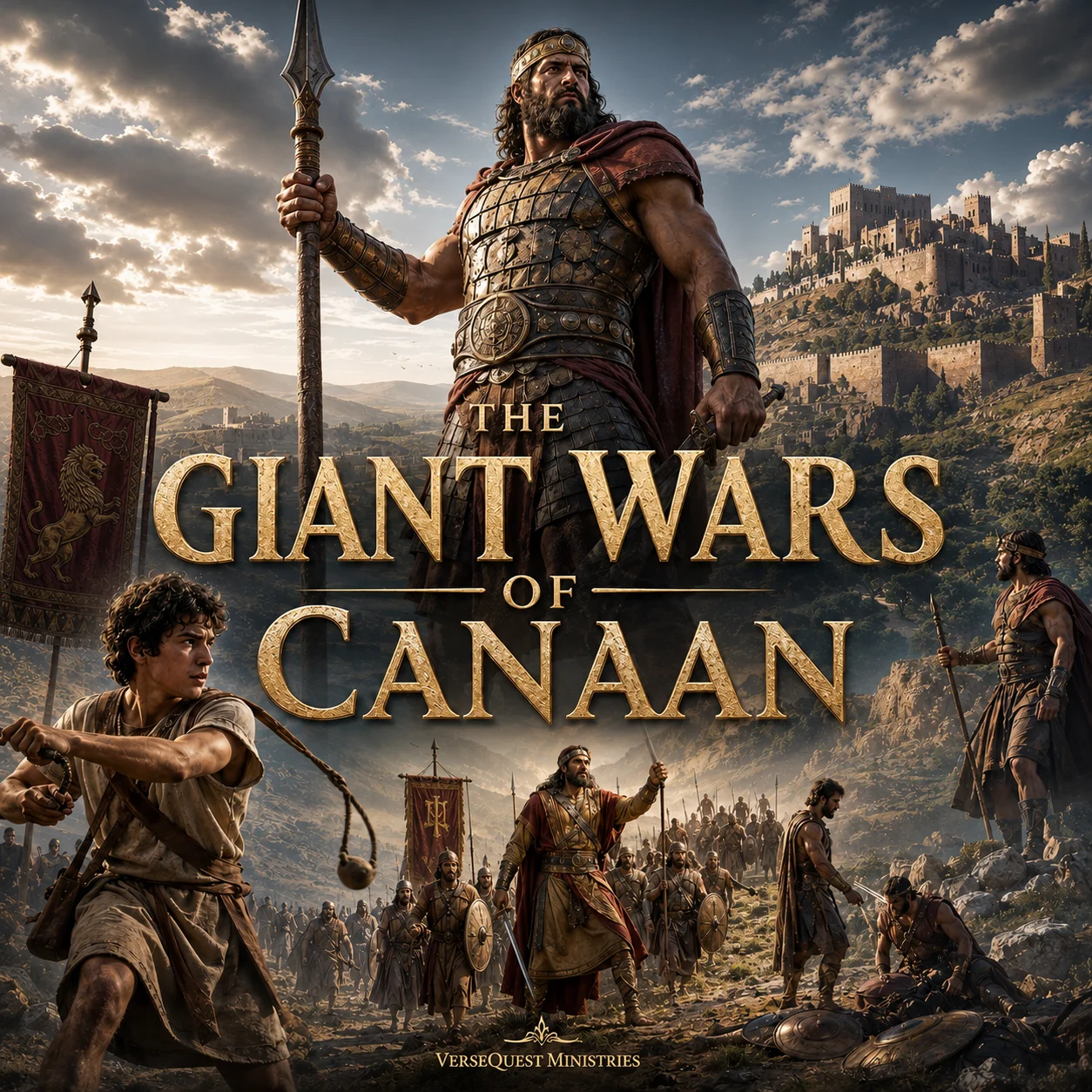
The Giant Wars of Canaan — 50-Study KJV Bible Book PDF | 381 Pages
The Giant Wars of Canaan is a 381-page, 50-study KJV Bible examination tracing the conflict from the Rephaim and Anakim to Og, Joshua, Caleb, Goliath, and David’s mighty men. This detailed downloadable PDF connects the names, cities, battles, covenant promises, and giant remnants most studies overlook, while carefully separating biblical fact from speculation and rightly dividing Israel’s warfare from the Church Age. Includes a full introduction, conclusion, and detailed Bible-study chart. Digital PDF — $9.99.
$9.99
Description
The giant wars of Canaan did not begin when Goliath walked into the valley of Elah, and they did not end when David cut off his head. The Giant Wars of Canaan is a massive 381-page, 50-study King James Bible examination tracing the giant conflict from the Rephaim named in Abraham’s day to the final warriors from Gath who fell by the hands of David and his servants.
Most Bible readers know about Goliath. Far fewer have followed the complete history behind him.
Who were the Rephaim, Zuzims, Emims, Zamzummims, and Anakim? Why were these peoples feared throughout the ancient land? Why did the ten spies describe themselves as grasshoppers? Why did God command Israel to destroy certain cities while forbidding them to attack others? What was the significance of Og’s iron bed, the fortified cities of Bashan, Caleb’s conquest of Hebron, and the Anakim remnant left in Gaza, Gath, and Ashdod?
This detailed study connects passages that are usually read as isolated stories and reveals one continuous biblical conflict involving the covenant land, divine judgment, giant populations, fortified kingdoms, national unbelief, and the faithfulness of God.
Joshua 11 records that Joshua cut off the Anakim from the mountains, yet remnants remained in Gaza, Gath, and Ashdod. Generations later, Gath sent out Goliath. The famous Philistine champion was not an unexplained giant who suddenly appeared because the story needed a dramatic villain. He came from one of the very cities where Scripture said the Anakim remained. Goliath was unfinished history walking back onto the battlefield wearing Philistine armor.
The studies trace this history through:
- The Rephaim named during Abraham’s lifetime
- The Emims, Zuzims, and Zamzummims
- God’s removal of giant powers before Israel entered Canaan
- Sihon and Og east of Jordan
- Og’s iron bed and the sixty fortified cities of Bashan
- The twelve spies and the evil report
- Israel’s forty years of judgment in the wilderness
- Joshua’s mountain campaign against the Anakim
- Caleb’s conquest of Hebron at eighty-five years old
- Ahiman, Sheshai, and Talmai
- Othniel’s capture of Debir
- The surviving remnant in Gaza, Gath, and Ashdod
- Goliath’s forty days of blasphemy
- David’s sling, five smooth stones, and covenant confidence
- Goliath’s defeat by his own sword
- Ishbi-benob’s attempt to extinguish the light of Israel
- Abishai, Sibbechai, Elhanan, and Jonathan
- Saph, Lahmi, and the later giant warriors from Gath
- The King James Bible’s accurate distinction between Goliath and his brother
- The greater Son of David who will place every enemy beneath His feet
This book also carefully separates what the Bible explicitly states from what men have added through speculation. Og’s bed is examined without pretending it provides an exact measurement of his body. David’s five stones are studied alongside the later giant family without claiming Scripture reveals David’s private calculation. Saph and Sippai are compared through the parallel accounts. Lahmi is correctly identified as Goliath’s brother, defending the Authorized Version against critics who manufacture a contradiction before finishing the cross-reference.
The conquest of Canaan is also handled from a rightly divided perspective. Israel’s wars were historical, national, judicial, geographical, and covenantal. They were commanded by God against named peoples within the land promised to Abraham’s seed. They are not Church Age instructions for Christians to wage carnal warfare or seize territory. The book explains why these judgments occurred without stealing Israel’s sword and placing it into the hands of the Church.
Throughout these fifty studies, the central contrast remains the same. Unbelief saw giants and forgot God. Faith saw the same giants and remembered the covenant.
The ten spies had accurate information but produced an evil report because they treated the enemy as decisive and God as a footnote. Caleb saw the same walls and Anakim but declared, “the LORD is with us.” Saul’s army heard Goliath and trembled. David heard the same words and asked why an uncircumcised Philistine had been permitted to defy the armies of the living God.
Faith does not deny walls, weapons, armies, fortified cities, or giant stature. Faith denies that any created thing possesses the authority to cancel what God has spoken.
David’s later years provide another powerful lesson. The young shepherd who once stood alone against Goliath eventually waxed faint and needed Abishai to rescue him from Ishbi-benob. Receiving help did not erase David’s former victories. It proved that his leadership had produced other faithful men. Gath continued producing giants, but David’s kingdom had learned how to produce giant killers.
This digital book includes:
381 fully formatted pages
50 extensive KJV Bible studies
A thorough series introduction
A powerful concluding study
A detailed Bible-study chart tracing the giant wars from Abraham to David
Immediate downloadable PDF access
The entire book is available for only $9.99.
This is not a short devotional, shallow character sketch, or motivational retelling of David and Goliath. It is a serious, detailed, doctrinal Bible study designed for pastors, teachers, students, families, and believers who want to follow the names, places, battles, covenants, and cross-references that most studies step over.
The giants received names, cities, weapons, reputations, and chapters.
The King gets the ending.
Digital PDF product. No physical item will be shipped.
The Rephaim and giant populations of Canaan, the Abrahamic covenant and the promised land, God’s patience and judicial judgment, the Emims and Zamzummims, Sihon and Og, Bashan and Argob, the Anakim and the twelve spies, the evil report of unbelief, Joshua’s conquest, Caleb’s inheritance, Hebron and Debir, the remnant in Gaza, Gath, and Ashdod, Goliath and the Philistine champions, David’s covenant faith, the multiplication of giant killers, the King James Bible’s textual accuracy, Israel and the Church rightly divided, and the final victory of Jesus Christ over every enemy.
This 50-study series should be read progressively because later events explain and complete details introduced in earlier books of the Bible. Genesis establishes the ancient giant peoples and places the Rephaim within the promised territory. Deuteronomy identifies several related populations and records the defeat of Sihon and Og. Numbers exposes Israel’s failure at Kadesh-barnea. Joshua records the cutting off of the Anakim while naming the coastal cities where remnants survived. Samuel and Chronicles then reveal how Gath produced Goliath and the later giant champions defeated by David’s servants.
Readers should compare every parallel passage carefully, especially Joshua 11:21–23, 1 Samuel 17, 2 Samuel 21:15–22, and 1 Chronicles 20:4–8. The included chart provides a visual overview of the peoples, locations, battles, major figures, and progression of the conflict.
Historical interpretation must come before personal application. These giants were real peoples and warriors, not merely symbols of modern problems. Applications concerning fear, faith, courage, leadership, preparation, and spiritual warfare should be drawn only after the historical and covenant setting has been established.
This book can be used as a complete fifty-week Bible-study series, a teaching resource for pastors and Sunday school teachers, a reference work for studies in Genesis through Chronicles, or a companion volume for examining David, Joshua, Caleb, the Rephaim, Anakim, Goliath, and the conquest of Canaan.
Teachers can use the studies to demonstrate the importance of comparing Scripture with Scripture, following geographical names, respecting parallel historical records, separating biblical facts from speculation, defending the King James Bible, and rightly dividing Israel’s national warfare from the Church’s present spiritual commission.
The studies also provide strong lessons concerning the danger of majority unbelief, the difference between accurate facts and an evil conclusion, the need for private preparation before public battles, the value of producing faithful successors, and the truth that past victories do not make a servant physically immortal or independent of help.
The King James Bible, a complete Bible concordance, a reliable Bible atlas showing Canaan, Bashan, Hebron, Gath, Gaza, Ashdod, and the valley of Elah, a notebook for tracing the Rephaim and Anakim passages, the included VerseQuest Ministries giant-wars chart, and additional VerseQuest studies concerning Genesis 6, the sons of God, the Rephaim, angels and demons, Joshua, Caleb, David, biblical warfare, and the coming kingdom of Jesus Christ.
Related products
-
The Rapture
-
-67%
- Caught Up Before the Wrath – 66-Essay KJV Rapture Study
- Caught Up Before the Wrath is a 430-page premium KJV Bible study defending the pre-tribulation Rapture of the Church from a rightly divided, dispensational perspective. This 66-essay VerseQuest Ministries book…
- Original price was: $29.99.$9.99Current price is: $9.99.
- Add to cart
-
-67%
-
Premium Studies
-
-25%
- The Doctrine of Hell — Premium Essay Series PDF
- A 383-page premium VerseQuest PDF study book containing 54 KJV essays on hell, fire, darkness, judgment, the lake of fire, the second death, and Jesus Christ as the only escape.
- Original price was: $39.99.$29.99Current price is: $29.99.
- Add to cart
-
-25%
-
KJV Studies
-
-67%
- The Blood of Christ – 66-Study KJV Bible Doctrine PDF
- A 441-page premium VerseQuest PDF featuring 66 detailed KJV Bible studies on the blood of Jesus Christ. This powerful doctrinal resource covers redemption, justification, propitiation, cleansing, access to God, eternal…
- Original price was: $29.99.$9.99Current price is: $9.99.
- Add to cart
-
-67%
-
Bible Overview Series
-
- The New Jerusalem Made Plain — 621-Page PDF Study
- The New Jerusalem Made Plain is a massive 621-page KJV/rightly divided PDF study on the literal holy city revealed in Revelation 21–22. This 100-essay book makes the New Jerusalem plain…
- $34.99
- Add to cart
-
-
Premium VerseQuest Books
-
-75%
- Christ in the Old Testament Made Plain — 100-Essay KJV Study PDF
- A massive 670-page premium KJV Bible study PDF featuring 100 detailed essays showing Jesus Christ throughout the Old Testament in promise, type, sacrifice, Christophany, prophecy, suffering, resurrection, priesthood, and future…
- Original price was: $39.99.$9.99Current price is: $9.99.
- Add to cart
-
-75%