
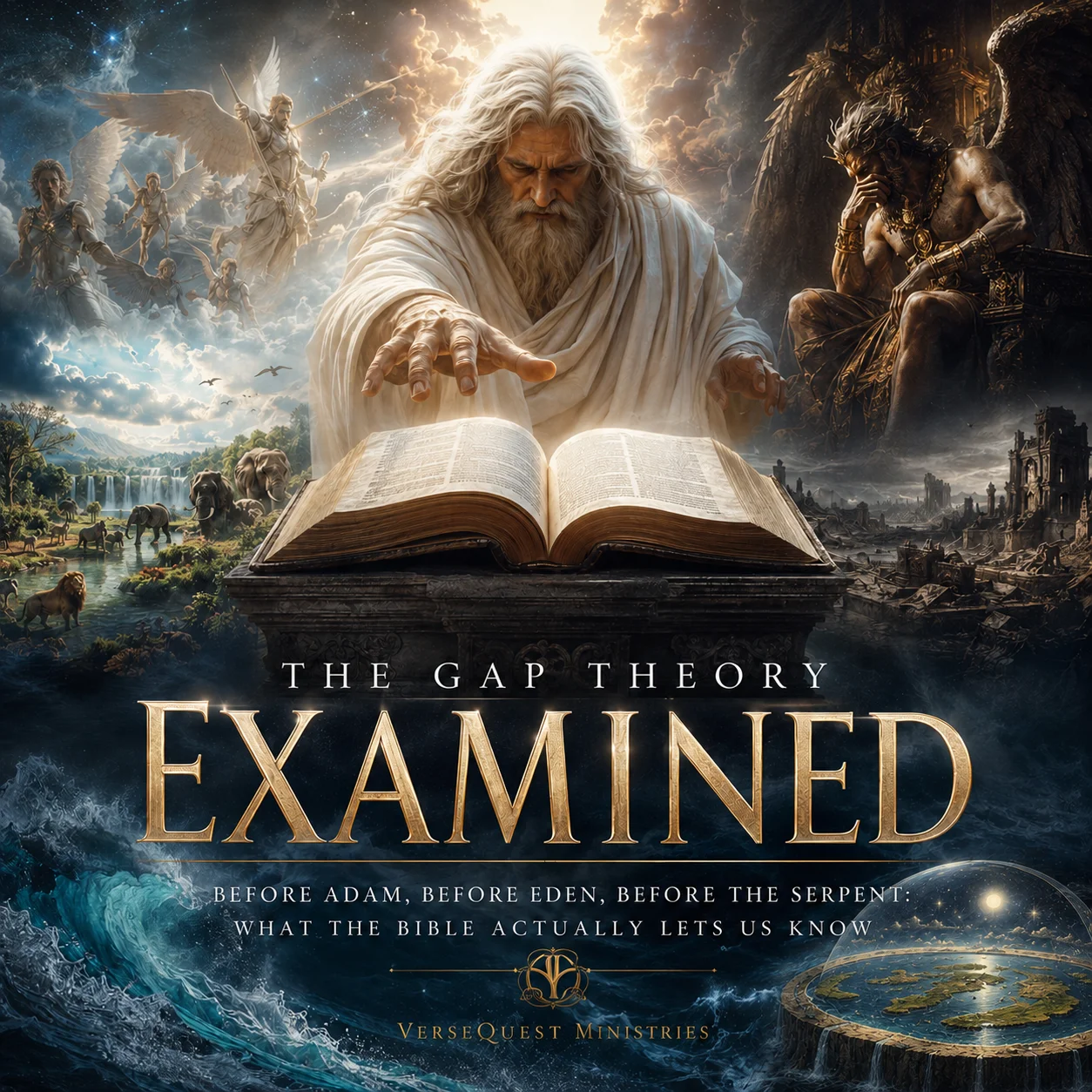
The Gap Theory Examined – Before Adam, Before Eden, Before the Serpent: What the Bible Actually Lets Us Know
The Gap Theory Examined is a complete downloadable KJV Bible-study PDF containing an introduction, 50 detailed studies, a comprehensive conclusion, and an extensive VerseQuest Bible-study chart examining what happened before Adam and what Genesis 1:1–2 may reveal about a pre-Adamic heavenly rebellion and judgment.
Follow the trail from the morning stars and sons of God in Job 38 to Lucifer’s anointed cherubic office in Ezekiel 28, his throne rebellion in Isaiah 14, the darkness and deep of Genesis 1:2, Jeremiah’s judgment language, the real firmament and waters above, Adamic dominion, Peter’s “world that then was,” and the major objections raised from Exodus 20, Romans 5, Genesis 1:31, Hebrew terminology, and church history.
This is a substantial resource for Bible students, pastors, preachers, teachers, and serious readers who want to examine the Gap Theory directly from the King James Bible rather than relying upon slogans, simplified creation charts, or speculation.
$19.99
Description
The Gap Theory Examined is a comprehensive downloadable VerseQuest Bible-study PDF devoted to one of the most overlooked questions in the opening chapter of Scripture: What happened between Genesis 1:1 and the dark, water-covered, “without form, and void” condition described in Genesis 1:2?
This is not a brief argument built around a single disputed Hebrew word or one isolated proof text. It is a complete 50-study examination that follows the subject through the King James Bible, comparing Genesis with Job, Psalms, Isaiah, Jeremiah, Ezekiel, Daniel, Romans, 2 Peter, Revelation, and other passages. The study begins with the wording of Genesis 1:1–2 and progressively develops the biblical evidence for a real pre-Adamic heavenly order, Lucifer’s original created perfection and appointed office, his governmental rebellion, divine judgment, the darkness and deep of Genesis 1:2, and God’s six-day ordering of the earth for Adamic dominion.
A major strength of this study is that it does not require changing the King James Bible in order to establish the case. “Was” is allowed to remain “was.” The argument does not depend upon forcing tohu to mean “ruined,” creating an absolute distinction between “created” and “made,” or turning the six days into geological ages. Instead, the case is developed cumulatively. Job 38 reveals morning stars and sons of God present at the earth’s foundations. Ezekiel 28 describes a created, perfect, anointed cherub before iniquity was found in him. Isaiah 14 reveals Lucifer’s throne, governmental ambition, the stars of God, the mount of the congregation, and his desire to be like the Most High. Genesis 3 then introduces the serpent already fallen, already deceitful, and already hostile to God’s word.
The study also gives extensive attention to Genesis 1 itself as a restoration narrative. The Spirit of God moves over the waters. God commands light into darkness. The firmament divides waters from waters. Dry land “appears” as the lower waters are gathered. The earth and waters “bring forth” according to God’s command. The lights are set in the firmament for signs, seasons, days, and years. Finally, Adam is created in God’s image and receives dominion over the restored earthly realm.
The biblical firmament receives substantial treatment throughout the book. Genesis describes a real firmament dividing waters below from waters above, while Psalm 148 still speaks of “ye waters that be above the heavens.” Ezekiel’s visions connect firmament imagery with the throne of God, and the study follows the relationship between the stars, sons of God, angelic beings, heavenly government, and Lucifer’s desire to exalt his throne “above the stars of God.”
The book carefully distinguishes a pre-Adamic angelic or heavenly order from speculative claims about another race of Adam-like humans. Adam remains “the first man Adam.” The earlier created order is presented through the Bible’s own terminology: morning stars, sons of God, cherubim, thrones, principalities, powers, sanctuaries, traffick, heavenly congregation, and supernatural government. The study deliberately refuses to make Atlantis, Lemuria, prehistoric humans, speculative technology, archaeological mysteries, or precise timelines necessary to the biblical case.
Major objections receive full treatment rather than dismissive answers. Exodus 20:11 is examined in relation to the six literal days. Romans 5 is studied according to Paul’s actual subject—sin and death entering the human race through “one man.” Genesis 1:31 and “very good” are examined in relation to the completed Adamic arrangement rather than stretched into a claim that Satan was somehow still holy immediately before Genesis 3. Jeremiah 4’s deliberate use of “without form, and void” in a judgment setting is studied in depth, as is 2 Peter 3 and Peter’s language concerning “the world that then was,” the heavens and earth “which are now,” and the coming judgment by fire.
The final studies distinguish explicit Scripture, strong biblical inference, possible conclusions, and unsupported speculation. The goal is not to make the Gap Theory spectacular by adding claims the Bible never requires. The goal is to make the biblical case strong by allowing every passage to contribute exactly what God gave it.
The PDF includes the complete introductory testimony explaining how the questions in Genesis 1:1–2 first arose through personal Bible reading, all 50 full studies, a comprehensive concluding synthesis, and an extremely detailed VerseQuest Bible-study chart summarizing the entire doctrinal case.
This resource is designed for serious Bible students, pastors, preachers, Sunday school teachers, families, ministry leaders, and readers who want to go beyond the simplified creation chart and examine the deeper biblical questions surrounding the world before Adam, Lucifer’s fall, Genesis 1:2, the firmament, the sons of God, and the six-day restoration.
Genesis 1:1 and Genesis 1:2 as distinct conditions — Original creation followed by a dramatically different description of the earth. The pre-Adamic heavenly order — Morning stars, sons of God, cherubim, principalities, powers, and supernatural administration before Adam. Lucifer before Satan — His created perfection, wisdom, beauty, appointed office, Edenic association, holy mountain, sanctuaries, and later corruption. Lucifer’s governmental rebellion — His throne, desire to ascend, stars of God, mount of congregation, and ambition to be like the Most High. Genesis 1:2 as judgmental catastrophe — Darkness, the deep, waters, formlessness, and void examined in light of later judgment passages. Jeremiah 4 and biblical de-creation language — How “without form, and void” functions in an explicit judgment setting. Six literal days of Adamic ordering — Light, division, firmament, waters, land, vegetation, luminaries, creatures, and human dominion. The real firmament — Its role in dividing waters above from waters below and containing the appointed heavenly lights. Waters above the heavens — Genesis 1 and Psalm 148 compared. Stars and angelic beings — Job 38, Isaiah 14, Judges 5, Revelation 1, Revelation 9, and Revelation 12. Adamic dominion — Man created in God’s image and installed as earthly ruler under divine authority. Adam and Noah as world-heads — Parallel commands involving blessing, fruitfulness, multiplication, and replenishment. The “world that then was” — Peter’s distinction between former, present, and future world-orders. Human death versus earlier supernatural rebellion — Romans 5 preserved in its Adamic and human context. “Very good” and the finished Adamic order — Genesis 1:31 understood according to the completed work being evaluated. Created versus made — Biblical vocabulary studied without artificial lexical absolutes. Hebrew as a tool, not final authority — Linguistic objections examined while retaining the preserved King James text. The Gap Theory and Darwinism separated — Literal days, direct creation, fixed kinds, and no evolutionary ancestry for Adam. Strong doctrine versus speculation — Explicit Scripture, strong inference, possible conclusions, and unrevealed details carefully distinguished. Creation, rebellion, judgment, and restoration — The Bible-wide pattern culminating in the new heaven and new earth.
Central Argument
The book argues that the King James Bible reveals a genuine pre-Adamic heavenly order and rebellion before Adam’s human Fall, and that the catastrophic condition of Genesis 1:2 is best understood in connection with that earlier judgment. Genesis 1:3 onward then records six literal days of divine ordering and furnishing for Adamic dominion.
Major Observations
Genesis 1:1 is a complete creation statement. Heaven and earth exist before verse 2 describes the earth’s condition.
“Was” does not explain cause. Genesis 1:2 tells the reader what condition the earth was in, not everything that produced that condition.
Job 38 establishes pre-Adamic history. Morning stars and sons of God were present when earth’s foundations were laid.
Lucifer existed before Satan. Ezekiel 28 presents a created, perfect, anointed cherub before iniquity was found in him.
Lucifer’s rebellion was governmental. Isaiah 14 emphasizes throne, stars, congregation, ascent, height, and likeness to the Most High.
Satan is already fallen in Genesis 3. The heavenly Fall therefore precedes the human Fall.
Jeremiah 4 gives a judgment control for Genesis 1:2 language. “Without form, and void” can describe the devastation of an already ordered realm.
Genesis 1 moves from ruin toward order. Light, separation, firmament, gathered waters, exposed land, fruitfulness, living creatures, and dominion progressively furnish the earthly realm.
The firmament is structural. It separates waters above from waters below and contains the appointed lights.
Dry land “appears.” The language naturally describes land emerging from beneath waters already covering it.
Adam and Noah hear remarkably similar commands. Both are blessed and commanded to be fruitful, multiply, and replenish the earth after major watery scenes.
Romans 5 concerns Adamic humanity. Adam brings sin and death upon mankind; the passage cannot mean Satan remained morally perfect until Adam sinned.
The six days remain literal. The Gap is not placed inside the days as evolutionary ages.
The pre-Adamic order is angelic rather than Adamic. The book does not require a race of prehistoric humans before “the first man Adam.”
Important Distinctions
- Explicit text is stronger than inference.
- Strong inference should not be presented as a direct quotation.
- Possible reconstruction should not be preached as established doctrine.
- Pre-Adamic angelic history does not require pre-Adamic humanity.
- An unrevealed interval does not automatically mean millions or billions of years.
- Biblical restoration does not require evolution.
- Historical teachers may help identify passages, but they do not determine truth.
- Hebrew and Greek may illuminate Scripture, but they do not replace the preserved Bible as final authority.
Memorable Teaching Points
Before Adam there was not silence. There was singing.
Adam did not create the Devil by sinning. The Devil arrived at Eden already fallen.
A throne proves government, but it does not give us a map of the kingdom.
Where the Bible stops talking, stop building prehistoric cities.
The Gap does not lengthen God’s days; it refuses to shorten God’s history.
An allusion is not an eraser; it is a highlighter.
The Gap was never needed to rescue Darwin.
The Hebrew department is not the fourth person of the Godhead.
When God speaks, ruin has an expiration date.
Subjects Worth Further Study
The precise relationship between the stars and angelic beings, the nature of Lucifer’s pre-fall sanctuaries, the mechanics of supernatural principalities and powers, the chronology of multiple angelic rebellions, Peter’s “world that then was,” and the full prophetic significance of the firmament remain valuable areas for continued Bible study.
This PDF can serve as an extended personal Bible-study course through Genesis 1:1–2 and the major passages connected with pre-Adamic history. Readers can work through one study at a time with an open King James Bible, following the cross-references and comparing the cumulative doctrinal case.
Pastors and preachers can use the material to develop sermon series on Genesis, Lucifer’s fall, the sons of God, biblical cosmology, Satan’s kingdom, spiritual government, creation, judgment, and restoration. Because major objections are treated separately, individual studies can also be used as standalone doctrinal messages.
Sunday school teachers and adult Bible-class instructors can divide the fifty studies into a long-form teaching curriculum. The included Bible-study chart provides a useful visual overview for introductory or concluding lessons.
Small groups and discipleship classes can use the book to practice comparing Scripture with Scripture and distinguishing explicit statements from inference and speculation. The book is particularly useful for teaching students how to slow down over individual words, repeated expressions, narrative sequence, and cross-references.
Families with older students can use selected chapters for deeper family Bible study, especially sections concerning Genesis 1, Lucifer’s rebellion, Adamic dominion, Noah, the firmament, and the difference between biblical doctrine and speculation.
Ministry training settings can use the book as an example of how to test a disputed doctrine against the whole testimony of Scripture rather than relying upon one scholar, one lexicon, or one historical teacher.
The most important companion resource is a King James Bible, preferably one suitable for extensive cross-referencing and personal notes.
A Strong’s Exhaustive Concordance or another comprehensive KJV concordance can help readers trace words such as world, stars, sons of God, firmament, deep, darkness, void, replenish, throne, cherub, principalities, and powers throughout Scripture.
A good King James Bible dictionary can assist with terms such as firmament, cherubim, dominion, principality, sanctuary, traffick, congregation, and replenish while keeping the study anchored in biblical usage.
Cross-reference Bibles and topical indexes are especially useful because this subject depends heavily upon comparing Genesis with Job, Psalms, Isaiah, Jeremiah, Ezekiel, Daniel, Romans, Peter, and Revelation.
Creation and prophetic timelines may be useful when they remain subordinate to the wording of Scripture and clearly distinguish explicit chronology from inference.
The included The Gap Theory Examined – Complete KJV Bible Study Chart should be used alongside the book as a visual doctrinal map of the complete argument.
For further study, readers should especially revisit Genesis 1–3, Job 1–2 and 38, Isaiah 14 and 45, Jeremiah 4, Ezekiel 28, Daniel 10, Romans 5, 2 Peter 2–3, and Revelation 1, 4, 12, 20–22.
Related products
-
doctrine of death Bible study
-
- The Doctrine of Death – KJV Bible Study on Death, Resurrection, Judgment, and No More Death
- The Doctrine of Death is a 270-page KJV Bible study PDF tracing death from Genesis to Revelation. This 40-part series examines death’s origin in sin, Satan’s first lie, death under…
- $9.99
- Add to cart
-
-
Heaven
-
- The Doctrine of Heaven Made Plain — 599-Page KJV Bible Study PDF
- A massive 599-page KJV, rightly divided study on heaven, covering the present heaven, resurrection body, Rapture, Millennium, New Jerusalem, eternal state, hard questions, funeral lies, and cult errors.
- $34.99
- Add to cart
-
-
Teachings of Christ
-
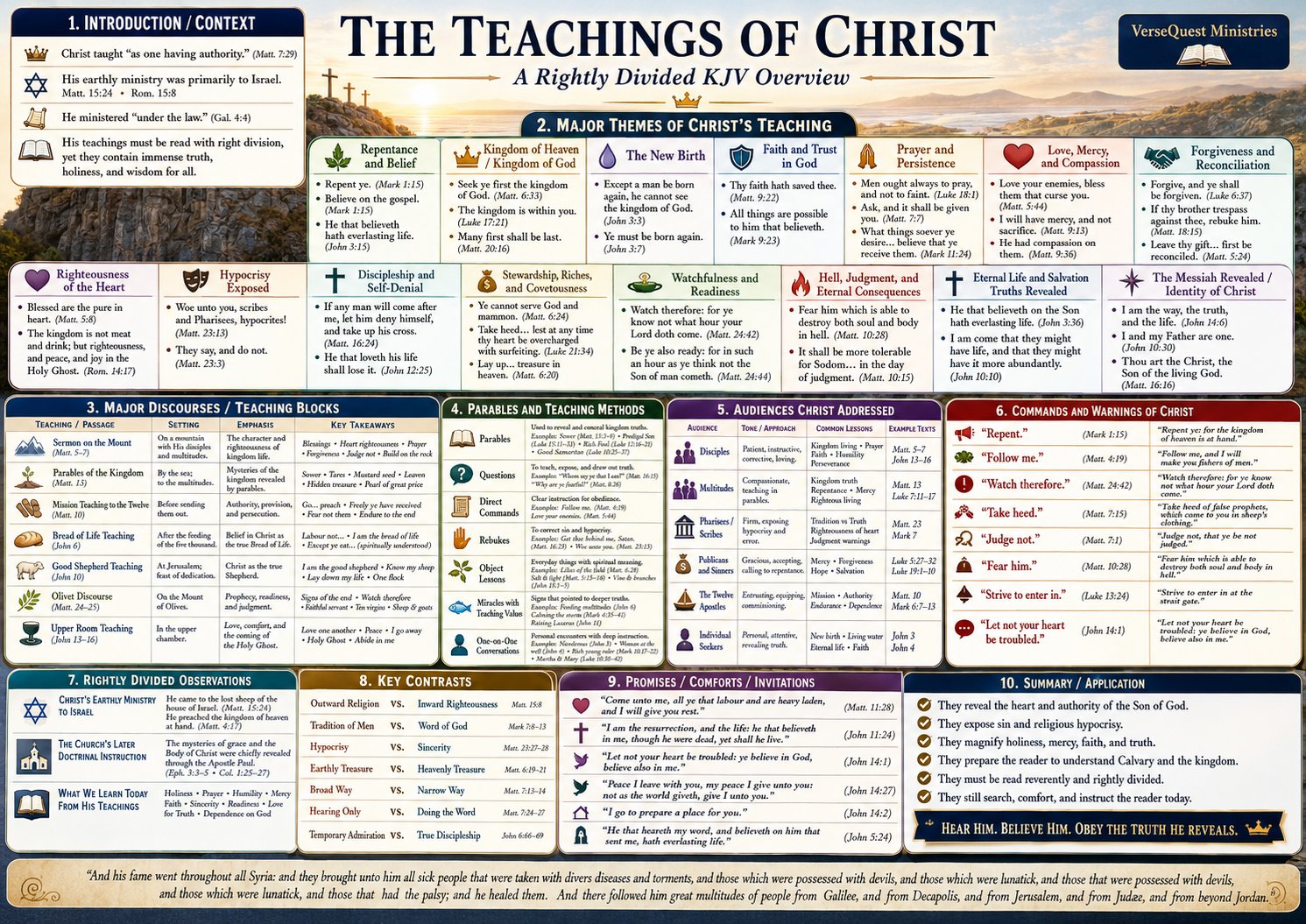
- The Teachings of Christ KJV Bible Study Chart – Printable Download
- This printable Teachings of Christ KJV Bible Study Chart gives a detailed overview of the Lord Jesus Christ’s teachings in the Gospels, including His sermons, parables, commands, warnings, promises, kingdom…
- $4.99
- Add to cart
-
-
Premium Studies
-
-25%
- The Doctrine of Hell — Premium Essay Series PDF
- A 383-page premium VerseQuest PDF study book containing 54 KJV essays on hell, fire, darkness, judgment, the lake of fire, the second death, and Jesus Christ as the only escape.
- Original price was: $39.99.$29.99Current price is: $29.99.
- Add to cart
-
-25%
-
KJV Studies
-
-67%
- The Blood of Christ – 66-Study KJV Bible Doctrine PDF
- A 441-page premium VerseQuest PDF featuring 66 detailed KJV Bible studies on the blood of Jesus Christ. This powerful doctrinal resource covers redemption, justification, propitiation, cleansing, access to God, eternal…
- Original price was: $29.99.$9.99Current price is: $9.99.
- Add to cart
-
-67%