
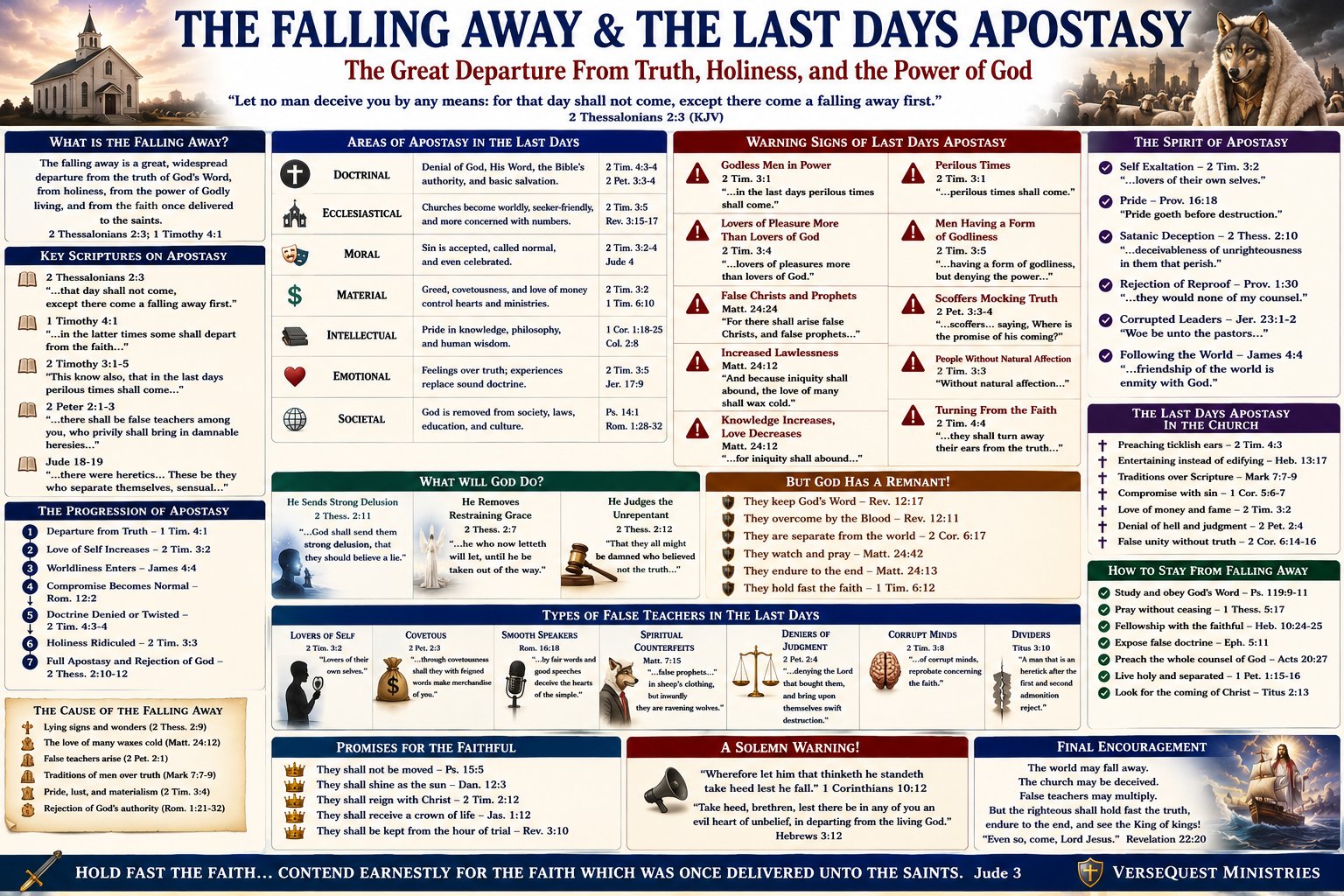
The Falling Away and the Last-Days Apostasy – The Great Departure from Truth, Holiness, and the Power of God (KJV Bible Study Chart)
Understand the falling away and last-days apostasy with this detailed KJV chart covering departure from truth, doctrinal and moral compromise, false teachers, seducing spirits, strong delusion, corrupt churches, the faithful remnant, and how believers can hold fast until Jesus Christ comes.
$3.99
Description
The Falling Away and the Last-Days Apostasy is a comprehensive KJV Bible study chart examining the widespread departure from biblical truth, sound doctrine, holiness, spiritual power, and the faith once delivered unto the saints. It explains the progression of apostasy, the principal areas in which it appears, the spirit operating behind it, the warning signs given throughout Scripture, the rise of false teachers, God’s judicial response to rejected truth, and the responsibility of faithful believers to hold fast until Jesus Christ comes.
Built around 2 Thessalonians 2:3, 1 Timothy 4:1, 2 Timothy 3:1–5, 2 Timothy 4:3–4, 2 Peter 2:1–3, and Jude 3–19, this chart presents apostasy as more than ordinary weakness, momentary discouragement, or the failure of an individual Christian. The falling away is a broad departure from the authority of God’s Word that produces doctrinal corruption, moral compromise, worldly churches, self-exalting religion, spiritual counterfeits, false unity, contempt for holiness, and eventual rejection of the truth.
Second Thessalonians 2:3 declares, “Let no man deceive you by any means: for that day shall not come, except there come a falling away first.” The warning is given in connection with the prophetic developments preceding the revelation of the man of sin. Paul does not describe a world accidentally misplacing truth through ignorance. He describes an identifiable departure in which people turn from what God has revealed and become prepared to receive the counterfeit ruler, false signs, strong delusion, and the final lie.
The chart defines the falling away as a great and widespread departure from the truth of God’s Word, the holiness commanded by God, the spiritual power of godly living, and “the faith which was once delivered unto the saints.” Apostasy begins when the words of God cease to function as the final authority and human wisdom, institutional tradition, cultural pressure, personal experience, emotion, popularity, or financial interest is allowed to overrule Scripture.
Not every disagreement, weakness, or immature opinion constitutes full apostasy. Christians may misunderstand a passage, require correction, or struggle in their practical walk without deliberately abandoning the faith. Apostasy becomes evident when revealed truth is resisted, redefined, denied, silenced, or replaced because it interferes with pride, pleasure, religious ambition, worldly acceptance, or human authority.
The falling away does not mean that Jesus Christ loses members of His Body or that the Holy Spirit’s seal fails. The saved believer remains secure in Christ, but believers may become carnal, deceived, compromised, unfruitful, or doctrinally unstable when they refuse Scripture. Apostasy appears most fully in professing Christendom, false teachers, corrupt institutions, counterfeit converts, and assemblies that retain Christian language while rejecting the doctrines that give those words their biblical meaning.
First Timothy 4:1 states, “Now the Spirit speaketh expressly, that in the latter times some shall depart from the faith, giving heed to seducing spirits, and doctrines of devils.” The Holy Spirit does not leave the matter uncertain. The latter times will be characterized by departure, spiritual seduction, and doctrines originating from a source more sinister than human misunderstanding.
A doctrine of devils does not always sound openly satanic. The devil is too experienced to place horns upon every counterfeit. He often dresses error in religious language, moral respectability, academic vocabulary, supernatural experience, social compassion, institutional authority, or an apparent concern for unity. The poison works better when the bottle carries a Christian label.
Second Corinthians 11 warns that Satan transforms himself into an angel of light and that his ministers appear as ministers of righteousness. The most dangerous counterfeits are not always found outside professing Christianity. They frequently arise among people who speak of Jesus, quote selected verses, claim spiritual authority, and offer a message that quietly changes Christ’s identity, corrupts His gospel, weakens His Word, or removes the offence of the cross.
The chart identifies doctrinal apostasy as one of the first and most serious forms of departure. Doctrinal apostasy denies or redefines the nature of God, the deity of Jesus Christ, the inspiration and authority of Scripture, the reality of sin, the necessity of Christ’s blood, salvation by grace through faith, eternal judgment, resurrection, and the future return of the Lord.
Doctrine is often dismissed as cold, divisive, or unnecessary because apostasy prefers a religion that cannot be tested. Yet doctrine simply means teaching. Every church teaches something, including the church that boasts that it has no doctrine. The real question is whether the teaching agrees with the King James Bible or has been manufactured to protect an institution, personality, tradition, experience, or audience.
Ecclesiastical apostasy appears when churches become worldly, seeker-driven, entertainment-centred, and primarily concerned with growth, influence, recognition, money, branding, and attendance. The local church is called to preach the Word, edify believers, defend sound doctrine, preach the gospel, practise charity, and maintain holiness. When those purposes are traded for religious marketing and crowd management, the building may remain full while the pulpit becomes empty.
A church may possess professional music, polished media, beautiful facilities, impressive programmes, and a crowded calendar while lacking prayer, conviction, doctrine, spiritual hunger, and the authority of Scripture. Apostasy does not always close churches. Sometimes it fills them with people who have been taught never to endure a sermon strong enough to disturb them.
Second Timothy 4:3 warns that people will not endure sound doctrine but will heap to themselves teachers, “having itching ears.” The itching ear does not ask, “What hath God said?” It asks, “Who will tell me that my desires are already righteous?” Once the audience becomes the customer, the preacher becomes a salesman and the gospel becomes a product adjusted to market demand.
Moral apostasy appears when sin is no longer merely tolerated but normalized, defended, renamed, and eventually celebrated. Behaviour once confessed with shame becomes announced with pride. Scripture is then reinterpreted, ignored, or attacked so that the sinner never has to change his judgment concerning his conduct.
The apostate spirit calls evil good and good evil. It presents holiness as hatred, restraint as oppression, conviction as psychological harm, biblical separation as extremism, and repentance as an attack upon personal identity. It does not merely commit sin; it demands that God revise His verdict.
Jude warns of men who turn the grace of God into lasciviousness. Biblical grace saves freely and teaches the saved believer to deny ungodliness. Counterfeit grace removes accountability, empties repentance of meaning, and treats the cross as permission to preserve the very rebellion from which Christ came to redeem sinners.
Material apostasy appears through covetousness, greed, financial manipulation, and the love of money. First Timothy 6:10 states that the love of money is the root of all evil. Money itself may be used lawfully, generously, and wisely, but the love of money corrupts doctrine, ministry, judgment, relationships, and conscience.
False teachers frequently make merchandise of people. They promise blessing, healing, promotion, prophetic favour, deliverance, or supernatural access in exchange for money. Religious offices become careers, congregations become markets, and giving becomes a lever used to enrich personalities who preach sacrifice from a platform built upon other people’s sacrifice.
The love of money also causes churches to soften truth when truth threatens income. A doctrine that might offend a wealthy donor, reduce attendance, damage public approval, or interfere with political access is quietly neglected. The price of compromise is often written on a cheque before it is written into a doctrinal statement.
Intellectual apostasy exalts human philosophy, academic pride, speculative knowledge, and worldly wisdom above God’s revelation. First Corinthians warns that the world by wisdom knew not God. Colossians 2 cautions believers against philosophy and vain deceit after the tradition of men and the rudiments of the world rather than after Christ.
Education can be useful, but knowledge becomes an idol when men assume that degrees, scholarly consensus, scientific prestige, philosophical systems, or linguistic expertise grant authority to correct Scripture. The Bible is then treated as a primitive religious document awaiting repair by the very mind it was given to judge.
The intellectual apostate rarely says, “I reject God because I love rebellion.” He says, “Modern understanding has moved beyond the text.” The vocabulary is cleaner, but the rebellion is the same one heard in Eden: “Yea, hath God said?”
Emotional apostasy places feelings, experiences, impressions, visions, dreams, atmosphere, and personal testimony above written truth. Emotions are real and may accompany genuine spiritual life, but they are not infallible. A person may feel peace while walking into error, feel excitement beneath false teaching, or feel condemned after God has declared him justified.
Jeremiah 17:9 warns that the heart is deceitful above all things. The believer therefore tests experience by Scripture rather than testing Scripture by experience. A doctrine is not true because it produced tears, goosebumps, excitement, relief, or a dramatic story.
Emotional apostasy replaces doctrine with atmosphere. Lights, music, repetition, crowd response, carefully managed tension, and charismatic personalities create an experience that is then treated as the presence of God. Yet spiritual excitement without scriptural truth may be nothing more than religious electricity running through dead wires.
Societal apostasy appears when God is removed from law, education, culture, public morality, family life, and national conscience. Psalm 14 describes the fool saying in his heart, “There is no God.” Romans 1 shows societies rejecting the knowledge of God, worshipping the creature, dishonouring the body, and receiving the consequences of corrupted thinking.
Removing God does not create neutrality. The vacant throne is immediately occupied by the state, the expert, the majority, the self, the market, or the latest ideology. A society that rejects God’s authority does not become free from religion; it establishes a new religion in which man worships himself.
The chart presents a clear progression of apostasy. It begins with departure from truth. Once Scripture’s authority is weakened, the love of self increases. Worldliness enters, compromise becomes normal, doctrine is denied or twisted, holiness is mocked, and open rejection of God follows.
The progression rarely happens in one dramatic moment. Apostasy usually arrives by degrees. A verse is neglected, a doctrine is softened, an error is excused, a worldly practice is baptized, and a biblical warning is dismissed as outdated. The house does not collapse when the first brick is removed, but the first brick announces what is coming.
Love of self is central to that progression. Second Timothy 3 begins with “lovers of their own selves.” Self-love produces pride, covetousness, ingratitude, rebellion, false accusation, uncontrolled desire, contempt for goodness, and pleasure worship. When self becomes the highest authority, God is valued only as long as He agrees with the self.
James 4:4 describes friendship with the world as enmity with God. Worldliness is not limited to clothing styles, entertainment choices, or visible habits. It is the adoption of the world’s values, ambitions, reasoning, priorities, methods, approval, and definitions of success.
Romans 12:2 commands believers not to be conformed to this world. Compromise becomes normal when Christians ask how closely they may resemble the world rather than how faithfully they may represent Jesus Christ. The church that imitates the world eventually loses the ability to rebuke it.
Doctrine is then denied or twisted. Second Timothy 4 describes teachers gathered to support the audience’s lusts. A false doctrine may begin as a clever reinterpretation, but once accepted it produces a different Christ, different gospel, different authority, and different kind of Christianity.
Holiness is ridiculed because holiness exposes compromise. Biblical separation is mocked as narrow-mindedness, while those who refuse worldliness are portrayed as unloving or extreme. Yet the God who saves sinners also commands them to depart from iniquity.
The final stage is full apostasy and rejection of God. Second Thessalonians 2:10–12 explains that those who receive not the love of the truth become subject to strong delusion, believe the lie, and face judgment because they had pleasure in unrighteousness.
Strong delusion is a judicial response to persistent rejection. God does not deceive a sincere soul who desires truth. The people in view refuse the truth, reject its love, prefer unrighteousness, and are then given over to the lie they chose.
The chart identifies major causes of the falling away. Lying signs and wonders prepare people to receive supernatural deception without scriptural testing. The love of many waxes cold as iniquity abounds. False teachers arise secretly introducing destructive heresies. Human traditions replace God’s commandments. Pride, lust, materialism, and rebellion against divine authority create soil in which apostasy grows.
Signs and wonders must never become the final test of truth. Pharaoh’s magicians produced counterfeits, false prophets may display supernatural phenomena, and the coming of the lawless one will include power, signs, and lying wonders. A miracle claim cannot authenticate a doctrine that contradicts Scripture.
Matthew 24:12 states that because iniquity abounds, the love of many will wax cold. Constant exposure to sin can make evil seem ordinary and holiness seem strange. What once shocked the conscience becomes entertainment, then acceptance, and finally identity.
Second Peter 2 warns that false teachers bring in damnable heresies privately. Error often enters quietly because the false teacher understands that an open assault would awaken resistance. He changes terminology, shifts emphasis, questions certainty, flatters the hearer, and waits for compromise to become familiar.
Mark 7 exposes the danger of religious tradition making the Word of God of none effect. Tradition may be ancient, respected, emotionally meaningful, and institutionally protected while still contradicting Scripture. Age does not sanctify error.
The chart also identifies the spirit of apostasy. Self-exaltation places man above God. Pride refuses correction. Satanic deception makes the lie attractive. Rejection of reproof silences the means of recovery. Corrupt leaders scatter the flock. Friendship with the world turns professing believers into enemies of God’s standard.
Second Thessalonians 3:2 warns of unreasonable and wicked men, while Second Timothy 3 describes people resisting truth with corrupt minds. Jeremiah 23 condemns pastors who destroy and scatter the sheep. Corrupt leadership is especially dangerous because people naturally assume that a religious title proves divine approval.
A false shepherd may possess charm, confidence, education, influence, and a large following while feeding the flock spiritual sawdust. God does not evaluate a ministry by the size of its platform but by its faithfulness to His Word.
The chart presents multiple warning signs of last-days apostasy. Perilous times increase, godless people gain influence, pleasure replaces devotion, religious forms remain while power disappears, false Christs and prophets multiply, scoffers mock truth, lawlessness abounds, natural affection weakens, knowledge increases while love decreases, and people turn their ears away from truth.
The reference to godless men in power does not mean that every political ruler must be a Christian before a nation can function. It warns that leadership without the fear of God eventually uses authority to protect rebellion, reward corruption, punish righteousness, and exalt man’s wisdom.
The lovers of pleasure possess a religion arranged around appetite. Worship must entertain, preaching must soothe, service must remain convenient, and sacrifice must never disturb comfort. God is welcomed as an accessory but rejected as Lord.
The form of godliness is especially deceptive because it allows apostasy to remain religious. The hymns may continue, the Bible may remain upon the pulpit, and Christian vocabulary may fill the programme while the authority and power of God are denied in practice.
False Christs and prophets multiply because people desire spiritual assurance without submission to Scripture. Some offer a Christ who never judges, a Christ who approves every path, a Christ disconnected from the Bible, or a Christ whose finished work must be completed by religious machinery.
Scoffers ask, “Where is the promise of his coming?” They use divine patience as evidence against divine judgment. Peter answers that God is longsuffering, not willing that any should perish, but the Day of the Lord will come.
Increased lawlessness causes love to wax cold. Fear, betrayal, broken trust, violence, and selfishness spread when God’s moral order is rejected. Society may become more connected technologically while becoming more divided spiritually and relationally.
The loss of natural affection appears in the breaking of family bonds, abandonment of responsibility, celebration of cruelty, exploitation of the weak, and contempt for life. What nature itself once taught is denied when rebellion becomes institutionalized.
The chart also lists manifestations of apostasy within churches: preaching designed for itching ears, entertainment replacing edification, tradition outranking Scripture, compromise with sin, love of money and fame, denial of Hell and judgment, and false unity without truth.
Preaching for itching ears avoids anything capable of producing conviction, doctrinal separation, repentance, or controversy. The preacher becomes a religious therapist whose highest goal is to keep the audience comfortable enough to return.
Entertainment is not identical to joy, music, fellowship, or beauty. The danger comes when the assembly is built around performance and the preaching of the Word is treated as the dull interruption between attractions.
Tradition becomes apostate when it claims authority over Scripture. A tradition that agrees with the Bible may be harmless or useful, but a tradition protected against biblical correction becomes an idol.
Compromise with sin usually begins under the language of compassion. True compassion seeks the sinner’s salvation and restoration. Counterfeit compassion refuses to name the disease because naming it might offend the patient.
The love of fame turns ministry into celebrity. The preacher’s image, brand, audience, influence, and legacy become more important than Christ’s honour. The servant begins by using the platform to preach Christ and ends by using Christ to preserve the platform.
Denial of Hell and judgment removes the urgency of the gospel. Once eternal consequences disappear, the cross becomes an inspirational symbol instead of the place where Jesus Christ bore the wrath sinners deserved.
False unity joins people around an institution, experience, cause, or broad religious sentiment while silencing doctrine. Biblical unity is unity in Christ, the Spirit, the gospel, and the truth. Unity purchased by surrendering truth is merely organized confusion.
The chart identifies several types of false teachers. Lovers of self build ministries around their personalities. Covetous teachers use deceptive words to make merchandise of people. Smooth speakers use fair words and flattering speeches to deceive simple hearts. Spiritual counterfeits appear as sheep but inwardly are ravening wolves.
Deniers of judgment remove the fear of God and promise peace without repentance. Corrupt minds resist truth and continually destabilize hearers. Dividers create factions, isolate followers, and use loyalty to themselves as the test of spirituality.
A divider is not simply a person who exposes false doctrine. Scripture commands believers to mark and avoid those causing divisions contrary to sound doctrine. The true divider is the teacher who separates people from biblical truth and gathers them around himself.
The chart asks, “What will God do?” Second Thessalonians 2 reveals strong delusion for those who reject the love of the truth. The present restraining order is removed in preparation for the revelation of the man of sin, and the unrepentant are judged because they believed not the truth but had pleasure in unrighteousness.
Within the chart’s pre-Tribulation framework, the removal of the present restraint accompanies the catching away of the Church before the full unveiling of the Antichrist. This does not mean the Holy Spirit ceases to exist or work upon the earth. It means the present Church-age restraining arrangement is taken out of the way as God resumes the final prophetic dealings surrounding Israel and the nations.
The man of sin will then rise in an atmosphere already conditioned to prefer lies, signs, centralized power, false unity, human worship, and religious deception. The final apostasy will not appear from nowhere. Present departures prepare the road for the coming counterfeit.
Yet the chart does not end with apostasy. God maintains a faithful remnant. Even when institutions compromise, teachers multiply, love grows cold, and the world embraces deception, God preserves people who keep His Word, overcome through Christ’s blood, separate from corruption, watch, pray, endure, and hold fast the faith.
Revelation 12:11 describes overcomers who prevail through the blood of the Lamb and the word of their testimony. Second Corinthians 6 calls believers to separation from spiritual uncleanness. First Timothy 6:12 commands the servant of God to fight the good fight of faith and lay hold on eternal life.
The remnant is not preserved by superior intelligence, personal courage, denominational loyalty, or political influence. Faithfulness rests upon the grace of God, the blood of Christ, the indwelling Holy Spirit, and submission to the written Word.
The chart provides clear instruction on how to remain faithful amid the falling away. Believers must study and obey God’s Word, pray without ceasing, fellowship with faithful saints, expose false doctrine, preach the whole counsel of God, live holy and separated lives, and look for the coming of Jesus Christ.
Psalm 119 teaches believers to hide God’s Word in their hearts so that they might not sin against Him. Bible reading must become more than collecting information. The Word must be believed, obeyed, remembered, compared, preached, and allowed to correct the life.
Prayer keeps the believer conscious of his dependence upon God. Apostasy flourishes where religious machinery operates without spiritual dependence. A prayerless church may continue functioning efficiently while possessing no strength beyond human organization.
Fellowship with faithful believers provides encouragement, accountability, correction, and strength. Hebrews 10 commands Christians not to forsake assembling together, especially as the approaching day is recognized.
False doctrine must be exposed because error protected by silence eventually spreads. Ephesians 5 commands believers to have no fellowship with unfruitful works of darkness but rather to reprove them. Biblical exposure should be truthful, scriptural, courageous, and free from personal vengeance.
Paul declared that he had not shunned to preach the whole counsel of God. The preacher who selects only comfortable portions leaves the flock unprepared for wolves, temptation, suffering, and deception.
Holy living remains essential. Separation does not mean isolation from every unsaved person or proud withdrawal from human need. It means refusing fellowship with sin, false worship, another gospel, and systems demanding disobedience to God.
Believers are also commanded to look for Jesus Christ. Titus 2:13 calls Him the blessed hope. The Church’s expectation is not centred upon the success of apostasy but upon the return of the Saviour who will gather His Body and ultimately destroy every counterfeit kingdom.
The chart includes promises for the faithful. Those grounded in God will not be moved. The righteous will shine in the coming Kingdom. Believers will reign with Christ, receive the crown of life for faithful endurance, and be kept from the worldwide hour of temptation in the chart’s pre-Tribulation interpretation.
These promises do not teach salvation by endurance or works. Eternal life is received through faith in Jesus Christ. Faithfulness affects testimony, usefulness, fellowship, reward, and the believer’s practical walk after salvation.
The solemn warning remains: “Wherefore let him that thinketh he standeth take heed lest he fall.” Confidence in Christ is necessary, but confidence in the flesh is dangerous. A believer who assumes he is too knowledgeable, experienced, spiritual, or established to be deceived has already opened a door to pride.
Hebrews 3:12 warns against an evil heart of unbelief in departing from the living God. The proper response is not panic but vigilance. The believer should keep a tender conscience, receive correction, test every spirit, reject pride, and remain anchored to Scripture.
The chart’s final encouragement is strong. The world may fall away, the professing church may be deceived, and false teachers may multiply, but the righteous can hold fast the truth, endure faithfully, and live in expectation of the King.
Apostasy does not surprise God, defeat Christ, cancel the gospel, erase the Scriptures, or overthrow the final purpose of Heaven. The wolf may wear wool for a season, but the Chief Shepherd knows the difference between His sheep and the counterfeit.
The final call is Jude 3: “Hold fast the faith… contend earnestly for the faith which was once delivered unto the saints.” The faith does not need to be reinvented for every generation. It must be believed, defended, preached, lived, and passed forward without surrender.
This resource is ideal for personal Bible study, last-days teaching, apostasy studies, false-teacher warnings, Church discernment, pastoral training, Christian leadership, youth ministry, sound-doctrine classes, new-believer discipleship, prophecy studies, Sunday school, homeschool Bible curriculum, Christian schools, Bible institutes, sermon preparation, and believers seeking to remain faithful during widespread spiritual compromise.
The falling away, last-days apostasy, 2 Thessalonians 2:3, departure from the faith, doctrines of devils, seducing spirits, perilous times, form of godliness, lovers of pleasure, itching ears, false teachers, false Christs, spiritual deception, moral apostasy, ecclesiastical apostasy, materialism in ministry, intellectual pride, emotional religion, strong delusion, faithful remnant, contending for the faith
The falling away is a widespread departure from revealed biblical truth, sound doctrine, holiness, godly power, and the faith once delivered unto the saints. It is more serious than ordinary weakness, immaturity, or an honest misunderstanding. Apostasy develops when God’s Word is knowingly resisted, redefined, silenced, or replaced by human authority, tradition, experience, pleasure, pride, material interest, or cultural pressure.
Second Thessalonians 2 places the falling away in the prophetic setting preceding the revelation of the man of sin. First Timothy 4 describes people departing from the faith while giving heed to seducing spirits and doctrines of devils. These passages show that last-days religious deception possesses both a visible human expression and an unseen satanic source.
Doctrinal apostasy denies or corrupts the identity of God and Christ, the authority of Scripture, the gospel of grace, the blood atonement, resurrection, judgment, and other foundational truths. Ecclesiastical apostasy turns churches toward worldliness, entertainment, numerical success, celebrity, money, and institutional preservation. Moral apostasy normalizes and celebrates conduct Scripture condemns, while material apostasy makes religious merchandise of people.
Intellectual apostasy places philosophy, academic pride, speculation, and human wisdom above revelation. Emotional apostasy treats feelings, experiences, visions, dreams, and atmosphere as more trustworthy than Scripture. Societal apostasy removes God from public morality, law, education, family, and culture while placing man, government, or ideology upon the vacant throne.
Apostasy progresses gradually. Departure from truth produces increasing self-love, friendship with the world, normalized compromise, doctrinal twisting, ridicule of holiness, and eventual rejection of God. The movement often begins with small concessions that appear harmless but steadily weaken the authority of Scripture.
Major causes include lying signs and wonders, false teachers, human traditions, materialism, pride, lust, lawlessness, love growing cold, and rejection of God’s authority. Miraculous claims cannot authenticate a doctrine that contradicts the Bible. Satan and his ministers may appear as angels of light and ministers of righteousness.
Warning signs include perilous times, godless leadership, love of pleasure, a form of godliness without power, false Christs, false prophets, scoffers, lawlessness, loss of natural affection, increasing knowledge without increasing truth, and people turning their ears from sound doctrine. These signs describe a culture and religious environment increasingly prepared to receive the final counterfeit.
The apostate spirit is marked by self-exaltation, pride, satanic deception, rejection of correction, corrupt leadership, and friendship with the world. A person who refuses scriptural reproof becomes increasingly difficult to recover because the very means God uses to correct him has been rejected.
Church apostasy includes preaching designed for itching ears, entertainment replacing edification, tradition overruling Scripture, compromise with sin, love of fame and money, denial of Hell and judgment, and false unity purchased through doctrinal surrender. Biblical unity must be grounded in Christ, the gospel, the Holy Spirit, and truth.
False teachers include lovers of self, covetous ministers, smooth speakers, spiritual counterfeits, deniers of judgment, corrupt minds, and dividers. The true divider is not the believer who exposes error through Scripture but the teacher who draws people away from truth and gathers them around personality, institution, or another gospel.
Second Thessalonians 2 teaches that those who refuse the love of the truth become subject to strong delusion and believe the lie. This is judicial judgment upon people who prefer unrighteousness. The present restraining arrangement is removed before the full revelation of the lawless one within the chart’s pre-Tribulation framework.
Apostasy does not mean that Christ loses His Body or that the Holy Spirit’s seal fails. Saved believers remain secure in Jesus Christ, though they may become carnal, compromised, deceived, chastened, or unfruitful. The falling away appears especially through professing Christendom, corrupt institutions, false teachers, and people who possess religious form without saving reality.
God preserves a faithful remnant. Faithful believers keep His Word, overcome through the blood of the Lamb, separate from spiritual corruption, watch, pray, endure, and fight the good fight of faith. Their strength comes from God’s grace rather than personal superiority.
Believers resist apostasy by studying and obeying Scripture, praying consistently, fellowshipping with faithful saints, exposing false doctrine, preaching the whole counsel of God, living holy lives, rejecting worldly compromise, and looking for Jesus Christ. The answer to increasing deception is not less Bible but deeper submission to the Bible.
The doctrine should produce vigilance without panic, conviction without pride, separation without bitterness, and courage without fleshly aggression. Believers must take heed lest they fall, receive correction, test every spirit, and hold fast the faith once delivered unto the saints.
Last-days-apostasy studies, falling-away teaching, false-teacher warnings, Church discernment, sound-doctrine classes, pastoral accountability, exposing counterfeit Christianity, studying Second Thessalonians 2, First Timothy 4 lessons, Second Timothy 3–4 instruction, Jude Bible studies, Christian separation, biblical holiness, spiritual warfare, new-believer discipleship, youth ministry, Sunday school lessons, homeschool Bible curriculum, Christian school teaching, Bible institute classes, sermon preparation
King James Bible, Strong’s Concordance, Thompson Chain-Reference Bible, Treasury of Scripture Knowledge, Nave’s Topical Bible, Second Thessalonians 2 study notes, First Timothy 4 outlines, Second Timothy 3–4 commentary materials, Jude study resources, false-teacher comparison charts, apostasy Scripture chains, sound-doctrine worksheets, Church-history studies, biblical separation materials, spiritual-discernment guides, Rapture and Antichrist timelines, Pauline mystery outlines, VerseQuest prophecy and Christian-living charts
Related products
-
Christology Studies
-
- The Deity of Christ Defended — 66 KJV Studies Proving Jesus Christ Is God Manifest in the Flesh
- he Deity of Christ Defended is a 444-page premium KJV Bible study defending the full deity of the Lord Jesus Christ. This 66-study book proves from Scripture that Jesus is…
- $29.99
- Add to cart
-
-
Revelation
-
-71%
- Moses and Elijah: The Two Witnesses Made Plain
- Moses and Elijah: The Two Witnesses Made Plain is a 636-page premium VerseQuest PDF study proving from Scripture that the Two Witnesses of Revelation 11 are Moses and Elijah. This…
- Original price was: $34.99.$9.99Current price is: $9.99.
- Add to cart
-
-71%
-
Jesus Christ Studies
-
-67%
- Jesus Christ Prophet Priest and King – 441-Page PDF Study
- A 441-page premium KJV PDF study on Jesus Christ as Prophet, Priest, and King. This detailed VerseQuest book covers Christ’s prophetic ministry to Israel, His finished sacrifice and present intercession…
- Original price was: $29.99.$9.99Current price is: $9.99.
- Add to cart
-
-67%
-
Chart Collections
-
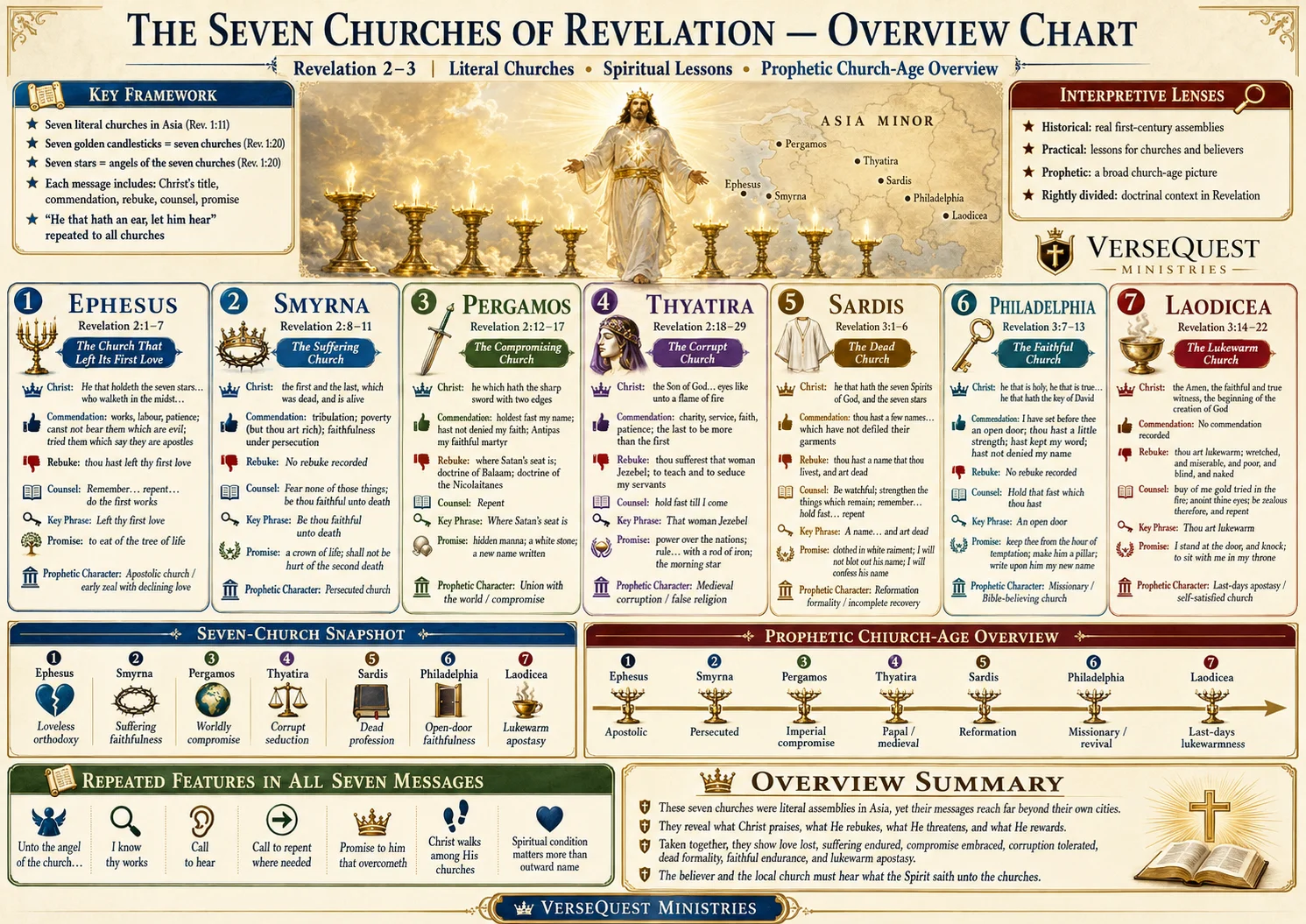
- The Seven Churches of Revelation Chart Collection – Christ Walking Among the Candlesticks
- A premium VerseQuest Ministries™ PDF chart collection covering the Seven Churches of Revelation in Revelation 2–3. Includes one overview chart plus individual KJV Bible study charts for Ephesus, Smyrna, Pergamos,…
- $12.99
- Add to cart
-
-
Angels
-
-67%
- The Doctrine of Angels Made Plain – 620-Page KJV Bible Study PDF
- The Doctrine of Angels Made Plain is a 620-page KJV Bible study that traces angels from Genesis to Revelation. This premium VerseQuest PDF explains holy angels, Christ’s supremacy over angels,…
- Original price was: $29.99.$9.99Current price is: $9.99.
- Add to cart
-
-67%