
The Devil Knocked, but There Was No Traitor Inside – The Temptation, Sinlessness, and Perfect Obedience of Jesus Christ (KJV Bible Study Chart)
Study the temptation and perfect sinlessness of Jesus Christ with this detailed KJV chart covering the wilderness, Satan’s misuse of Scripture, Christ’s holy nature, Gethsemane, Calvary, and His help for believers facing temptation.
$3.99
Description
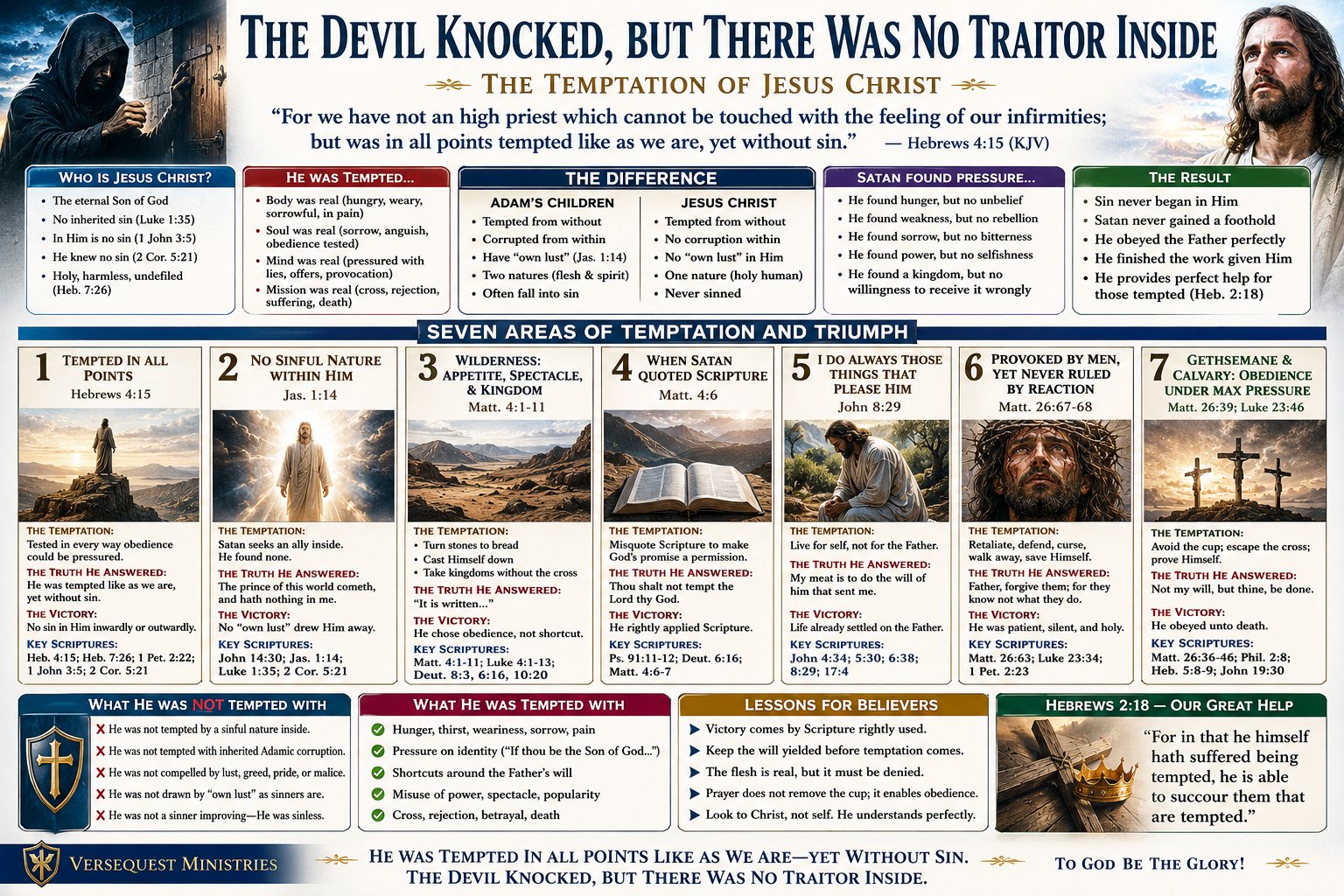
The Devil Knocked, but There Was No Traitor Inside: The Temptation of Jesus Christ is a detailed KJV Bible study chart examining how the Lord Jesus Christ experienced genuine temptation, physical weakness, sorrow, opposition, rejection, and pressure while remaining completely sinless in nature, thought, word, motive, and deed.
Built around Hebrews 4:15, this chart explains the glorious truth that Christ “was in all points tempted like as we are, yet without sin.” His temptations were real, Satan’s attacks were fierce, and the pressures placed upon His humanity were genuine—but the devil found no sinful nature, rebellious desire, inward corruption, or secret ally within Him.
The chart’s title captures the central doctrine memorably: the devil knocked, but there was no traitor inside. Satan could approach from without, offer lies, suggest shortcuts, misuse Scripture, exploit hunger, stir human opposition, and place the Lord beneath severe pressure. Yet there was nothing within Jesus Christ that agreed with the tempter.
This distinguishes Christ from Adam’s fallen children. Fallen sinners are tempted not only by outward pressure but by inward corruption. James 1:14 states that a man is tempted when he is drawn away by “his own lust, and enticed.” Every ordinary human being possesses a fallen nature that responds to sin’s appeal.
Jesus Christ possessed no such inward corruption. He was fully human, but He was not merely another fallen son of Adam. His conception was miraculous, His humanity was holy, and His nature was unstained by inherited sin.
Luke 1:35 records the angel’s declaration concerning His birth: “that holy thing which shall be born of thee shall be called the Son of God.” Christ entered the world through the virgin birth without receiving Adam’s sinful nature.
The chart establishes who Jesus Christ is. He is the eternal Son of God, the Word made flesh, truly God and truly man. He was not partly divine and partly human, nor did He merely appear to possess a human body.
His body was real. He experienced hunger, thirst, weariness, pain, physical weakness, and death. His soul was real. He experienced sorrow, anguish, rejection, grief, and the pressure of suffering. His mind was real and encountered lies, offers, provocations, and false accusations.
Yet His genuine humanity never required Him to possess sin. Sin is not an essential part of being human; it is the corruption of humanity. Adam was human before the fall, and Jesus Christ was perfectly human without sharing Adam’s rebellion.
Second Corinthians 5:21 declares that Christ “knew no sin.” First Peter 2:22 says He “did no sin, neither was guile found in his mouth.” First John 3:5 states, “in him is no sin.”
Hebrews 7:26 describes Him as “holy, harmless, undefiled, separate from sinners.” These passages leave no room for the idea that Jesus possessed a sinful nature that He merely managed more successfully than other men.
Christ was not a sinner improving Himself, suppressing hidden corruption, or gradually overcoming sinful desires. He was the spotless Lamb of God from the beginning.
The chart compares Adam’s children with Jesus Christ. Fallen humanity faces temptation from without and corruption from within. Sinners possess the flesh, experience “own lust,” and often consent to temptation.
Jesus Christ faced temptation from without but possessed no corruption within. He had no “own lust,” no inward rebellion, no selfish ambition, and no fallen nature answering Satan’s call.
John 14:30 records Christ saying of the devil, “the prince of this world cometh, and hath nothing in me.” Satan could find pressure points connected with genuine human experience, but he could find no foothold of sin.
He found hunger, but no unbelief. He found physical weakness, but no rebellion. He found sorrow, but no bitterness. He found authority and power, but no selfish ambition.
He found a promised Kingdom, but no willingness to receive it through disobedience. He found suffering ahead, but no determination to abandon the Father’s will.
The first major area of temptation is expressed through Hebrews 4:15: Christ was “tempted in all points like as we are.” This does not require that Jesus experienced every specific modern form of temptation imaginable.
It means He faced the complete range and essential categories of human testing: bodily appetite, prideful spectacle, misuse of power, false worship, social rejection, fear of suffering, opposition, loneliness, betrayal, injustice, and pressure to depart from God’s will.
Because He endured these pressures without sin, Christ understands temptation more completely than the sinner who gives in. The person who surrenders early does not experience the full force of sustained resistance. Christ resisted every temptation to its end.
The chart’s second truth is that no sinful nature existed within Him. Satan sought an ally inside, but found nothing. The world made its offers, yet Christ’s heart remained wholly devoted to His Father.
The flesh, as a sinful nature, did not operate within Jesus. He possessed a real human body with natural needs, but bodily appetite is not itself sin. Hunger becomes an occasion of sin only when it is answered through unbelief, rebellion, selfishness, or disobedience.
Christ’s third major testing occurred in the wilderness. After fasting forty days and nights, He was hungry. Satan approached when His body had reached genuine weakness.
The devil first commanded Him to turn stones into bread. The temptation was not merely to eat. Food was a legitimate need. The attack encouraged Christ to use divine power independently of the Father’s will and prove His Sonship through self-directed action.
Jesus answered with Scripture: “Man shall not live by bread alone, but by every word that proceedeth out of the mouth of God.” He refused to allow physical need to outrank obedience.
Satan next took Him to the pinnacle of the Temple and quoted Scripture, urging Him to cast Himself down. The devil demonstrated that quoting a Bible verse does not automatically make an argument biblical.
Satan omitted context, twisted the promise, and attempted to turn trust into presumption. Christ responded, “Thou shalt not tempt the Lord thy God.”
Faith obeys God; presumption creates an unnecessary crisis and demands that God rescue the person from self-willed folly. Jesus refused religious spectacle and would not use divine protection to promote Himself.
The third wilderness temptation offered the kingdoms of the world in exchange for worship. Christ is the rightful King, and the kingdoms will ultimately become His. The temptation offered a shortcut to the crown without the cross.
Satan’s bargain removed suffering, rejection, crucifixion, and the Father’s timing—but required disobedience and false worship. Jesus answered, “Thou shalt worship the Lord thy God, and him only shalt thou serve.”
Christ chose the Father’s will rather than the shortcut. He would receive the Kingdom through obedience, suffering, death, resurrection, and divine appointment—not through compromise with the devil.
The chart gives particular attention to Satan’s misuse of Scripture. The enemy can quote the Bible while opposing its Author. A verse removed from context can become a religious costume placed upon rebellion.
Jesus did not answer Satan with private impressions, emotional declarations, philosophical arguments, or newly invented revelation. He repeatedly answered, “It is written.”
His use of Scripture was accurate, contextual, obedient, and sufficient. He did not merely quote words; He remained submitted to the authority and intended meaning of those words.
This provides a central lesson for believers. Victory does not come from carrying a Bible as a religious object while ignoring its truth. Scripture must be known, believed, rightly divided, and obeyed.
The chart’s fourth major section examines Christ’s settled desire to please the Father. John 8:29 records Him saying, “I do always those things that please him.”
His life was not divided between public obedience and private rebellion. He did not obey reluctantly while inwardly resenting the Father. His will, love, purpose, and mission remained in perfect harmony with God.
Christ did not live for personal comfort, recognition, applause, self-preservation, or earthly advancement. His meat was to do the will of the One who sent Him and finish His work.
Satan could offer Him popularity, power, protection, and immediate success, but those things held no authority over a heart already settled upon the Father’s glory.
The fifth major area concerns provocation by men. Jesus endured lies, mockery, false accusation, betrayal, abandonment, religious hatred, political injustice, physical abuse, and public humiliation.
He was struck, spat upon, mocked, crowned with thorns, falsely tried, and condemned. Yet He was never ruled by rage, revenge, bitterness, panic, or self-pity.
First Peter 2:23 declares that when He was reviled, He reviled not again; when He suffered, He threatened not, but committed Himself to the One who judges righteously.
This did not make Christ weak. He spoke truth sharply, condemned hypocrisy, cleansed the Temple, exposed false teachers, and refused manipulation. His responses were governed by holiness rather than wounded pride.
At the cross He prayed, “Father, forgive them; for they know not what they do.” Human cruelty could wound His body but could not corrupt His heart.
The chart then moves to Gethsemane and Calvary—the supreme pressure of obedience. Jesus knew the betrayal, arrest, mockery, scourging, crucifixion, abandonment, and sin-bearing judgment that lay before Him.
His prayer, “Not my will, but thine, be done,” did not reveal rebellion within Him. It revealed the sinless Son submitting His genuine human will to the Father beneath unimaginable pressure.
The cup was dreadful because sin and judgment are dreadful. Christ did not desire suffering for suffering’s sake, yet He willingly accepted the cross because it was the Father’s redemptive will.
Prayer did not remove the cup. Prayer strengthened obedient submission to drink it. This corrects the shallow idea that prayer always removes hardship when faith is strong enough.
Sometimes prayer changes circumstances. Sometimes it prepares the servant to obey within circumstances God has determined not to remove.
At Calvary, Christ refused every shortcut. He would not call twelve legions of angels to escape. He would not come down from the cross to satisfy mockers. He would not save Himself because He had come to save sinners.
Philippians 2 states that He humbled Himself and became obedient unto death, even the death of the cross. His obedience did not weaken under the final pressure.
Jesus finished the work given to Him. His cry, “It is finished,” announced completed redemption, fulfilled Scripture, satisfied justice, and perfect obedience.
The chart distinguishes what Christ was tempted with from what He was not tempted with. He experienced hunger, thirst, weariness, sorrow, pain, rejection, pressure upon His identity, appeals to misuse power, shortcuts around suffering, betrayal, and death.
He was not tempted by an inherited sinful nature, inward Adamic corruption, personal lust, greed, pride, malice, unbelief, or hidden rebellion.
This distinction protects the sinlessness and deity of Christ while preserving the reality of His human suffering. The temptation was genuine because the pressure was genuine, not because sin had an inward chance of conquering Him.
A strong doctrinal term often used for this truth is the impeccability of Christ. Christ did not merely avoid sin as though His holy character might have collapsed. He is the sinless Son of God whose divine Person and holy humanity could not be corrupted by evil.
His inability to sin was not weakness but perfection. God cannot lie, yet His truthfulness is not deficient. In the same way, Christ’s holiness did not make the temptation unreal; it guaranteed that every attack met perfect resistance.
The ocean does not become less powerful because a rock cannot be persuaded to become water. Satan’s storm was real, but Christ’s holiness was immovable.
The chart also guards against the idea that Christ’s victory means believers should trust themselves. Jesus defeated temptation perfectly because of who He is. Christians overcome only through dependence upon Him, the Holy Spirit, and the written Word.
The believer still possesses the flesh. Temptation often finds an internal traitor ready to open the gate. The answer is not denial of the flesh but refusal to yield to it.
Romans 6 commands believers not to let sin reign in their mortal bodies. Galatians 5 commands them to walk in the Spirit so they will not fulfill the lust of the flesh.
Believers should keep the will yielded before temptation arrives. Many falls occur because the heart attempts to decide whether to obey only after the temptation is already pounding at the door.
A settled heart answers before the debate begins. Joseph refused Potiphar’s wife because his loyalty to God had already been established. Daniel purposed in his heart before Babylon’s pressure reached its height.
The chart teaches that Scripture must be used rightly. Satan quoted Scripture, and Jesus quoted Scripture. The difference was not who possessed Bible words but who submitted to their truth.
The devil used Scripture to encourage presumption. Christ used Scripture to remain obedient. False teachers may quote verses to baptize fleshly desire, but the rightly divided Word exposes the deception.
Believers must also understand that prayer does not eliminate all testing. Jesus prayed in Gethsemane, yet proceeded to the cross. Prayer gave expression to submission, dependence, and obedience.
The flesh is real and must be denied. A Christian should not excuse temptation by saying, “That is simply who I am.” Neither should he assume temptation itself proves he has already sinned.
Temptation becomes sin when the heart welcomes, nourishes, and obeys it. Believers must bring thoughts under Christ’s authority, resist the devil, flee youthful lusts, and remove opportunities for the flesh.
The chart directs Christians to look to Christ rather than themselves. He understands hunger, rejection, sorrow, opposition, betrayal, pain, and pressure perfectly.
Hebrews 2:18 declares, “For in that he himself hath suffered being tempted, he is able to succour them that are tempted.” The word succour communicates help, aid, and support given to those in need.
Christ is not a distant High Priest unfamiliar with human weakness. He entered genuine human experience without entering human sin.
Hebrews 4 invites believers to come boldly to the throne of grace so they may obtain mercy and find grace to help in time of need. The tempted Christian does not need to hide until he feels stronger. He needs to come to Christ.
Jesus provides perfect help because He possesses perfect understanding and perfect holiness. He sympathizes with infirmity without approving rebellion.
The Lord knows the difference between weakness and wickedness, pressure and consent, sorrow and bitterness, fear and unbelief, hunger and fleshly indulgence.
The chart’s practical application is direct. Victory comes through Scripture believed and rightly used. The will should be yielded before temptation comes.
The flesh must be denied rather than trusted. Prayer should seek obedience, not merely escape. Believers must refuse shortcuts around God’s will, even when those shortcuts promise comfort, success, recognition, or relief.
Christians should remember that Satan often presents a good object through a forbidden means. Bread is good, protection is good, and the Kingdom belongs to Christ—but obtaining them through disobedience would have been sin.
Not every opportunity is God’s will. Not every shortcut is providence. Not every Bible quotation is sound doctrine. Not every relief from pressure is victory.
Sometimes obedience means remaining hungry rather than using unauthorized means. Sometimes it means refusing spectacle. Sometimes it means rejecting immediate advancement. Sometimes it means enduring the cross placed before us.
The final doctrinal message is powerful: Christ was tempted in all points like as we are, yet without sin. Satan found pressure, weakness, sorrow, rejection, and suffering, but he found no inward rebellion.
The devil knocked, but there was no traitor inside. Sin never began in Jesus Christ. Satan never gained a foothold. The Son obeyed the Father perfectly, completed redemption, and now provides help for every believer facing temptation.
This resource is ideal for personal Bible study, Christology, studies of Christ’s temptation, the sinlessness and impeccability of Jesus, spiritual-warfare teaching, Christian discipleship, pastoral counseling, Sunday school, homeschool Bible curriculum, Christian schools, Bible institutes, sermon preparation, and believers seeking biblical help in temptation.
Temptation of Jesus Christ, Jesus tempted yet without sin, sinlessness of Christ, impeccability of Christ, wilderness temptation, Satan tempting Jesus, it is written, Christ’s perfect obedience, no sinful nature in Christ, virgin birth, eternal Son of God, no own lust in Christ, Satan found nothing in Him, temptation from without, Gethsemane prayer, obedience unto death, cross of Christ, Christ our High Priest, help in temptation, victory through Scripture
Jesus Christ is the eternal Son of God who became truly human without ceasing to be God.
His humanity was genuine. He experienced hunger, thirst, weariness, sorrow, pain, rejection, and death.
Humanity does not require sin. Sin is the corruption of human nature rather than an essential part of humanity.
Christ entered the world through the virgin birth and did not inherit Adam’s sinful nature.
Luke 1:35 calls Him “that holy thing.” His holiness was present from conception, not acquired gradually.
Second Corinthians 5:21 says Christ knew no sin. First Peter 2:22 says He did no sin. First John 3:5 says that in Him is no sin.
Jesus was holy inwardly and outwardly. He possessed no hidden rebellion, sinful lust, or corrupt desire.
Hebrews 4:15 teaches that He was tempted in all points like as we are, yet without sin.
The word temptation may describe testing, pressure, trial, or solicitation toward evil. Context determines the emphasis.
Christ experienced real external pressure but no internal sinful response.
James 1 explains that fallen people are drawn away by their own lust. Jesus possessed no “own lust” drawing Him toward evil.
John 14:30 records Christ saying that the prince of this world had nothing in Him.
Satan found hunger but no unbelief, suffering but no bitterness, power but no selfishness, and a Kingdom but no willingness to receive it through compromise.
The first wilderness temptation encouraged Christ to use divine power independently to satisfy legitimate hunger.
Jesus answered that man lives by every word proceeding from God, placing obedience above appetite.
The second temptation used a biblical quotation to encourage spectacle and presumption.
Satan’s use of Scripture proves that a quoted verse can still be misapplied, omitted from context, or used to support rebellion.
Christ refused to tempt God. Faith trusts God while obeying; presumption acts foolishly and demands rescue.
The third temptation offered the kingdoms without the cross. Satan offered the proper destination through a forbidden road.
Jesus refused the shortcut and affirmed that worship belongs to God alone.
Christ repeatedly answered, “It is written.” He demonstrated complete submission to the written Word.
The difference between Christ and Satan’s use of Scripture was not possession of words but submission to their true meaning.
Jesus always did those things that pleased the Father. His life was governed by perfect love and obedience.
Human provocation never created sinful reaction in Him. He spoke truth without fleshly rage or personal revenge.
When reviled, He reviled not again. He committed judgment to the righteous Father.
Gethsemane demonstrated obedience beneath maximum pressure. Christ submitted His genuine human will to the Father.
His request concerning the cup did not reveal sinful resistance. It revealed the horror of judgment and the perfection of willing obedience.
Prayer did not remove the cross. Prayer prepared Him to proceed obediently toward it.
At Calvary, Christ refused to save Himself because He had come to save sinners.
He became obedient unto death, even the death of the cross.
Christ’s impeccability means He was not merely a sinner who happened never to fail. He was the holy Son of God who could not be corrupted by sin.
His inability to sin did not make the temptation imaginary. It demonstrated the invincible strength of His holiness.
The one who never surrendered endured temptation’s pressure more fully than those who yield early.
Christ understands believers’ infirmities without sharing their sin.
Hebrews 2:18 promises that He is able to succour those who are tempted.
Hebrews 4 invites believers to approach the throne of grace for mercy and timely help.
Believers still possess the flesh and must not assume they can imitate Christ through self-confidence.
Christian victory requires the indwelling Spirit, Scripture, prayer, obedience, vigilance, and dependence upon Christ.
The believer should settle his will before temptation arrives. Undecided loyalty becomes vulnerable under pressure.
Temptation is not automatically sin. Consent, indulgence, and disobedience turn temptation into sin.
The flesh should be denied rather than negotiated with. Scripture instructs believers to flee lust, resist the devil, and yield themselves to God.
Not every opportunity, shortcut, relief, or promotion comes from God. The proposed means must agree with Scripture.
The central truth remains: Satan knocked, but there was no traitor inside Jesus Christ.
Temptation-of-Christ studies, Christology classes, teaching the sinlessness of Jesus, explaining the impeccability of Christ, wilderness-temptation lessons, spiritual-warfare instruction, resisting Satan with Scripture, distinguishing temptation from sin, denying the flesh, preparing the heart before temptation, Gethsemane studies, cross and obedience teaching, pastoral counseling, new-believer discipleship, Sunday school lessons, homeschool Bible curriculum, Christian school teaching, Bible institute classes, sermon preparation
King James Bible, Strong’s Concordance, Thompson Chain-Reference Bible, Treasury of Scripture Knowledge, Nave’s Topical Bible, Gospel harmony of Christ’s temptation, Matthew 4 study notes, Luke 4 commentary materials, Hebrews 2 and 4 studies, Christology outlines, virgin-birth resources, sinlessness-of-Christ studies, spiritual-warfare worksheets, Scripture-memory cards for temptation, prayer journals, Philippians 2 teaching materials, VerseQuest Jesus Christ and Christian Living charts
Related products
-
Jesus Christ / Christology
-
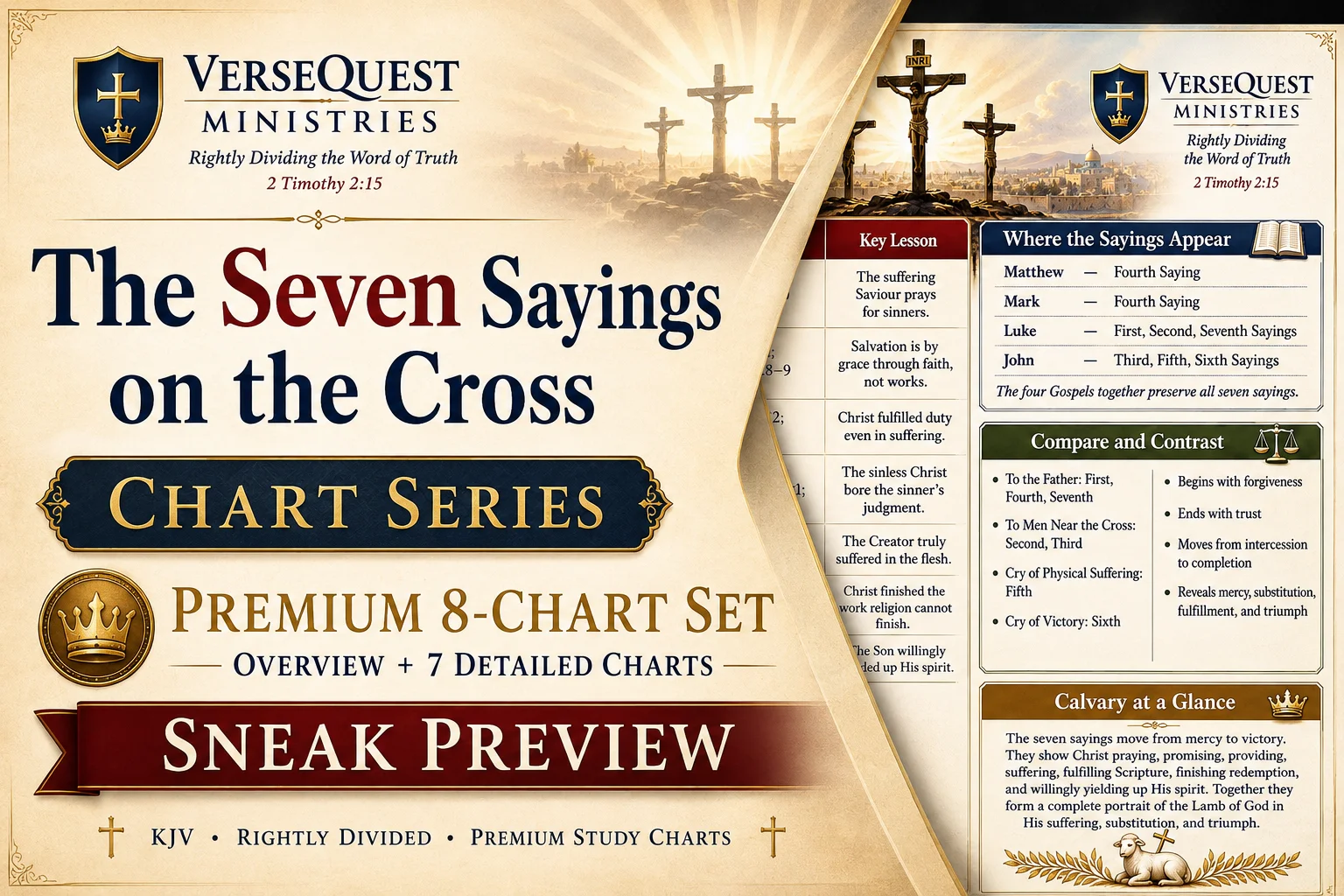
- The Seven Sayings on the Cross – Premium 8-Chart KJV Study Set
- A premium VerseQuest Ministries digital PDF study set on The Seven Sayings on the Cross, featuring an overview chart plus seven detailed KJV Bible study charts. This resource examines Calvary,…
- $12.99
- Add to cart
-
-
Doctrine Series
-
-14%
- Judas Iscariot and the Coming Antichrist – Premium KJV Prophecy Study
- A massive 459-page premium KJV prophecy study tracing the biblical connection between Judas Iscariot, the son of perdition, and the coming Antichrist. This detailed VerseQuest Ministries PDF examines Judas’ betrayal,…
- Original price was: $34.99.$29.99Current price is: $29.99.
- Add to cart
-
-14%
-
Doctrine Series
-

- The Lost Tribes Myth Exposed (213-Page Premium Study)
- A 213-page premium KJV study exposing the Lost Tribes myth, tribal identity errors, prophecy abuse, race theories, and false Israel claims through 35 detailed essays.
- $24.99
- Add to cart
-
-
VerseQuest Premium Library
-
-67%
- The Book of Psalms Made Plain – 383-Page KJV Psalm Study
- The Book of Psalms Made Plain is a 383-page premium KJV Bible study featuring 54 detailed essays through the major themes, doctrines, prophecies, prayers, laments, and praises of the Psalms.…
- Original price was: $29.99.$9.99Current price is: $9.99.
- Add to cart
-
-67%
-
Premium Studies
-
-25%
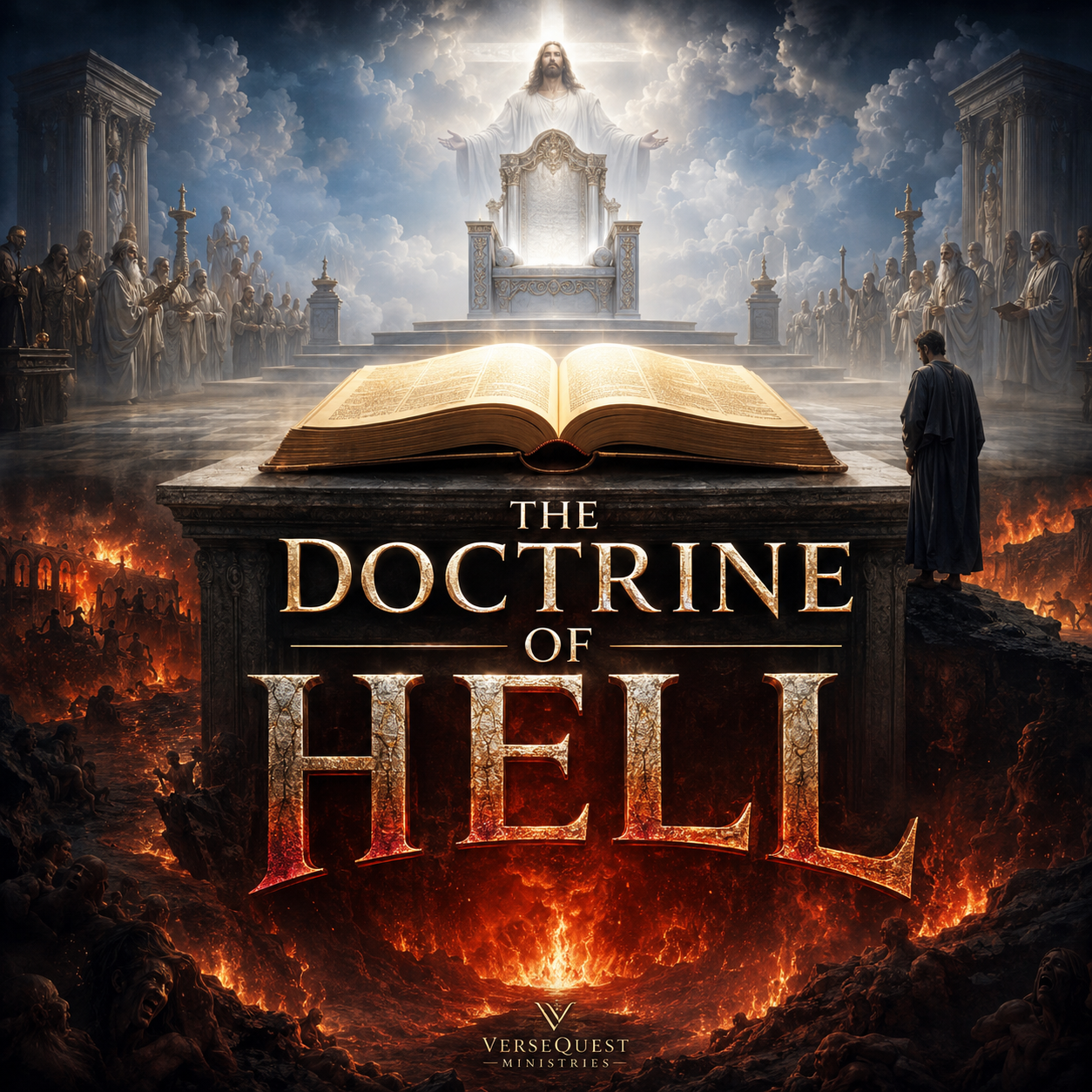
- The Doctrine of Hell — Premium Essay Series PDF
- A 383-page premium VerseQuest PDF study book containing 54 KJV essays on hell, fire, darkness, judgment, the lake of fire, the second death, and Jesus Christ as the only escape.
- Original price was: $39.99.$29.99Current price is: $29.99.
- Add to cart
-
-25%