
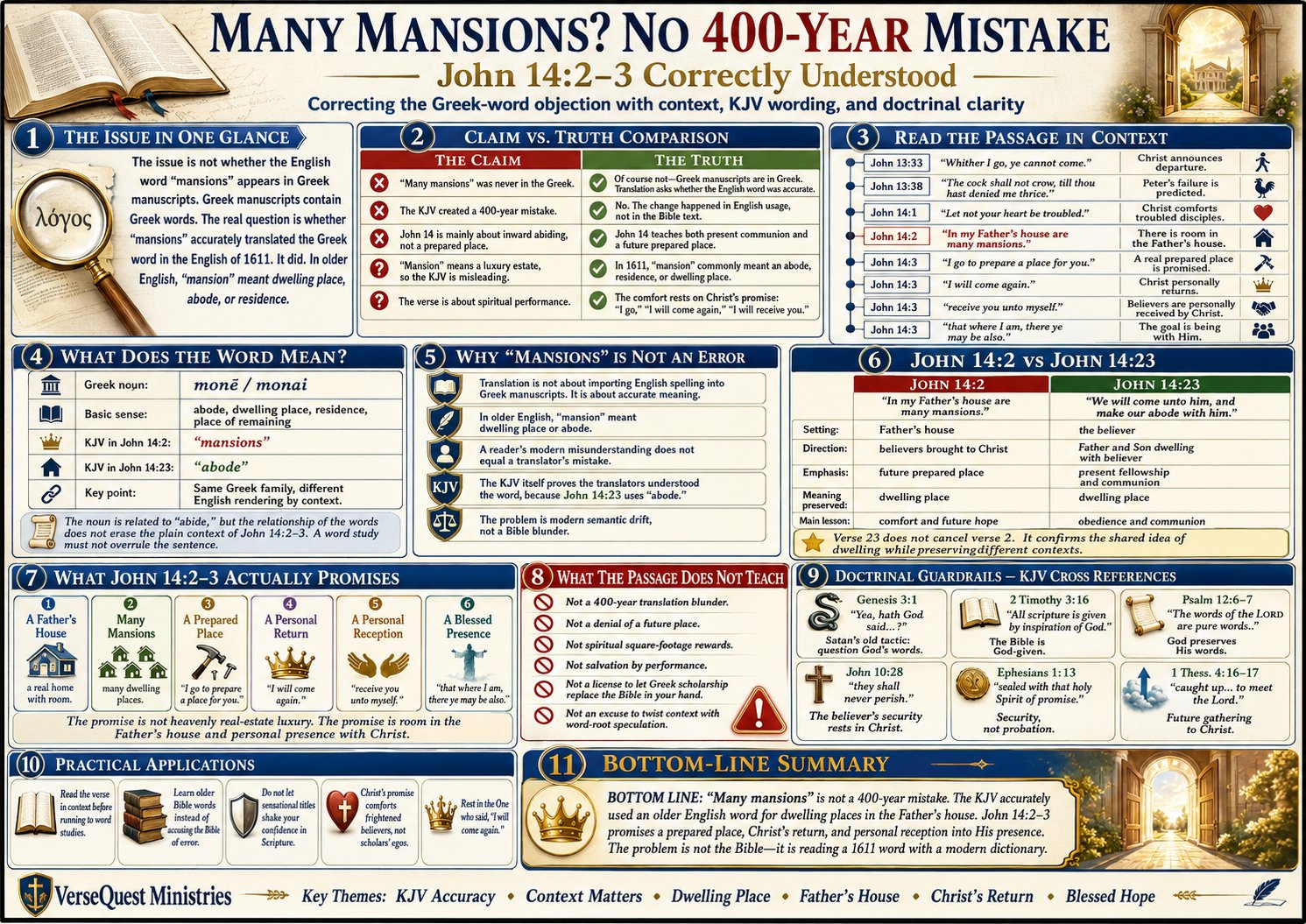
Many Mansions? No 400-Year Mistake – John 14:2–3 Correctly Understood and the KJV Wording Defended (KJV Bible Study Chart)
Defend and understand “many mansions” in John 14:2–3 with this detailed KJV chart covering older English usage, the Greek-word objection, mansion versus abode, the Father’s house, Christ’s prepared place, His personal return, and the believer’s blessed hope.
$3.99
Description
Many Mansions? No 400-Year Mistake: John 14:2–3 Correctly Understood is a detailed KJV Bible study chart answering the modern objection that the King James Bible supposedly mistranslated the Greek word behind “mansions” in John 14:2. By examining the passage in context, the historical meaning of the English word, the related wording of John 14:23, and the doctrine of Christ’s promised return, this chart demonstrates that “many mansions” is accurate, meaningful, and entirely consistent with the inspired passage.
The controversy often begins with the claim that the Greek manuscripts do not contain the English word “mansions.” That objection misses the basic nature of translation. Greek manuscripts contain Greek words, not English words. The real question is whether the King James translators selected an accurate English expression for the Greek noun used in John 14:2. The chart explains that the word carries the sense of an abode, residence, dwelling place, or place of remaining.
Modern readers commonly hear the word mansion and imagine a vast luxury estate with enormous rooms, marble staircases, swimming pools, and private grounds. That modern association is then read backward into a translation completed in 1611. Once that happens, critics accuse the King James Bible of exaggerating the verse or creating an idea absent from the underlying Greek.
The difficulty does not lie in the Bible. It lies in treating a historical English word as though its meaning must be limited to its most common modern usage. In earlier English, mansion could refer to an abiding place, dwelling, residence, or permanent habitation. The King James wording therefore communicates the essential meaning of the passage without requiring the reader to imagine a modern luxury property.
John 14 must also be read in its immediate context. In John 13, Christ tells His disciples that He is departing and that they cannot presently follow Him. Peter confidently promises loyalty but is warned that he will deny the Lord three times. The disciples are facing confusion, sorrow, weakness, and the announcement of Christ’s departure.
John 14 begins with comfort: “Let not your heart be troubled: ye believe in God, believe also in me.” Christ does not answer their fear with an abstract vocabulary lesson. He gives them a promise concerning His Father’s house, the preparation of a place, His personal return, and their future presence with Him.
Jesus declares, “In my Father’s house are many mansions.” The Father’s house is real, and there is abundant room within it. The statement communicates provision, permanence, belonging, and a prepared dwelling with God. Christ’s followers are not being offered temporary shelter, uncertain accommodation, or spiritual homelessness.
The Lord continues, “if it were not so, I would have told you.” The promise rests upon the truthfulness of Jesus Christ. The believer’s confidence is not grounded in speculative descriptions of heavenly architecture but in the character of the One who cannot lie.
Christ then says, “I go to prepare a place for you.” The verse speaks of a real prepared place connected with His departure. The passage cannot be reduced merely to an inward emotional experience, present spiritual improvement, or mystical fellowship detached from the believer’s future hope.
The preparation is personal: “for you.” Jesus Christ knows those who belong to Him, receives them individually, and secures their future through His finished redemptive work. The believer’s heavenly hope is not an impersonal destination but a promised place prepared by the Saviour.
Christ also promises, “I will come again.” John 14:3 therefore joins the prepared place with the personal return of Jesus Christ. The disciples’ comfort rests not simply in the existence of heaven but in the certainty that Christ Himself will return and receive His own.
The phrase “receive you unto myself” places Jesus Christ at the centre of the promise. The greatest blessing of the believer’s future is not architectural splendour, material luxury, or celestial real estate. It is everlasting presence with the Lord.
The goal is stated plainly: “that where I am, there ye may be also.” The believer’s hope is to be with Christ. The mansions belong within the Father’s house, but the heart of the passage is reunion, reception, security, and permanent fellowship with the Saviour.
The chart compares common claims against the King James wording with the truth revealed by language and context. Critics may claim that “many mansions” was never present in the Greek. Of course it was not present as an English phrase; the Greek text required translation into English.
Others claim that the King James Bible created a mistake that has survived for four hundred years. The chart answers that the change occurred primarily in modern English usage, not in the biblical text. A word’s later narrowing or altered association does not prove that the translators used it incorrectly.
Some object that mansion now means an extravagant estate and therefore cannot accurately represent the Greek. That reasoning ignores historical language. The proper question is what the English word communicated when the translation was produced and whether that meaning faithfully expressed the source text.
The chart also addresses the argument that John 14 is primarily about inward abiding rather than a future prepared place. John 14 certainly contains teaching about present fellowship, obedience, the Comforter, and the Father and Son making their abode with the believer. Yet those later truths do not cancel the plain promise of verses 2 and 3.
John 14:2 and John 14:23 use related Greek words while the King James Bible uses different English renderings according to context. In verse 2, Christ speaks of “many mansions” in the Father’s house. In verse 23, He promises, “we will come unto him, and make our abode with him.”
The shared word family supports the underlying sense of dwelling, remaining, or residence. The different English expressions preserve the different directions and doctrinal settings of the two statements.
In John 14:2, the Father’s house contains dwelling places, and believers are promised future reception into Christ’s presence. The direction is toward the Father’s house, and the emphasis is future hope.
In John 14:23, the Father and Son make their abode with the obedient believer. The direction is toward the believer, and the emphasis is present communion and fellowship.
Verse 23 does not correct verse 2. It confirms the shared idea of dwelling while allowing the English translation to preserve the distinct contexts. Using the same English word mechanically in both verses would not necessarily produce a clearer translation.
The King James translators demonstrated their awareness of the word’s range by rendering it according to context. They were not blindly repeating one English equivalent wherever the related Greek form appeared. They translated meaning rather than performing a wooden word-for-word substitution without regard for the sentence.
The chart explains why “mansions” is not an error. Translation is not the act of importing English spelling into Greek manuscripts. It is the act of accurately expressing the meaning of one language in another.
Older English allowed mansion to mean an abode, residence, or dwelling place. The translators therefore used a legitimate English word that conveyed the sense of the passage to their readers.
A modern reader’s misunderstanding does not automatically prove a translator’s mistake. Language changes, words develop new associations, and meanings may narrow or broaden. Bible students should learn historical usage rather than accuse Scripture whenever modern vocabulary has shifted.
The chart also points out that the King James Bible itself supplies contextual help. John 14:23 uses “abode,” revealing the same general semantic territory of dwelling and residence. The translators were clearly aware of the concept and selected their English wording deliberately.
The objection therefore becomes less a matter of textual accuracy and more a matter of modern readers assuming that their present dictionary associations must govern seventeenth-century English.
John 14:2–3 gives six great promises. First, there is a Father’s house. The believer’s future is connected with God’s household rather than an uncertain or impersonal afterlife.
Second, there are many mansions. The Father’s house contains abundant dwelling places. Christ’s people will not discover that heaven lacks room or that God’s promises were overstated.
Third, there is a prepared place. Jesus Christ has gone ahead, and the believer’s future rests in His promise and completed work.
Fourth, there will be a personal return. Christ says, “I will come again.” Christianity does not end with a departed founder whose followers merely preserve His memory. The risen Lord is returning.
Fifth, there will be a personal reception. Christ promises, “I will receive you unto myself.” The believer is not gathered into an anonymous multitude and forgotten. He is received by the Saviour.
Sixth, there will be a blessed presence. The goal is that believers may be where Christ is. The greatest glory of heaven is Jesus Christ Himself.
The chart guards against several false conclusions. The passage does not teach that the King James Bible contains a four-hundred-year translation blunder. The wording was accurate within the English usage of its time and remains understandable when studied honestly.
The passage does not deny a real future place. Christ speaks plainly of the Father’s house, many mansions, a place being prepared, His return, and His reception of believers.
The passage does not teach that each believer earns a larger heavenly estate through spiritual performance. Reward and stewardship are real biblical doctrines, but John 14:2–3 is fundamentally a promise of comfort, reception, and presence with Christ.
The passage does not teach salvation by performance. The sinner is saved by grace through faith in the finished work of Jesus Christ, not by qualifying for a mansion through religious achievement.
The passage does not authorize believers to let Greek scholarship replace the Bible in their hands. Study of the biblical languages may be useful, but it must not become a device through which every clear English statement is placed under perpetual suspicion.
A believer should not be trained to read, “In my Father’s house are many mansions,” and immediately think, “That cannot be right until an expert repairs it.” The Bible should correct the reader; the reader should not be conditioned to correct the Bible.
The chart connects the passage with major doctrinal guardrails. Genesis 3:1 records Satan’s original tactic: “Yea, hath God said?” The first attack upon God’s revelation was not open atheism but a question planted against His words.
Second Timothy 3:16 declares that all Scripture is given by inspiration of God. The Bible’s authority does not originate in the approval of modern committees, critics, or lexical trends.
Psalm 12:6–7 presents the words of the LORD as pure words and affirms God’s preservation. The believer’s confidence should rest in God’s ability to give and preserve His words.
John 10:28 teaches the security of Christ’s sheep. The believer’s future in the Father’s house rests upon Christ’s promise and power rather than personal merit.
Ephesians 1:13 declares that believers are sealed with the Holy Spirit of promise after believing the gospel. Their future inheritance is secure, not probationary.
First Thessalonians 4:16–17 describes the future catching away of believers to meet the Lord in the air. John 14’s promise of Christ returning and receiving His own fits naturally with the Church’s blessed hope.
The passage should therefore be read within the larger New Testament expectation of Christ’s return, the gathering of His people, bodily redemption, heavenly citizenship, and everlasting presence with the Lord.
The chart offers practical instruction for Bible students. Read verses within their surrounding context rather than chasing isolated word studies. Context identifies the speaker, audience, problem, promise, direction, and doctrinal emphasis.
Learn the meaning of older Bible words instead of assuming that modern usage controls every historical text. Dictionaries, older literature, and the Bible’s own cross-references can help clarify unfamiliar expressions.
Do not allow sensational internet titles, confident critics, or scholarly language to shake confidence without examining the claim carefully. An objection may sound impressive while resting upon a basic misunderstanding of translation and language change.
Remember that Christ’s promise comforts frightened believers rather than feeding scholarly pride. The disciples needed assurance that His departure was not abandonment and that they possessed a future with Him.
Rest in the One who said, “I will come again.” The reliability of the promise ultimately rests upon the reliability of Jesus Christ.
The bottom-line conclusion is clear: “Many mansions” is not a four-hundred-year mistake. The King James Bible accurately used an older English word for dwelling places within the Father’s house.
John 14:2–3 promises a prepared place, the personal return of Jesus Christ, the personal reception of believers, and everlasting presence with the Lord. The problem is not the Bible. The problem is reading a word from 1611 through a limited modern definition and then accusing the translation of error.
This resource is ideal for personal Bible study, King James Bible defense, John 14 teaching, translation discussions, older-English word studies, Rapture and blessed-hope lessons, assurance counseling, new-believer discipleship, Sunday school, homeschool Bible curriculum, Christian schools, Bible institutes, pastoral training, apologetics, sermon preparation, and anyone encountering the claim that “many mansions” is a mistranslation.
Many mansions, John 14:2–3, Father’s house, prepared place, Christ will come again, receive you unto myself, where I am there ye may be also, KJV accuracy, King James Bible defense, older English Bible words, mansion and abode, John 14:23, Greek word objections, translation accuracy, context matters, heavenly hope, blessed hope, Rapture of the Church, believer’s security, preservation of Scripture
The objection is not resolved by observing that the Greek manuscripts do not contain the English word “mansions.” Greek manuscripts naturally contain Greek words that must be translated.
The real question is whether “mansions” accurately conveyed the meaning of the Greek noun in the English of the King James translators.
The word carries the basic sense of an abode, dwelling place, residence, or place of remaining.
In older English, mansion could refer to a dwelling or residence without requiring the modern idea of an extravagant luxury estate.
A modern semantic association should not be imposed backward upon a historical translation and then used to accuse that translation of error.
John 14:2 must be interpreted within the context beginning in John 13.
Christ had announced His departure, warned Peter of his coming denial, and comforted troubled disciples.
The Father’s house is presented as real and possessing abundant room.
The phrase “many mansions” communicates multiple dwelling places within the Father’s household.
Christ’s statement “if it were not so, I would have told you” grounds the promise in His truthfulness.
The words “I go to prepare a place for you” teach a genuine prepared place rather than only an inward spiritual experience.
The phrase “I will come again” establishes Christ’s personal return.
The promise “receive you unto myself” makes the reception personal.
The goal “that where I am, there ye may be also” places Christ’s presence at the centre of the believer’s hope.
John 14:2 and John 14:23 use related Greek forms connected with dwelling or abiding.
The King James Bible renders the term “mansions” in John 14:2 and “abode” in John 14:23 according to the differing contexts.
John 14:2 points toward the Father’s house and a future prepared dwelling.
John 14:23 points toward the Father and Son dwelling with the believer in present fellowship.
The shared word family does not require an identical English rendering in every context.
The different renderings demonstrate contextual translation rather than ignorance of the underlying word.
John 14:23 does not correct or cancel John 14:2.
Translation concerns communicating meaning accurately rather than importing English spelling into a Greek manuscript.
A reader’s modern misunderstanding does not automatically establish a translator’s historical mistake.
The promise is not primarily a description of heavenly luxury or square footage.
The central truths are the Father’s house, abundant dwelling places, Christ’s preparation, His return, His reception of believers, and their presence with Him.
John 14:2–3 does not teach salvation by works or mansion size determined by spiritual performance.
Christian reward is a separate doctrine and should not be forced into this comfort passage.
The passage supports the believer’s future hope and fits with the Church being gathered to Jesus Christ.
First Thessalonians 4 teaches that believers will be caught up to meet the Lord and remain with Him forever.
The believer’s future rests upon Christ’s finished work, promise, and faithfulness.
Word studies must remain subordinate to context rather than replacing it.
Greek scholarship may assist study but must not become an authority used continually to correct the Bible in the believer’s hands.
Historical English usage should be considered before accusing an older translation of error.
The proper response is to read contextually, learn older words honestly, trust Christ’s promise, and hold fast the written Word.
John 14 Bible studies, King James Bible defense, answering Greek-word objections, teaching older English vocabulary, explaining many mansions, translation and context lessons, Rapture teaching, blessed-hope instruction, heavenly-home studies, assurance-of-salvation counseling, apologetics training, new-believer discipleship, Bible-authority classes, pastoral teaching, Sunday school lessons, homeschool Bible curriculum, Christian school instruction, Bible institute classes, sermon preparation
King James Bible, Strong’s Concordance, Oxford English Dictionary or another historical English dictionary, Webster’s 1828 Dictionary, Thompson Chain-Reference Bible, Treasury of Scripture Knowledge, Nave’s Topical Bible, Gospel of John study notes, John 13–14 context worksheets, older-English Bible word studies, KJV translation-defense resources, Rapture and blessed-hope charts, heavenly-citizenship studies, Scripture-preservation materials, Pauline epistle outlines, VerseQuest Bible-authority and prophecy charts
Related products
-
Prophecy Studies
-
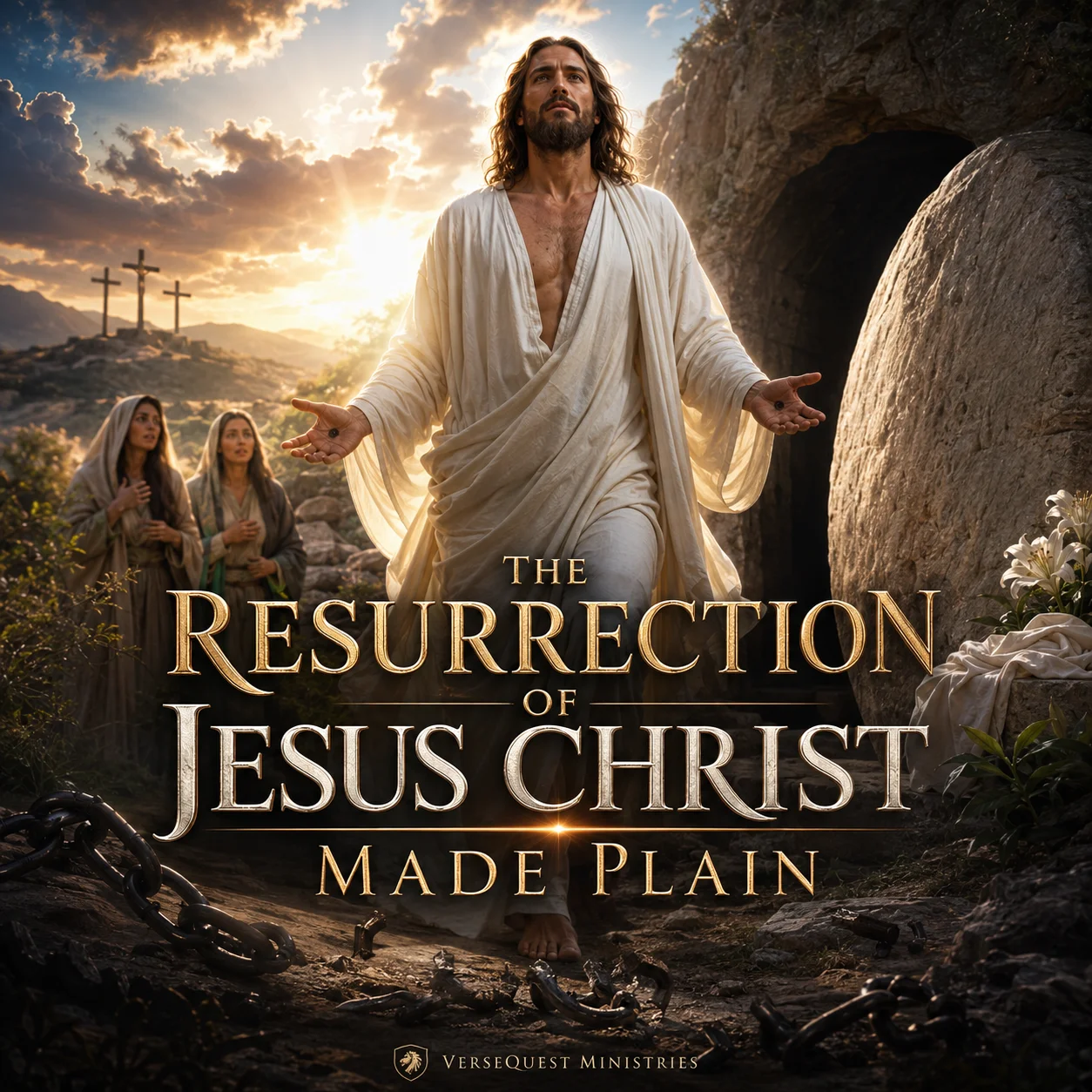
- The Resurrection of Jesus Christ Made Plain – 501-Page KJV Bible Study
- A massive 501-page VerseQuest Ministries PDF Bible study defending and explaining the bodily resurrection of Jesus Christ from a KJV, rightly divided perspective. This 80-essay study covers the empty tomb,…
- $34.99
- Add to cart
-
-
Bible Prophecy Charts
-
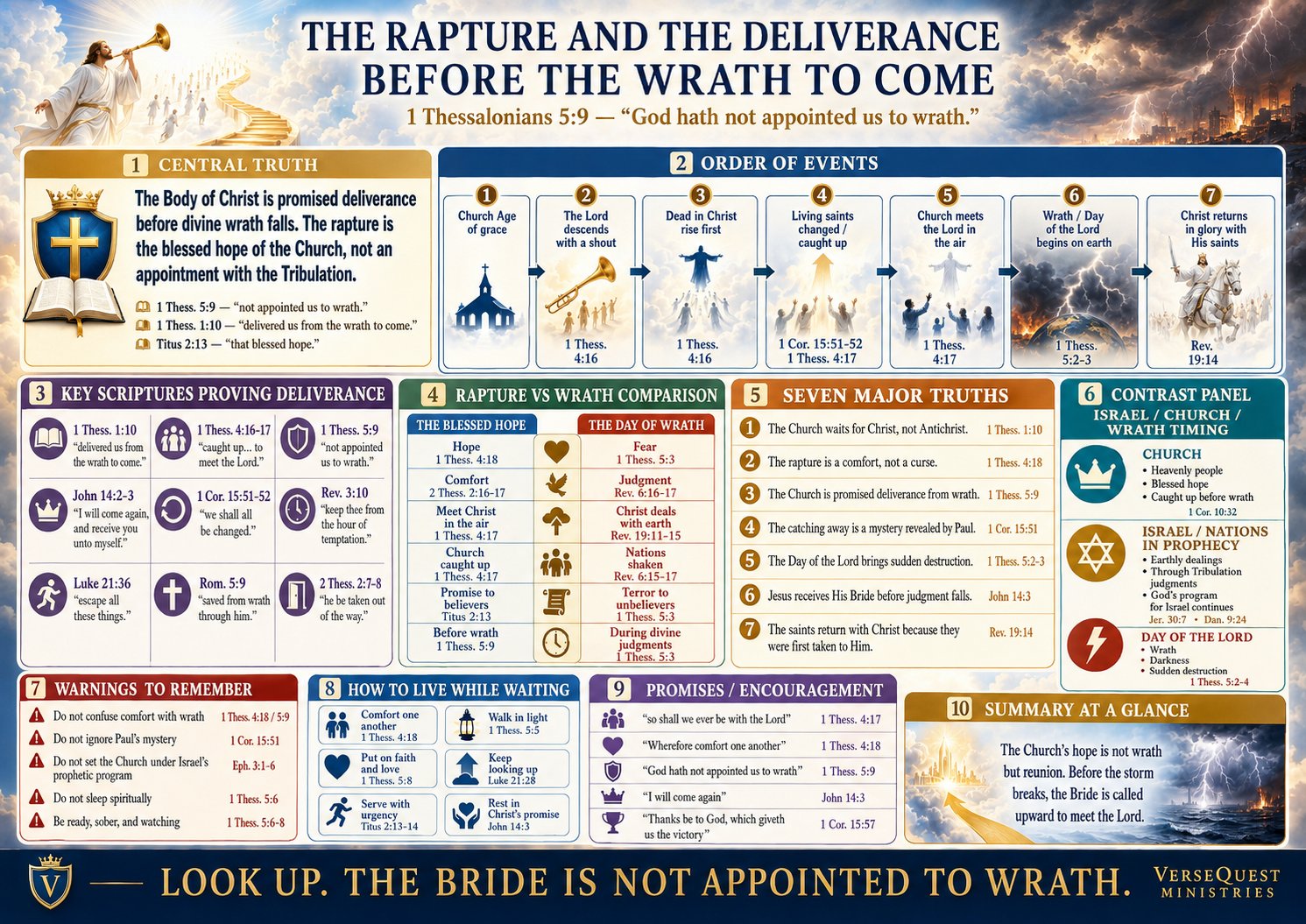
- The Rapture and the Deliverance Before the Wrath to Come – Printable Bible Study Chart
- Printable KJV Bible study chart on The Rapture and the Deliverance Before the Wrath to Come, showing from 1 Thessalonians 5:9 that the Church is not appointed to wrath. This…
- $4.99
- Add to cart
-
-
Chart Collections
-
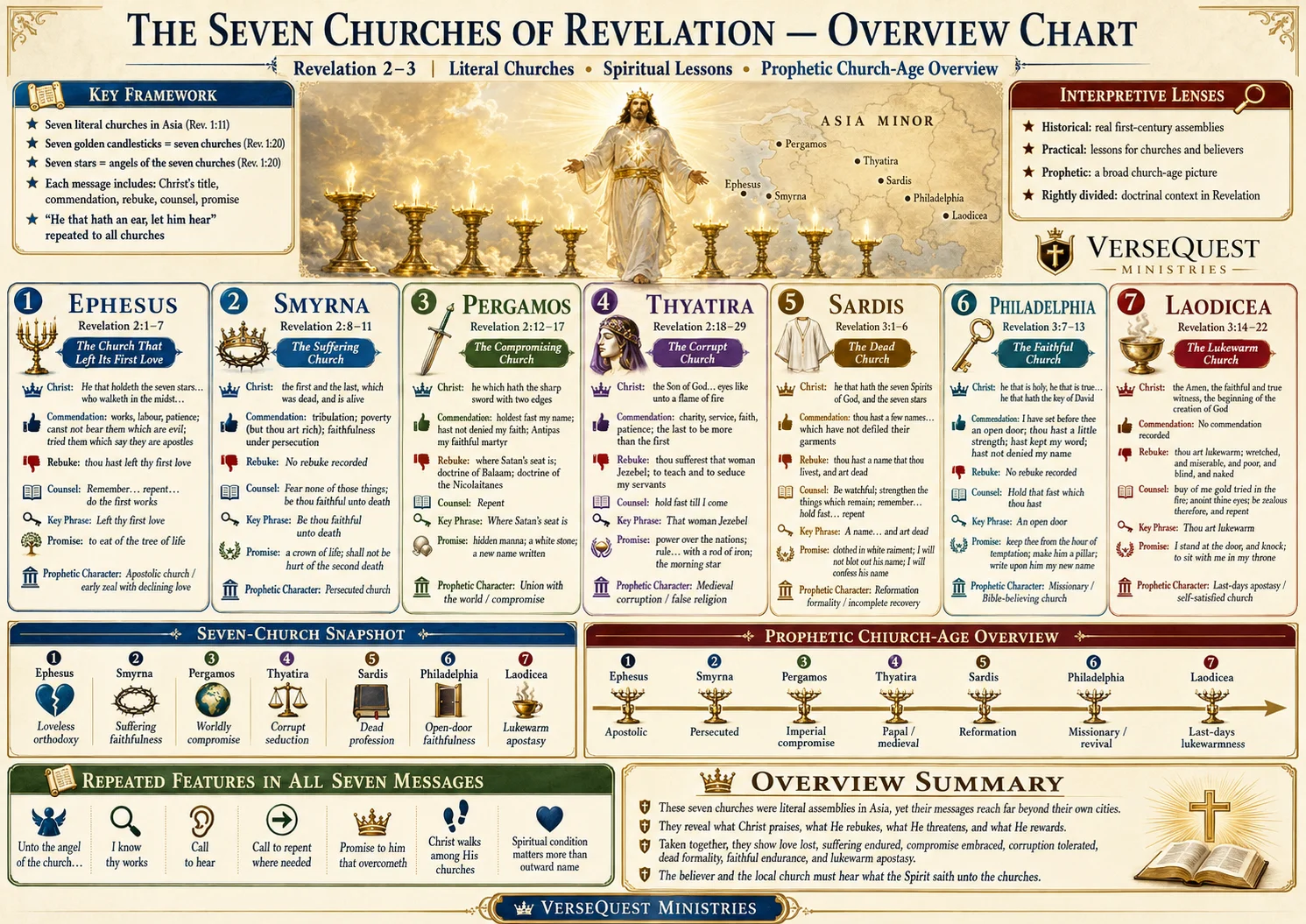
- The Seven Churches of Revelation Chart Collection – Christ Walking Among the Candlesticks
- A premium VerseQuest Ministries™ PDF chart collection covering the Seven Churches of Revelation in Revelation 2–3. Includes one overview chart plus individual KJV Bible study charts for Ephesus, Smyrna, Pergamos,…
- $12.99
- Add to cart
-
-
Revelation
-
-71%
- Moses and Elijah: The Two Witnesses Made Plain
- Moses and Elijah: The Two Witnesses Made Plain is a 636-page premium VerseQuest PDF study proving from Scripture that the Two Witnesses of Revelation 11 are Moses and Elijah. This…
- Original price was: $34.99.$9.99Current price is: $9.99.
- Add to cart
-
-71%
-
KJV Bible Study Resources
-
-60%
- Practical Christianity for Daily Battles – 329-Page KJV Study PDF
- A premium 329-page KJV study PDF with 40 full essays applying sound, rightly divided Bible doctrine to real daily Christian battles. Topics include temptation, anxiety, marriage, parenting, pornography, grief, church…
- Original price was: $24.99.$9.99Current price is: $9.99.
- Add to cart
-
-60%