
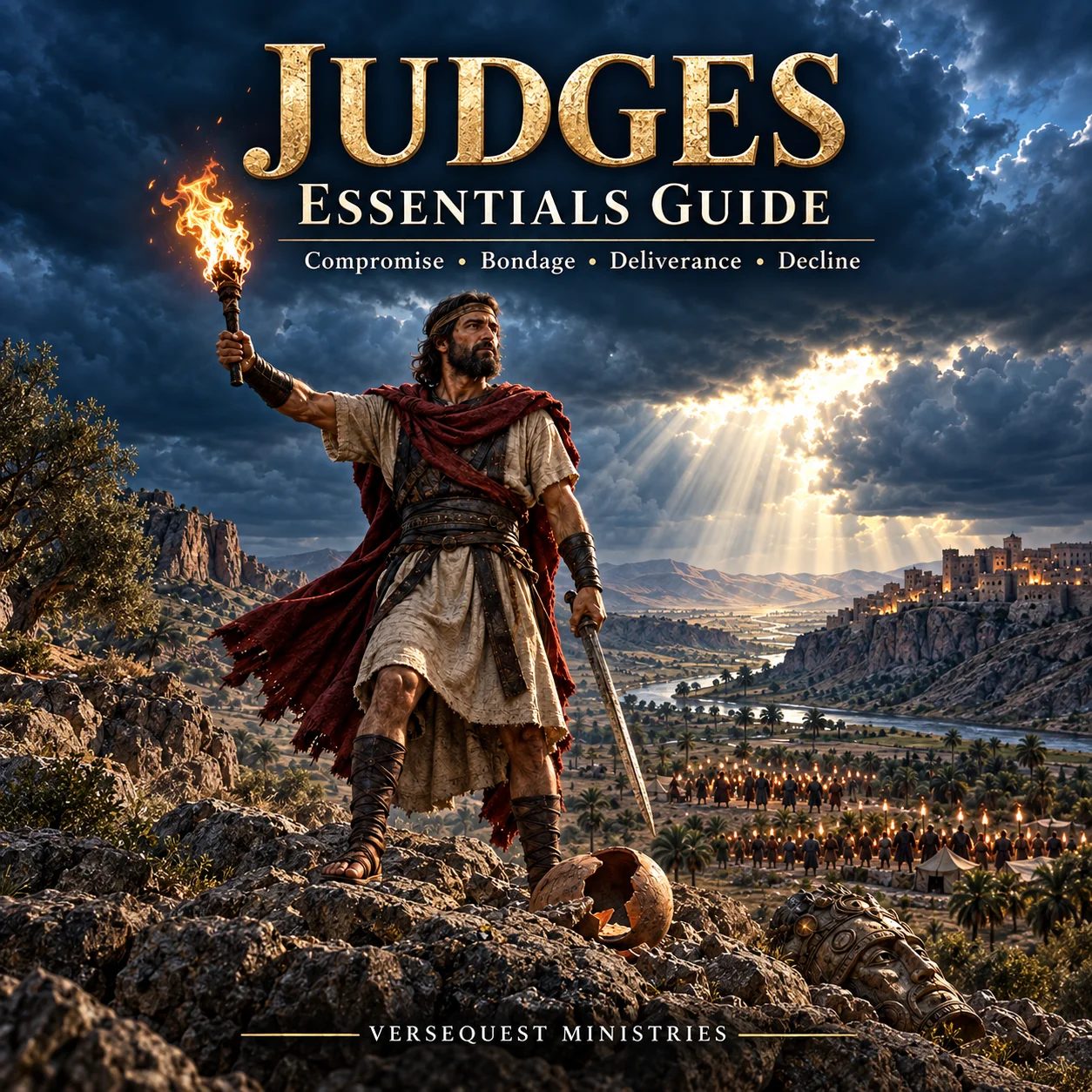
Judges Essentials Guide
The Judges Essentials Guide is a 120-page downloadable and printable KJV Bible-study PDF that gives readers a clear foundation in one of the Old Testament’s most important and frequently misunderstood books. Its 88 structured lessons trace Israel’s incomplete conquest, recurring cycles of sin and deliverance, major judges, spiritual decline, false worship, and final civil war.
Important King James Bible passages are printed within the guide and supported by explanations, essential truths, dispensational distinctions, charts, timelines, chapter maps, review material, teaching questions, and room for personal notes. Priced at $14.99, it is an excellent resource for beginners, personal study, discipleship, Sunday school, family study, sermon preparation, and anyone who wants the essential teachings of Judges in one organized volume.
$14.99
Description
The Judges Essentials Guide is a 120-page downloadable and printable KJV Bible-study PDF designed to give readers a clear, substantial, and well-organized foundation in the Book of Judges. Priced at $14.99, this guide is especially suited for new believers, beginning Bible students, and readers who want the essential teachings of Judges without first working through a large commentary or lengthy academic study.
Judges records one of the darkest and most revealing periods in Israel’s history. The nation had entered the Promised Land, but it failed to complete the work God had commanded. Compromise led to idolatry, idolatry brought bondage, bondage produced cries for deliverance, and the LORD raised up judges to rescue His people. After each period of rest, however, Israel returned to rebellion, and the cycle began again.
This guide carefully traces that downward pattern from Israel’s incomplete conquest through the final civil war involving Benjamin. It explains the opening failures of the tribes, the recurring cycle of sin and deliverance, and the lives and ministries of Othniel, Ehud, Shamgar, Deborah, Barak, Jael, Gideon, Abimelech, Jephthah, Samson, and the lesser-known judges. It also examines Micah’s private idolatry, the corrupted Levite, the migration of Dan, the wickedness of Gibeah, and Israel’s devastating internal conflict.
The guide contains 88 structured lessons arranged across twelve units. Important King James Bible passages are printed directly within the lessons, allowing readers to study the text without continually stopping to locate every reference. Each lesson explains what is happening, identifies the essential truth, highlights important facts, preserves proper dispensational distinctions, supplies a memorable conclusion, and provides thought-provoking questions with room for personal notes.
Charts, timelines, chapter maps, comparison tables, chronological observations, teaching outlines, and review pages help readers understand how the people, events, oppressors, deliverers, and spiritual conditions fit together. Special attention is given to difficult passages and commonly misunderstood events, including Gideon’s signs, Abimelech’s counterfeit rule, Jephthah’s vow, Samson’s failures, the Angel of the LORD, the Spirit of the LORD upon the judges, and the repeated statement that every man did that which was right in his own eyes.
This guide treats Judges as the inspired historical record of God’s dealings with Israel. It does not transfer Israel’s national covenant, land promises, warfare, or judicial responsibilities directly to the Church. At the same time, it draws legitimate spiritual instruction from Israel’s failures, showing the destructive results of compromise, self-rule, corrupted worship, pride, divided leadership, and disobedience to the written word.
The Judges Essentials Guide is suitable for personal Bible study, discipleship, Sunday school, family study, small groups, sermon preparation, ministry training, classroom instruction, and quick reference. It gives the reader enough substance to understand the book responsibly while remaining accessible to someone encountering Judges for the first time.
Incomplete obedience: Israel began possessing the land but failed to remove the influences God had commanded it to destroy. The downward cycle: Sin leads to servitude, suffering produces supplication, God sends salvation, rest follows, and rebellion eventually returns. Compromise and its consequences: Small accommodations with Canaanite culture develop into idolatry, bondage, corrupted worship, and national ruin. God’s covenant faithfulness: Israel repeatedly fails, yet the LORD remains faithful to His word and responds to genuine cries for deliverance. The sovereignty of God in deliverance: God uses unexpected people, unlikely methods, reduced armies, ordinary instruments, and human weakness to accomplish His purposes. The judges as flawed deliverers: The judges are real historical deliverers, but their weaknesses demonstrate Israel’s need for a righteous and permanent King. The Angel of the LORD: Divine appearances in Judges reveal the LORD calling, commissioning, correcting, and strengthening His servants. The Spirit of the LORD: The Spirit empowers chosen judges for specific responsibilities in Israel’s national deliverance. Othniel and the first complete cycle: Othniel provides the clearest early example of oppression, deliverance, and rest. Ehud and unexpected means: God uses an unlikely deliverer and an unconventional method to overthrow Moabite oppression. Deborah, Barak, and Jael: Their account explores leadership, courage, hesitation, willing service, and the shame of tribes that refused to help. Gideon’s growth and decline: Gideon moves from fear to faith and victory, yet his later decisions contribute to idolatry and future disaster. Abimelech’s counterfeit kingship: Self-appointed authority secured through murder produces tyranny, division, and destruction. Jephthah’s leadership and rash vow: Jephthah’s account combines courageous deliverance, careful historical argument, uncontrolled speech, and severe consequences. Samson’s strength and weakness: Samson possesses supernatural power but repeatedly suffers because of ungoverned appetites, compromised separation, and poor judgment. Private religion becoming public corruption: Micah’s household idols and hired priesthood spread until an entire tribe adopts the counterfeit system. Moral collapse at Gibeah: The final chapters reveal how far covenant society can descend when every man becomes his own authority. Civil conflict among brethren: Ephraim’s pride, Benjamin’s protection of wicked men, and Israel’s internal warfare reveal the destructive power of unchecked sin. Israel and the Church rightly divided: Israel’s land, covenant responsibilities, national warfare, and judges must not be carelessly transferred to the Body of Christ. The need for righteous authority: The repeated absence of a king points beyond failed human deliverers toward the necessity of God’s righteous rule.
- Judges begins after Joshua’s generation and records Israel’s failure to maintain the obedience required for possession of the land.
- The book is not merely a collection of heroic biographies. Its principal subject is Israel’s continuing spiritual and moral decline.
- Judges 2:6–23 supplies the interpretive framework for the rest of the book.
- Israel’s recurring pattern can be remembered as sin, servitude, supplication, salvation, and silence or rest.
- The cycles are not identical. Each return to rebellion produces deeper compromise and greater disorder.
- The chronology of Judges is not necessarily presented as one uninterrupted sequence. Some oppressions and judges may have overlapped in different regions.
- The judges were raised up as national or regional deliverers. Their office should not be confused with the position of a New Testament pastor or civil judge.
- God’s use of a person does not mean that He approves every decision that person makes.
- Gideon’s reduced army makes it impossible for Israel to claim that military strength produced the victory.
- Gideon’s later ephod demonstrates that a memorial connected with victory can become a snare when it replaces obedience.
- Abimelech is not a godly judge raised up by the LORD. He seizes power through violence and represents counterfeit rule.
- Jephthah’s knowledge of Israel’s history strengthens his case against Ammon, but his rash vow shows the danger of speaking beyond what God commanded.
- Samson’s physical strength does not compensate for his lack of personal discipline. His life demonstrates that divine gifting cannot safely replace obedience.
- Samson’s final victory does not erase his failures, but it does show that he turned to the LORD in his final hour.
- Micah’s religion contains religious language, images, a priest, and personal sincerity, yet it remains unauthorized idolatry.
- The Levite in Judges 17–18 demonstrates how religious service can be corrupted by money, position, convenience, and private ambition.
- The sin at Gibeah resembles the wickedness of Sodom and reveals the depth of Israel’s moral collapse.
- Benjamin’s defense of guilty men turns local wickedness into national disaster.
- Israel repeatedly attempts to repair one sinful decision through additional human schemes.
- The statement that every man did that which was right in his own eyes explains the book’s final condition.
- Judges does not teach that Israel had no divine authority. Israel possessed God’s written law but refused to submit to it.
- The book should be interpreted historically before its spiritual applications are drawn.
- Israel remains Israel, and the Church remains the Church. National warfare, land inheritance, and Mosaic covenant judgments must be kept in their proper dispensational setting.
- Legitimate applications include warnings against compromise, idolatry, pride, self-rule, corrupted worship, divided leadership, and neglect of Scripture.
- The flawed judges create an expectation for a Deliverer who is righteous, permanent, and completely obedient.
- A useful review question is: Where does the compromise begin, and how does it grow?
- Another important question is: What does each judge reveal about human weakness and divine mercy?
- A final subject for deeper study is the connection between the absence of righteous authority in Judges and the later establishment of Israel’s monarchy.
Personal Bible Study: Readers can move through Judges in manageable lessons while keeping the important KJV passages, explanations, charts, and review questions together in one resource.
New-Believer Discipleship: The guide introduces the historical setting, principal people, recurring cycle, major doctrines, and practical warnings without assuming that the student already understands Old Testament history.
Sunday School Lessons: The twelve-unit structure can be adapted into a teaching series covering Israel’s compromise, the judges, the downward national cycle, and the final moral collapse.
Sermon Preparation: Pastors and preachers can use the chapter maps, teaching outlines, essential truths, memorable conclusions, and related passages to organize messages from Judges.
Small Groups: Each lesson contains enough biblical content for guided discussion, along with questions that encourage observation, interpretation, doctrinal distinction, and personal application.
Family Study: Families can read the printed KJV passages, discuss the explanation, and use the lesson questions to teach obedience, courage, leadership, consequences, and the faithfulness of God.
Classroom Instruction: Teachers can use the charts, chronological observations, comparisons, maps, and review sections to help students understand the people and events of Judges.
Ministry Training: The guide provides examples of faithful service, compromised leadership, false worship, pride, division, and the consequences of operating without submission to God’s word.
Quick Reference: Readers can return to the tables, timelines, chapter summaries, and character studies when they need to locate an event or remember how a judge fits within the larger book.
A King James Bible for reading every chapter of Judges in its complete context.
A KJV concordance for tracing words such as judge, deliver, rest, spirit, covenant, serve, evil, cry, and king.
A reliable Bible dictionary for historical information about Canaan, the Philistines, Midian, Moab, Ammon, tribal territories, and ancient weapons.
A Bible atlas showing the tribal allotments, the Jezreel Valley, Mount Tabor, the Jordan crossings, Gilead, Timnath, Gaza, Shiloh, Dan, Gibeah, and other important locations.
A chronological timeline of Joshua, Judges, and the early monarchy.
Cross-reference tools connecting Judges with Deuteronomy, Joshua, Psalms, Hosea, Acts, and Hebrews.
The Deuteronomy Essentials Guide for understanding the covenant commands and warnings that form the background of Judges.
The Joshua Essentials Guide for studying Israel’s entrance into the land and the responsibilities passed to the following generation.
Peter S. Ruckman’s Reference Bible notes on Judges for additional dispensational and prophetic observations.
The Scofield Reference Bible for its dispensational framework and cross-references.
Dake’s study notes for additional topical and historical research.
The Jamieson-Fausset-Brown Commentary for historical and textual observations.
Bullinger’s Bible-study notes for structural and linguistic study.
Related products
-
Genesis 23
-
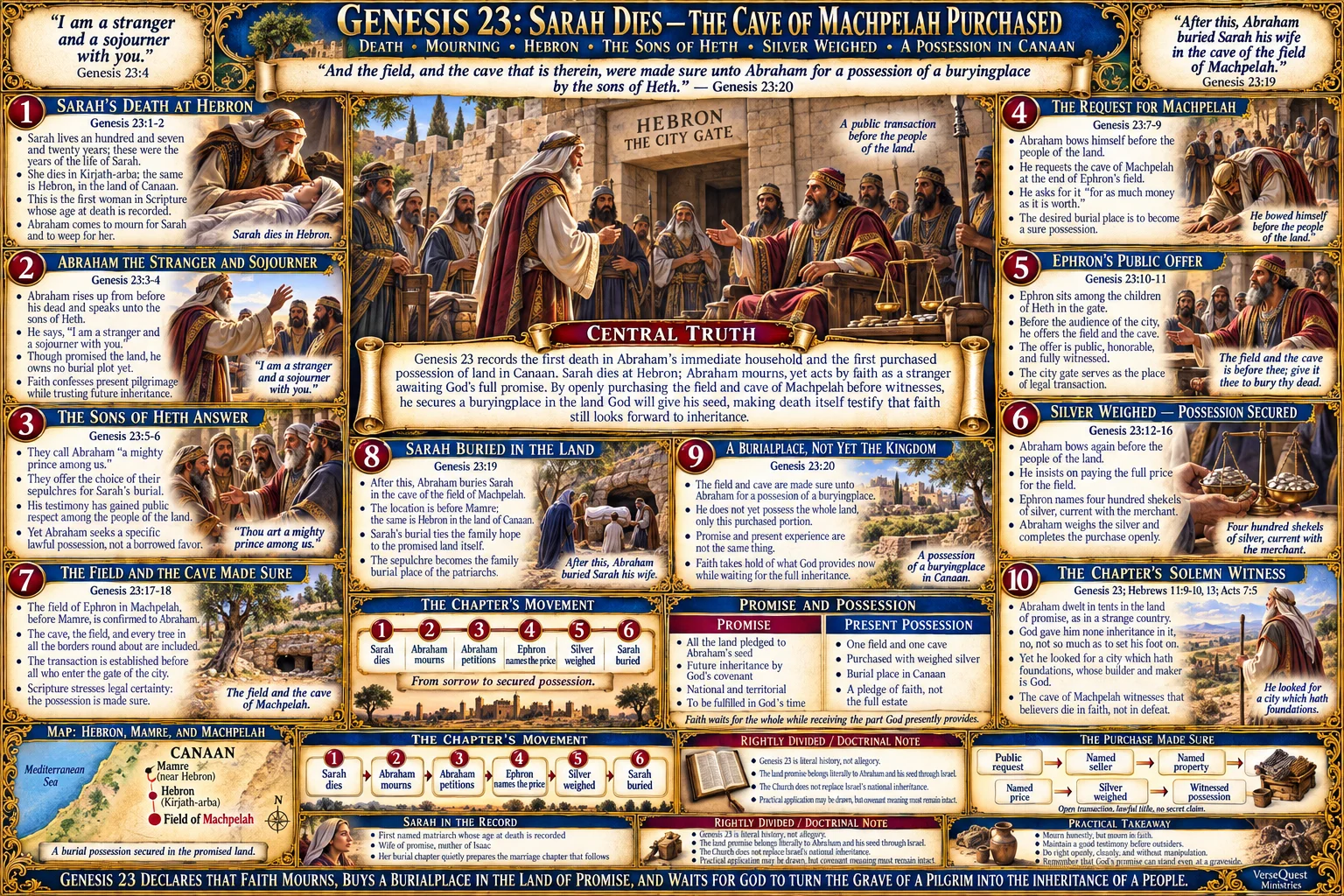
- Genesis 23 – Sarah Dies and the Cave of Machpelah Is Purchased: Abraham the Stranger, Hebron, Four Hundred Shekels, and a Possession in Canaan (KJV Bible Study Chart)
- Explore Genesis 23 with this detailed KJV Bible study chart tracing Sarah’s death at Hebron, Abraham’s mourning, his declaration that he is “a stranger and a sojourner,” and his negotiations…
- $4.99
- Add to cart
-
-
Genesis 22
-
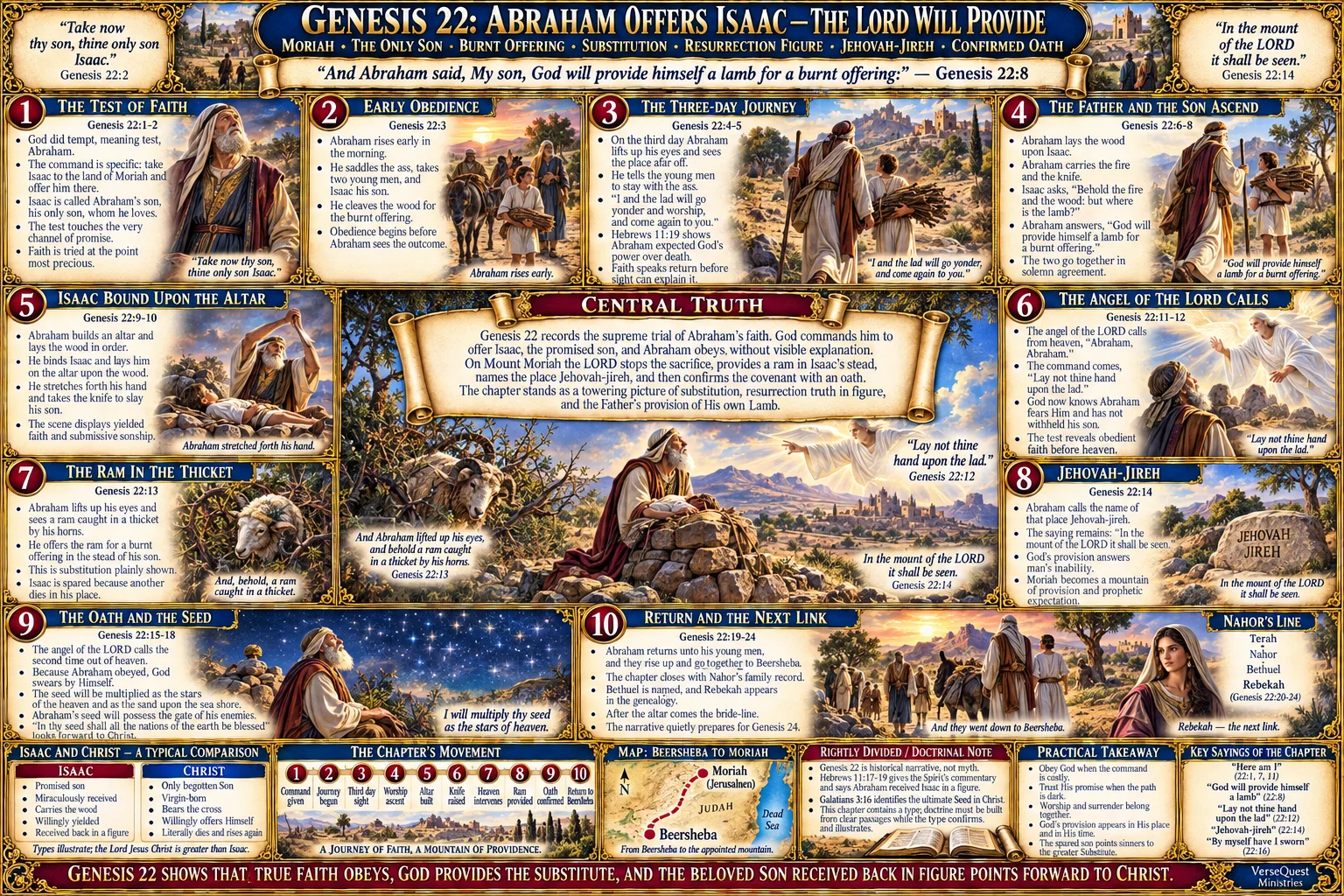
- Genesis 22 – Abraham Offers Isaac: The Only Son, Mount Moriah, the Ram in the Thicket, Jehovahjireh, and the Confirmed Oath (KJV Bible Study Chart)
- Explore Genesis 22 with this detailed KJV Bible study chart examining Abraham’s supreme test of faith, the command to offer Isaac, the three-day journey into the land of Moriah, and…
- $4.99
- Add to cart
-
-
Genesis Chapter 16
-
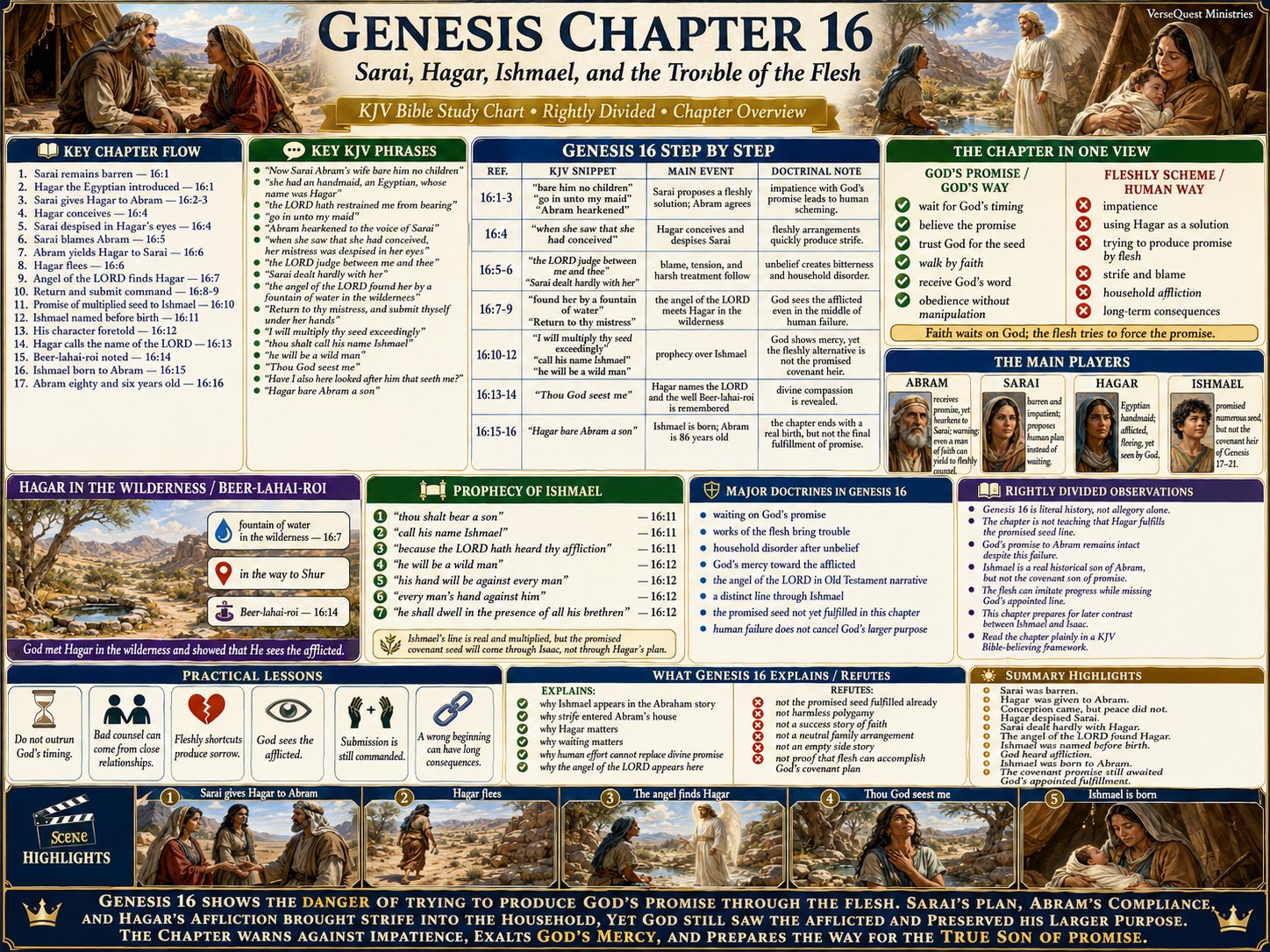
- Genesis Chapter 16 Bible Study Chart – Sarai, Hagar, Ishmael, and the Trouble of the Flesh (KJV)
- Explore Genesis Chapter 16 with this detailed KJV Bible study chart covering Sarai’s plan, Hagar’s affliction, Ishmael’s birth, the trouble of the flesh, and God’s mercy toward those He sees.
- $3.99
- Add to cart
-
-
Dueteronomy Bible Study
-
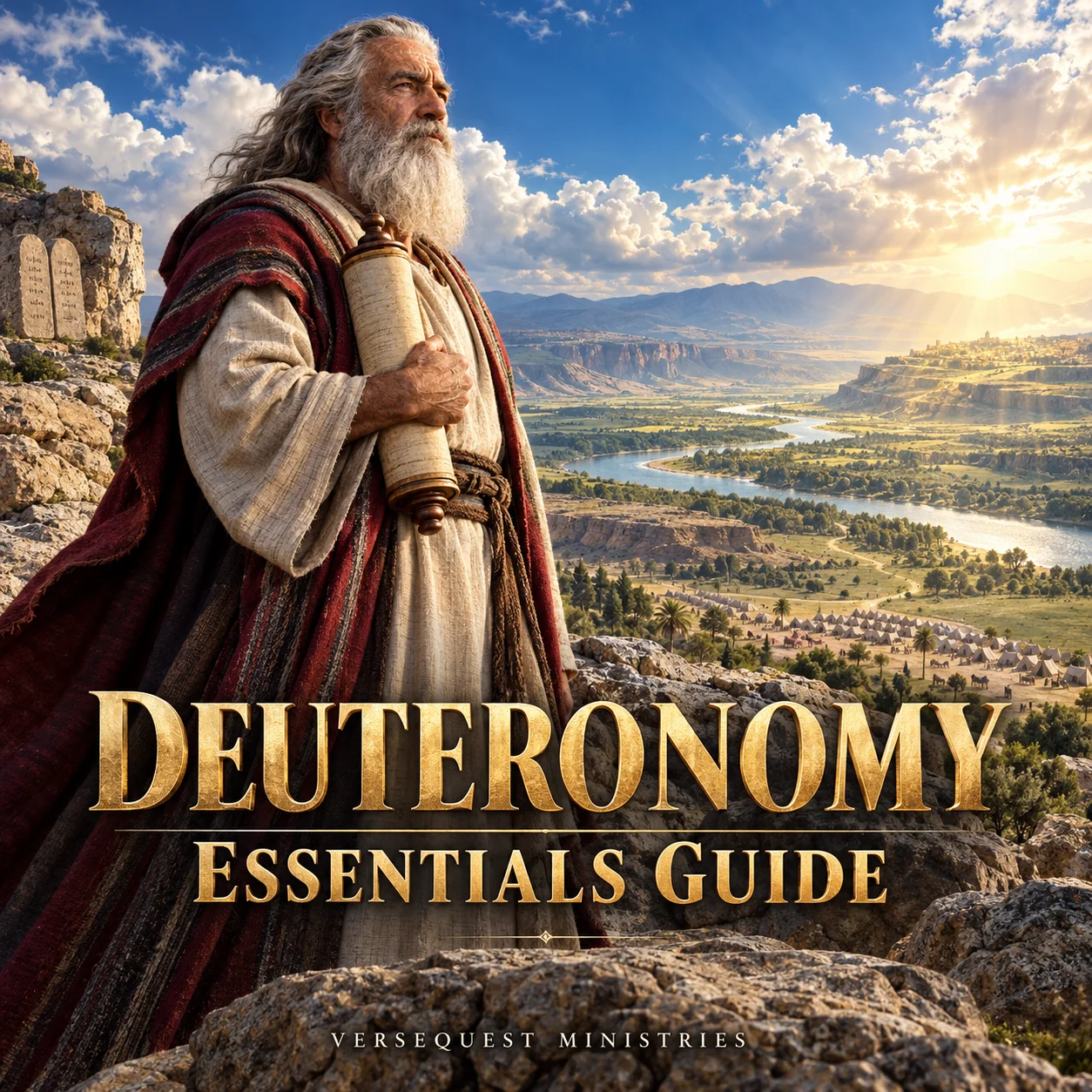
- Deuteronomy Essentials Guide
- The Deuteronomy Essentials Guide is a 112-page downloadable and printable KJV Bible-study book that gives beginners a clear foundation for understanding Moses’ final words, Israel’s covenant, the wilderness lessons, the…
- $14.99
- Add to cart
-
-
Genesis Chapter 12
-
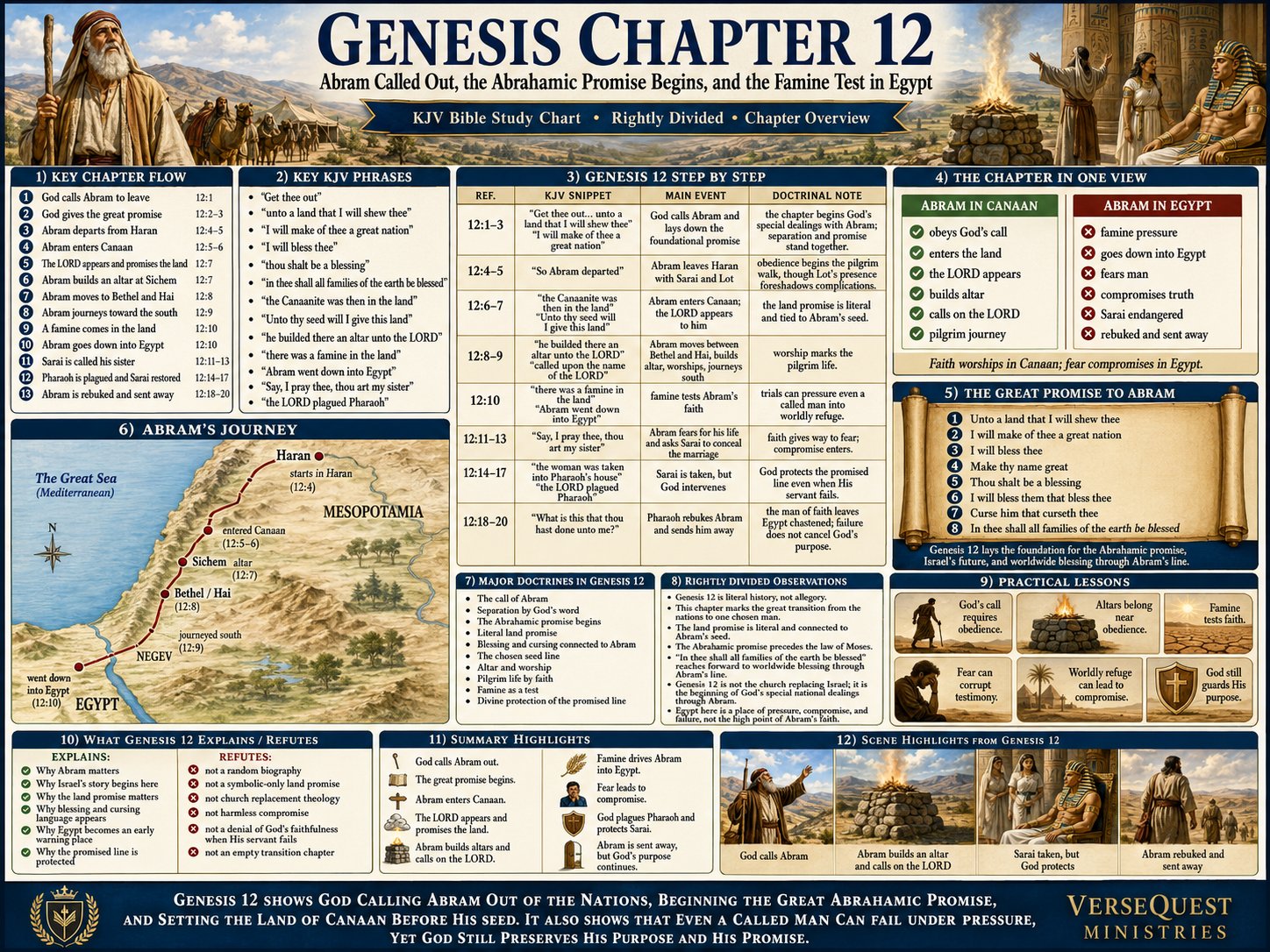
- Genesis Chapter 12 Bible Study Chart – Abram Called Out, the Abrahamic Promise, and the Famine Test in Egypt (KJV)
- Explore Genesis Chapter 12 with this detailed KJV Bible study chart covering Abram’s call, the Abrahamic promise, the land of Canaan, the famine test, Egypt, and God’s protection of the…
- $3.99
- Add to cart
-