
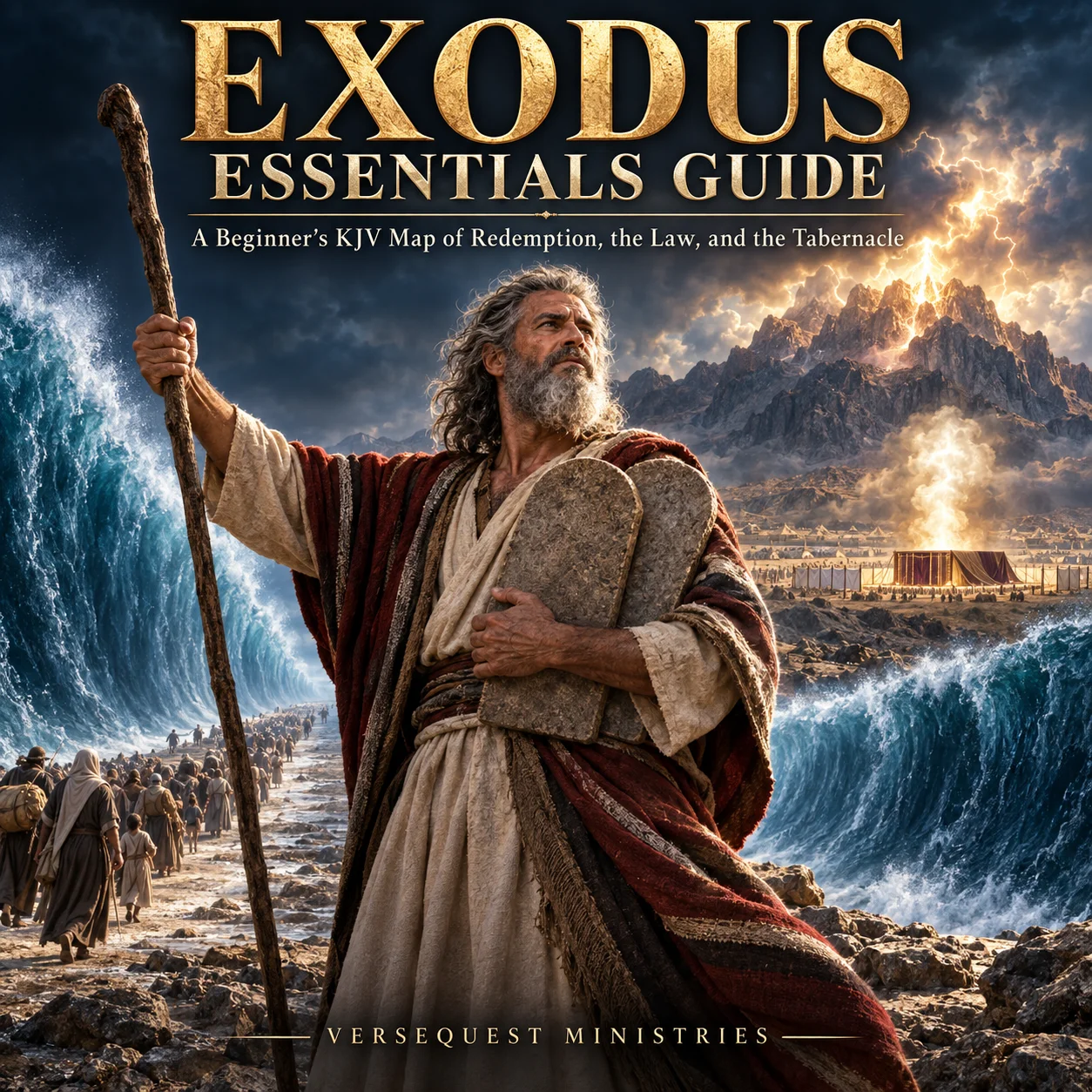
Exodus Essentials Guide: A Beginner’s KJV Map of Redemption, the Law, and the Tabernacle
The Exodus Essentials Guide is a 65-page downloadable and printable KJV study that presents the Book of Exodus in a clear, concise, and beginner-friendly format. Follow Israel from Egyptian bondage through the calling of Moses, the plagues, Passover, the Red Sea, the wilderness, Sinai, the law, the tabernacle, the golden calf, covenant renewal, and the glory of the LORD.
Every teaching passage is printed in full from the King James Bible, so you can examine the Scriptures without constantly stopping to look up references. Plain definitions, doctrinal distinctions, summary tables, common questions, essential teaching points, and a five-minute overview make this an excellent resource for new believers, personal study, discipleship, Sunday school, family study, or anyone wanting Exodus in a nutshell.
Download and print the complete guide for $14.99 and begin building a firm foundation for understanding redemption, the law, Israel, the tabernacle, and their connection to Jesus Christ.
$14.99
Description
The Exodus Essentials Guide is a 65-page downloadable and printable PDF study designed to give beginning Bible students a clear foundation in one of the most important books of the King James Bible. Rather than overwhelming the reader with every historical, geographical, and theological detail, this guide identifies the truths that must be understood before deeper study can begin.
Exodus opens with Israel suffering under Pharaoh and closes with the glory of the LORD filling the completed tabernacle. Between those two scenes stands the tremendous account of Moses, the burning bush, the plagues of Egypt, the Passover lamb, the crossing of the Red Sea, Israel’s wilderness testing, the covenant at Sinai, the giving of the law, the golden calf, the priesthood, and the construction of the tabernacle. Together, these events reveal the book’s central movement: the LORD brings Israel out of bondage, brings the nation unto Himself, and establishes His dwelling in its midst.
The guide explains why redemption comes before the giving of the law, why the Passover blood sheltered Israel from judgment, and how the Red Sea displayed God’s power to complete the deliverance He began. It also introduces the purpose of the Mosaic law, the distinction between Israel and the Church, and the necessity of rightly dividing Israel’s national covenant from the believer’s standing under grace in Jesus Christ.
Special attention is given to the tabernacle, its ordered approach to God, and its major furnishings, including the brazen altar, laver, table of shewbread, candlestick, veil, ark, and mercy seat. The guide also examines Aaron’s priesthood, Moses as Israel’s mediator, the sin of the golden calf, covenant renewal, willing service, and the final descent of God’s glory upon the sanctuary.
Every Bible reference used as a teaching proof is printed in full from the King James Bible, allowing readers to examine the words of Scripture without constantly stopping to look up passages. Plain-language definitions, doctrinal distinctions, summary tables, memorable teaching statements, common questions, twenty-five essential truths, and a five-minute explanation of Exodus make the material easy to follow and review.
This guide is especially useful for newly saved Christians, beginning Bible students, discipleship classes, families, Sunday school teachers, pastors, preachers, and anyone who wants to understand Exodus without first working through a large commentary. It is concise enough for quick study while providing the biblical framework needed for more advanced examination later.
The Exodus Essentials Guide is available as a digital PDF for $14.99. It may be downloaded, read electronically, or printed for convenient personal study.
Redemption from bondage — Exodus demonstrates the LORD’s power to deliver Israel from Pharaoh’s cruel dominion. The faithfulness of God’s covenant promises — Israel’s deliverance fulfills promises previously made to Abraham, Isaac, and Jacob. Moses as deliverer and mediator — Moses is preserved, prepared, called, and sent to stand between the LORD, Pharaoh, and Israel. The revelation of I AM — The authority behind Moses’ mission rests in the eternal and self-existent LORD. The plagues as divine judgment — Egypt’s punishment answers Pharaoh’s rebellion and exposes the helplessness of Egypt’s gods and magicians. God’s distinction between Israel and Egypt — The LORD demonstrates His ability to separate His covenant people during judgment. The Passover lamb and appointed blood — Judgment passes over the houses sheltered beneath the blood God required. Christ our Passover — The Passover prepares the biblical pattern fulfilled in the sacrificial death of Jesus Christ. The literal crossing of the Red Sea — Israel crosses through divided waters on dry ground while Pharaoh’s army is destroyed. Redemption before law — Israel is brought out of Egypt before receiving the commandments at Sinai. Wilderness testing and dependence — Bitter water, manna, the rock, Amalek, and other trials expose Israel’s heart and reveal God’s provision. The Mosaic covenant with Israel — The law is given to Israel as the covenant nation and must not be confused with the Church’s standing in Christ. The purpose and limitation of the law — The law reveals holiness, defines transgression, and condemns sin but cannot give fallen man spiritual life. The Ten Commandments and covenant justice — God orders Israel’s worship, conduct, government, and national responsibilities. The tabernacle and divine presence — The sanctuary demonstrates God’s desire to dwell among His redeemed people. God’s appointed order of approach — Sacrifice, cleansing, priesthood, the veil, and the mercy seat establish that sinful man cannot approach a holy God on his own terms. The Aaronic priesthood — Aaron and his sons are consecrated to minister in holy things and represent Israel before God. Christ greater than the shadows — Jesus Christ surpasses Moses, Aaron, the sacrifices, the priesthood, the tabernacle, and every temporary figure. The danger of corrupted worship — The golden calf proves that religious language cannot sanctify idolatry or human invention. Intercession and covenant renewal — Moses pleads for a guilty nation, while the LORD displays mercy without surrendering His justice. Willing service after redemption — Israel moves from forced labor under Pharaoh to willing work upon the LORD’s sanctuary. The glory of the LORD — Exodus reaches its intended conclusion when God’s glory fills the completed tabernacle.
Central Argument
Exodus records how the LORD redeemed His covenant people from Egyptian bondage, brought them unto Himself, established His covenant with Israel, and placed His presence among them. Its central movement is not merely from slavery to national independence. Israel moves from serving Pharaoh to belonging to and serving the LORD.
Major Observations
Exodus continues the history and promises of Genesis. The family that entered Egypt becomes a mighty nation, but a new Pharaoh treats that nation as a political threat and subjects it to bitter bondage.
God hears Israel’s groaning and remembers His covenant. Israel does not deliver itself through organization, military force, negotiation, or moral improvement. The LORD repeatedly declares what He will do and redeems Israel with a stretched-out arm.
Moses must learn that natural ability, education, anger, and self-confidence cannot accomplish God’s work. The deliverer who first acts in his own strength later returns under the authority of I AM.
The plagues are not random disasters. They are deliberate judgments answering Pharaoh’s refusal to obey the LORD and demonstrating God’s authority over Egypt.
The Passover establishes the biblical relationship between judgment and appointed blood. Safety is not based upon Israelite nationality, personal sincerity, or good intentions. The household must stand beneath the blood God commanded.
The Red Sea completes Israel’s separation from Pharaoh’s pursuit. The same waters that provide a pathway for Israel become judgment upon Egypt’s army.
The wilderness reveals what bondage had hidden. Once Pharaoh is behind them, Israel’s unbelief, murmuring, fear, and dependence become visible.
At Sinai, Israel enters a national covenant with the LORD. The Mosaic law governs the redeemed nation but does not produce redemption.
The tabernacle teaches that God determines how He is approached. Every furnishing, priestly service, sacrifice, and boundary follows the pattern revealed by God.
The golden calf demonstrates that people can retain religious language while completely corrupting biblical worship. Calling an idolatrous feast “a feast to the LORD” does not make it acceptable.
The book closes with the successful completion of the tabernacle and the glory of the LORD filling it. This ending reveals the goal toward which the entire book has been moving.
Important Distinctions
- Israel must not be confused with the New Testament Church.
- The Abrahamic promises must be distinguished from the Mosaic covenant.
- Redemption from Egypt occurs before the giving of the law.
- The Passover blood shelters from judgment, while the Red Sea breaks Pharaoh’s pursuit.
- A literal historical event may contain spiritual applications without losing its historical meaning.
- A biblical type must be controlled by Scripture rather than human imagination.
- God’s moral character remains holy, but Israel’s national statutes belong to Israel’s covenant arrangement.
- Israel’s Sabbath sign must not be treated as the means of Christian justification.
- Moses is a faithful servant, while Jesus Christ is the Son.
- Aaron’s earthly priesthood is temporary, while Christ’s priesthood is perfect.
- The brazen altar represents sacrifice, while the laver concerns cleansing for service.
- God’s mercy must never be mistaken for indifference toward sin.
Doctrinal Conclusions
Redemption is accomplished by God rather than earned by the captive. The Passover blood establishes the necessity of God’s appointed substitute, and the New Testament identifies Jesus Christ as our Passover.
The law is holy and reveals the righteousness of God, but it cannot regenerate a sinner, justify the ungodly, or impart eternal life. The Church is under grace and must not be placed beneath Israel’s national covenant.
The tabernacle, sacrifices, priesthood, veil, and mercy seat prepare the reader to understand the superior person and work of Jesus Christ. He is the greater Deliverer, the perfect Sacrifice, the sinless High Priest, and the only sufficient way of access to God.
Key Facts to Remember
- Exodus contains forty chapters.
- Moses is the central human figure.
- The LORD is the true Deliverer.
- Pharaoh cannot overturn God’s covenant promises.
- God distinguishes Israel from Egypt during judgment.
- The Passover lamb must be without blemish.
- Israel crosses a literal divided sea on dry ground.
- Israel is redeemed before receiving the law.
- The Mosaic covenant is made with Israel.
- The tabernacle is constructed according to God’s pattern.
- The golden calf brings judgment and requires intercession.
- Exodus ends with God’s glory dwelling among Israel.
Memorable Teaching Points
- The fear of God breaks the fear of Pharaoh.
- Pharaoh could make Israel’s service bitter, but he could not make God’s promise fail.
- Redemption changes both the master and the purpose of service.
- The destination of redemption is not independence from God; it is belonging to God.
- Safety rests beneath the blood God appointed.
- The LORD does not merely begin deliverance; He completes it.
- The law governs a redeemed nation but does not create redeemed people.
- A religious label cannot sanctify an idol.
- Giftedness must serve revelation rather than revise it.
- The goal was not simply to get Israel out of Egypt, but to bring Israel unto the LORD.
Questions for Further Study
- How do the Passover lamb and its blood point toward Jesus Christ?
- What do the plagues reveal about the LORD’s authority over earthly rulers and false gods?
- Why does God allow Israel to experience wilderness testing after deliverance?
- What is the relationship between the Abrahamic promises and the Mosaic covenant?
- Which parts of Israel’s law express permanent moral truth, and which belong specifically to Israel’s national covenant?
- How do the tabernacle furnishings illustrate sacrifice, cleansing, fellowship, light, intercession, mercy, and access?
- In what ways is Moses a type of Christ, and where does the comparison stop?
- How does Hebrews explain the superiority of Christ over the Aaronic priesthood?
- Why is the distinction between Israel and the Church necessary for understanding Exodus?
- What does the golden calf teach about mixing biblical language with man-made worship?
Personal Bible Study: The guide provides a manageable pathway through all forty chapters of Exodus. A reader can study one unit at a time, read each complete Scripture panel, and then return to the corresponding chapters in the King James Bible.
New-Believer Discipleship: Its definitions, summaries, distinctions, and full Bible passages make it especially helpful for newly saved Christians who may not yet understand terms such as redemption, covenant, Passover, tabernacle, priesthood, atonement, intercession, type, or dispensation.
Sunday School Lessons: The twelve-unit organization can be adapted into a short teaching series covering bondage, Moses, the plagues, Passover, the Red Sea, the wilderness, Sinai, the law, the tabernacle, the priesthood, Israel’s failure, and God’s dwelling.
Sermon Preparation: Pastors and preachers can use its central movements, doctrinal distinctions, key passages, and memorable summaries as a starting framework for messages about redemption, the blood, deliverance, holiness, worship, service, and the presence of God.
Small Groups and Bible Classes: The guide’s natural divisions allow groups to discuss one major section of Exodus at each meeting without requiring participants to complete a large commentary beforehand.
Family Bible Study: Parents can use the plain explanations and printed KJV passages to introduce children and teenagers to the major people, events, doctrines, and spiritual lessons of Exodus.
Homeschool and Christian Classroom Instruction: The guide supplies a concise biblical overview suitable for Bible history, Old Testament survey, doctrinal instruction, or introductory tabernacle study.
Ministry Training: Teachers and ministry workers can use the guide to practice distinguishing literal history, spiritual application, biblical types, covenant doctrine, and New Testament fulfillment.
Evangelistic Follow-Up: The Passover, redemption, judgment, blood, deliverance, and the superiority of Jesus Christ provide natural points of contact for explaining the gospel to those unfamiliar with biblical terminology.
Topical Teaching: Individual sections may support focused studies on Moses, Pharaoh, the plagues, Passover, the Red Sea, the Ten Commandments, the Sabbath, the golden calf, intercession, priesthood, or the tabernacle.
The King James Bible — Read all forty chapters of Exodus and mark every declaration of what the LORD will do, every command to Pharaoh, every act of deliverance, and every reference to the tabernacle pattern.
Genesis Essentials Guide — This VerseQuest guide supplies the immediate background of Abraham, Isaac, Jacob, Joseph, Israel’s descent into Egypt, and the covenant promises continued in Exodus.
Dispensational Truth – Essentials Guide — This VerseQuest study can help readers understand why Israel’s Mosaic covenant must be distinguished from the New Testament Church’s standing under grace.
A complete KJV concordance — Useful for tracing redemption, covenant, blood, Passover, law, holiness, priesthood, tabernacle, glory, and related subjects across Scripture.
A KJV cross-reference Bible — Helps connect Exodus with Genesis, the Psalms, Acts, Romans, Corinthians, Galatians, Hebrews, and 1 Peter.
A Bible dictionary — Helpful for studying unfamiliar objects, measurements, materials, offices, sacrifices, and customs connected with Egypt, Sinai, the priesthood, and the tabernacle.
Bible maps of Egypt, the Red Sea, Sinai, and the wilderness — Useful for following Israel’s movement from bondage toward the promised land while remembering that disputed locations should not overshadow the certainty of the biblical events.
A detailed tabernacle diagram — Helps readers identify the court, brazen altar, laver, holy place, most holy place, table of shewbread, candlestick, veil, ark, and mercy seat.
A biblical timeline from Joseph to Sinai — Provides historical orientation for Israel’s descent into Egypt, multiplication, enslavement, deliverance, wilderness journey, and covenant formation.
Peter S. Ruckman’s Exodus commentary — Provides a much deeper doctrinal and verse-by-verse examination for readers ready to move beyond the essentials.
Finis Dake’s study notes — May be consulted selectively for outlines, cross-references, and additional observations while keeping the King James Bible as the final authority.
The Scofield Reference Bible — Useful for dispensational structure, cross-references, covenant study, and broader biblical organization.
E. W. Bullinger’s study notes and reference materials — Helpful for structural observations, vocabulary, and cross-reference study when examined beneath the authority of Scripture.
Hebrews 3-10 — These chapters provide essential New Testament instruction concerning Moses, Christ’s priesthood, the earthly sanctuary, the sacrifices, the veil, and the believer’s access to God.
Related products
-
Not Under Law But Grace
-
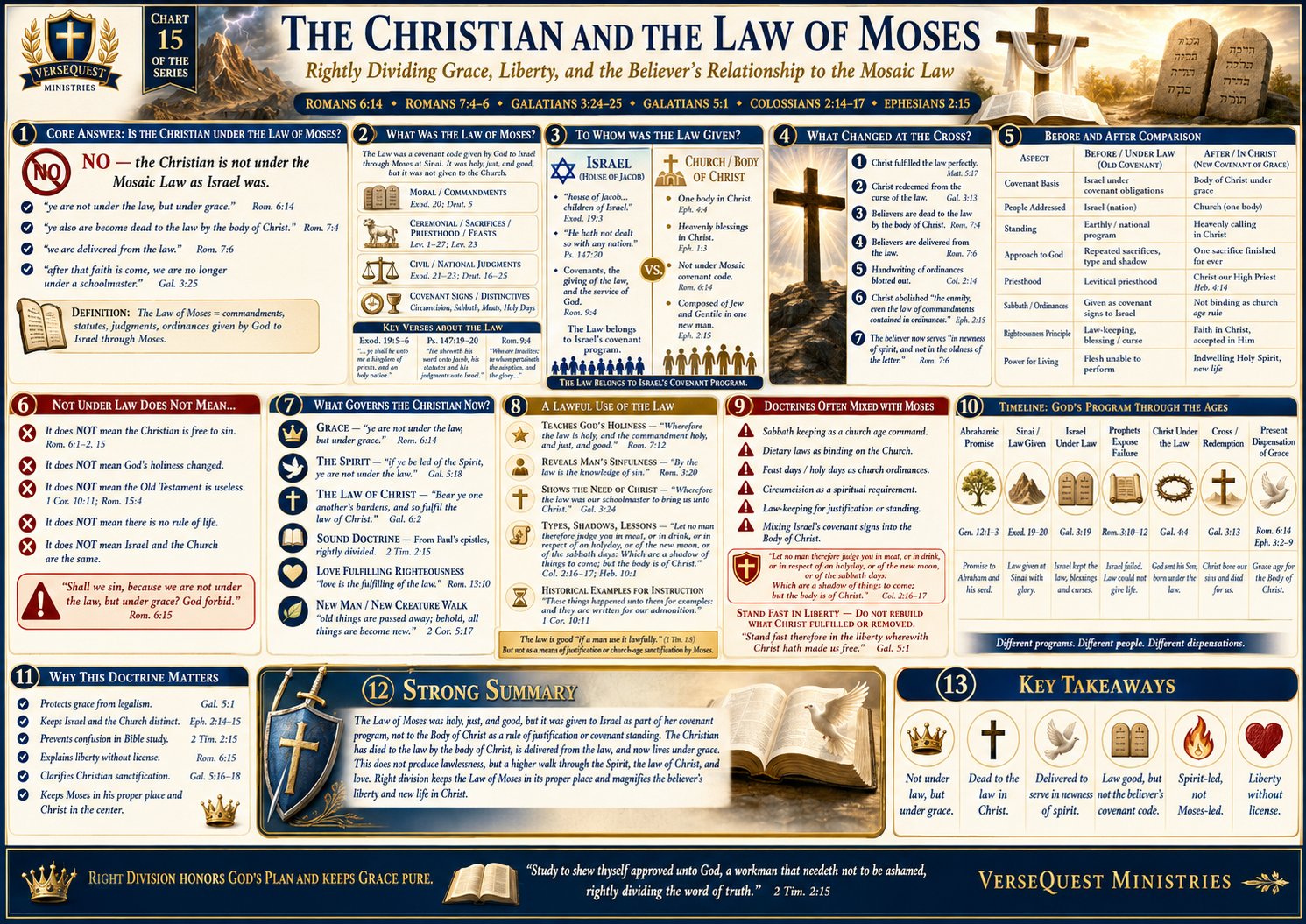
- The Christian and the Law of Moses – Grace, Liberty, and the Believer’s Relationship to the Mosaic Law (KJV Bible Study Chart)
- Understand the Christian’s relationship to the law of Moses with this detailed KJV chart covering Israel’s covenant, grace, liberty, the cross, the law of Christ, and Spirit-led living.
- $3.99
- Add to cart
-
-
Romans Study Workbook KJV
-
- Romans KJV Chapter-by-Chapter Workbook
- The Romans KJV Chapter-by-Chapter Workbook is a complete 180-page, downloadable Bible curriculum covering all sixteen chapters of Romans from a King James Bible, rightly divided, dispensational perspective. Each chapter receives…
- $39.99
- Add to cart
-
-
Doctrine
-
-50%
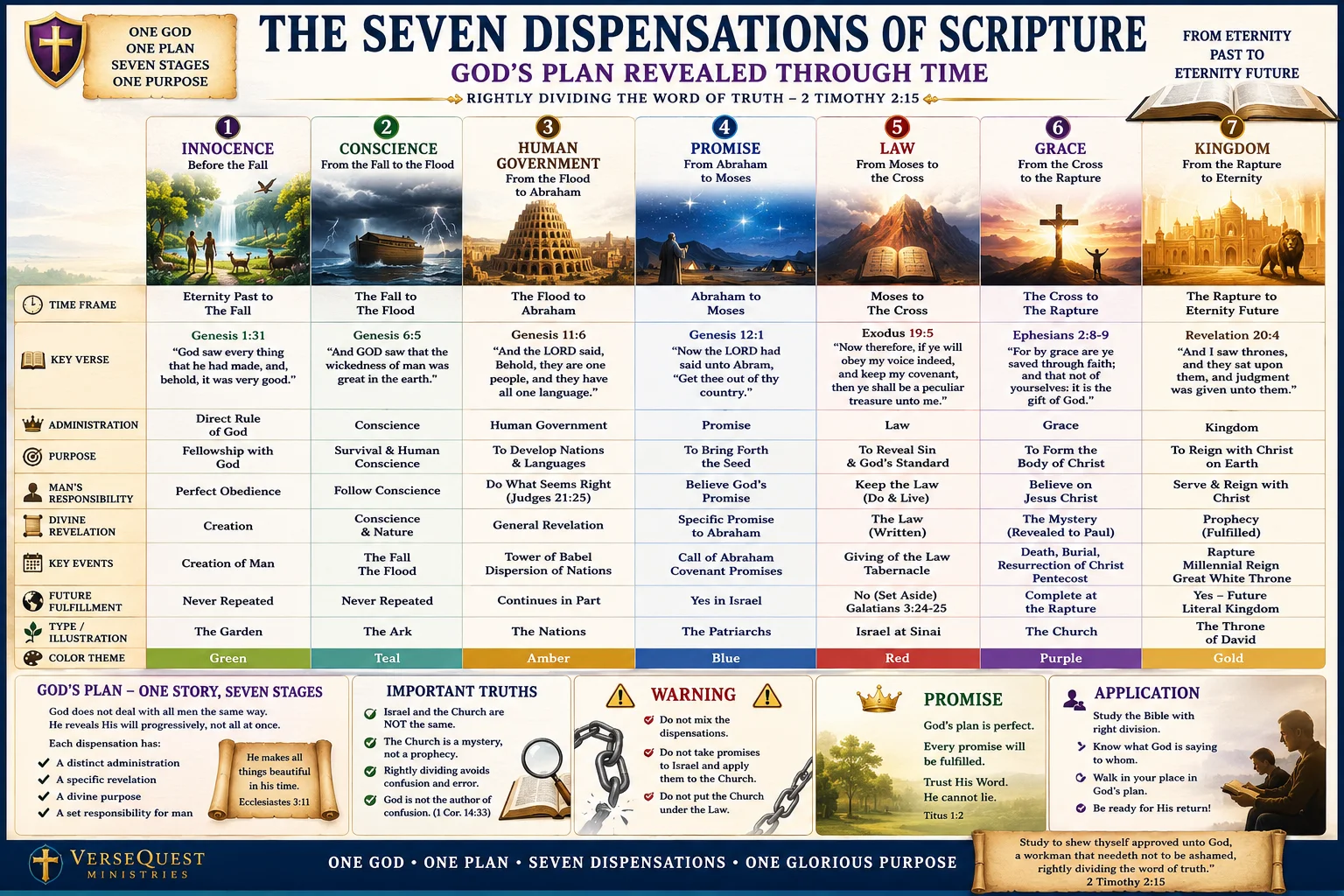
- The Seven Dispensations of Scripture Chart — KJV Rightly Divided (Copy)
- Premium printable KJV Bible study chart explaining the seven dispensations of Scripture from Innocence to the Kingdom. Rightly divided, visually organized, and designed for teaching, printing, and personal study.
- Original price was: $10.00.$4.99Current price is: $4.99.
- Add to cart
-
-50%
-
Law vs Grace
-
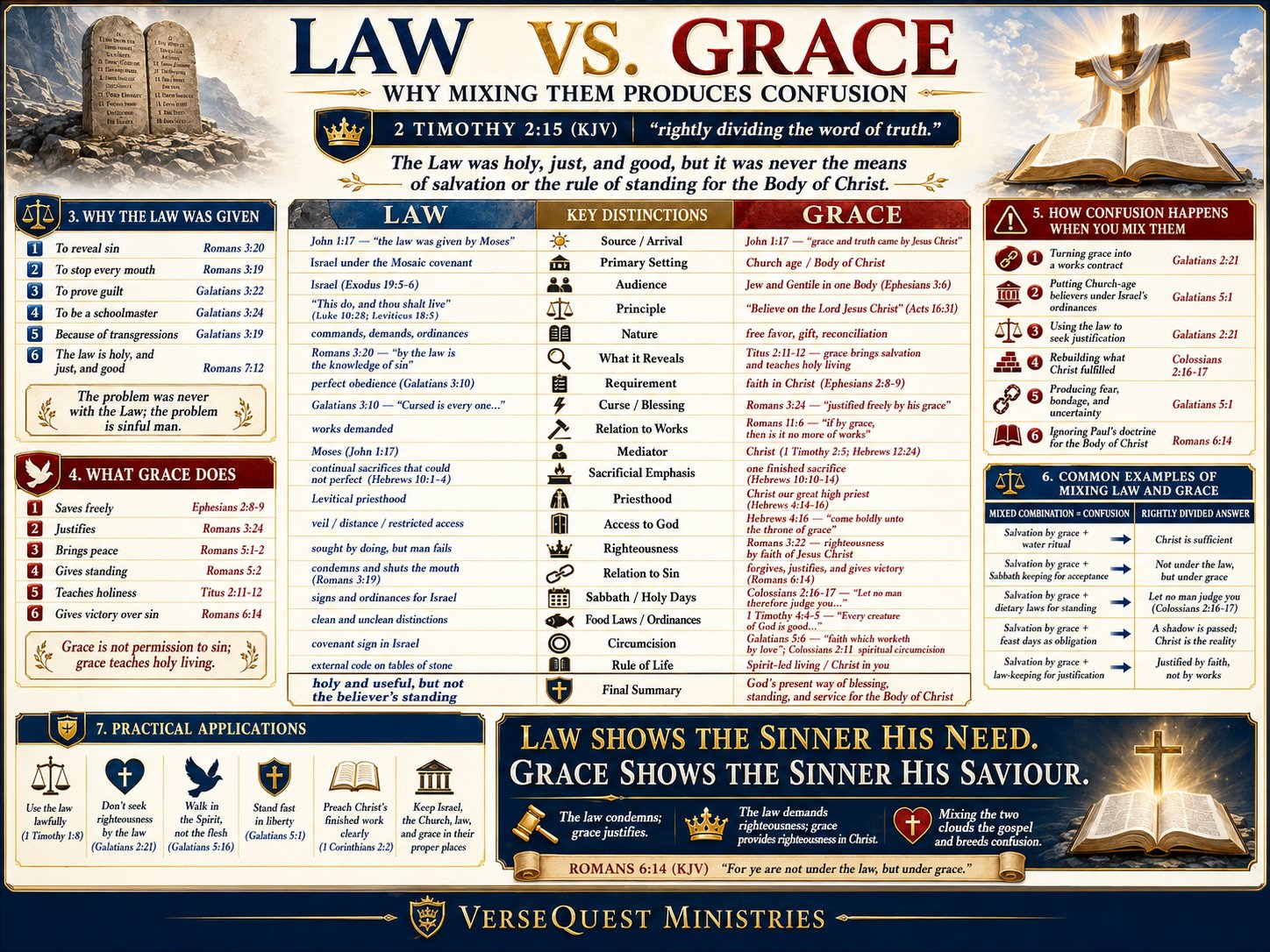
- Law vs. Grace Bible Study Chart – Why Mixing Them Produces Confusion (KJV)
- Compare law and grace with this detailed KJV Bible study chart explaining salvation, justification, holiness, Israel’s Mosaic covenant, Christian liberty, and the danger of mixing law with the gospel.
- $3.99
- Add to cart
-
-
Bible Study Chart
-
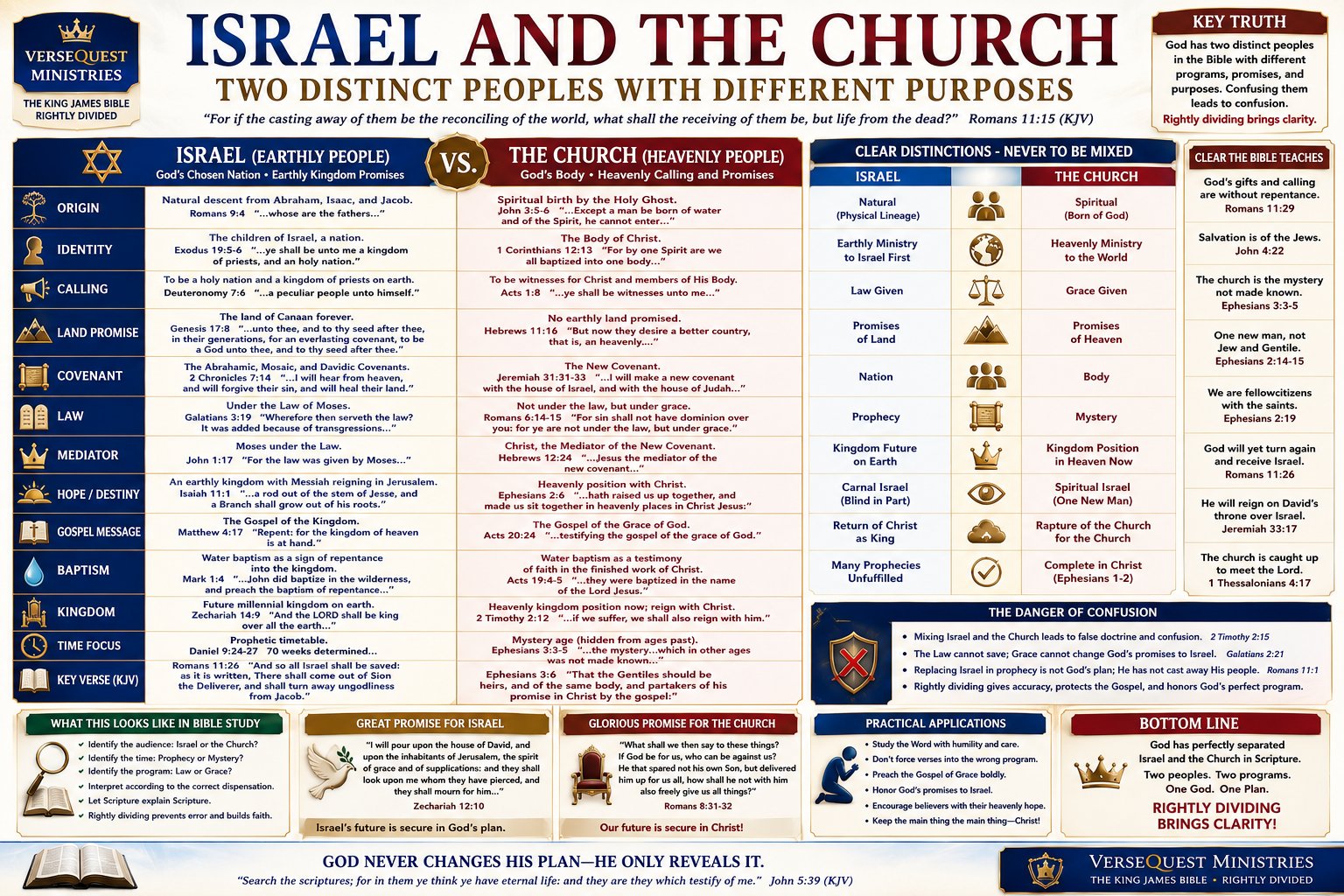
- Israel and the Church Bible Study Chart – Two Distinct Peoples with Different Purposes (KJV)
- Compare Israel and the Church with this detailed KJV Bible study chart covering their distinct origins, identities, covenants, callings, promises, gospel programs, and future destinies.
- $3.99
- Add to cart
-