
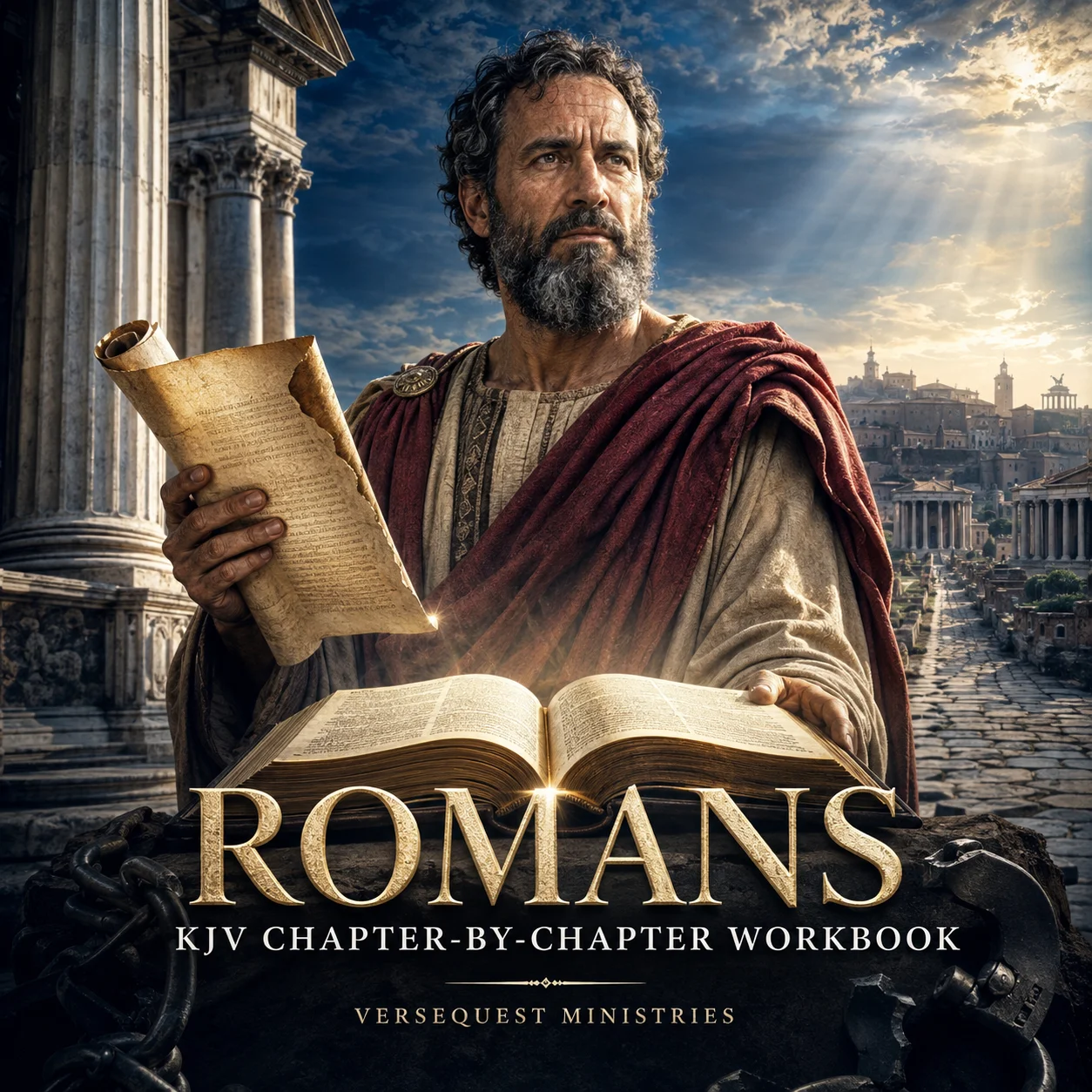
Romans KJV Chapter-by-Chapter Workbook
The Romans KJV Chapter-by-Chapter Workbook is a complete 180-page, downloadable Bible curriculum covering all sixteen chapters of Romans from a King James Bible, rightly divided, dispensational perspective. Each chapter receives eight dedicated student pages containing a chapter map, guided exposition, doctrinal instruction, KJV word studies, cross-references, written exercises, deeper study, review, memory work, and personal response.
The workbook also includes a suggested sixteen-week schedule, pre-course assessment, Teacher and Leader Guide, sixteen teaching plans, complete answer keys, a Romans glossary, final assessment, subject and doctrine index, and completion record. It is designed for homeschool instruction, Sunday school, church classes, Bible-study groups, discipleship, personal study, and ministry training.
Delivered as a printable PDF for $39.99. No physical book is shipped.
$39.99
Description
The Romans KJV Chapter-by-Chapter Workbook is a complete 180-page, rightly divided Bible curriculum designed to help students understand, explain, remember, and teach every chapter of Paul’s Epistle to the Romans. Rather than merely supplying information for the reader to absorb, this interactive workbook requires the student to open the King James Bible, examine the text, trace Paul’s argument, compare Scripture with Scripture, answer doctrinal questions, and put the lessons into written form.
Romans begins with the universal guilt of mankind, reveals the righteousness of God through the gospel of Christ, establishes justification by faith, explains the believer’s identification with Christ, confronts the law and the flesh, unfolds life in the Spirit, defends the security of the believer, preserves God’s promises to Israel, and applies sound doctrine to Christian service. This workbook follows that complete movement chapter by chapter without reducing Romans to disconnected devotional thoughts or isolated memory verses.
Each of Romans’ sixteen chapters receives a distinct eight-page student lesson. Although the instructional format remains consistent throughout the course, every lesson is written specifically for the doctrine, argument, vocabulary, and practical responsibilities found in that chapter. Each chapter includes a chapter map, key passage, guided exposition, doctrinal instruction, dispensational distinctions, KJV word studies, cross-reference work, written exercises, a deeper examination of the text, chapter review, memory work, personal response, and dedicated writing space.
The opening material prepares students to approach Romans as a sustained doctrinal argument. It includes instructions for using the workbook, an explanation of the repeatable eight-page learning system, a complete overview of Romans, a rightly divided interpretation framework, a table of contents, a suggested sixteen-week schedule, and a pre-course assessment. Students are taught to distinguish Israel from the Body of Christ, law from grace, prophecy from mystery, standing from state, and salvation from Christian service.
The workbook follows the doctrinal progression of Romans from beginning to end. Romans 1–3 brings the Gentile, the moralist, and the Jew before the righteous judgment of God. Romans 3–5 explains justification, redemption, propitiation, imputation, peace with God, reconciliation, and the contrast between Adam and Christ. Romans 6–8 examines the believer’s identification with Christ, freedom from sin’s dominion, the inability of the law to empower the flesh, life in the Spirit, adoption, coming glory, and eternal security.
Romans 9–11 is studied as God’s dispensational explanation of Israel’s past election, present unbelief, preserved remnant, temporary blindness, and promised future restoration. Gentile blessing is never permitted to erase national Israel or turn the Church into Israel. Romans 12–16 then carries doctrine into practical Christian living through the living sacrifice, renewal of the mind, spiritual service, the functioning Body, love, civil government, Christian liberty, conscience, edification, Paul’s Gentile ministry, local-church labor, doctrinal separation, and establishment according to Paul’s gospel and the revelation of the mystery.
A consolidated Teacher and Leader Guide follows the student lessons. It provides teaching objectives, suggested pacing, principal doctrinal emphases, discussion guidance, common-error corrections, model summaries, grading and follow-up space, and complete answer keys for all sixteen chapters. This makes the same volume useful to independent students, parents, pastors, Sunday school teachers, Bible-study leaders, and ministry instructors.
The closing resources include a four-page glossary of important Romans terminology, a final course review and assessment, recommendations for continued study, a two-page subject and doctrine index, and a workbook completion record. The final assessment returns students to the central questions introduced before the course and requires them to demonstrate greater precision, stronger cross-references, clearer doctrinal understanding, and the ability to explain what they have learned.
This workbook is especially suited to homeschool Bible instruction, middle- and high-school courses, Sunday school classes, church Bible studies, discipleship programs, family study, personal devotions, prison and recovery ministries, Bible institutes, and ministry training. Younger students may complete selected questions orally with parental guidance, while advanced students can defend their answers with additional references and use the chapter maps to develop teaching or preaching outlines.
The Romans KJV Chapter-by-Chapter Workbook is not intended to replace a detailed Romans commentary. It serves a different purpose. A commentary explains the text to the reader; this workbook trains the reader to observe, compare, answer, summarize, and teach the text personally. Used together with a trustworthy KJV commentary, it provides both detailed instruction and active learning.
This product is delivered as a downloadable, printable, 180-page PDF formatted for standard US Letter paper. No physical book is shipped. The workbook may be printed and used according to the license applicable at purchase. The retail price is $39.99.
The authority of the King James Bible — Every lesson directs the student back to the actual words, vocabulary, context, and cross-references of the King James text. Paul’s apostleship to the Gentiles — Romans is approached in light of Paul’s distinct calling, gospel ministry, and responsibility toward Gentile believers. The gospel of Christ — The workbook keeps Christ’s death, burial, and resurrection at the center of God’s saving message. Universal guilt before God — Gentile, moralist, Jew, and religious worker are brought under sin until every mouth is stopped. The righteousness of God — Romans reveals both God’s own righteous character and the righteousness supplied to the believing sinner through Christ. Justification by faith — God judicially declares the believing sinner righteous apart from personal merit or the works of the law. Redemption and propitiation — Christ’s blood supplies the righteous basis upon which God can remain just while justifying the ungodly. Imputed righteousness — Abraham and David demonstrate that righteousness is counted to the believer rather than earned as a religious wage. Peace and reconciliation with God — The justified believer possesses peace with God through the death of His Son. Adam and Christ — Romans traces condemnation and death through Adam while revealing righteousness, justification, and life through Jesus Christ. Identification with Christ — The believer is identified with Christ’s death and resurrection and is no longer under the dominion of sin. The old man and practical sanctification — Students learn to know their position, reckon upon what God has declared, and yield themselves unto God. The purpose and limitation of the law — The law reveals sin and condemns transgression but cannot justify the sinner or empower fallen flesh. Life in the Spirit — Romans 8 presents spiritual liberty, adoption, intercession, hope, coming glory, and victory through the Spirit of God. Eternal security — The believer’s preservation rests upon God’s justification, Christ’s intercession, and the inseparable love of God in Christ Jesus. Israel and the Body of Christ — National Israel retains its biblical identity and must not be confused with or replaced by the Church. Israel’s past, present, and future — Romans 9–11 explains Israel’s election, present blindness, believing remnant, and promised future restoration. Prophecy and mystery — The workbook distinguishes truths spoken by the prophets from truths kept secret and later revealed through Paul’s ministry. Standing and state — The believer’s fixed acceptance in Christ is distinguished from daily conduct, growth, discipline, fellowship, and service. Salvation and service — Free justification is distinguished from Christian obedience, stewardship, rewards, testimony, and the judgment seat of Christ. The living sacrifice — Sound doctrine produces surrendered bodies, renewed minds, humble service, genuine love, and practical holiness. The functioning Body of Christ — Believers possess different gifts and responsibilities while serving as members of one spiritual Body. Civil government and Christian responsibility — Romans 13 is studied in context to identify the believer’s duties and the God-ordained purpose of civil authority. Christian liberty and conscience — Doubtful matters require patience, charity, self-restraint, and concern for another believer’s edification. Doctrinal separation — Romans distinguishes patience concerning doubtful matters from the command to mark and avoid those who corrupt learned doctrine. Biblical creation witness — Romans 1 treats creation as real divine testimony, while Genesis 1 is allowed to define the earth, firmament, lights, and stars. Christian missions and ministry — Paul’s burden for Rome, ministry among the Gentiles, travel plans, fellowlaborers, and churches provide a working model of service. Establishment according to Paul’s gospel — Romans closes by connecting spiritual establishment with Paul’s gospel, Jesus Christ, the revealed mystery, Scripture, and the obedience of faith.
Central Argument
Romans demonstrates why every sinner needs the righteousness of God, how that righteousness is supplied through faith in Jesus Christ, what God accomplishes for and in the believer, how Israel fits within God’s dispensational purposes, and how saving doctrine should govern Christian conduct and service.
Major Movement of Romans
- Romans 1:1–17 — The gospel introduced: Paul identifies his calling, presents the gospel concerning God’s Son, and announces righteousness by faith.
- Romans 1:18–3:20 — The world condemned: The Gentile, moralist, and Jew are brought under sin until every mouth is stopped before God.
- Romans 3:21–5:21 — Justification explained: Righteousness, redemption, propitiation, faith, imputation, peace, reconciliation, Adam, and Christ are examined.
- Romans 6:1–8:39 — Sanctification and security: The believer’s identification with Christ, freedom from sin’s dominion, struggle with the flesh, life in the Spirit, adoption, and security are developed.
- Romans 9:1–11:36 — Israel dispensationally explained: Israel’s election, unbelief, remnant, blindness, Gentile opportunity, and future restoration are placed in their proper order.
- Romans 12:1–15:33 — Christian service practiced: Doctrine produces surrender, renewal, service, charity, responsible citizenship, liberty, edification, missions, and prayer.
- Romans 16:1–27 — Servants and establishment: The epistle closes with faithful laborers, local churches, doctrinal separation, Paul’s gospel, and the revelation of the mystery.
Important Distinctions
- Israel is not the Body of Christ, and the Body of Christ has not permanently replaced national Israel.
- The law exposes and condemns sin, but it cannot justify the sinner or empower the flesh.
- Grace provides salvation freely, while Christian service follows salvation and remains subject to accountability.
- The believer’s standing in Christ is settled, while daily state, fellowship, growth, and usefulness require obedience.
- Prophecy concerns truths made known through the prophets, while the mystery concerns truth once kept secret and later revealed.
- Doubtful matters in Romans 14 must not be confused with false doctrine and divisive teachers in Romans 16.
- Water ceremonies must not replace the Spirit-wrought identification with Christ taught in Romans 6.
- Present suffering does not cancel justification, adoption, coming glory, or eternal security.
- Gentile blessing must produce humility and gratitude rather than boasting against Israel.
- Personal application must arise from the passage’s contextual meaning rather than replacing it.
Doctrinal Conclusions
- All men are sinners and stand guilty before the righteous judgment of God.
- No sinner can earn justification through morality, religion, circumcision, law-keeping, or human merit.
- God justifies the believing sinner freely by grace through the redemption that is in Christ Jesus.
- Christ’s blood provides the propitiatory basis for God to remain just while justifying the believer.
- Righteousness is imputed through faith and is not paid as a wage for religious works.
- The justified believer has peace with God and access into grace.
- Sin and death entered through Adam, while righteousness and life come through Jesus Christ.
- The believer’s old man is judicially crucified with Christ, and sin no longer possesses rightful dominion.
- The law is holy, just, and good, but fallen flesh cannot use it to produce spiritual victory.
- There is no condemnation to those who are in Christ Jesus.
- Nothing can separate the justified believer from the love of God in Christ Jesus.
- God has not cast away Israel, and Israel’s present blindness is neither total nor permanent.
- Sound doctrine should produce a living sacrifice, renewed mind, faithful service, charity, humility, discernment, and gospel witness.
- Christian liberty must be governed by faith, conscience, charity, edification, and accountability before Christ.
- Believers are established according to Paul’s gospel, the preaching of Jesus Christ according to the revealed mystery, and the written Scriptures.
Memorable Teaching Points
- Romans begins with the gospel before presenting the indictment because God reveals the remedy before completing the courtroom case.
- Creation leaves mankind without excuse, but rejected light produces deeper darkness rather than neutrality.
- The law can reveal the disease, but it cannot supply the cure.
- Grace is not God lowering His standard; grace is God providing in Christ the righteousness the sinner could never produce.
- Abraham was counted righteous before circumcision, preventing religious ceremony from becoming the source of justification.
- Romans 6 does not tell the believer to crucify the old man; it tells him to reckon upon what God has already accomplished in Christ.
- Romans 7 reveals that knowing what is right does not give fallen flesh the power to perform it.
- Romans 8 begins with no condemnation and ends with no separation.
- Romans 9–11 prevents the Church from stealing Israel’s identity, promises, and prophetic future.
- Romans 12 demonstrates that the proper response to doctrinal mercy is bodily surrender and mental renewal.
- Romans 14 protects Christian liberty, while Romans 16 protects Christian doctrine.
- Romans does not end with religious sentiment. It ends with establishment according to Paul’s gospel and the revelation of the mystery.
Questions for Further Study
- How does Paul’s argument progress from Romans 1:18 to Romans 3:20?
- Why does Paul use both Abraham and David when explaining imputed righteousness?
- What doctrinal truths are contained in the contrast between Adam and Christ?
- How do “know,” “reckon,” and “yield” govern practical victory in Romans 6?
- What is the relationship between the law, sin, and the flesh in Romans 7?
- How does Romans 8 support the eternal security of the believer?
- How do Romans 9–11 preserve the distinction between Israel and the Body of Christ?
- What limitations are placed upon Gentile boasting in Romans 11?
- How should Romans 13 be interpreted alongside the complete biblical testimony concerning authority and obedience to God?
- Which matters belong to Christian liberty, and which matters involve fixed doctrine?
- How does Romans 16:25–27 connect Paul’s gospel, Jesus Christ, the mystery, Scripture, and the obedience of faith?
Personal Bible study — An individual student can complete one chapter each week, use the written exercises to test understanding, and retain the completed workbook as a permanent reference.
Homeschool curriculum — Parents can use the suggested sixteen-week schedule, chapter lessons, assessments, teacher plans, and answer keys as a structured middle- or high-school Bible course.
Sunday school instruction — Teachers can convert each chapter map into a lesson outline and use the accompanying questions, doctrinal distinctions, and discussion prompts to guide the class.
Church Bible-study groups — A group can read one chapter in advance, complete selected exercises independently, and meet to compare answers and discuss the deeper-study questions.
New-believer discipleship — Romans supplies foundational instruction concerning sin, salvation, justification, assurance, sanctification, the Spirit-filled life, and Christian service.
Family Bible study — Parents can adapt written questions into oral discussion, assign memory work, and guide family members through the doctrinal progression of Romans.
Sermon and lesson preparation — Pastors, preachers, and teachers can use the chapter movements, doctrinal summaries, cross-reference chains, and teach-back exercises to develop original teaching outlines.
Bible institute coursework — Instructors can assign readings, written exercises, chapter summaries, doctrinal definitions, oral presentations, and the final assessment as part of a Romans course.
Ministry training — Students preparing to teach can practice explaining each chapter, correcting common errors, defending conclusions with Scripture, and presenting five-minute chapter summaries.
Prison and recovery ministries — The course can provide structured biblical instruction concerning guilt, grace, identity in Christ, freedom from sin’s dominion, renewal of the mind, and responsible Christian living.
Independent correspondence study — The consistent lesson format and consolidated answer section permit guided study when a live classroom is unavailable.
Advanced review — Experienced Bible students can use the workbook to test whether they can explain Romans clearly, preserve dispensational distinctions, and support their conclusions from the text.
A King James Bible — The workbook is designed to be completed with the Bible open. Students should read each chapter in full before consulting the lesson.
An exhaustive KJV concordance — A concordance will help students trace important Romans words such as righteousness, faith, law, grace, sin, death, life, Spirit, Israel, Gentiles, body, and gospel.
A reliable Bible dictionary — This can provide historical and lexical background while remaining subordinate to the immediate biblical context.
A cross-reference Bible or cross-reference treasury — Comparison passages are essential for following Paul’s Old Testament quotations and parallel doctrinal teaching.
Maps of Paul’s missionary journeys and the Roman Empire — These help students understand Rome’s location, Paul’s ministry movements, and the historical setting behind the epistle.
A chronological Acts and Pauline Epistles timeline — A timeline helps place Romans within Paul’s ministry and the transitional history recorded in Acts.
A detailed KJV Romans commentary — A commentary can expand difficult verses, historical questions, doctrinal controversies, and textual observations while the workbook provides active exercises.
The VerseQuest Romans Commentary — This can serve as a companion for deeper verse-by-verse study alongside the workbook where available.
Through the Bible with VerseQuest — This complete Bible survey provides a broader overview of all sixty-six books and helps place Romans within the entire biblical revelation.
Genesis 1–15 — These chapters provide essential foundations concerning creation, Adam, sin, death, Abraham, promise, and imputed righteousness.
The Book of Acts — Acts supplies the historical transition and ministry background needed to understand Paul’s apostleship and Gentile mission.
Galatians — Galatians provides a strong companion study concerning justification, grace, faith, Abraham, and freedom from law-righteousness.
Ephesians — Ephesians expands the revelation of the one Body, the believer’s heavenly position, Paul’s stewardship, and the mystery.
Doctrinal comparison charts — Charts addressing law and grace, Israel and the Church, Adam and Christ, standing and state, or prophecy and mystery can reinforce the distinctions taught in Romans.
A dedicated study notebook — Students can use a separate notebook for longer definitions, sermon outlines, cross-reference chains, questions, and teaching assignments.
Related products
-
Doctrine
-
-50%
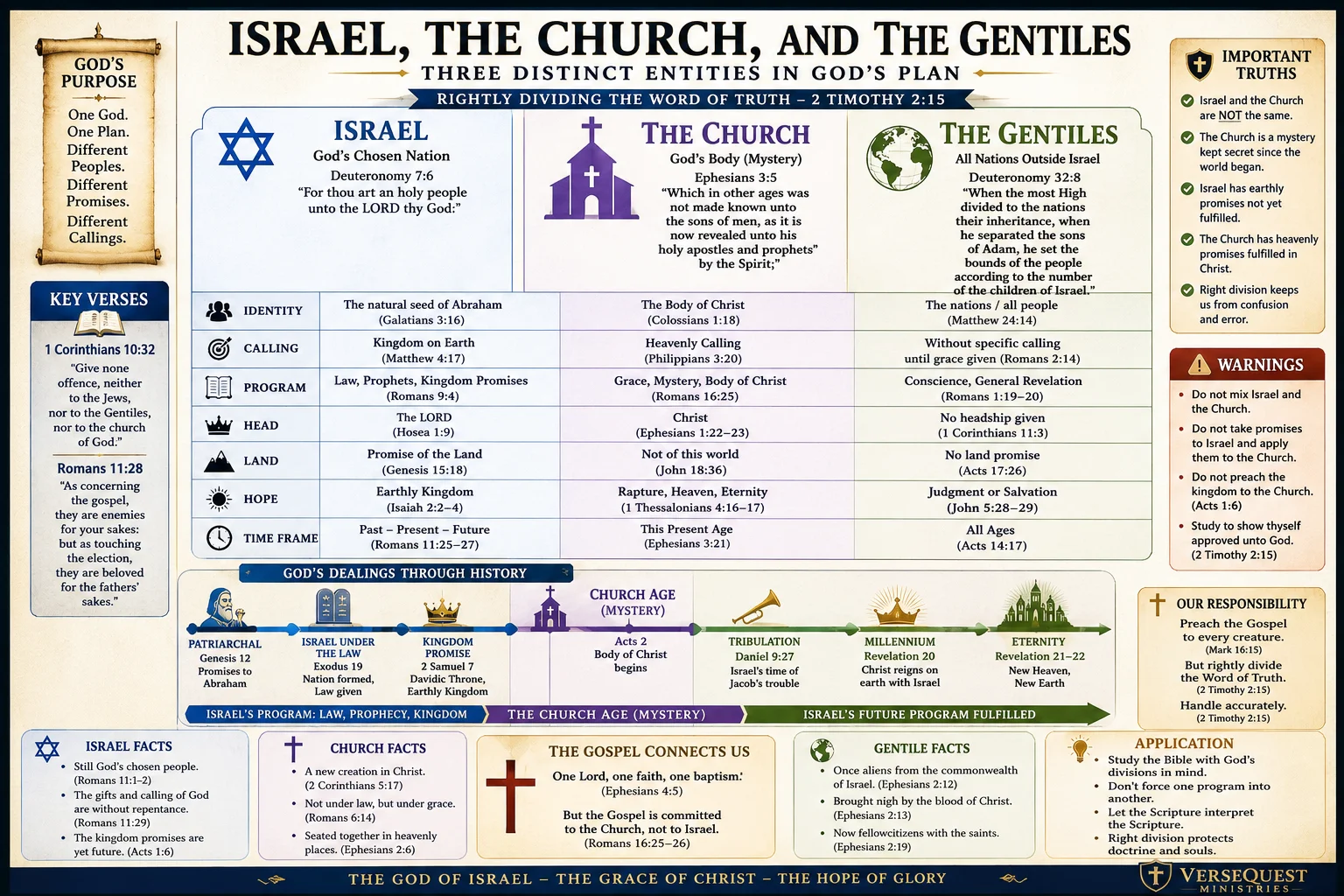
- Israel, the Church, and the Gentiles Chart — KJV Rightly Divided
- Premium printable KJV Bible study chart comparing Israel, the Church, and the Gentiles as three distinct entities in God’s plan. Rightly divided, visually organized, and designed for teaching and personal…
- Original price was: $10.00.$4.99Current price is: $4.99.
- Add to cart
-
-50%
-
Prophecy vs Mystery
-
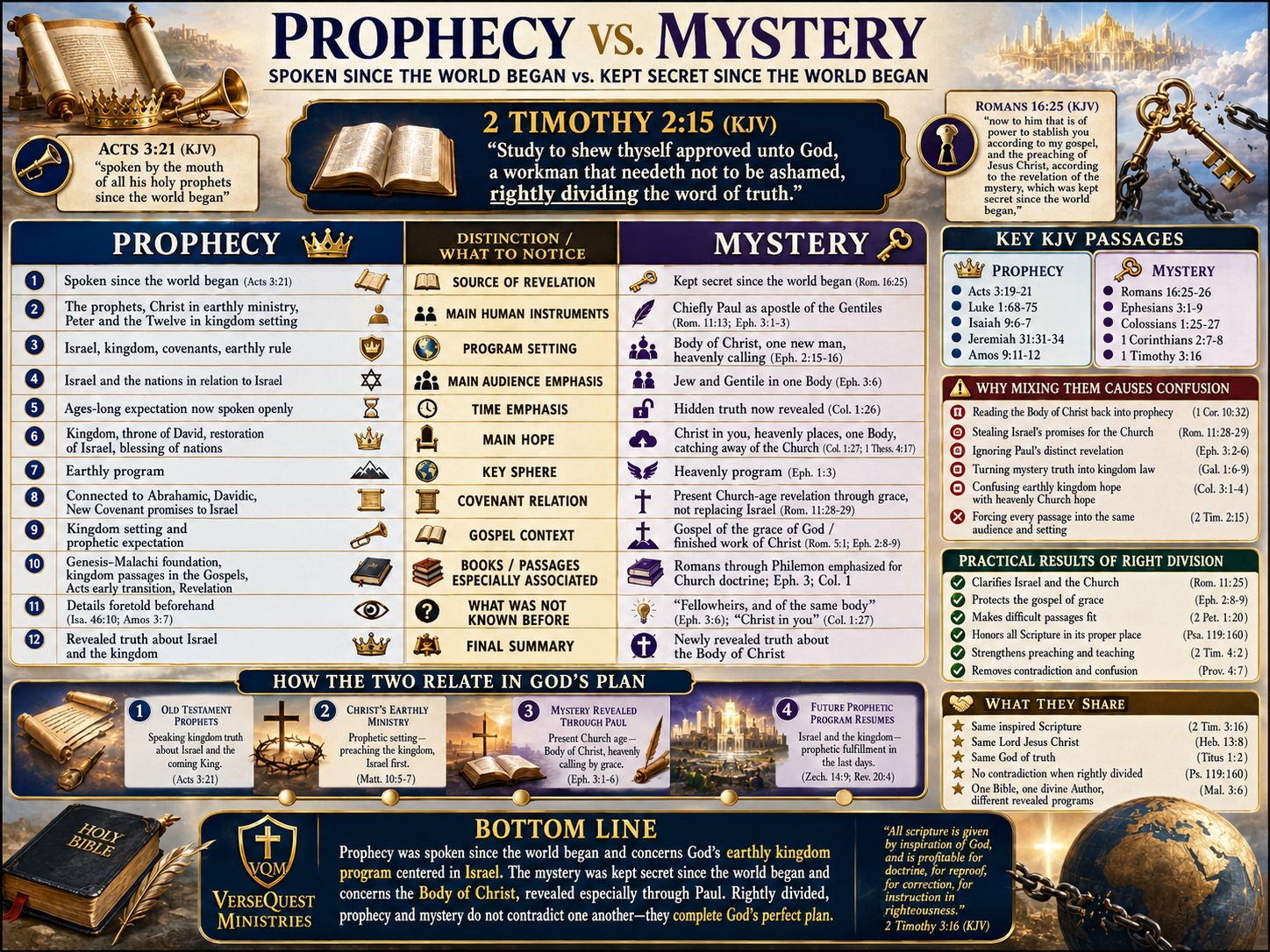
- Prophecy vs. Mystery Bible Study Chart – Spoken Since the World Began vs. Kept Secret Since the World Began (KJV)
- Compare prophecy and mystery with this detailed KJV chart explaining Israel’s earthly Kingdom program, the Body of Christ, Paul’s revelation, the heavenly calling, and the importance of right division.
- $3.99
- Add to cart
-
-
The Rapture
-
-67%
- Caught Up Before the Wrath – 66-Essay KJV Rapture Study
- Caught Up Before the Wrath is a 430-page premium KJV Bible study defending the pre-tribulation Rapture of the Church from a rightly divided, dispensational perspective. This 66-essay VerseQuest Ministries book…
- Original price was: $29.99.$9.99Current price is: $9.99.
- Add to cart
-
-67%
-
Heavenly Program
-
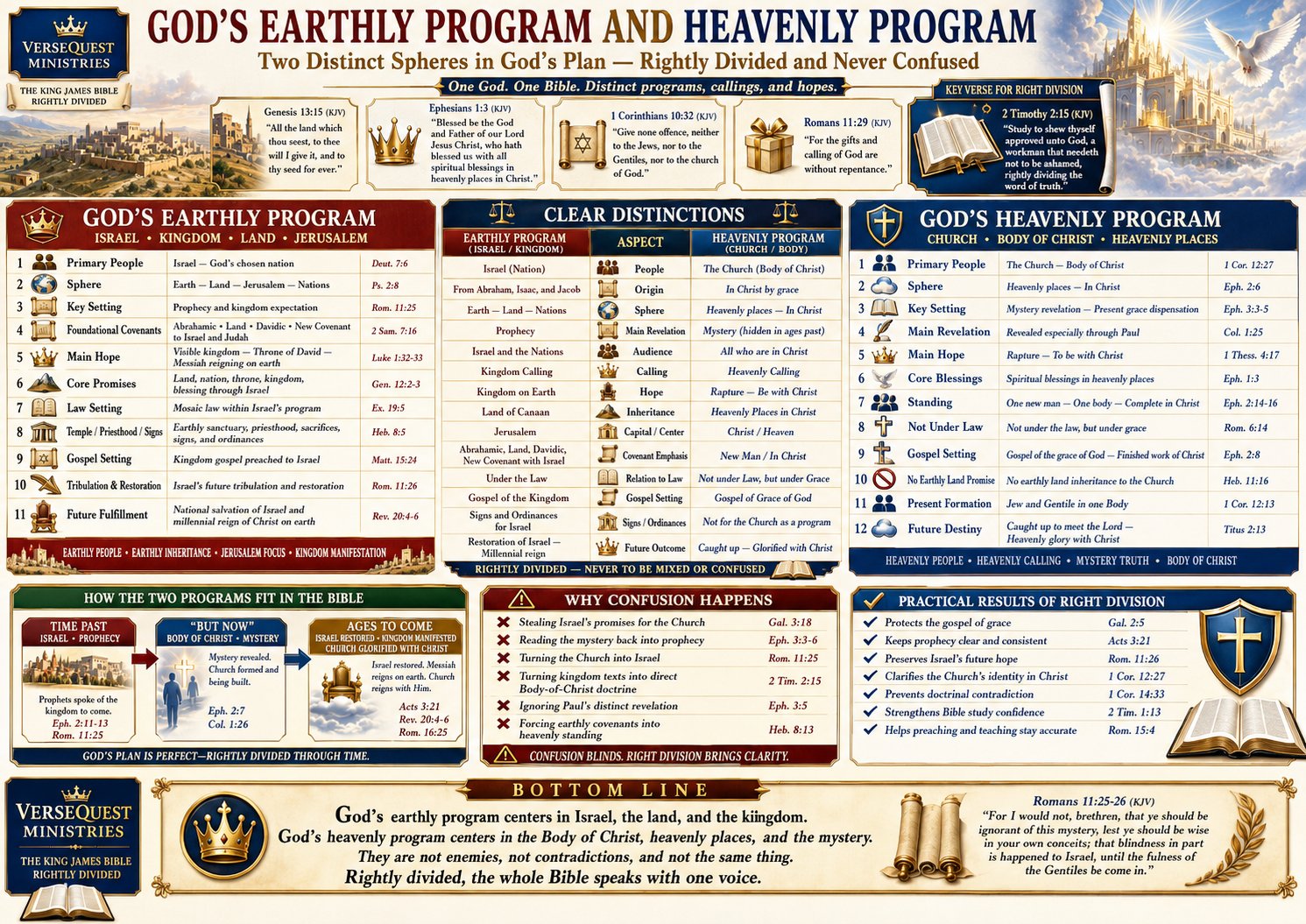
- Israel and the Church: Earthly and Heavenly Callings – KJV Bible Study Chart
- Printable digital KJV Bible study chart comparing Israel’s earthly promises and kingdom hope with the Church’s heavenly calling in Christ. Covers prophecy and mystery, biblical covenants, law and grace, the…
- $3.99
- Add to cart
-
-
Hebrews Rightly Divided
-
-71%
- Hebrews Without Confusion – 833-Page, 120-Study KJV PDF Commentary
- Hebrews Without Confusion is an enormous 833-page digital KJV commentary containing 120 detailed studies through all thirteen chapters of Hebrews. This rightly divided study explains Christ’s supremacy, His eternal priesthood,…
- Original price was: $34.99.$9.99Current price is: $9.99.
- Add to cart
-
-71%