Sermon Title:
One Question, One Answer, One Saviour: What Must I Do to Be Saved?
Key Passage:
Acts 16:30–31 — “And brought them out, and said, Sirs, what must I do to be saved? And they said, Believe on the Lord Jesus Christ, and thou shalt be saved, and thy house.”
Series:
Foundations of the Gospel of Grace
Topic:
Salvation by Faith in the Lord Jesus Christ Apart From Works, Law, Religion, or Human Merit
Book:
Acts, Romans, 1 Corinthians, Ephesians, Galatians, Titus, John
Speaker:
Paul Tackett
Suggested Sermon Text:
Acts 16:25–34; Romans 3:19–28; Romans 4:4–5; Romans 5:1; Romans 10:9–13; 1 Corinthians 15:1–4; Ephesians 2:8–9; Galatians 2:16; Titus 3:5–7; John 3:16–18; John 5:24; 2 Timothy 2:15
Short Sermon Description:
This detailed KJV sermon outline answers the most important question a sinner can ever ask: “What must I do to be saved?” Acts 16:30–31 gives God’s direct answer through Paul and Silas: “Believe on the Lord Jesus Christ, and thou shalt be saved.” This study explains what salvation is, why every sinner needs it, what it means to believe, who the Lord Jesus Christ is, and why salvation cannot be earned through law, baptism, sacraments, church membership, morality, emotional experience, or religious works. It also clarifies the meaning of “and thy house,” showing that families are not saved by another person’s faith but by hearing and believing the same gospel. Designed for pastors, preachers, teachers, Bible study leaders, and serious students of Scripture, this outline presents the death, burial, and resurrection of Christ as the finished gospel by which sinners are saved in the present dispensation of grace.
One Question, One Answer, One Saviour
What Must I Do to Be Saved?
Introduction
There are thousands of questions a man may ask during his lifetime, but none carries more eternal weight than the question of Acts 16:30: “Sirs, what must I do to be saved?” A man may ask how to become wealthy, how to protect his health, how to repair his marriage, how to build a career, or how to prepare for retirement. Those questions matter for a few years. This question matters forever. A man may live without wealth, reputation, influence, education, or comfort, but he cannot afford to die without salvation. “What must I do to be saved?” is not religious curiosity. It is the cry of a sinner who suddenly realizes that eternity is near, judgment is real, and he cannot rescue himself.
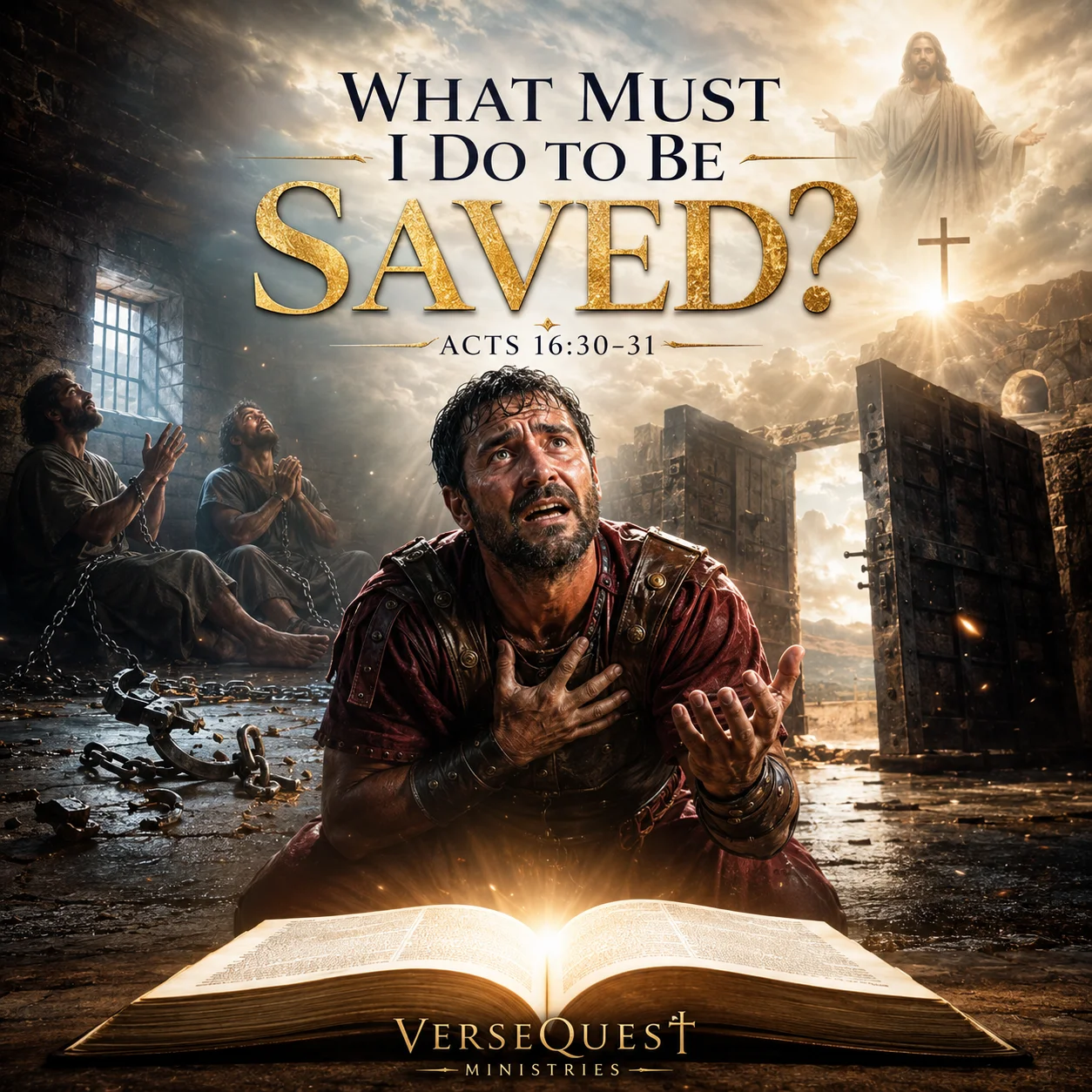
The setting makes the question even more powerful. Paul and Silas had been beaten, imprisoned, and placed in stocks for preaching Jesus Christ. At midnight they prayed and sang praises unto God. Then an earthquake shook the prison, opened the doors, and loosed every prisoner’s bands. The keeper of the prison, assuming the prisoners had escaped, drew his sword and was ready to kill himself. Paul cried with a loud voice, “Do thyself no harm: for we are all here.” The jailer then came trembling, fell before Paul and Silas, brought them out, and asked the question. He had guarded their bodies, but now he knew his own soul was imprisoned. He had held the keys to the jail, but he possessed no key to eternal life.
Paul did not answer with a religious obstacle course. He did not tell the man to reform his life, keep the law, join a denomination, make restitution, endure to the end, keep the Sabbath, take a sacrament, confess to a priest, or earn enough merit to satisfy God. The answer was direct: “Believe on the Lord Jesus Christ, and thou shalt be saved.” The gospel of grace does not leave the sinner crawling through a maze of ceremonies, hoping that he may eventually find God. It points immediately to the Lord Jesus Christ. Salvation is not found in what the sinner does for Christ but in what Christ has already done for the sinner.
I. The Jailer Asked the Right Question
Key Text: Acts 16:30
Supporting Texts: Hebrews 9:27; Romans 2:3–6; Luke 13:3
The jailer asked, “What must I do to be saved?” He did not ask how to feel better, become religious, quiet his conscience, or escape his immediate troubles. He asked about salvation. That word assumes danger. A drowning man needs to be saved from water. A trapped man needs to be saved from destruction. A condemned man needs to be saved from judgment. The sinner needs to be saved from sin, death, condemnation, and the wrath of God.
Modern religion often hides the danger because it does not want to offend the sinner. It tells men that they are wounded but not wicked, confused but not condemned, unfinished but not fallen. The Bible speaks differently. “All have sinned, and come short of the glory of God.” The wages of sin is death. The soul that sinneth, it shall die. Men are not merely travelling an imperfect spiritual path; they are lost. They are not merely separated from their potential; they are separated from God.
The jailer’s trembling was more reasonable than the world’s carelessness. He understood that something greater than an earthquake had shaken him. One day, every false security will collapse. Money will not stop death. Medicine will eventually fail. Religion will not erase guilt. Human confidence will not survive the judgment. The wise sinner asks the question before death forces him to face the answer.
Main Truth:
Salvation becomes urgent when a sinner understands that he is lost, guilty, condemned, and unable to save himself.
II. Every Sinner Needs to Be Saved
Key Text: Romans 3:23
Supporting Texts: Romans 3:9–19; Romans 6:23; Ephesians 2:1–3
Romans 3:23 says, “For all have sinned, and come short of the glory of God.” The word “all” leaves no privileged class outside the indictment. The jailer needed salvation. Paul had needed salvation. The religious Pharisee needs salvation. The respectable businessman needs salvation. The church member, moral neighbour, addict, criminal, professor, politician, and preacher all descend from Adam and possess a sinful nature.
Men compare themselves with other men and imagine they are righteous because they are not as outwardly wicked as someone else. But God does not measure a sinner against another sinner. He measures him against His own holiness. A man may stand taller than every other man in a deep pit, but he remains in the pit. He may have fewer visible sins than his neighbour, but he still comes short of God’s glory.
Ephesians 2 says the unsaved are dead in trespasses and sins. A dead man does not need encouragement; he needs life. A condemned man does not need decoration on his prison cell; he needs pardon. A lost man does not need religion to make him comfortable in the wilderness; he needs to be found. Salvation begins when pride dies and the sinner admits God’s verdict.
Main Truth:
Every human being needs salvation because all are sinners by nature, choice, and conduct before a holy God.
III. The Sinner Cannot Save Himself by Works
Key Text: Ephesians 2:8–9
Supporting Texts: Romans 3:20; Romans 4:4–5; Titus 3:5
Ephesians 2:8–9 says, “For by grace are ye saved through faith; and that not of yourselves: it is the gift of God: Not of works, lest any man should boast.” Salvation is “not of yourselves.” That phrase closes the door upon every human rescue plan. The sinner cannot educate himself into salvation, reform himself into salvation, baptize himself into salvation, behave himself into salvation, or purchase salvation through charitable acts.
Romans 3:20 says, “Therefore by the deeds of the law there shall no flesh be justified in his sight.” The law reveals sin but cannot remove it. It is a mirror, not a cleansing fountain. A mirror can show dirt upon a man’s face, but rubbing his face against the mirror will not wash him. The law can expose guilt, pronounce judgment, and shut the sinner’s mouth, but it cannot provide righteousness to the guilty.
Romans 4 contrasts works with faith. To the man who works, the reward is counted as debt. But to him who “worketh not, but believeth on him that justifieth the ungodly,” his faith is counted for righteousness. Religion cannot tolerate “worketh not” because religion survives by giving men something to perform. Grace leaves the sinner with empty hands and gives him everything in Christ.
Main Truth:
The sinner cannot earn salvation because works cannot erase guilt, produce righteousness, or complete the finished work of Christ.
IV. God’s Answer Is to Believe
Key Text: Acts 16:31
Supporting Texts: John 3:16; John 5:24; Romans 4:5
Paul and Silas answered, “Believe.” They did not say “behave first and then believe.” They did not say “believe plus religious works.” They did not say “believe until your next failure.” Faith is the hand that receives what grace provides. It does not purchase salvation, deserve salvation, or complete salvation. It receives Jesus Christ and rests upon His finished work.
Biblical faith is not merely believing that God exists. The devils believe and tremble. It is not admiring the life of Jesus, respecting Christian morality, or agreeing that religion has social value. To believe on Christ is to place personal trust in Him as the only sufficient Saviour. It is to abandon confidence in oneself and depend upon His death, burial, and resurrection.
John 5:24 says the believer “hath everlasting life, and shall not come into condemnation; but is passed from death unto life.” Notice the present possession: “hath.” Notice the future security: “shall not.” Notice the completed transition: “is passed.” The believer is not placed on spiritual probation. He receives eternal life upon believing God’s testimony concerning His Son.
Main Truth:
To believe is to abandon confidence in self and place complete trust in Jesus Christ and His finished work for salvation.
V. The Object of Saving Faith Is the Lord Jesus Christ
Key Text: Acts 16:31
Supporting Texts: John 14:6; Acts 4:12; 1 Timothy 2:5–6
Paul did not tell the jailer merely to “have faith.” Faith has no saving value apart from its object. A man may sincerely trust a broken bridge and fall to his death. Another may weakly trust a solid bridge and cross safely. The issue is not the emotional strength of faith but the sufficiency of the One trusted.
The object is “the Lord Jesus Christ.” “Lord” declares His authority and deity. “Jesus” identifies the historical Saviour who came into the world. “Christ” identifies Him as God’s anointed Messiah. He is not one religious option among many. Acts 4:12 says there is salvation in no other name. First Timothy 2 says there is one Mediator between God and men, the man Christ Jesus.
Jesus Christ is sufficient because He is both God manifest in the flesh and the perfect sinless Man. He alone could represent humanity without sharing humanity’s guilt. He alone could bear the sins of others because He had no sin of His own. He alone could satisfy divine justice, conquer death, and rise bodily from the grave. Salvation is exclusive because only one Person accomplished redemption.
Main Truth:
Saving faith rests exclusively in the Lord Jesus Christ, the only Saviour, Mediator, and sufficient Redeemer of sinners.
VI. The Gospel Is Christ’s Death, Burial, and Resurrection
Key Text: 1 Corinthians 15:1–4
Supporting Texts: Romans 4:25; Romans 5:8–9; 2 Corinthians 5:21
Paul defined the gospel by which men are saved: “Christ died for our sins according to the scriptures; And that he was buried, and that he rose again the third day according to the scriptures.” These are not decorative details. They are the content of the saving message. Christ died for our sins. The cross was substitution. He took the sinner’s place, bore the sinner’s guilt, and suffered the sinner’s judgment.
He was buried. The burial confirms the reality of His death. Jesus Christ did not faint, escape, or merely appear to die. The wages of sin is death, and He truly entered death for us. Then He rose again the third day. The resurrection proves that the sacrifice was accepted, death was defeated, and justification was secured. Romans 4:25 says He “was raised again for our justification.”
The gospel is therefore news about something accomplished, not instructions for something unfinished. Religion says, “Do.” The gospel says, “Done.” Religion tells the sinner to climb. Grace announces that Christ came down. Religion puts a ladder against heaven. The gospel reveals that the Saviour descended, died, was buried, rose again, and now saves every sinner who believes.
Main Truth:
The gospel that saves is the finished historical work of Jesus Christ—His death for our sins, burial, and bodily resurrection.
VII. Salvation Is Immediate, Certain, and Everlasting
Key Text: Acts 16:31
Supporting Texts: Romans 5:1; Ephesians 1:13–14; Romans 8:1
Paul said, “thou shalt be saved.” He did not say the jailer might be saved, could begin becoming saved, or would be evaluated after a lifetime of religious performance. God’s promise is certain because Christ’s work is complete. The sinner who believes is justified, forgiven, reconciled, redeemed, and accepted in Christ.
Romans 5:1 says, “Therefore being justified by faith, we have peace with God through our Lord Jesus Christ.” Justification is God’s legal declaration that the believer is righteous in Christ. It is not the slow process of becoming worthy. The believer’s practical growth continues throughout life, but his judicial standing changes the moment he believes.
Ephesians 1 says believers are sealed with the Holy Spirit of promise after hearing and believing the gospel. The Spirit is the earnest of the inheritance. Salvation is not secured by the believer’s grip upon God but by God’s seal upon the believer. Eternal life that lasts only until the next failure would not be eternal, and salvation that depended upon sinless performance would save no one.
Main Truth:
The sinner who believes on Jesus Christ receives immediate justification, present peace with God, and everlasting security in Christ.
VIII. “And Thy House” Does Not Teach Salvation by Proxy
Key Text: Acts 16:31–32
Supporting Texts: Acts 16:33–34; Romans 10:13–17; John 1:12
Paul said, “Believe on the Lord Jesus Christ, and thou shalt be saved, and thy house.” Some have treated that statement as though the jailer’s faith automatically saved every member of his family. But the following verses explain the meaning. Paul and Silas “spake unto him the word of the Lord, and to all that were in his house.” The household heard the word because each person needed to respond to the gospel.
Acts 16:34 says the jailer rejoiced, “believing in God with all his house.” The household was not saved by the jailer’s faith without personal belief. The same gospel promise extended to every person under his roof. If they believed on the same Lord Jesus Christ, they too would be saved. God has no grandchildren. A child is not saved because his father believes. A wife is not saved because her husband believes. Every sinner must personally receive Christ.
Yet the verse offers great hope to Christian families. One believer can bring the gospel into an entire household. The jailer’s conversion opened the door for his family to hear. His home became a mission field before the night ended. Salvation is individual, but its influence spreads. A converted father, mother, son, daughter, or grandparent can become the human instrument through whom God brings the word of life to the rest.
Main Truth:
The household was saved by hearing and personally believing the gospel, not automatically through the jailer’s faith.
IX. Genuine Salvation Produces a Changed Life
Key Text: Acts 16:33–34
Supporting Texts: 2 Corinthians 5:17; Ephesians 2:10; Titus 2:11–14
The jailer’s actions changed immediately. The man who had guarded Paul and Silas after their beating washed their stripes. He brought them into his house, set food before them, and rejoiced. These works did not save him; they followed his salvation. The order matters. He did not wash their wounds to earn eternal life. He washed their wounds because grace had already changed his heart.
Second Corinthians 5:17 says, “if any man be in Christ, he is a new creature.” Salvation does not instantly make every believer mature or remove every struggle with the flesh, but it gives him a new identity, new life, new relationship with God, and new direction. The same grace that saves also teaches believers to deny ungodliness and live soberly, righteously, and godly.
Ephesians 2:8–9 excludes works from the cause of salvation, but verse 10 places good works after salvation: “For we are his workmanship, created in Christ Jesus unto good works.” Works are the fruit, not the root. They are evidence of life, not the price of life. The jailer’s compassion did not purchase grace. Grace produced compassion.
Main Truth:
Good works do not create salvation, but genuine salvation produces a transformed heart, changed direction, and faithful service.
Conclusion
“What must I do to be saved?” The answer has not changed: “Believe on the Lord Jesus Christ, and thou shalt be saved.” The sinner must first recognize that he is lost. He must abandon confidence in religion, works, morality, baptism, church membership, law-keeping, feelings, and personal merit. He must hear the gospel that Christ died for his sins, was buried, and rose again the third day. Then he must believe on the Lord Jesus Christ.
The answer is simple, but it is not shallow. Salvation is simple for the sinner because it was costly for the Saviour. Christ bore the judgment. Christ shed the blood. Christ entered death. Christ conquered the grave. Christ completed redemption. The sinner contributes nothing but the guilt that made salvation necessary. Grace supplies everything through Jesus Christ.
The religious world complicates salvation because simple grace gives man nothing in which to boast. Systems want ceremonies they can administer, standards they can control, payments they can collect, and performances they can measure. But God’s answer remains direct. Not believe and be baptized for completion. Not believe and keep the law. Not believe and endure perfectly. Not believe and join our denomination. “Believe on the Lord Jesus Christ, and thou shalt be saved.”
Final Call
You may be as frightened as the jailer or as outwardly calm as the prisoners, but your need is the same. You have sinned against God. Death is certain. Judgment is real. Religion cannot save you. Your good works cannot erase your evil works, and your sincerity cannot turn error into truth.
Jesus Christ died for your sins according to the Scriptures. He was buried. He rose again the third day according to the Scriptures. The debt has been paid. The tomb is empty. The Saviour lives. God is not asking you to complete Christ’s work. He commands you to believe His testimony concerning His Son.
Believe on the Lord Jesus Christ, and thou shalt be saved. Trust Him now. Rest your soul upon His blood, death, burial, and resurrection. Believer, preach this gospel without addition, subtraction, embarrassment, or compromise. Let every sinner hear the same clear answer Paul and Silas gave in that Philippian prison.
Closing Verse:
Romans 10:13 — “For whosoever shall call upon the name of the Lord shall be saved.”
Closing Statement:
Salvation is not found in what the sinner promises to do for God, but in believing what Jesus Christ has already done for the sinner.