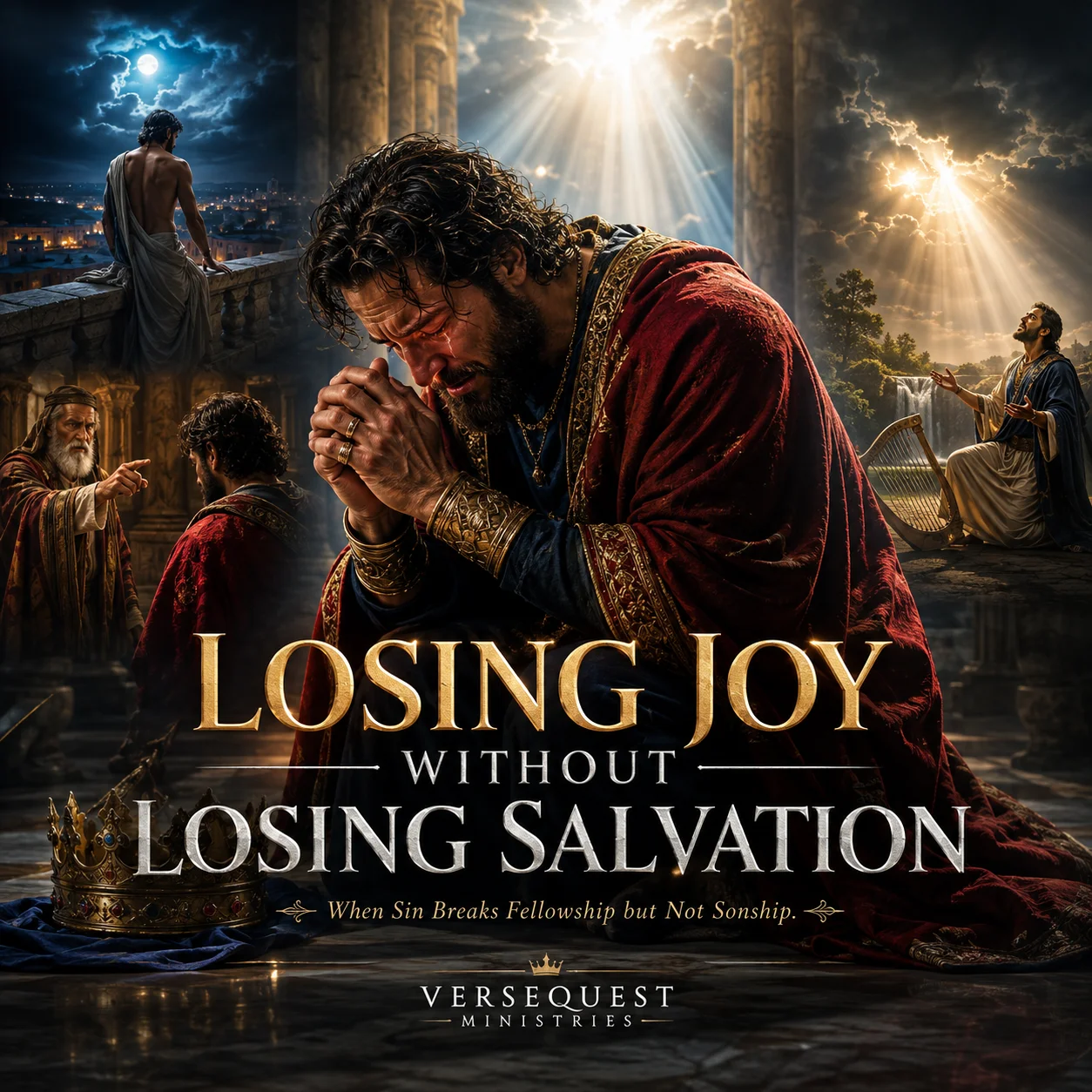
Losing Joy Without Losing Salvation
When Sin Breaks Fellowship but Not Sonship
Sermon Title:
Losing Joy Without Losing Salvation: When Sin Breaks Fellowship but Not Sonship
Key Passage:
Psalm 51:12 — “Restore unto me the joy of thy salvation; and uphold me with thy free spirit.”
Series:
Foundations of the Gospel of Grace
Topic:
The Difference Between Losing the Joy of Salvation and Losing Salvation Itself
Book:
Psalms, 2 Samuel, Romans, John, Ephesians, 1 John, Hebrews, 1 Corinthians, Galatians
Speaker:
Paul Tackett
Suggested Sermon Text:
Psalm 51:1–19; 2 Samuel 11:1–27; 2 Samuel 12:1–14; John 5:24; John 10:27–29; Romans 8:1; Ephesians 1:13–14; Ephesians 4:30; 1 John 1:7–9; Hebrews 12:5–11; 1 Corinthians 11:31–32; 2 Corinthians 5:10; Galatians 6:7–8
Short Sermon Description:
This detailed VerseQuest Ministries sermon outline explains Psalm 51:12 and the vital difference between losing the joy of salvation and losing salvation itself. David’s sin with Bathsheba, his murder of Uriah, his concealment, conviction, confession, and restoration show the terrible cost of sin in the life of one who belongs to God. Yet David did not pray, “Restore unto me thy salvation,” but “Restore unto me the joy of thy salvation.” This sermon distinguishes Israel’s Old Testament setting from the believer’s Church-age standing in Christ, while showing the abiding Bible truth that sin breaks fellowship, robs joy, grieves the Spirit, damages testimony, invites chastening, and must be confessed honestly before God. It also defends the gospel truth that believers today are saved by grace, sealed with the Holy Spirit, held by Christ, and free from condemnation. Designed for pastors, preachers, teachers, Bible students, and believers, this outline magnifies confession, restoration, chastening, assurance, holiness, and the mercy of God toward His own.
Losing Joy Without Losing Salvation
When Sin Breaks Fellowship but Not Sonship
Introduction
Psalm 51:12 is one of the clearest verses in the Bible for understanding the difference between salvation and the joy of salvation: “Restore unto me the joy of thy salvation; and uphold me with thy free spirit.” David did not say, “Restore unto me thy salvation.” He said, “Restore unto me the joy of thy salvation.” That distinction is not a little doctrinal hair split for theologians with too much spare time. It is the difference between sonship and fellowship, between standing and state, between possession and enjoyment, between being saved and walking in the sunlight of that salvation. Sin does not become harmless because salvation is secure. Sin becomes more serious because the man who sins against grace sins against the God who saved him.
David’s situation was ugly. This was not a minor bad mood, a careless word, or a moment of ordinary weakness. David committed adultery with Bathsheba, arranged the death of Uriah, concealed the matter, and lived under the weight of conviction until Nathan put his finger in the king’s face and said, “Thou art the man.” Psalm 51 is not the polished language of a man protecting his image. It is the broken confession of a man whose sin had crushed his joy, defiled his conscience, damaged his fellowship, wounded his testimony, and brought the chastening hand of God into his house. The sweet psalmist of Israel lost the song in his own soul because sin had filled his mouth with ashes.
This sermon must be rightly divided. David lived under the law, before the cross was historically accomplished, before the Church as the Body of Christ was revealed through Paul, and before the sealing of the Spirit in the present dispensation was declared in Ephesians 1:13–14 and 4:30. A preacher must not flatten David into a Church-age believer and act as though every phrase in Psalm 51 is written with no dispensational distinction. Yet the passage gives enduring practical truth about sin, confession, fellowship, chastening, and joy. The believer today is saved by grace through faith, sealed unto the day of redemption, and has no condemnation in Christ Jesus. But he can lose joy, grieve the Holy Spirit, break fellowship, damage testimony, and suffer chastening. Eternal security is not a pillow for sin; it is the ground from which the child of God gets right with the Father.
I. David’s Sin Shows That Saved People Can Fall Terribly
Key Text: 2 Samuel 11:1–4
Supporting Texts: 1 Corinthians 10:12; Galatians 6:1; Romans 7:18
David’s fall began in a season when kings went forth to battle, but David tarried still at Jerusalem. That is not an accident in the text. Idleness, comfort, misplaced ease, and unguarded eyes have ruined many a man who once stood strong in the battle. David saw Bathsheba, inquired after her, took her, and lay with her. The progression was swift, but the heart was already moving before the body acted. Sin rarely breaks down the front door first. It usually picks the lock through imagination, opportunity, and a flesh that has been treated too kindly.
The Bible does not hide David’s sin. That is one of the marks of Scripture’s honesty. Men write biographies that polish heroes into statues. God writes truth that shows men as they are. David was a man after God’s own heart, yet he fell into adultery and murder. That does not excuse his sin. It warns every believer. First Corinthians 10:12 says, “Wherefore let him that thinketh he standeth take heed lest he fall.” The man who thinks he is beyond falling has already taken his first step toward the ditch.
Galatians 6:1 says that if a man be overtaken in a fault, spiritual believers are to restore such an one in the spirit of meekness, “considering thyself, lest thou also be tempted.” The flesh in a saved man is still flesh. Romans 7:18 says, “For I know that in me (that is, in my flesh,) dwelleth no good thing.” David’s sin teaches that position, history, ministry, victories, and past devotion do not make a man immune to the flesh. A believer who stops watching can still fall hard.
Main Truth:
David’s fall warns believers that genuine faith and past victories do not make the flesh safe or sin impossible.
II. Sin Robs Joy Before It Ruins Public Testimony
Key Text: Psalm 51:8
Supporting Texts: Psalm 32:3–4; Proverbs 28:13; James 1:14–15
David prayed, “Make me to hear joy and gladness; that the bones which thou hast broken may rejoice.” Before everybody else knew, David knew. Before Nathan exposed him publicly, the weight of sin was already crushing him privately. Psalm 32 says, “When I kept silence, my bones waxed old through my roaring all the day long.” Sin may smile when it enters, but it starts charging rent immediately. It takes peace first, then joy, then boldness, then testimony, then fruit.
Proverbs 28:13 says, “He that covereth his sins shall not prosper.” David tried covering sin with silence, deception, manipulation, and eventually murder. That is what sin does. One sin asks for another as a bodyguard. Lust called for deception. Deception called for murder. Murder called for silence. Silence called for inward misery. The man who refuses confession often becomes a servant to the sin he is trying to hide.
James 1 says lust, when it hath conceived, bringeth forth sin; and sin, when it is finished, bringeth forth death. Sin is never satisfied with a corner. It wants the whole house. The first thing it steals from the believer is joy in God. A saved man walking in sin may still know the doctrines, still quote the verses, still attend the services, still argue theology, and still keep up appearances. But the song is gone. The joy is gone. The gladness is gone. He may still have salvation, but he is not enjoying it.
Main Truth:
Sin begins its damage inwardly by robbing the believer of joy, peace, gladness, and spiritual liberty before the outward collapse is seen.
III. David Asked for the Joy of Salvation to Be Restored
Key Text: Psalm 51:12
Supporting Texts: Psalm 51:1–4; 1 John 1:9; John 5:24
David’s prayer is precise: “Restore unto me the joy of thy salvation.” He does not ask God to save him again. He asks for the joy of salvation to be restored. The phrase matters. It shows that sin had not made salvation worthless, but it had made the experience of salvation bitter. A child who has disobeyed his father may still be a child, but he may not enjoy the father’s smile while hiding guilt. David had lost fellowship joy, not the fact that God was his salvation.
Psalm 51 begins with David throwing himself upon mercy: “Have mercy upon me, O God, according to thy lovingkindness.” He does not bargain. He does not blame Bathsheba. He does not blame Uriah. He does not blame pressure, loneliness, politics, or the burdens of kingship. He says, “my transgressions,” “mine iniquity,” “my sin.” Real restoration begins when the sinner stops hiring lawyers for his flesh. Confession names sin before God without perfume.
For the Church-age believer, 1 John 1:9 gives the practical fellowship principle: “If we confess our sins, he is faithful and just to forgive us our sins, and to cleanse us from all unrighteousness.” John 5:24 gives assurance: the believer hath everlasting life and shall not come into condemnation. These truths do not contradict. The believer has life, yet must confess sin. He is free from condemnation, yet can lose joy. He is secure in Christ, yet must walk in the light. David’s prayer helps us see the difference.
Main Truth:
The believer may lose the joy of salvation through sin, but restoration comes through honest confession and God’s mercy.
IV. Sonship and Fellowship Must Be Rightly Distinguished
Key Text: Psalm 51:12
Supporting Texts: John 1:12–13; Galatians 4:4–7; 1 John 1:7; Hebrews 12:6
David’s prayer illustrates a distinction that every believer must understand: relationship is not the same as fellowship. Sonship speaks of belonging. Fellowship speaks of practical communion. A child does not stop being a child because he disobeys, but disobedience can break the sweetness of fellowship. A dirty child is still a child, but he needs washing. A rebellious child is still a child, but he needs correction. A silent child hiding guilt is still a child, but he is not enjoying the father’s presence.
John 1:12 says those who receive Christ are given power to become the sons of God. Galatians 4 says believers receive the adoption of sons and cry, “Abba, Father.” That is relationship. First John 1 says believers are to walk in the light and enjoy fellowship. That is communion. Hebrews 12 says the Father chastens the sons He loves. That is correction. These doctrines belong together, but they must not be mashed into confusion.
Legalism confuses broken fellowship with lost sonship and keeps saints in terror. Careless Christianity confuses secure sonship with irrelevant fellowship and lets the flesh run loose. The Bible rejects both. The believer’s standing in Christ is secure, but his daily walk matters. Sin does not make the born-again believer unborn, but it grieves the Spirit, wounds fellowship, and invites chastening. The Father does not cast away His child; He corrects him.
Main Truth:
Sonship is the believer’s settled relationship in Christ, while fellowship is practical communion that sin can hinder and confession restores.
V. Chastening Is Not Condemnation
Key Text: Hebrews 12:5–6
Supporting Texts: 1 Corinthians 11:31–32; Romans 8:1; John 10:28–29
Hebrews 12 says, “For whom the Lord loveth he chasteneth, and scourgeth every son whom he receiveth.” Chastening is family discipline. It is not eternal condemnation. It is not God throwing His child away. It is the Father correcting the child He loves. David’s life after his sin shows severe consequences, but those consequences were not proof that God had no mercy. They were proof that God deals seriously with His own.
First Corinthians 11:31–32 makes the distinction plain: “But when we are judged, we are chastened of the Lord, that we should not be condemned with the world.” There it is in one verse. Chastened of the Lord is not condemned with the world. Romans 8:1 says, “There is therefore now no condemnation to them which are in Christ Jesus.” John 10 says Christ’s sheep shall never perish and no man can pluck them out of His hand. These verses cannot be broken by a hard providence, a season of chastening, or a painful consequence.
Sin can cost a believer dearly. It can cost joy, peace, testimony, relationships, health, opportunity, usefulness, and reward. In some cases, God may take a believer home early. But chastening is not hell. Discipline is not damnation. Fatherly rebuke is not judicial wrath. David felt the rod, but he still knew where to go: back to God in confession. The chastened child should not run from the Father. He should run to Him.
Main Truth:
God may chasten His children severely, but chastening is not condemnation and must not be confused with losing salvation.
VI. The Holy Spirit Can Be Grieved Without the Believer Being Unsealed
Key Text: Ephesians 4:30
Supporting Texts: Ephesians 1:13–14; Psalm 51:11; Galatians 5:16–25
David prayed in Psalm 51:11, “Cast me not away from thy presence; and take not thy holy spirit from me.” That prayer belongs to David’s Old Testament setting, under Israel’s economy, before the Church-age sealing of the Spirit was revealed. Saul had experienced the Spirit of the LORD departing from him in connection with kingship and service. David knew that history and trembled. A Bible preacher must not carelessly drag Psalm 51:11 over Ephesians 1 and make a sealed Church-age believer live in fear of losing the indwelling Spirit.
Ephesians 1:13–14 says believers today are sealed with that holy Spirit of promise after hearing and believing the gospel of salvation. Ephesians 4:30 says, “grieve not the holy Spirit of God, whereby ye are sealed unto the day of redemption.” Notice both truths in one verse: the Spirit can be grieved, and the believer is sealed unto the day of redemption. Sin grieves the Spirit, but the seal is not broken every time the believer fails. God did not seal His children with a weak seal made of human performance.
This truth should not make the believer careless. It should make him sober. The Spirit who seals can be grieved. A sealed believer dragging the temple of God into sin is not a small matter. Galatians 5 commands believers to walk in the Spirit and not fulfil the lust of the flesh. The saved man does not live holy to keep the Spirit sealed; he lives holy because the Spirit has sealed him, indwells him, and is grieved by sin.
Main Truth:
A Church-age believer can grieve the Holy Spirit through sin, but he remains sealed unto the day of redemption by God’s promise.
VII. Restoration Requires Honest Confession, Not Religious Covering
Key Text: Psalm 51:3–4
Supporting Texts: 1 John 1:9; Proverbs 28:13; 2 Samuel 12:13
David said, “For I acknowledge my transgressions: and my sin is ever before me.” He also said, “Against thee, thee only, have I sinned, and done this evil in thy sight.” That does not mean David had not sinned against Bathsheba, Uriah, his family, and the nation. It means all sin is first and ultimately against God. Real confession does not merely admit that consequences got uncomfortable. It agrees with God about sin. It stops negotiating. It stops blaming. It stops pretending.
When Nathan confronted David, David said, “I have sinned against the LORD.” That is one of the most important sentences in David’s life. There is no long defense speech, no royal excuse, no shifting of blame, no public relations statement, no lawyerly fog. Just confession. First John 1:9 promises that if believers confess their sins, God is faithful and just to forgive and cleanse. Confession is not informing God of something He missed. It is the believer coming out of hiding into the light.
Proverbs 28:13 says the man who covers his sins shall not prosper, but the one who confesseth and forsaketh them shall have mercy. Religious covering is not the same as biblical confession. Some men cover sin with service, doctrinal arguments, public activity, emotional displays, or vague language. David’s restoration began when he got specific before God. The joy of salvation does not return while the heart is still negotiating with sin.
Main Truth:
Restoration of joy requires honest confession before God, not excuses, religious covering, blame-shifting, or vague regret.
VIII. Restored Joy Leads to Restored Usefulness
Key Text: Psalm 51:13
Supporting Texts: Luke 22:31–32; Galatians 6:1; 2 Corinthians 1:3–4
After David prayed for restored joy, he said, “Then will I teach transgressors thy ways; and sinners shall be converted unto thee.” David understood that restored fellowship leads to restored usefulness. Sin had damaged his voice. Guilt had silenced his song. But once restored, he would have something to say to transgressors. A restored man does not preach from pride. He preaches as one who knows the mercy of God.
The Lord told Peter in Luke 22:32, “when thou art converted, strengthen thy brethren.” Peter did not lose salvation when he denied the Lord, but he lost his boldness, his fellowship joy, and his standing in his own eyes. Christ prayed for him, restored him, and used him. That is grace. Restored men should not boast in their fall, but neither should they waste the mercy that restored them. A scar can become a warning sign if it is held under the light of Scripture.
Galatians 6:1 says spiritual believers should restore the overtaken brother in the spirit of meekness. Second Corinthians 1 says God comforts us so we may comfort others. Restored joy should produce humility, compassion, warning, and usefulness. The believer who has been restored should be harder on sin and gentler with broken repentant sinners. God can use a restored man, but He does not restore him so he can return to the same ditch.
Main Truth:
When God restores the joy of salvation, He restores usefulness, witness, humility, and service.
IX. The Gospel Gives the Final Ground of Joy and Assurance
Key Text: 1 Corinthians 15:3–4
Supporting Texts: Romans 4:25; Romans 5:1; Ephesians 1:7; John 5:24
David prayed from his Old Testament setting, but the believer today stands in the full light of the finished work of Jesus Christ. The gospel that saves today is that Christ died for our sins according to the Scriptures, was buried, and rose again the third day according to the Scriptures. The believer’s joy ultimately rests not in his emotional condition, but in Christ’s completed redemption. Feelings rise and fall. Christ’s work does not.
Romans 4:25 says Christ was delivered for our offences and raised again for our justification. Romans 5:1 says being justified by faith, we have peace with God through our Lord Jesus Christ. Ephesians 1:7 says believers have redemption through His blood, the forgiveness of sins. John 5:24 says the believer hath everlasting life and shall not come into condemnation. These are not fragile comforts. They are gospel foundations.
When a believer sins, joy may be lost, fellowship may be broken, and chastening may come. But the answer is not to re-save himself by sorrow, works, penance, or religious effort. The answer is to confess sin and return to the God whose Son has already paid for sin. The gospel does not make confession unnecessary. It makes restoration righteous. God is faithful and just to forgive because Christ has already satisfied justice. The joy of salvation returns when the believer stops hiding from the God who saved him and stands again in the truth of grace.
Main Truth:
The believer’s joy and assurance rest on the finished gospel of Christ’s death, burial, and resurrection, not on emotion or religious performance.
Conclusion
Psalm 51:12 teaches the believer that sin can rob the joy of salvation without undoing the salvation itself. David did not pray, “Restore unto me thy salvation,” but “Restore unto me the joy of thy salvation.” That does not make his sin small. It makes the distinction clear. Sin breaks fellowship, wounds the conscience, grieves the Spirit, damages testimony, and brings chastening. But God’s mercy restores the repentant child who comes honestly into the light.
The believer must rightly divide David’s Old Testament setting from the Church-age sealing and security revealed through Paul. David’s prayer about the Holy Spirit must not be used to terrorize sealed believers into thinking the Spirit comes and goes with every failure. Ephesians 4:30 says believers can grieve the Holy Spirit and are sealed unto the day of redemption. Both are true. Security does not erase seriousness. Assurance does not excuse sin. Grace does not turn the Father into a careless parent.
The way back to joy is not denial, excuses, penance, religious cover, or self-punishment. It is confession before God on the basis of His mercy and the finished work of Jesus Christ. A believer who has lost joy does not need to get saved again. He needs to get honest with God. He needs to confess, forsake, receive cleansing, submit to correction, and walk again in the light. The Lord who saved him is able to restore the song that sin stole.
Final Call
Sinner, if you are outside Jesus Christ, your problem is not that you have lost the joy of salvation. Your problem is that you do not have salvation. You are dead in sins, under condemnation, and without eternal life. Religion cannot save you. Morality cannot save you. Baptism, sacraments, church membership, law-keeping, and good works cannot save you.
Jesus Christ died for your sins according to the Scriptures. He was buried. He rose again the third day according to the Scriptures. Believe on the Lord Jesus Christ, and thou shalt be saved. Only then can you know the salvation whose joy David longed to have restored.
Believer, if sin has stolen your joy, stop hiding. Stop excusing. Stop blaming. Come clean before God. Confess the sin. Trust the blood. Submit to the Father’s correction. Stand on the promises of Christ. You may have lost the joy of salvation, but you have not found a sin greater than the mercy, blood, and advocacy of Jesus Christ.
Closing Verse:
Psalm 51:12 — “Restore unto me the joy of thy salvation; and uphold me with thy free spirit.”
Closing Statement:
Sin can steal the believer’s song, but honest confession brings him back to the God whose salvation was never lost and whose mercy restores joy.