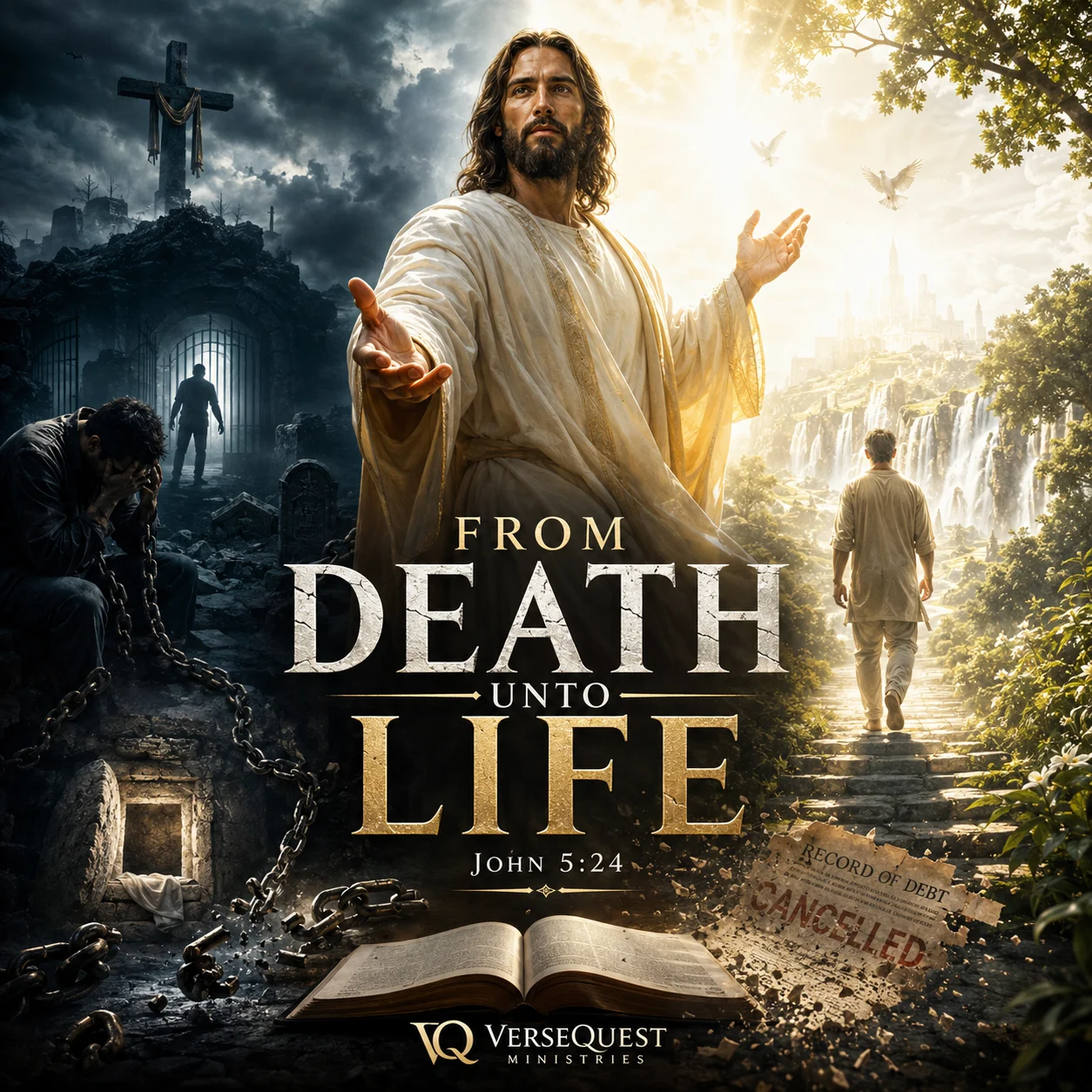
From Death Unto Life
The Moment the Believer Passes Forever
Sermon Title:
From Death Unto Life: The Moment the Believer Passes Forever
Key Passage:
John 5:24 — “Verily, verily, I say unto you, He that heareth my word, and believeth on him that sent me, hath everlasting life, and shall not come into condemnation; but is passed from death unto life.”
Series:
Foundations of the Gospel of Grace
Topic:
The Believer’s Present Possession of Everlasting Life and Permanent Passage From Death Unto Life
Book:
John, Romans, Ephesians, Colossians, 1 Corinthians, 1 John, 2 Timothy, Hebrews
Speaker:
Paul Tackett
Suggested Sermon Text:
John 5:19–29; John 3:16–18; John 3:36; John 6:47; John 10:27–30; Romans 5:1–11; Romans 6:23; Romans 8:1; Ephesians 2:1–9; Colossians 1:12–14; Colossians 2:13–14; 1 Corinthians 15:1–4; 1 John 5:11–13; 2 Timothy 1:10; Hebrews 10:14
Short Sermon Description:
This detailed VerseQuest Ministries sermon outline explains John 5:24 and the Lord Jesus Christ’s promise that the believer “hath everlasting life,” “shall not come into condemnation,” and “is passed from death unto life.” This sermon shows that salvation is not a religious process, probationary uncertainty, sacramental hope, moral improvement plan, or human achievement, but a present possession received by hearing Christ’s word and believing on the Father who sent Him. It explains spiritual death, everlasting life, the authority of Christ’s word, the certainty of no condemnation, the completed passage from death to life, and the connection between John’s Gospel and Paul’s full gospel declaration of Christ’s death, burial, and resurrection. Designed for pastors, preachers, teachers, Bible students, and believers, this outline magnifies eternal life, assurance, justification by faith, freedom from condemnation, and the settled standing of every believer in Jesus Christ.
From Death Unto Life
The Moment the Believer Passes Forever
Introduction
John 5:24 is one of the strongest assurance verses ever spoken by the Lord Jesus Christ: “Verily, verily, I say unto you, He that heareth my word, and believeth on him that sent me, hath everlasting life, and shall not come into condemnation; but is passed from death unto life.” That verse is not weak religion leaning on a cane. It is divine certainty standing with both feet planted on eternal truth. The Lord does not say the believer might receive life if he behaves well enough. He does not say the believer may avoid condemnation if religion keeps the account active. He does not say the believer is gradually passing from death toward life if the sacraments, ceremonies, and works all cooperate. He says the one who hears and believes “hath everlasting life,” “shall not come into condemnation,” and “is passed from death unto life.”
This verse cuts the throat of religious uncertainty. Religion loves to keep men somewhere between death and life, somewhere between condemnation and pardon, somewhere between saved and lost, somewhere between Christ’s cross and man’s contribution. It makes salvation into a fog bank so priests, systems, rules, ordinances, and fear can keep selling lanterns. But Jesus Christ did not speak fog in John 5:24. He spoke with a double “Verily, verily,” laying down certainty from the mouth of God manifest in the flesh. The issue is hearing His word and believing on Him that sent Him. The result is everlasting life as a present possession, no condemnation as a future security, and a completed passage from death unto life.
The doctrine must be preached because many professing Christians live as though they are still waiting to find out whether life really came. They talk about eternal life like a future possibility rather than a present possession. They treat condemnation like a storm cloud always hanging over the believer’s head. They confuse chastening with damnation, conviction with condemnation, service with salvation, and rewards with justification. But the Bible draws clean lines. A lost sinner is dead in trespasses and sins. A believer has everlasting life. A lost sinner is under condemnation. A believer shall not come into condemnation. A lost sinner remains in death. A believer is passed from death unto life. That is not religious wishful thinking. That is the word of the Son of God.
I. Christ Speaks With Divine Authority
Key Text: John 5:24
Supporting Texts: John 5:19–23; John 1:1–14; Hebrews 1:1–3; Matthew 7:28–29
The verse begins, “Verily, verily, I say unto you.” When the Lord Jesus Christ says “Verily, verily,” He is not offering a religious opinion, a theological suggestion, or a comforting possibility. He is speaking with divine authority. The words come from the One who is the Word made flesh, the Son who does what He sees the Father do, the One whom the Father has committed all judgment unto, and the One whom all men should honour even as they honour the Father. John 5 is not the speech of a mere teacher trying to inspire disciples. It is the voice of the Son of God declaring eternal truth.
The Jews understood that Jesus was making Himself equal with God. John 5:18 says they sought the more to kill Him because He said God was His Father, “making himself equal with God.” The modern religious world often wants a smaller Jesus than the Bible presents. It wants a teacher, prophet, moral example, reformer, or inspirational figure. But John presents Christ as the eternal Son with life in Himself, authority to quicken, authority to judge, and authority to speak the words by which men pass from death unto life.
This matters because assurance rests on the authority of the Speaker. A weak speaker gives weak assurance. A liar gives false assurance. A religious system gives conditional assurance. But Jesus Christ gives divine assurance. If He says the believer hath everlasting life, then the believer hath it. If He says the believer shall not come into condemnation, then condemnation is off the table. If He says the believer is passed from death unto life, then the passage is complete. The believer’s confidence is not arrogance; it is faith in the words of the Son of God.
Main Truth:
The certainty of John 5:24 rests on the divine authority of Jesus Christ, whose word cannot fail.
II. The Sinner Begins in Death
Key Text: John 5:24
Supporting Texts: Ephesians 2:1–3; Romans 5:12; Romans 6:23; Colossians 2:13
The verse says the believer passes “from death unto life,” which means the sinner begins in death. The Bible does not describe the lost man as spiritually bruised, mildly confused, slightly misdirected, or simply lacking religious polish. Ephesians 2 says he is “dead in trespasses and sins.” Dead is not sick. Dead is not weak. Dead is not underdeveloped. Dead is dead. A corpse may be dressed, perfumed, decorated, and surrounded by soft music, but it remains dead. Religion has been decorating spiritual corpses for centuries and calling the result ministry.
Romans 5:12 says death entered by sin and passed upon all men. Romans 6:23 says the wages of sin is death. Sin is not a harmless mistake that man can erase with good intentions. Sin brings death, condemnation, separation, guilt, and judgment. The lost man may have education, morality, religious heritage, church attendance, charitable habits, and outward respectability, but if he is outside Christ, he remains in death. A well-dressed dead man still needs life.
Colossians 2:13 says believers were dead in their sins before God quickened them together with Christ. The movement from death to life is not man improving himself; it is God giving life. The sinner does not need a religious facelift. He needs resurrection life. He does not need Adam trained. He needs life in Christ. The reason John 5:24 is so glorious is because Christ does not merely advise the dead. He gives life to those who hear and believe.
Main Truth:
Every sinner outside Christ is dead in sins and needs the life only Jesus Christ can give.
III. The Sinner Must Hear Christ’s Word
Key Text: John 5:24
Supporting Texts: Romans 10:17; John 6:63; James 1:18; 1 Peter 1:23
Jesus said, “He that heareth my word.” The movement from death unto life is connected to the word of Christ. Faith does not come through religious atmosphere, emotional manipulation, ritual performance, stained glass, candles, incense, or spiritual entertainment. Romans 10:17 says, “So then faith cometh by hearing, and hearing by the word of God.” God uses His word to bring sinners to faith. A church that starves men of Scripture while feeding them mood and music should not wonder why the pews are full of religious spectators instead of living saints.
John 6:63 says, “the words that I speak unto you, they are spirit, and they are life.” James 1:18 says God begat us with the word of truth. First Peter 1:23 says believers are born again by the word of God, which liveth and abideth for ever. The word of God is not decorative material for religious speeches. It is living seed, saving truth, divine light, and the instrument the Holy Ghost uses to bring men to Christ. The dead need the word of life.
But hearing in Scripture is more than sound waves bouncing off an eardrum. A man can physically hear sermons for years and never receive the truth. He can sit under Bible preaching and remain dead if unbelief rules his heart. The hearing in John 5:24 is hearing that receives the testimony of Christ and believes Him that sent Him. The sinner must let the word of God condemn his self-righteousness, expose his sin, and point him to the Saviour. Hearing Christ’s word is not passive religious attendance; it is the soul coming under divine truth.
Main Truth:
God brings sinners to life through the word of Christ, heard and received as divine truth.
IV. The Sinner Must Believe on Him That Sent Christ
Key Text: John 5:24
Supporting Texts: John 3:16; John 6:47; Romans 4:5; Acts 16:31
Jesus said the one who hears His word and “believeth on him that sent me” hath everlasting life. Faith is the issue. Not works. Not sacraments. Not law-keeping. Not baptism as a saving cause. Not church membership. Not family religion. Not moral reform. Believing. The sinner receives life by believing the testimony of God concerning His Son. To believe on the Father who sent Christ is to receive God’s witness that Jesus Christ is the sent Son, the Saviour, the giver of life, and the one way of salvation.
John 3:16 says whosoever believeth in Him should not perish but have everlasting life. John 6:47 says, “He that believeth on me hath everlasting life.” Acts 16:31 says, “Believe on the Lord Jesus Christ, and thou shalt be saved.” Romans 4:5 says God justifies the one who “worketh not, but believeth on him that justifieth the ungodly.” Scripture does not speak with the stammering tongue of religious uncertainty. It points sinners to faith in Christ.
This faith is not faith in faith. It is not mental positivity. It is not emotional excitement. It is not signing a religious card while trusting something else. Saving faith has the right object: the Lord Jesus Christ and the God who sent Him. The sinner stops trusting self, religion, works, ceremonies, feelings, and human merit, and rests in the Saviour God provided. In the full light of Paul’s gospel, that means believing that Christ died for our sins, was buried, and rose again the third day according to the Scriptures. Faith receives what grace provides.
Main Truth:
The sinner passes from death unto life by believing God’s testimony concerning Jesus Christ, not by works or religion.
V. The Believer Hath Everlasting Life
Key Text: John 5:24
Supporting Texts: John 3:36; John 10:28; 1 John 5:11–13; Romans 6:23
Jesus said the believer “hath everlasting life.” That word “hath” is present possession. It does not say he hopes to have it after enough religious maintenance. It does not say he may have it if his good works outweigh his failures. It does not say he leases it until the next bad day. It says he hath everlasting life. Everlasting life is not temporary life wearing a religious name tag. If it is everlasting, it lasts forever. If it can be lost after being received, then words have lost meaning.
John 3:36 says, “He that believeth on the Son hath everlasting life.” John 10:28 says, “And I give unto them eternal life; and they shall never perish.” First John 5:13 says believers may know that they have eternal life. God does not want His children living in a spiritual waiting room, wondering whether Christ’s promise will hold. The life is in the Son, and the believer has the Son. Therefore, the believer has life.
Romans 6:23 says “the gift of God is eternal life through Jesus Christ our Lord.” A gift is not a wage. Eternal life is not earned, rented, or kept alive by religious effort. It is given through Christ. A man who thinks everlasting life can become temporary life has allowed theology to bully plain English. The believer’s assurance is not based on his grip on Christ, but on Christ’s word, Christ’s gift, and Christ’s faithfulness.
Main Truth:
Everlasting life is the believer’s present possession in Christ, not a future possibility earned by religious performance.
VI. The Believer Shall Not Come Into Condemnation
Key Text: John 5:24
Supporting Texts: Romans 8:1; Romans 8:33–34; John 3:18; Colossians 2:13–14
Jesus said the believer “shall not come into condemnation.” That is future security. The believer has life now and will not come into condemnation later. The Lord does not say the believer might not come into condemnation if his works remain strong enough. He says “shall not.” That is the future guarded by the word of the Son of God. Religion may tremble, but Scripture does not.
Romans 8:1 says, “There is therefore now no condemnation to them which are in Christ Jesus.” Romans 8:33–34 asks, “Who shall lay any thing to the charge of God’s elect?” The answer is not the believer’s flawless performance. The answer is God’s justification and Christ’s death, resurrection, and intercession. Colossians 2 says God has forgiven all trespasses and blotted out the handwriting that was against us. A condemned record nailed to the cross cannot lawfully condemn the believer again.
John 3:18 says, “He that believeth on him is not condemned.” The believer is not waiting for the condemnation question to be settled. It is settled in Christ. This does not mean no chastening, no conviction, no loss of reward, or no accountability. It means no eternal condemnation. A saved man may be corrected as a son, but he is not condemned as a lost sinner. The Judge has already declared the verdict in Christ.
Main Truth:
The believer shall not come into condemnation because Christ has settled the believer’s judgment through His finished work.
VII. The Believer Is Passed From Death Unto Life
Key Text: John 5:24
Supporting Texts: Colossians 1:13; Ephesians 2:5–6; 2 Timothy 1:10; Romans 6:4
Jesus said the believer “is passed from death unto life.” That is completed transfer. The believer is not halfway across a bridge between death and life, hoping the boards hold until the end. He has passed. The tense matters because the doctrine matters. The Lord does not describe salvation as a suspended process waiting for religious completion. He describes it as a passage already accomplished for the one who hears and believes.
Colossians 1:13 says God “hath delivered us from the power of darkness, and hath translated us into the kingdom of his dear Son.” Ephesians 2 says God quickened us together with Christ and raised us up together. Second Timothy 1:10 says Christ “hath abolished death, and hath brought life and immortality to light through the gospel.” Salvation is not God offering a dying man a self-help plan. It is God bringing the believer into life through Christ.
This passage from death unto life is irreversible because it is grounded in Christ, not flesh. A man born again by the word of God is not unborn by his weakness. A man given everlasting life is not returned to spiritual death because religion got nervous. A man placed in Christ is not slipped back into Adam when he struggles. The believer may stumble in his walk, but his passage has been made. He is no longer in death before God. He is in life in Christ.
Main Truth:
The believer has already passed from death unto life through faith in Jesus Christ.
VIII. This Assurance Does Not Excuse Sin but Establishes Grace
Key Text: Romans 6:1–2
Supporting Texts: Titus 2:11–14; Romans 6:11–14; Ephesians 2:10
Every time Bible assurance is preached, legalism asks its tired old question: “Shall we continue in sin, that grace may abound?” Paul’s answer is still, “God forbid.” John 5:24 does not teach that sin is harmless. It teaches that Christ is sufficient. The believer who has passed from death unto life should not live like death still owns him. He has been given life, and life should show itself in a new walk.
Titus 2 says the grace of God that brings salvation teaches believers to deny ungodliness and worldly lusts. Grace is not a permission slip for the flesh; it is the schoolmaster of holiness under Christ. Romans 6 says believers should reckon themselves dead indeed unto sin, but alive unto God through Jesus Christ our Lord. Sin shall not have dominion over them because they are not under the law, but under grace. Grace does not enthrone sin. Grace dethrones it.
Ephesians 2:8–9 says salvation is not of works, but verse 10 says believers are created in Christ Jesus unto good works. Works do not move the sinner from death to life. Christ does. But after the sinner is made alive, good works should follow as fruit. The believer serves not to escape condemnation, but because he shall not come into condemnation. Gratitude, not terror, becomes the engine.
Main Truth:
Assurance of everlasting life does not excuse sin, but establishes the believer in grace for holy service.
IX. John 5:24 Finds Its Full Gospel Ground in Christ’s Death, Burial, and Resurrection
Key Text: 1 Corinthians 15:1–4
Supporting Texts: Romans 4:25; Ephesians 1:13; Romans 10:9–13
John 5:24 gives the promise of life through hearing and believing, spoken before the cross. After the death, burial, and resurrection of Christ, Paul declares the saving gospel in full clarity: Christ died for our sins according to the Scriptures, He was buried, and He rose again the third day according to the Scriptures. The life promised in John rests on the work accomplished at Calvary and proven by the empty tomb. The same Christ who promised life is the Christ who died and rose to secure it.
Romans 4:25 says Christ “was delivered for our offences, and was raised again for our justification.” That is why the believer shall not come into condemnation. The offences were dealt with at the cross. Justification is secured in the risen Saviour. Ephesians 1:13 says believers trusted Christ after hearing the word of truth, the gospel of salvation, and after believing, were sealed with the Holy Spirit of promise. That is Church-age clarity on how sinners receive salvation today.
Romans 10 says if a man believes God raised Jesus from the dead and calls upon the name of the Lord, he shall be saved. The sinner today should not be pointed to religious works, sacraments, law, morality, church membership, or emotional experience. He should be pointed to the gospel of the crucified, buried, risen Christ. The promise of passing from death unto life is not a slogan; it is blood-bought truth grounded in the finished work of Jesus Christ.
Main Truth:
The promise of passing from death unto life is secured by the gospel of Christ’s death, burial, and resurrection.
Conclusion
John 5:24 gives the believer a threefold assurance from the lips of Jesus Christ: present life, future security, and completed transfer. The believer “hath everlasting life.” The believer “shall not come into condemnation.” The believer “is passed from death unto life.” Those words are not fragile. They are not religious sales language. They are the promises of the Son of God, spoken with divine authority and secured by His finished work.
The sinner begins in death, but Christ gives life. The sinner is under condemnation, but faith in Christ brings him into a standing where condemnation no longer waits for him. The sinner cannot cross from death to life by works, rituals, law-keeping, morality, or church membership. He passes by hearing Christ’s word and believing God’s testimony concerning His Son. In the full light of the gospel of grace, that means trusting the Lord Jesus Christ who died for our sins, was buried, and rose again.
The Church must preach this assurance without apology and without turning it into carelessness. Eternal life does not make sin harmless. It makes Christ sufficient. No condemnation does not erase chastening. It removes damnation. Passing from death to life does not produce laziness in a sound believer. It produces gratitude, worship, and service. A man who knows he has been brought from death unto life ought to spend his days pointing dead men to the living Saviour.
Final Call
Sinner, if you are outside Christ, you are not merely religiously incomplete. You are dead in trespasses and sins. You are under condemnation. You need life. No church can manufacture it. No ritual can pour it into you. No moral reform can raise you from spiritual death. You must hear Christ’s word and believe on the One who sent Him.
Jesus Christ died for your sins according to the Scriptures. He was buried. He rose again the third day according to the Scriptures. Believe on the Lord Jesus Christ, and thou shalt be saved. The promise is not uncertain: he that believeth hath everlasting life, shall not come into condemnation, and is passed from death unto life.
Believer, stand on the words of Christ. Do not let religion drag you back into fear. Do not confuse correction with condemnation. Do not live like death still owns what Christ has made alive. Walk in the life God has given you, preach the gospel clearly, and tell sinners that the passage from death unto life is found only in Jesus Christ.
Closing Verse:
John 5:24 — “Verily, verily, I say unto you, He that heareth my word, and believeth on him that sent me, hath everlasting life.”
Closing Statement:
The believer is not climbing out of death by religion; he has passed from death unto life by the word and promise of Jesus Christ.