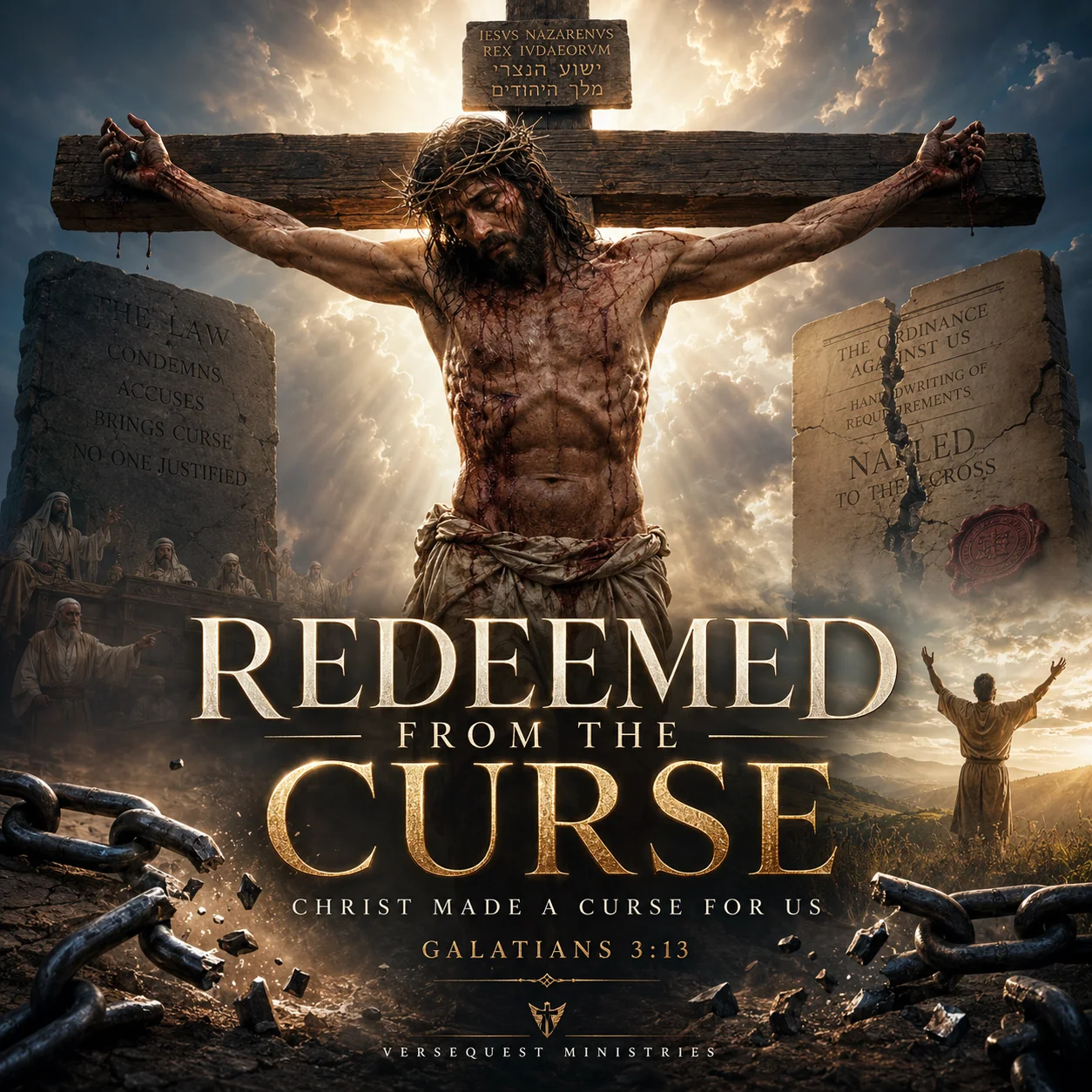
Redeemed From the Curse
Christ Made a Curse for Us
Sermon Title:
Redeemed From the Curse: Christ Made a Curse for Us
Key Passage:
Galatians 3:13 — “Christ hath redeemed us from the curse of the law, being made a curse for us: for it is written, Cursed is every one that hangeth on a tree.”
Series:
Foundations of the Gospel of Grace
Topic:
Redemption From the Curse of the Law Through the Substitutionary Death of Jesus Christ
Book:
Galatians, Deuteronomy, Romans, 2 Corinthians, Ephesians, Colossians, Hebrews, 1 Peter, 1 Corinthians
Speaker:
Paul Tackett
Suggested Sermon Text:
Galatians 3:10–14; Deuteronomy 21:22–23; Romans 3:19–28; Romans 4:4–8; Romans 5:1–11; Romans 6:14; Romans 7:4–6; Romans 8:1–4; 2 Corinthians 5:21; Ephesians 1:7; Colossians 2:13–14; Hebrews 10:10–14; 1 Peter 2:24; 1 Corinthians 15:1–4
Short Sermon Description:
This detailed VerseQuest Ministries sermon outline explains Galatians 3:13 and the gospel truth that Jesus Christ redeemed believers from the curse of the law by being made a curse for us. The law is holy, just, and good, but it places every lawbreaker under a curse because sinful flesh cannot keep it perfectly. This sermon shows why the curse of the law cannot be removed by religion, morality, baptism, sacraments, church membership, law-keeping, reform, or human merit, but only by the substitutionary death of Jesus Christ. It explains Christ’s redemption, the meaning of being made a curse, the connection to Deuteronomy 21:23, the cross as the place where the curse was borne, and the believer’s freedom from condemnation under grace. Designed for pastors, preachers, teachers, Bible students, and believers, this outline magnifies the blood of Christ, justification by faith, the finished work of Calvary, and the believer’s liberty from legal bondage.
Redeemed From the Curse
Christ Made a Curse for Us
Introduction
Galatians 3:13 is one of the strongest verses in the Bible on the substitutionary work of Jesus Christ: “Christ hath redeemed us from the curse of the law, being made a curse for us.” That sentence is not religious decoration. It is the gospel in legal thunder. The law had a curse. The sinner was under that curse. Christ stepped into the place of the cursed and redeemed the believer by bearing what the guilty deserved. The verse does not say Christ gave sinners a religious example so they could climb out of the curse by trying harder. It says He redeemed us from the curse by being made a curse for us.
The book of Galatians was written against a poisoned mixture of grace and law. Men had come along trying to add law-keeping to the believer’s standing before God. They were not merely suggesting moral seriousness. They were corrupting the foundation of the gospel. Paul’s answer is not soft, vague, or diplomatic. He says if righteousness come by the law, then Christ is dead in vain. He says those under the works of the law are under the curse. Then he points to the cross and says Christ redeemed us from that curse. The issue is not whether the law is evil. The issue is whether sinful man can be justified by it. The law is holy. The sinner is not. That is the problem.
The curse of the law is not removed by putting a church sign over it, dipping it in water, wrapping it in sacraments, quoting Moses over it, or promising to do better next week. The curse required death. The curse required satisfaction. The curse required a Substitute. Jesus Christ did not come to help the sinner negotiate with the curse. He came to redeem him from it. He was made a curse for us, hung on a tree, shed His blood, died for our sins, was buried, and rose again. The believer now stands in Christ, not under the law as a condemning system, not under the curse as a doomed lawbreaker, but under grace, justified by faith, and free in the risen Saviour.
I. The Law Pronounces a Curse on Every Lawbreaker
Key Text: Galatians 3:10
Supporting Texts: Deuteronomy 27:26; James 2:10; Romans 3:19–20
Galatians 3:10 says, “For as many as are of the works of the law are under the curse.” Paul then quotes the law itself: “Cursed is every one that continueth not in all things which are written in the book of the law to do them.” That is the standard. Not most things. Not sincere effort. Not cultural respectability. Not religious intention. “All things.” The law does not grade on a curve, wink at the flesh, or hand out participation trophies for failed obedience. It demands perfect continuance.
James 2:10 says, “For whosoever shall keep the whole law, and yet offend in one point, he is guilty of all.” That does not mean every sin is identical in earthly consequence, but it means one violation makes a man a lawbreaker. A chain with one broken link is broken. A window with one shattered pane is not whole. A man cannot stand before God boasting that he kept some commandments while admitting he broke others. The law’s curse falls on the guilty.
Romans 3:19–20 says the law speaks so that every mouth may be stopped and all the world may become guilty before God. The law was never given as a ladder for sinners to climb into righteousness. It exposes sin. It shuts mouths. It makes guilt visible. It brings the sinner to the end of himself. When the law finishes speaking, the honest sinner has nothing left to say except, “God be merciful to me a sinner.”
Main Truth:
The law pronounces a curse on every lawbreaker because it demands perfect obedience and exposes universal guilt.
II. The Curse Cannot Be Removed by Human Righteousness
Key Text: Galatians 3:11
Supporting Texts: Romans 3:20; Galatians 2:16; Titus 3:5
Paul says, “But that no man is justified by the law in the sight of God, it is evident.” That statement should end the argument, but religious flesh keeps digging it back up like a dog returning to a bone. No man is justified by the law in God’s sight. Not the Jew with Moses. Not the Gentile with morality. Not the churchgoer with rituals. Not the sincere man with good intentions. No man.
Galatians 2:16 says a man is not justified by the works of the law, but by the faith of Jesus Christ. Romans 3:20 says by the deeds of the law there shall no flesh be justified. Titus 3:5 says salvation is not by works of righteousness which we have done. God has repeated this truth with enough clarity to make only two things possible: believe it or fight the Bible. The law can define righteousness, but it cannot produce righteousness in a sinner. It can diagnose disease, but it cannot heal the dead.
Human righteousness is not strong enough to remove a divine curse. A man may become more religious, more moral, more disciplined, more charitable, and more respected by other sinners, but none of that removes the curse. Works may impress men because men compare sinners with sinners. God compares man with His own holiness. Before that standard, man’s righteousness collapses into filthy rags. The curse remains until Christ redeems.
Main Truth:
Human righteousness cannot remove the curse of the law because no sinner is justified by law-keeping in the sight of God.
III. The Just Shall Live by Faith
Key Text: Galatians 3:11
Supporting Texts: Habakkuk 2:4; Romans 1:16–17; Galatians 2:20; Hebrews 10:38
Paul quotes Habakkuk: “The just shall live by faith.” That is the Bible answer to the curse of works-based religion. The law says do and continue in all things. Faith rests in what God has provided. The law demands righteousness from man. The gospel reveals righteousness from God. The law exposes the sinner’s inability. Faith lays hold of the Saviour’s sufficiency.
Romans 1 says the righteousness of God is revealed from faith to faith, “as it is written, The just shall live by faith.” This is not a New Testament novelty invented by Paul to escape Moses. The principle is rooted in Scripture. A sinner is never justified by presenting God with his own greatness. He is justified by faith in what God has done. In this present dispensation of grace, that means believing the gospel that Christ died for our sins, was buried, and rose again.
Galatians 2:20 says the believer lives by the faith of the Son of God, who loved him and gave Himself for him. Faith does not make the sinner worthy. Faith receives Christ. Faith does not pay the curse. Faith trusts the One who bore it. Faith does not boast in itself. Faith points away from self and toward the crucified and risen Lord. The just live by faith because the law cannot give life to condemned flesh.
Main Truth:
The sinner is not justified by law-keeping but by faith in the Lord Jesus Christ and His finished work.
IV. Christ Redeemed Us From the Curse
Key Text: Galatians 3:13
Supporting Texts: Ephesians 1:7; Colossians 1:14; 1 Peter 1:18–19
Galatians 3:13 says, “Christ hath redeemed us from the curse of the law.” Redemption means deliverance by payment. The sinner was not merely sick, confused, or inconvenienced. He was under a curse. He needed redemption. Christ did not come to decorate the curse with religion or teach the sinner how to manage it. He came to redeem the believer out from under it.
Ephesians 1:7 says, “In whom we have redemption through his blood.” Colossians 1:14 says the same: redemption through His blood, even the forgiveness of sins. First Peter 1 says believers were not redeemed with corruptible things, as silver and gold, but with the precious blood of Christ. The price was not human sincerity, church membership, baptismal water, sacraments, penance, law-keeping, or moral reform. The price was blood.
This redemption is not theoretical. The believer has it. “Christ hath redeemed us.” That is settled language. The law’s curse is not hanging over the saved man waiting for the next failure to reactivate. Christ redeemed him. The debt was not reduced. It was paid. The curse was not postponed. It was borne. The believer is not in spiritual layaway waiting for final approval from religion. He is redeemed in Christ.
Main Truth:
Christ redeemed believers from the curse of the law by paying the redemption price through His own blood.
V. Christ Was Made a Curse for Us
Key Text: Galatians 3:13
Supporting Texts: 2 Corinthians 5:21; Isaiah 53:6; 1 Peter 2:24
Paul does not merely say Christ redeemed us. He tells us how: “being made a curse for us.” That is substitution. Christ was not cursed for His own sin, because He had none. He was made a curse for us. The curse that belonged to the guilty was laid upon the innocent. The sinless One stood in the place of the lawbreaker. The blessed Son bore the curse so cursed sinners could be redeemed.
Second Corinthians 5:21 says God made Christ “to be sin for us, who knew no sin; that we might be made the righteousness of God in him.” Isaiah 53 says the LORD laid on Him the iniquity of us all. First Peter 2:24 says He bare our sins in His own body on the tree. These verses say the same thing from different angles: substitution. Our sins. His body. Our curse. His cross. Our guilt. His blood.
This truth must never be softened into vague religious sentiment. Christ being made a curse is not a metaphor for human sympathy. It is the legal, substitutionary, sacrificial work of the Son of God. He bore what we deserved. He stood where we could not stand. He took the curse that would have damned us. That is why no works gospel can be true. If Christ was made a curse for us, then man’s works did not redeem him from it.
Main Truth:
Jesus Christ was made a curse for us, bearing the law’s judgment as the sinner’s Substitute.
VI. The Tree Reveals the Shame and Judgment of the Curse
Key Text: Galatians 3:13
Supporting Texts: Deuteronomy 21:22–23; Acts 5:30; Acts 10:39; 1 Peter 2:24
Paul quotes Deuteronomy: “Cursed is every one that hangeth on a tree.” In the law, hanging on a tree signified curse, shame, and public judgment. The body was not to remain all night upon the tree because he that is hanged is accursed of God. Paul takes that text and applies it to Christ. The cross was not merely Rome’s execution device. It was the place where the curse was displayed and borne.
Acts repeatedly speaks of Christ being slain and hanged on a tree. First Peter 2:24 says He bare our sins in His own body “on the tree.” The Holy Ghost wants the believer to see the connection. The tree is not incidental. It is the place where the sinless Christ became the cursed Substitute. The holy Son of God entered the place of shame so sinners could receive redemption.
The cross exposes the seriousness of sin better than any sermon illustration ever could. If the curse required the Son of God to hang on a tree, then sin is not a light matter. If the law’s curse fell on Christ for us, then law-breaking is not harmless. Calvary is the end of every shallow view of sin. The tree tells the truth: the curse is real, the judgment is real, and the Substitute is the only hope.
Main Truth:
The tree reveals the shame, judgment, and public curse Christ bore in the sinner’s place.
VII. Redemption From the Curse Brings Freedom From Legal Bondage
Key Text: Galatians 3:13
Supporting Texts: Galatians 5:1; Romans 6:14; Romans 7:4–6; Colossians 2:14
If Christ redeemed believers from the curse of the law, then believers are not to crawl back under that curse as a system of standing before God. Galatians 5:1 says, “Stand fast therefore in the liberty wherewith Christ hath made us free.” That liberty is not permission to sin. It is freedom from the law as a condemning covenant and from every religious system that tries to put the believer back under fear.
Romans 6:14 says, “ye are not under the law, but under grace.” Romans 7 says believers are become dead to the law by the body of Christ, that they should be married to another, even to Him who is raised from the dead. Colossians 2 says the handwriting of ordinances that was against us was blotted out, taken out of the way, and nailed to Christ’s cross. That is liberty grounded in doctrine, not emotional slogans.
Legalism hates this because legalism thinks fear is the only way to make people behave. But the Bible teaches that grace, rightly understood, produces service, gratitude, holiness, and fruit. The believer does not obey to escape the curse. Christ already bore it. He obeys because he belongs to the One who redeemed him from it. That is not a lower motive. That is a higher one.
Main Truth:
Redemption from the curse frees the believer from legal bondage and establishes him under grace in the risen Christ.
VIII. Redemption From the Curse Opens the Blessing of Abraham to the Gentiles
Key Text: Galatians 3:14
Supporting Texts: Genesis 12:3; Romans 4:9–17; Ephesians 2:11–18
Galatians 3:14 says Christ redeemed from the curse “that the blessing of Abraham might come on the Gentiles through Jesus Christ.” That statement must be handled carefully and rightly divided. Paul is not saying Gentiles become Israel or that the Church steals Israel’s earthly covenant promises. He is showing that justification by faith was witnessed beforehand in Abraham, and that Gentiles now receive blessing through Christ apart from the works of the law.
Romans 4 explains that Abraham was justified by faith before circumcision, making him the father of all them that believe. Genesis 12 promised blessing connected to Abraham, and Paul shows that through Christ, Gentiles are brought into spiritual blessing by faith. This is not replacement theology. This is Pauline doctrine. Israel remains Israel. The Church remains the Body of Christ. But Gentiles who were once without Christ are now made nigh by the blood of Christ.
Ephesians 2 says Gentiles were aliens from the commonwealth of Israel and strangers from the covenants of promise, having no hope and without God in the world. But now in Christ Jesus they are made nigh by the blood. The blessing comes through Christ, not through becoming law-keeping Jews. The Redeemer removes the curse and brings believing sinners into grace, promise, and spiritual life.
Main Truth:
Christ’s redemption brings believing Gentiles into spiritual blessing through Abraham’s faith principle without turning the Church into Israel.
IX. Redemption From the Curse Is Secured by the Gospel That Saves Today
Key Text: 1 Corinthians 15:3–4
Supporting Texts: Galatians 1:8–9; Romans 4:25; Ephesians 1:13
The saving message today is the gospel Paul preached: Christ died for our sins according to the Scriptures, was buried, and rose again the third day according to the Scriptures. Galatians 3:13 explains the curse-bearing meaning of the cross. First Corinthians 15 declares the gospel facts by which sinners are saved. Christ died for our sins. He bore the curse. He was buried. He rose again.
Romans 4:25 says Christ was delivered for our offences and raised again for our justification. The resurrection proves the curse-bearing work was accepted. If Christ had remained in the grave, there would be no gospel, no justification, and no assurance. But He rose again. The curse was borne, the payment was accepted, and the believer is justified in the risen Christ.
Ephesians 1:13 says believers trusted Christ after hearing the word of truth, the gospel of salvation, and after believing, were sealed with the Holy Spirit of promise. The sinner today is not saved by law-keeping, baptism, sacraments, church membership, emotional experience, or reform. He is saved by believing on the Lord Jesus Christ, the One who bore the curse, died for sins, and rose again. Any gospel that adds works to Christ’s curse-bearing redemption is another gospel and must be rejected.
Main Truth:
Redemption from the curse is received through believing the gospel of Christ’s death, burial, and resurrection.
Conclusion
Galatians 3:13 declares the believer’s deliverance with divine force: “Christ hath redeemed us from the curse of the law, being made a curse for us.” The law pronounced the curse. Sin placed man under it. Human righteousness could not remove it. Religion could not soften it. But Christ bore it. He was made a curse for us, hung on the tree, shed His blood, died for our sins, was buried, and rose again.
This doctrine destroys every attempt to put the believer back under the law as a system of justification or standing. The law is holy, but sinful flesh cannot be justified by it. The law exposes guilt; Christ redeems from the curse. The law demands righteousness; Christ provides righteousness. The law condemns the lawbreaker; Christ bears the condemnation. The believer is not under the curse, not under condemnation, not under law as a covenant of death, but under grace in Jesus Christ.
The Church must preach this clearly. Legalism dresses itself in reverence, but it often denies what Christ accomplished. Sacramental systems dress bondage in ceremony, but they cannot redeem from the curse. Moralism flatters Adam, but Adam is cursed. The answer is not better flesh. The answer is Christ crucified and risen. The Redeemer did not make the curse manageable. He redeemed us from it.
Final Call
Sinner, if you are outside Jesus Christ, you are under sin, guilt, death, and judgment. Your works cannot redeem you. Your morality cannot redeem you. Your baptism cannot redeem you. Your church membership cannot redeem you. Your law-keeping cannot redeem you. You need the One who was made a curse for sinners.
Jesus Christ died for your sins according to the Scriptures. He was buried. He rose again the third day according to the Scriptures. He bore the curse on the tree so that guilty sinners might be redeemed, justified, and saved by grace through faith. Believe on the Lord Jesus Christ, and thou shalt be saved.
Believer, stand fast in the liberty Christ purchased. Do not let any man drag you back under the curse Christ bore. Live holy, serve faithfully, walk in the Spirit, and glory in the cross. You are redeemed from the curse, not by your strength, but by the blood and substitutionary death of the Lord Jesus Christ.
Closing Verse:
Galatians 3:13 — “Christ hath redeemed us from the curse of the law, being made a curse for us.”
Closing Statement:
The curse that would have condemned the sinner fell on the sinless Christ, and the believer now stands redeemed by blood, free by grace, and alive in the risen Lord.