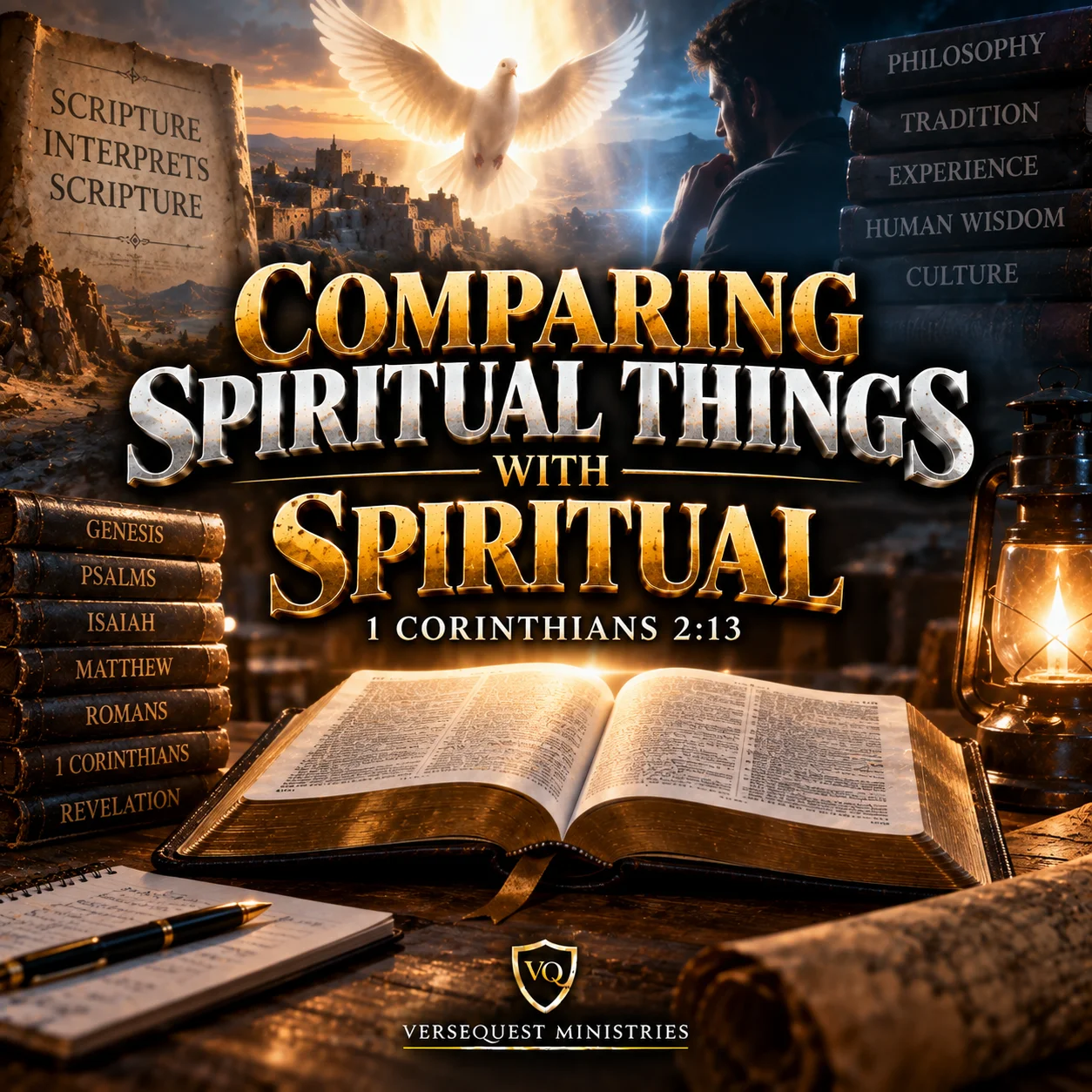
Sermon Title:
Comparing Spiritual Things With Spiritual
Key Passage:
1 Corinthians 2:13
“Which things also we speak, not in the words which man’s wisdom teacheth, but which the Holy Ghost teacheth; comparing spiritual things with spiritual.” (1 Corinthians 2:13)
Series:
The Book God Gave
Topic:
How the Holy Ghost Teaches Biblical Truth by Comparing Scripture With Scripture
Book:
1 Corinthians
Speaker:
Paul Tackett
Suggested Sermon Text:
1 Corinthians 2:6–16; Isaiah 28:9–13; Psalm 119:18, 89, 130, 160; Proverbs 30:5–6; John 14:26; John 16:13–15; Acts 17:10–11; Romans 16:25–26; Ephesians 3:1–10; 2 Timothy 2:15; 2 Timothy 3:15–17; 2 Peter 1:19–21; 2 Peter 3:15–16
Short Sermon Description:
First Corinthians 2:13 reveals one of the great principles of Bible study: spiritual truth must be handled by means of the words “which the Holy Ghost teacheth,” while “comparing spiritual things with spiritual.” This sermon examines the divine origin of biblical words, the ministry of the Holy Ghost in teaching believers, the necessity of comparing Scripture with Scripture, and the danger of allowing philosophy, tradition, experience, or isolated proof texts to become the controlling authority in interpretation. It shows why context, cross-reference, doctrinal consistency, and right division belong together; distinguishes illumination from new revelation; explains why the natural man cannot properly receive spiritual truth apart from the Spirit of God; and demonstrates how difficult passages become clearer when the Bible is allowed to interpret itself. Preachers, teachers, and Bible students will gain a practical sermon-ready framework for studying the King James Bible by comparing spiritual things with spiritual rather than forcing human wisdom upon divine revelation. The supplied VerseQuest standard requires a KJV-only, rightly divided, detailed, sermon-ready structure. Sermon Outline Prompt – VerseQu…
COMPARING SPIRITUAL THINGS WITH SPIRITUAL
Introduction
There are two fundamentally different ways to approach the Bible. One begins with man and forces the Bible to answer to him. The other begins with God and allows God’s words to explain God’s words. Paul draws that line sharply in 1 Corinthians 2. He contrasts “the wisdom of this world” with “the wisdom of God,” the spirit of the world with “the spirit which is of God,” and the words “which man’s wisdom teacheth” with the words “which the Holy Ghost teacheth.” Then he gives the method: “comparing spiritual things with spiritual.” The Bible is not a puzzle that requires unbelieving philosophy to rescue it. God gave the words, and God supplied within Scripture the material necessary to understand the doctrine He intended those words to communicate.
That does not mean every verse is instantly easy. Peter admitted that some things in Paul’s epistles are “hard to be understood” (2 Peter 3:16). Difficulty is not the same thing as defect. A difficult mathematical problem does not become wrong because the student cannot solve it in thirty seconds. Likewise, when a passage is difficult, the Bible believer does not immediately reach for a red pen and begin repairing the Author. He compares passages, traces terminology, studies context, notices distinctions, and keeps reading until clearer Scripture illuminates less obvious Scripture. The problem is often not that God failed to speak clearly but that man stopped comparing too soon.
The modern religious world frequently reverses the process. One man compares Scripture with philosophy. Another compares it with church tradition. Another compares it with his feelings. Another with the latest archaeological headline. Another with an internet preacher. Another with a theological system constructed before the text was ever opened. Paul says something far more reliable: compare spiritual things with spiritual. The Holy Ghost who inspired Genesis is the same Holy Ghost who inspired Revelation. He does not contradict Himself. When the Book is compared with the Book, doctrine begins to lock together like pieces made by the same hand.
I. SPIRITUAL TRUTH ORIGINATES WITH GOD, NOT WITH HUMAN WISDOM
Key Text: 1 Corinthians 2:6–10
Supporting Texts: Proverbs 2:6; Romans 11:33–36; Colossians 2:8; James 3:15–17
Paul begins the chapter by distinguishing two kinds of wisdom. “We speak wisdom among them that are perfect: yet not the wisdom of this world” (1 Corinthians 2:6). The rulers of this world possessed education, philosophy, political power, religious authority, and cultural influence, yet Paul says they did not know the wisdom of God, “for had they known it, they would not have crucified the Lord of glory” (1 Corinthians 2:8).
Human intelligence is not useless, but intelligence is not revelation. A brilliant man can reason accurately from bad premises and arrive brilliantly at the wrong conclusion. A scholar can know Hebrew grammar, Greek syntax, ancient history, and Near Eastern archaeology while remaining spiritually blind to the doctrinal truth God placed in Scripture. Academic ability may assist study, but it cannot manufacture divine revelation.
Paul says God revealed these things “unto us by his Spirit” (1 Corinthians 2:10). The direction is important. Truth originates with God and comes down to man. Christianity is not mankind climbing an intellectual ladder toward heaven. God speaks. Man receives.
Main Truth: Divine truth originates in the mind of God and is revealed by His Spirit, not discovered independently through human philosophy or intellect.
II. THE HOLY GHOST TAUGHT THE WORDS THEMSELVES
Key Text: 1 Corinthians 2:13
Supporting Texts: Matthew 4:4; Psalm 12:6; Proverbs 30:5; 2 Peter 1:21; 2 Timothy 3:16
Paul does not merely say the Holy Ghost supplied religious ideas. He says, “not in the words which man’s wisdom teacheth, but which the Holy Ghost teacheth.” That verse is one of Scripture’s clearest testimonies to verbal inspiration. Divine revelation comes through words.
Jesus said, “Man shall not live by bread alone, but by every word that proceedeth out of the mouth of God” (Matthew 4:4). Psalm 12 says, “The words of the LORD are pure words.” Proverbs 30:5 says, “Every word of God is pure.” Second Peter 1:21 says holy men spoke “as they were moved by the Holy Ghost.” Scripture repeatedly moves beyond general concepts to the actual language used to communicate those concepts.
This is why Bible study requires attention to words. If God cared enough to teach the words, we should care enough to notice them. Repeated words matter. Contrasts matter. Singulars and plurals matter. Names matter. Verb tenses matter. Terms such as “kingdom,” “church,” “mystery,” “gospel,” “law,” “grace,” “Israel,” and “Gentiles” cannot simply be flattened into whatever meaning our theological system prefers.
Main Truth: The Holy Ghost inspired the very words of Scripture, so sound interpretation must take God’s wording seriously.
III. THE BIBLE IS DESIGNED TO BE COMPARED WITH ITSELF
Key Text: 1 Corinthians 2:13
Supporting Texts: Isaiah 28:9–10; Psalm 119:160; Acts 17:11; Luke 24:27
Paul’s phrase “comparing spiritual things with spiritual” establishes a fundamental study principle: Scripture should illuminate Scripture. A doctrine should not be built on one isolated phrase while ignoring dozens of passages dealing with the same subject.
Isaiah describes instruction as “precept upon precept; line upon line…here a little, and there a little” (Isaiah 28:10). Whatever the immediate prophetic setting and judgmental context of that passage, it illustrates something visibly true about the Bible: God frequently reveals a subject across multiple passages rather than placing every detail into one verse. The student gathers those passages and allows them to speak together.
Luke 24 gives a beautiful example. Jesus began “at Moses and all the prophets” and “expounded unto them in all the scriptures the things concerning himself” (Luke 24:27). One passage illuminated another. Prophecy illuminated fulfillment. Type illuminated antitype. Scripture formed a unified witness.
A concordance therefore can be more valuable than a shelf full of speculative theology if it drives the student back to the Book. Find the word. Trace the phrase. Compare the contexts. See where the Holy Ghost uses the same terminology elsewhere. Let God explain God.
Main Truth: The safest interpreter of Scripture is Scripture itself, as related passages are compared and allowed to clarify one another.
IV. CONTEXT MUST CONTROL EVERY CROSS-REFERENCE
Key Text: 1 Corinthians 2:13
Supporting Texts: 2 Timothy 2:15; Matthew 4:5–7; 2 Peter 3:16; Nehemiah 8:8
Comparing Scripture with Scripture does not mean grabbing verses merely because they contain similar words. Satan quoted Scripture in Matthew 4. The quotation was biblical; the application was satanic. A true verse can be used to teach false doctrine when it is severed from its context.
Every comparison must therefore begin with the immediate passage. Who is speaking? To whom? What is the subject? What happened before the verse? What follows it? What covenant, dispensation, historical setting, or doctrinal issue governs the passage? Words derive meaning from context.
Second Peter 3:16 warns that men “wrest” Scripture. The word of God itself remains true while the interpreter twists it. That means sincerity is not enough. A man can sincerely mishandle a verse. He can sincerely steal Israel’s promise, sincerely confuse salvation with discipleship, sincerely mix law with grace, and sincerely build a doctrine from a passage never saying what he claims it says.
Nehemiah 8:8 gives an excellent model: “So they read in the book in the law of God distinctly, and gave the sense, and caused them to understand the reading.” Read the text. Give the sense. Cause understanding. Do not use cross-references to escape the passage in front of you.
Main Truth: Scripture should be compared with Scripture only after each passage is respected in its own immediate and doctrinal context.
V. RIGHT DIVISION IS ESSENTIAL TO SPIRITUAL COMPARISON
Key Text: 2 Timothy 2:15
Supporting Texts: 1 Corinthians 10:32; Ephesians 2:11–16; Romans 11:25–29; Ephesians 3:1–10
Paul commands the believer to be “rightly dividing the word of truth.” Notice again that all of it is truth. Right division does not deny Scripture. It prevents Scripture from being mishandled.
When comparing spiritual things with spiritual, the student must notice to whom God is speaking. First Corinthians 10:32 identifies “the Jews,” “the Gentiles,” and “the church of God.” God has spoken to different groups in different settings and administrations. Israel under Moses was not operating under identical instructions to the body of Christ under Pauline revelation.
This becomes especially important when studying salvation, ordinances, kingdom doctrine, prophecy, signs, Israel’s covenants, and the mystery revealed through Paul. The student who indiscriminately combines every verse with every other verse may create contradictions God never created.
Ephesians 3 describes a mystery “which in other ages was not made known unto the sons of men” as it was now revealed. If revelation itself contains historical distinctions, faithful Bible study must honor those distinctions.
Main Truth: Comparing Scripture properly requires rightly dividing Scripture so passages are connected without erasing the dispensational distinctions God placed in His word.
VI. CLEAR PASSAGES SHOULD HELP INTERPRET DIFFICULT PASSAGES
Key Text: 2 Peter 3:15–16
Supporting Texts: Psalm 119:130; Proverbs 2:1–6; John 5:39; Acts 17:11
Peter admits that Paul wrote “some things hard to be understood.” That is refreshing honesty. The Bible does not claim every verse will be instantly obvious to the casual reader.
But Peter does not say difficult passages should be discarded. He warns against twisting them. The proper response to difficulty is more study, not less confidence. Psalm 119:130 says, “The entrance of thy words giveth light; it giveth understanding unto the simple.” Light accumulates as words enter.
When a difficult passage appears, begin with what Scripture states plainly elsewhere. Build doctrine primarily from clear passages, then interpret difficult passages consistently with truths already established. Do not allow an obscure expression to overthrow fifty plain verses.
This is where comparing Scripture becomes invaluable. One passage supplies a definition. Another gives historical background. Another establishes doctrinal boundaries. Another provides an example. Another reveals an exception. Together they create clarity.
Main Truth: Difficult Scripture should be interpreted in harmony with clearer Scripture rather than used to overthrow plainly established biblical doctrine.
VII. THE HOLY GHOST ILLUMINATES THE SCRIPTURES HE INSPIRED
Key Text: 1 Corinthians 2:12
Supporting Texts: John 14:26; John 16:13; Ephesians 1:17–18; Psalm 119:18
Paul says believers have received “the spirit which is of God; that we might know the things that are freely given to us of God” (1 Corinthians 2:12). The Holy Ghost does not merely stand behind the original inspiration of Scripture. He also works in believers to enable spiritual understanding.
This ministry should not be confused with new revelation. The Spirit helping you understand Romans does not mean He is writing Romans chapter 17 through you. Illumination opens the believer’s understanding to truth already revealed. Inspiration produced Scripture. Illumination helps the believer comprehend Scripture.
Jesus promised that the Spirit would guide into truth and glorify Christ (John 16:13–14). The Spirit therefore never leads contrary to the Book He inspired. A supposed spiritual insight that contradicts Scripture has not come from the Spirit of truth.
This should also produce humility. We pray, “Open thou mine eyes, that I may behold wondrous things out of thy law” (Psalm 119:18). The Bible student needs more than a sharp mind. He needs a submissive heart willing to see what God actually wrote.
Main Truth: The Holy Ghost illuminates believers to understand revealed Scripture, but His teaching ministry never competes with or adds to the written revelation He inspired.
VIII. THE NATURAL MAN CANNOT JUDGE SPIRITUAL TRUTH CORRECTLY
Key Text: 1 Corinthians 2:14
Supporting Texts: Romans 8:5–8; John 3:3–8; Ephesians 4:17–18; 2 Corinthians 4:3–4
Immediately after speaking of comparing spiritual things with spiritual, Paul says, “But the natural man receiveth not the things of the Spirit of God.” The natural man may be educated, civilized, religious, cultured, eloquent, and intelligent. He is still natural.
Paul says spiritual things are “foolishness unto him” and that “neither can he know them, because they are spiritually discerned.” That does not mean an unsaved man cannot understand the dictionary meaning of Bible sentences. It means he lacks the spiritual capacity and relationship necessary to receive divine truth as God intends it.
This explains why unbelieving scholarship can sometimes describe grammatical details accurately while rejecting the central spiritual reality of the passage. The natural man can dissect the sentence and miss the Saviour.
Regeneration does not instantly make every Christian a skilled Bible student, but it gives him the indwelling Spirit and spiritual life necessary for genuine growth in understanding. The saved believer must then study.
Main Truth: Spiritual truth requires spiritual discernment, and the natural man cannot substitute intellectual ability for the regenerating and illuminating work of the Spirit of God.
IX. COMPARING SPIRITUAL THINGS WITH SPIRITUAL PRODUCES DOCTRINAL STABILITY
Key Text: 2 Timothy 3:16–17
Supporting Texts: Ephesians 4:14; Acts 20:27; Psalm 119:128; Titus 1:9
A Christian who knows isolated verses can still be easily deceived. A Christian who understands how those verses fit together becomes much harder to move. Paul warns against remaining “children, tossed to and fro, and carried about with every wind of doctrine” (Ephesians 4:14).
Comparing Scripture with Scripture creates doctrinal stability because false teaching usually survives by isolating passages. A cult quotes one verse and hides ten others. A false teacher emphasizes one truth while suppressing its biblical qualifications. A doctrinal system magnifies one passage and explains away everything that refuses to fit.
The Bible student who knows “all the counsel of God” (Acts 20:27) can recognize those distortions. He does not ask merely, “Does this preacher have a verse?” The devil had verses. He asks, “Does this teaching agree with the whole biblical witness when the passages are read in context and rightly divided?”
That method protects the believer from both ignorance and imbalance. The goal is not merely collecting more facts. The goal is a Bible-shaped mind.
Main Truth: Comparing Scripture with Scripture produces balanced doctrine and protects believers from error built upon isolated or misapplied passages.
Conclusion
“Comparing spiritual things with spiritual” is more than a clever Bible-study technique. It grows directly out of the nature of revelation. The Holy Ghost gave the words. The same Spirit speaks consistently throughout the Book. Therefore one passage can illuminate another without man importing an outside authority above Scripture.
That principle must operate together with context and right division. Comparison without context becomes proof-texting. Comparison without dispensational distinction becomes doctrinal confusion. Illumination without Scripture becomes mysticism. Scholarship without submission becomes human pride. The safe path is to read the King James Bible, compare it with itself, rightly divide it, pray for understanding, and allow clearer Scripture to illuminate difficult Scripture.
Build your doctrine from the Book instead of building a system first and forcing verses into it afterward. Trace words. Compare passages. Notice distinctions. Search the Scriptures daily. Let Genesis speak to Revelation and Revelation send you back to Genesis. Let Moses, the prophets, Christ, Peter, and Paul stand in their proper places. The Holy Ghost did not scatter disconnected religious sayings across sixty-six books. He gave one inspired Bible whose parts illuminate one another when handled according to truth.
Final Call
If you are lost, you do not need enough Bible knowledge to become your own saviour. You need the Christ revealed in the Scriptures. “Christ died for our sins according to the scriptures; And that he was buried, and that he rose again the third day according to the scriptures” (1 Corinthians 15:3–4). Trust Jesus Christ and His finished work, not your religion, baptism, morality, church membership, education, or Bible knowledge.
If you are saved, become a student of the Book. Do not survive on isolated quotations and secondhand teaching. Open the King James Bible. Search it. Compare it. Rightly divide it. Pray over it. Let the Holy Ghost teach you through the words He inspired. When one passage seems difficult, keep reading. Somewhere in the Book, God has often placed the light that makes the other passage shine.
Closing Verse:
“The entrance of thy words giveth light; it giveth understanding unto the simple.” (Psalm 119:130)
Closing Statement:
The best commentary on the Bible is the Bible itself—when the believer compares spiritual things with spiritual and lets the Holy Ghost’s words explain one another.