Sermon Title:
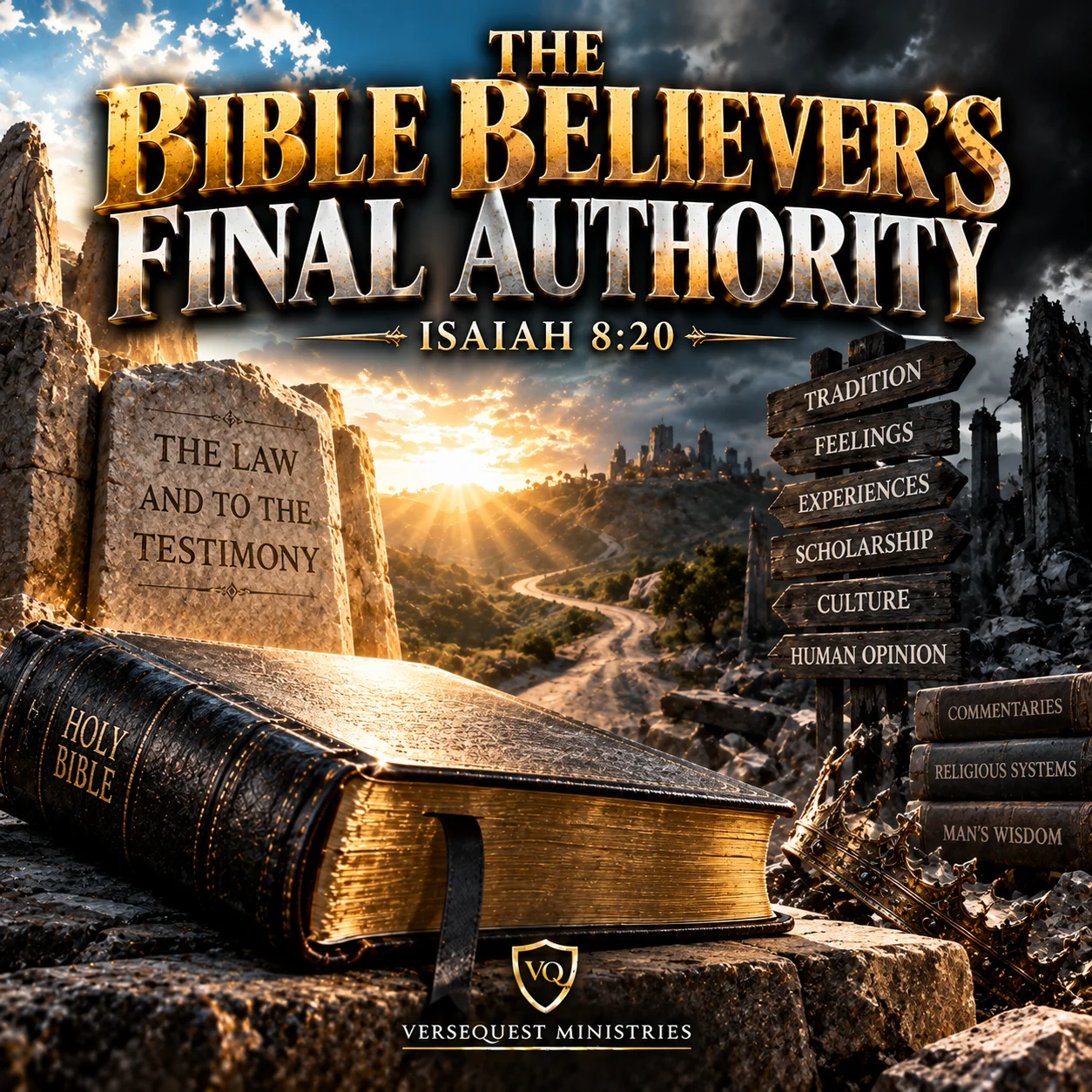
The Bible Believer’s Final Authority
Key Passage:
Isaiah 8:20
“To the law and to the testimony: if they speak not according to this word, it is because there is no light in them.” (Isaiah 8:20)
Series:
The Book God Gave
Topic:
The Written Word of God as the Believer’s Final Authority
Book:
Isaiah
Speaker:
Paul Tackett
Suggested Sermon Text:
Isaiah 8:16–22; Deuteronomy 13:1–5; Psalm 12:6–7; Psalm 119:89, 105, 128, 140, 160; Proverbs 30:5–6; Matthew 4:4, 7, 10; Matthew 15:1–9; John 10:35; John 17:17; Acts 17:10–12; Romans 3:4; 1 Corinthians 2:12–13; Galatians 1:8–9; Colossians 2:8; 1 Thessalonians 5:21; 2 Timothy 2:15; 2 Timothy 3:15–17; 1 John 4:1
Short Sermon Description:
Isaiah 8:20 gives one of Scripture’s clearest principles for testing religious claims: “To the law and to the testimony.” In its immediate prophetic context, Isaiah warns Israel against seeking supernatural guidance from familiar spirits, wizards, and the dead when God had already given His word. This sermon applies that governing principle carefully to the Bible believer today, establishing the written Scriptures as the final authority above feelings, experiences, traditions, visions, cultural opinion, scholarship, religious personalities, and supernatural claims. It explains why every voice must be tested by what God has written, why Scripture itself must be rightly divided, why human authorities may serve beneath the Bible but never rule above it, and why genuine faith submits even cherished beliefs to correction by the Book. The VerseQuest standard calls for a KJV-only, Bible-believing, rightly divided, dispensational, detailed, sermon-ready treatment. Sermon Outline Prompt – VerseQu…
THE BIBLE BELIEVER’S FINAL AUTHORITY
Introduction
Every man has a final authority whether he admits it or not. For one man it is his education. For another it is his church. For another it is his pastor, denomination, feelings, experiences, family tradition, favorite theologian, cultural consensus, or personal reasoning. Somebody eventually reaches the point where he says, “This settles it for me.” The question is not whether you possess a final authority. The question is what occupies that throne.
Isaiah 8 provides a striking setting for that question. Israel was surrounded by spiritual darkness, fear, political turmoil, and religious confusion. Instead of seeking the God who had spoken, people were tempted to consult those “that have familiar spirits” and “wizards that peep, and that mutter” (Isaiah 8:19). Isaiah responds with a question that slices through every counterfeit: “should not a people seek unto their God? for the living to the dead?” Then comes the standard: “To the law and to the testimony.” God had already spoken. They did not need another voice from the darkness.
The verse belongs doctrinally to Israel under the prophetic setting of Isaiah, and a rightly divided Bible student should say so plainly. The Church is not Israel, and “the law” in Isaiah 8:20 belongs to Israel’s covenant setting. Yet the underlying principle remains unmistakable throughout Scripture: what God has revealed judges every competing claim. For the Bible believer today, the completed written word of God is not one authority among several equal authorities. It is the final court of appeal. Preachers can be wrong. Commentaries can be wrong. Traditions can be wrong. Experiences can be misunderstood. Feelings can lie. But when God has spoken, the argument is over.
I. GOD’S PEOPLE WERE NEVER SUPPOSED TO SEEK TRUTH FROM COUNTERFEIT SPIRITUAL SOURCES
Key Text: Isaiah 8:19–20
Supporting Texts: Deuteronomy 18:9–14; Leviticus 19:31; 1 John 4:1; 1 Timothy 4:1
Isaiah’s warning does not appear in a vacuum. Verse 19 describes people being directed toward “familiar spirits” and “wizards that peep, and that mutter.” God’s answer is not, “Compare several spiritual sources and choose whichever feels peaceful.” His answer is to send them back to what He had already revealed.
Israel had been forbidden to imitate the occult practices of the nations. Deuteronomy 18 condemned divination, enchantment, witchcraft, consulting familiar spirits, and seeking information from the dead. God’s people possessed something the heathen did not possess in the same covenantal relationship: revelation from God. To leave God’s revealed word in order to obtain secret information elsewhere was not spiritual curiosity. It was rebellion.
The New Testament likewise tells believers, “believe not every spirit, but try the spirits whether they are of God” (1 John 4:1). Scripture never teaches Christians to accept something simply because it feels supernatural. Spiritual claims require testing. Religious excitement is not authority. A dream is not authority. A vision is not authority. A voice is not authority. The Bible judges the experience; the experience never judges the Bible.
Main Truth: God’s people must never abandon revealed truth in order to seek authority from supernatural experiences, private revelations, or counterfeit spiritual sources.
II. “TO THE LAW AND TO THE TESTIMONY” ESTABLISHES A WRITTEN STANDARD OUTSIDE MAN
Key Text: Isaiah 8:20
Supporting Texts: Deuteronomy 4:2; Psalm 119:105; John 17:17; Romans 3:4
Isaiah directs the people outside themselves: “To the law and to the testimony.” That is critical. Final authority cannot safely reside inside fallen man. Jeremiah says, “The heart is deceitful above all things” (Jeremiah 17:9). Human reasoning is limited. Memory is fallible. Emotion shifts. Culture changes. Personal sincerity proves only that somebody sincerely believes something, not that the thing believed is true.
God therefore supplies an objective standard. Jesus prayed, “Sanctify them through thy truth: thy word is truth” (John 17:17). Psalm 119 says, “Thy word is a lamp unto my feet, and a light unto my path” (Psalm 119:105). The believer is not left drifting through religious fog trying to determine truth by internal sensation.
Romans 3:4 gives the order plainly: “Let God be true, but every man a liar.” God’s word is not true because we confirm it. We confirm truth because God’s word is true. The creature does not sit on a jury and vote upon whether the Creator gave acceptable testimony.
Main Truth: Final authority must stand outside fallen man, and God has supplied that objective authority through His revealed word.
III. EVERY VOICE MUST SPEAK ACCORDING TO THE WORD
Key Text: Isaiah 8:20
Supporting Texts: Acts 17:11; Galatians 1:8–9; 1 Thessalonians 5:21; 2 Corinthians 11:4
Isaiah says, “if they speak not according to this word, it is because there is no light in them.” Notice that the speaker is judged by the word. The word is never placed on trial by the speaker.
The Bereans understood this principle. They received Paul’s preaching “with all readiness of mind,” but they also “searched the scriptures daily, whether those things were so” (Acts 17:11). Luke calls them noble for doing it. They were listening to an apostle, yet Scripture remained the test. No modern preacher, teacher, denomination, or religious institution deserves exemption from examination that an apostle did not demand.
Paul makes the matter even stronger in Galatians 1:8: “Though we, or an angel from heaven, preach any other gospel unto you than that which we have preached unto you, let him be accursed.” An angelic appearance does not outrank revealed truth. Miraculous atmosphere does not outrank doctrine. The messenger stands beneath the message God has already given.
Main Truth: Every preacher, teacher, spirit, doctrine, tradition, and religious claim must be judged by the written word of God.
IV. TRADITION BECOMES DANGEROUS WHEN IT OVERRULES SCRIPTURE
Key Text: Matthew 15:3
Supporting Texts: Matthew 15:1–9; Mark 7:7–13; Colossians 2:8; Proverbs 30:5–6
Tradition is not automatically evil. Families have traditions. Churches have customs. Believers inherit useful practices from faithful Christians who came before them. The problem begins when tradition acquires authority equal to or greater than Scripture.
Jesus confronted religious leaders with precisely that problem: “Why do ye also transgress the commandment of God by your tradition?” (Matthew 15:3). He later says they had “made the commandment of God of none effect by your tradition” (Matthew 15:6). Religion had developed a system in which God’s words remained technically present while human tradition controlled what those words were permitted to mean.
That danger has never disappeared. A doctrine may have been repeated for five hundred years and still deserve examination. A denominational confession may be useful and still be subordinate to Scripture. A preacher may have taught something for fifty years and still be wrong. Age does not transform error into truth.
The Bible believer respects faithful teachers but refuses to give them the throne belonging to the Book. Peter is not final authority. Paul Tackett is not final authority. Your pastor is not final authority. Peter Ruckman is not final authority. A creed is not final authority. A seminary is not final authority. The Book is.
Main Truth: Tradition may serve the believer, but the moment tradition contradicts or controls Scripture, tradition must yield.
V. SCHOLARSHIP IS A SERVANT OF SCRIPTURE, NOT ITS MASTER
Key Text: Colossians 2:8
Supporting Texts: 1 Corinthians 1:19–21; 1 Corinthians 2:4–5, 12–13; Proverbs 3:5–7; Romans 3:4
Paul warns, “Beware lest any man spoil you through philosophy and vain deceit” (Colossians 2:8). The warning is not against learning. Paul was educated. Luke was a physician. Scripture contains history, law, poetry, logic, geography, prophecy, and careful argument. Ignorance is not spirituality.
The issue is authority. Scholarship is useful when it helps us understand grammar, history, geography, language, manuscripts, culture, or context. But scholarship becomes dangerous when the scholar begins speaking as though the words of God require his permission to remain true.
Human expertise changes. One generation of scholars corrects another. Textbooks are replaced. Academic theories rise, dominate, and disappear. God does not require a revised revelation every time a university department changes its consensus.
For the King James Bible believer, dictionaries, lexicons, commentaries, historical studies, and teachers may all function as tools—but the tool never becomes the judge of the Book. The Book judges the tool.
Main Truth: Scholarship is valuable beneath biblical authority but becomes destructive when human learning is allowed to sit in judgment over the words of God.
VI. FEELINGS AND EXPERIENCES CANNOT FUNCTION AS FINAL AUTHORITY
Key Text: Proverbs 14:12
Supporting Texts: Jeremiah 17:9; 2 Corinthians 5:7; Deuteronomy 13:1–4; Matthew 24:24
“There is a way which seemeth right unto a man, but the end thereof are the ways of death” (Proverbs 14:12). Something can seem right and still be wrong. That single principle dismantles the modern claim that internal peace automatically equals divine guidance.
A man says, “I felt led.” Another says, “I had peace about it.” Another says, “God gave me a sign.” Another reports a dream, coincidence, vision, healing, prophecy, or supernatural experience. Those claims may be sincere. But sincerity cannot elevate them above Scripture.
Deuteronomy 13 warned Israel that even if a sign or wonder actually occurred, the message still had to be judged according to revealed truth. God would not permit spectacle to become final authority. Matthew 24 likewise warns of impressive signs associated with deception.
The Christian should never be ashamed to say, “My feelings are real, but they are not infallible.” Faith rests upon what God said. “For we walk by faith, not by sight” (2 Corinthians 5:7).
Main Truth: Feelings, impressions, signs, dreams, and experiences must always remain subordinate to the objective authority of Scripture.
VII. THE FINAL AUTHORITY MUST ALSO BE RIGHTLY DIVIDED
Key Text: 2 Timothy 2:15
Supporting Texts: 1 Corinthians 10:32; Ephesians 2:11–16; Romans 11:25–29; 2 Timothy 3:16
Possessing the right authority does not guarantee that a man handles it rightly. Satan quoted Scripture to Jesus Christ in Matthew 4. The verse was genuine. The application was corrupt.
That is why Paul commands, “Study to shew thyself approved unto God…rightly dividing the word of truth” (2 Timothy 2:15). The Bible contains distinctions God expects the student to recognize. Israel is not the Church. The Church is not Israel. Law is not grace. Prophecy is not mystery. The earthly kingdom is not identical to the body of Christ. The Rapture is not the Second Advent.
Every Scripture is inspired and profitable, but not every command is doctrinally directed to every person in every dispensation. Noah was told to build an ark. Israel received dietary laws and sabbath commandments. The Twelve ministered in a specific kingdom setting. Paul received revelation connected with the mystery and the body of Christ.
Final authority without right division can still produce doctrinal confusion. The solution is never to lower biblical authority. The solution is to study the authority more carefully.
Main Truth: The Bible is the believer’s final authority, but that authority must be interpreted according to the divisions and doctrinal distinctions God placed within Scripture.
VIII. SCRIPTURE IS SUFFICIENT TO FURNISH THE BELIEVER FOR EVERY GOOD WORK
Key Text: 2 Timothy 3:16–17
Supporting Texts: Psalm 19:7–11; Acts 20:32; Psalm 119:130; John 17:17
Paul says, “All scripture is given by inspiration of God.” He then lists its functions: doctrine, reproof, correction, and instruction in righteousness. The result is “That the man of God may be perfect, throughly furnished unto all good works.”
If Scripture can thoroughly furnish the man of God unto all good works, then the Christian does not need an additional infallible authority to complete the Bible. Church tradition cannot complete it. Private revelation cannot complete it. Philosophy cannot complete it. A religious hierarchy cannot complete it.
Scripture tells us what to believe through doctrine. It tells us when we are wrong through reproof. It tells us how to get right through correction. It tells us how to stay right through instruction in righteousness. That is a remarkably complete spiritual equipment list.
The Bible believer therefore does not believe in biblical authority merely because he likes having a theological argument. He believes the Book is sufficient for actual Christian living.
Main Truth: The inspired Scriptures are sufficient to establish doctrine, expose error, correct the believer, and equip him for every good work.
IX. FINAL AUTHORITY MEANS I MUST CHANGE WHEN THE BOOK CORRECTS ME
Key Text: James 1:22–25
Supporting Texts: Hebrews 4:12; Psalm 119:128; Romans 12:2; 2 Timothy 3:16
The doctrine of final authority becomes meaningless if the Bible is only final when it agrees with us. Real authority reveals itself at the point of conflict.
Psalm 119:128 says, “Therefore I esteem all thy precepts concerning all things to be right; and I hate every false way.” Notice the order. God’s precepts are right. Therefore the false way must be abandoned. The Psalmist does not negotiate with Scripture until it becomes compatible with his preferences.
Hebrews says the word of God is “quick, and powerful, and sharper than any twoedged sword” (Hebrews 4:12). Scripture exposes thoughts and intents. It gets beneath public behavior and deals with motives. It corrects doctrine, temper, pride, bitterness, lust, covetousness, fear, unbelief, laziness, and religious tradition.
The hardest test of whether a man believes the Bible is his final authority is not what he does when it condemns someone else. It is what he does when it condemns him.
Main Truth: Calling Scripture the final authority means allowing the Bible to correct our doctrine, conduct, feelings, traditions, and personal opinions.
Conclusion
“To the law and to the testimony.” Isaiah spoke those words in a specific prophetic setting to Israel surrounded by spiritual darkness and counterfeit voices. The answer was not another voice. The answer was the revelation God had already supplied. That principle echoes throughout Scripture: test the spirits, prove all things, search the Scriptures, compare spiritual things with spiritual, and reject any gospel that contradicts what God revealed.
The Bible believer therefore does not place Scripture in a committee with tradition, scholarship, experience, culture, feelings, and religious authorities and give everybody one vote. The Book does not get one vote. The Book presides over the meeting. Every other authority is secondary, limited, fallible, and subject to correction.
Take the King James Bible and make its authority practical. Study it. Rightly divide it. Believe it when it agrees with you. Believe it when it embarrasses your tradition. Believe it when it rebukes your conduct. Believe it when an expert disagrees. Believe it when culture laughs. Believe it when your feelings resist. The final authority is not the book you defend when everybody is watching. It is the Book you obey when it tells you that you are wrong.
Final Call
If you are lost, Scripture has already given God’s final word concerning the gospel that saves today: “Christ died for our sins according to the scriptures; And that he was buried, and that he rose again the third day according to the scriptures” (1 Corinthians 15:3–4). You do not need a vision, sacrament, religious institution, moral record, baptism, or private revelation to complete Christ’s finished work. Believe on the Lord Jesus Christ.
If you are saved, decide where the throne actually is. If your church can overrule the Bible, the church is your authority. If your feelings can overrule the Bible, your feelings are your authority. If scholarship can overrule the Bible, scholarship is your authority. If tradition can overrule the Bible, tradition is your authority. But if the King James Bible is your final authority, then when every competing voice speaks, you have one question left to ask: What saith the Scripture?
Closing Verse:
“Thy word is true from the beginning: and every one of thy righteous judgments endureth for ever.” (Psalm 119:160)
Closing Statement:
The Bible believer’s final authority is the one authority that never needs permission from the authorities beneath it.