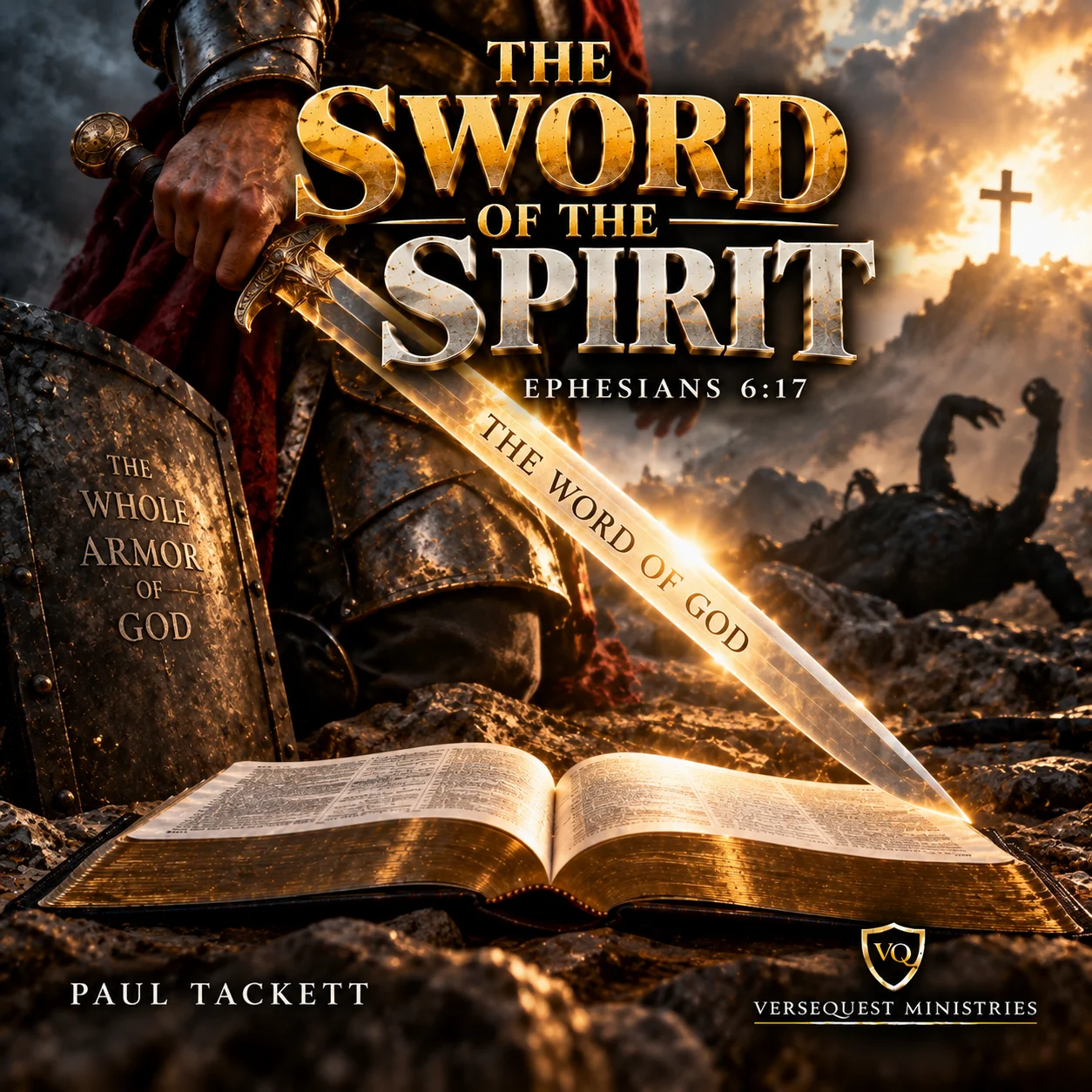
Sermon Title:
The Sword of the Spirit
Key Passage:
Ephesians 6:17
“And take the helmet of salvation, and the sword of the Spirit, which is the word of God:” (Ephesians 6:17)
Series:
The Book God Gave
Topic:
The Word of God as the Holy Spirit’s Weapon in Spiritual Warfare
Book:
Ephesians
Speaker:
Paul Tackett
Suggested Sermon Text:
Ephesians 6:10–20; Matthew 4:1–11; Psalm 119:9–11, 105, 130, 140, 160; Isaiah 55:10–11; John 17:17; 1 Corinthians 2:12–13; 2 Corinthians 10:3–5; 2 Timothy 2:15; 2 Timothy 3:15–17; Hebrews 4:12; 2 Peter 1:20–21
Short Sermon Description:
Ephesians 6:17 identifies one piece of the believer’s spiritual armor with absolute precision: “the sword of the Spirit, which is the word of God.” This sermon examines why the Christian’s conflict is spiritual rather than carnal, why the weapon belongs to the Holy Spirit, how the word of God exposes deception and answers temptation, and why simply owning a Bible is not the same as knowing how to wield it. It traces Christ’s use of “It is written” against Satan, the living and piercing work of Scripture, the necessity of memorization and meditation, the importance of right division, and the danger of using biblical words out of context. It also shows that the sword which confronts the enemy first cuts the believer himself through doctrine, reproof, correction, and instruction in righteousness. The VerseQuest standard calls for a KJV-only, rightly divided, detailed, sermon-ready outline suitable for preaching, teaching, and serious Bible study. Sermon Outline Prompt – VerseQu…
THE SWORD OF THE SPIRIT
Introduction
Paul does not end the book of Ephesians with the Christian admiring his position in Christ from an easy chair. The first chapters reveal staggering spiritual blessings: chosen in Christ, redeemed by His blood, sealed with the Holy Spirit, raised together with Christ, made members of one body, and seated together in heavenly places. But by Ephesians 6 the believer discovers that heavenly position does not eliminate spiritual conflict. Paul says, “Finally, my brethren, be strong in the Lord, and in the power of his might” (Ephesians 6:10). The Christian life is not a playground where saved people wander around looking for pleasant religious experiences. There is an adversary, there are “wiles of the devil,” there is spiritual wickedness, and God tells the believer to stand.
The armor in Ephesians 6 is not theatrical costume. Truth, righteousness, the preparation of the gospel of peace, faith, salvation, and the word of God are not decorations for church language. They are divine provisions for an actual spiritual conflict. Then Paul identifies something extraordinary: “the sword of the Spirit, which is the word of God.” The believer is not told to fight Satan with personality, emotional intensity, political power, intellectual pride, church tradition, mystical experiences, or positive thinking. The weapon supplied by the Spirit of God is the word of God.
But a sword is useful only when it is known, carried, handled, and used correctly. A man may own the finest sword ever forged and still be helpless if he has never learned to draw it. In the same way, a Christian can own six Bibles, underline hundreds of verses, display Scripture on the wall, and remain spiritually defenseless because he does not know what the Book says or how to apply it. The sword of the Spirit is not religious decoration. It was given to be wielded.
I. THE CHRISTIAN’S BATTLE IS SPIRITUAL, NOT CARNAL
Key Text: Ephesians 6:12
Supporting Texts: Ephesians 6:10–13; 2 Corinthians 10:3–5; 1 Peter 5:8–9; James 4:7
Paul says, “For we wrestle not against flesh and blood.” That does not mean human beings never oppose Christians. Paul experienced persecution from plenty of flesh-and-blood opponents. His point is that the ultimate conflict reaches beyond visible human personalities into a spiritual realm involving “principalities,” “powers,” “the rulers of the darkness of this world,” and “spiritual wickedness in high places.”
That immediately determines what kind of weapon is required. Second Corinthians 10:4 says, “For the weapons of our warfare are not carnal.” Carnal warfare employs force against bodies. Spiritual warfare deals with lies, temptation, false doctrine, unbelief, deception, accusation, and thoughts exalted “against the knowledge of God” (2 Corinthians 10:5).
The believer therefore loses perspective whenever he treats another human being as though that person were the ultimate enemy. Christians are not commissioned to conquer sinners physically; we preach a gospel capable of saving them. We do not defeat false doctrine by hating the people deceived by it. We expose the lie with truth.
Main Truth: Because the believer’s deepest conflict is spiritual, God supplies spiritual armor and a spiritual weapon rather than carnal means.
II. THE SWORD BELONGS TO THE HOLY SPIRIT
Key Text: Ephesians 6:17
Supporting Texts: 1 Corinthians 2:13; 2 Peter 1:21; John 16:13; 2 Timothy 3:16
Paul calls it “the sword of the Spirit.” That expression identifies ownership and origin. Scripture is not fundamentally man’s weapon repurposed for religious use. It belongs to the Spirit because the Spirit stands behind the words.
First Corinthians 2:13 speaks of “the words which the Holy Ghost teacheth.” Second Peter 1:21 says holy men of God “spake as they were moved by the Holy Ghost.” Second Timothy 3:16 says, “All scripture is given by inspiration of God.” The Spirit who equips the believer for warfare is the same Spirit who gave the weapon.
That also means the Spirit never leads contrary to His sword. A supposed spiritual impression that contradicts Scripture has failed immediately. The Holy Ghost does not whisper one thing into a Christian’s heart while the Book He inspired says the opposite. He is the Spirit of truth, not the author of doctrinal schizophrenia.
Calling the Bible the sword of the Spirit also protects us from treating Scripture like a magical object. Ink and leather do not frighten Satan simply because a Bible is sitting on a table. The power lies in divine truth believed, understood, and wielded under the ministry of the Spirit.
Main Truth: The word of God is the Spirit’s sword because the Holy Ghost inspired it, teaches through it, and never leads contrary to it.
III. THE SWORD IS SPECIFICALLY IDENTIFIED AS THE WORD OF GOD
Key Text: Ephesians 6:17
Supporting Texts: Matthew 4:4; Psalm 12:6; Proverbs 30:5; Hebrews 4:12
Paul does not leave the weapon open to interpretation: “the sword of the Spirit, which is the word of God.” The Christian does not invent his weapon. God identifies it.
That matters because modern Christianity is tempted to replace Scripture with everything imaginable—personal stories, motivational slogans, psychology, political commentary, religious entertainment, emotional atmosphere, alleged prophetic words, and inspirational opinions. Those things may stir people, but Paul does not call them the sword of the Spirit.
Jesus said man lives “by every word that proceedeth out of the mouth of God” (Matthew 4:4). Psalm 12:6 says, “The words of the LORD are pure words.” Proverbs 30:5 says, “Every word of God is pure.” Hebrews 4:12 declares, “For the word of God is quick, and powerful, and sharper than any twoedged sword.”
The biblical emphasis repeatedly lands on God’s words. The believer needs more than a general appreciation for Christian ideas. He needs the actual Book.
Main Truth: God has identified His written word—not human wisdom or religious substitutes—as the weapon designed for spiritual conflict.
IV. THE SWORD MUST BE TAKEN BEFORE IT CAN BE USED
Key Text: Ephesians 6:17
Supporting Texts: Psalm 119:11; Colossians 3:16; 2 Timothy 2:15; Joshua 1:8
Paul says, “take…the sword of the Spirit.” A weapon lying untouched in an armory does nothing on the battlefield. The command assumes personal appropriation.
Many Christians possess a Bible without possessing much Bible in their thinking. They know where the Book is but do not know what is in the Book. They can locate the app but cannot locate the doctrine. When temptation arrives, they have vague impressions instead of verses.
Psalm 119:11 gives the practical solution: “Thy word have I hid in mine heart, that I might not sin against thee.” The word must move from the page into the mind and heart. Colossians 3:16 commands, “Let the word of Christ dwell in you richly.” Richly means more than an emergency verse when trouble comes.
This requires reading, memorization, meditation, repeated exposure, and study. Nobody becomes skilled with a sword by looking at it once a week. Spiritual competence likewise develops through continual familiarity with Scripture.
Main Truth: The believer must personally read, learn, memorize, and internalize Scripture before he can wield it effectively in spiritual warfare.
V. JESUS CHRIST SHOWED HOW TO WIELD THE SWORD AGAINST TEMPTATION
Key Text: Matthew 4:4
Supporting Texts: Matthew 4:1–11; Deuteronomy 8:3; Deuteronomy 6:13, 16; Psalm 119:11
Matthew 4 provides perhaps the clearest biblical demonstration of the sword in action. Satan tempts Jesus three times, and Christ answers three times with the same opening declaration: “It is written.”
Christ certainly possessed divine power. He could have silenced Satan by command. Yet the recorded temptation deliberately shows Him answering the adversary with written Scripture. When tempted concerning bread, He quotes Deuteronomy. When Satan misuses Psalm 91, Christ answers from Deuteronomy. When offered the kingdoms of the world, Christ again answers what is written.
Notice also that Satan himself quoted Scripture. That destroys the childish assumption that quoting a verse automatically proves sound doctrine. Satan cited Scripture while tempting Christ. The difference was not that Jesus had verses and Satan did not. The difference was that Christ handled the word correctly.
A verse ripped from context is not a properly wielded sword. The enemy knows how to put Bible language into a false argument. The believer must know enough Scripture to recognize the misuse.
Main Truth: Jesus defeated temptation with accurately applied written Scripture, giving believers the pattern for using God’s word against deception.
VI. THE SWORD CUTS THE BELIEVER BEFORE IT CUTS THE ARGUMENT
Key Text: Hebrews 4:12
Supporting Texts: 2 Timothy 3:16–17; James 1:22–25; Jeremiah 23:29; Psalm 139:23–24
Hebrews describes the word of God as “sharper than any twoedged sword.” A two-edged sword cuts both directions. The Christian who wants Scripture only as a weapon against everyone else has misunderstood the weapon.
The word first exposes us. It is “a discerner of the thoughts and intents of the heart” (Hebrews 4:12). It penetrates beneath public appearances. A believer can fool his family, church, pastor, friends, and even himself for a while, but Scripture reaches the motive.
Second Timothy 3:16 explains the cutting work: doctrine, reproof, correction, instruction in righteousness. Doctrine tells you what is right. Reproof shows where you are wrong. Correction gets you back where you belong. Instruction trains you to continue rightly.
Before you swing the sword at the cultist, skeptic, Calvinist, legalist, liberal theologian, false prophet, or anybody else, allow it to operate on your own doctrine, pride, temper, lust, bitterness, unbelief, laziness, and hypocrisy.
Main Truth: The sword of the Spirit is not merely a weapon against external error; it is God’s instrument for cutting through the believer’s own deception and sin.
VII. THE SWORD MUST BE RIGHTLY DIVIDED
Key Text: 2 Timothy 2:15
Supporting Texts: 1 Corinthians 10:32; Ephesians 2:11–16; Romans 11:25–29; 2 Peter 3:15–16
A sharp sword in untrained hands can injure the wrong person. Likewise, true Scripture wrongly handled can produce false doctrine. Paul therefore commands the believer to be “rightly dividing the word of truth.”
The Book contains distinctions that must remain intact. Israel is not the Church. The Church is not Israel. Law is not grace. Prophecy is not mystery. The earthly kingdom promises given to Israel are not identical to the heavenly position of the body of Christ. Salvation by grace today cannot be confused with instructions given under another doctrinal administration.
Second Peter 3:16 warns that people “wrest” Scripture “unto their own destruction.” Notice: the Scripture is not defective. The handling is defective.
A Bible believer therefore does more than collect verses. He asks who is speaking, to whom, in what setting, under what covenant or dispensation, and with what doctrinal purpose. Right division keeps the sword sharp instead of turning it into a club for indiscriminate proof-texting.
Main Truth: The word of God must be rightly divided so that the Spirit’s sword is used according to the doctrinal distinctions God placed in Scripture.
VIII. THE SWORD DESTROYS LIES BY ESTABLISHING TRUTH
Key Text: 2 Corinthians 10:4–5
Supporting Texts: John 17:17; Ephesians 4:14–15; Psalm 119:104; Titus 1:9
Paul describes spiritual warfare as “casting down imaginations, and every high thing that exalteth itself against the knowledge of God.” The conflict therefore involves truth against falsehood.
The devil works through lies. Jesus called him “a liar, and the father of it” (John 8:44). False doctrine is dangerous because it introduces false ideas about God, Christ, salvation, Scripture, sin, prophecy, Israel, the Church, and eternity.
The answer to a lie is not louder emotion. It is truth. Jesus prayed, “thy word is truth” (John 17:17). Psalm 119:104 says, “Through thy precepts I get understanding: therefore I hate every false way.”
The believer therefore uses Scripture to expose error, but the goal is not merely winning arguments. Titus 1:9 speaks of being able “by sound doctrine both to exhort and to convince the gainsayers.” The sword defends truth so people can be rescued from error.
Main Truth: The sword of the Spirit defeats spiritual deception by bringing every false claim into collision with the truth of God’s word.
IX. THE SWORD MUST BE WIELDED IN DEPENDENCE UPON GOD, NOT HUMAN PRIDE
Key Text: Ephesians 6:18
Supporting Texts: Ephesians 6:10; Zechariah 4:6; James 4:6–7; 1 Corinthians 2:4–5
The armor passage does not stop with verse 17. Verse 18 immediately says, “Praying always with all prayer and supplication in the Spirit.” Sword and prayer belong together.
A Christian can know hundreds of verses and still become proud, argumentative, harsh, and spiritually useless. Biblical knowledge divorced from dependence upon God easily becomes ammunition for the flesh.
Paul began the armor passage with, “be strong in the Lord, and in the power of his might.” He did not say, “Be impressed with how much doctrine you know.” The strength comes from the Lord.
The Spirit’s sword should therefore be handled with courage but also humility. We do not apologize for truth, yet neither do we pretend truth originated with us. We are carrying somebody else’s sword. God supplied the weapon, God supplied the words, and God receives the glory when those words accomplish their work.
Main Truth: The believer must wield Scripture prayerfully and humbly, depending upon God’s power rather than intellectual pride or fleshly aggression.
Conclusion
“The sword of the Spirit, which is the word of God.” Paul could hardly have made the identification clearer. The Christian faces spiritual opposition, and God has not left him defenseless. The weapon is already supplied. It is not hidden in heaven waiting for a mystical experience. It is the word of God.
But the sword must be taken. Learn the Book. Hide it in your heart. Compare Scripture with Scripture. Rightly divide it. Know enough Bible to recognize when Satan quotes Bible. Allow it to correct you before using it to correct somebody else. Bring false doctrine against the edge of truth and watch which one survives.
The King James Bible is not decoration for the Christian soldier. It belongs in his hand, his mind, his heart, his preaching, his home, and his daily life. A dusty sword helps nobody. Open the Book. Sharpen your understanding. Stand in the armor God provided. And when the adversary says, “Yea, hath God said?” learn to answer the way the Lord Jesus Christ answered: “It is written.”
Final Call
If you are lost, the sword of the Spirit gives you the gospel plainly. “Christ died for our sins according to the scriptures; And that he was buried, and that he rose again the third day according to the scriptures” (1 Corinthians 15:3–4). You cannot fight your way into heaven. You cannot earn salvation with religion, baptism, works, morality, or church membership. Believe on the Lord Jesus Christ and trust His finished work.
If you are saved, quit going into spiritual battle unarmed. Read the Bible. Study the Bible. Memorize the Bible. Rightly divide the Bible. Believe the Bible. Obey the Bible. When temptation comes, answer it with Scripture. When false doctrine comes, test it by Scripture. When your own heart deceives you, let Scripture expose it. Take the sword God gave you—and learn to use it.
Closing Verse:
“For the word of God is quick, and powerful, and sharper than any twoedged sword.” (Hebrews 4:12)
Closing Statement:
A Bible left closed is a sword left sheathed—and no soldier wins a battle by admiring a weapon he refuses to draw.