
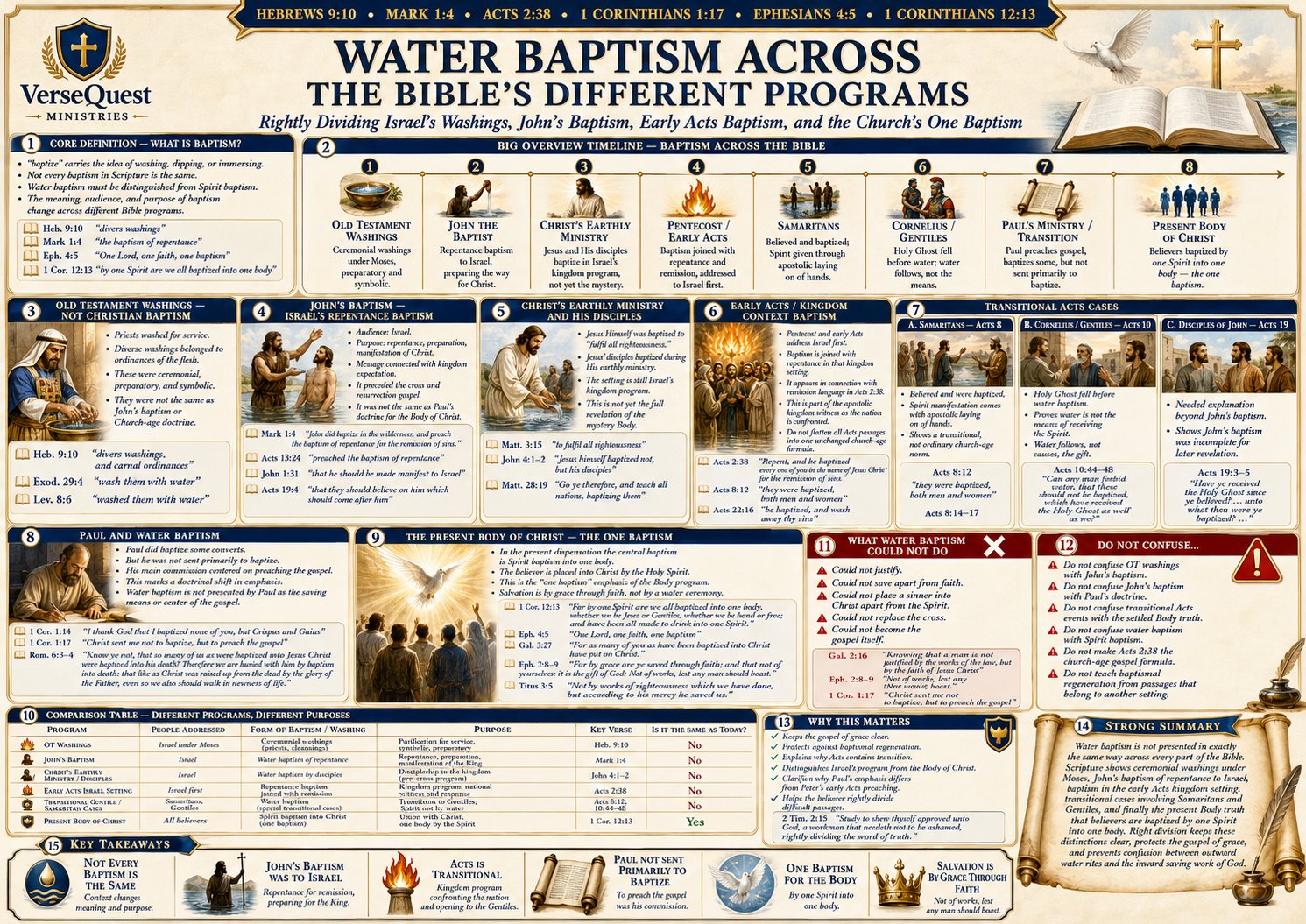
Water Baptism Across the Bible’s Different Programs – Israel’s Washings, John’s Baptism, Acts, Paul, and the Church’s One Baptism (KJV Bible Study Chart)
Compare water baptism throughout Scripture with this detailed KJV chart covering Old Testament washings, John’s baptism, Christ’s ministry, early Acts, transitional cases, Paul, and the one Spirit baptism of the Body of Christ.
$3.99
Description
Water Baptism Across the Bible’s Different Programs is a detailed KJV Bible study chart explaining why every reference to baptism in Scripture should not automatically be treated as the same ordinance, directed to the same audience, carrying the same meaning, or serving the same purpose.
Built around Hebrews 9:10, Mark 1:4, Acts 2:38, 1 Corinthians 1:17, Ephesians 4:5, and 1 Corinthians 12:13, this chart follows baptism through the major programs and transitional settings of the Bible. It compares Old Testament ceremonial washings, John’s baptism of repentance to Israel, baptism during Christ’s earthly ministry, early Acts Kingdom baptism, transitional Acts cases, Paul’s ministry, and the one spiritual baptism that places present believers into the Body of Christ.
The chart begins by defining baptism. The word carries the idea of washing, dipping, immersing, or identifying. Yet Scripture uses baptismal language in several different ways. Some baptisms involve water, some involve suffering or judgment, and the central baptism for the present Body of Christ is performed by the Holy Spirit rather than by a human minister.
A major timeline traces eight stages of baptismal teaching across Scripture. It begins with ceremonial washings under the Mosaic law, moves to John the Baptist preparing Israel for its Messiah, continues through Christ’s earthly Kingdom ministry, and then follows the transitional events recorded in Acts before reaching Paul’s doctrine concerning the one Body.
The first category concerns Old Testament washings. Hebrews 9:10 refers to “divers washings” connected with Israel’s sanctuary, priesthood, offerings, cleansings, and carnal ordinances. Priests washed before service, objects were ceremonially cleansed, and water played an important role in Israel’s approach to covenant worship.
These washings were literal commands given under Moses, but they were not Christian baptism. They belonged to Israel’s ceremonial law and prepared the nation to understand cleansing, separation, holiness, priesthood, and the need for an acceptable approach to God.
The second major category is John’s baptism. Mark 1:4 identifies John as preaching the baptism of repentance for the remission of sins. His audience was Israel, and his ministry prepared the people for the manifestation of their promised Messiah and the announcement that the Kingdom was at hand.
John’s baptism occurred before the cross and before the full revelation of the mystery concerning the Body of Christ. It was connected with repentance, confession, Israel’s Kingdom expectation, and preparation for the coming King.
John clearly distinguished himself from Jesus Christ. He baptized with water, but he announced that the One coming after him would baptize with the Holy Ghost. Water baptism and Spirit baptism therefore should not be carelessly treated as identical.
The third category concerns Christ’s earthly ministry. Jesus was baptized by John, not because He needed repentance or cleansing, but to fulfill all righteousness and identify Himself publicly within Israel’s prophetic program.
Christ’s disciples also baptized during His earthly ministry. This activity remained within Israel’s Kingdom setting. The complete mystery of the one Body had not yet been revealed, and the disciples did not yet understand the cross in the full doctrinal form later proclaimed by Paul.
The fourth category is early Acts and Kingdom-context baptism. Acts 2 records Peter preaching to Israel at Pentecost and commanding his hearers to repent and be baptized in the name of Jesus Christ. The message remained connected with Israel, the promised Messiah, national guilt, remission, the Holy Ghost, and the continued Kingdom offer.
Acts is a transitional historical book. It records God moving from Israel’s prophetic setting toward the wider Gentile ministry and the later doctrinal revelation committed to Paul. Every event in Acts should therefore be interpreted according to its audience, timing, message, and place within that transition.
The chart examines three important transitional cases. In Acts 8, the Samaritans believed and were baptized, yet the Holy Ghost was received through apostolic laying on of hands. This unusual order demonstrated apostolic authority and the transitional nature of the period.
In Acts 10, Cornelius and the Gentiles received the Holy Ghost before water baptism. This reversal proved that God had granted salvation to Gentiles apart from first becoming Jewish proselytes or entering Israel’s covenant standing. Water followed the reception of the Spirit rather than causing it.
In Acts 19, certain disciples knew only John’s baptism. Paul explained the fuller truth concerning Jesus Christ, after which they were baptized and received the Holy Ghost through Paul’s laying on of hands. Their experience should not be turned into a universal formula for every Church-age believer.
These Acts passages demonstrate that the historical order surrounding water, belief, apostolic authority, and the reception of the Spirit was not identical in every account. A doctrine built by forcing every transitional event into one unchanging sequence will create contradiction rather than clarity.
The chart then examines Paul and water baptism. Paul baptized some converts, including Crispus, Gaius, and the household of Stephanas. Water baptism therefore appeared during his ministry, particularly within the transitional period recorded in Acts.
However, Paul plainly stated, “Christ sent me not to baptize, but to preach the gospel.” This does not mean Paul condemned water baptism, but it proves that the ceremony was not the centre of his gospel commission and could not be the saving power of the gospel itself.
Paul thanked God that he had baptized relatively few members of the Corinthian church because factions were forming around human personalities. If water baptism were the instrument that placed sinners into Christ or completed their salvation, Paul could not have spoken this way.
Romans 6 describes believers as baptized into Jesus Christ and into His death. Galatians 3:27 speaks of being baptized into Christ and putting on Christ. These passages concern the believer’s spiritual identification with Christ rather than merely the physical application of water.
The chart’s central Church-age doctrine is the one baptism of the Body of Christ. First Corinthians 12:13 states, “For by one Spirit are we all baptized into one body.” This baptism is performed by the Holy Spirit and places every saved believer into spiritual union with Christ and with every other member of His Body.
This one spiritual baptism does what water could never accomplish. It joins the believer to Christ, identifies him with Christ’s death and resurrection, places him into the one Body, and gives him a new spiritual standing.
Ephesians 4:5 declares, “One Lord, one faith, one baptism.” Within the present dispensation, the doctrinal emphasis rests upon the Spirit’s work of placing believers into Christ, not upon a water ceremony as the means of salvation, justification, regeneration, or incorporation into the Body.
The chart also explains what water baptism could not do. It could not justify a sinner, replace faith, impart the Holy Spirit automatically, complete Christ’s cross, regenerate the fallen heart, remove the guilt of sin, or become the saving content of the gospel.
Galatians teaches that a sinner is justified by faith in Jesus Christ and not by the works of the law. Ephesians 2 declares that salvation is by grace through faith and not of works. First Corinthians 1 separates Paul’s gospel commission from water baptism.
This does not make the historical baptismal passages unimportant. Every passage is inspired, profitable, and necessary for understanding God’s dealings with Israel, the development of Acts, the apostolic transition, and the revelation of the Body of Christ.
Right division prevents several common errors. Old Testament washings should not be confused with John’s baptism. John’s baptism should not be treated as identical to Paul’s doctrine. Transitional Acts events should not automatically become the settled order for the present Church.
Acts 2:38 should not be isolated from its Jewish, prophetic, and Kingdom context and then used to overthrow the clear Pauline doctrine of salvation by grace through faith. Neither should every occurrence of baptism be assumed to refer to water.
The chart’s comparison table organizes the principal programs by the people addressed, form of baptism or washing, purpose, key passage, and whether the baptism is the same as the present Body’s one spiritual baptism.
Old Testament washings addressed Israel under Moses and concerned ceremonial cleansing. John’s baptism addressed Israel and prepared the nation for its Messiah. Baptism during Christ’s earthly ministry remained within Israel’s Kingdom setting.
Early Acts baptism appeared in a period of national remnant response and apostolic transition. Samaritan and Gentile cases demonstrated the widening ministry and God’s recognition of new groups. The present Body is formed by one Spirit baptizing all believers into one Body.
Understanding these distinctions protects the gospel of grace. Salvation rests upon the death, burial, and resurrection of Jesus Christ, received through faith, rather than upon water, ritual performance, religious succession, or human administration.
It also protects the distinction between Israel and the Church. Israel’s washings, Kingdom preparations, national repentance, and apostolic signs belong within their proper biblical settings. The Church’s spiritual standing is found in Christ through the Spirit.
The chart’s strong summary is clear: water baptism is not presented in exactly the same way throughout every part of Scripture. Washings under Moses, John’s baptism, early Acts baptism, transitional Gentile events, and the one baptism of the Body of Christ must be rightly divided.
The believer is saved by grace through faith in Jesus Christ. At salvation, the Holy Spirit places him into the one Body. This spiritual baptism is complete, immediate, and accomplished by God rather than by a human ceremony.
This resource is ideal for personal Bible study, baptismal-regeneration discussions, Acts studies, Pauline doctrine, dispensational teaching, Israel-and-Church comparisons, new-believer discipleship, pastoral training, Sunday school, homeschool Bible curriculum, Bible institutes, sermon preparation, and anyone seeking a clear KJV overview of baptism across Scripture.
Water baptism across the Bible, Old Testament washings, divers washings, John’s baptism, baptism of repentance, Israel’s Kingdom program, Christ’s earthly ministry, Acts 2:38, baptism in early Acts, transitional Acts, Samaritan baptism, Cornelius and the Gentiles, disciples of John in Acts 19, Paul and baptism, Christ sent me not to baptize, one baptism, Spirit baptism, Body of Christ, baptism into Christ, salvation by grace through faith
The word baptism should be interpreted by context. Scripture contains ceremonial washings, water baptisms, Spirit baptism, baptism into Christ, baptism into suffering, and baptism connected with judgment.
Old Testament washings belonged to Israel’s ceremonial law. Priests, worshippers, garments, vessels, and those affected by uncleanness were washed according to Mosaic ordinances.
Hebrews 9 calls these practices “divers washings.” They prepared Israel for sanctuary service but did not place anyone into the Body of Christ.
John’s baptism was directed to Israel. It accompanied repentance, confession, remission, and preparation for the manifestation of the Messiah.
John baptized with water but announced that Christ would baptize with the Holy Ghost. The distinction between the administrator and nature of these baptisms should be preserved.
Jesus was baptized to fulfill all righteousness, not because He possessed sin. His baptism publicly identified Him within Israel’s prophetic program.
The disciples baptized during Christ’s earthly ministry, but they did not yet possess the complete Pauline revelation concerning the one Body.
Acts records a transition. The book begins with Israel, Jerusalem, the Twelve, Pentecost, and the continued Kingdom offer and gradually moves toward Paul and the Gentile mission.
Acts 2:38 was preached by Peter to Israelites who had participated nationally in rejecting their Messiah. Its context should not be detached from Israel’s prophetic setting.
The Samaritans believed and were baptized before receiving the Spirit through apostolic hands. This order confirmed the authority of the Jerusalem apostles during a transitional moment.
Cornelius received the Holy Ghost before water baptism. His experience proves that water did not cause the new birth or force God to give the Spirit.
The disciples in Acts 19 knew only John’s baptism. Their case demonstrates incomplete revelation rather than a standard sequence every believer must reproduce.
Paul baptized some converts, but he clearly separated baptism from the central commission to preach the gospel.
First Corinthians 1:17 would be impossible language if water baptism were the means by which Paul’s hearers were regenerated or placed into Christ.
Paul’s gospel is defined in 1 Corinthians 15 as Christ’s death for sins, burial, and resurrection. Water baptism is not included as part of the saving work accomplished by Christ.
First Corinthians 12:13 identifies the baptism that forms the Body of Christ. The Holy Spirit places every believer into one Body.
Spirit baptism is not an emotional second blessing sought after salvation. It is God’s uniting work accomplished when a sinner believes the gospel.
Romans 6 describes the believer’s identification with Christ’s death and resurrection. Water can picture this truth, but only God can place a person spiritually into Christ.
Ephesians 4 declares one baptism within the unity of the Spirit. The settled doctrinal emphasis for the Body is the Spirit’s work, not competing ceremonial baptisms.
Water baptism could not justify, regenerate, cleanse the conscience permanently, remove sin, or complete the cross.
Salvation is by grace through faith. A ceremony administered by man cannot add saving power to the blood and finished work of Jesus Christ.
Right division does not remove baptismal passages from the Bible. It honours each passage by identifying its audience, program, purpose, and place within God’s revelation.
Baptism Bible studies, baptismal-regeneration discussions, Acts transition teaching, Pauline doctrine classes, Israel-and-Church distinctions, explaining Acts 2:38, comparing water and Spirit baptism, John the Baptist studies, Old Testament cleansing studies, gospel-of-grace instruction, Ephesians 4 teaching, 1 Corinthians 12 studies, new-believer discipleship, Sunday school lessons, homeschool Bible curriculum, Christian school instruction, Bible institute classes, pastoral training, sermon preparation
King James Bible, Strong’s Concordance, Thompson Chain-Reference Bible, Treasury of Scripture Knowledge, Nave’s Topical Bible, Bible atlas, Old Testament washings study notes, Gospel baptism passages, Acts transition outlines, Romans 6 commentary notes, 1 Corinthians study materials, Ephesians 4 worksheets, Israel-and-Church comparison charts, Pauline epistle studies, baptism comparison resources, VerseQuest right-division and doctrine charts
Related products
-
Law vs Grace
-
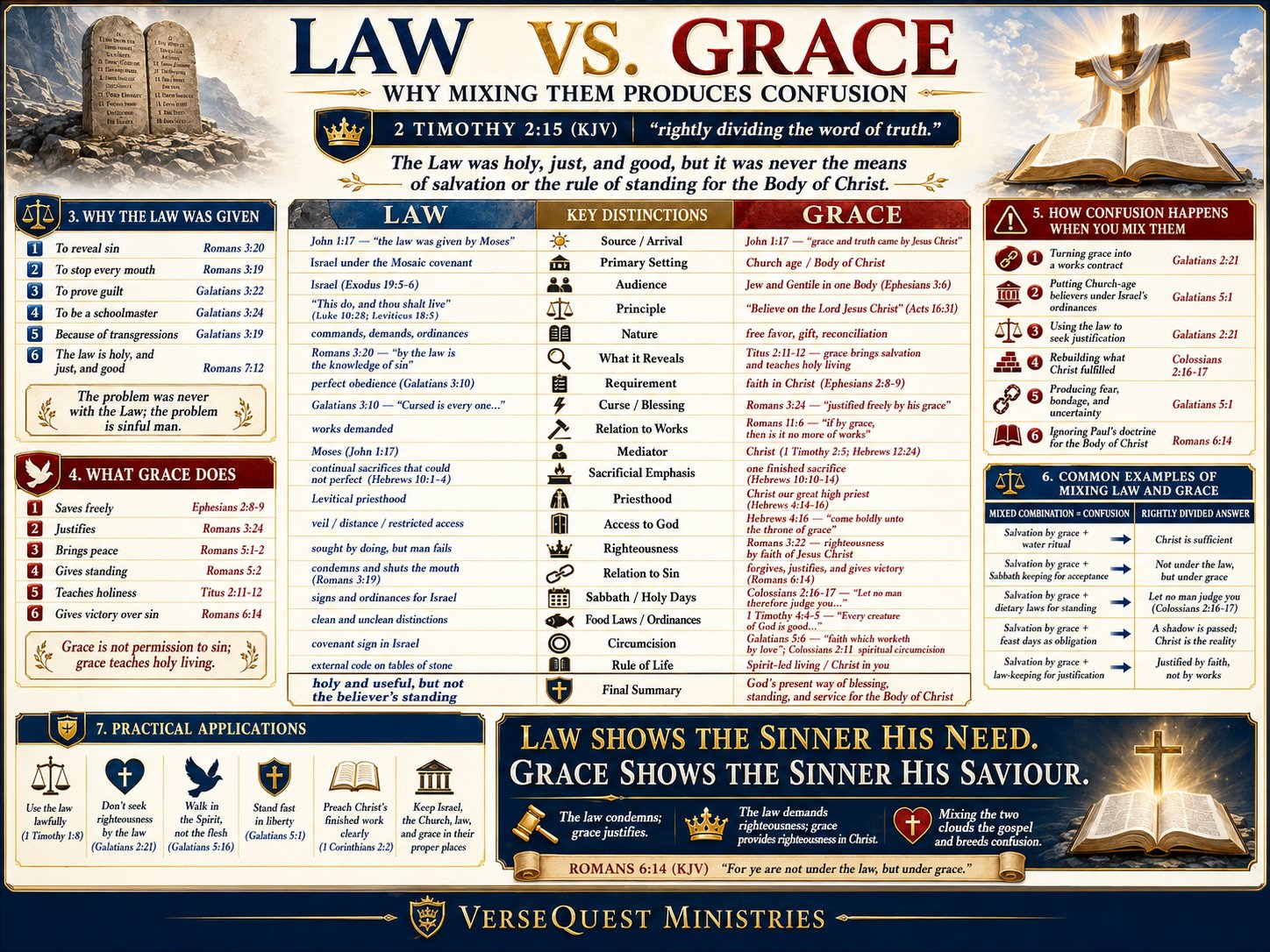
- Law vs. Grace Bible Study Chart – Why Mixing Them Produces Confusion (KJV)
- Compare law and grace with this detailed KJV Bible study chart explaining salvation, justification, holiness, Israel’s Mosaic covenant, Christian liberty, and the danger of mixing law with the gospel.
- $3.99
- Add to cart
-
-
Ages To Come
-
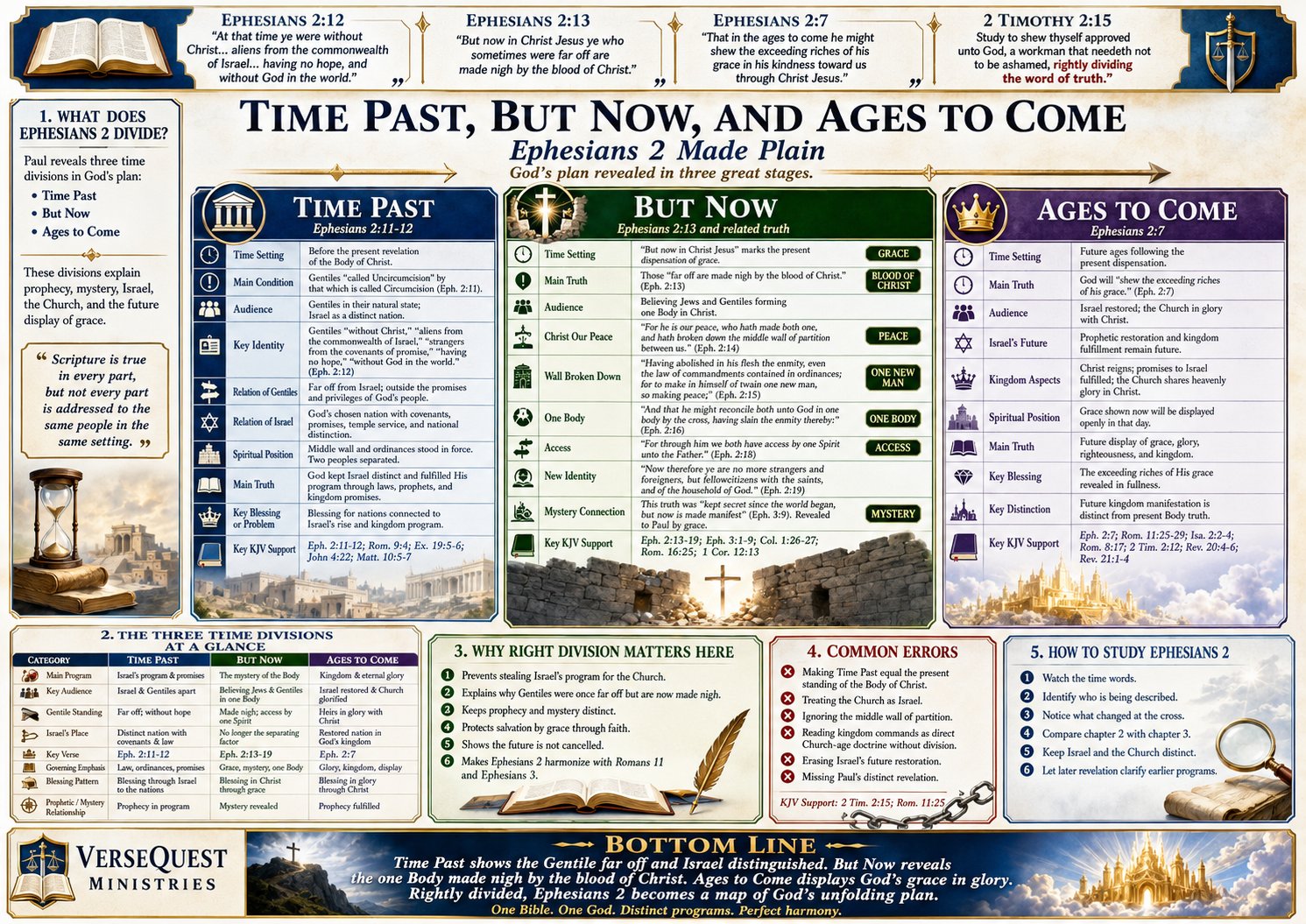
- Time Past, But Now, and Ages to Come – Ephesians 2 Rightly Divided KJV Bible Study Chart
- Understand Ephesians 2 with this detailed KJV chart explaining Time Past, But Now, Ages to Come, Gentile distance, the one Body, Israel’s future, and the importance of right division.
- $3.99
- Add to cart
-
-
Doctrine
-
-50%
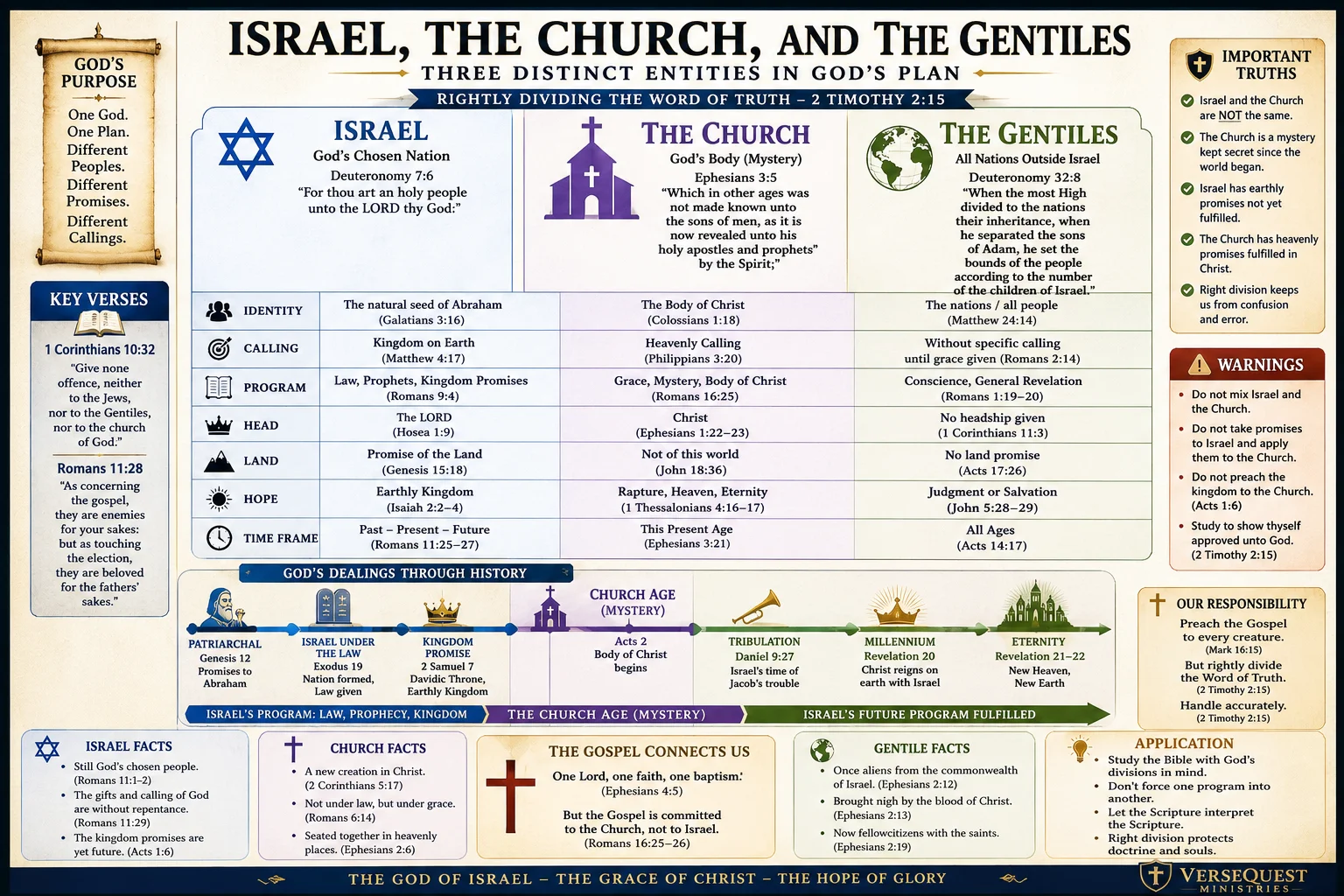
- Israel, the Church, and the Gentiles Chart — KJV Rightly Divided
- Premium printable KJV Bible study chart comparing Israel, the Church, and the Gentiles as three distinct entities in God’s plan. Rightly divided, visually organized, and designed for teaching and personal…
- Original price was: $10.00.$4.99Current price is: $4.99.
- Add to cart
-
-50%
-
Holy Spirit in the Believer
-
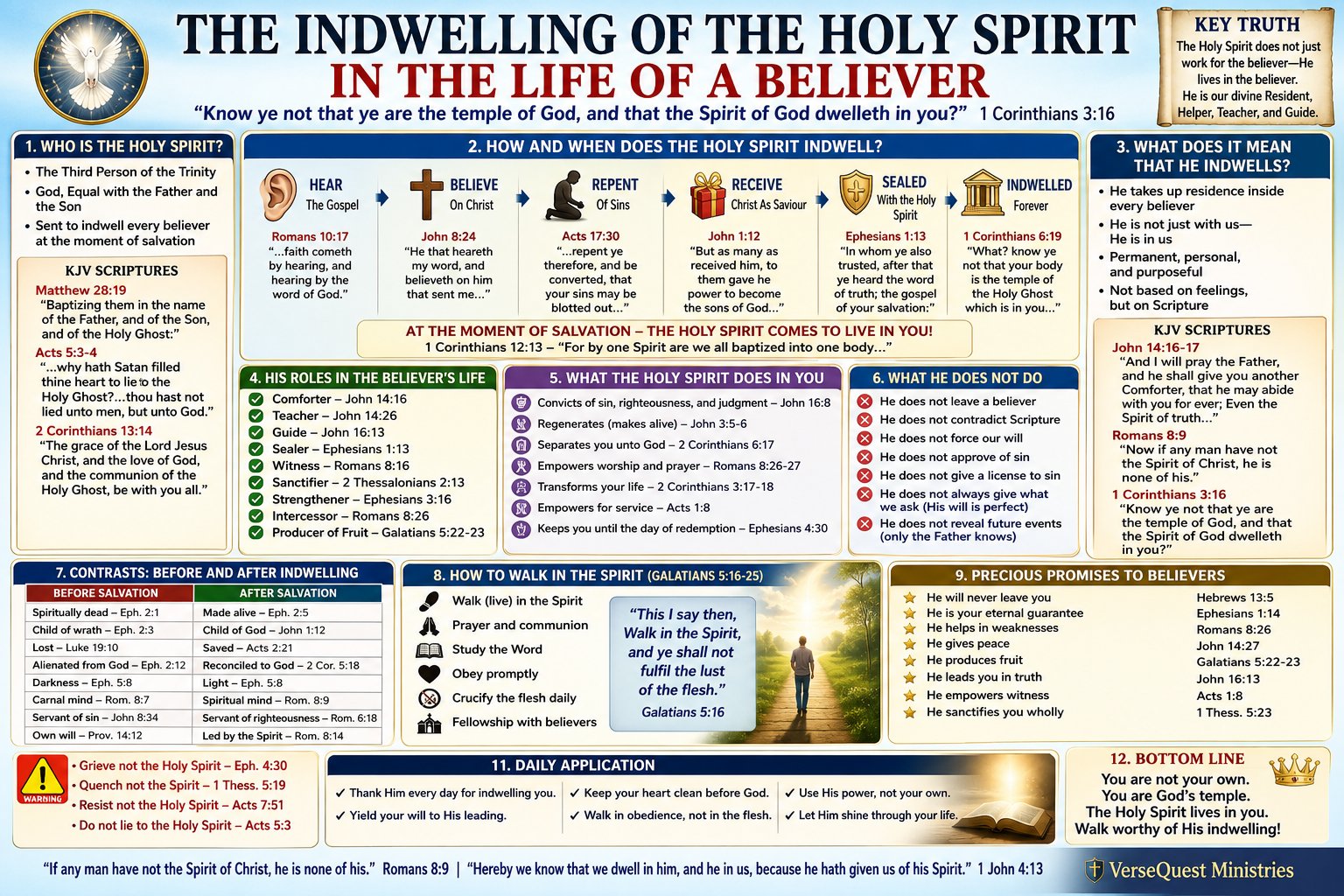
- The Indwelling of the Holy Spirit in the Life of a Believer – Sealed, Taught, Guided, Sanctified, and Empowered (KJV Bible Study Chart)
- Understand the indwelling of the Holy Spirit with this detailed KJV chart covering salvation, regeneration, spiritual baptism, sealing, guidance, prayer, sanctification, fruit, Christian service, and walking in the Spirit.
- $3.99
- Add to cart
-
-
Mystery of Iniquity
-
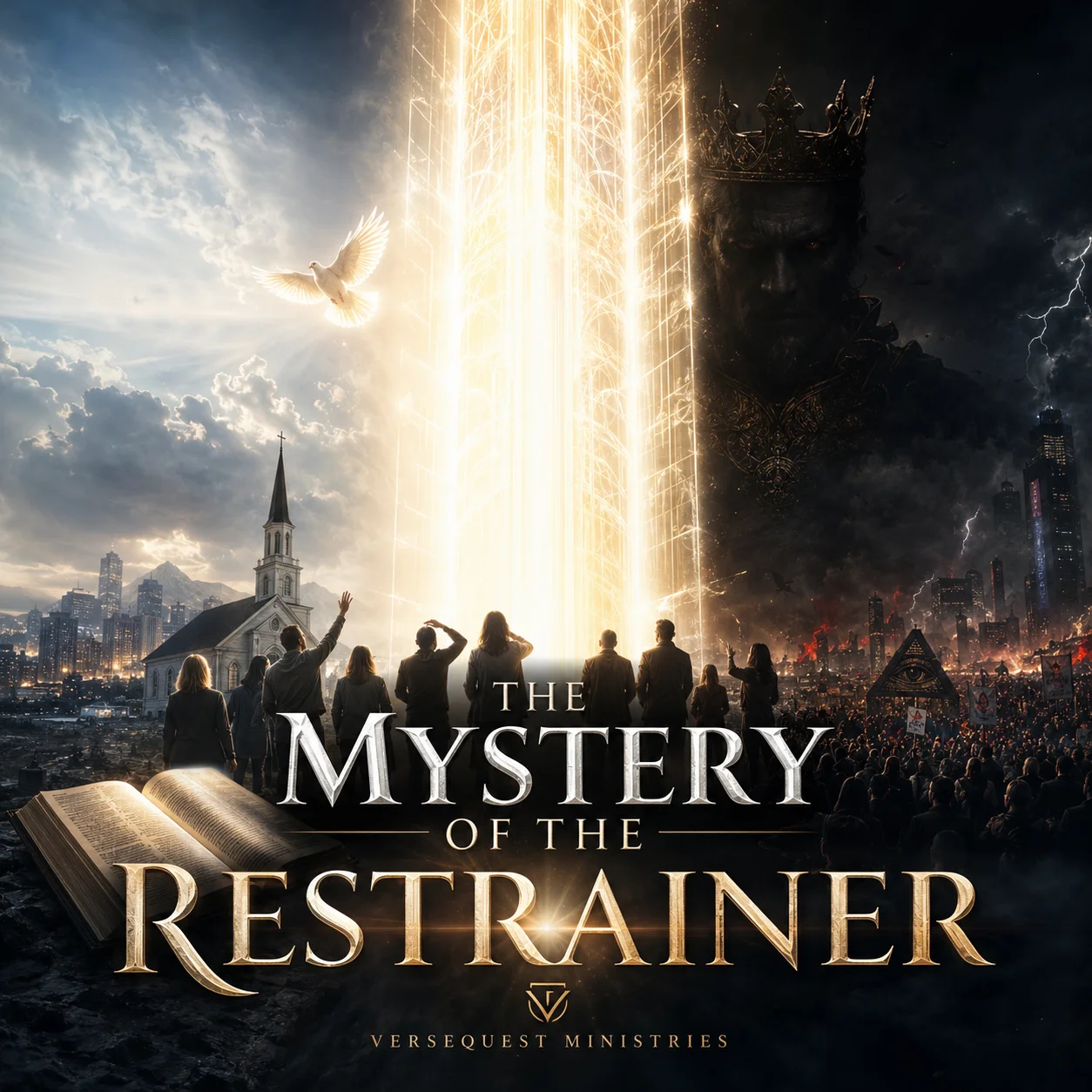
- The Mystery of the Restrainer — 50-Study Bible Prophecy PDF Book
- Who is restraining the man of sin—and what happens when that restraint is removed? The Mystery of the Restrainer is a massive 399-page, 50-study Bible prophecy book examining 2 Thessalonians…
- $9.99
- Add to cart
-