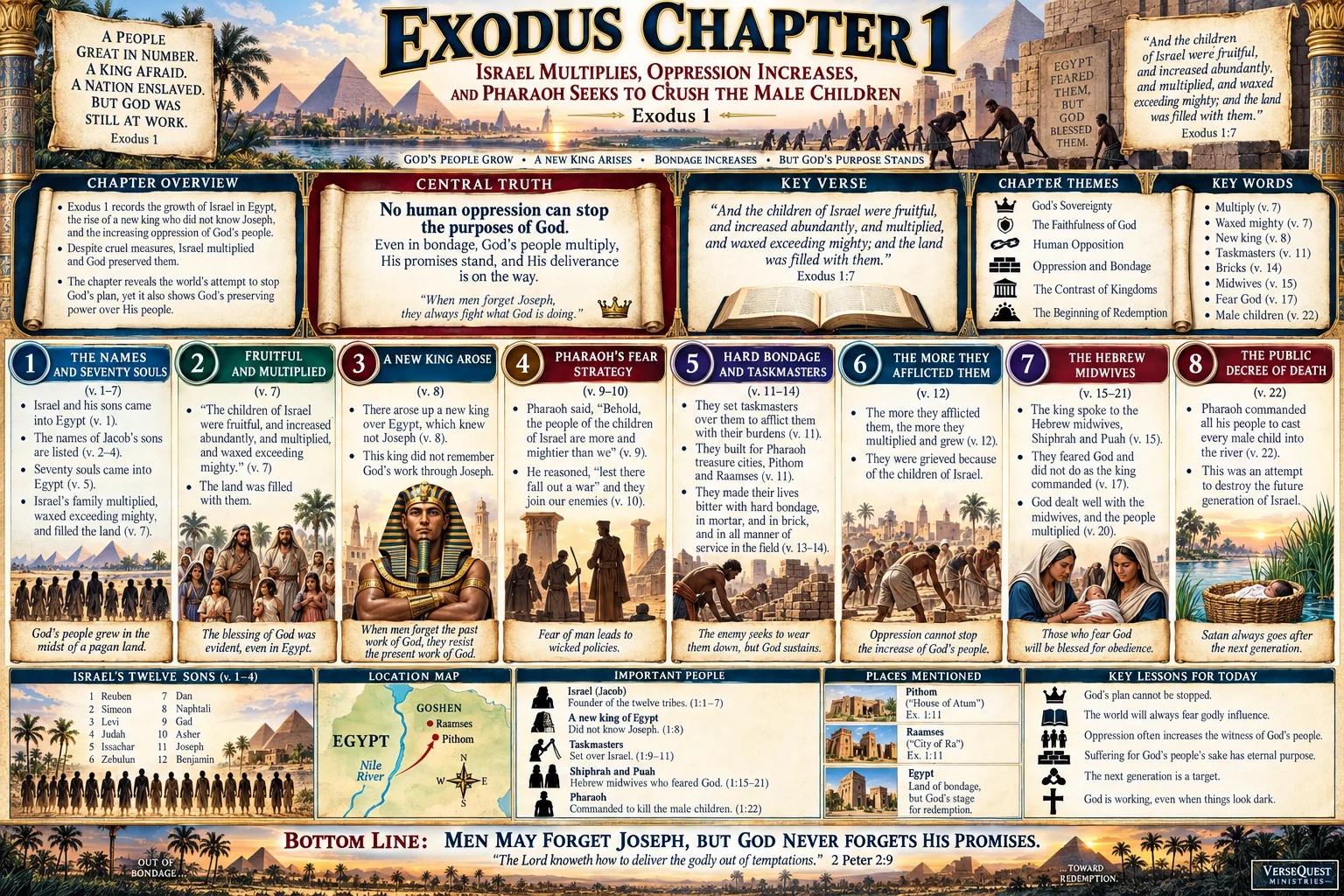
Exodus 1 – Israel Multiplies Under Oppression: Pharaoh’s Bondage, the Hebrew Midwives, and the Decree Against the Male Children (KJV Bible Study Chart)
Explore Exodus 1 with this detailed KJV Bible study chart tracing Israel’s growth from the seventy souls who entered Egypt into a numerous people feared by Pharaoh. Follow the rise of the new king who knew not Joseph, the appointment of Egyptian taskmasters, the hard bondage in mortar and brick, and the building of Pithom and Raamses. The chart also examines Pharaoh’s order to the Hebrew midwives Shiphrah and Puah, their courageous refusal because they “feared God,” and the final decree commanding that every Hebrew son be cast into the river. Exodus 1 establishes the conflict that will drive the book: human oppression intensifies while God’s covenant people multiply and His purpose moves steadily toward redemption. Ideal for Bible study, Sunday school, homeschool, sermon preparation, and Exodus teaching.
$4.99
Description
Exodus 1: Israel Multiplies, Oppression Increases, and Pharaoh Seeks to Crush the Male Children is a detailed KJV Bible study chart introducing the book of Exodus and tracing Israel’s transformation from one extended family in Egypt into a numerous people feared by a new king. The chapter connects directly with Genesis, showing that Joseph’s generation passes away while God’s covenant purposes continue.
Exodus begins by naming the sons of Israel who entered Egypt. The household originally numbered seventy souls, but the situation changes dramatically after Joseph and his generation die. Scripture emphasizes Israel’s extraordinary increase: “the children of Israel were fruitful, and increased abundantly, and multiplied, and waxed exceeding mighty.” The land becomes filled with them. What God promised to Abraham, Isaac, and Jacob is visibly advancing even in a foreign land.
A new king arises “which knew not Joseph.” He sees Israel’s growth not as blessing but as a political threat. Pharaoh fears that the Hebrews may become greater, join Egypt’s enemies during war, and escape from the land. Fear therefore becomes the foundation of oppressive policy.
Taskmasters are appointed to afflict Israel with burdens. The Hebrews build the treasure cities Pithom and Raamses, and their lives are made bitter with hard bondage in mortar, brick, and field labor. Yet Pharaoh’s strategy produces the opposite of its intended effect: “the more they afflicted them, the more they multiplied and grew.” Egypt can increase the burden, but it cannot cancel God’s covenant promise.
Pharaoh next attacks Israel’s future through the Hebrew midwives Shiphrah and Puah. He commands them to kill the male Hebrew children at birth while allowing the daughters to live. The women refuse because they “feared God.” Their allegiance to God stands above the wicked command of the king, and Scripture says God deals well with them and makes them houses.
When the private plan fails, Pharaoh turns murder into public policy. He commands all his people to cast every Hebrew son into the river. Exodus 1 therefore ends with Israel numerous yet enslaved, oppressed, and facing an assault upon the next generation.
But Pharaoh is not the controlling power in the story. The very river appointed as an instrument of death will become part of the story of Moses’ preservation in Exodus 2. Exodus 1 introduces the great conflict that drives the book: an earthly king seeks to enslave and destroy God’s people, while the covenant God remains faithful to His promises and prepares redemption.
Exodus 1, Israel in Egypt, children of Israel, seventy souls, twelve sons of Jacob, new king over Egypt, Pharaoh, Joseph forgotten, Israel multiplies, fruitful and multiplied, Egyptian oppression, hard bondage, taskmasters, Pithom, Raamses, brick and mortar, Shiphrah, Puah, Hebrew midwives, fear of God, male children, Pharaoh’s decree, covenant faithfulness, persecution, preservation, beginning of redemption
Exodus 1 deliberately connects the new book with Genesis by naming the sons of Israel who entered Egypt. Verse 5 gives the household total as seventy souls, while Joseph was already in Egypt. The family that entered Egypt small does not remain small. After Joseph, his brethren, and that generation die, Israel becomes remarkably fruitful and numerous.
The language of Exodus 1:7 is deliberately emphatic: the Israelites are “fruitful,” “increased abundantly,” “multiplied,” and “waxed exceeding mighty.” This growth continues the covenant promises concerning Abraham’s seed. Egypt is a foreign land, but geographical displacement cannot prevent God from fulfilling His Word.
A new king arises “which knew not Joseph.” Whether this means he literally possessed no historical knowledge of Joseph or deliberately refused to recognize Joseph’s significance, the practical result is the same: Joseph’s former service no longer protects his descendants politically. Pharaoh sees Israel’s population as a threat and fears that they may join an enemy and leave Egypt.
His first strategy is oppression. Taskmasters afflict Israel and force the people to build the treasure cities Pithom and Raamses. Verse 14 describes hard service in mortar, brick, and field labor. The bondage becomes bitter, yet verse 12 states that “the more they afflicted them, the more they multiplied and grew.” Pharaoh’s policy cannot reverse the blessing of God.
The next attack becomes more direct. Pharaoh commands the Hebrew midwives, Shiphrah and Puah, to kill the sons while preserving the daughters. The women refuse because “the midwives feared God.” Their conduct is significant: Scripture normally teaches submission to rulers, but human authority does not possess the right to command murder. Fear of God takes precedence over obedience to a wicked decree.
God deals well with the midwives, the people continue multiplying, and the women receive houses. Their faithfulness does not stop Pharaoh from escalating the persecution, however.
Verse 22 turns the secret order into a national decree: “Every son that is born ye shall cast into the river.” Pharaoh is now attempting to destroy Israel’s future generation. This prepares directly for Exodus 2 and the birth of Moses.
The river that Pharaoh designates for death becomes connected with Moses’ preservation. That irony introduces one of Exodus’s recurring themes: God can overturn the instruments of oppression and use the enemy’s own circumstances to advance deliverance.
Exodus 1 should first be read as literal history concerning Israel, not as Church-age allegory. Applications regarding persecution, courage, and providence are legitimate, but Israel’s bondage and coming national redemption retain their historical and dispensational setting. Pharaoh appears powerful, but the chapter’s deeper message is that God’s covenant purpose remains unstoppable.
Exodus 1 is useful for teaching that God’s promises are not defeated by hostile governments, persecution, changing generations, or difficult circumstances. It demonstrates how fear can drive rulers toward increasingly wicked policies and how believers must fear God above man when human authority commands evil. Shiphrah and Puah provide an important example of courageous obedience, while Israel’s multiplication under affliction shows that opposition cannot prevent God from fulfilling His purpose. The chapter is excellent for personal Bible study, Sunday school, homeschool instruction, Bible institutes, sermon preparation, Exodus surveys, studies of persecution and civil authority, and lessons on courage, providence, generational faithfulness, and trusting God during oppression.
King James Bible, Strong’s Concordance, Thompson Chain-Reference Bible, Treasury of Scripture Knowledge, Nave’s Topical Bible, Genesis 46–50 study notes, Exodus 1–6 study notes, Exodus chronology charts, Israel in Egypt maps, Abrahamic covenant studies, Genesis 15 prophecy studies, Moses life timelines, Hebrew midwives studies, Acts 7 Stephen studies, Hebrews 11 faith studies, biblical civil authority studies, persecution Scripture chains, VerseQuest Exodus charts
Related products
-
Doctrine Series
-
-14%
- Judas Iscariot and the Coming Antichrist – Premium KJV Prophecy Study
- A massive 459-page premium KJV prophecy study tracing the biblical connection between Judas Iscariot, the son of perdition, and the coming Antichrist. This detailed VerseQuest Ministries PDF examines Judas’ betrayal,…
- Original price was: $34.99.$29.99Current price is: $29.99.
- Add to cart
-
-14%
-
KJV Studies
-
-67%
- The Blood of Christ – 66-Study KJV Bible Doctrine PDF
- A 441-page premium VerseQuest PDF featuring 66 detailed KJV Bible studies on the blood of Jesus Christ. This powerful doctrinal resource covers redemption, justification, propitiation, cleansing, access to God, eternal…
- Original price was: $29.99.$9.99Current price is: $9.99.
- Add to cart
-
-67%
-
Jesus Christ
-
-10%
- The Lord Jesus Christ Made Plain – 637-Page KJV Bible Study
- A massive 637-page, 100-part KJV Bible study on the Person and work of the Lord Jesus Christ. This premium VerseQuest resource covers His deity, incarnation, blood, cross, resurrection, present ministry,…
- Original price was: $39.00.$34.99Current price is: $34.99.
- Add to cart
-
-10%
-
The Rapture
-
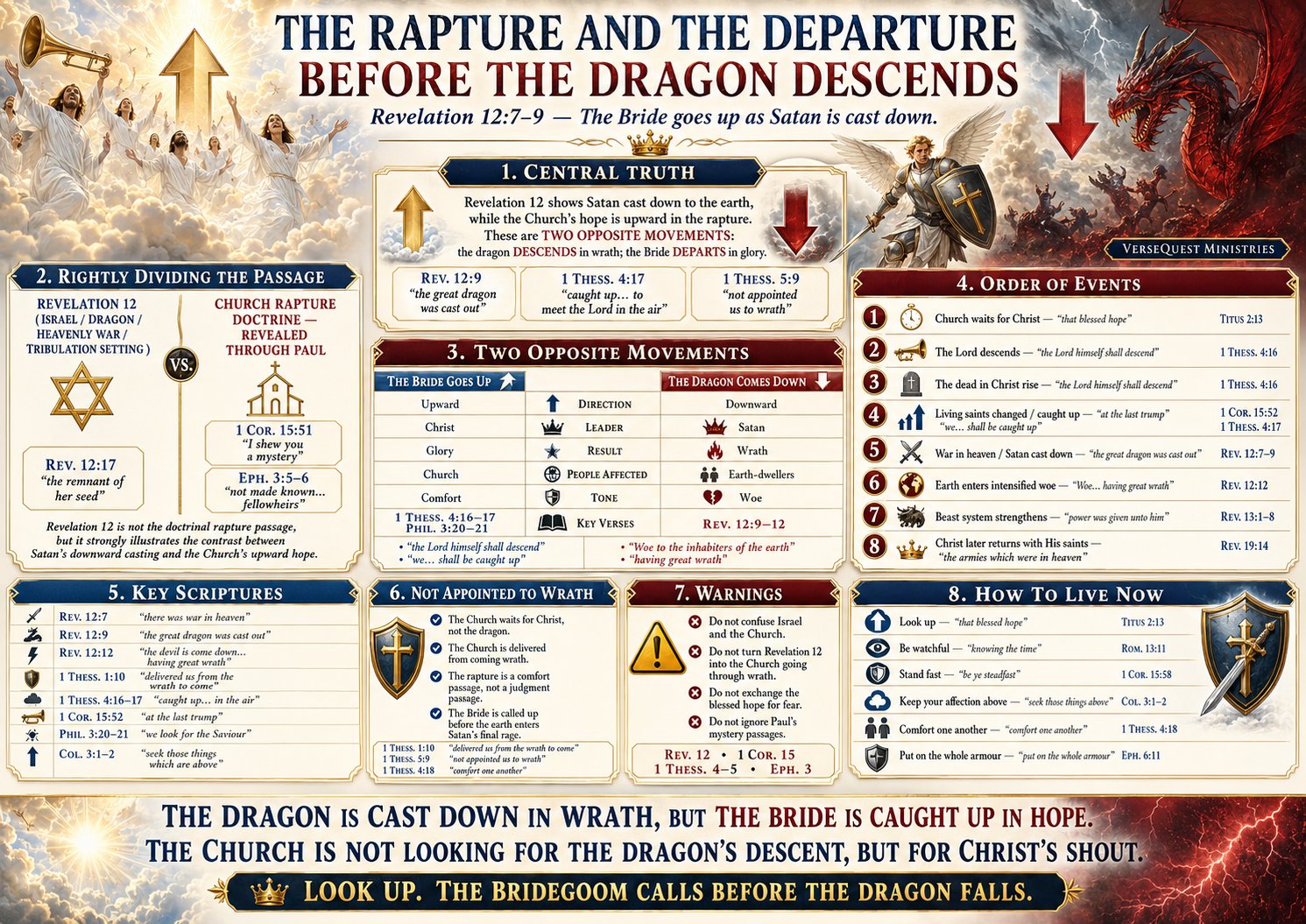
- The Rapture and the Departure Before the Dragon Descends – Printable Bible Study Chart
- Printable KJV Bible study chart on The Rapture and the Departure Before the Dragon Descends, showing the Bride caught up before Satan is cast down in wrath. This premium VerseQuest…
- $4.99
- Add to cart
-
-
Doctrine Series