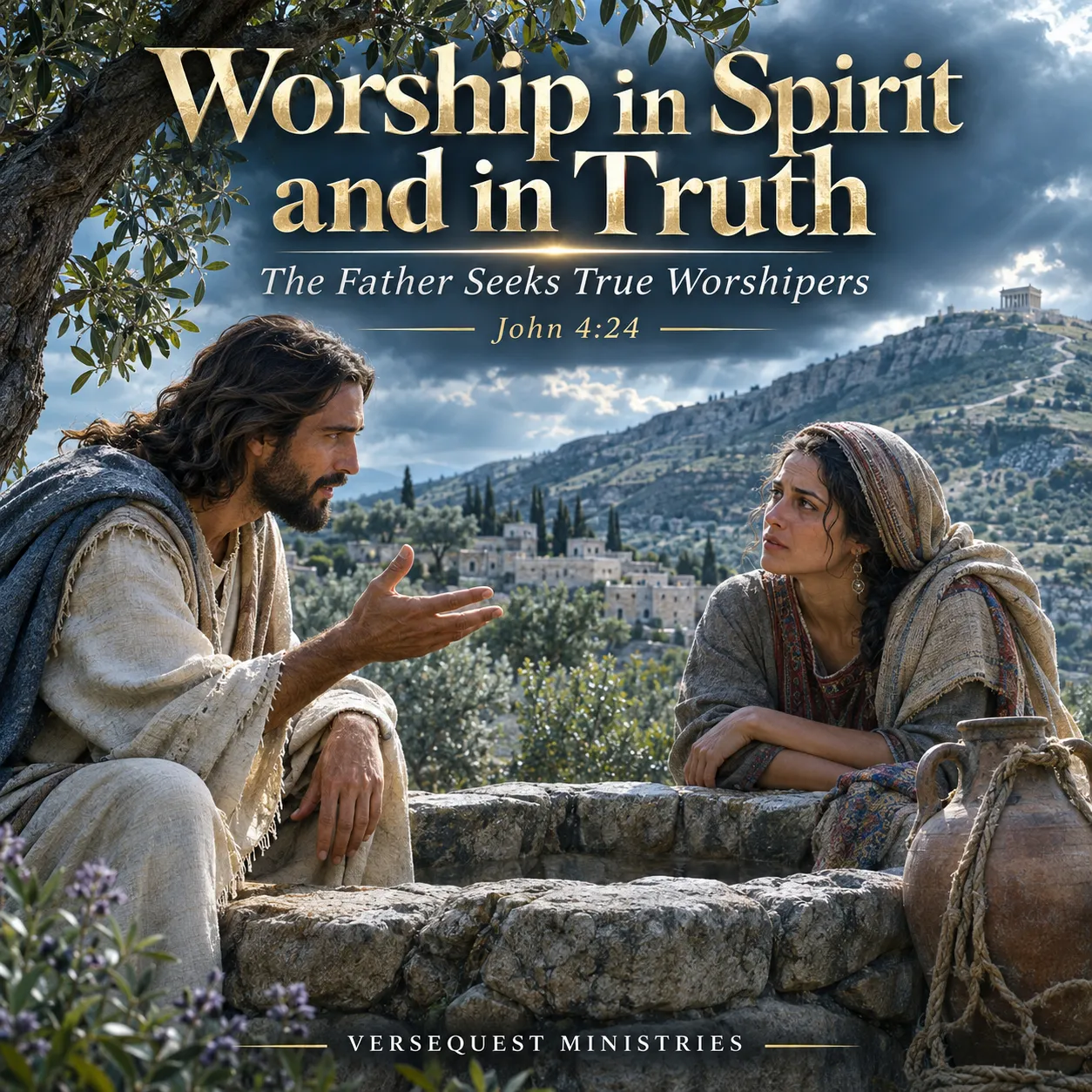
Sermon Title:
Worship in Spirit and in Truth
Key Passage:
John 4:24
“God is a Spirit: and they that worship him must worship him in spirit and in truth.” (John 4:24)
Series:
The Book God Gave
Topic:
The Biblical Meaning of True Worship, the Nature of God as Spirit, the Necessity of Worship According to Divine Truth, the Difference Between Sincere Devotion and Religious Performance, and the Believer’s Responsibility to Glorify the Father Through Jesus Christ Rather Than Human Traditions, Emotional Experiences, or Outward Ceremonies
Book:
John
Speaker:
Paul Tackett
Suggested Sermon Text:
Genesis 4:3–7; Genesis 22:1–19; Genesis 28:10–22; Exodus 3:1–15; Exodus 20:1–26; Exodus 25:8–22; Exodus 32:1–35; Deuteronomy 6:4–15; Deuteronomy 12:1–14; Joshua 24:14–24; 1 Kings 8:22–61; 1 Kings 18:17–39; 2 Kings 17:24–41; 2 Chronicles 7:1–22; Nehemiah 8:1–12; Psalm 29:1–2; Psalm 95:1–11; Psalm 96:1–13; Psalm 100:1–5; Psalm 115:1–18; Psalm 119:9–16, 89–105, 160; Isaiah 1:10–20; Isaiah 6:1–8; Isaiah 29:13; Isaiah 42:8; Isaiah 55:6–11; Isaiah 66:1–2; Jeremiah 7:1–15; Daniel 3:1–30; Malachi 1:6–14; Matthew 4:8–10; Matthew 6:1–18; Matthew 15:1–20; Matthew 21:12–17; Matthew 22:34–40; Matthew 23:1–39; Mark 7:1–23; Luke 4:5–8; Luke 10:38–42; Luke 18:9–14; John 1:1–18, 29–34; John 2:13–25; John 3:1–21; John 4:1–54; John 6:35–69; John 8:12–59; John 10:1–30; John 14:1–27; John 15:1–26; John 16:7–15; John 17:1–26; John 20:24–31; Acts 2:36–47; Acts 4:8–12; Acts 7:44–60; Acts 17:16–34; Romans 1:16–25; Romans 3:21–28; Romans 4:4–8; Romans 5:1–11; Romans 6:1–14; Romans 8:1–17; Romans 10:9–17; Romans 12:1–2; Romans 14:7–19; 1 Corinthians 2:9–16; 1 Corinthians 6:19–20; 1 Corinthians 10:14–33; 1 Corinthians 11:17–34; 1 Corinthians 12:12–27; 1 Corinthians 14:1–40; 1 Corinthians 15:1–4; 2 Corinthians 3:4–18; 2 Corinthians 4:1–6; 2 Corinthians 5:14–21; 2 Corinthians 6:14–18; Galatians 2:20; Galatians 4:4–7; Galatians 5:16–26; Ephesians 1:3–14; Ephesians 2:8–22; Ephesians 3:12–21; Ephesians 4:1–32; Ephesians 5:15–21; Philippians 2:1–11; Philippians 3:1–11; Philippians 4:4–9; Colossians 1:12–22; Colossians 2:6–23; Colossians 3:1–17; 1 Thessalonians 1:2–10; 1 Thessalonians 5:16–24; 1 Timothy 2:1–8; 1 Timothy 4:1–16; 2 Timothy 2:15; 2 Timothy 3:14–17; Titus 2:11–14; Hebrews 4:14–16; Hebrews 7:24–28; Hebrews 9:1–28; Hebrews 10:1–25; Hebrews 12:18–29; Hebrews 13:15–16; James 1:22–27; 1 Peter 2:4–10; 1 John 1:5–10; 1 John 4:1–6; 1 John 5:11–15.
Short Sermon Description:
John 4:24 contains one of the Lord Jesus Christ’s clearest declarations concerning the nature of genuine worship: “God is a Spirit: and they that worship him must worship him in spirit and in truth.” This sermon examines those words within the extraordinary conversation between Jesus Christ and the Samaritan woman at Jacob’s well, where a discussion concerning living water, spiritual need, and the promised Messiah develops into a confrontation over the proper place and manner of worship. The message establishes the historical conflict between Jewish and Samaritan worship, the significance of Mount Gerizim and Jerusalem, and why Jesus declared that the coming hour would change the question of worship from a dispute over sacred locations to the necessity of worshiping the Father in spirit and truth. Special attention is given to the declaration “Ye worship ye know not what,” the statement “salvation is of the Jews,” the revelation that God is a Spirit, and the requirement that genuine worship agree with His nature and revealed truth. The sermon explains why sincerity alone cannot make false doctrine acceptable, why outward religious correctness cannot excuse a heart filled with pride and hypocrisy, and why biblical worship must never be reduced to music, emotional excitement, elaborate ceremonies, religious traditions, or impressive church performances. Drawing upon John 4:1–42, Matthew 15, Romans 12, Philippians 3, Ephesians 2, Colossians 3, and other supporting passages, the outline distinguishes Christ’s earthly ministry to Israel and His dealings with the Samaritans from the Church-Age believer’s spiritual position and access to the Father through Jesus Christ by the Holy Spirit. The message examines the danger of worshiping a god constructed through human imagination, the necessity of spiritual regeneration, the authority of Scripture, the unique mediatorial office of Jesus Christ, and the importance of genuine reverence, thanksgiving, holiness, prayer, praise, and obedience. It also follows the Samaritan woman’s encounter with the Messiah into her testimony before the people of her city, demonstrating why true worship should direct attention toward Jesus Christ rather than the personality of the worshiper. Preachers, pastors, teachers, and Bible students will gain a comprehensive, KJV-based, rightly divided, sermon-ready framework for teaching worship in spirit and truth, the deity of Jesus Christ, sound doctrine, spiritual sincerity, the dangers of religious hypocrisy, and the Christian’s responsibility to glorify God through the finished work of the Lord Jesus Christ.
WORSHIP IN SPIRIT AND IN TRUTH
Introduction
There is something terribly wrong with a religious system that can produce a magnificent performance for an hour on Sunday and then spend the remaining six days behaving as though Almighty God has never spoken. A man can enter an impressive building, stand beneath expensive lights, listen to beautiful music, participate in carefully rehearsed ceremonies, and leave convinced that he has worshiped God simply because he experienced a powerful emotional reaction. He may have shouted, cried, raised his hands, repeated familiar phrases, and described the entire experience as extraordinary. Yet he might never have seriously considered whether the teaching agreed with Scripture, whether the Lord Jesus Christ was being glorified, or whether the activity was directed toward the true God revealed in the Bible. Another man may condemn all that emotional excitement while proudly congratulating himself because his congregation possesses the correct hymnal, traditional furniture, conservative clothing, and an orderly service. But his heart may be filled with self-righteousness, resentment, and contempt for everyone who does not share his preferred arrangements. One crowd mistakes excitement for worship, while the other mistakes external respectability for holiness. The Lord Jesus Christ exposes both errors with one declaration: “God is a Spirit: and they that worship him must worship him in spirit and in truth.” Notice those final words. Christ does not say that worship becomes acceptable merely because a person feels sincere. He does not say that an outward ceremony is sufficient because its participants know the correct religious vocabulary. He identifies two inseparable requirements: spirit and truth. The greatest question concerning worship is not whether the congregation enjoyed the service, whether the music sounded beautiful, or whether the preacher received applause. The question is whether Almighty God was worshiped according to His revealed truth.
The setting of John 4 makes this declaration especially important. Jesus Christ was traveling through Samaria when He came to Jacob’s well near the city of Sychar. The Gospel records the Lord speaking with a Samaritan woman who had come to draw water. The encounter immediately crossed social and religious boundaries that were deeply significant in that historical setting. The Jews and Samaritans possessed longstanding religious disagreements, and John 4:9 explicitly acknowledges that the Jews had no dealings with the Samaritans. Christ began with an ordinary request for water but quickly directed the conversation toward the living water He could provide. He exposed the woman’s circumstances, demonstrated supernatural knowledge, and brought the discussion to the question of worship. The woman raised the dispute between the worship associated with the Samaritan mountain and the worship associated with Jerusalem. It was not a trivial controversy about which building had the most comfortable benches. It involved the history of Israel, the division between Jewish and Samaritan religious traditions, and competing claims concerning the place where God ought to be worshiped. Jesus did not respond by declaring that every religious tradition was equally valid. He said, “Ye worship ye know not what: we know what we worship: for salvation is of the Jews” (John 4:22). Then He announced the coming hour when true worshipers would worship the Father in spirit and in truth. The Saviour did not solve the disagreement by pretending doctrine did not matter. He identified the truth and then revealed a greater reality concerning worship.
This passage also requires careful attention to the divisions of Scripture. Jesus Christ was speaking during His earthly ministry, before His death, burial, resurrection, and the later revelation of the mystery concerning the body of Christ entrusted to the Apostle Paul. The discussion belonged to the historical setting of Israel and Samaria, including the temple, the prophetic promises, and the expectation of the Messiah. We must not erase that setting by pretending the Samaritan woman already possessed the complete Pauline revelation concerning the Church’s heavenly position. Nevertheless, Christ’s declaration concerning the nature of God and the necessity of true worship remains an essential foundation for understanding Christian worship. Under grace, saved believers possess access to the Father through Jesus Christ by the Holy Spirit. Their salvation rests upon the finished work of the Saviour, not upon ceremonies, buildings, music, religious excitement, or personal dedication. Yet the same grace that saves them instructs them to glorify God in their bodies and spirits, study His word, walk in the Spirit, and live faithfully. The Church must therefore distinguish biblical spiritual worship from religious entertainment and sound doctrine from lifeless pride. True worship is not the art of making men feel religious while leaving them ignorant of God. It is the reverent response of those who approach the living God according to the truth He has revealed and the salvation He has provided through Jesus Christ. That is the doctrine before us in John 4:24.
I. THE CONVERSATION AT JACOB’S WELL REVEALS THAT SPIRITUAL NEED IS GREATER THAN RELIGIOUS APPEARANCE
Key Text: John 4:5–15
Supporting Texts: John 3:1–21; John 4:1–26; John 6:35–40; John 7:37–39; Romans 3:21–28; Ephesians 2:8–10
The Lord Jesus Christ arrived at Jacob’s well near Sychar, weary from His journey, and sat upon the well while His disciples went into the city to buy food. A woman of Samaria came to draw water, and Christ said unto her, “Give me to drink.” The woman immediately recognized the unusual character of the request. She asked why a Jew would request water from a Samaritan woman. Jesus answered by directing her toward the gift of God and the identity of the One speaking with her. John 4:10 declares, “If thou knewest the gift of God, and who it is that saith to thee, Give me to drink; thou wouldest have asked of him, and he would have given thee living water.” The discussion moves from ordinary water necessary for physical life toward the spiritual provision available through Jesus Christ. The woman initially understood the conversation according to the circumstances immediately before her. The well was deep, and Jesus possessed no visible vessel for drawing water. But the Saviour was introducing a provision that could never be obtained through another ordinary journey to Jacob’s well. The contrast is essential: physical water addresses a temporary bodily need, while the gift Christ describes concerns spiritual life.
John 4:13–14 records Jesus declaring, “Whosoever drinketh of this water shall thirst again: But whosoever drinketh of the water that I shall give him shall never thirst.” Those words reach far beyond the ordinary disputes of religious institutions. The woman could belong to a community with established worship customs, recognize Jacob as an important ancestral figure, and possess definite opinions concerning the proper location of worship while remaining in need of the spiritual life Jesus Christ could provide. The same problem appears whenever religious association is mistaken for salvation. A man may know the order of a church service, understand the language of familiar hymns, possess an impressive family history of religious activity, and still be lost because he has never trusted the Saviour. The outward framework of religion cannot manufacture eternal life. It may teach people where to stand, what to say, and when to participate, but it cannot replace the saving work of Jesus Christ. A man can spend his entire life carrying a religious bucket to an earthly well and never receive the living water that only the Saviour can provide.
This distinction must be understood in its dispensational setting without losing its central testimony concerning Christ. The Lord was speaking before Calvary, and the Samaritan woman did not yet possess the full Church-Age gospel concerning His death, burial, and resurrection. Yet the conversation unmistakably identifies Jesus Christ as the One possessing the gift of spiritual life. The later Pauline revelation explains that sinners are saved by grace through faith in the finished work of Jesus Christ, not through works of righteousness performed by the flesh. The Church should therefore refuse to make worship services, religious experiences, or participation in ordinances substitutes for salvation. A lost sinner does not become regenerated because he attended an emotional service or followed the traditions of his family. He needs the Saviour. Before a man begins congratulating himself upon how faithfully he worships, he ought to examine whether he has actually received the salvation that no amount of religious activity can provide.
Main Truth: Jesus Christ directed the Samaritan woman from ordinary physical needs toward the gift of spiritual life, demonstrating that religious heritage, ceremonial participation, and outward worship cannot replace salvation through the Saviour.
II. THE DISPUTE BETWEEN GERIZIM AND JERUSALEM EXPOSES THE LIMITATIONS OF RELIGION CENTERED UPON LOCATION
Key Text: John 4:19–21
Supporting Texts: Deuteronomy 12:5–14; 1 Kings 8:22–30; 2 Kings 17:24–41; John 2:13–21; John 4:19–24; Acts 7:44–50; Hebrews 9:1–12
After Jesus exposed the woman’s marital circumstances, she acknowledged His prophetic knowledge and raised the subject of worship. John 4:20 records her statement: “Our fathers worshipped in this mountain; and ye say, that in Jerusalem is the place where men ought to worship.” That verse identifies a real historical disagreement. The Samaritans associated worship with Mount Gerizim, while the Jews recognized Jerusalem as the divinely appointed center associated with the temple and Israel’s worship under the law. The controversy cannot be understood properly if the preacher simply reduces it to two groups arguing about which hill possessed a more attractive view. The location of Israel’s worship was connected with divine revelation and the covenant arrangements given through Moses. Jerusalem was not selected merely because Jewish people preferred its architecture. The temple belonged to the historical program of God with Israel. Yet the Samaritan woman was standing before the very Messiah to whom the Scriptures pointed, and her question about competing religious locations provided the occasion for a revelation greater than the geographical disagreement itself.
Jesus responded in verse 21, “Woman, believe me, the hour cometh, when ye shall neither in this mountain, nor yet at Jerusalem, worship the Father.” The Lord was announcing a coming change in the manner in which worship would be understood and practiced. That statement did not mean the history of Israel had become false or that every previous command concerning the tabernacle and temple had been a human invention. God had actually appointed those arrangements under the law. But the Son of God was revealing that worship would not remain confined to the dispute between Gerizim and Jerusalem. The coming hour would bring a greater reality centered upon the Father, spiritual worship, and divine truth. The Christian must recognize both parts of the statement. We should neither erase Israel’s legitimate historical worship arrangements nor attempt to make the Church return to them as though the finished work of Jesus Christ had accomplished nothing. The problem was not that Jerusalem had never mattered in the history of God’s dealings with Israel. The problem was that the woman was discussing the proper location of worship while standing before the Messiah who would reveal its greater fulfillment.
The practical application is searching. Religious people still spend tremendous amounts of time arguing about buildings, architecture, furniture, denominational customs, and external arrangements. Some of those matters deserve appropriate consideration. A congregation should provide an orderly place for believers to gather, teach Scripture, and fulfill their responsibilities. But the building itself does not become the source of salvation or the guarantee of acceptable worship. A magnificent sanctuary cannot compensate for false doctrine. A modest meeting room does not make biblical teaching inferior. Neither does worship become more spiritual simply because people gather outside, meet in a house, or reject every traditional arrangement. The real question concerns the truth of God and the spiritual condition of those participating. A church can possess a beautiful building and a spiritually empty message, while another congregation may meet in an ordinary room and faithfully proclaim the word of God. The value of worship is not determined by the cost of the walls surrounding it.
Main Truth: Christ’s teaching concerning Gerizim and Jerusalem reveals that true worship cannot be reduced to sacred geography or impressive buildings, while preserving the historical reality of Israel’s divinely established worship under the law.
III. “YE WORSHIP YE KNOW NOT WHAT” DEMONSTRATES THAT SINCERITY CANNOT SUBSTITUTE FOR THE TRUTH
Key Text: John 4:22
Supporting Texts: John 4:19–26; Isaiah 29:13; Matthew 15:7–9; Mark 7:6–13; Romans 1:18–25; Acts 17:22–31; 2 Timothy 3:16–17
Jesus Christ did not respond to the Samaritan woman by declaring that every religious belief was equally acceptable if its adherents possessed sincere feelings. He said, “Ye worship ye know not what: we know what we worship.” Those words should permanently settle the modern claim that sincerity is the highest standard of worship. The Samaritans possessed religious customs, a historical identity, and genuine convictions concerning their place of worship. But Christ identified a deficiency in their knowledge. Their devotion did not automatically make their understanding correct. Religious sincerity can coexist with serious doctrinal error. A man may sincerely believe that another mediator is necessary for salvation, but his sincerity cannot overturn the declaration that Jesus Christ is the one Mediator between God and men. A person may sincerely trust religious ceremonies to remove sin, but those ceremonies cannot improve upon the finished sacrifice of Christ. Another may sincerely worship a god constructed according to his personal preferences, but that sincerity cannot transform an imaginary deity into the living God revealed in Scripture. A man may be sincerely wrong, and sincerity does not become truth merely because the error is expressed with tears in his eyes.
This does not mean every Samaritan individual was insincere or that all religious practices outside Jerusalem were equally corrupt. The Lord was making a particular doctrinal statement within an actual historical controversy. The Samaritan worship tradition differed from the revelation and worship established for Israel. Jesus identified that deficiency and connected salvation with the Jews. The statement must be respected rather than softened until it means nothing. But the principle also applies to the way Christians examine modern religious claims. A congregation may possess energetic music, impressive attendance, enthusiastic testimonies, and a preacher capable of moving people emotionally while teaching false doctrine concerning Jesus Christ, salvation, the Holy Spirit, or the Scriptures. The emotional response cannot make the error biblical. The Church must test what is preached and practiced according to the word of God. Second Timothy 3:16 declares, “All scripture is given by inspiration of God, and is profitable for doctrine, for reproof, for correction, for instruction in righteousness.” The Bible is not a decorative object placed near the pulpit to make the religious performance look respectable. It is the authority by which doctrine and practice must be examined.
The opposite danger must also be recognized. A man may understand many correct doctrines and become so proud of his knowledge that he treats every struggling believer with contempt. He may possess the right terminology while displaying a spirit governed by anger, vanity, or hypocrisy. But Christ does not present truth as a substitute for spiritual sincerity. He requires worship in spirit and in truth. Correct doctrine is essential, yet outward correctness cannot justify a heart deliberately devoted to self-glory. Matthew 15:8 records the Lord’s warning concerning people who honor God with their lips while their hearts remain far from Him. Truth without genuine devotion can become another occasion for fleshly pride, while devotion without truth may become worship directed toward something God never revealed. True worship requires both.
Main Truth: Sincere feelings and inherited religious traditions cannot make false doctrine acceptable, while genuine worship must unite spiritual devotion with the truth God has revealed.
IV. “SALVATION IS OF THE JEWS” IDENTIFIES THE DIVINE REVELATION AND THE MESSIAH THROUGH WHOM TRUE WORSHIP BECOMES POSSIBLE
Key Text: John 4:22–26
Supporting Texts: Genesis 12:1–3; Genesis 49:10; Deuteronomy 18:15–19; Psalm 2:1–12; Isaiah 9:6–7; Luke 1:30–33; John 1:11–18; John 4:25–42; Romans 1:16; Romans 9:1–5; Romans 11:1–29
After identifying the deficiency in Samaritan worship, Jesus declared, “for salvation is of the Jews.” Those words carry tremendous historical and doctrinal significance. The Lord was not teaching that Jewish people were naturally righteous or that an individual could obtain eternal life simply by possessing Israelite ancestry. He was identifying the nation through which God had given His covenants, promises, Scriptures, and the promised Messiah. The LORD called Abraham, established His covenant promises, dealt with Israel through Moses, raised up the prophets, and revealed His purpose concerning the coming Redeemer. Romans 9:4–5 later identifies the Israelites as those to whom belonged the adoption, glory, covenants, giving of the law, service of God, and promises, and declares that Christ came concerning the flesh through that people. The Samaritan woman was not merely discussing competing religious customs with another traveler. She was speaking with the promised Messiah of Israel. The salvation God had revealed through the Scriptures would not be accomplished through Samaritan religious traditions or a human attempt to combine contradictory systems. It would be accomplished through Jesus Christ. The Lord did not say salvation was of the Jews because every Jew was saved. He said it because God’s revealed plan of redemption came through the nation from which the promised Saviour entered the world.
The woman understood that a greater revelation was associated with the coming Messiah. John 4:25 records her statement: “I know that Messias cometh, which is called Christ: when he is come, he will tell us all things.” Jesus answered, “I that speak unto thee am he.” That declaration is the climax of the conversation. The issue is no longer merely which mountain possesses the proper religious claim. The promised Messiah is personally revealing Himself to the woman. He is the One who can provide living water, expose hidden spiritual need, and establish the truth concerning acceptable worship. Later in the chapter, the Samaritans who believed testified that Jesus Christ was “the Saviour of the world” (John 4:42). That statement is particularly important because it demonstrates that salvation was not restricted to Jewish ethnicity. The Messiah came through Israel, but the salvation provided through Him reaches beyond Israel. John 1:29 identifies Jesus as “the Lamb of God, which taketh away the sin of the world.” The nation through which He came must not be confused with the full scope of His saving provision.
Right division preserves this history without turning Israel and the Church into the same institution. Jesus was speaking during His earthly ministry, before the full revelation of the mystery concerning the body of Christ through the Apostle Paul. The Church should not claim that every national and earthly promise given to Israel has been transferred to itself merely because salvation is now proclaimed to Jew and Gentile alike. Romans 11 warns against Gentile boasting and establishes that God has not abandoned His purposes concerning Israel. Yet the present gospel of salvation through the death, burial, and resurrection of Jesus Christ is offered to sinners without distinction concerning their ethnic ancestry. Romans 3:22 declares that the righteousness of God is “unto all and upon all them that believe: for there is no difference.” Worship under grace must therefore be centered upon the Saviour whose completed work provides access to the Father. A man does not become an acceptable worshiper because he belongs to the correct ancestry, stands in the correct building, or repeats the correct ceremony. He must come to God through the Lord Jesus Christ, the Saviour whom the Father sent.
Main Truth: Salvation came through God’s revealed dealings with Israel and the promised Jewish Messiah, Jesus Christ, whose finished work provides salvation to all who believe without erasing the biblical distinction between Israel and the Church.
V. “GOD IS A SPIRIT” REVEALS WHY HE CANNOT BE WORSHIPED ACCORDING TO MAN’S IMAGINARY REPRESENTATIONS
Key Text: John 4:24
Supporting Texts: Exodus 20:1–6; Deuteronomy 4:12–19; Psalm 115:1–8; Isaiah 40:18–26; John 1:1–18; John 4:23–24; John 14:6–11; Acts 17:22–31; Romans 1:18–25; Colossians 1:15–19
Jesus begins the central declaration with these words: “God is a Spirit.” That statement establishes a truth concerning the nature of God that must govern the entire subject of worship. The living God is not a material idol manufactured through human craftsmanship. He is not a carved figure requiring men to carry Him from one location to another. He is not confined to the dimensions of a temple, the boundaries of a mountain, or the architectural design of a religious institution. The God who created heaven and earth cannot be reduced to a physical object fashioned by the hands of His creatures. Acts 17:24–25 records Paul declaring concerning the true God, “God that made the world and all things therein, seeing that he is Lord of heaven and earth, dwelleth not in temples made with hands; Neither is worshipped with men’s hands, as though he needed any thing.” That statement should bring every religious pretension into proper perspective. Man did not create God, cannot sustain God, and possesses no authority to redesign Him according to personal imagination. The living God does not require human beings to build Him a more comfortable residence before He becomes worthy of worship. He is the Creator, not the possession of His creatures.
The statement also exposes the folly of idolatry. Throughout the Old Testament, the LORD condemned the worship of false gods represented through carved images and manufactured idols. Israel repeatedly encountered the temptation to imitate the religious practices of surrounding nations. The golden calf in Exodus 32 demonstrates how quickly people can exchange divine revelation for a visible object around which they arrange religious excitement. The idol possessed no independent divine power, but the people behaved as though the object could represent the authority that had delivered them from Egypt. Romans 1 describes fallen humanity changing the glory of the uncorruptible God into images resembling created things. These passages establish the danger of attempting to make God conform to the imagination of man. Modern idolatry is not restricted to physical statues. A person may construct a false understanding of God through philosophy, personal preference, cultural expectations, or religious traditions that contradict Scripture. He may insist that God could never judge sin because such judgment would offend his understanding of love. Another may imagine a deity who approves every human appetite. But a god constructed from personal preferences is not necessarily the God revealed in the Bible. When a man decides what God must be like before he opens the Scriptures, he has placed his imagination upon the throne and invited the living God to become its servant.
Yet “God is a Spirit” must not be distorted into a denial of the literal incarnation of Jesus Christ. John 1:14 declares, “And the Word was made flesh, and dwelt among us.” The eternal Son of God truly became man without ceasing to be God. His humanity was genuine, His death was real, and His bodily resurrection was literal. The truth concerning the spiritual nature of God does not mean the Father and the Son are merely different appearances of one Person pretending to converse with Himself. John 4 itself distinguishes the Father being worshiped from the Son who is revealing Him. The Holy Spirit likewise possesses His own divine ministry. Nor does the spiritual nature of God make material creation inherently wicked or render the use of a physical meeting place sinful. It establishes that God cannot be contained or adequately represented by the objects men manufacture. The Christian must worship the God who has revealed Himself through Scripture and through His Son—not a deity imagined by human philosophy or confined within the walls of a religious building.
Main Truth: God is Spirit and cannot be confined to physical locations or represented according to human imagination, while the true revelation of His nature must be understood alongside the literal incarnation, deity, and saving work of Jesus Christ.
VI. “IN SPIRIT” REQUIRES GENUINE INWARD WORSHIP RATHER THAN MERE OUTWARD RELIGIOUS PERFORMANCE
Key Text: John 4:23–24
Supporting Texts: Psalm 51:16–17; Isaiah 29:13; Matthew 15:7–9; John 3:3–8; Romans 8:1–17; 1 Corinthians 6:19–20; Galatians 5:16–25; Ephesians 1:13–14; Philippians 3:3
Jesus declares that true worshipers “shall worship the Father in spirit and in truth.” The expression “in spirit” immediately directs attention beyond the outward form of religious observance. A person may physically participate in a ceremony while inwardly remaining indifferent toward the God supposedly being honored. He may stand when others stand, sing when others sing, bow when others bow, and repeat words at the proper moment without seriously considering their meaning. The activity may appear orderly and impressive, but the heart can remain far from the Lord. Isaiah 29:13 records the LORD’s rebuke concerning people whose worship was associated with outward expressions while their hearts were far removed from Him. Jesus Christ later applied that warning to the religious hypocrisy of His own day. Matthew 15:8 declares, “This people draweth nigh unto me with their mouth, and honoureth me with their lips; but their heart is far from me.” The problem was not that spoken words are inherently improper or that outward conduct never matters. It was that external religious activity had become separated from genuine inward devotion. A man can move his lips through an entire worship service without ever seriously directing his heart toward the God whose name he is speaking.
This distinction should concern both emotional and traditional religious movements. Some congregations equate worship with the intensity of the visible response. If people shout, weep, raise their hands, or appear overwhelmed, the service is automatically described as powerful. But an emotional reaction does not establish that the teaching was biblical or that the activity was directed toward the true God. People may become emotional during a theatrical performance, political speech, sporting event, or moving song without those experiences constituting divine worship. Conversely, another congregation may treat solemnity, silence, and orderly tradition as automatic evidence of superior spirituality. Yet a quiet building can contain proud hearts just as easily as a noisy one. Christ does not establish a decibel requirement for worship. He does not say that the loudest congregation is the most spiritual or that the most restrained congregation necessarily possesses the purest devotion. The question concerns whether the worship is genuinely directed toward the Father and agrees with His truth. A man can shout without worshiping, and he can remain silent without worshiping. The volume of the room does not reveal the condition of every heart within it.
For believers under the present dispensation of grace, the Pauline epistles explain the relationship between regeneration, the indwelling Holy Spirit, and spiritual worship. Ephesians 1:13 declares that believers are sealed with the Holy Spirit of promise after believing the gospel. Romans 8:9 establishes that those belonging to Christ possess the Spirit of God. Philippians 3:3 contains the remarkable statement, “For we are the circumcision, which worship God in the spirit, and rejoice in Christ Jesus, and have no confidence in the flesh.” That verse is particularly valuable because it connects spiritual worship with rejoicing in Christ and rejecting confidence in the flesh. The Church does not need to create the indwelling Spirit through extraordinary music, emotional manipulation, or religious excitement. The Spirit already dwells within those who belong to Jesus Christ. The Christian should therefore worship sincerely, walk in the Spirit, remain governed by Scripture, and refuse to make his natural personality the measure of spiritual devotion. True spiritual worship does not begin when the flesh becomes sufficiently excited. It belongs to those who recognize their dependence upon God and approach Him through the salvation and spiritual life provided by Jesus Christ.
Main Truth: Worship in spirit requires genuine inward devotion rather than empty outward performance, while Church-Age believers worship through their relationship to Jesus Christ and the indwelling Holy Spirit rather than confidence in the flesh.
VII. “IN TRUTH” ESTABLISHES THE WORD OF GOD AS THE AUTHORITY FOR ACCEPTABLE WORSHIP
Key Text: John 4:23–24
Supporting Texts: Psalm 119:89–105, 160; John 8:31–32; John 14:6; John 17:17; Acts 17:10–12; Romans 10:17; 2 Timothy 2:15; 2 Timothy 3:16–17; 1 John 4:1–6
The second requirement in Christ’s declaration is “in truth.” These words immediately destroy the idea that worship becomes acceptable merely because the worshiper feels sincere. The Father is not worshiped properly through falsehood. A congregation cannot replace biblical teaching with human philosophy, emotional entertainment, or religious traditions and then claim that sincerity has made the activity pleasing to God. Truth is not established through a majority vote, the popularity of a preacher, the age of a religious institution, or the intensity of a spiritual experience. The truth concerning God must come from God Himself. John 17:17 records Jesus praying, “Sanctify them through thy truth: thy word is truth.” That statement identifies divine revelation as the proper standard. The Christian should therefore examine what is being taught, sung, prayed, and practiced according to Scripture. If a song teaches false doctrine concerning salvation, beautiful music cannot transform that error into truth. If a preacher denies the deity of Jesus Christ, an impressive sermon delivery cannot make his message acceptable. If a religious institution teaches that sinners must purchase redemption through ceremonies or good works, centuries of tradition cannot improve upon the gospel of Jesus Christ. A lie does not become worship merely because somebody puts it to music, surrounds it with beautiful architecture, and persuades the congregation to sing it with enthusiasm.
This makes sound doctrine essential to genuine Christian worship. The believer must know whom he worships, understand the gospel by which he was saved, and recognize the authority of the word of God. The Bible identifies Jesus Christ as the eternal Son of God who became flesh, died for sinners, was buried, and rose again victorious over death. The Church-Age sinner is saved by grace through faith in the finished work of Christ, not through baptismal regeneration, religious ceremonies, personal righteousness, or the preservation of salvation through the works of the flesh. The believer is sealed with the Holy Spirit and possesses access to the Father through Jesus Christ. These are not optional matters to be discarded so that a worship service may become more agreeable to every religious opinion. First John 4:1 commands believers to “try the spirits whether they are of God: because many false prophets are gone out into the world.” The fact that a speaker possesses a Christian vocabulary does not establish that his teaching agrees with Scripture. The Church must be willing to examine religious claims rather than accepting them because they produce excitement or attract large crowds.
The command to worship in truth also requires that Scripture be rightly divided. Second Timothy 2:15 declares, “Study to shew thyself approved unto God, a workman that needeth not to be ashamed, rightly dividing the word of truth.” God has dealt with men according to the revelation and responsibilities appropriate to different periods of biblical history. The law given to Israel must not be confused with the Church’s salvation under grace. Israel’s temple worship must not be treated as though it remains the required approach for every saved believer today. The future earthly kingdom promises must not be dissolved into the Church’s present spiritual position. Neither should sound dispensational understanding become an excuse for ignoring the moral and spiritual instruction found throughout the Scriptures. All Scripture is inspired and profitable, but it must be interpreted according to its proper setting. The Christian who worships in truth should therefore possess a serious concern for doctrine, interpretation, and obedience. God did not give His people a Bible so they could decorate the pulpit with it while building their worship around whatever the flesh finds most entertaining. He gave them His word so they could know the truth and worship Him accordingly.
Main Truth: Worship in truth requires submission to God’s written revelation, sound doctrine, and Scripture rightly divided, rejecting the idea that sincerity, religious popularity, or emotional excitement can make false teaching acceptable.
VIII. “THE FATHER SEEKETH SUCH TO WORSHIP HIM” REVEALS THAT TRUE WORSHIP IS DIRECTED TOWARD GOD RATHER THAN HUMAN ADMIRATION
Key Text: John 4:23
Supporting Texts: Isaiah 42:8; Isaiah 66:1–2; Matthew 4:8–10; Matthew 6:1–18; Matthew 15:7–9; John 4:19–26; Romans 11:33–36; 1 Corinthians 10:31; Colossians 3:16–17
Jesus declares concerning true worshipers, “for the Father seeketh such to worship him.” That statement should redirect the attention of every congregation away from itself and toward Almighty God. Worship is not fundamentally an activity in which the audience becomes the final judge of whether the service was successful. The central concern is not whether the music satisfied everybody’s preferences, whether the preacher possessed an entertaining personality, or whether every participant experienced the emotional reaction he expected. The Father seeks worshipers who worship Him in spirit and in truth. He does not need human beings to supply something lacking in His divine nature. The Creator is perfectly sufficient in Himself. But He has revealed the kind of worship that agrees with His nature and truth. The Christian must therefore recognize that worship is directed toward God, not toward the admiration of men. The purpose of worship is not to make the congregation impressed with itself. It is to glorify the Lord who alone is worthy of worship.
This exposes the danger of religious performance. Matthew 6 records Jesus warning against religious activities undertaken for the purpose of receiving human recognition. He condemned hypocrites who prayed publicly because they wanted to be seen of men. The problem was not that public prayer is inherently sinful; Scripture contains legitimate examples of believers praying together. The problem was that the activity had become a performance for an audience. The same danger exists whenever worship becomes a method of advertising the spirituality of the participants. A preacher may become more interested in his reputation than the faithful proclamation of Scripture. A singer may become more interested in applause than the truth of the words being sung. A congregation may become so concerned with impressive presentation that sound doctrine and reverence are treated as obstacles to an entertaining experience. Yet the opposite extreme is equally dangerous. A religious leader may boast about how traditional, serious, or uncompromising his congregation appears while secretly enjoying the superiority he believes those customs establish. The flesh can turn a concert into an idol, and it can turn an old-fashioned church service into an idol just as easily when human recognition becomes the object of devotion.
There is also a practical question every believer should consider: Would the worship remain sincere if nobody praised the participants afterward? Would the preacher still teach faithfully if his congregation were small? Would the Christian still pray if nobody knew how long he had prayed? Would the musician still desire to honor the Lord if no public recognition followed? Would the person giving an offering remain generous if his name were never announced? These questions are not designed to condemn legitimate public ministry or suggest that every encouraging word from another believer is improper. Scripture commands Christians to encourage one another and recognize faithful service appropriately. But human recognition must never become the foundation of worship. First Corinthians 10:31 declares, “Whether therefore ye eat, or drink, or whatsoever ye do, do all to the glory of God.” The Lord’s glory must remain greater than human reputation. The Father is not searching for the most impressive religious performance mankind can manufacture. He seeks true worshipers whose devotion is sincere and whose worship agrees with the truth He has revealed.
Main Truth: True worship is directed toward the glory of the Father rather than the admiration of men, requiring sincerity, humility, reverence, and faithfulness without turning religious activity into entertainment or personal self-promotion.
IX. THE SAMARITAN WOMAN’S TESTIMONY SHOWS THAT AN ENCOUNTER WITH THE TRUE MESSIAH SHOULD DIRECT OTHERS TOWARD CHRIST
Key Text: John 4:28–42
Supporting Texts: John 4:23–26; John 20:30–31; Acts 4:10–12; Romans 10:9–17; Romans 12:1–2; 1 Corinthians 6:19–20; 1 Corinthians 14:26–33; Ephesians 2:18; Colossians 3:16–17; Philippians 3:3
The conversation at Jacob’s well did not end with a discussion of religious geography or an abstract definition of worship. Jesus Christ revealed Himself as the promised Messiah, and the woman responded by going into the city and speaking to others about Him. John 4:28–29 records that she left her waterpot, went her way into the city, and said to the men, “Come, see a man, which told me all things that ever I did: is not this the Christ?” The woman’s testimony was not a complete theological exposition of every doctrine that would later be revealed through the Apostle Paul. It was a personal witness concerning the One she had encountered. She did not establish herself as a new mediator of salvation or demand that the people accept her authority in place of Christ’s. She directed them toward Jesus. Later in the chapter, many Samaritans believed because of her testimony, and others believed because they heard the Lord Himself. Their final confession identified Jesus Christ as the Saviour of the world. The progression is significant. The woman began with questions concerning water and worship. She encountered the Messiah. Her testimony then directed others toward Him. True worship does not build its final monument to the person who experienced it. It directs attention toward the Saviour who is worthy of the glory.
The Church today should understand that principle while preserving the passage’s historical setting. John 4 records an event during Christ’s earthly ministry, before the full revelation of the Church as one body in Jesus Christ. We should not treat the Samaritan woman as though she had already received every doctrine revealed in the Pauline epistles. Nevertheless, the central testimony concerning Jesus Christ remains essential. Under the present dispensation, the Church proclaims the gospel that Christ died for our sins according to the Scriptures, was buried, and rose again the third day according to the Scriptures. The sinner receives eternal life through faith in that finished work. The believer then possesses access to the Father through Jesus Christ by the Holy Spirit. Worship should therefore include genuine thanksgiving for redemption, reverent prayer, faithful teaching, scripturally sound praise, fellowship, and obedience. Colossians 3:16 declares, “Let the word of Christ dwell in you richly in all wisdom,” and continues with instruction concerning teaching, admonishing, psalms, hymns, and spiritual songs, singing with grace in the heart to the Lord. The word of Christ and genuine praise belong together. Music is not inherently a substitute for worship, but music cannot become a substitute for truth.
Romans 12:1 provides another important aspect of practical Christian devotion: “I beseech you therefore, brethren, by the mercies of God, that ye present your bodies a living sacrifice, holy, acceptable unto God, which is your reasonable service.” Paul addresses people already saved and appeals to them according to the mercies of God. Their service does not purchase redemption. It is the fitting response of those who have received redemption. First Corinthians 6:20 likewise commands believers to glorify God in their bodies and spirits, which are God’s. Consequently, worship must not become something confined to a scheduled religious gathering while the rest of life remains governed by the flesh. A man should not sing about holiness on Sunday while practicing dishonesty on Monday. He should not speak eloquently about charity while continually mistreating his household. He should not claim to worship God in truth while refusing correction from Scripture. Nor should he use these responsibilities as another method of boasting about his personal righteousness. The believer belongs to Jesus Christ, and his conduct should glorify the Saviour whose blood purchased him. The Christian who truly worships in spirit and in truth should not be satisfied with a religious performance that ends when the service is over. His worship should be reflected in a life that continues honoring the Lord after the congregation has gone home.
Main Truth: Genuine worship should direct others toward Jesus Christ and produce faithful Christian testimony, thanksgiving, biblical teaching, praise, and practical obedience without confusing those responsibilities with the finished work through which salvation is received.
Conclusion
John 4:24 contains one of the most searching declarations concerning worship in the entire Bible: “God is a Spirit: and they that worship him must worship him in spirit and in truth.” Those words were spoken by the Lord Jesus Christ during His encounter with the Samaritan woman at Jacob’s well. The woman raised a longstanding dispute concerning the proper place of worship, identifying the Samaritan mountain and Jerusalem as the competing locations. Jesus did not dismiss the historical truth concerning God’s dealings with Israel, nor did He pretend that every religious tradition was equally acceptable. He declared, “Ye worship ye know not what: we know what we worship: for salvation is of the Jews.” Then He directed the conversation toward the coming hour when true worshipers would worship the Father in spirit and in truth. The statement revealed something greater than the geography of an earthly religious institution. God is Spirit, and He cannot be confined to a building or reduced to an idol constructed through human imagination. He must be worshiped according to His true nature and revealed word. The Samaritan woman was standing before the Messiah Himself, the One through whom God would accomplish redemption. The discussion ultimately led to the testimony of the Samaritans that Jesus Christ is the Saviour of the world. The lesson is not that worship becomes acceptable wherever a person happens to feel religious. It is that the living God must be worshiped according to His truth, and that truth directs the sinner toward the Lord Jesus Christ.
The passage also exposes two errors that continue corrupting religious worship. One substitutes emotional excitement for spiritual truth. It treats impressive music, dramatic presentation, extraordinary experiences, and the approval of the congregation as evidence that God has been honored. But a religious experience cannot make false doctrine true. The other error possesses correct religious terminology while allowing pride, hypocrisy, resentment, and spiritual indifference to govern the heart. It may defend biblical truth publicly while neglecting genuine devotion privately. Jesus Christ condemns both errors through the inseparable requirements of spirit and truth. Worship must not become emotional entertainment without sound doctrine, nor should doctrinal knowledge become a platform for fleshly self-exaltation. Under the present dispensation of grace, the saved believer possesses access to the Father through Jesus Christ by the Holy Spirit. His salvation rests upon the finished work of the Saviour, not upon church attendance, music, ceremonial observance, religious emotion, or personal achievement. Yet the grace that saves him also instructs him concerning worship, holiness, thanksgiving, prayer, charity, and faithful service. The Church must study Scripture, rightly divide the word of truth, preserve the distinction between Israel and the Church, reject false doctrine, and glorify the Lord according to what He has revealed. A church service may impress every person in attendance and still fail to honor God if the truth has been abandoned. A congregation may possess every outward mark of respectability and still be spiritually deficient if its heart is far from the Lord.
So take the King James Bible and examine what worship means in your life. Are you worshiping the God who has revealed Himself in Scripture, or have you gradually constructed a deity who approves whatever your flesh desires? Are you more concerned with the emotional atmosphere of a service than the truth being proclaimed? Have you become so attached to religious traditions that you consider your preferred arrangements more important than what God has written? Are you singing words that agree with Scripture, or have you accepted false doctrine because the music sounds beautiful? Are you studying the Bible, rightly dividing the word of truth, and learning to glorify the Father through Jesus Christ? Or have you allowed your knowledge to become another reason for pride and contempt toward those who are still learning? Do you approach the Lord with genuine reverence, or has worship become something you perform for the admiration of other people? And when the service ends, does your conduct reflect the Saviour whose name you have been praising? If these questions expose something requiring correction, return to the Scriptures. Read John 4 in its complete context. Understand the history of Israel and Samaria. Recognize the divine identity of Jesus Christ. Study what the Apostle Paul teaches concerning salvation, the indwelling Holy Spirit, the Church, and the believer’s reasonable service. Reject every attempt to substitute emotional excitement for truth or external religious correctness for sincere devotion. Worship the Father through Jesus Christ. Walk in the Spirit. Give thanks. Pray. Sing with understanding. Practice charity. Maintain sound doctrine. And remember that the highest purpose of Christian worship is not making men impressed with the Church, but glorifying the Lord who purchased the Church through His blood. The true measure of worship is not how deeply the congregation was moved by the performance, but whether the living God was honored in spirit and in truth according to the revelation He has given.
Final Call
If you are lost, you cannot obtain eternal life by participating in a worship service, singing religious songs, joining a church, being baptized, following ancient ceremonies, or becoming emotionally overwhelmed during a sermon. You may possess an impressive knowledge of religious traditions while remaining without salvation because you have never personally believed the gospel. The Samaritan woman knew the historical controversy concerning worship on Mount Gerizim and at Jerusalem, but she needed to know the Messiah who stood before her. Likewise, the modern sinner needs more than a religious experience. He needs the Lord Jesus Christ. The Bible declares, “For all have sinned, and come short of the glory of God” (Romans 3:23). No sinner can purchase righteousness through the works of the flesh. But the gospel announces “that Christ died for our sins according to the scriptures; And that he was buried, and that he rose again the third day according to the scriptures” (1 Corinthians 15:3–4). Jesus Christ shed His blood for sinners and rose again victorious over death. Romans 4:5 declares that God justifies the ungodly who believe on Him. Ephesians 2:8–9 teaches salvation by grace through faith, not of works. Acts 16:31 says, “Believe on the Lord Jesus Christ, and thou shalt be saved.” Do not confuse sincerity with salvation. Do not imagine that an impressive worship experience can replace the finished work of Calvary. Believe the gospel. Trust the Lord Jesus Christ. Receive eternal life through faith in the risen Saviour. You cannot worship your way into redemption through religious performance. You must receive the salvation accomplished by Jesus Christ, the only Saviour through whom sinners can come unto God.
If you are saved, remember that the Lord has already redeemed you through His blood, justified you through faith, sealed you with the Holy Spirit, and provided access to the Father through Jesus Christ. Those blessings should produce gratitude, reverence, humility, and faithful devotion rather than spiritual carelessness. Stop judging worship exclusively by how much excitement a service produces. Stop treating music, religious customs, impressive buildings, or public recognition as substitutes for biblical truth. Stop imagining that correct doctrinal terminology gives you permission to cultivate pride, hypocrisy, or bitterness. Study the Scriptures. Rightly divide the word of truth. Understand the difference between Israel’s former worship under the law and the Church’s position under grace. Test every religious claim against what God has written. Worship the Father through Jesus Christ by the Holy Spirit. Pray sincerely. Sing with understanding. Give thanks. Maintain sound doctrine. Practice charity. Walk in the Spirit. Fulfill your responsibilities faithfully. Proclaim the gospel to lost sinners. And remember that worship is not something the Christian performs for an hour before returning to a life governed by the flesh. His entire life belongs to the Saviour who redeemed him. The Lord does not need another impressive religious performance that leaves His people unchanged. He calls for worship that is genuine, governed by truth, directed toward His glory, and consistent with the salvation provided through Jesus Christ.
Closing Verse:
“God is a Spirit: and they that worship him must worship him in spirit and in truth.” (John 4:24)
Closing Statement:
God is not honored because the music was beautiful, the building was magnificent, the congregation was emotional, or the preacher was impressive—He is honored when those who know Him through Jesus Christ approach Him with genuine devotion, submit to His revealed word, and worship the Father in spirit and in truth.