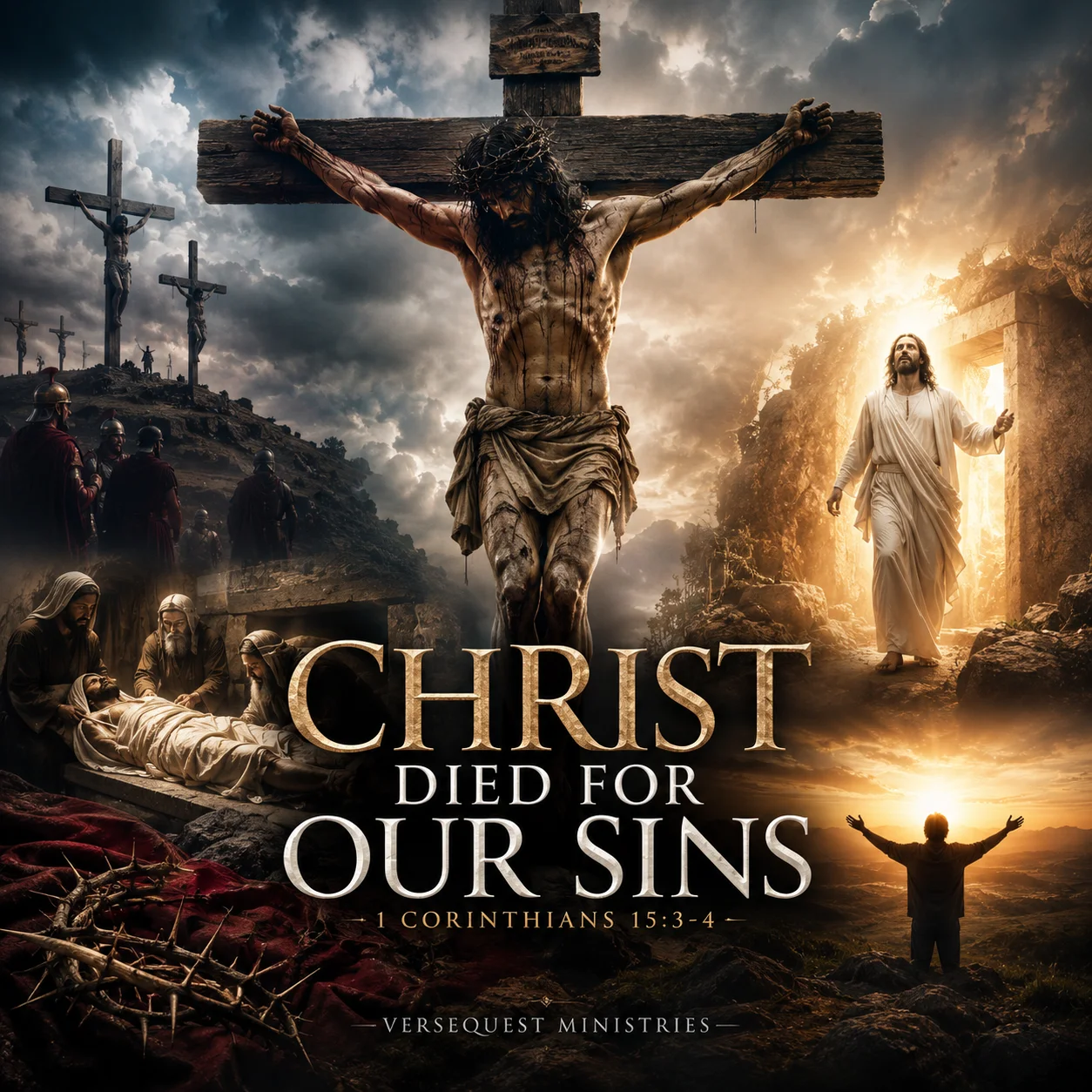
Sermon Title:
The Death That Paid It All: Christ Died for Our Sins
Key Passage:
1 Corinthians 15:3–4 — “For I delivered unto you first of all that which I also received, how that Christ died for our sins according to the scriptures; And that he was buried, and that he rose again the third day according to the scriptures.”
Series:
Foundations of the Gospel of Grace
Topic:
The Substitutionary Death, Burial, and Resurrection of Jesus Christ as the Saving Gospel
Book:
1 Corinthians, Romans, Galatians, Ephesians, Colossians, 2 Corinthians, Hebrews, Isaiah
Speaker:
Paul Tackett
Suggested Sermon Text:
1 Corinthians 15:1–4; Romans 3:23–28; Romans 4:24–25; Romans 5:6–11; Romans 6:23; 2 Corinthians 5:19–21; Galatians 1:3–5; Galatians 3:13; Ephesians 1:7; Ephesians 2:8–9; Colossians 1:13–14; Colossians 2:13–15; Isaiah 53:4–6; Hebrews 9:26–28; 1 Peter 2:24
Short Sermon Description:
This detailed VerseQuest Ministries sermon outline explains the saving truth that “Christ died for our sins according to the scriptures.” The death of Jesus Christ was not merely the tragic execution of an innocent teacher, a moral example of sacrifice, or a political martyrdom. It was the substitutionary, blood-bought payment for human sin. Christ died in the sinner’s place, bore the curse, satisfied divine justice, was buried, and rose again for our justification. This study explains the guilt of man, the necessity of the blood, the meaning of substitution, the completeness of Christ’s payment, the burial that confirmed His death, and the resurrection that declared His victory. It also distinguishes Paul’s clear gospel of grace from religious additions involving law, ceremonies, sacraments, human merit, and endurance. Designed for pastors, preachers, teachers, Bible students, and believers, this outline presents the death, burial, and resurrection of Jesus Christ as the only foundation of salvation in the present dispensation of grace.
The Death That Paid It All
Christ Died for Our Sins
Introduction
First Corinthians 15:3–4 gives the gospel in language so plain that a child can understand it and so deep that eternity will never exhaust it: “Christ died for our sins according to the scriptures; And that he was buried, and that he rose again the third day according to the scriptures.” Paul says he delivered this truth “first of all.” It was not a secondary doctrine tucked behind church organization, spiritual gifts, charitable projects, moral instruction, or religious ceremonies. It came first because everything else in Christianity stands or falls with the gospel. Remove the death of Christ for our sins, and Christianity becomes another moral club with stained glass. Remove the burial, and the reality of His death is weakened. Remove the resurrection, and the cross becomes a grave marker instead of a victory banner. The gospel is not advice about how to become a better version of Adam. It is news that the last Adam entered death, paid for sin, and rose in triumph.
The verse does not merely say Christ died. Every generation produces dead men. Soldiers die, criminals die, martyrs die, kings die, beggars die, and preachers die. The wonder is not merely that Christ died, but that “Christ died for our sins.” Those three words—“for our sins”—move Calvary from history into substitution. He did not die because He had sinned. He “did no sin, neither was guile found in his mouth.” He died because we had sinned. He took the place of the guilty, carried the burden of the condemned, and received the stroke that divine justice required. At the cross, God did not sweep sin beneath heaven’s carpet. He dealt with it openly, righteously, completely, and bloodily. Religion tells the sinner to pay God in installments. The gospel announces that Christ paid the account in full.
The modern religious world often speaks of the cross while quietly removing its offense. It presents Jesus as a victim of intolerance, an example of love, a champion of the oppressed, or a teacher who remained faithful to His ideals. Those statements may contain fragments of truth, but fragments cannot save a soul. Christ was not merely showing us how to suffer; He was suffering for us. He was not merely revealing human cruelty; He was bearing divine judgment against sin. He was not merely dying beside criminals; He was being numbered with transgressors and making intercession for them. The gospel does not invite sinners to admire the cross from a safe religious distance. It commands them to trust the One who hung there in their place. Calvary is not God asking for man’s sympathy; it is God providing man’s salvation.
I. Our Sins Made the Cross Necessary
Key Text: Romans 3:23
Supporting Texts: Romans 3:9–19; Romans 6:23; Isaiah 53:6; Ephesians 2:1–3
“For all have sinned, and come short of the glory of God.” The cross cannot be understood until sin is understood. Modern man thinks sin is a social mistake, a psychological wound, an outdated religious label, or the unfortunate result of poor circumstances. God calls it transgression, rebellion, iniquity, uncleanness, and unbelief. Sin is not merely what man does; it is what man is in Adam. He sins because he is a sinner, and every sin confirms the nature he inherited. The sinner does not merely need improvement. He needs deliverance from condemnation, death, and the dominion of sin.
Romans 3 strips every class of man of his excuses. The immoral sinner is guilty. The moral sinner is guilty. The religious sinner is guilty. The Jew under the law and the Gentile without the law are both guilty before God. The law stops every mouth because no sinner can stand before divine holiness and successfully defend himself. Men compare themselves with other men and feel righteous because they have found someone worse. But God does not grade sinners against the neighborhood average. He measures them against His own glory, and “all have sinned.”
Isaiah 53:6 says, “All we like sheep have gone astray; we have turned every one to his own way.” The essence of sin is man insisting upon his own way against God’s way. One man’s way is drunkenness. Another man’s way is pride. Another man’s way is respectable religion. Another man’s way is self-righteous morality. The roads look different, but they all lead away from God. The sinner’s greatest problem is not that he has failed to achieve his potential; it is that he has offended his Creator and stands condemned beneath righteous judgment.
Main Truth:
The cross was necessary because every sinner is guilty before God, spiritually dead, and unable to remove his own sin.
II. Christ Died as the Sinless Substitute
Key Text: 2 Corinthians 5:21
Supporting Texts: Isaiah 53:4–6; 1 Peter 2:22–24; Hebrews 4:15; Romans 5:6–8
Second Corinthians 5:21 declares, “For he hath made him to be sin for us, who knew no sin.” Jesus Christ was qualified to die for sinners because He had no sin of His own. He was born of a virgin, lived beneath the law without violating it, resisted every temptation, spoke no falsehood, committed no secret wickedness, and possessed no inherited corruption. The judges who condemned Him could find no legitimate charge. Pilate said, “I find no fault in him.” The thief beside Him confessed, “this man hath done nothing amiss.” Heaven itself testified, “This is my beloved Son, in whom I am well pleased.”
Yet the sinless One was “made…to be sin for us.” That does not mean Christ became personally sinful or corrupt in character. It means God treated Him judicially as the sin-bearer. Our sins were laid upon Him, and the penalty fell upon Him. Isaiah says, “the LORD hath laid on him the iniquity of us all.” First Peter says He “bare our sins in his own body on the tree.” The cross is substitution: the innocent takes the place of the guilty, the righteous suffers for the unrighteous, and the spotless Lamb bears the sinner’s judgment.
Religion says man must become worthy enough for God to accept him. The gospel says Christ was worthy enough to stand in man’s place. Salvation is not God pretending the sinner is righteous. It is God placing the believer into the righteous One. Christ received what we deserved so that believers might receive what He deserved. The sentence passed from the guilty to the Substitute, and righteousness passes from the Substitute to those who believe. The cross is where the sinner’s guilt met Christ’s grace and divine justice approved the exchange.
Main Truth:
Jesus Christ could die for sinners because He was the sinless Substitute who bore our guilt without possessing guilt of His own.
III. Christ’s Death Satisfied the Justice of God
Key Text: Romans 3:25–26
Supporting Texts: Isaiah 53:10–11; Hebrews 9:22; Romans 5:9; 1 John 2:2
God cannot deny His holiness in order to display His love. A judge who ignores guilt is not merciful; he is corrupt. If God simply excused sin without payment, He would cease to be righteous. Romans 3 explains that God set forth Jesus Christ “to be a propitiation through faith in his blood,” so that God might be both “just, and the justifier of him which believeth in Jesus.” At Calvary, God did not choose between justice and mercy. Justice was satisfied, and mercy was released through the blood of Christ.
Propitiation means the righteous demands of God against sin were fully met. The cross did not persuade an unwilling Father to love sinners. The Father sent the Son because He loved. Yet divine love did not erase divine wrath. Christ bore the wrath that sin deserved. Isaiah says, “it pleased the LORD to bruise him.” This does not describe cruel pleasure in pain; it describes the settled purpose of God to accomplish redemption through the suffering of the Substitute. The travail of Christ’s soul satisfied the righteous demand.
Hebrews 9:22 says, “without shedding of blood is no remission.” Sin brings death, and blood represents life poured out. The sacrifices of the Old Testament could picture payment but could not perfect the conscience. They were shadows awaiting the Lamb of God. Christ’s blood was not one offering among many. It was the final payment toward which every lamb, goat, altar, and mercy seat pointed. When the true Lamb shed His blood, the shadows had met their substance.
Main Truth:
Christ’s blood satisfied God’s righteous judgment against sin, allowing God to justify believers without compromising His holiness.
IV. Christ’s Death Redeemed Us From the Curse
Key Text: Galatians 3:13
Supporting Texts: Ephesians 1:7; Colossians 1:13–14; Titus 2:14; 1 Peter 1:18–19
Galatians 3:13 says, “Christ hath redeemed us from the curse of the law, being made a curse for us.” Redemption means deliverance by payment. The sinner was not merely wandering freely and needing better directions. He was under bondage, guilt, and sentence. Sin held the debt. The law pronounced the curse. Death waited to collect. Jesus Christ stepped into the marketplace of condemnation and paid the full price with His own blood.
Ephesians 1:7 says, “In whom we have redemption through his blood, the forgiveness of sins, according to the riches of his grace.” Redemption is not promised merely after years of religious performance. Paul says believers “have” it. Forgiveness is not earned by confession booths, pilgrimages, church payments, emotional suffering, or ceremonial observance. It is possessed in Christ because His blood purchased it. The price of redemption was not silver, gold, morality, or human tears. First Peter says we were redeemed “with the precious blood of Christ.”
The curse fell upon Christ at the cross. He hung upon the tree, bore reproach, suffered outside the gate, and received the judgment attached to violated law. Religion keeps trying to put the redeemed sinner back beneath the curse Christ bore. It tells believers that Christ began salvation but Moses must maintain it, that grace opens the door but works keep it from closing. Paul says Christ redeemed us from the curse. A debt paid in full cannot honestly be presented again for collection.
Main Truth:
Christ’s death paid the sinner’s debt and redeemed believers from the curse, bondage, and condemnation of sin.
V. Christ’s Burial Confirmed the Reality of His Death
Key Text: 1 Corinthians 15:4
Supporting Texts: Isaiah 53:9; Matthew 27:57–66; John 19:38–42; Romans 6:3–4
Paul’s gospel includes the statement, “And that he was buried.” The burial is not unnecessary detail between the cross and the resurrection. It confirms that Jesus Christ truly died. He did not faint upon the cross, recover in the coolness of a tomb, and stagger out as a weakened survivor. Roman soldiers knew death. The spear entered His side. Blood and water came forth. Joseph of Arimathaea and Nicodemus wrapped the body and laid it in a tomb. The stone was sealed, and guards were posted.
Isaiah had prophesied, “he made his grave with the wicked, and with the rich in his death.” Christ was crucified among criminals, yet buried in a rich man’s tomb. Even in death, Scripture controlled the details. His enemies intended shame, but God fulfilled prophecy. The body placed in Joseph’s new tomb was the same body that had hung upon the cross, and the same body would rise on the third day.
The burial also declares that the believer’s old identification in Adam has been dealt with through Christ. Romans 6 says believers are identified with His death and burial. The old man is not being rehabilitated for heaven; God declares him crucified with Christ. Christianity is not Adam receiving a religious makeover. It is the believer receiving new life in the risen Christ. The gospel puts the old man in the grave before it teaches the new man to walk.
Main Truth:
Christ’s burial proves the reality of His death and pictures the believer’s separation from the condemned life of the old man.
VI. Christ Rose Again for Our Justification
Key Text: Romans 4:25
Supporting Texts: 1 Corinthians 15:4; Romans 6:4–11; 1 Corinthians 15:17–20; Acts 13:30–39
Romans 4:25 says Christ “was delivered for our offences, and was raised again for our justification.” The resurrection is God’s public declaration that the payment was accepted. If Christ remained in the grave, the cross would be an unpaid check drawn upon a closed account. But the tomb opened, the stone moved, death lost its prisoner, and the Son of God rose bodily. The resurrection did not merely show that life continues after death. It proved that sin’s penalty had been answered and redemption had succeeded.
First Corinthians 15 says, “if Christ be not raised, your faith is vain; ye are yet in your sins.” Without the resurrection, there is no saving gospel, no justification, no living Head of the Church, no blessed hope, and no resurrection for believers. Christianity does not rest upon inspiring memories of a dead founder. It rests upon a living Lord who conquered the grave. Buddha is dead. Muhammad is dead. Popes die. Gurus die. Philosophers die. Jesus Christ rose and “ever liveth.”
Because Christ lives, the believer’s justification is secure. The same righteousness that raised Christ from the dead declares the believing sinner righteous in Him. The believer is not justified because he has performed enough good works to balance his sins. He is justified because Christ’s resurrection confirms that the offence was paid. The empty tomb is heaven’s receipt stamped across the debt of every believer: Paid, accepted, finished, and settled forever.
Main Truth:
The bodily resurrection of Jesus Christ proves that His sacrifice was accepted and secures the believer’s justification and eternal life.
VII. Christ’s Finished Work Requires No Religious Addition
Key Text: John 19:30
Supporting Texts: Ephesians 2:8–9; Colossians 2:10–14; Hebrews 10:10–14; Galatians 2:16
Before Jesus Christ bowed His head and gave up the ghost, He said, “It is finished.” He did not say, “It is nearly finished once the sinner adds baptism, sacraments, church membership, Sabbath keeping, endurance, or sufficient good behavior.” The work of redemption was completed by Christ. Hebrews 10 says that by one offering He perfected forever those who are sanctified. Colossians says believers are complete in Him. Grace leaves no unfinished corner for religion to decorate.
Ephesians 2:8–9 says salvation is “not of works.” Galatians 2:16 says a man is not justified by the works of the law. Yet religion continually crawls out of the grave carrying a toolbox and offers to repair the cross. Rome adds the mass. Campbellism adds baptismal regeneration. Legalism adds law observance. Cults add loyalty to an organization. Human pride cannot bear to receive salvation as a gift because a gift leaves the receiver with no boasting rights.
Works have a proper place after salvation, but never as the cause or completion of salvation. Ephesians 2:10 follows verses 8–9 and says believers are created in Christ Jesus unto good works. The order is divine: saved by grace, then created unto service. Religion reverses the order and makes service the price of salvation. The gospel says the believer works because he is saved, not in order to become saved. Good works are the fruit growing from salvation, not the coins used to purchase it.
Main Truth:
Christ’s finished work is complete and cannot be improved, maintained, or supplemented by religious ceremonies or human merit.
VIII. Christ’s Gospel Must Be Believed, Not Merely Admired
Key Text: 1 Corinthians 15:1–2
Supporting Texts: Acts 16:30–31; Romans 10:9–13; Ephesians 1:13; John 3:18
Paul says the Corinthians received the gospel and stood in it. The gospel is not automatically applied to every person merely because Christ died. The payment is sufficient for all, but salvation is received by faith. The Philippian jailer asked, “What must I do to be saved?” Paul answered, “Believe on the Lord Jesus Christ.” The sinner is not commanded to admire Christ’s courage, imitate His suffering, or appreciate the cultural influence of Christianity. He must personally trust Christ.
Believing the gospel means relying upon the death, burial, and resurrection of Jesus Christ as the sufficient answer to one’s sin. It is not merely mental acknowledgment that a historical crucifixion occurred. A man may believe George Washington lived without trusting him for salvation. Saving faith receives God’s testimony concerning His Son and abandons every competing confidence. The sinner stops trusting baptism, morality, religion, heritage, sincerity, and works, and rests upon Christ alone.
Ephesians 1:13 says that after hearing “the word of truth, the gospel of your salvation,” and believing, the believer is sealed with the Holy Spirit of promise. Faith comes by hearing the word of God. The message must be presented clearly so the sinner knows what he is believing. Foggy preaching creates foggy professions. The gospel is Christ’s death for our sins, His burial, and His resurrection. The preacher’s duty is not to entertain the goats but to announce the Lamb.
Main Truth:
The saving benefits of Christ’s finished work are received personally when the sinner believes the gospel and trusts Christ alone.
IX. Christ’s Death Creates a New Life of Grace
Key Text: 2 Corinthians 5:14–15
Supporting Texts: Romans 6:10–13; Galatians 2:20; Titus 2:11–14; Ephesians 5:1–2
Second Corinthians 5 says Christ “died for all, that they which live should not henceforth live unto themselves.” The cross saves the believer from sin’s penalty and calls him away from sin’s mastery. Grace is not permission to drag the old life into heaven’s waiting room. The believer belongs to the One who died and rose again. Christ’s love constrains him. Gratitude becomes the motive for holiness, not fear of losing salvation.
Galatians 2:20 says, “I am crucified with Christ: nevertheless I live; yet not I, but Christ liveth in me.” Christian living is not the flesh struggling to imitate Jesus beneath the threat of law. It is the life of Christ expressed through a believer who reckons himself dead to sin and alive unto God. The cross has changed ownership. The body, time, mind, speech, relationships, money, and service of the believer now belong to Christ.
Titus 2 says grace teaches believers to deny ungodliness and worldly lusts and live soberly, righteously, and godly. The same grace that saves also trains. Legalism says fear will produce holiness. License says grace makes holiness unnecessary. Paul rejects both errors. Grace secures the believer’s standing and then teaches him to walk worthy of it. The cross does not save a sinner so he can live for himself with a Christian bumper sticker; it saves him so Christ may live through him.
Main Truth:
Christ’s death saves believers unto a new life in which grace, gratitude, and union with Christ produce practical holiness and service.
Conclusion
“Christ died for our sins according to the scriptures.” That is the heart of the gospel. Our sins created the guilt. Christ became the Substitute. His blood satisfied divine justice. His death paid the price. His burial confirmed the reality. His resurrection declared victory. No priest completed it. No church council approved it. No sacrament strengthened it. No human work supplements it. God planned it, Christ accomplished it, Scripture foretold it, and the gospel now announces it.
The cross reveals the worst about man and the best about God. Man’s religion crucified the Son of God while pretending to defend God. Human government condemned the innocent while boasting of justice. The crowd chose Barabbas while rejecting Christ. Yet through that wickedness, God accomplished redemption. The cross shows sin at its blackest and grace at its brightest. Men drove the nails, but Christ willingly gave Himself. Satan bruised the heel, but Christ crushed the serpent’s claim through death and resurrection.
The Church must never move beyond the gospel as though the cross were elementary material for beginners. Every doctrine flows from it. Every hope rests upon it. Every victory grows from it. Every act of service should be motivated by it. The believer will spend eternity praising the Lamb who was slain. If heaven never becomes tired of the blood, the Church has no right to replace it with motivational speeches, political activism, emotional entertainment, or religious performance. The cross is not the doorway we leave behind; it is the foundation beneath every step we take.
Final Call
You have sinned against God. You cannot erase your record, reform your nature, or pay your debt. Religion cannot save you. Baptism cannot wash away the guilt of an unbelieving heart. Church membership cannot place you in Christ. Good works cannot undo evil works. The law can expose you, but it cannot justify you.
Jesus Christ died for your sins according to the Scriptures. He was buried. He rose again the third day according to the Scriptures. He completed the payment you could never make. God is not asking you to help Christ save you. He commands you to believe the gospel.
Believe on the Lord Jesus Christ, and thou shalt be saved. Trust His blood, death, burial, and resurrection. Stop trusting yourself. Stop trusting religion. Stop negotiating with the Judge. Receive the gift of eternal life through Jesus Christ our Lord. Believer, preach this gospel plainly, boldly, and without mixture, because eternity hangs upon whether sinners hear that Christ died for their sins.
Closing Verse:
Galatians 6:14 — “But God forbid that I should glory, save in the cross of our Lord Jesus Christ, by whom the world is crucified unto me, and I unto the world.”
Closing Statement:
Christ did not die to make salvation possible for those who could finish the work; He died, was buried, and rose again because He alone could finish it completely.