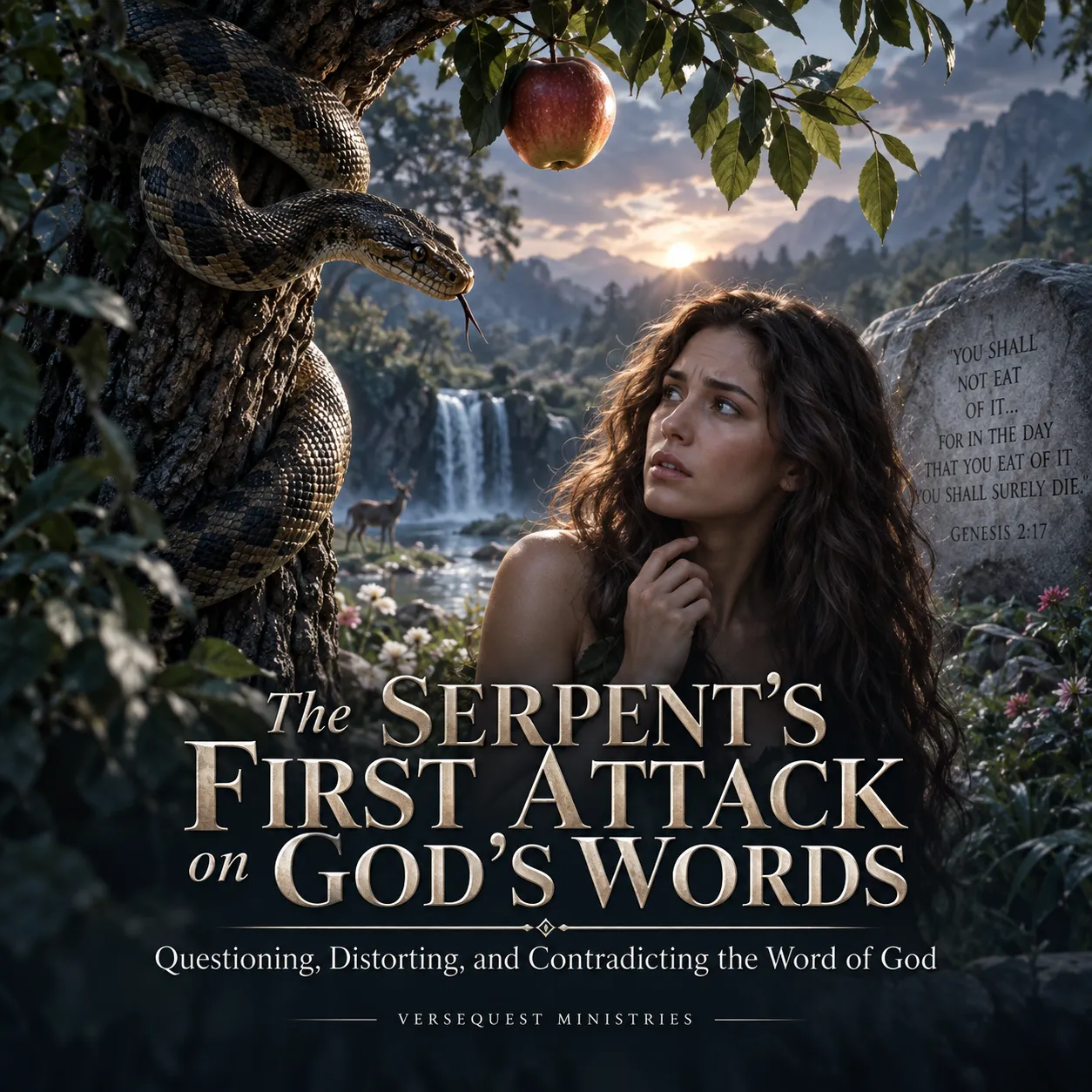
Sermon Title:
The Serpent’s First Attack on God’s Words
Key Passage:
Genesis 3:1–5
“Now the serpent was more subtil than any beast of the field which the LORD God had made. And he said unto the woman, Yea, hath God said, Ye shall not eat of every tree of the garden?” (Genesis 3:1)
Series:
The Book God Gave
Topic:
How Satan Attacks God’s Words Through Questioning, Alteration, Contradiction, and False Interpretation
Book:
Genesis
Speaker:
Paul Tackett
Suggested Sermon Text:
Genesis 2:16–17; Genesis 3:1–7; Psalm 12:6–7; Psalm 119:89, 128, 140, 160; Proverbs 30:5–6; Isaiah 8:20; Matthew 4:1–11; Matthew 24:35; John 8:44; John 10:35; 2 Corinthians 2:17; 2 Corinthians 4:2; 2 Corinthians 11:3–4; 1 Corinthians 2:12–13; 2 Timothy 2:15; 2 Timothy 3:15–17; 2 Peter 1:19–21; Revelation 22:18–19
Short Sermon Description:
Genesis 3:1–5 records the first direct satanic assault upon God’s revealed words and exposes a pattern that continues throughout Scripture: the serpent first questions what God said, then distorts what God said, contradicts what God said, attacks God’s character, and finally substitutes his own interpretation for God’s revelation. This sermon traces Satan’s strategy phrase by phrase, beginning with “Yea, hath God said?” and ending with the promise, “ye shall be as gods.” It examines Eve’s own alteration of the command, the significance of Satan removing the certainty from God’s warning, and the spiritual danger of allowing human reasoning, religious tradition, experience, or scholarship to sit above the written word. The message also demonstrates how Jesus Christ answered the tempter with “It is written,” why Scripture must be rightly divided rather than corrected, and why confidence in the pure, preserved words of God is foundational to doctrinal stability, obedience, and spiritual discernment.
THE SERPENT’S FIRST ATTACK ON GOD’S WORDS
Introduction
The first recorded attack upon mankind was not launched with a sword, an army, a government, or a false church. It began with a sentence. More precisely, it began with a question: “Yea, hath God said?” Genesis 3 does not merely record the fall of man; it reveals the devil’s operating procedure. Before the serpent attacks Adam’s authority, Eve’s purity, the home, the human race, or the physical creation, he attacks the words God spoke. That ought to get the attention of anybody who claims to believe the Bible. Satan understood from the beginning that if God’s words remained unquestioned, believed, remembered, and obeyed, the tree remained forbidden and the serpent remained exposed. He therefore did not start with the fruit. He started with the sentence.
The subtlety of Genesis 3 is that Satan does not initially sound like an atheist. He sounds like a theologian asking a question. He does not say, “There is no God.” He says, in effect, “Are you sure God said that?” He does not immediately deny revelation. He invites Eve to discuss the wording. Once the wording becomes negotiable, the command becomes negotiable. Once the command becomes negotiable, obedience becomes optional. The devil does not always need a man to burn his Bible. Sometimes it is enough to persuade him that the Bible in his hands cannot quite be trusted until somebody else explains what it should have said.
Genesis 3:1–5 therefore belongs in every serious discussion of biblical authority. The issue is larger than Eden. The serpent’s first method becomes a pattern: question, subtract, add, weaken, contradict, reinterpret. The names of the players change, but the strategy remains suspiciously familiar. The Bible believer must learn to recognize the hiss even when it comes wearing a necktie, carrying a degree, or speaking from behind a pulpit. The devil’s oldest question is still a dangerous one whenever it is asked from a position of unbelief: “Yea, hath God said?”
I. THE ATTACK BEGAN WITH SUBTLETY, NOT OPEN REBELLION
Key Text: Genesis 3:1
Supporting Texts: 2 Corinthians 11:3; Matthew 10:16; John 8:44
Genesis introduces the serpent as “more subtil than any beast of the field which the LORD God had made.” Satan’s method is rarely to announce himself honestly. He does not arrive wearing a badge that says, “Enemy of God—here to destroy your faith.” He approaches indirectly. Paul later warns the Corinthians that “the serpent beguiled Eve through his subtilty” (2 Corinthians 11:3). Beguilement works because the victim does not recognize the trap until he is already inside it.
Subtlety frequently mixes enough truth with error to lower the listener’s guard. Satan acknowledges that God has spoken. He acknowledges the existence of the command. He even frames his question around the subject God addressed. The poison is not in blatant denial yet; it is in shifting the atmosphere from believing God to debating God. That shift is the first victory.
The believer must therefore understand that every attack on Scripture does not sound wicked. Some sound intelligent, balanced, careful, scholarly, cautious, or open-minded. Error occasionally enters church wearing muddy boots, but it often comes in polished shoes.
Main Truth: Satan’s first attack upon God’s words came through subtle questioning rather than immediate open denial.
II. “YEA, HATH GOD SAID?” PLACED GOD’S WORDS UNDER SUSPICION
Key Text: Genesis 3:1
Supporting Texts: Genesis 2:16–17; Psalm 119:160; John 10:35; Romans 3:4
God’s original command was plain: “Of every tree of the garden thou mayest freely eat,” with one exception. There was no textual mystery in Eden. Adam was not waiting for a manuscript conference. God had spoken clearly.
The serpent’s question turns certainty into suspicion. “Yea, hath God said?” The words invite Eve to move from receiving revelation to reviewing revelation. The issue is no longer, “What did God command?” but, “Should we reconsider whether God really said it exactly that way?”
That change of posture matters. The believer who approaches Scripture merely to understand it stands beneath the Book. The man who approaches Scripture assuming it must first survive his correction stands above the Book. Those are not the same attitude.
Psalm 119:160 says, “Thy word is true from the beginning.” Jesus said, “the scripture cannot be broken” (John 10:35). Romans 3:4 says, “Let God be true, but every man a liar.” Scripture begins with God as the reliable Speaker, not man as the reliable judge.
Main Truth: Spiritual confusion begins when God’s words cease to be the unquestioned standard and become the object standing trial.
III. THE SERPENT DISTORTED GOD’S GENEROSITY BEFORE ATTACKING GOD’S COMMAND
Key Text: Genesis 3:1
Supporting Texts: Genesis 2:16–17; Psalm 84:11; James 1:17
Notice the serpent’s wording: “Ye shall not eat of every tree of the garden?” God had actually said, “Of every tree of the garden thou mayest freely eat,” except one. Satan frames the command as though God were primarily restrictive.
God said, in effect, “Everything here is yours except one tree.” The serpent makes Eve hear, “Look what God will not let you have.”
That is still how temptation operates. Sin magnifies the one prohibition and hides ten thousand mercies. The flesh can sit in a house full of blessings and stare resentfully at the one thing God has forbidden. The devil is a remarkable accountant when counting restrictions and strangely forgetful when counting grace.
The attack upon God’s words therefore also becomes an attack upon God’s character. If the command can be made to look unreasonable, the Commander can be made to look unkind.
Main Truth: Satan distorts God’s words in order to distort God’s character, making divine protection appear like divine deprivation.
IV. EVE’S ANSWER SHOWS HOW QUICKLY GOD’S WORDS CAN BE ALTERED
Key Text: Genesis 3:2–3
Supporting Texts: Genesis 2:16–17; Proverbs 30:5–6; Deuteronomy 4:2
Eve’s reply deserves careful comparison with God’s original command. God said, “Of every tree of the garden thou mayest freely eat.” Eve says, “We may eat of the fruit of the trees of the garden.” “Freely” disappears.
God said, “thou shalt not eat of it.” Eve adds, “neither shall ye touch it.” The prohibition has grown beyond what God actually stated.
Then God had said, “thou shalt surely die.” Eve says, “lest ye die.” Certainty becomes possibility.
In a few sentences the wording has suffered subtraction, addition, and weakening. That is not a small lesson. Proverbs 30:5 says, “Every word of God is pure,” and immediately warns, “Add thou not unto his words.” God knows exactly what He wants said. Man does not improve revelation by editing it.
The mouth was drifting before the hand touched the fruit.
Main Truth: Once God’s exact words are treated casually, subtraction, addition, and doctrinal weakening quickly follow.
V. SATAN MOVED FROM QUESTIONING GOD’S WORD TO FLATLY CONTRADICTING IT
Key Text: Genesis 3:4
Supporting Texts: Genesis 2:17; John 8:44; Numbers 23:19
“Ye shall not surely die.”
There is no ambiguity left. God said, “thou shalt surely die.” Satan says, “Ye shall not surely die.” The serpent has moved from question mark to contradiction.
That progression matters. Satan often does not begin where he intends to end. First comes uncertainty. Then reinterpretation. Then contradiction. Then replacement. The man who would have rejected the final statement immediately can sometimes be walked toward it gradually through repeated questions.
Jesus calls the devil “a liar, and the father of it” (John 8:44). Genesis 3 shows the father of lies at work. His lie targets the certainty of judgment. God warns of death; Satan assures Eve there will be no such consequence.
False doctrine still thrives by softening divine warnings. God says sin has consequences; man says God would never judge. God says a thing is wrong; man says the wording is culturally conditioned. The serpent did not retire from theology after Eden.
Main Truth: Satan’s questioning of God’s words ultimately leads to direct contradiction of what God plainly said.
VI. SATAN REPLACED GOD’S EXPLANATION WITH HIS OWN INTERPRETATION
Key Text: Genesis 3:5
Supporting Texts: Isaiah 5:20–21; Romans 1:21–25; Colossians 2:8
After contradicting God, Satan supplies his own explanation: “For God doth know that in the day ye eat thereof, then your eyes shall be opened…”
Now the serpent is not merely questioning the text. He is interpreting God’s motive. God did not prohibit the tree for their good, Satan suggests; God prohibited it because He was withholding advancement.
That is how false teaching gains momentum. First, undermine confidence in what the text says. Then supply a new interpretation explaining why the obvious reading cannot possibly be right.
Satan promises enlightenment: “your eyes shall be opened.” That is still one of rebellion’s favorite advertisements. Reject God’s authority and become enlightened. Discard the old Book and become sophisticated. Correct the text and become educated. Humanity has been chasing that promise since Eden and still manages to look surprisingly lost in broad daylight.
Main Truth: Once God’s words are rejected, Satan supplies an alternate interpretation that makes rebellion appear intelligent.
VII. THE FINAL TEMPTATION WAS SELF-EXALTATION: “YE SHALL BE AS GODS”
Key Text: Genesis 3:5
Supporting Texts: Isaiah 14:12–14; Romans 1:25; Proverbs 16:18
The serpent’s promise reaches its climax: “ye shall be as gods, knowing good and evil.”
That phrase reveals where the attack on God’s words ultimately leads. If God’s words are no longer final, somebody must occupy the vacant throne. Man steps up.
The desire to “be as gods” is not confined to pagan idols. Every time man claims the right to determine good and evil independently of divine revelation, Eden repeats. Every time he says, “I will decide which part of God’s command is acceptable,” the old temptation breathes again.
Bible correction can become the same authority problem in miniature. If Scripture says one thing but I possess the right to declare what it should say, I have made my judgment superior to the text.
Pride always wants the red pencil.
Main Truth: The attack on God’s words ultimately seeks to enthrone human judgment where divine authority belongs.
VIII. CHRIST ANSWERED THE SERPENT’S METHOD WITH “IT IS WRITTEN”
Key Text: Matthew 4:4
Supporting Texts: Matthew 4:1–11; Deuteronomy 8:3; Psalm 119:11; Ephesians 6:17
Genesis 3 shows the first Adam facing satanic temptation and falling. Matthew 4 shows Jesus Christ facing the tempter and answering differently.
Three times Satan tempts. Three times Christ answers with the written word: “It is written.”
That comparison is powerful. Eve entered discussion with the serpent and began adjusting God’s wording. Christ met temptation with settled Scripture. He did not negotiate with the devil. He quoted the Book.
Satan even quotes Scripture himself during the temptation, proving again that merely possessing a verse is not enough. Scripture must be known, understood, and applied correctly. The devil can quote a Bible he does not obey.
The Christian therefore needs more than admiration for Scripture. He needs Scripture stored in his mind, rightly divided, ready for use.
Main Truth: Jesus Christ defeated satanic temptation by trusting and correctly applying the written word rather than questioning or altering it.
IX. THE BELIEVER’S DEFENSE IS TO BELIEVE, PRESERVE, STUDY, AND RIGHTLY DIVIDE GOD’S WORDS
Key Text: 2 Timothy 2:15
Supporting Texts: Psalm 12:6–7; 2 Timothy 3:16–17; 2 Peter 1:19–21; John 17:17
Paul tells the believer to “Study to shew thyself approved unto God…rightly dividing the word of truth.” The answer to confusion is not less Bible study but better Bible study.
Right division recognizes that God has spoken in different dispensational settings to different people concerning different programs. Israel is not the Church. Law is not grace. Prophecy is not mystery. The Second Advent is not the Rapture. Failure to observe those distinctions can create apparent contradiction where God created none.
But right division never means correcting the text. The text is called “the word of truth” before the workman is told to divide it. The workman is responsible for handling the Book properly; the Book is not responsible for adjusting itself to the workman.
Psalm 12 speaks of pure words. Second Timothy says all Scripture is given by inspiration of God. Second Peter says holy men spoke as they were moved by the Holy Ghost. The believer therefore approaches Scripture with confidence rather than suspicion.
Main Truth: The Christian resists the serpent’s attack by trusting God’s words, studying them carefully, and rightly dividing them rather than placing them beneath human correction.
Conclusion
Genesis 3:1–5 is not merely an account of a conversation beside a tree. It is the blueprint of satanic assault upon revelation. The serpent questions God’s words. Eve alters them. Satan contradicts them. Then he supplies a rival interpretation and promises enlightenment through rebellion. The fruit does not appear in Eve’s hand until the words of God have first been destabilized in her mind.
That pattern explains why biblical authority matters so deeply. If the words are uncertain, doctrine becomes uncertain. If doctrine becomes uncertain, obedience becomes negotiable. And once obedience becomes negotiable, the serpent has accomplished most of his work before the sin ever becomes visible.
So learn the lesson Eden teaches. When the serpent asks, “Yea, hath God said?” answer with what Christ answered: “It is written.” Take the King James Bible. Read it. Study it. Memorize it. Compare Scripture with Scripture. Rightly divide it. Believe it before you understand every difficult passage. Let it correct you rather than training yourself to correct it. Satan started his first attack by placing God’s words under suspicion. The Bible believer’s answer is to put the Book back where God placed it—above the argument.
Final Call
If you are lost, the same enemy who questioned God’s word in Eden would gladly keep you questioning the gospel until death. The word of God says that “Christ died for our sins according to the scriptures; And that he was buried, and that he rose again the third day according to the scriptures” (1 Corinthians 15:3–4). Stop trusting religion, works, morality, baptism, or your own goodness. Believe on the Lord Jesus Christ and trust His finished work.
If you are saved, guard your confidence in Scripture. Do not let every new teacher, footnote, theory, experience, or scholarly claim make you suspicious of the Book God gave you. Study carefully. Ask questions. Rightly divide. But never forget where questioning becomes unbelief. The serpent’s first sentence still tells you exactly what he wants: he wants you wondering whether God really said what God said.
Closing Verse:
“Thy word is very pure: therefore thy servant loveth it.” (Psalm 119:140)
Closing Statement:
The serpent did not begin by offering Eve the fruit—he began by getting her to question the words that told her not to eat it.