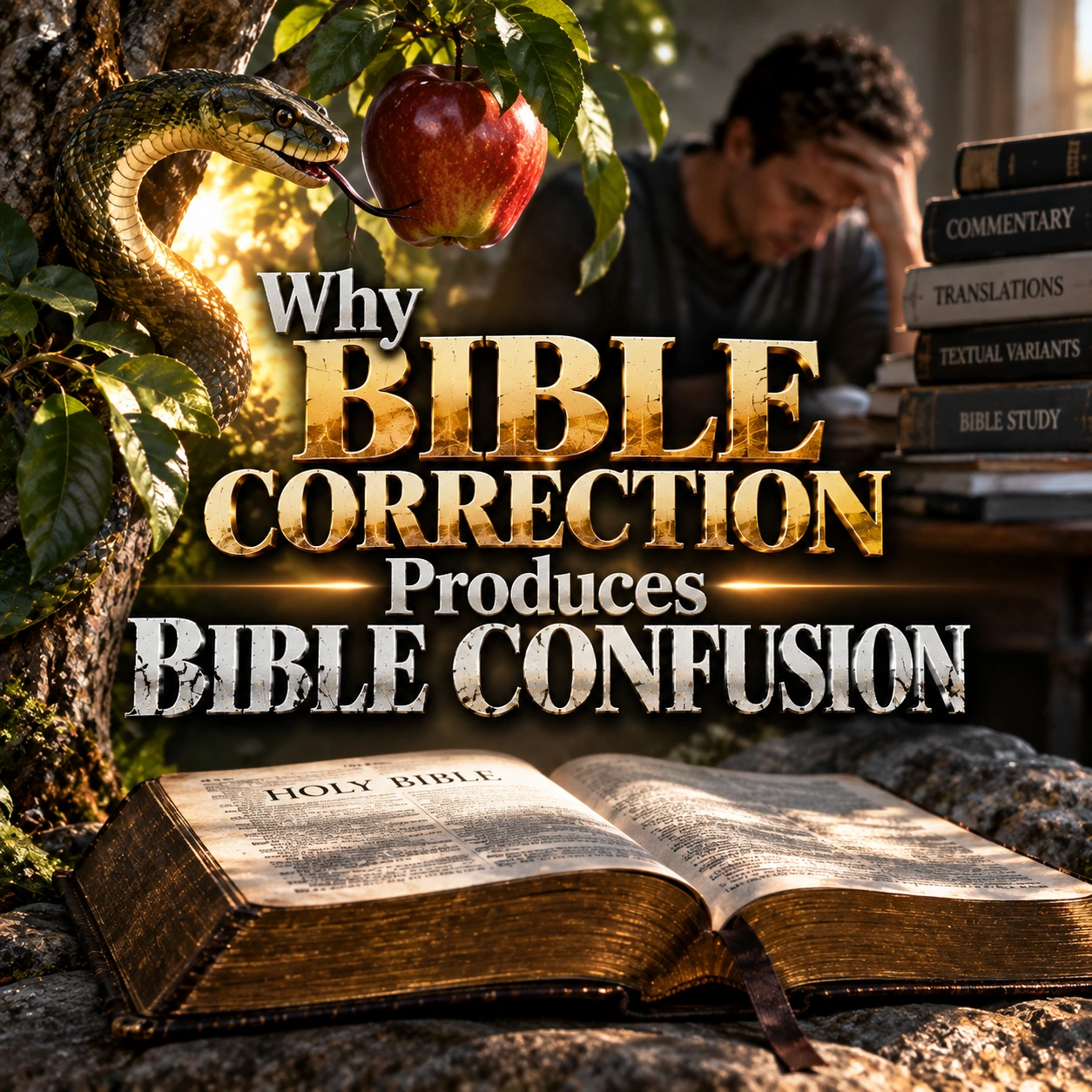
Sermon Title:
Why Bible Correction Produces Bible Confusion
Key Passage:
Genesis 3:1
“Now the serpent was more subtil than any beast of the field which the LORD God had made. And he said unto the woman, Yea, hath God said, Ye shall not eat of every tree of the garden?” (Genesis 3:1)
Series:
The Book God Gave
Topic:
How Questioning, Altering, and Correcting God’s Words Produces Doubt, Doctrinal Confusion, and Spiritual Defeat
Book:
Genesis
Speaker:
Paul Tackett
Suggested Sermon Text:
Genesis 2:16–17; Genesis 3:1–7; Psalm 12:6–7; Psalm 119:89, 128, 140, 160; Proverbs 30:5–6; Isaiah 8:20; Matthew 4:1–11; Matthew 5:18; Matthew 24:35; John 10:35; 1 Corinthians 2:12–13; 1 Corinthians 14:33; 2 Corinthians 2:17; 2 Corinthians 4:2; 2 Corinthians 11:3; 2 Timothy 2:15; 2 Timothy 3:15–17; 2 Peter 1:20–21; Revelation 22:18–19
Short Sermon Description:
Genesis 3:1 records the first satanic attack upon the revealed word of God with four deceptively simple words: “Yea, hath God said?” This sermon examines how the serpent introduced doubt before introducing outright denial, how Eve’s handling of God’s command demonstrates the danger of adding to, weakening, and misquoting divine words, and how Satan’s progression from questioning God’s words to contradicting them produced confusion before it produced disobedience. The message applies that biblical pattern to the believer’s attitude toward Scripture, showing why God’s words are to be believed, studied, rightly divided, and obeyed rather than placed beneath human opinion as though they were awaiting correction. It also distinguishes legitimate study from an attitude that assumes the Book is guilty until scholars declare it innocent, explains how right division resolves apparent contradictions without rewriting Scripture, and demonstrates why confidence in the King James Bible provides doctrinal stability rather than perpetual uncertainty. Sermon Outline Prompt – VerseQu…
WHY BIBLE CORRECTION PRODUCES BIBLE CONFUSION
Introduction
The first doctrinal question in human history was not asked by a confused Bible student. It came from the serpent. Genesis 3:1 records the words, “Yea, hath God said?” Before Satan persuaded Eve to disobey God, he persuaded her to place God’s words under examination. Before he contradicted the command, he questioned it. Before sin entered through the act, doubt entered through the ear. That order matters. The serpent did not begin by saying there was no God, no Garden, no command, and no consequence. He began much more politely. He simply invited the woman to reconsider exactly what God had said.
That method has aged remarkably well. The packaging changes, the vocabulary becomes more respectable, and the serpent occasionally acquires academic credentials, but the strategy remains recognizable: create uncertainty concerning the words, encourage man to become the judge of the words, introduce an alternate wording, and eventually produce a different doctrine. Genesis 3 shows that confusion about God’s words is not a harmless intellectual hobby. Words determine meaning, meaning governs belief, and belief shapes conduct. Once Eve became uncertain about the command, the forbidden tree became easier to rationalize.
This does not mean Bible believers should fear honest study. God commands study (2 Timothy 2:15). Context matters. Grammar matters. History matters. Comparing Scripture with Scripture matters. Right division matters. But there is an enormous difference between studying the Bible in order to understand what God said and approaching the Bible as though God’s words stand in the dock awaiting correction from man. One posture bows over the Book. The other places the Book beneath the reader. Genesis 3 tells us which posture appeared first.
I. SATAN’S FIRST MOVE WAS TO QUESTION WHAT GOD SAID
Key Text: Genesis 3:1
Supporting Texts: Genesis 2:16–17; 2 Corinthians 11:3; John 8:44
God’s command had been plain. “Of every tree of the garden thou mayest freely eat,” followed by one restriction: “But of the tree of the knowledge of good and evil, thou shalt not eat of it” (Genesis 2:16–17). The command was understandable, specific, and accompanied by a definite consequence.
Then the serpent arrives: “Yea, hath God said?” Notice the subtlety. He does not initially deny God’s existence. He questions God’s wording. Satan understands something modern religion often forgets: if you can create uncertainty about the words, you can eventually create uncertainty about the doctrine those words communicate.
Paul later warns the Corinthians that “as the serpent beguiled Eve through his subtilty,” their minds could likewise be corrupted “from the simplicity that is in Christ” (2 Corinthians 11:3). Satan prefers complication whenever simplicity threatens his program.
The first step toward confusion is often not open rejection of Scripture but cultivated suspicion toward Scripture.
Main Truth: Satan’s first recorded attack upon mankind began by making God’s clear words appear questionable.
II. EVE BEGAN ALTERING THE WORD BEFORE SHE BROKE THE COMMAND
Key Text: Genesis 3:2–3
Supporting Texts: Genesis 2:16–17; Proverbs 30:5–6; Deuteronomy 4:2
Compare Eve’s answer with God’s original statement. God said, “Of every tree of the garden thou mayest freely eat.” Eve says, “We may eat of the fruit of the trees of the garden.” The word “freely” disappears.
God said of the forbidden tree, “thou shalt not eat of it.” Eve adds, “neither shall ye touch it.” Then God’s certain warning, “thou shalt surely die,” becomes Eve’s weaker expression, “lest ye die.”
Something is already happening before the fruit reaches her hand. God’s generosity has been softened. God’s command has been expanded. God’s warning has been weakened.
Proverbs 30:5 says, “Every word of God is pure.” The next verse therefore says, “Add thou not unto his words, lest he reprove thee, and thou be found a liar.” That order is not accidental. If every word is pure, man improves nothing by adding his editorial contribution.
The fall teaches that mishandling God’s words is not disconnected from disobeying God’s will. The mouth began drifting before the feet followed.
Main Truth: Spiritual confusion grows whenever man subtracts from, adds to, or weakens what God actually said.
III. SATAN MOVED FROM QUESTIONING THE WORD TO CONTRADICTING THE WORD
Key Text: Genesis 3:4
Supporting Texts: Genesis 2:17; Genesis 3:1–5; John 8:44
Once doubt has been established, denial becomes easier. The serpent moves from “Yea, hath God said?” to the flat contradiction, “Ye shall not surely die.”
God said, “thou shalt surely die.” Satan says, “Ye shall not surely die.” That is not interpretation. That is contradiction.
Satan does not need to remove the entire Bible if he can reverse the force of what it says. One strategically placed change can alter a doctrine. One weakened warning can affect obedience. One erased distinction can produce a theological mess large enough to keep a denomination busy for centuries.
Jesus called the devil “a liar, and the father of it” (John 8:44). Genesis 3 shows the family business opening early.
The progression is worth remembering: question the words, modify the words, contradict the words, then offer an alternative explanation.
Main Truth: Once God’s words are treated as uncertain, outright contradiction of those words becomes much easier to accept.
IV. BIBLE CORRECTION TRANSFERS AUTHORITY FROM GOD TO MAN
Key Text: Proverbs 30:5–6
Supporting Texts: Romans 3:4; Isaiah 8:20; John 10:35; Psalm 119:160
Every correction requires a corrector, and the corrector necessarily occupies a position above the thing being corrected.
If man possesses the authority to decide where Scripture is wrong, then Scripture is no longer man’s final authority. The man correcting it is.
Romans 3:4 gives a far safer arrangement: “Let God be true, but every man a liar.” Isaiah says, “To the law and to the testimony.” Jesus says “the scripture cannot be broken.” Psalm 119:160 declares, “Thy word is true from the beginning.”
The Bible believer therefore does not begin with, “What parts of this Book deserve my approval?” He begins with, “What did God say?”
Study tools may be servants. Teachers may be servants. Historical knowledge may be useful. Grammar may clarify. But the servant does not become lord simply because he owns a dictionary.
The moment Scripture must pass man’s examination before it can become authoritative, man has quietly seated himself on God’s throne.
Main Truth: Correcting Scripture necessarily makes the human corrector a higher practical authority than the Scripture he claims to correct.
V. MULTIPLE COMPETING AUTHORITIES NATURALLY PRODUCE CONFUSION
Key Text: 1 Corinthians 14:33
Supporting Texts: James 3:16; Ephesians 4:14; 2 Corinthians 11:3–4
“God is not the author of confusion” (1 Corinthians 14:33). Yet doctrinal instability multiplies whenever believers are taught that the words before them may or may not be God’s words depending upon which expert, manuscript theory, translation committee, commentary, or teacher they consult.
What happens practically? One preacher says, “Your Bible says this, but a better rendering says something else.” Another says the phrase should not be there. Another says a word should be changed. Another appeals to a footnote. Soon the ordinary Christian no longer asks, “What saith the scripture?” He asks, “Which authority am I supposed to trust this week?”
That is not spiritual maturity. It is authority paralysis.
Paul warns about believers being “tossed to and fro, and carried about with every wind of doctrine” (Ephesians 4:14). A ship cannot hold its course if every gust becomes captain.
The Bible believer needs somewhere for the argument to end.
Main Truth: When Scripture is replaced by competing layers of human authority, doctrinal certainty gives way to perpetual instability and confusion.
VI. JESUS CHRIST ANSWERED SATAN WITH THE WRITTEN WORD, NOT WITH CORRECTIONS TO IT
Key Text: Matthew 4:4
Supporting Texts: Matthew 4:1–11; Deuteronomy 8:3; John 10:35; Matthew 5:18
When Satan tempted Jesus Christ, the Lord answered repeatedly, “It is written.”
Christ did not stop mid-temptation to warn Satan that the available text contained unfortunate transmission problems. He did not apologize for Scripture. He did not suggest that an alternate reading might improve Moses. He used the written word as authority.
Even more striking, Satan himself quoted Scripture in the temptation. That means the issue is not merely whether somebody can produce a verse. Scripture must be handled accurately and in context. Jesus answered the misuse of Scripture with properly applied Scripture.
In John 10:35 Christ says, “the scripture cannot be broken.” In Matthew 5:18 He places extraordinary weight upon even a jot and tittle.
A Christian who claims to follow Christ should notice Christ’s attitude toward the written word. He did not correct the Book. The Book corrected men.
Main Truth: Jesus Christ treated written Scripture as authoritative and answered spiritual deception by correctly applying what God had already written.
VII. RIGHT DIVISION SOLVES CONFUSION WITHOUT REWRITING THE BIBLE
Key Text: 2 Timothy 2:15
Supporting Texts: 1 Corinthians 10:32; Romans 11:25–29; Ephesians 2:11–16; Ephesians 3:1–10
Many alleged biblical contradictions disappear when the student obeys Paul’s command to be “rightly dividing the word of truth.”
Notice what Paul calls it before telling you to divide it: “the word of truth.” The problem is not impurity in the Book. The problem is often poor handling by the workman.
God distinguishes Israel, Gentiles, and the Church. He distinguishes law and grace, prophecy and mystery, earthly kingdom promises and the heavenly calling of the body of Christ. Noah was given instructions that were not given to Paul. Israel received commandments under Moses that are not Church Age doctrine. Paul received revelation concerning the mystery that had previously been hidden.
Flatten those distinctions and the Bible can appear contradictory. Honor the distinctions and order emerges.
The Bible does not need correction nearly as often as the student needs instruction.
Main Truth: Right division resolves doctrinal confusion by respecting the distinctions God placed in Scripture rather than altering Scripture to fit a theological system.
VIII. PURE WORDS PRODUCE CERTAINTY; CORRECTED WORDS PRODUCE DEPENDENCE ON CORRECTORS
Key Text: Psalm 12:6–7
Supporting Texts: Psalm 119:89, 140; Proverbs 30:5; Matthew 24:35; 1 Peter 1:23–25
Psalm 12 says, “The words of the LORD are pure words.” The Bible believer’s confidence rests first in God’s character and God’s promise concerning His word.
Jesus says, “Heaven and earth shall pass away, but my words shall not pass away” (Matthew 24:35). Peter speaks of “the word of God, which liveth and abideth for ever” (1 Peter 1:23).
If God’s people are perpetually told that they cannot know exactly what God said without an expert standing nearby, practical dependence shifts from the Book to the expert. The expert becomes priest of the text.
That arrangement is remarkably convenient for the expert.
Biblical Christianity places the believer before an accessible Book and commands him to read, study, compare, believe, preach, and obey it. A final authority must actually be available or it is not final in any practical sense.
For the English-speaking Bible believer, confidence in the King James Bible means the Christian can open the Book and believe he possesses Scripture rather than a religious puzzle awaiting scholarly reconstruction.
Main Truth: Confidence in preserved Scripture gives the believer a usable final authority, while perpetual correction makes certainty depend upon whichever human corrector is speaking.
IX. THE REAL QUESTION IS WHETHER THE BOOK WILL CORRECT US OR WE WILL CORRECT THE BOOK
Key Text: 2 Timothy 3:16
Supporting Texts: Hebrews 4:12; James 1:22–25; Psalm 119:128; Jeremiah 23:29
Second Timothy 3:16 says Scripture is profitable “for correction.” Notice the direction of correction. The Scripture corrects us.
Modern man often prefers the arrangement reversed. If the Bible condemns something he enjoys, perhaps the translation is wrong. If Scripture disrupts a theological tradition, perhaps the wording needs adjustment. If a verse embarrasses the age, perhaps somebody can discover a technical reason that it should say something friendlier.
That is a convenient Bible. It never wins an argument because the reader owns the eraser.
Hebrews says the word is “sharper than any twoedged sword.” Jeremiah calls it a hammer. James calls it a mirror. None of those pictures suggests that Scripture exists to flatter the person examining it.
The honest Bible believer says with Psalm 119:128, “I esteem all thy precepts concerning all things to be right.” Therefore when Scripture and I disagree, I already know which party requires correction.
Main Truth: God gave Scripture to correct the believer, and confusion begins when the believer reverses that authority and attempts to correct Scripture.
Conclusion
Genesis 3 reveals the pattern at the beginning: “Yea, hath God said?” The serpent questioned the word, Eve altered the wording, Satan contradicted the warning, and sin followed the confusion. The attack upon mankind’s obedience began as an attack upon mankind’s confidence in what God said.
The answer is not intellectual laziness. Study harder. Compare Scripture with Scripture. Learn context. Understand doctrine. Rightly divide the Book. Ask hard questions. But conduct the investigation like a student beneath the word, not a judge sitting above it. There is a world of difference between asking, “What does this verse mean?” and asking, “How shall I correct what God failed to say properly?”
Take the King James Bible and let the correcting go in the biblical direction. Let the Book correct your theology. Let it correct your tradition. Let it correct your assumptions, your conduct, your pride, your feelings, and your favorite preacher. The Christian does not need a Bible that agrees with him. He needs a Bible authoritative enough to tell him when he is wrong.
Final Call
If you are lost, Satan would be delighted to keep you arguing about words while you remain without Christ. The gospel is plain: “Christ died for our sins according to the scriptures; And that he was buried, and that he rose again the third day according to the scriptures” (1 Corinthians 15:3–4). Stop trusting religion, baptism, morality, works, or your own goodness. Believe on the Lord Jesus Christ and trust His finished work.
If you are saved, decide who holds the red pencil. If the Book can be corrected every time it offends your assumptions, you have no final authority beyond yourself and your chosen experts. Read the Bible. Study it. Rightly divide it. Believe it. Obey it. And when you encounter something you do not understand, begin with the possibility that the difficulty is in the reader before assuming the defect is in the Book.
Closing Verse:
“Every word of God is pure: he is a shield unto them that put their trust in him.” (Proverbs 30:5)
Closing Statement:
The serpent began with “Yea, hath God said?”—and every generation that puts God’s words back on trial eventually discovers that uncertainty about the Book produces uncertainty everywhere else.