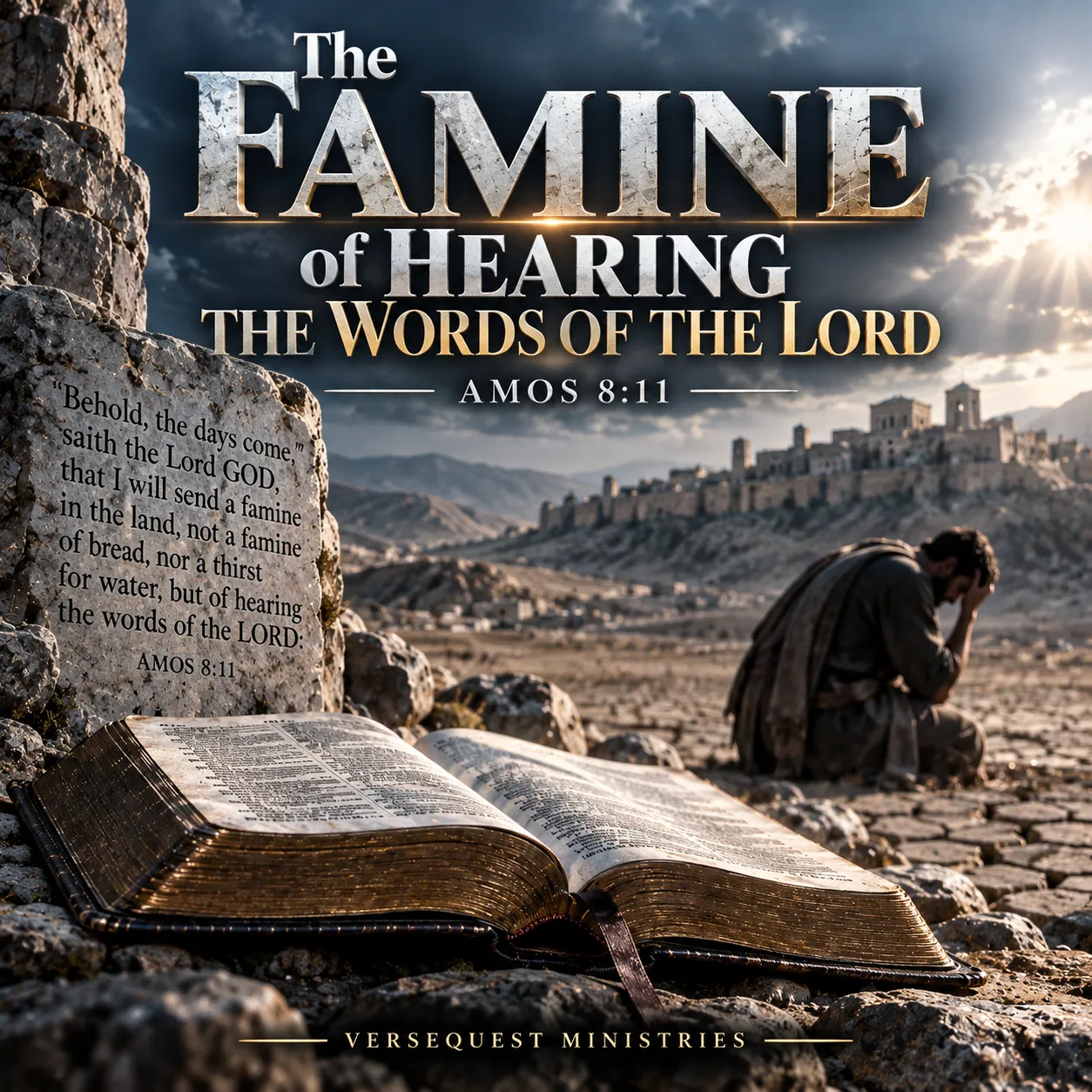
Sermon Title:
The Famine of Hearing the Words of the Lord
Key Passage:
Amos 8:11
“Behold, the days come, saith the Lord GOD, that I will send a famine in the land, not a famine of bread, nor a thirst for water, but of hearing the words of the LORD:” (Amos 8:11)
Series:
The Book God Gave
Topic:
The Judgment of Losing Access to God’s Revealed Words and the Danger of Despising Truth While It Is Available
Book:
Amos
Speaker:
Paul Tackett
Suggested Sermon Text:
Amos 8:1–14; Amos 2:4; Amos 5:10–15; Deuteronomy 8:3; 1 Samuel 3:1; Psalm 119:89, 105, 130, 140; Proverbs 1:20–33; Isaiah 5:13; Jeremiah 6:16–19; Ezekiel 7:26; Matthew 4:4; Matthew 13:10–17; Luke 16:29–31; John 8:31–32, 47; Romans 10:17; 2 Timothy 2:15; 2 Timothy 3:15–17; 2 Timothy 4:2–4
Short Sermon Description:
Amos 8:11 warns of a terrifying judgment upon Israel: not a famine of bread or thirst for water, but “of hearing the words of the LORD.” This sermon examines that warning in its proper prophetic setting, where a nation that had repeatedly rejected God’s law, despised His prophets, oppressed the poor, corrupted worship, and refused correction would eventually discover what it meant for God’s word to become scarce. The message carefully distinguishes Amos’s national judgment upon Israel from doctrine addressed directly to the Church, while drawing a powerful spiritual application for believers who possess abundant access to Scripture yet can neglect, dilute, replace, or refuse it. It explores the difference between possessing Bibles and hearing God’s words, why rejected light can lead to greater darkness, how religious activity cannot substitute for revelation, why false teachers thrive where sound doctrine is unwanted, and why Christians should treasure, study, rightly divide, preach, and obey the King James Bible while truth is readily available. The supplied standard calls for a KJV-only, rightly divided, detailed, sermon-ready treatment suitable for preaching and teaching. Sermon Outline Prompt – VerseQu…
THE FAMINE OF HEARING THE WORDS OF THE LORD
Introduction
There are famines men recognize immediately. Crops fail. Rivers dry up. Storehouses empty. Prices rise. Stomachs hurt. Everybody understands that kind of famine because the body begins shouting what the eye can already see. Amos announces something far more frightening. God says there is coming a famine “not a famine of bread, nor a thirst for water, but of hearing the words of the LORD.” A man can live for several weeks without food, but a nation can destroy itself spiritually while still eating three meals a day. Full cupboards do not prove a full soul.
The warning occurs in a specific setting. Amos is preaching to Israel, especially the northern kingdom, during a time of outward prosperity and inward corruption. The people had religion. They had feasts. They had songs. They had commerce. They had markets. They had money. What they did not have was an appetite for the truth that judged their sin. Amos 8 describes merchants waiting impatiently for holy days to end so they could return to dishonest business. They wanted religious observance without divine interference. God’s answer was severe: since they did not want to hear His words when He sent them, a day would come when they would want a word from Him and not find it.
That must be handled rightly. Amos 8:11 is not a direct doctrinal prophecy saying that the Church in the present dispensation will someday be unable to possess Scripture. The passage concerns divine judgment upon Israel. But the spiritual principle is unmistakable and sobering: truth rejected is not owed indefinitely to the rejecter. Men imagine they can ignore God today and consult Him tomorrow whenever convenient. Amos says otherwise. There may come a day when the voice they mocked is the voice they desperately wish they had heard.
I. THE FAMINE WAS A JUDGMENT FROM GOD
Key Text: Amos 8:11
Supporting Texts: Amos 2:4; Amos 5:10–13; Jeremiah 6:19; Proverbs 1:24–31
God says, “I will send a famine.” This is not presented as an unfortunate accident, a communication failure, or a temporary shortage caused by poor religious administration. It is judgment.
Israel had repeatedly rejected revelation. Amos 2:4 says Judah had “despised the law of the LORD.” Amos 5 describes people hating him “that rebuketh in the gate.” They did not simply misunderstand truth; they resisted it.
That distinction matters. God is patient, but divine patience should never be mistaken for divine indifference. When men continually push away correction, they are not guaranteed endless opportunities to repeat the process without consequence.
Proverbs 1 gives a frightening parallel. Wisdom cries publicly, but those who refuse eventually cry themselves and receive no answer. The Bible is not teaching that God enjoys withholding truth from sincere seekers. It is warning people not to treat truth contemptuously while they have it.
A nation can become so accustomed to rejecting the preacher that judgment eventually comes in the form of silence.
Main Truth: The famine of Amos 8 was divine judgment upon people who had repeatedly despised the revelation God had already given them.
II. THE FAMINE WAS NOT OF FOOD, BUT OF HEARING GOD’S WORDS
Key Text: Amos 8:11
Supporting Texts: Deuteronomy 8:3; Matthew 4:4; Jeremiah 15:16; Job 23:12
God deliberately contrasts physical hunger with spiritual deprivation: “not a famine of bread, nor a thirst for water.”
That contrast teaches the relative value God places upon His words. Deuteronomy 8:3 says that man does not live by bread only, “but by every word that proceedeth out of the mouth of the LORD.” Jesus quotes that statement directly in Matthew 4:4.
Modern man behaves as though material prosperity proves spiritual health. If the economy functions, restaurants are full, entertainment is abundant, and technology works, he assumes civilization is flourishing. Amos would ask a different question: Can you still hear from God?
A society can have supermarkets on every corner and still be starving. It can possess universities, libraries, satellites, streaming platforms, political speeches, podcasts, and twenty-four-hour news while lacking the one voice capable of telling it why it is dying.
Bread keeps the body alive temporarily. God’s words address eternity.
Main Truth: Physical abundance cannot compensate for spiritual starvation because man ultimately needs the words of God more than earthly bread.
III. THE JUDGMENT CONCERNED “HEARING,” NOT MERELY THE EXISTENCE OF WORDS
Key Text: Amos 8:11
Supporting Texts: Romans 10:17; Matthew 13:13–15; John 8:43, 47; Ezekiel 33:31–32
The wording is precise: “a famine…of hearing the words of the LORD.”
That is deeper than simply saying no religious documents would exist. A man may possess words and still fail to hear them spiritually. Israel had law, history, covenant, prophets, and priestly institutions, yet their ears had grown dull.
Jesus later confronts the same kind of condition. He asks, “Why do ye not understand my speech? even because ye cannot hear my word” (John 8:43). The problem was not acoustics. They could hear the syllables. Their hearts rejected the authority behind them.
Ezekiel describes people who came to hear the prophet almost as entertainment. They listened, admired his delivery, and refused to obey. That is church attendance without submission.
There is a difference between having a Bible in the house and hearing God in the Bible. One is possession. The other is reception.
Main Truth: Spiritual famine can exist even where religious words are present if hearts have become unwilling to receive what God actually says.
IV. PEOPLE WHO REFUSED THE WORD WOULD LATER SEARCH FOR IT
Key Text: Amos 8:12
Supporting Texts: Proverbs 1:28; Hosea 5:6; 1 Samuel 28:6; Luke 13:24–28
Amos says, “they shall wander from sea to sea, and from the north even to the east, they shall run to and fro to seek the word of the LORD, and shall not find it.”
The tragedy is almost unbearable. Earlier, God sent truth to them. Later, they run looking for it.
Human nature often undervalues what is available until it disappears. A Bible sitting on the table seems ordinary until the day somebody desperately needs an answer. A faithful preacher can seem irritating until his voice is gone. Parental counsel sounds intrusive until the funeral home is quiet.
Israel wanted silence from God while judgment was preventable. Later they wanted speech from God when consequences had arrived.
There is a dreadful irony in running for the truth you once ran from.
The lesson is not to panic about whether God may hide the Bible tomorrow. The lesson is to stop acting as though today’s access to truth is worthless.
Main Truth: Those who despise God’s word while it is available may eventually discover how precious it was only after opportunity has passed.
V. RELIGIOUS ACTIVITY CANNOT SUBSTITUTE FOR THE WORD OF GOD
Key Text: Amos 5:21–24
Supporting Texts: Isaiah 1:11–17; Matthew 15:7–9; Mark 7:13; 2 Timothy 3:5
Israel was not irreligious. That is part of what makes Amos so powerful.
They had feast days, solemn assemblies, offerings, songs, and instruments. God says He hated the religious performance because the people’s lives contradicted His truth.
Religion without obedience becomes noise.
Matthew 15 shows Jesus confronting people who honored God with their lips while their hearts were far from Him. Their worship became vain because commandments of men had displaced divine authority.
A church can have music, programs, attendance, branding, buildings, activities, conferences, and still suffer severe spiritual malnutrition if the Book is no longer opened and preached plainly.
A full calendar is not the same thing as a full pulpit.
When sermons become motivational speeches, Scripture becomes decoration, and doctrine becomes an embarrassment, people can sit beneath religious production while starving beside a closed pantry.
Main Truth: Religious activity cannot replace the words of God, because ceremony without truth leaves people spiritually hungry.
VI. REJECTED TRUTH MAKES FALSEHOOD EASIER TO ACCEPT
Key Text: Amos 8:14
Supporting Texts: 2 Timothy 4:3–4; 2 Thessalonians 2:10–12; Romans 1:25; Jeremiah 5:30–31
Amos ends the chapter describing people swearing by false religious objects and systems. When truth is rejected, falsehood rarely leaves the space empty.
Paul warns that people will accumulate teachers “having itching ears” and “turn away their ears from the truth, and shall be turned unto fables” (2 Timothy 4:3–4).
Notice the sequence. They turn from truth, then turn to fables.
That is not accidental. Truth provides boundaries. Remove the boundaries and imagination rushes in.
A congregation that becomes tired of doctrine will not remain neutral. It will eventually be fed something else—experience, personality, politics, entertainment, mysticism, pop psychology, prosperity slogans, private revelation, or whatever happens to be fashionable.
Empty stomachs eventually eat something. Spiritual stomachs do the same.
The answer to false teaching is not merely attacking every counterfeit. Fill believers with so much sound Scripture that counterfeits begin tasting strange.
Main Truth: When people reject the truth of God’s word, they become increasingly vulnerable to religious substitutes and spiritual counterfeits.
VII. TODAY’S PROBLEM IS OFTEN NOT A SHORTAGE OF BIBLES BUT A SHORTAGE OF BIBLE HEARING
Key Text: 2 Timothy 4:2–4
Supporting Texts: 2 Timothy 3:15–17; Romans 10:17; Colossians 3:16; Acts 20:27
In much of the modern world, Scripture is not materially scarce. Bibles can be purchased cheaply, accessed digitally, searched instantly, and carried on a phone.
Yet abundance of access does not guarantee abundance of hearing.
Paul tells Timothy, “Preach the word.” Why? Because “the time will come when they will not endure sound doctrine.” Notice that the problem is not that sound doctrine ceases to exist. People stop enduring it.
That distinction matters when applying Amos spiritually today. We should not carelessly declare that Amos 8:11 is being doctrinally fulfilled in the Church because people dislike preaching. Amos concerns Israel under judgment. But the spiritual resemblance is still striking: people surrounded by religious resources can develop no appetite for God’s actual words.
A generation with thousands of Bible apps can still be biblically illiterate.
Technology solved access. It did not solve appetite.
Main Truth: Modern believers can experience practical spiritual starvation not because Scripture is unavailable, but because sound doctrine is neglected, resisted, or replaced.
VIII. RIGHT DIVISION KEEPS AMOS 8 FROM BECOMING ANOTHER MISUSED PROPHECY
Key Text: 2 Timothy 2:15
Supporting Texts: Amos 8:11–14; 1 Corinthians 10:32; Romans 11:25–29; Ephesians 3:1–10
Amos was a prophet to Israel. The famine described in Amos 8 belongs to a judgment context involving that nation.
That must be stated plainly.
The Church is not Israel. Israel’s national covenant judgments should not be transferred automatically to the body of Christ. Right division protects Scripture from enthusiastic misuse.
Second Timothy 2:15 tells the workman to be “rightly dividing the word of truth.” The proper application is not to erase Amos’s setting but to understand it first and then draw legitimate spiritual instruction.
That is how Bible study should work. Doctrine first. Application second.
Otherwise every earthquake becomes a prophecy fulfilled, every war becomes Armageddon, every food shortage becomes Revelation, and every bad sermon becomes Amos 8:11. That is not Bible study. That is newspaper roulette with verses.
Respecting context does not weaken the sermon. It strengthens it.
Main Truth: Amos 8:11 is a prophetic judgment concerning Israel, and sound application requires preserving that setting before drawing spiritual lessons for believers today.
IX. THE BELIEVER SHOULD TREASURE THE WORD WHILE IT IS OPEN BEFORE HIM
Key Text: Psalm 119:140
Supporting Texts: Psalm 119:97, 105, 130; Colossians 3:16; 2 Timothy 2:15
“Thy word is very pure: therefore thy servant loveth it” (Psalm 119:140).
The proper response to Amos’s famine is not merely fear. It is gratitude.
You have the Book. Read it.
You have access to sound doctrine. Learn it.
You have the privilege of comparing Scripture with Scripture. Use it.
You possess words millions of people throughout history would have traveled miles to hear, yet modern Christians sometimes leave them unopened while scrolling through everybody else’s opinions.
Paul tells believers to let “the word of Christ dwell in you richly.” Richly does not mean one emergency verse when life catches fire.
The Bible should inhabit the believer’s thinking.
Study before crisis. Memorize before temptation. Learn doctrine before deception arrives. Rightly divide before confusion sets in. Fill the storehouse while grain is plentiful.
A famine is the wrong time to start wishing you had valued food.
Main Truth: The believer should treasure, study, memorize, rightly divide, and obey Scripture while God has given abundant opportunity to hear His words.
Conclusion
Amos announces one of the strangest famines in Scripture. No empty wheat fields. No cracked reservoirs. No starving livestock. Instead, men wander desperately looking for something they once treated lightly: “the words of the LORD.” That is judgment measured not by an empty stomach but by divine silence.
The doctrinal setting belongs to Israel, and right division must keep it there. Yet the spiritual warning is powerful for every generation: do not despise light while you have light. Do not treat truth as though it can be summoned whenever you finally become interested. Do not assume that unlimited access produces unlimited opportunity. Hearts harden. Teachers disappear. Churches compromise. Memory fades. Life passes quickly.
Open the King James Bible while it is in your hands. Read it before you need the emergency verse. Study it before false doctrine knocks. Memorize it before temptation speaks. Rightly divide it before confusion comes. Preach it before audiences demand something softer. Love it before you learn by deprivation how valuable it was. A starving man understands bread better than a full man playing with his supper.
Final Call
If you are lost, there is no reason to remain spiritually starving when the gospel is plainly available. “Christ died for our sins according to the scriptures; And that he was buried, and that he rose again the third day according to the scriptures” (1 Corinthians 15:3–4). Salvation is not earned through baptism, religion, morality, church membership, sacraments, or works. Believe on the Lord Jesus Christ and trust His finished work.
If you are saved, stop living beside a full pantry with an empty soul. Read the Book. Study the Book. Rightly divide the Book. Hide it in your heart. Sit under sound preaching. Teach it to your children. Defend it without apologizing for it. Obey what you already know. God has given you access to His words; treat that access like the privilege it is.
Closing Verse:
“The entrance of thy words giveth light; it giveth understanding unto the simple.” (Psalm 119:130)
Closing Statement:
The worst famine is not when a man reaches for bread and finds the cupboard empty—it is when he finally reaches for God’s word and discovers how long he had been starving while the Book sat unopened beside him.