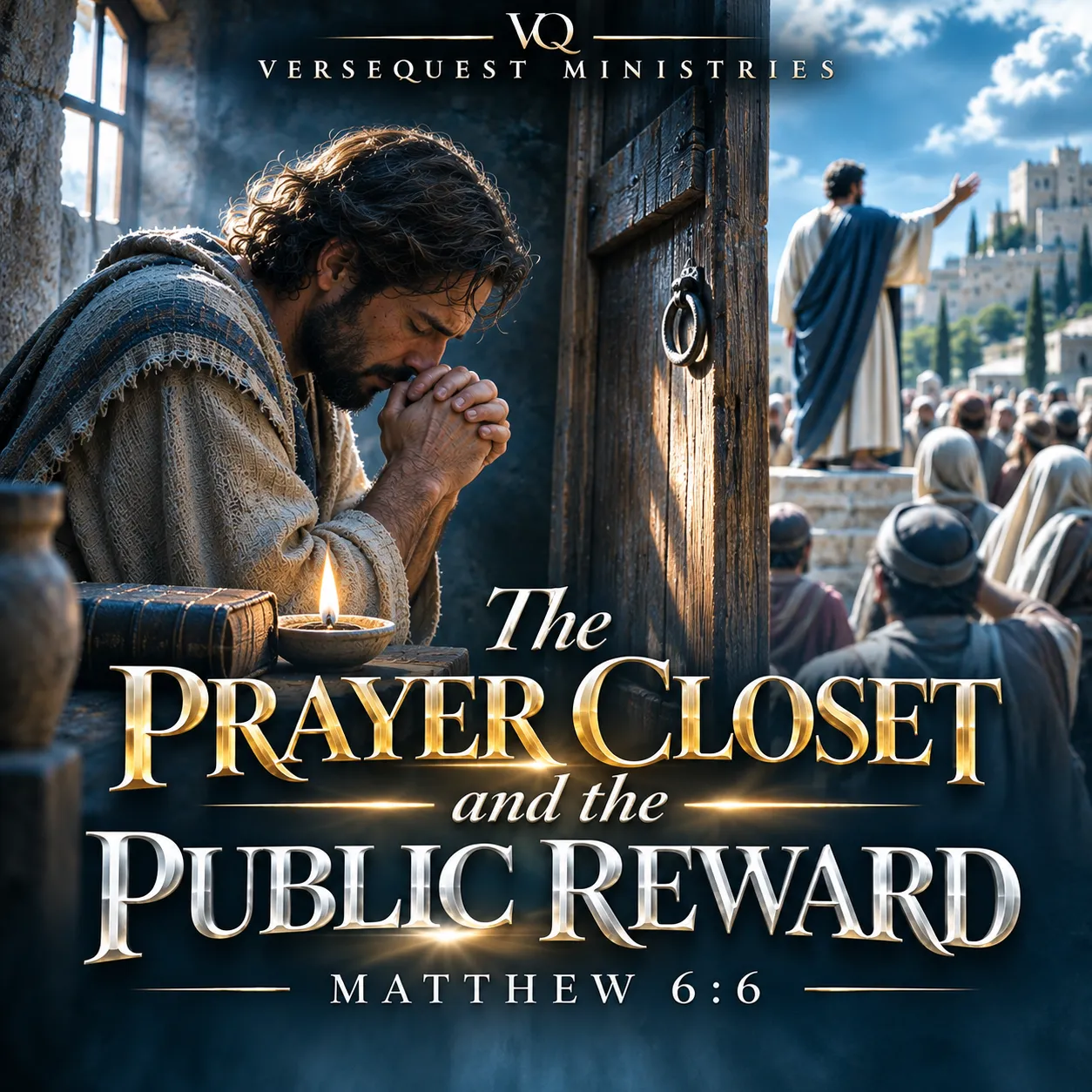
Sermon Title:
The Prayer Closet and the Public Reward
Key Passage:
Matthew 6:6
“But thou, when thou prayest, enter into thy closet, and when thou hast shut thy door, pray to thy Father which is in secret; and thy Father which seeth in secret shall reward thee openly.” (Matthew 6:6)
Series:
The Book God Gave
Topic:
The Biblical Importance of Secret Prayer, the Danger of Religious Hypocrisy, the Father’s Knowledge of Hidden Devotion, and the Promise of Divine Reward for Prayer Offered in Sincerity Rather Than for the Praise of Men
Book:
Matthew
Speaker:
Paul Tackett
Suggested Sermon Text:
Matthew 5:1–48; Matthew 6:1–34; Matthew 7:7–12, 21–27; Matthew 15:7–9; Matthew 18:19–20; Matthew 23:1–39; Luke 6:12–13; Luke 11:1–13; Luke 18:1–14; Luke 22:39–46; John 4:23–24; John 14:13–14; John 15:7; John 16:23–27; John 17:1–26; 1 Samuel 1:9–18; 1 Kings 8:22–61; 2 Kings 20:1–6; Psalm 5:1–3; Psalm 27:7–14; Psalm 34:15–18; Psalm 51:1–17; Psalm 62:5–8; Psalm 66:16–20; Psalm 139:1–12, 23–24; Proverbs 15:8, 29; Isaiah 29:13; Isaiah 55:6–7; Daniel 6:10–23; Daniel 9:3–19; Acts 1:12–14; Acts 2:42; Acts 4:23–31; Acts 12:5–17; Acts 16:25; Romans 4:4–5; Romans 5:1–2; Romans 8:15–27, 34; Romans 12:9–21; Romans 14:10–12; Romans 15:30–33; 1 Corinthians 3:11–15; 1 Corinthians 4:1–5; 1 Corinthians 13:1–13; 1 Corinthians 14:14–19; 1 Corinthians 15:1–4; 2 Corinthians 4:1–6; 2 Corinthians 5:7–10; Galatians 1:10; Galatians 4:4–7; Ephesians 1:3–14; Ephesians 2:8–18; Ephesians 3:12–21; Ephesians 6:18–20; Philippians 1:3–11; Philippians 4:4–9; Colossians 1:9–14; Colossians 4:2–6; 1 Thessalonians 5:16–18; 1 Timothy 2:1–8; 2 Timothy 2:15; Hebrews 4:14–16; Hebrews 7:25; James 4:1–10; James 5:13–18; 1 John 5:14–15.
Short Sermon Description:
Matthew 6:6 contains one of the Lord Jesus Christ’s most searching instructions concerning genuine prayer: “But thou, when thou prayest, enter into thy closet, and when thou hast shut thy door, pray to thy Father which is in secret; and thy Father which seeth in secret shall reward thee openly.” This sermon examines Christ’s teaching within the Sermon on the Mount, where He exposes the hypocrisy of religious men who perform outward acts of devotion primarily to obtain human recognition. The message explains the contrast between the hypocrites who prayed publicly to be seen of men and the disciple who enters his closet, shuts the door, and approaches the Father without an earthly audience. It explores the meaning of secret prayer, the significance of the closed door, the Father’s knowledge of hidden devotion, and the promise that He will reward according to His own righteousness and wisdom. Special attention is given to the difference between genuine prayer and religious performance, why Christ’s warning does not prohibit appropriate public or congregational prayer, and how the desire for human applause can corrupt otherwise legitimate religious activities. The sermon also examines Matthew 6:7–15, including the warning against vain repetitions, the Father’s knowledge of human needs, the pattern of prayer taught by Christ, and the necessity of preserving the original kingdom setting of His earthly instruction to Israel. Drawing upon Romans 8, Ephesians 2–3, Philippians 4, Colossians 4, and other Pauline passages, the outline distinguishes the Church-Age believer’s salvation by grace and access to the Father through Jesus Christ from attempts to earn divine acceptance through religious performance. It further considers the difference between God’s promised reward and the worldly assumption that sincere prayer guarantees public fame, financial prosperity, or immediate earthly recognition. Preachers, teachers, and Bible students will gain a comprehensive, KJV-based, rightly divided, sermon-ready framework for teaching private prayer, sincerity before God, spiritual humility, biblical reward, the danger of religious hypocrisy, Christian perseverance, and the importance of seeking the Father’s approval above the praise of men.
THE PRAYER CLOSET AND THE PUBLIC REWARD
Introduction
There is something almost comical about a religious man who cannot pray unless somebody is watching him. Give him a pulpit, a microphone, a congregation, and a sufficiently appreciative audience, and suddenly he can speak to heaven for twenty minutes without drawing a breath. He can arrange his voice, select impressive expressions, develop a rhythm, and sound as though he has personally occupied the throne room of Almighty God since breakfast. But remove the microphone, dismiss the audience, close the church doors, and leave the same man alone with his Bible, and there may not be enough prayer left in him to fill sixty seconds. That is a terrible contradiction, but the Lord Jesus Christ exposed it long before anybody invented microphones or social media. Matthew 6:6 declares, “But thou, when thou prayest, enter into thy closet, and when thou hast shut thy door, pray to thy Father which is in secret; and thy Father which seeth in secret shall reward thee openly.” The issue is not whether a man possesses the ability to construct a beautiful public prayer. The issue is whether he genuinely desires communion with God when there is no earthly advantage in appearing spiritual. The hypocrite wants an audience. The disciple is directed toward the Father. The hypocrite wants somebody to hear how religious he sounds. The disciple is taught to approach the God who knows every word before it is spoken. A prayer that requires an audience before it can become sincere may have been directed toward the audience all along.
The setting of this passage makes the warning even stronger. Matthew 6 belongs to the Sermon on the Mount, where Jesus Christ was instructing His disciples during His earthly ministry to Israel. He had addressed the righteousness associated with the kingdom, exposed the inadequacy of religious externalism, corrected corrupt interpretations of the law, and confronted the tendency of men to replace genuine obedience with outward appearances. In Matthew 6:1, Christ warns against performing religious acts “to be seen of them.” He then discusses almsgiving, prayer, and fasting, exposing the hypocrisy of men who deliberately arranged their religious conduct to attract public admiration. The instruction about the prayer closet cannot be detached from that broader warning. Christ is not merely providing architectural advice concerning where a disciple ought to stand when speaking to God. He is exposing religious ambition disguised as devotion. He is confronting the man who wants credit for righteousness more than he wants righteousness itself. The same chapter contains the instruction to seek first the kingdom of God and His righteousness. These truths must be understood within the historical and dispensational setting of the Lord’s earthly ministry to Israel, before the cross, resurrection, and the revelation of the mystery concerning the body of Christ through the Apostle Paul. Nevertheless, the spiritual danger Christ exposes is not restricted to one generation. The flesh has always enjoyed being admired, and religious flesh is particularly talented at disguising vanity as holiness.
There is also a vital distinction between the Lord’s promise of reward and the salvation of a sinner through Jesus Christ. Matthew 6:6 is not teaching that lost men can obtain eternal life by accumulating enough hours of private prayer. Neither does it establish that a person must maintain an impressive secret devotional record before the blood of Jesus Christ becomes sufficient for redemption. Salvation under the present dispensation is by grace through faith in the finished work of the Saviour. Christ died for our sins, was buried, and rose again the third day according to the Scriptures. The believer is justified through faith, sealed with the Holy Spirit, and accepted in Jesus Christ. His private prayers do not purchase that standing. But the fact that salvation is freely given does not make Christian motives unimportant. The same grace that saves the sinner teaches the redeemed man to reject fleshly pride and live unto the Lord. A Christian may be eternally secure while wasting years performing religious activities for the applause of other people. He may become so interested in appearing devoted that genuine private communion with God gradually disappears. He may receive public recognition for service that was primarily motivated by personal vanity. The prayer closet reveals a truth the public platform can easily conceal: a man may impress everybody watching him while remaining terribly uninterested in the God he claims to be addressing. Christ teaches that the Father sees what men cannot see, and that His approval is infinitely more valuable than human applause.
I. THE SERMON ON THE MOUNT EXPOSES RELIGIOUS RIGHTEOUSNESS PERFORMED FOR HUMAN RECOGNITION
Key Text: Matthew 6:1
Supporting Texts: Matthew 5:1–20; Matthew 6:1–18; Matthew 23:1–12, 23–28; Isaiah 29:13; Galatians 1:10; Philippians 2:3–5
Before examining the prayer closet, we must understand the warning that introduces the entire discussion. Matthew 6:1 declares, “Take heed that ye do not your alms before men, to be seen of them: otherwise ye have no reward of your Father which is in heaven.” Notice the particular danger. Christ is not condemning every good work performed where another person might see it. Matthew 5:16 had already instructed His hearers to let their light shine before men so that others might see their good works and glorify the Father in heaven. There is no contradiction. In Matthew 5, the proper objective is the Father’s glory. In Matthew 6, the condemned objective is human recognition. One man performs a legitimate act of obedience that directs attention toward God. Another performs a similar outward act because he wants people to admire him. The activity may appear identical to the casual observer, but the motive differs. That is precisely why the Lord’s warning is so searching. Human beings can examine outward actions to a limited extent, but they cannot perfectly determine every intention of the heart. The man giving money may be genuinely helping someone in need, or he may be purchasing a reputation for generosity. The man praying publicly may sincerely desire the Father’s help, or he may be displaying his religious vocabulary for the benefit of the audience.
Matthew 6 exposes this hypocrisy through three ordinary religious activities: almsgiving, prayer, and fasting. Each activity can be performed sincerely, and each can be corrupted by the desire for recognition. A man may give because compassion moves him to assist another person, or he may give because he enjoys hearing his name announced. He may pray because he recognizes his dependence upon God, or because he desires to sound more spiritual than the people surrounding him. He may fast with a sincere purpose before the Lord, or deliberately arrange his appearance so everybody will notice his supposed sacrifice. The flesh is capable of transforming nearly any legitimate religious responsibility into a stage upon which self becomes the central performer. That is why Christ addresses motives. The problem is not merely the external form of an activity. It is the heart seeking glory from men through something that ought to glorify God. Religion becomes a particularly effective hiding place for pride when the person practicing it has learned to make self-advertisement sound like devotion.
Right division is necessary here. The Sermon on the Mount belongs to Christ’s earthly ministry and contains genuine kingdom instruction directed to His disciples within Israel’s prophetic setting. It must not be indiscriminately treated as though every statement were a direct Pauline explanation of the Church’s heavenly calling. But the moral warning against hypocrisy agrees with the instruction given to believers under grace. Galatians 1:10 asks, “for if I yet pleased men, I should not be the servant of Christ.” Philippians 2:3 commands, “Let nothing be done through strife or vainglory.” The Church-Age believer is therefore responsible to examine whether his service is governed by the Lord’s truth or by a desire for admiration. He need not hide every good work from public view, but he must refuse to make human praise the purpose of obedience. The Lord is not condemning good works that happen to be seen. He is condemning religious works performed because the man wants to be seen.
Main Truth: Christ’s warning concerning outward religious righteousness exposes the danger of seeking human recognition through spiritual activities rather than sincerely glorifying God.
II. THE HYPOCRITE’S PUBLIC PRAYER MAY RECEIVE THE ONLY REWARD HE REALLY WANTED
Key Text: Matthew 6:5
Supporting Texts: Matthew 6:1–6; Matthew 23:5–14; Luke 18:9–14; Isaiah 29:13; Proverbs 29:25; Galatians 1:10
Jesus Christ declares, “And when thou prayest, thou shalt not be as the hypocrites are: for they love to pray standing in the synagogues and in the corners of the streets, that they may be seen of men.” Notice that the Lord identifies the purpose behind the conduct. He does not simply condemn men for standing. He does not declare every synagogue prayer sinful. He does not prohibit every occasion when prayer may be heard by others. His statement concerns men who love public religious visibility because they desire an audience. The location becomes useful to them because people are present to observe. The religious posture becomes valuable because it creates an impression. The prayer becomes a performance. The hypocrite has discovered that appearing spiritual can bring recognition without requiring genuine private devotion. He may be able to impress people who cannot see beyond the outward appearance, but the Father knows the actual motive. A man can fool a congregation about his dedication. He can fool his neighbors about his character. He can even develop an impressive ability to excuse his own vanity. But the God who searches the heart is not deceived by the arrangement of a man’s public religious performance.
Christ concludes the warning with a devastating statement: “Verily I say unto you, They have their reward.” Think about those words. The hypocrites wanted admiration, and they received it. They desired recognition, and people noticed them. They wanted a reputation for spirituality, and their impressive public prayers supplied it. But the Lord identifies that earthly recognition as their reward. Their objective was never primarily to seek the Father. It was to receive glory from men. Consequently, the very applause they pursued became the payment they obtained. This should cause every preacher, teacher, and Christian worker to examine the motives behind public service. A man may become famous for preaching and still be personally motivated by vanity. A person may become widely admired for charitable work while privately resenting every occasion when nobody notices his generosity. A church leader may pray eloquently before hundreds but neglect the Father when alone. The external activity may receive public appreciation, but human appreciation does not settle the question of divine approval. The hypocrite wanted to be paid in applause, and Christ declared that he had already collected his wages.
The same danger appears in Luke 18, where Jesus describes a Pharisee and a publican going up into the temple to pray. The Pharisee rehearses his religious accomplishments and compares himself favorably with other men. The publican stands afar off and cries, “God be merciful to me a sinner.” The passage belongs to the Lord’s earthly ministry and must be understood within its proper setting, but the contrast is unmistakable. One man uses prayer as an opportunity to congratulate himself. The other recognizes his need for mercy. The Christian should not conclude that humble prayer requires displaying an artificially miserable appearance or continually announcing how unworthy he feels. That can become another form of religious performance. The issue is sincerity before God. A man who spends his prayers advertising his humility has simply found a more sophisticated way to boast. If the chief accomplishment of your prayer is that everybody now knows how spiritual you are, you may have succeeded with the audience while missing the purpose of the prayer entirely.
Main Truth: Christ condemns prayer performed for human admiration and warns that public applause may be the only reward received by the religious hypocrite.
III. “ENTER INTO THY CLOSET” DIRECTS THE DISCIPLE AWAY FROM THE AUDIENCE AND TOWARD THE FATHER
Key Text: Matthew 6:6
Supporting Texts: Matthew 6:5–8; Matthew 14:23; Mark 1:35; Luke 5:16; Luke 6:12; Psalm 62:5–8; Daniel 6:10
Jesus begins the positive instruction with these words: “But thou, when thou prayest, enter into thy closet.” The contrast with the hypocrites is deliberate. They sought locations where people could observe them. Christ directs the disciple toward a private place where human recognition is no longer the objective. The closet serves as an illustration of genuine privacy before God. It is the place where a man can pray without arranging his speech for the approval of other people. There is no congregation to impress, no audience to persuade, and no earthly reputation to improve through religious display. The disciple is directed away from human spectators and toward the Father. That does not mean the physical structure of a closet possesses special spiritual power. The Bible does not teach that prayers offered in a particular room become more acceptable because the walls are narrow or the door is made of wood. The point concerns secrecy and sincerity. A person may pray privately in a quiet room, outdoors, during a period of solitude, or wherever legitimate circumstances permit genuine communion with God. The location serves the purpose of undistracted prayer, but the Father remains the One who hears.
The Lord Jesus Christ Himself provides examples of seeking solitude for prayer. Mark 1:35 declares, “And in the morning, rising up a great while before day, he went out, and departed into a solitary place, and there prayed.” Luke 5:16 says, “And he withdrew himself into the wilderness, and prayed.” Matthew 14:23 records Christ going up into a mountain apart to pray. These passages belong to the Lord’s unique earthly ministry, and His prayers must be understood in connection with His incarnate obedience and communion with the Father. Yet they also demonstrate that prayer does not require the presence of an audience. The Lord who possessed authority over sickness, devils, nature, and death deliberately withdrew from crowds to pray. He did not need to arrange an impressive public spectacle every time He addressed the Father. The Christian should not imagine that his responsibilities, ministry experience, or biblical knowledge have made private dependence unnecessary. If the sinless Son of God sought solitude for prayer, the saved sinner has very little reason to boast that he is too important, too busy, or too spiritually advanced to do the same.
But the command must not become another legalistic ceremony. Some people take Christ’s instruction concerning the closet and begin inventing rules about how long a person must remain there, what posture must be used, which direction he must face, and whether the room meets their preferred standard of religious privacy. Scripture establishes no such universal ritual. The Christian should develop habits of private prayer that are appropriate to his responsibilities and circumstances without confusing the arrangement of his environment with the actual condition of his heart. A father may need to pray before the household awakens. A mother caring for young children may need to use brief opportunities throughout the day. An elderly believer may pray quietly from a chair or bed. A Christian laboring through difficult hours may find moments of solitude before or after work. The essential matter is not that every believer follows an identical schedule. It is that he genuinely seeks the Lord rather than allowing prayer to exist only when other people are present to admire it. The prayer closet is not valuable because the room is impressive. It is valuable because the believer has deliberately left the audience behind and turned his attention toward the Father.
Main Truth: The prayer closet illustrates private and sincere communion with God, removing the temptation to perform for human recognition and directing the believer’s attention toward the Father.
IV. “WHEN THOU HAST SHUT THY DOOR” REQUIRES A WILLINGNESS TO LEAVE DISTRACTIONS AND RELIGIOUS PERFORMANCE OUTSIDE
Key Text: Matthew 6:6
Supporting Texts: Matthew 6:5–8; Psalm 46:10; Psalm 62:5–8; Mark 1:35; Luke 5:16; Luke 10:38–42; Colossians 3:1–2; Philippians 4:6–8
Christ continues, “and when thou hast shut thy door.” That is a small expression with a substantial practical lesson. The disciple enters the closet and shuts the door. The audience is excluded. The opportunity to display spiritual superiority is removed. The man who came to pray must now deal with the simple reality that God is the One being addressed. The closed door does not make the room holy or create a supernatural barrier against the devil. The Lord is not teaching that evil spirits are unable to enter a room because someone has turned a handle. The point is privacy. The disciple has deliberately withdrawn from the public setting in which religious hypocrisy flourishes. He is no longer arranging his conduct for the benefit of spectators. That is a searching illustration for an age in which almost every activity can be recorded, displayed, announced, and converted into an opportunity for public recognition. There is nothing inherently sinful about communicating the importance of prayer, encouraging others to pray, or reporting an answer to prayer for the glory of God. But the moment a person becomes more interested in displaying his devotion than actually practicing it, the purpose has been corrupted.
The closed door also provides a useful practical illustration concerning attention. A man can physically enter a private room while carrying every distraction of the outside world into it. He may close the door and then spend the next thirty minutes examining his telephone, reviewing arguments, planning responses to critics, thinking about financial matters, and imagining what other people think of him. His body has entered the closet, but his attention remains in the marketplace. Now Scripture does not command believers to eliminate every ordinary concern before praying. Those concerns may be the very matters that ought to be brought before the Lord. But there is a difference between bringing a burden before God and continually allowing the burden to replace communion with God. Philippians 4:6 commands believers to make their requests known unto God through prayer and supplication with thanksgiving. The Christian should therefore learn to give the Lord deliberate attention rather than treating prayer as something to be squeezed into whatever moments remain after every less important distraction has been entertained.
This instruction also exposes the difference between genuine solitude and religious isolation. Christ does not command the disciple to withdraw permanently from people, abandon fellowship, neglect his family, or refuse the responsibilities of ordinary life. The man who uses his prayer closet as an excuse to neglect the work God has plainly given him has misunderstood the lesson. Private prayer should strengthen faithful obedience, not replace it. A believer may pray earnestly for his family, but he should also fulfill his responsibilities toward that family. He may pray for opportunities to witness, but he should not refuse every appropriate opportunity when it arrives. He may ask for wisdom while neglecting the Scriptures that provide divine instruction. The closed door is not an escape from obedience. It is an opportunity to approach the Father without the distractions and applause that can corrupt the motives of the heart.
Main Truth: The closed door illustrates deliberate privacy, sincere attention, and freedom from religious performance, while private prayer should strengthen rather than replace the believer’s practical obedience.
V. “THY FATHER WHICH SEETH IN SECRET” REVEALS THAT GOD KNOWS WHAT THE WORLD CAN NEVER OBSERVE
Key Text: Matthew 6:6
Supporting Texts: Matthew 6:4, 6, 8, 18; Psalm 139:1–12; Proverbs 15:3; 1 Samuel 16:7; 1 Corinthians 4:3–5; Romans 8:26–27; Hebrews 4:12–16
Jesus then directs attention toward “thy Father which is in secret,” and concludes by identifying Him as the Father “which seeth in secret.” That statement should permanently settle the notion that religious devotion becomes valuable only when another human being recognizes it. God sees what men cannot see. He knows the motives of the heart. He knows the circumstances hidden from public observation. He knows the burden a person struggles to express and the gratitude that may never become part of an impressive public testimony. Psalm 139 begins with David declaring, “O LORD, thou hast searched me, and known me.” The psalm continues by describing the LORD’s knowledge of his thoughts, words, and ways. The historical setting belongs to David, but the truth concerning divine omniscience is unmistakable. The Lord does not depend upon a public announcement to discover what His people are doing. He does not require a witness to verify that a believer has prayed. The Father sees in secret because nothing is hidden from His knowledge.
That truth is both comforting and sobering. It is comforting because the believer does not need to advertise his private devotion in order for God to recognize it. The elderly Christian praying quietly for family members may never know how many people benefited from that intercession. The parent who repeatedly brings a child before the Father may receive little recognition for the burden carried. The preacher who prays privately before teaching Scripture may never receive public acknowledgment for those moments. Yet the Father sees. On the other hand, divine knowledge also exposes the motives that human beings cannot examine. A man may appear humble in public while secretly nourishing pride. He may use private prayer as another opportunity to rehearse hatred, justify wrongdoing, or demand that God serve his personal ambitions. The Father knows the difference between genuine dependence and religious self-congratulation. The absence of an earthly audience does not automatically make every private prayer sincere. A man can deceive the public with his religious appearance, and he can deceive himself with his own excuses, but he cannot hide the actual condition of his heart from God.
Matthew 6:8 adds another important truth: “for your Father knoweth what things ye have need of, before ye ask him.” That statement raises an obvious question. If the Father already knows the need, why pray? Because prayer is not primarily a method of supplying God with information He lacks. It is an expression of dependence, trust, reverence, and fellowship. The Lord knows the needs of His creatures, yet He instructs them to pray. For the Church-Age believer, Romans 8:26 explains that the Holy Spirit helps our infirmities because “we know not what we should pray for as we ought.” The Father possesses complete knowledge while the believer’s understanding remains limited. The Christian may be unable to explain every dimension of his circumstances, but he can approach the Lord through Jesus Christ with confidence in divine wisdom. The comfort of secret prayer is not that you have finally discovered a place where nobody knows what is happening in your heart. It is that you are speaking to the Father who already knows and has invited you to come.
Main Truth: The Father possesses perfect knowledge of secret prayer, hidden motives, and genuine needs, making human recognition unnecessary while calling the believer to sincerity and humility before God.
VI. “SHALL REWARD THEE OPENLY” ESTABLISHES DIVINE APPROVAL ABOVE HUMAN APPLAUSE
Key Text: Matthew 6:6
Supporting Texts: Matthew 6:1–6, 16–18; Matthew 5:11–12; Matthew 10:40–42; Matthew 16:27; 1 Corinthians 3:11–15; 1 Corinthians 4:1–5; 2 Corinthians 5:9–10; Colossians 3:23–24
The final expression in Matthew 6:6 is perhaps the most striking: “and thy Father which seeth in secret shall reward thee openly.” Notice the contrast. The hypocrite deliberately seeks public recognition and receives the applause of men. The sincere disciple approaches the Father privately, and the Father promises reward. The first man tries to control the publicity surrounding his devotion. The second is instructed to leave the matter of recognition in God’s hands. This is not a command to become uninterested in doing what is right. It is a command to stop making human admiration the objective of obedience. The Lord’s words reveal that the apparent secrecy of an action does not make that action insignificant. The Father sees what men overlook, and He is able to reward according to His own righteous judgment. The believer should not imagine that a prayer becomes worthless because nobody else heard it. Human observation is not the measure of divine knowledge. What men cannot see is not therefore unknown to God, and what men refuse to recognize is not therefore without value before Him.
But the phrase “reward thee openly” must not be transformed into a promise that every person who maintains a private prayer life will eventually become wealthy, famous, publicly celebrated, or recognized before a large congregation. Christ does not say that the sincere disciple will receive a profitable business, widespread popularity, immediate healing, or an earthly reward of the disciple’s personal choosing. The passage establishes the Father’s promised reward in contrast with the hypocrite’s desire for human glory. It does not specify the timing, form, or earthly visibility of every reward. Nor does it authorize the believer to begin praying secretly with the calculated ambition of eventually receiving a more impressive public reputation. That would merely relocate the original hypocrisy. A man could enter his closet, shut the door, and spend his time imagining the day when everybody will discover what a remarkable prayer warrior he has become. The door would be closed, but the audience would still occupy the center of his imagination. The Father cannot be fooled by changing the location of the performance.
The distinction between Matthew’s kingdom setting and the Church’s future accountability must also be preserved. Matthew 6 belongs to Christ’s earthly instruction to His disciples. The Pauline epistles separately establish the future Judgment Seat of Christ, where the works of saved believers will be examined. First Corinthians 3:13 declares, “Every man’s work shall be made manifest.” First Corinthians 4:5 explains that the Lord will bring to light hidden things and make manifest the counsels of the hearts. Those passages provide a fitting comparison concerning divine knowledge and reward, but they should not simply be made identical in every doctrinal detail to Matthew 6:6. The Church-Age believer’s salvation is secure through faith in Jesus Christ, while the quality and motives of his service will be examined by the Lord. A saved man may receive human applause for work that does not withstand divine examination, while another may remain obscure and yet serve faithfully. The Christian who serves for applause has chosen a reward that dies when the audience stops clapping. The believer who serves for Christ has entrusted the matter of reward to the only Judge whose knowledge is perfect.
Main Truth: The Father’s promise of reward establishes the value of sincere devotion before God without guaranteeing earthly fame, financial prosperity, or recognition according to human expectations.
VII. THE PRAYER CLOSET IS NOT A PLACE FOR VAIN REPETITIONS OR RELIGIOUS FORMULAS
Key Text: Matthew 6:7–8
Supporting Texts: Matthew 6:5–15; 1 Kings 18:25–29; Luke 18:9–14; Romans 8:26–27; 1 Corinthians 14:14–19; Philippians 4:6–7; Colossians 4:2; 1 John 5:14–15
Immediately after teaching His disciples concerning secret prayer, Jesus Christ issues another warning: “But when ye pray, use not vain repetitions, as the heathen do: for they think that they shall be heard for their much speaking.” That statement exposes another form of religious error. The hypocrite seeks human applause, while the heathen imagines that repeated words possess some power to compel divine attention. Both misunderstand prayer. One is attempting to influence the audience, and the other is attempting to influence God through a mechanical performance. Christ rejects the idea that prayer becomes acceptable merely because a person has repeated particular phrases enough times. The Lord is not persuaded by quantity in place of sincerity. He does not become more willing to listen because the petitioner has learned to arrange impressive language into long speeches. The question is not how many words a person can produce but whether he is genuinely approaching God according to the truth He has revealed. A man may spend an hour repeating beautiful religious phrases while never exercising meaningful dependence upon the Father. Another may express a sincere need in a few sentences. The length alone does not establish the spiritual quality of either prayer.
The Old Testament provides an interesting illustration in 1 Kings 18, where the prophets of Baal cried out for hours and attempted to attract the attention of a false god. They repeated their appeals, leaped upon the altar, and ultimately cut themselves in their desperate effort to obtain a response. But there was no answer because Baal was no god at all. Elijah then prayed unto the LORD, and the living God answered according to His purpose. The passage belongs to the historical confrontation between Elijah and the false prophets in Israel, not to a direct instruction concerning the Church’s prayer schedule. Nevertheless, it illustrates the difference between trusting the living God and attempting to manufacture spiritual results through religious excitement. The Christian should not imagine that certain words possess supernatural power independently of the Lord who hears them. Neither should he confuse biblical perseverance with vain repetition. Paul commands believers to pray without ceasing, and Christ Himself teaches earnest persistence. Repeating a genuine request is not automatically sinful. The problem arises when repetition becomes empty, manipulative, or a substitute for understanding and faith.
For believers under grace, Philippians 4:6 commands prayer and supplication with thanksgiving. First John 5:14 teaches confidence in asking according to God’s will. Romans 8:26 reminds us that the Holy Spirit helps our infirmities because we do not always know what we should pray for as we ought. These passages should make the Christian humble rather than superstitious. The Lord has never commanded believers to discover a secret sequence of words that will obligate heaven to obey them. Neither has He required unintelligible private utterances as proof of genuine spirituality. First Corinthians 14:15 declares, “I will pray with the spirit, and I will pray with the understanding also.” A Christian should pray thoughtfully, sincerely, scripturally, and with confidence in the Father’s wisdom. He may repeat a request when the need continues, but he should not imagine that repetition gives him authority to control God. The prayer closet is not a factory where enough religious words eventually manufacture an answer. It is a place where the believer approaches the living God through the access He has provided.
Main Truth: Christ condemns empty and mechanical repetition in prayer, teaching that genuine communion with God depends upon sincerity, faith, and divine truth rather than the length, quantity, or ceremonial arrangement of religious words.
VIII. CHRIST’S PATTERN OF PRAYER MUST BE UNDERSTOOD IN ITS KINGDOM SETTING AND APPLIED WITH RIGHT DIVISION
Key Text: Matthew 6:9–15
Supporting Texts: Luke 11:1–13; Matthew 5:1–20; Matthew 6:9–15, 33; Romans 4:4–8; Ephesians 1:7, 13–14; Ephesians 2:8–18; Colossians 2:13–14; Colossians 3:12–13
After warning against hypocrisy and vain repetitions, the Lord Jesus Christ provides His disciples with a pattern of prayer. Matthew 6:9 begins, “After this manner therefore pray ye: Our Father which art in heaven, Hallowed be thy name.” Christ then directs attention toward the Father’s kingdom, His will, daily provision, forgiveness, and deliverance from temptation. Notice that the Lord does not teach the disciples to begin with personal ambition, earthly recognition, or an inventory of possessions they desire. He begins with the Father’s name and divine purpose. That order is instructive. The person praying should remember that God is greater than the requests being presented. Prayer should be governed by reverence and a genuine desire for the Lord’s will rather than the assumption that heaven exists to satisfy fallen human appetites. The disciples were not being supplied with a magical formula whose repetition would automatically produce spiritual power. They were being taught a manner of prayer consistent with the Father’s holiness, purposes, provision, and authority.
But the doctrinal setting must be preserved. Jesus Christ was ministering to Israel before His crucifixion and resurrection. The instruction “Thy kingdom come” belongs to the prophetic expectation of God’s kingdom and the promised reign of the Messiah. It must not be carelessly reduced to the idea that the Church can establish the literal Millennium through religious programs or political influence. Likewise, Matthew 6:14–15 connects divine forgiveness with the forgiveness extended to others within that setting. Those verses must not be indiscriminately converted into a condition by which a genuinely saved Church-Age believer repeatedly loses and regains eternal redemption according to his success in forgiving other people. Ephesians 1:7 declares that believers possess redemption through Christ’s blood, the forgiveness of sins according to the riches of His grace. Colossians 2:13 says believers have been forgiven all trespasses. The Pauline instruction concerning forgiveness is grounded in what God has already accomplished through Jesus Christ. Ephesians 4:32 commands Christians to forgive one another “even as God for Christ’s sake hath forgiven you.” The order is vital. Forgiveness does not purchase redemption. The redeemed should practice forgiveness because Christ has already provided it.
Right division does not mean the Church should discard Christ’s instruction concerning reverence, sincerity, humility, dependence, and prayer. It means those truths must be applied according to the completed revelation of Scripture. The sinner is saved through faith in the death, burial, and resurrection of Jesus Christ, not by successfully reciting a prayer. The saved believer possesses access to the Father through Jesus Christ by the Holy Spirit. He should pray with thanksgiving, submit to the Father’s will, request help concerning genuine needs, forgive others, and remain spiritually watchful. But he should not mistake the repetition of a familiar prayer for a substitute for personal communion with God. Nor should he imagine that an impressive ability to explain dispensational distinctions excuses neglecting the very spiritual responsibilities the Pauline epistles command. Rightly dividing the Book does not give the Christian permission to become prayerless. It teaches him how to approach the Father without confusing God’s different dealings with men throughout Scripture.
Main Truth: Christ’s pattern of prayer must be understood within His earthly kingdom ministry to Israel, while its enduring principles of reverence, dependence, forgiveness, and submission must be applied consistently with the Church’s position under grace.
IX. PRIVATE PRAYER MUST PRODUCE SINCERE PUBLIC FAITHFULNESS WITHOUT BECOMING PUBLIC PERFORMANCE
Key Text: Matthew 6:6
Supporting Texts: Acts 1:12–14; Acts 2:42; Acts 4:23–31; Acts 12:5; Romans 8:15–27; Ephesians 2:18; Ephesians 6:18–20; Colossians 4:2–6; 1 Timothy 2:1–8; 1 Thessalonians 5:17
One of the most common mistakes concerning Matthew 6:6 is the assumption that Christ condemned public prayer altogether. That conclusion contradicts the broader testimony of Scripture. The Lord Jesus Christ Himself prayed in circumstances where others could hear Him. John 17 records His prayer to the Father concerning His disciples and the work entrusted to Him. The early Church likewise engaged in united prayer. Acts 1 records believers continuing with one accord in prayer and supplication. Acts 2:42 identifies prayer among the activities characterizing the early believers. Acts 4:24 describes Christians lifting up their voice to God with one accord, and the following verses record their request for boldness in speaking His word. Acts 12:5 declares, “Peter therefore was kept in prison: but prayer was made without ceasing of the church unto God for him.” These passages demonstrate that appropriate public and congregational prayer is not inherently sinful. The problem condemned in Matthew 6 is prayer offered for the purpose of being admired. Christ does not prohibit believers from praying together. He prohibits the hypocrisy of turning prayer into a performance designed to obtain human recognition.
That distinction should influence every Christian who participates in public worship, family prayer, or organized ministry. A pastor may appropriately lead a congregation before the Father. A father may pray with his family. Believers may gather to intercede for missionaries, those suffering, and lost sinners who need the gospel. The ability of others to hear the prayer does not make it hypocritical. But the person leading should remember whom he is addressing. Public prayer should not become a sermon disguised as communication with God, an opportunity to embarrass another person, or a means of announcing how much spiritual authority the speaker supposedly possesses. A man should not use the prayer meeting to spread accusations, rebuke people indirectly, or advertise personal accomplishments. Neither should he deliberately avoid praying in appropriate public settings merely because he fears that somebody might accuse him of hypocrisy. The issue is not the presence of other people. It is the motive of the heart. A man may pray publicly and sincerely address the Father, while another may pray privately and spend the entire time imagining how impressive his secret devotion will appear when somebody discovers it.
The Church-Age believer’s prayer life must ultimately rest upon his relationship with Jesus Christ. Ephesians 2:18 declares, “For through him we both have access by one Spirit unto the Father.” That access is not earned through private prayer, public ministry, or the quality of one’s religious vocabulary. It is provided through the Saviour’s finished work. Yet the privilege should produce genuine dependence upon God. The believer ought to cultivate regular private communion with the Father while remaining faithful in public responsibilities. He should pray for the salvation of the lost and communicate the gospel when opportunities appear. He should pray for fellow believers and provide appropriate assistance when he possesses the means and responsibility to help. He should pray for sound doctrine while studying Scripture and rightly dividing the word of truth. He should pray for patience while refusing the flesh’s desire for retaliation. He should pray for humility while rejecting personal ambition. And he should serve without requiring public recognition before he becomes dependable. The prayer closet was never intended to produce a Christian who hides from obedience. It should strengthen the believer to walk faithfully before men while seeking the approval of God.
Main Truth: Christ’s teaching concerning secret prayer condemns religious performance rather than appropriate public prayer, and the saved believer should unite sincere private dependence upon God with faithful public obedience and service.
Conclusion
Matthew 6:6 places one of the most searching contrasts in Scripture before every person who claims to pray: “But thou, when thou prayest, enter into thy closet, and when thou hast shut thy door, pray to thy Father which is in secret; and thy Father which seeth in secret shall reward thee openly.” The instruction belongs to the Sermon on the Mount, where the Lord Jesus Christ exposes the hypocrisy of religious men who perform outward acts of devotion for the purpose of receiving human recognition. He warns against giving alms to attract attention, praying where an audience may admire the speaker, and fasting in a manner designed to advertise personal sacrifice. The recurring issue is the same: religious activity can be corrupted when the person performing it becomes more interested in human praise than divine approval. Christ therefore directs His disciple toward the closet, away from spectators, and into the presence of the Father who sees in secret. The closed door removes the opportunity for public performance. The Father’s knowledge establishes that hidden devotion is not unnoticed. And the promise of reward reminds the hearer that the Lord’s judgment is more important than the applause of men. The issue is not whether everybody knows how much a person prays. It is whether the person genuinely approaches God when nobody else is watching. The prayer closet exposes the difference between wanting to be known as a man of prayer and actually being a man who prays.
The passage also requires proper doctrinal distinctions. Matthew 6 belongs to Christ’s earthly kingdom instruction to His disciples, and the promise concerning reward must not be transformed into another condition for earning eternal salvation under grace. The sinner is justified through faith in Jesus Christ, whose death, burial, and resurrection provide the complete foundation of redemption. The saved believer possesses access to the Father through the Son by the Holy Spirit. His standing does not depend upon the number of hours spent privately praying, the perfection of his requests, or the ability to maintain an impressive devotional routine. Yet salvation by grace does not make sincerity, humility, and obedience unimportant. The Apostle Paul commands believers to pray without ceasing, continue in prayer with thanksgiving, intercede for others, and seek the Lord’s help in spiritual warfare. Those responsibilities belong to the saved man’s practical walk. Likewise, the coming Judgment Seat of Christ will expose the quality and motives of Christian service. The Lord will not be deceived by earthly reputation or religious self-promotion. A preacher may receive considerable public recognition while pursuing his own glory, and a quiet believer may faithfully serve Christ without anybody recognizing the sacrifice. The final judgment belongs to the Lord. The Christian does not need to become invisible to men in order to be faithful to God, but he must never make being visible to men the reason he serves God.
So take the King James Bible and examine your prayer life according to Matthew 6. Do you pray when nobody is present to admire your words? Are you willing to approach the Father without announcing the details of your devotion afterward? Do you find genuine satisfaction in bringing the needs of others before God even when those people never know you prayed for them? Have you become so occupied with public religious responsibilities that private communion with the Lord has gradually disappeared? Are you praying according to Scripture, or have you become dependent upon familiar phrases repeated without serious understanding? Do you approach God with reverence, or have you mistaken boldness through Jesus Christ for permission to command the Father according to the ambitions of the flesh? And when you perform a legitimate religious responsibility, is your primary concern the glory of Christ or the possibility that somebody will recognize your personal dedication? If these questions expose something requiring correction, the answer is not to begin advertising a new prayer schedule or inventing another religious ceremony. Return to the Book. Understand the instruction in its proper setting. Remember the finished work of Jesus Christ. Approach the Father through Him. Pray sincerely. Intercede for others. Give thanks. Submit to divine wisdom. Maintain sound doctrine. Fulfill the responsibilities God has already placed before you. And stop measuring the value of your spiritual life according to how many people know what you have been doing. The man who truly understands the prayer closet has learned that the Father’s attention is worth more than the admiration of every audience the world could assemble.
Final Call
If you are lost, the prayer closet cannot save you. You may spend years praying privately, maintain an impressive religious routine, memorize beautiful prayers, practice moral discipline, attend church faithfully, and perform charitable works while remaining guilty before God because you have never trusted the Lord Jesus Christ as your Saviour. Salvation is not the reward for religious sincerity. It is the gift of God received through faith in the finished work of Jesus Christ. First Corinthians 15:3–4 declares “that Christ died for our sins according to the scriptures; And that he was buried, and that he rose again the third day according to the scriptures.” Romans 4:5 declares that God justifies the ungodly who believe on Him. Ephesians 2:8–9 says, “For by grace are ye saved through faith; and that not of yourselves: it is the gift of God: Not of works, lest any man should boast.” Acts 16:31 declares, “Believe on the Lord Jesus Christ, and thou shalt be saved.” Do not confuse praying religious words with believing the gospel. A repeated prayer cannot substitute for personal faith in the risen Saviour. Jesus Christ accomplished redemption through His own blood, and no amount of private devotion can add anything to His sufficient sacrifice. Believe the gospel. Trust Jesus Christ. Receive eternal life through faith in Him. The most important thing about your prayer life is not whether other people consider you spiritual. The most important question before the lost sinner is whether he has believed on the Saviour who alone can save.
If you are saved, remember that the Lord has already redeemed you through His blood, justified you by faith, sealed you with the Holy Spirit, and provided access to the Father through Jesus Christ. Those blessings should produce gratitude, humility, sincerity, and faithful dependence rather than religious self-advertisement. Stop measuring your spiritual devotion according to public recognition. Stop treating prayer as something worth practicing only when other people can hear how well you speak. Stop confusing impressive language with genuine communion. And stop imagining that a private prayer routine becomes more valuable when it eventually produces earthly fame. Read the Scriptures. Study them. Rightly divide the word of truth. Cultivate sincere private prayer according to your opportunities and responsibilities. Pray for your family. Pray for fellow believers. Pray for pastors, teachers, missionaries, and those who proclaim the gospel. Pray for the salvation of the lost. Give thanks for the blessings already received. Seek mercy and grace through the Saviour who purchased your redemption. And when opportunities for public service appear, fulfill them faithfully without turning the work of God into a performance for human applause. You do not need a crowd to validate your prayers, and you do not need public recognition to make faithful service valuable. The Father sees what others cannot, and His approval is worth more than all the applause this world has to offer.
Closing Verse:
“But thou, when thou prayest, enter into thy closet, and when thou hast shut thy door, pray to thy Father which is in secret; and thy Father which seeth in secret shall reward thee openly.” (Matthew 6:6)
Closing Statement:
The hypocrite opens his mouth so the crowd will notice him, but the sincere disciple shuts the door because the Father is already listening—and when the applause of men has faded into silence, the approval of God will still be worth more than every public reward the world could ever give.