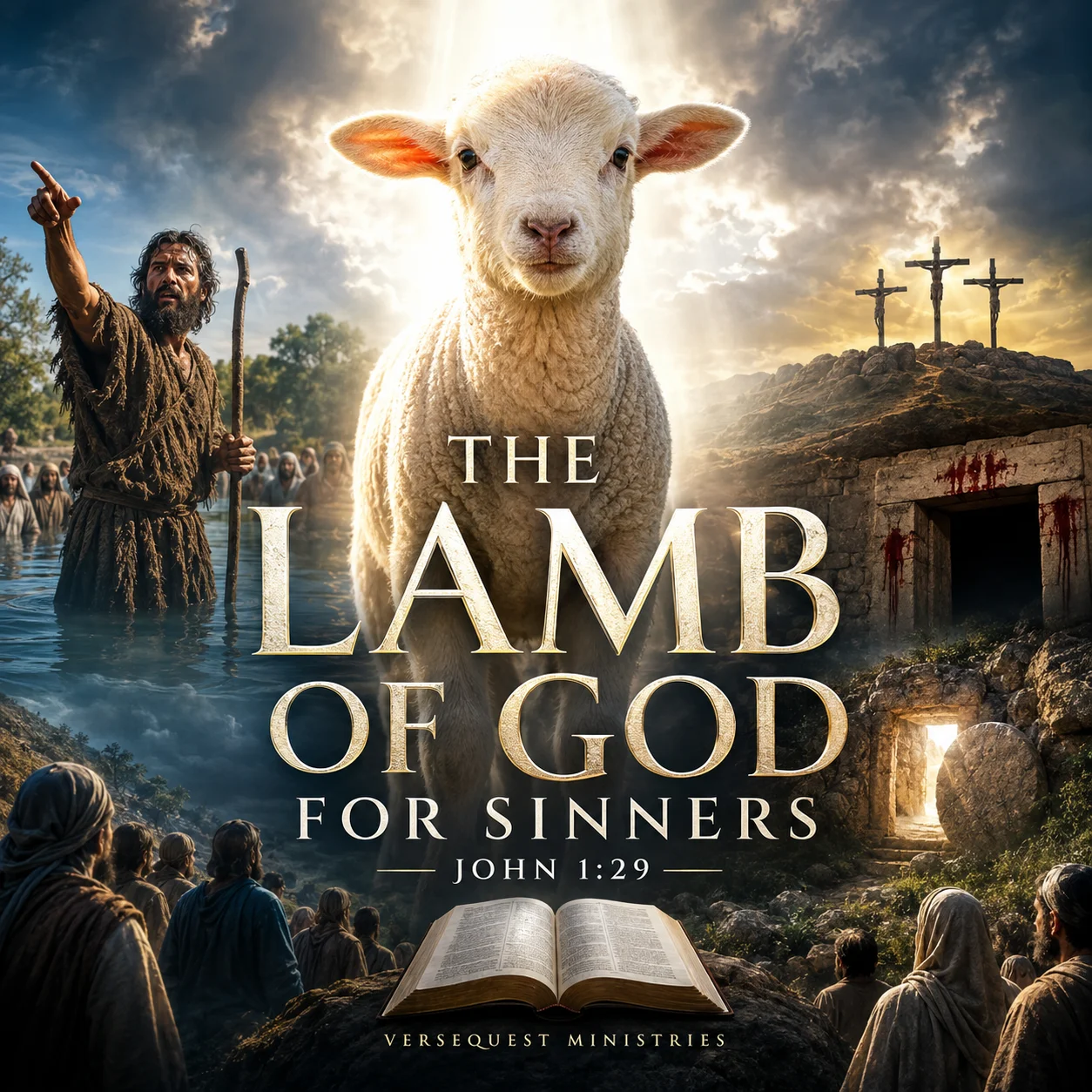
Sermon Title:
Behold the Lamb: The Lamb of God for Sinners
Key Passage:
John 1:29 — “The next day John seeth Jesus coming unto him, and saith, Behold the Lamb of God, which taketh away the sin of the world.”
Series:
Foundations of the Gospel of Grace
Topic:
Jesus Christ as the Lamb of God Who Takes Away Sin Through His Blood, Death, Burial, and Resurrection
Book:
John, Exodus, Leviticus, Isaiah, 1 Corinthians, Romans, Hebrews, 1 Peter, Revelation
Speaker:
Paul Tackett
Suggested Sermon Text:
John 1:29–36; Exodus 12:1–14; Leviticus 17:11; Isaiah 53:4–7; 1 Corinthians 5:7; 1 Corinthians 15:1–4; Romans 3:23–26; Romans 5:6–11; 2 Corinthians 5:21; Hebrews 9:11–14; Hebrews 10:10–14; 1 Peter 1:18–19; Revelation 5:6–14; Revelation 13:8
Short Sermon Description:
This detailed VerseQuest Ministries sermon outline explains John 1:29, where John the Baptist identifies Jesus Christ as “the Lamb of God, which taketh away the sin of the world.” This sermon traces the Lamb through Scripture, from Abel’s offering, the Passover lamb, the Levitical sacrifices, and Isaiah’s suffering servant, to the Lord Jesus Christ as the final, sinless, blood-shedding Substitute for sinners. It shows that Christ did not come merely as a teacher, reformer, moral example, political deliverer, or religious symbol, but as God’s appointed Lamb to bear sin and provide redemption through His blood. The outline distinguishes John’s testimony to Israel from the later full declaration of Paul’s gospel of grace, while showing that the same Lamb is the Saviour whose death, burial, and resurrection now form the saving message for sinners today. Designed for pastors, preachers, Bible teachers, Bible students, and believers, this sermon magnifies Christ’s blood, substitutionary death, finished sacrifice, and eternal worth.
Behold the Lamb
The Lamb of God for Sinners
Introduction
John 1:29 is one of the greatest announcements ever made by a prophet standing on this earth: “Behold the Lamb of God, which taketh away the sin of the world.” John the Baptist did not point to a new religious program, a moral improvement campaign, a political revolution, a priestly institution, or a ceremonial upgrade. He pointed to a Person. “Behold the Lamb of God.” That is where every sinner must look. Not inside himself. Not to his works. Not to his church. Not to his baptism. Not to his ancestry. Not to his sincerity. Not to his religious performance. John’s finger points straight at Jesus Christ, and God’s answer to sin is standing there in flesh and blood.
The title “Lamb of God” is not soft religious poetry. It is sacrificial language. It smells like blood, altar, substitution, death, and atonement. A lamb in Scripture was not a classroom mascot. It was an innocent victim placed where the guilty deserved to stand. From Abel’s offering to the Passover night in Egypt, from the morning and evening sacrifices to Isaiah’s prophecy of the suffering Servant, the lamb pointed to one final Lamb who would not merely cover sin in figure but take it away by His own blood. John did not say, “Behold a lamb of religion.” He said, “Behold the Lamb of God.” This Lamb was not man’s invention. He was God’s provision.
The world wants a Jesus who inspires, educates, socializes, reforms, and affirms. God presents a Jesus who dies for sin. Modern religion loves a bloodless Christ because a bloodless Christ can be managed, marketed, and molded into whatever the crowd wants. But the Bible’s Christ is the Lamb. He came to shed blood. He came to bear sin. He came to be offered. He came to die. He came to rise again. The sinner’s only hope is not to admire Jesus from a polite distance but to trust the Lamb who stood in the sinner’s place. The Lamb of God is not heaven’s decoration; He is heaven’s answer to hell-bound sinners.
I. The Lamb Was God’s Provision, Not Man’s Achievement
Key Text: John 1:29
Supporting Texts: Genesis 22:7–8; John 3:16; Romans 5:8
John says, “Behold the Lamb of God.” The Lamb belongs to God’s provision. Man did not produce Him. Religion did not manufacture Him. Israel did not earn Him. Rome did not understand Him. The Pharisees did not approve Him. The scholars did not design Him. God provided Him. This takes salvation out of man’s hands at the very beginning. The sinner cannot provide his own lamb. He cannot furnish his own sacrifice. He cannot reach into the bankrupt warehouse of Adam’s flesh and pull out something acceptable to God.
Genesis 22 gives the prophetic question: “Where is the lamb for a burnt offering?” Abraham answers, “My son, God will provide himself a lamb for a burnt offering.” That statement reaches far beyond Mount Moriah. God did not merely provide a substitute for Isaac that day. He announced the principle of redemption: God Himself must provide the sacrifice. Isaac could not provide it. Abraham could not invent it. The ram caught in the thicket was a shadow, but Christ is the substance. John 1:29 is the answer to Genesis 22. “Behold the Lamb of God.”
Romans 5:8 says, “But God commendeth his love toward us, in that, while we were yet sinners, Christ died for us.” God did not wait for man to become worthy and then provide the Lamb as a reward. The Lamb came because man was unworthy, guilty, and helpless. Religion says man must climb up with an offering in his hand. The gospel says God came down with His own Lamb. Salvation begins with divine provision, not human achievement.
Main Truth:
The Lamb of God is God’s own provision for sinners who could never provide an acceptable sacrifice for themselves.
II. The Lamb Reveals the Seriousness of Sin
Key Text: John 1:29
Supporting Texts: Romans 3:23; Romans 6:23; Leviticus 17:11; Hebrews 9:22
John did not say the Lamb came to take away low self-esteem, social inconvenience, cultural discomfort, or religious confusion. He said He came to take away “sin.” That is man’s real problem. Not merely sins plural as individual acts, but sin as the great condemning reality standing between man and God. The world calls it mistakes. Psychology calls it dysfunction. Politics calls it injustice. Religion calls it weakness when it wants to soften the matter. God calls it sin.
Romans 3:23 says, “For all have sinned, and come short of the glory of God.” Romans 6:23 says, “For the wages of sin is death.” Sin is not harmless. It is not a small stain that religion can buff out with ceremony. It is guilt before God. It brings death. It demands judgment. The fact that God sent a Lamb to die tells you what God thinks of sin. If sin could be removed by moral effort, Christ did not need to be slain. If sin could be washed away by water, the Lamb did not need to bleed. If sin could be outweighed by good deeds, Calvary was unnecessary.
Leviticus 17:11 says, “for it is the blood that maketh an atonement for the soul.” Hebrews 9:22 says, “without shedding of blood is no remission.” The Bible’s answer to sin is blood because sin brings death. The Lamb reveals that sin is deadly, costly, and impossible for man to erase. A bloodless gospel is not a gentle gospel; it is a lying gospel. It hides the seriousness of sin and robs the sinner of the only remedy God provided.
Main Truth:
The Lamb of God reveals that sin is so serious that only blood, death, and divine substitution could answer it.
III. The Passover Lamb Pointed to Christ
Key Text: Exodus 12:5–7
Supporting Texts: Exodus 12:12–13; 1 Corinthians 5:7; John 19:36
In Exodus 12, Israel was commanded to take a lamb without blemish, kill it, and strike the blood upon the doorposts and upper door post of the houses. God said, “when I see the blood, I will pass over you.” The issue that night was not the worthiness of the people inside the house. It was the blood applied outside the house. The firstborn was safe because a lamb had died and the blood stood between judgment and the guilty.
First Corinthians 5:7 says plainly, “For even Christ our passover is sacrificed for us.” The Passover lamb was a type; Christ is the fulfillment. Egypt was under judgment. Israel needed deliverance. The lamb died. The blood was applied. Judgment passed over. That is not religious decoration; that is redemption by blood. The lamb was not a pet that improved the atmosphere of the house. The lamb was slain. Its blood testified that death had already fallen upon a substitute.
John 19:36 says of Christ’s crucifixion, “A bone of him shall not be broken,” matching the Passover pattern. God was not improvising at Calvary. Christ is the true Passover Lamb. His blood does not merely shield from temporal judgment in Egypt; it redeems sinners from eternal condemnation. Religion keeps telling sinners to show God their sincerity. The Passover says show God the blood.
Main Truth:
The Passover lamb pointed forward to Jesus Christ, whose blood delivers believers from judgment.
IV. The Lamb Had to Be Without Blemish
Key Text: 1 Peter 1:18–19
Supporting Texts: Exodus 12:5; Hebrews 4:15; 2 Corinthians 5:21; 1 John 3:5
First Peter 1:18–19 says believers were redeemed “with the precious blood of Christ, as of a lamb without blemish and without spot.” The Lamb had to be spotless because a sinful substitute cannot redeem sinners. If Christ had sin of His own, He would have needed a Saviour Himself. But He was holy, harmless, undefiled, separate from sinners. He did no sin, knew no sin, and in Him is no sin.
Exodus 12 required a lamb “without blemish.” That requirement was not cosmetic. It pictured the moral perfection of the coming Christ. Hebrews 4:15 says He “was in all points tempted like as we are, yet without sin.” He faced temptation without surrender, opposition without corruption, suffering without bitterness, and death without guilt. Pilate said, “I find no fault in him,” though Pilate was too cowardly to act honestly on what he knew. Heaven’s verdict was stronger: “This is my beloved Son, in whom I am well pleased.”
Second Corinthians 5:21 says He “knew no sin.” That is why He could be made sin for us judicially at the cross. The sinless One bore the sins of the guilty. This is the glory of substitution. God did not put a sinner in the sinner’s place. He put the spotless Lamb there. The Lamb’s perfection is not a minor doctrine. It is essential to redemption. A stained lamb cannot cleanse stained sinners.
Main Truth:
Jesus Christ could redeem sinners because He was the spotless Lamb without blemish and without sin.
V. The Lamb Was Substituted for the Guilty
Key Text: Isaiah 53:6–7
Supporting Texts: 2 Corinthians 5:21; 1 Peter 2:24; Romans 5:6–8
Isaiah 53 says, “the LORD hath laid on him the iniquity of us all,” and then says, “he is brought as a lamb to the slaughter.” That is substitution. The guilty sheep went astray; the innocent Lamb went to slaughter. The sinner wandered; Christ was wounded. The sinner deserved judgment; Christ bore it. The sinner earned death; Christ entered death. That is the gospel logic of the cross.
First Peter 2:24 says Christ “bare our sins in his own body on the tree.” That is not metaphorical fluff. That is the great transaction. Our sins were placed upon Him. He suffered under their judgment. He stood where we deserved to stand. Second Corinthians 5:21 says God made Him to be sin for us, who knew no sin, that we might be made the righteousness of God in Him. The Lamb took our place so believers could receive His righteousness.
Romans 5 says Christ died for the ungodly. That word strips man of his pride. He did not die for the worthy, improved, baptized, churched, sacramental, law-keeping, or religiously polished. He died for the ungodly. The Lamb was not offered because sinners were close to saving themselves. He was offered because sinners had no hope without Him. Substitution is not a side room in the gospel; it is the heart of it.
Main Truth:
The Lamb of God stood in the place of guilty sinners and bore the judgment their sins deserved.
VI. The Lamb Takes Away Sin, Not Merely Covers It in Figure
Key Text: John 1:29
Supporting Texts: Hebrews 10:1–4; Hebrews 10:10–14; Hebrews 9:26
John says the Lamb of God “taketh away the sin of the world.” The Old Testament sacrifices pointed forward, but they could not finally remove sin. Hebrews 10:4 says, “For it is not possible that the blood of bulls and of goats should take away sins.” Those sacrifices were shadows, reminders, and figures. They preached blood, substitution, and death, but they were not the final answer.
Hebrews 9:26 says Christ appeared “to put away sin by the sacrifice of himself.” That is stronger than the repeated sacrifices of the law. Christ did not offer another animal. He offered Himself. Hebrews 10:14 says, “For by one offering he hath perfected for ever them that are sanctified.” One offering. Perfected forever. That is not an unfinished religious system. That is the final sacrifice of the Lamb of God.
This is where every repeating-sacrifice religion collapses. If Christ took away sin by the sacrifice of Himself, no priestly system can keep offering what God says was finished. If one offering perfected forever, then the believer does not need a religious machine to keep reapplying an unfinished sacrifice. The Lamb did not make a temporary dent in sin. He took it away in the only way God accepts: by His own blood.
Main Truth:
Jesus Christ is the final Lamb whose one sacrifice truly takes away sin and perfects believers forever.
VII. The Lamb of God Is for the World, but Must Be Personally Believed
Key Text: John 1:29
Supporting Texts: John 3:16; 1 John 2:2; Acts 16:31; Romans 10:13
John says the Lamb taketh away “the sin of the world.” That shows the scope of Christ’s sufficiency. The value of His blood is not small. The Lamb is sufficient for Jew and Gentile, rich and poor, moral and immoral, religious and irreligious, educated and ignorant. John 3:16 says God so loved the world that He gave His only begotten Son. First John 2:2 says He is the propitiation not for ours only, but also for the sins of the whole world.
But universal sufficiency is not universal salvation. The Lamb must be personally believed. Acts 16:31 says, “Believe on the Lord Jesus Christ, and thou shalt be saved.” Romans 10:13 says, “whosoever shall call upon the name of the Lord shall be saved.” The Lamb has been provided, the blood has been shed, the gospel has been preached, but the sinner must receive Christ by faith. A Passover lamb slain but blood not applied left no safety for the house. A gospel heard but not believed leaves the sinner condemned.
This also guards against religious presumption. A man is not saved because Christ is generally the Saviour of sinners. He is saved when he personally trusts Christ. He is not saved by admiring the Lamb, singing about the Lamb, painting the Lamb, wearing jewelry about the Lamb, or attending a church that mentions the Lamb. He must believe on the Lamb of God. Behold Him, yes—but do not merely behold Him like a museum piece. Trust Him as your only Saviour.
Main Truth:
The Lamb of God is sufficient for the world, but each sinner must personally believe on Jesus Christ to be saved.
VIII. The Lamb Is the Center of Heaven’s Worship
Key Text: Revelation 5:6–9
Supporting Texts: Revelation 5:12–13; Revelation 7:14; Revelation 13:8
Revelation 5 shows a Lamb “as it had been slain” in the midst of the throne. Heaven does not forget Calvary. The scars of the Lamb are not embarrassing reminders of defeat; they are eternal marks of victory. The Lamb takes the book. The redeemed sing, “thou wast slain, and hast redeemed us to God by thy blood.” Heaven’s worship is blood-centered, Lamb-centered, redemption-centered, and Christ-centered.
Revelation 5:12 says, “Worthy is the Lamb that was slain.” Not worthy is man. Not worthy is religion. Not worthy are works. Not worthy are ceremonies. Worthy is the Lamb. If heaven gives the Lamb all the glory, the Church has no business handing some of it back to human merit. If the redeemed in glory sing about blood, preachers on earth should not be ashamed to preach it. A bloodless church is out of tune with heaven.
Revelation 13:8 calls Him “the Lamb slain from the foundation of the world.” The cross was not God’s emergency repair after history slipped. The Lamb was in the eternal purpose of God. Calvary was not plan B. Before man sinned in time, God already knew the Lamb who would answer sin. Heaven’s throne is occupied by the One who was slain, rose again, and is worthy of all praise. The Lamb is not merely how we get saved; He is whom we will worship forever.
Main Truth:
The Lamb of God is the eternal center of heaven’s worship because He redeemed sinners to God by His blood.
IX. The Lamb Must Be Preached as the Saving Gospel Today
Key Text: 1 Corinthians 15:3–4
Supporting Texts: Ephesians 1:13; Romans 1:16; Galatians 1:8–9
John the Baptist identified Jesus to Israel as the Lamb of God. After the cross and resurrection, Paul declares the saving gospel in its full Church-age clarity: Christ died for our sins according to the Scriptures, was buried, and rose again the third day according to the Scriptures. The Lamb has now been slain, buried, and raised. The sinner today is not saved by bringing a lamb to an altar. He is saved by believing the gospel of the Lamb who already offered Himself.
Ephesians 1:13 says sinners trust Christ after hearing the word of truth, the gospel of salvation, and after believing, they are sealed with the Holy Spirit of promise. Romans 1:16 says the gospel of Christ is the power of God unto salvation to every one that believeth. The message is not “bring your sacrifice.” The message is “believe on the Sacrifice God provided.” The Lamb has died. The blood has been shed. The tomb is empty. Salvation is offered by grace through faith.
Galatians 1 warns against another gospel. Any message that adds law, baptism, sacraments, church membership, moral reform, human merit, or religious endurance as the cause of salvation is another gospel. The Lamb does not need co-saviours. The Lamb does not need religious assistants to finish His blood work. The sinner’s command is clear: believe on the Lord Jesus Christ. The Church’s message is clear: behold the Lamb who died for sinners and rose again.
Main Truth:
The Lamb of God must be preached today through Paul’s clear gospel of Christ’s death, burial, and resurrection, received by faith alone.
Conclusion
John 1:29 is a verse that gathers the blood trail of Scripture and points it straight to Jesus Christ: “Behold the Lamb of God, which taketh away the sin of the world.” Abel’s offering whispered it. Abraham’s prophecy expected it. Passover pictured it. Leviticus required blood for it. Isaiah foretold it. John announced it. Calvary fulfilled it. Revelation worships Him for it. The Lamb is not an accessory to Bible doctrine; He is the center of redemption.
The sinner’s problem is sin, and God’s answer is the Lamb. Not religion. Not morality. Not law-keeping. Not rituals. Not sacraments. Not baptismal water. Not church membership. Not emotional experiences. Not human merit. The Lamb of God takes away sin by His blood. Every false gospel either minimizes sin, replaces the Lamb, or adds something to His sacrifice. The Bible believer refuses all of it. If the Lamb is enough for heaven’s worship, He is enough for the sinner’s salvation.
The Church must preach the Lamb with clarity, reverence, and force. We do not need a bloodless Jesus for a delicate age. We need the Lamb of God for sinners. We need the cross, the blood, the substitution, the burial, the resurrection, and the gospel of grace. John said, “Behold.” That is still the preacher’s task: point sinners away from themselves and toward the Lamb. Behold Him. Trust Him. Worship Him. Preach Him. There is no other sacrifice coming.
Final Call
Sinner, you cannot take away your own sin. You cannot cleanse your record with good works. You cannot wash your soul with religious water. You cannot buy forgiveness with morality, church membership, sacraments, law-keeping, or sincerity. You need the Lamb of God.
Jesus Christ died for your sins according to the Scriptures. He was buried. He rose again the third day according to the Scriptures. He is the spotless Lamb, the Substitute, the Redeemer, the blood-shedding Saviour, and the risen Lord. Believe on the Lord Jesus Christ, and thou shalt be saved.
Believer, never grow tired of the Lamb. Heaven does not. Preach the Lamb, sing of the Lamb, glory in the Lamb, and keep the gospel clear. The Lamb of God did not come to help sinners save themselves. He came to take away sin by the sacrifice of Himself.
Closing Verse:
Revelation 5:12 — “Worthy is the Lamb that was slain to receive power, and riches, and wisdom, and strength, and honour, and glory, and blessing.”
Closing Statement:
The sinner has no hope in his own hands, but God has placed all hope in His own Lamb, slain for sinners and worthy forever.