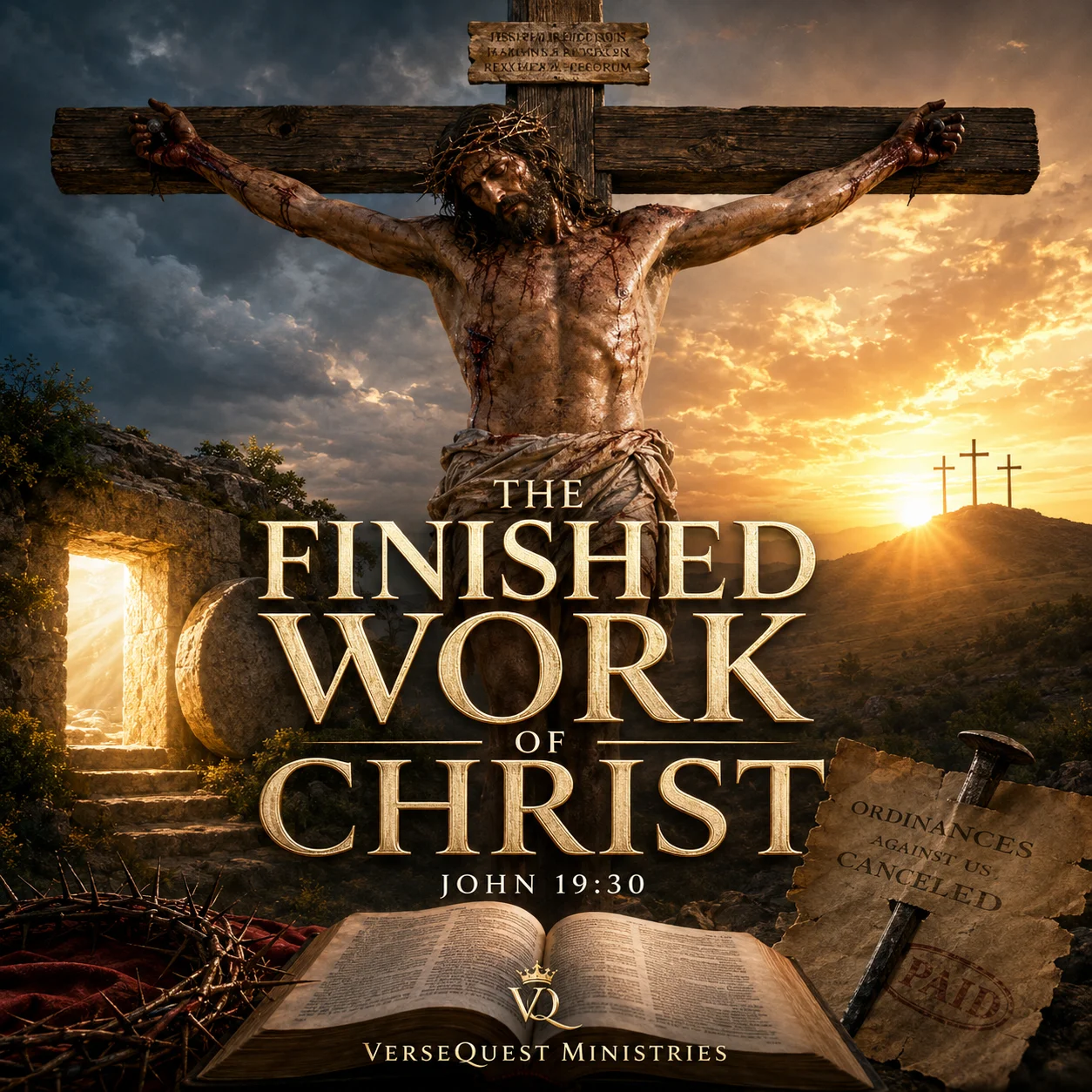
Sermon Title:
Paid in Full: The Finished Work of Christ
Key Passage:
John 19:30 — “When Jesus therefore had received the vinegar, he said, It is finished: and he bowed his head, and gave up the ghost.”
Series:
Foundations of the Gospel of Grace
Topic:
The Finished Work of Jesus Christ at Calvary and the Complete Salvation Purchased by His Blood
Book:
John, Romans, Hebrews, Colossians, Galatians, Ephesians, 1 Corinthians, 2 Corinthians
Speaker:
Paul Tackett
Suggested Sermon Text:
John 19:28–30; 1 Corinthians 15:1–4; Romans 3:21–28; Romans 4:24–25; Romans 5:6–11; Hebrews 9:11–14; Hebrews 10:10–14; Colossians 2:13–15; Galatians 2:16–21; Galatians 3:13; Ephesians 1:7; Ephesians 2:8–9; 2 Corinthians 5:19–21; Titus 3:5–7
Short Sermon Description:
This detailed VerseQuest Ministries sermon outline explains the finished work of Christ from John 19:30, where the Lord Jesus cried, “It is finished,” bowed His head, and gave up the ghost. The cross was not a failed Jewish tragedy, a sentimental symbol, a religious example, or the beginning of a salvation plan that sinners must complete through works, law, baptism, sacraments, church membership, penance, morality, or endurance. It was the completed payment for sin, the fulfillment of Scripture, the satisfaction of divine justice, the redemption price paid in blood, and the foundation of salvation by grace through faith. This sermon shows what was finished at Calvary, why Christ’s death was substitutionary, how the law’s condemning claim was answered, why religious additions insult the sufficiency of the cross, and how the resurrection proves the payment was accepted. Designed for pastors, preachers, Bible teachers, Bible students, and believers, this outline magnifies Jesus Christ as the only Saviour and defends the gospel of grace from every unfinished, man-centered, religious counterfeit.
Paid in Full
The Finished Work of Christ
Introduction
John 19:30 records one of the greatest statements ever spoken in time: “It is finished.” Those three words are not the sigh of a defeated martyr, the collapse of a disappointed reformer, or the final breath of a religious teacher whose movement had failed. They are the victory cry of the Son of God completing the work the Father gave Him to do. Jesus Christ did not die as a helpless victim dragged beneath circumstances He could not control. He laid down His life. He received the vinegar, fulfilled the Scripture, cried “It is finished,” bowed His head, and gave up the ghost. Even in death, He was not managed by men. He was fulfilling the Book.
The finished work of Christ is the battlefield where every false gospel gets shot between the eyes. If it is finished, Rome cannot finish it. If it is finished, Moses cannot complete it. If it is finished, baptism cannot add to it. If it is finished, sacraments cannot extend it. If it is finished, church membership cannot secure it. If it is finished, human merit cannot improve it. The religious world loves an unfinished cross because an unfinished cross creates job security for priests, systems, rituals, altars, payments, ordinances, and fear. But the Bible does not say, “It is started.” It does not say, “It is available if you complete your portion.” It does not say, “It is finished once religion approves the paperwork.” It says, “It is finished.”
The sinner’s salvation rests either on a finished work or an unfinished religion. It cannot rest on both. If Christ paid the debt in full, then religion has no authority to keep sending collection notices. If Christ bore the curse, then law cannot demand a second payment from the believer. If Christ shed the blood, then no bloodless ceremony can replace it. If Christ satisfied divine justice, then man’s righteousness is not needed to help God make up His mind. The gospel of grace is not Christ plus human effort. It is Christ crucified, buried, and risen, saving sinners who believe. The cross is not heaven’s suggestion. It is God’s completed transaction in blood.
I. The Finished Work Was the Fulfillment of Scripture
Key Text: John 19:28–30
Supporting Texts: Psalm 22:1–18; Psalm 69:21; Isaiah 53:4–6; Luke 24:44
John 19:28 says, “After this, Jesus knowing that all things were now accomplished, that the scripture might be fulfilled, saith, I thirst.” Before the Lord cried, “It is finished,” the Scripture had to be fulfilled. This was not random suffering. This was not history spinning out of control. Every detail of Calvary moved according to the word of God. The mockery, the pierced hands and feet, the parted garments, the thirst, the vinegar, the suffering among transgressors, the burial with the rich—all of it had already been written.
Psalm 22 reads like a report from the foot of the cross before crucifixion was even a Roman instrument of death. Isaiah 53 says He was wounded for our transgressions and bruised for our iniquities. Psalm 69:21 says, “in my thirst they gave me vinegar to drink.” John does not present Jesus as a victim of Roman efficiency or Jewish envy alone. He presents Him as the Lamb fulfilling Scripture. Men did what they wickedly wanted, and God accomplished what He had eternally purposed.
This matters because the gospel rests on Scripture, not sentiment. First Corinthians 15 says Christ died for our sins “according to the scriptures,” was buried, and rose again “according to the scriptures.” The cross was not interpreted later by clever apostles trying to salvage a disaster. The cross was foretold by God before it happened. When Christ said, “It is finished,” He was not closing a tragic chapter; He was fulfilling the written counsel of God.
Main Truth:
The finished work of Christ was not an accident of history but the exact fulfillment of the Scriptures concerning the suffering Saviour.
II. The Finished Work Was the Payment for Sin
Key Text: John 19:30
Supporting Texts: Romans 6:23; Romans 5:8–9; 1 Peter 2:24; 2 Corinthians 5:21
“It is finished” means the debt was paid. The wages of sin is death, and Jesus Christ entered death for sinners. He did not die for His own sins, for He had none. He died for ours. First Peter 2:24 says He “bare our sins in his own body on the tree.” Second Corinthians 5:21 says God made Him “to be sin for us, who knew no sin.” That is substitution. The innocent took the place of the guilty.
Sin is not a light matter. Modern religion treats sin like a weakness, a mistake, a wound, a social problem, or an unfortunate pattern. God treated sin as guilt requiring blood. The cross is God’s answer to every fool who thinks sin is harmless. If sin could have been removed by good intentions, Christ did not need to die. If sin could have been paid by baptism, Christ did not need to bleed. If sin could have been solved by morality, Christ did not need to be made a curse. Calvary proves sin is so serious that only the blood of the Son of God could answer it.
Romans 5:8 says, “while we were yet sinners, Christ died for us.” Not after we improved. Not after we became worthy. Not after we promised enough. Christ died for sinners. The finished work is not God accepting our payment; it is God providing His own. The sinner brings the debt. Christ brings the blood. The sinner brings guilt. Christ brings righteousness. The sinner brings death. Christ brings life.
Main Truth:
The finished work of Christ paid the sinner’s debt because Jesus Christ bore our sins in His own body on the tree.
III. The Finished Work Satisfied Divine Justice
Key Text: Romans 3:24–26
Supporting Texts: Hebrews 9:22; Isaiah 53:10–11; 1 John 2:2; Romans 5:9
Romans 3 says God set forth Jesus Christ “to be a propitiation through faith in his blood,” so that God might be “just, and the justifier of him which believeth in Jesus.” That is one of the strongest statements in the Bible about the justice of the cross. God did not forgive sinners by pretending sin did not happen. He did not sweep guilt under heaven’s rug. He did not lower the standard, soften His holiness, or ignore His own righteousness. Justice was satisfied in the blood of Christ.
Propitiation means the righteous demands of God against sin were fully met. The wrath that sin deserved was answered by the Substitute. Isaiah 53 says, “it pleased the LORD to bruise him,” and “he shall see of the travail of his soul, and shall be satisfied.” That is not divine cruelty. That is divine justice accomplishing redemption through the voluntary suffering of the Son. The cross is where mercy and truth met together, and righteousness and peace kissed each other.
Hebrews 9:22 says, “without shedding of blood is no remission.” Every bloodless gospel is a lie. Every religion that minimizes the blood minimizes the justice of God. Every system that replaces Christ’s blood with water, wafers, rituals, candles, beads, law, or human effort is trying to pay an eternal debt with Monopoly money. Christ’s blood satisfied what man could never satisfy.
Main Truth:
The finished work of Christ satisfied the justice of God so that God can be just and the justifier of the believer.
IV. The Finished Work Redeemed the Believer
Key Text: Ephesians 1:7
Supporting Texts: Colossians 1:14; 1 Peter 1:18–19; Galatians 3:13; Revelation 5:9
Ephesians 1:7 says, “In whom we have redemption through his blood, the forgiveness of sins, according to the riches of his grace.” Redemption means deliverance by payment. The sinner was in bondage to sin, guilt, death, and condemnation. He could not buy himself free. He had no spiritual currency accepted in heaven. His works were insufficient, his righteousness was filthy, and his religion was bankrupt. Christ paid the redemption price with His blood.
First Peter 1:18–19 says we were not redeemed with corruptible things, as silver and gold, but “with the precious blood of Christ.” Silver can buy property, gold can buy influence, money can buy comfort, but no earthly treasure can purchase a sinner out of guilt. The price was blood. Not the blood of a sinner. Not the blood of a martyr only. The blood of Christ, the Lamb without blemish and without spot.
Galatians 3:13 says Christ redeemed us from the curse of the law, being made a curse for us. The curse did not disappear into thin air. Christ bore it. The debt did not evaporate. Christ paid it. The bondage was not decorated. Christ broke it. When He said, “It is finished,” redemption’s price had been paid. Heaven will sing, “thou wast slain, and hast redeemed us to God by thy blood.”
Main Truth:
The finished work of Christ redeemed believers by His blood, delivering them from sin’s bondage and the curse of the law.
V. The Finished Work Blotted Out the Handwriting Against Us
Key Text: Colossians 2:13–14
Supporting Texts: Romans 7:4–6; Galatians 2:19–21; Romans 8:1
Colossians 2:13–14 says God forgave all trespasses, blotted out the handwriting of ordinances that was against us, took it out of the way, and nailed it to Christ’s cross. That is finished-work language. The record against the believer was not reduced, postponed, filed for later review, or transferred to a religious collection agency. It was blotted out and nailed to the cross. The debt was not put on a payment plan. It was cancelled through Christ.
The handwriting was against us. The law exposed guilt. Ordinances stood contrary to the sinner. The law was holy, but man was not. The law demanded righteousness but could not supply it. It condemned transgression but could not cleanse the transgressor. The sinner did not need the handwriting edited. He needed it removed. Christ did not come to help sinners manage the paperwork. He nailed it to His cross.
Romans 8:1 says, “There is therefore now no condemnation to them which are in Christ Jesus.” No condemnation means no condemnation. Religion keeps trying to resurrect what God nailed down. Legalism drags believers back to the handwriting as though Christ only made a partial payment. But the Scripture says it was blotted out, taken out of the way, and nailed to His cross. A debt nailed to Calvary cannot be honestly collected by religion.
Main Truth:
The finished work of Christ blotted out the condemning record against the believer and removed its power to condemn.
VI. The Finished Work Ended the Need for Repeated Sacrifices
Key Text: Hebrews 10:10–14
Supporting Texts: Hebrews 9:12; Hebrews 9:26–28; John 1:29
Hebrews 10:10 says believers are sanctified through the offering of the body of Jesus Christ “once for all.” Hebrews 10:14 says, “For by one offering he hath perfected for ever them that are sanctified.” One offering. Once for all. Perfected forever. That is not the language of an unfinished religion. That is the language of a completed sacrifice.
Old Testament sacrifices were repeated because they could not finally remove sin. Every lamb was a shadow. Every altar pointed forward. Every priest stood daily ministering and offering oftentimes the same sacrifices, which could never take away sins. But Jesus Christ, after He offered one sacrifice for sins for ever, sat down on the right hand of God. The sitting down matters. The work was finished.
Any system that repeats, extends, renews, or re-presents sacrifice insults the finality of Calvary. The mass, religious penance, repeated offerings, and sacramental systems act as though Christ’s “It is finished” needs institutional maintenance. But Hebrews says one offering perfected forever. The Lamb of God did not make a temporary dent in sin. He finished the sacrifice.
Main Truth:
The finished work of Christ ended the need for repeated sacrifices because His one offering perfected believers forever.
VII. The Finished Work Excludes Boasting and Human Merit
Key Text: Ephesians 2:8–9
Supporting Texts: Romans 3:27–28; Titus 3:5; Galatians 2:16
Ephesians 2:8–9 says salvation is by grace through faith, “not of works, lest any man should boast.” The finished work of Christ leaves no room for human boasting. If Christ finished the work, man cannot brag that he helped complete it. If salvation is by grace, works cannot share the foundation. If eternal life is a gift, religion cannot turn it into wages.
Romans 3:27 asks, “Where is boasting then? It is excluded.” By what law? “Of works? Nay: but by the law of faith.” Faith receives. Faith rests. Faith stops trying to purchase what Christ already bought. Titus 3:5 says salvation is not by works of righteousness which we have done. Not by bad works only. Not by obvious sins only. Not by works of righteousness. God rejects man’s best as a saving cause so Christ gets all the glory.
Galatians 2:16 says a man is not justified by the works of the law. If works could justify, Christ died in vain. That is the issue. A works gospel is not a harmless variation. It is an insult to the finished work. Religion says, “Christ did His part; now do yours.” The Bible says Christ finished the work, and the sinner is saved by believing on Him.
Main Truth:
The finished work of Christ excludes all human boasting because salvation is by grace through faith, not by works.
VIII. The Resurrection Proves the Work Was Accepted
Key Text: Romans 4:25
Supporting Texts: 1 Corinthians 15:17–20; Acts 13:30–39; Romans 10:9
Romans 4:25 says Christ “was delivered for our offences, and was raised again for our justification.” The resurrection is God’s receipt that the payment was accepted. If Christ had remained in the grave, there would be no saving gospel. First Corinthians 15 says if Christ be not raised, faith is vain and believers are yet in their sins. But Christ rose again. The tomb is empty. The payment cleared.
The resurrection does not undo the cross; it proves the cross succeeded. The crucified Christ is the risen Christ. The One who said, “It is finished,” came out of the grave with death defeated and justification secured. A dead saviour cannot save. A buried teacher cannot justify. A religious memory cannot give eternal life. Jesus Christ lives.
Acts 13 says through the risen Christ is preached the forgiveness of sins, and by Him all that believe are justified from all things. That is gospel power. The resurrection means Christ’s sacrifice was accepted, His claims were true, His victory is real, and the believer’s hope is secure. The cross declared the work finished; the resurrection declared the finished work accepted.
Main Truth:
The resurrection proves that Christ’s finished work was accepted and that believers are justified in the risen Saviour.
IX. The Finished Work Must Be Preached Without Addition
Key Text: Galatians 1:8–9
Supporting Texts: 1 Corinthians 15:1–4; Acts 16:31; Romans 1:16
Paul warned that any other gospel is cursed. The gospel is not Christ plus law, Christ plus baptism, Christ plus sacraments, Christ plus church membership, Christ plus morality, Christ plus penance, Christ plus emotional experiences, or Christ plus human endurance as the cause of salvation. The gospel that saves today is Christ’s death for our sins, His burial, and His resurrection, received by faith.
Acts 16:31 gives the answer: “Believe on the Lord Jesus Christ, and thou shalt be saved.” The preacher’s duty is to make that clear, not to bury it beneath religious fog. Sinners do not need a complicated theological maze when eternity is at stake. They need Christ. They need the cross. They need the blood. They need the empty tomb. They need the finished work.
Romans 1:16 says the gospel of Christ is the power of God unto salvation to every one that believeth. The power is not in religious additions. The power is not in human methods. The power is not in sacramental machinery. The power is in the gospel of Christ. The Church must preach “It is finished” like it believes Christ told the truth.
Main Truth:
The finished work of Christ must be preached without religious additions because the gospel is complete in Christ alone.
Conclusion
John 19:30 stands as heaven’s answer to every unfinished religion: “It is finished.” Scripture was fulfilled. Sin was paid for. Justice was satisfied. Redemption was purchased. The handwriting was blotted out. The sacrifice was offered once for all. Human boasting was excluded. The resurrection proved the payment was accepted. The finished work of Christ is not a doctrine for the edge of Christian teaching; it is the foundation under salvation itself.
The religious world keeps trying to improve the cross because flesh cannot stand being left out of the glory. It wants a ceremony to perform, a law to keep, a payment to make, a sacrifice to repeat, a ritual to administer, and a merit badge to wear. But Calvary strips the sinner naked of boasting and clothes him only in Christ. The believer’s standing is not “Christ plus my contribution.” It is Christ alone. The moment man adds his work to the foundation, he denies the sufficiency of the Saviour’s work.
The Church must hold the line here. A finished work produces assurance, worship, gratitude, service, holiness, and gospel clarity. An unfinished work produces fear, bondage, priestcraft, superstition, legalism, and religious confusion. Jesus Christ did not die to start a payment plan. He died to finish the work of redemption. When He cried, “It is finished,” every religious collector should have closed his office and gone home.
Final Call
You cannot finish what Christ already finished. You cannot pay what Christ already paid. You cannot improve what God has already accepted. You cannot add your works, religion, baptism, morality, sacraments, or law-keeping to the blood of Jesus Christ and call it humility. That is unbelief with religious manners.
Jesus Christ died for your sins according to the Scriptures. He was buried. He rose again the third day according to the Scriptures. The work is finished. The payment is complete. The Saviour lives. Believe on the Lord Jesus Christ, and thou shalt be saved.
Believer, rest in the finished work and serve from gratitude. Do not let religion drag you back to an unpaid ledger. Do not let fear rename grace. Do not let legalism nail another bill to your door after Christ nailed the debt to His cross. Preach the finished work clearly, boldly, and without apology.
Closing Verse:
Hebrews 10:14 — “For by one offering he hath perfected for ever them that are sanctified.”
Closing Statement:
The cross was not Christ opening a religious account for man to finish; it was the Son of God paying the sinner’s debt in full and crying, It is finished.