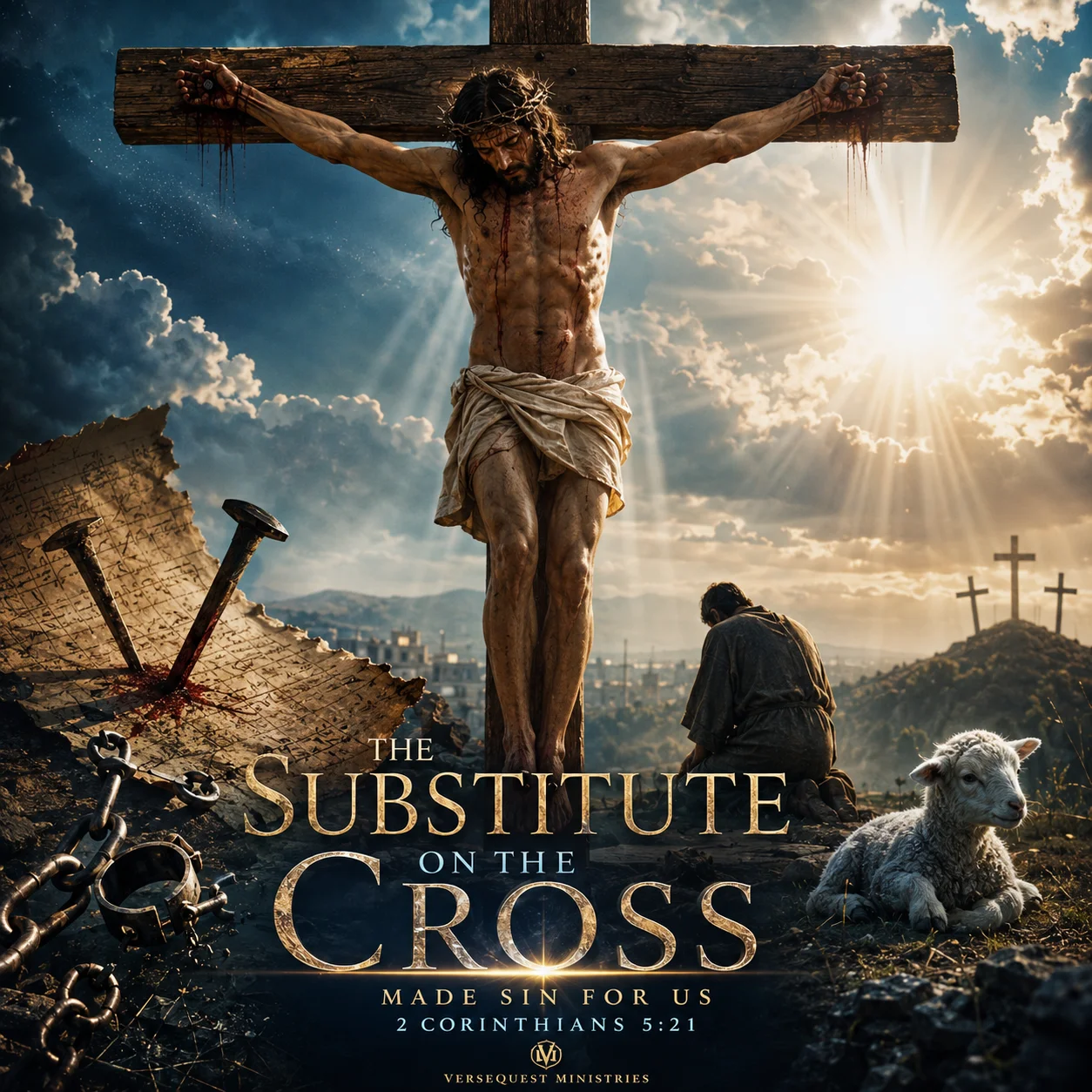
Sermon Title:
The Substitute on the Cross: Made Sin for Us
Key Passage:
2 Corinthians 5:21 — “For he hath made him to be sin for us, who knew no sin; that we might be made the righteousness of God in him.”
Series:
Foundations of the Gospel of Grace
Topic:
Substitutionary Atonement, Imputed Righteousness, and the Finished Work of Jesus Christ
Book:
2 Corinthians, Romans, Isaiah, Galatians, 1 Peter, Hebrews, John, 1 Corinthians
Speaker:
Paul Tackett
Suggested Sermon Text:
2 Corinthians 5:14–21; Isaiah 53:4–6; Romans 3:21–28; Romans 4:4–8; Romans 5:6–11; Galatians 3:13; 1 Peter 2:24; 1 Peter 3:18; Hebrews 9:26–28; Hebrews 10:10–14; John 19:30; 1 Corinthians 15:1–4; Ephesians 1:7; Colossians 2:13–14
Short Sermon Description:
This detailed VerseQuest Ministries sermon outline explains the doctrine of substitutionary atonement from 2 Corinthians 5:21: Jesus Christ, who knew no sin, was made sin for us, that believers might be made the righteousness of God in Him. The cross was not merely an example of love, a religious symbol, a tragic miscarriage of justice, or a moral influence upon mankind; it was the place where the sinless Substitute stood in the guilty sinner’s place and bore the judgment our sins deserved. This sermon shows why sinners need a Substitute, why Christ alone qualified as the sinless One, what it means that He was made sin for us, how His death satisfied divine justice, how righteousness is imputed to the believer, and why no works, religion, baptism, sacraments, law-keeping, morality, or human merit can add to the finished work of Christ. Designed for pastors, preachers, teachers, Bible students, and believers, this outline magnifies the blood, cross, grace, righteousness, and substitution of the Lord Jesus Christ.
The Substitute on the Cross
Made Sin for Us
Introduction
Second Corinthians 5:21 is one of the clearest and strongest verses in all the King James Bible on the substitutionary work of Jesus Christ: “For he hath made him to be sin for us, who knew no sin; that we might be made the righteousness of God in him.” That verse is not religious poetry. It is not decorative cross-talk for a church calendar. It is the very heart of the gospel transaction. The guilty sinner had sin. The sinless Christ had righteousness. At Calvary, God dealt with sin in the body of His Son so that the believing sinner could be made righteous in Him. The sinner did not climb up to God with a basket of good works. God came down in Christ and supplied the Substitute.
Modern religion likes a cross that inspires but does not substitute. It likes a Jesus who teaches kindness, models humility, improves society, comforts feelings, and gives men an example to imitate. But the Bible does not merely say Christ died near sinners, among sinners, or because sinners rejected Him. It says He was made sin “for us.” It says He bare our sins in His own body on the tree. It says the LORD laid on Him the iniquity of us all. It says Christ redeemed us from the curse of the law, being made a curse for us. The cross is not God giving sinners a motivational poster. It is God placing the sinless Lamb where the guilty belonged.
This doctrine matters because without substitution, there is no salvation. If Christ did not stand in the sinner’s place, the sinner must stand in his own place before God. If Christ did not bear sin, the sinner must bear it. If Christ did not satisfy justice, the sinner must face justice. If Christ did not become the Substitute, then religion has nothing to offer but decorated despair. The sinner’s only hope is not that God will ignore sin, but that God has judged sin in Another. The Substitute on the cross is the death of human boasting and the glory of saving grace.
I. The Sinner Needed a Substitute Because He Was Guilty Before God
Key Text: Romans 3:23
Supporting Texts: Romans 3:9–20; Romans 6:23; Isaiah 53:6
Romans 3:23 says, “For all have sinned, and come short of the glory of God.” That is the universal indictment. No man escapes it by education, religion, morality, heritage, sincerity, baptism, church membership, or good intentions. The problem is not that a few unfortunate people have stumbled while the rest of mankind remains basically sound. The whole race is under sin. Romans 3 says there is none righteous, no, not one. Every mouth is stopped, and all the world becomes guilty before God.
The sinner needs a Substitute because sin has wages, and Romans 6:23 says those wages are death. God’s justice is not a soft suggestion that can be negotiated by religious effort. Sin must be judged. The guilty cannot simply promise improvement and call that payment. A criminal does not erase the crime by promising to behave next week. The stain of sin is not removed by future sincerity. The debt must be paid, the judgment must fall, and the righteousness of God must be satisfied.
Isaiah 53:6 says, “All we like sheep have gone astray; we have turned every one to his own way.” That is the sinner’s biography in one verse. Man’s way may be religious or rebellious, polished or filthy, respectable or scandalous, but it is still “his own way.” The sinner went astray, and the Substitute had to stand where the sinner could not stand. Without a Substitute, the sinner remains under guilt, wrath, death, and judgment.
Main Truth:
The sinner needs a Substitute because he is guilty before God and cannot answer the wages of sin by his own works.
II. Jesus Christ Alone Qualified as the Sinless Substitute
Key Text: 2 Corinthians 5:21
Supporting Texts: Hebrews 4:15; 1 Peter 1:18–19; 1 John 3:5
The verse says Christ “knew no sin.” That is not merely saying He sinned less than other men. It is not saying He overcame bad tendencies through discipline. It is declaring His absolute sinlessness. He knew no sin in nature, thought, word, deed, motive, or desire. He was tempted in all points like as we are, yet without sin. The Substitute had to be sinless, or He would have needed a substitute Himself.
First Peter 1:18–19 says believers are redeemed “with the precious blood of Christ, as of a lamb without blemish and without spot.” The Old Testament lambs had to be without blemish because they pointed to the perfect Lamb of God. A stained substitute cannot cleanse stained sinners. A guilty man cannot die redemptively for another guilty man. The only acceptable Substitute is the sinless Son of God.
First John 3:5 says, “And ye know that he was manifested to take away our sins; and in him is no sin.” There is the doctrine in plain KJV English. He came to take away sins, and in Him is no sin. The world may admire Jesus as a teacher. Religion may borrow His name for ceremonies. Skeptics may rank Him among moral philosophers. But Scripture presents Him as the sinless Substitute. That is why His blood can redeem, His death can satisfy, and His righteousness can be imputed.
Main Truth:
Jesus Christ alone could stand as the sinner’s Substitute because He knew no sin and was the spotless Lamb of God.
III. God Made Christ to Be Sin for Us
Key Text: 2 Corinthians 5:21
Supporting Texts: Isaiah 53:6; Galatians 3:13; Romans 8:3
The verse says, “For he hath made him to be sin for us.” This does not mean Christ became sinful in His character or nature. God forbid. He remained the holy Son of God. It means our sin was judicially laid upon Him. He was treated as the sin-bearer, the Substitute, the One standing in the place of the guilty. The sinless One bore the legal burden of the sinner’s guilt before God.
Isaiah 53:6 says, “the LORD hath laid on him the iniquity of us all.” That is not sentiment. That is substitution. The sinner’s iniquity was placed upon Christ. Galatians 3:13 says Christ was “made a curse for us.” The curse did not evaporate. It fell upon the Substitute. Romans 8:3 says God condemned sin in the flesh through His own Son. Sin was not excused at Calvary; it was condemned there.
This destroys every shallow cross. The cross was not merely God showing sympathy. It was not merely man showing cruelty. It was not merely Christ showing courage. It was God dealing with sin in the Substitute. The sky went dark because the matter was not small. The holy Son of God stood under judgment for sins He never committed, so guilty sinners could be saved by grace through faith.
Main Truth:
Christ was made sin for us judicially, bearing our guilt and curse as the sinless Substitute at Calvary.
IV. The Substitute Bore Our Sins in His Own Body
Key Text: 1 Peter 2:24
Supporting Texts: Isaiah 53:4–5; Hebrews 9:28; John 19:30
First Peter 2:24 says Christ “bare our sins in his own body on the tree.” That is personal, physical, substitutionary language. He did not merely think about sin. He did not merely preach against sin. He bore our sins. The place was the tree. The body was His own. The sins were ours. There is the cross in four words: His body, our sins.
Isaiah 53:5 says, “he was wounded for our transgressions, he was bruised for our iniquities.” The wounds were His, but the transgressions were ours. The bruising was His, but the iniquities were ours. The chastisement was upon Him, but the peace is ours. With His stripes we are healed. Substitution is written all through the passage. The innocent suffers for the guilty. The Shepherd dies for the sheep. The Lamb is slain for sinners.
When Christ cried, “It is finished,” He was not announcing that His pain had merely ended. He was declaring that the work was completed. Sin had been borne. The debt had been paid. The sacrifice had been offered. The Substitute had done what no sinner could ever do. The cross does not ask religion to finish the transaction. It announces that the Substitute finished it.
Main Truth:
Jesus Christ bore our sins in His own body on the cross and finished the work sinners could never complete.
V. The Substitute Satisfied the Justice of God
Key Text: Romans 3:25–26
Supporting Texts: Hebrews 9:22; Isaiah 53:10–11; 1 John 2:2
Romans 3:25 says God set forth Christ “to be a propitiation through faith in his blood.” Propitiation means satisfaction. God’s righteous judgment against sin was fully answered by the blood and death of Christ. God did not save sinners by pretending sin was not serious. He saved sinners by judging sin in the Substitute. That is why Romans 3:26 says God is “just, and the justifier of him which believeth in Jesus.”
This is where biblical grace differs from sentimental religion. Grace is not God shrugging at evil. Grace is God providing a sacrifice so that mercy can flow righteously. Hebrews 9:22 says, “without shedding of blood is no remission.” The remission of sins required blood because the justice of God required death for sin. Christ shed His blood as the only sufficient answer.
Isaiah 53:11 says God “shall see of the travail of his soul, and shall be satisfied.” That is the divine verdict on the Substitute’s suffering. God was satisfied. If God is satisfied with Christ, what fool is trying to improve the payment with human works? If justice was satisfied at Calvary, what priest, ritual, sacrament, law, or ceremony dares to suggest the sinner must add something to make God accept him? The Substitute satisfied God.
Main Truth:
Christ’s substitutionary death satisfied the justice of God so that God can righteously justify the believer.
VI. The Believer Is Made the Righteousness of God in Christ
Key Text: 2 Corinthians 5:21
Supporting Texts: Romans 4:5–8; Philippians 3:9; Romans 3:21–22
The second half of 2 Corinthians 5:21 says, “that we might be made the righteousness of God in him.” This is the other side of the transaction. Christ was made sin for us; believers are made righteous in Him. The sinner’s guilt was charged to Christ, and Christ’s righteousness is counted to the believer. That is not moral improvement. That is imputation. That is not religion cleaning Adam. That is God placing the believer in Christ.
Romans 4 says God justifies the ungodly who believe and imputes righteousness without works. David described the blessedness of the man unto whom God imputeth righteousness without works. That means the believer does not stand before God in his own righteousness. He stands in Christ’s righteousness. His acceptance is not based on how religiously polished his flesh becomes, but on the righteousness of the risen Saviour.
Philippians 3:9 says Paul wanted to be found in Christ, “not having mine own righteousness.” That is the end of religious boasting. The believer’s righteousness is not self-made, church-issued, law-produced, sacrament-delivered, or merit-earned. It is the righteousness of God in Christ. The Substitute not only took what we deserved; He gives believers what only He deserves.
Main Truth:
The believer is made righteous in Christ through imputation, receiving the righteousness of God apart from works.
VII. Substitution Excludes Every Works-Based Gospel
Key Text: Galatians 2:21
Supporting Texts: Ephesians 2:8–9; Titus 3:5; Romans 11:6
Galatians 2:21 says, “for if righteousness come by the law, then Christ is dead in vain.” That is plain enough to make a legalist sweat. If works can produce righteousness, Christ died for nothing. If baptism can wash away sin as the saving cause, the Substitute was unnecessary. If sacraments can complete redemption, Calvary was insufficient. If law-keeping can justify, the cross was overkill.
Ephesians 2:8–9 says salvation is by grace through faith, not of works. Titus 3:5 says not by works of righteousness which we have done. Romans 11:6 says grace and works cannot be mixed as causes of salvation. Substitution leaves no room for man’s contribution. The guilty sinner does not help the Substitute bear sin. He trusts the Substitute who bore it.
Works have their place after salvation as fruit, but not before salvation as payment. A saved man should serve, obey, give, preach, love, and walk in good works. But those works are gratitude, not redemption money. They are the fruit of life, not the price of life. The cross says Christ did the saving work. Religion says man must help. The Bible believer sides with the cross.
Main Truth:
Substitution excludes every works-based gospel because Christ alone bore sin and provided righteousness.
VIII. The Resurrection Proves the Substitute’s Work Was Accepted
Key Text: Romans 4:25
Supporting Texts: 1 Corinthians 15:3–4; 1 Corinthians 15:17–20; Acts 13:30–39
Romans 4:25 says Christ “was delivered for our offences, and was raised again for our justification.” The resurrection is God’s receipt that the Substitute’s work was accepted. If Christ had remained dead, there would be no gospel to preach. First Corinthians 15 says if Christ be not raised, faith is vain and believers are yet in their sins. But Christ rose again the third day according to the Scriptures.
The cross paid the debt. The empty tomb proves the payment cleared. The Substitute did not remain under death because sin’s claim had been answered. Death had no legal hold on the sinless One once He had borne sin and satisfied justice. He came out of the grave as the victorious Saviour, not a failed martyr remembered by sentimental followers.
Acts 13 preaches forgiveness of sins and justification from all things through the risen Christ. That is why sinners today are called to believe the gospel of Christ’s death, burial, and resurrection. A dead substitute might inspire pity, but a risen Substitute gives salvation. The believer’s justification rests in the risen Lord Jesus Christ.
Main Truth:
The resurrection proves that God accepted Christ’s substitutionary work and secured the believer’s justification.
IX. The Church Must Preach the Substitute Clearly
Key Text: 2 Corinthians 5:18–21
Supporting Texts: 1 Corinthians 15:1–4; Galatians 1:8–9; Romans 1:16
The context of 2 Corinthians 5 says believers have been given the ministry of reconciliation and the word of reconciliation. That means the Church must preach the Substitute. We are not called to preach self-help with Bible verses sprinkled on top. We are not called to preach moral reform as the gospel. We are not called to preach religious systems, ceremonies, politics, psychology, or denominational fog. We are called to preach Christ made sin for us, that sinners might be made the righteousness of God in Him.
First Corinthians 15:1–4 gives the gospel that saves today: Christ died for our sins, was buried, and rose again. That is substitution, proof of death, and resurrection victory. Galatians 1 warns that another gospel is cursed. Any message that hides the Substitute beneath works, law, baptism, sacraments, church membership, morality, or human merit corrupts the gospel. It may sound religious, but it points sinners away from the only One who can save.
Romans 1:16 says the gospel of Christ is the power of God unto salvation to every one that believeth. The power is in the message of Christ’s finished work. The sinner does not need a vague religious encouragement. He needs to hear that Jesus Christ stood in his place, bore his sins, satisfied God, rose again, and offers righteousness by faith. Preach the Substitute, and preach Him plainly.
Main Truth:
The Church must preach Jesus Christ as the sinner’s Substitute, without hiding His finished work beneath religious additions.
Conclusion
Second Corinthians 5:21 is the gospel transaction stated with holy precision: “For he hath made him to be sin for us, who knew no sin; that we might be made the righteousness of God in him.” The sinless One was made sin for the guilty. The guilty who believe are made righteous in Him. That is the glory of substitution. The sinner brings sin. Christ bears it. Christ has righteousness. The believer receives it. Religion brings a ladder. Grace brings a Substitute.
The cross is not a religious decoration. It is not a sentimental symbol for vague spirituality. It is the place where God dealt with sin in the body of His Son. The justice of God was satisfied. The blood was shed. The curse was borne. The sins were carried. The debt was paid. The righteousness of God was made available in Christ. When men add works to that, they are not helping the gospel. They are insulting the Substitute.
The Church must stand firm on this doctrine. Without substitution, there is no gospel of grace. Without the sinless Lamb bearing sin, there is no justification for the ungodly. Without imputed righteousness, there is no standing before God. Without the resurrection, there is no proof that the work was accepted. But Christ died, was buried, and rose again. The Substitute lives, and sinners who believe are made the righteousness of God in Him.
Final Call
Sinner, you cannot stand before God in your own righteousness. You cannot bear your own sin and survive. You cannot pay your own debt. You cannot cleanse your own soul. You cannot earn your way into heaven by religion, morality, baptism, sacraments, church membership, law-keeping, or good works.
Jesus Christ knew no sin, yet He was made sin for us. He died for our sins according to the Scriptures. He was buried. He rose again the third day according to the Scriptures. He is the Substitute God provided, the Lamb who bore sin, the Saviour who gives righteousness to all who believe.
Believe on the Lord Jesus Christ, and thou shalt be saved. Trust the Substitute. Rest in His blood. Receive the righteousness of God in Him. Believer, never move from this foundation. Preach the cross, glory in Christ, and refuse every gospel that gives man credit for what only the Substitute could do.
Closing Verse:
1 Peter 3:18 — “For Christ also hath once suffered for sins, the just for the unjust, that he might bring us to God.”
Closing Statement:
The sinner’s only hope is that the Just One stood for the unjust, bore what we deserved, and gave believers the righteousness only He possessed.