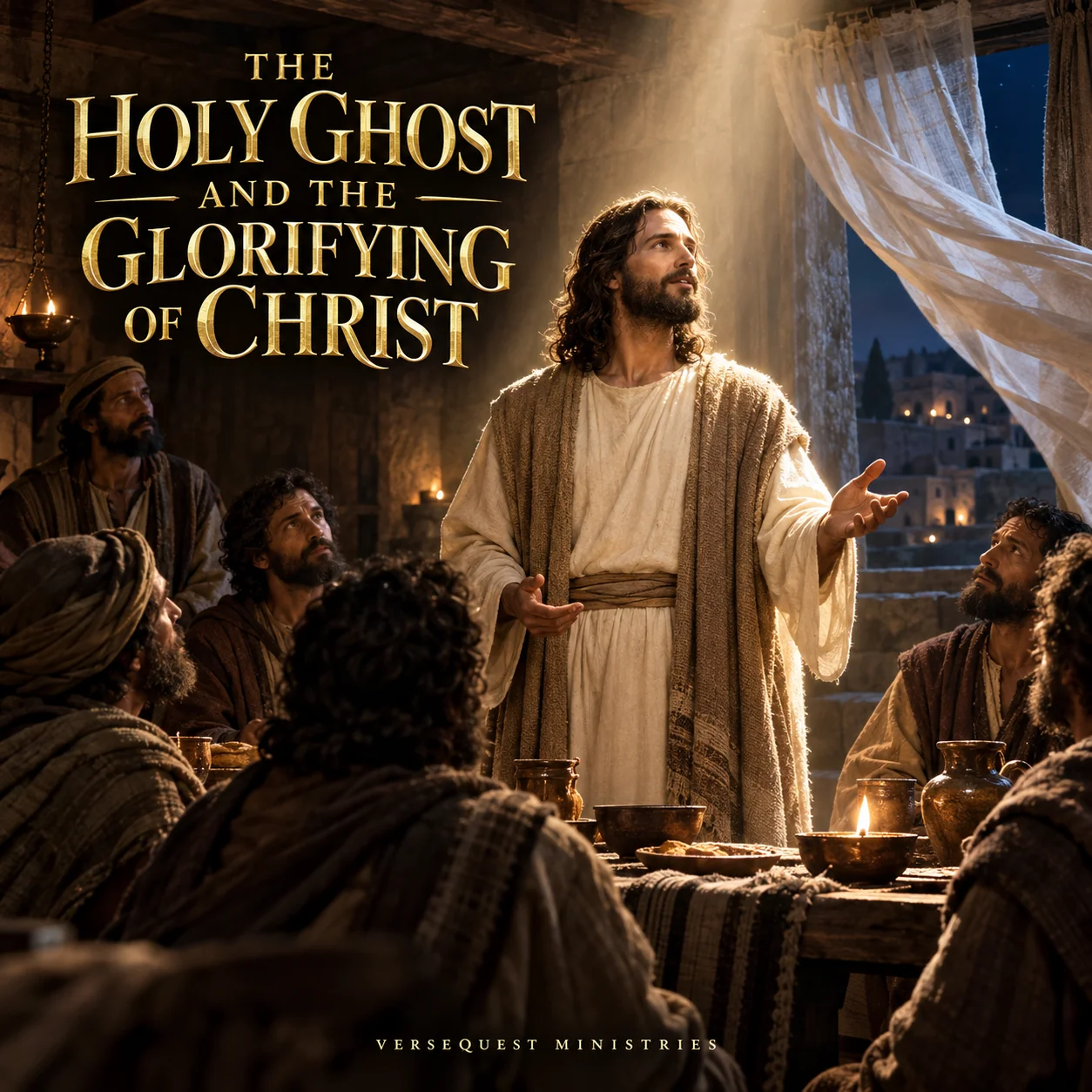
Sermon Title:
The Holy Ghost and the Glorifying of Christ
Key Passage:
John 16:12–15
Key Verse:
“He shall glorify me: for he shall receive of mine, and shall shew it unto you.” — John 16:14
Series:
The Promise and Ministry of the Holy Spirit
Topic:
The Holy Ghost’s ministry of revealing and glorifying the Lord Jesus Christ
Book:
John
Speaker:
Paul Tackett
Suggested Sermon Text:
John 14:16–18, John 14:26, John 15:26, John 16:7–15, Acts 1:8, 1 Corinthians 2:9–14, 1 Corinthians 12:3, 2 Corinthians 3:17–18, Galatians 5:22–25, Ephesians 1:13–14, Ephesians 5:18–20, Colossians 1:15–19
Short Sermon Description:
This sermon examines the words of Jesus Christ in John 16:14 and the central purpose of the Holy Ghost’s ministry: “He shall glorify me.” The Holy Ghost is not an impersonal influence, a religious sensation, or a means by which men may glorify themselves. He is the divine Spirit of truth who reveals Christ, magnifies Christ, illuminates the written word, convicts the world, indwells believers, and produces lives that testify of Christ. This outline distinguishes the apostolic promise of inspired revelation from the Spirit’s present ministry of illumination and shows how every supposedly spiritual message, movement, and manifestation must be judged by its treatment of Jesus Christ and the authority of Scripture.
THE HOLY GHOST AND THE GLORIFYING OF CHRIST
Introduction
The night before the crucifixion, the Lord Jesus Christ prepared His disciples for His departure. They had walked beside Him, heard His voice, witnessed His miracles, and depended upon His visible presence. Now He was telling them that He would go away. Sorrow had filled their hearts, but Christ explained that His departure would not leave them helpless or abandoned. He would send the Comforter, the Spirit of truth, who would guide them, teach them, remind them of Christ’s words, and reveal the truth that they were not yet able to bear. The earthly ministry of Christ was approaching Calvary, but the testimony concerning Christ would continue through the ministry of the Holy Ghost.
John 16:14 gives us one of the clearest statements in the Bible concerning the purpose of the Holy Ghost: “He shall glorify me.” The Holy Ghost did not come to build a reputation for Himself independently of the Son. He did not come to turn the Church into a religious sideshow where people chase sensations, boast about experiences, and place human personalities at the center. He came to make Jesus Christ known. Where the Holy Ghost is working according to Scripture, Christ is exalted, the word of God is honored, sin is exposed, truth is made plain, and believers are drawn into deeper obedience to their Saviour.
This truth gives us a scriptural test for everything that claims to be spiritual. Does it glorify Jesus Christ or glorify the person claiming the experience? Does it agree with the written word or require us to abandon the Bible for private revelations? Does it produce holiness, humility, truth, and gospel witness, or confusion, pride, disorder, and religious entertainment? The Holy Ghost never competes with the Son of God, contradicts the word of God, or crowns sinful man with the glory that belongs to Christ. His ministry is Christ-centered from beginning to end.
I. The Holy Ghost Was Promised by Jesus Christ
Key Text: John 16:7
Supporting Texts: John 14:16–18, John 14:26, John 15:26, Acts 1:4–5
Jesus told His disciples, “Nevertheless I tell you the truth; It is expedient for you that I go away.” To the disciples, Christ’s departure appeared to be a terrible loss. Yet the Lord declared that His going away was necessary because the Comforter would not come unto them unless He departed. Christ would accomplish redemption through His death, burial, and resurrection, return to the Father, and send the Holy Ghost to continue the divine work of testimony and revelation.
The coming of the Holy Ghost was not an emergency arrangement devised after men rejected Christ. It was part of God’s revealed purpose. Jesus promised in John 14:16, “And I will pray the Father, and he shall give you another Comforter, that he may abide with you for ever.” The Son prayed, the Father gave, and the Spirit came. These passages reveal the Father, Son, and Holy Ghost working in perfect divine unity. The Comforter was not another god, nor merely another form taken temporarily by Jesus. He was “another Comforter,” a distinct divine Person sent to continue the testimony of Christ.
The disciples would soon lose the visible presence of Christ, but they would not lose divine help. Jesus said, “I will not leave you comfortless: I will come to you” (John 14:18). The risen Christ would be present with His people through the Holy Ghost. The Comforter would abide, teach, guide, strengthen, and testify. What appeared to be a departure would become the beginning of a worldwide testimony concerning the crucified, risen, and glorified Son of God.
Main Truth:
The Holy Ghost came according to Christ’s promise to continue the divine testimony concerning the Lord Jesus Christ.
II. The Holy Ghost Is a Divine Person
Key Text: John 16:13
Supporting Texts: John 14:26, John 15:26, Acts 5:3–4, Acts 13:2, Ephesians 4:30
Jesus repeatedly referred to the Holy Ghost with personal pronouns: “he,” “him,” and “himself.” John 16:13 says, “Howbeit when he, the Spirit of truth, is come, he will guide you into all truth.” The Holy Ghost guides, hears, speaks, shows, teaches, testifies, commands, and may be grieved. These are the works and characteristics of a person, not an impersonal force. The Holy Ghost is not religious electricity, emotional excitement, or an invisible power that men learn to manipulate.
Acts 5 demonstrates His deity. Peter told Ananias that he had lied to the Holy Ghost, and then said, “thou hast not lied unto men, but unto God” (Acts 5:4). Acts 13:2 records the Holy Ghost speaking and commanding, “Separate me Barnabas and Saul for the work whereunto I have called them.” He possesses intelligence, will, authority, and divine power. Ephesians 4:30 warns believers, “And grieve not the holy Spirit of God, whereby ye are sealed unto the day of redemption.” An impersonal force cannot be grieved, but a divine Person can.
Recognizing the personhood of the Holy Ghost protects the believer from treating Him as a tool for obtaining influence, power, or attention. We do not control the Holy Ghost; He is God. We do not command Him to endorse our plans; we submit ourselves to the truth He inspired. His ministry will always agree with the Father’s purpose, magnify the Son, and operate consistently with the written word.
Main Truth:
The Holy Ghost is a divine Person who speaks, teaches, guides, commands, and glorifies Jesus Christ.
III. The Holy Ghost’s Supreme Purpose Is to Glorify Christ
Key Text: John 16:14
Supporting Texts: John 15:26, 1 Corinthians 12:3, Colossians 1:15–19, Revelation 19:10
Jesus did not leave us to guess why the Holy Ghost would come. He stated plainly, “He shall glorify me.” The Holy Ghost directs attention toward Jesus Christ—His person, words, cross, resurrection, present glory, and coming kingdom. John 15:26 says, “he shall testify of me.” The Spirit’s ministry places Christ before the sinner as the only Saviour and before the believer as the preeminent Lord.
Colossians 1 declares that Christ is “the image of the invisible God,” the Creator of all things, the Head of the body, and the One in whom “all fulness” dwells. The Holy Ghost opens the believer’s understanding to these truths. He does not reduce Jesus to a moral teacher, social reformer, revolutionary, or one religious leader among many. He reveals Him as the eternal Son of God, the Creator manifest in the flesh, the Lamb who shed His blood for sinners, the risen Head of the Church, and the Lord before whom every knee will bow.
This exposes the error of any movement that talks much about the Spirit while making little of Christ. A meeting may be loud, emotional, unusual, or exciting, but those things do not prove that the Holy Ghost is directing it. The question is whether Jesus Christ is being glorified according to Scripture. The genuine work of the Spirit does not terminate upon the experience, the preacher, the musician, or the congregation. It brings the glory back to Christ.
Main Truth:
The unmistakable purpose of the Holy Ghost’s ministry is to reveal, exalt, and glorify Jesus Christ.
IV. The Holy Ghost Receives the Truth of Christ
Key Text: John 16:14–15
Supporting Texts: John 3:34–35, John 17:10, Colossians 2:3, Colossians 2:9, Hebrews 1:1–3
Jesus continued, “for he shall receive of mine, and shall shew it unto you.” He then said, “All things that the Father hath are mine.” There is perfect unity among the Father, Son, and Holy Ghost. The Spirit does not bring a rival message, establish a competing authority, or contradict what Christ has spoken. He receives and reveals the truth belonging to the Son, and everything belonging to the Father belongs to the Son.
The riches revealed by the Spirit are the riches found in Christ. Colossians 2:3 declares, “In whom are hid all the treasures of wisdom and knowledge.” Verse 9 continues, “For in him dwelleth all the fulness of the Godhead bodily.” The Spirit is not sent to lead the Church beyond Christ into some supposedly higher revelation. There is no deeper truth that makes Christ unnecessary, no advanced spirituality that outgrows the cross, and no secret knowledge that replaces the written word.
When someone claims to receive a revelation from the Spirit, that claim must be judged by Scripture. The Holy Ghost will not deny the deity of Christ, diminish the sufficiency of His sacrifice, add human works to His gospel, or speak contrary to the Bible He inspired. A spirit that contradicts the words and glory of Jesus Christ is not the Holy Spirit, regardless of how impressive, supernatural, or religious the claim may appear.
Main Truth:
The Holy Ghost reveals the inexhaustible truth belonging to Christ and never introduces a message that contradicts Him.
V. The Holy Ghost Revealed Christ Through the Written Word
Key Text: John 16:13–14
Supporting Texts: John 14:26, 1 Corinthians 2:9–14, 2 Timothy 3:16–17, 2 Peter 1:20–21
The promise in John 16 had a special and direct application to the apostles who were with Christ in the upper room. Jesus told them that the Spirit would guide them “into all truth,” show them “things to come,” and bring His words to their remembrance. This promise prepared them to preach with divine authority and to provide the inspired apostolic revelation preserved in the New Testament. The verse was not a promise that every Christian would receive new doctrine or privately inspired additions to Scripture.
Second Peter 1:21 explains the process of inspiration: “For the prophecy came not in old time by the will of man: but holy men of God spake as they were moved by the Holy Ghost.” The Scriptures did not originate in religious imagination. God used human writers, but the Holy Ghost superintended their words. Second Timothy 3:16 states, “All scripture is given by inspiration of God.” The Spirit who glorifies Christ gave us a Book that testifies of Christ from Genesis through Revelation.
Believers today have the indwelling Holy Ghost, and He illuminates the Scriptures, helping us understand and apply what God has already revealed. Illumination is not inspiration. The Spirit helps us understand the Book; He does not authorize us to rewrite it. He opens our understanding; He does not give us permission to correct the words He inspired and preserved. The Spirit of truth works through the word of truth to reveal the One who said, “I am the way, the truth, and the life” (John 14:6).
Main Truth:
The Holy Ghost glorifies Christ through the inspired Scriptures and illuminates those Scriptures for the believer’s understanding.
VI. The Holy Ghost Produces a Christ-Centered Testimony
Key Text: Acts 1:8
Supporting Texts: 1 Corinthians 2:1–5, 1 Corinthians 12:3, 2 Corinthians 4:5–7, Galatians 6:14
Jesus told the disciples, “But ye shall receive power, after that the Holy Ghost is come upon you: and ye shall be witnesses unto me.” The Spirit’s power was given for testimony. It was not given so that the disciples could establish themselves as spiritual celebrities, build personal kingdoms, or entertain crowds. The power of the Holy Ghost made ordinary believers bold witnesses to the death, burial, resurrection, and lordship of Jesus Christ.
Paul followed this pattern in his ministry. He declared, “For we preach not ourselves, but Christ Jesus the Lord; and ourselves your servants for Jesus’ sake” (2 Corinthians 4:5). He refused to make the gospel dependent upon “excellency of speech” or “enticing words of man’s wisdom.” His preaching centered upon “Jesus Christ, and him crucified” so that the faith of his hearers would stand “in the power of God” rather than in the wisdom of men.
A Spirit-filled witness will not constantly direct attention toward himself. He will not treat the pulpit as a stage or the ministry as a personal brand. He will speak of Christ, preach the gospel of Christ, defend the words of Christ, and point sinners toward Christ. Paul said, “But God forbid that I should glory, save in the cross of our Lord Jesus Christ” (Galatians 6:14). That is the language of a man whose testimony has been shaped by the Holy Ghost.
Main Truth:
The power of the Holy Ghost is given so believers may bear a clear, courageous, and Christ-centered witness.
VII. The Holy Ghost Glorifies Christ in the Believer’s Life
Key Text: 1 Corinthians 6:19–20
Supporting Texts: Romans 8:9–14, Galatians 5:22–25, Ephesians 5:18–21, Philippians 1:20–21
The Holy Ghost does more than place the name of Christ upon a believer’s lips; He works to display the character of Christ through the believer’s life. First Corinthians 6:19 asks, “What? know ye not that your body is the temple of the Holy Ghost which is in you?” The believer has been bought with a price and is therefore commanded to glorify God in body and spirit. The Spirit’s indwelling presence gives the Christian both the privilege and the responsibility of living for Christ.
Galatians 5 describes the fruit of the Spirit as “love, joy, peace, longsuffering, gentleness, goodness, faith, meekness, temperance.” These qualities do not provide a means of earning salvation; they are the fruit that should grow in one who has already been saved and indwelt by the Spirit. The flesh advertises itself, demands recognition, and seeks its own gratification. The Spirit produces a life in which the mind, speech, conduct, relationships, and priorities increasingly bring honor to Jesus Christ.
To be filled with the Spirit is not to lose control in religious excitement. Ephesians 5 connects the Spirit-filled life with speaking truth, singing to the Lord, giving thanks, and submitting properly to others. Colossians 3 presents the parallel command by telling believers to let “the word of Christ dwell in you richly.” The Spirit-filled life and the word-filled life are not enemies. The Holy Ghost uses the word of Christ to form the likeness of Christ in the people of Christ for the glory of Christ.
Main Truth:
The Holy Ghost glorifies Jesus Christ by producing Christlike character, obedient conduct, and thankful worship in the believer.
Conclusion
John 16:14 reduces the matter to one decisive statement: “He shall glorify me.” The Holy Ghost was promised by Christ, sent by the Father, and given to testify concerning the Son. He is a divine Person, not an impersonal power. He reveals the riches of Christ, inspired the written word, illuminates the believer’s understanding, empowers gospel witness, and produces a life that honors the Saviour.
This truth also provides a necessary warning. Not everything advertised as spiritual comes from the Spirit of God. Religious noise is not the same as spiritual power, emotional intensity is not the same as divine truth, and supernatural claims are not self-authenticating. Every message, ministry, manifestation, and movement must be tested by the King James Bible. If it contradicts Scripture, minimizes the cross, obscures the gospel, exalts man, or steals attention from Jesus Christ, it does not bear the identifying mark of the Holy Ghost’s ministry.
The believer should therefore seek neither empty emotionalism nor cold religious formalism. We should yield ourselves to the Holy Ghost through obedience to the written word. We should ask Him to illuminate the Scriptures, expose sin, strengthen our witness, produce His fruit, and conform our lives to the Lord Jesus Christ. The Spirit does not shine the spotlight upon Himself; He turns it toward the Son. When the Holy Ghost has His rightful way in a life, Christ will be seen, Christ will be preached, Christ will be obeyed, and Christ will receive the glory.
Final Call
The Holy Ghost glorifies Christ by revealing Him as the only Saviour of sinners. The gospel is not a religious system, a moral improvement program, or a ladder of good works by which men climb toward God. Christ died for our sins according to the Scriptures, was buried, and rose again the third day according to the Scriptures. Salvation is received by grace through faith in the finished work of Jesus Christ.
If you are lost, stop trusting your religion, baptism, church membership, good intentions, or personal righteousness. Believe on the Lord Jesus Christ. Trust His shed blood, His substitutionary death, and His bodily resurrection as the complete payment for your sins. “For by grace are ye saved through faith; and that not of yourselves: it is the gift of God: Not of works, lest any man should boast” (Ephesians 2:8–9).
If you are saved, remember that your body is the temple of the Holy Ghost. Study the word He inspired, believe the truth He reveals, walk in the Spirit, and live so that Jesus Christ receives the glory. Do not seek an experience that makes much of you. Seek to be a faithful believer whose doctrine, testimony, worship, conduct, and witness make much of Christ.
Closing Verse:
“But when the Comforter is come, whom I will send unto you from the Father, even the Spirit of truth, which proceedeth from the Father, he shall testify of me.” — John 15:26
Closing Statement:
Where the Holy Ghost is truly at work, man steps out of the spotlight, the Bible stands open, and Jesus Christ receives all the glory.