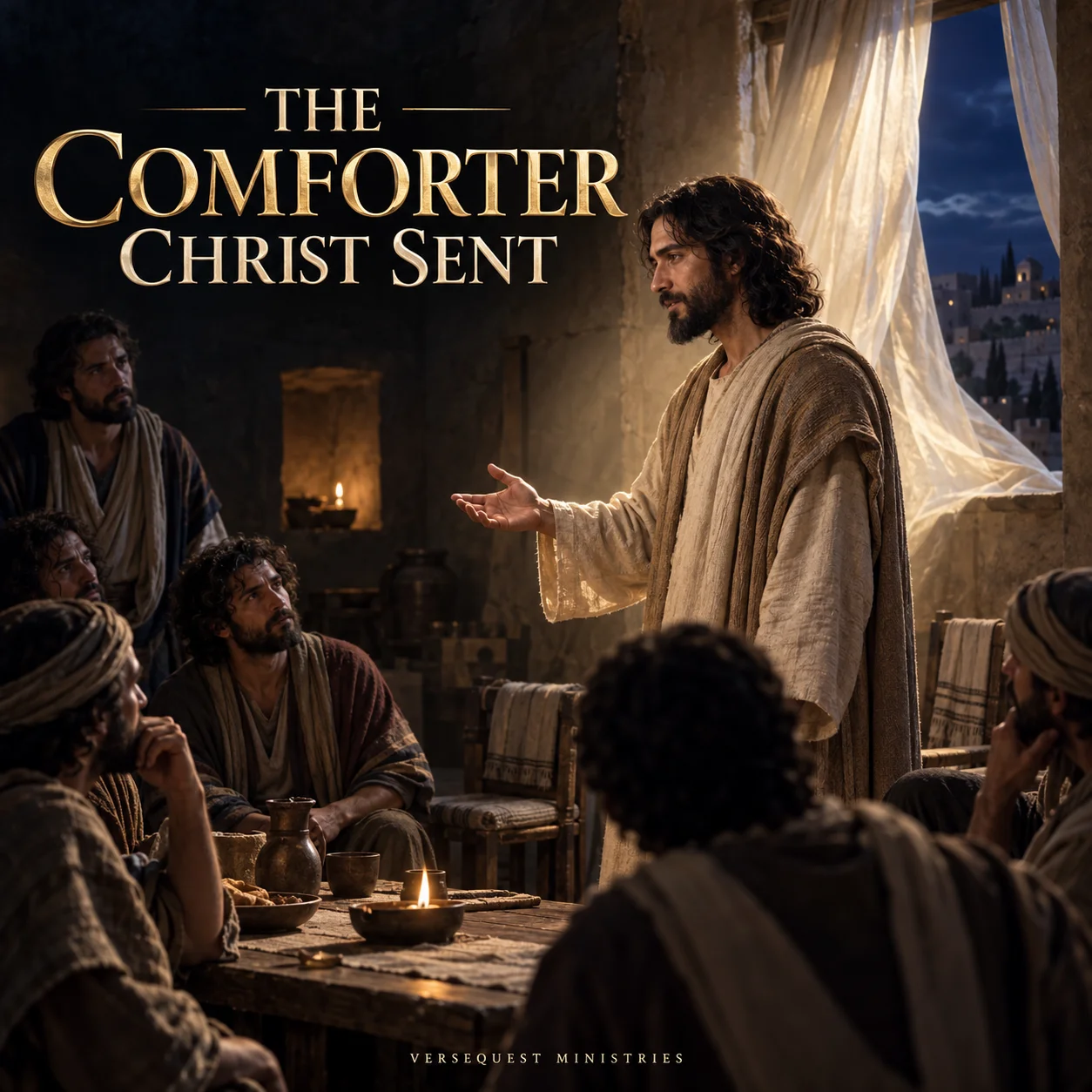
Sermon Title:
The Comforter Christ Sent
Key Passage:
John 14:16–18
Key Verse:
“And I will pray the Father, and he shall give you another Comforter, that he may abide with you for ever.” — John 14:16
Series:
The Promise of the Holy Spirit
Topic:
Christ’s promise of the Holy Spirit, His permanent indwelling presence, and His ministry as the believer’s Comforter
Book:
John
Speaker:
Paul Tackett
Suggested Sermon Text:
John 14:15–27; John 15:26–27; John 16:7–15; Acts 1:4–8; Acts 2:1–4; Romans 8:9–16; Ephesians 1:12–14; Ephesians 4:30
Short Sermon Description:
John 14:16–18 records the Lord Jesus Christ’s promise that the Father would send “another Comforter” to abide with His people forever. This detailed KJV sermon outline examines the Holy Spirit as a divine Person, the Spirit of truth, the permanent indwelling presence promised to believers, and the One who continues Christ’s ministry within the Church. It distinguishes the Spirit’s relationship to Old Testament saints from His present sealing ministry in the body of Christ, exposes the error of reducing Him to an emotional influence or religious force, and shows how He teaches, guides, strengthens, assures, and glorifies Jesus Christ. Because the Comforter has come, no believer in Christ has been abandoned, orphaned, or left to face the Christian life alone.
The Comforter Christ Sent
Introduction
John 14 opens beneath the shadow of the cross. The disciples have heard that one of them will betray Christ, Peter will deny Him, and the Lord is going somewhere they cannot immediately follow. Everything familiar appears to be slipping out of their hands. For more than three years, they had walked beside Jesus Christ, heard His voice, watched His miracles, asked Him questions, and depended upon His visible presence. Now He speaks of departure. Into that troubled room the Lord says, “Let not your heart be troubled.” He does not comfort them by pretending nothing painful is coming. He comforts them by revealing that His departure will not mean their abandonment.
The promise of “another Comforter” stands at the heart of that assurance. Christ would leave bodily, return to the Father, and send the Holy Spirit to continue His divine ministry among and within His people. The disciples would no longer have Christ walking visibly beside them on the dusty roads of Israel, but they would receive the Spirit dwelling permanently within them. That was not a second-rate substitute. The Comforter would teach them, bring Christ’s words to their remembrance, testify of Christ, reprove the world, guide into truth, and glorify the Son. Christ’s physical departure would make possible a ministry extending beyond one geographical place to believers throughout the world.
The doctrine has nevertheless been buried beneath emotionalism, religious confusion, and charismatic theater. Some speak of the Holy Spirit as though He were an impersonal force that can be switched on by music, manipulated by repetition, or summoned by the correct atmosphere. Others treat Him as an occasional visitor who abandons Christians whenever they stumble. Still others attribute every impulse, dream, shiver, uncontrolled action, and doctrinal contradiction to the Spirit. John 14 gives something far more substantial. The Comforter is a divine Person, the Spirit of truth, sent by the Father at the request of the Son, known by believers, rejected by the world, dwelling within the redeemed, and abiding with them forever.
I. The Comforter Was Promised by the Son and Given by the Father
Key Text: John 14:16
Supporting Texts: John 14:26; John 15:26; John 16:7; Acts 1:4–5; Acts 2:32–33
Jesus said, “And I will pray the Father, and he shall give you another Comforter.” The sending of the Spirit reveals the perfect agreement and operation of the Godhead. The Son prays, the Father gives, and the Spirit comes. These are not three gods negotiating with one another, nor is one Person merely changing costumes. The Father, Son, and Holy Ghost are distinct in Person while perfectly united in deity, purpose, and work. John 14 does not flatten the Trinity into a religious fog. Christ speaks to the Father concerning another Comforter who will come to the disciples.
The promise also rests upon Christ’s completed redemptive work. John 16:7 says, “It is expedient for you that I go away.” His departure included the cross, burial, resurrection, ascension, and glorification. Sin had to be paid for, death conquered, and the risen Christ exalted before the Spirit’s promised Church Age ministry commenced. Acts 2:33 declares that the exalted Christ, “having received of the Father the promise of the Holy Ghost,” shed forth what the people witnessed at Pentecost. The coming of the Comforter announced that Christ had finished the work and taken His place at the Father’s right hand.
The believer therefore receives the Spirit because of what Christ accomplished, not because of what human flesh performs. The Spirit is not God’s trophy for religious overachievers. He is God’s gift to those who receive Jesus Christ. Galatians 3:2 asks, “Received ye the Spirit by the works of the law, or by the hearing of faith?” The answer leaves religious merit standing outside with its hat in its hand. The Comforter comes through faith in Christ because Christ’s blood, not human effort, opened the way.
Main Truth:
The Father gave the Holy Spirit according to the Son’s promise and on the basis of Christ’s completed redemptive work.
II. “Another Comforter” Is a Divine Person, Not an Impersonal Power
Key Text: John 14:16
Supporting Texts: John 14:26; John 16:13–14; Acts 5:3–4; Acts 13:2; Ephesians 4:30
Jesus promised “another Comforter.” Christ Himself had comforted, taught, guided, corrected, protected, and strengthened the disciples during His earthly ministry. The word “another” shows that the One coming would continue that ministry without being the same Person as Christ. The Holy Spirit is not merely Christ’s influence lingering in the room after His departure. He is the third Person of the Godhead, possessing divine intelligence, will, knowledge, holiness, and power.
Scripture assigns personal actions to the Holy Ghost. He teaches, speaks, guides, hears, testifies, commands, forbids, chooses, intercedes, and can be grieved. Acts 13:2 records the Holy Ghost saying, “Separate me Barnabas and Saul for the work whereunto I have called them.” Ephesians 4:30 warns believers not to grieve Him. Electricity does not speak, call missionaries, select servants, teach doctrine, or experience grief. Anyone who reduces the Holy Spirit to a spiritual voltage has traded biblical doctrine for religious wiring.
Acts 5 identifies lying to the Holy Ghost as lying to God. His deity is not an honorary title bestowed by the Church; it is revealed throughout Scripture. The Spirit was present in creation, inspired the words of God, empowered Christ’s earthly ministry, raised Him from the dead, regenerates sinners, baptizes believers into Christ’s body, and seals them unto redemption. The Comforter is not a lesser deity or divine assistant. He is God dwelling within those who belong to Jesus Christ.
Main Truth:
The Comforter Christ sent is a distinct divine Person who thinks, speaks, acts, teaches, and possesses every attribute of God.
III. The Comforter Is the Spirit of Truth Whom the World Cannot Receive
Key Text: John 14:17
Supporting Texts: John 15:26; John 16:13; 1 Corinthians 2:10–14; Ephesians 1:13; 1 John 4:6
Christ called the Comforter “the Spirit of truth.” His ministry is inseparable from truth because He inspired the words of truth and always testifies concerning the One who declared, “I am the way, the truth, and the life.” The Spirit never leads contrary to the King James Bible, never corrects the words He inspired, and never produces doctrine that diminishes Jesus Christ. Every alleged spiritual experience must be judged by the written word. An impression contradicting Scripture did not become divine because someone attached the phrase “The Spirit told me.”
John 14:17 says the world “cannot receive” the Spirit “because it seeth him not, neither knoweth him.” The natural man demands what he can observe, measure, explain, commercialize, or control. First Corinthians 2:14 says he “receiveth not the things of the Spirit of God: for they are foolishness unto him.” The world may imitate religious excitement, use spiritual language, and market emotional experiences, but it cannot receive the Comforter while rejecting Jesus Christ. The Spirit does not come through human philosophy, mystical exercises, institutional ceremony, or moral improvement. He comes to those who believe the gospel.
The Spirit’s invisibility does not make His presence imaginary. The wind cannot be seen, yet its work becomes evident. Likewise, the Spirit produces conviction, regeneration, illumination, spiritual fruit, and testimony concerning Christ. His genuine work does not require manufactured confusion to prove that He is present. First Corinthians 14:33 states, “For God is not the author of confusion.” When disorder, pride, fleshly exhibition, doctrinal contradiction, and uncontrolled spectacle dominate a meeting, attaching the Holy Ghost’s name does not sanctify the mess. The Spirit of truth produces truth.
Main Truth:
The Holy Spirit always operates in agreement with God’s truth and can be received only through faith in Jesus Christ.
IV. The Promise Moved From “With You” to “In You”
Key Text: John 14:17
Supporting Texts: John 7:37–39; Acts 1:4–8; Acts 2:1–4; Romans 8:9; 1 Corinthians 6:19–20
Jesus told the disciples, “he dwelleth with you, and shall be in you.” The distinction marks an important transition. The Spirit was already present with them through Christ’s ministry and had operated throughout the Old Testament. He came upon selected individuals for particular service, empowered judges and kings, inspired prophets, and worked among God’s people. Yet Christ spoke of a future relationship: “shall be in you.” The cross, resurrection, ascension, and coming of the Spirit at Pentecost stood between those two expressions.
Under the Old Testament economy, the Spirit could come upon a person for service and later depart. Saul lost the Spirit’s empowering presence, and David prayed, “take not thy holy spirit from me.” That prayer was appropriate for David under the law and within Israel’s kingdom program, but it is not the Church Age believer’s doctrinal position. The Christian is sealed with the Spirit “unto the day of redemption.” Taking David’s fear and forcing it upon a member of Christ’s body is not humility. It is failure to rightly divide the word of truth.
Romans 8:9 declares, “Now if any man have not the Spirit of Christ, he is none of his.” Every person belonging to Christ possesses the Spirit. There is no spiritually superior class that has Him while ordinary Christians wait for an upgrade. The believer’s body is “the temple of the Holy Ghost.” God no longer dwells in a tabernacle made of skins or a temple built of stones. He dwells within redeemed people purchased by Christ’s blood. The Christian should therefore glorify God in body and spirit because both belong to Him.
Main Truth:
Christ promised a new and permanent relationship in which the Holy Spirit would dwell within every believer.
V. The Comforter Abides With the Believer Forever
Key Text: John 14:16
Supporting Texts: Ephesians 1:13–14; Ephesians 4:30; 2 Corinthians 1:21–22; Romans 8:35–39; John 10:27–30
Jesus said the Comforter would “abide with you for ever.” The word “forever” does not require improvement from a committee. It means the Spirit’s presence is permanent. He does not enter the believer under a short-term lease, inspect the premises after every failure, and move out when the flesh causes trouble. The Christian can grieve the Spirit and must never treat sin lightly, but the Spirit’s grief demonstrates His continued presence. He is grieved because He remains within someone who belongs to God.
Ephesians 1:13–14 says believers are sealed with the Holy Spirit of promise, who is “the earnest of our inheritance until the redemption of the purchased possession.” Ephesians 4:30 repeats that they are sealed “unto the day of redemption.” The Spirit is both God’s seal of ownership and His earnest guaranteeing completion. If salvation could be lost before the day of redemption, the seal would fail, the earnest would be worthless, and Christ’s promise to abide forever would require an expiration date that the Bible forgot to print.
Permanent indwelling does not provide permission to sin. It provides the strongest possible reason for holiness. A believer carries the presence of God into every place he goes, every relationship he enters, and every decision he makes. Sin is not merely breaking an external regulation; it grieves the divine Person dwelling within. Eternal security removes the slave’s fear of being cast out, but it increases the son’s responsibility to please his Father. Grace does not make holiness unnecessary. Grace gives holiness its proper foundation.
Main Truth:
The Holy Spirit’s indwelling presence is permanent because Christ promised that the Comforter would abide with His people forever.
VI. The Comforter Continues Christ’s Ministry Through the Word
Key Text: John 14:26
Supporting Texts: John 15:26; John 16:13–15; 1 Corinthians 2:9–13; Ephesians 6:17; 2 Timothy 3:16–17
John 14:26 says the Comforter “shall teach you all things, and bring all things to your remembrance, whatsoever I have said unto you.” In its immediate setting, this promise had special application to the apostles. They would bear authoritative witness concerning Christ, and the Spirit would bring His words to their remembrance. This helps explain the trustworthy apostolic testimony preserved in the New Testament. The promise does not mean every Christian receives perfect memory, private inspiration, or authority to add chapters to the Bible.
The Spirit also teaches believers by illuminating the Scripture He inspired. First Corinthians 2 explains that spiritual truth is revealed and taught by the Spirit. Ephesians 6:17 calls the word of God “the sword of the Spirit.” Spirit-filled living and Scripture-filled living never oppose one another. The Holy Ghost does not lead Christians away from the Bible into a wilderness of private impressions. He opens understanding, applies truth, brings Scripture to mind, and conforms thinking to what God has written.
John 16:14 gives the controlling purpose of His ministry: “He shall glorify me.” The genuine work of the Spirit magnifies Jesus Christ rather than the preacher, musician, healer, personality, experience, or movement. The Comforter did not come to make men fascinated with themselves. He came to reveal the Son, testify of His work, and form His character in believers. When a ministry talks constantly about the Spirit yet produces little reverence for Christ and little submission to Scripture, something has gone wrong with the advertising.
Main Truth:
The Comforter teaches through the written word, testifies of Jesus Christ, and directs all genuine spiritual ministry toward His glory.
VII. Christ Has Not Left His People Comfortless
Key Text: John 14:18
Supporting Texts: Matthew 28:20; Romans 8:14–16; Romans 8:26–27; Hebrews 13:5–6; Philippians 4:11–13
Jesus concluded, “I will not leave you comfortless: I will come to you.” The word carries the sense of being left as an orphan. Christ promised that His disciples would not be abandoned, fatherless, or helpless after His departure. He would rise from the dead, appear to them, and continue His presence through the Comforter. The Father, Son, and Spirit work in such perfect unity that receiving the Spirit means enjoying the abiding presence of God. Christ departed bodily, but He did not desert His own.
The Spirit’s comfort is stronger than sentimental reassurance. He strengthens the believer in weakness, intercedes when words fail, bears witness to sonship, produces hope, gives understanding, and enables obedience. Sometimes His comfort includes peace during a storm rather than immediate deliverance from it. He does not always remove the furnace, but He makes the presence of Christ real within it. Biblical comfort is not God patting the flesh on the head and promising that nothing difficult will happen. It is divine strength that keeps the saint standing when difficulty arrives.
The believer may feel lonely without ever being abandoned. Feelings change with exhaustion, grief, illness, disappointment, and circumstance, but Christ’s promise does not change. Hebrews 13:5 records, “I will never leave thee, nor forsake thee.” The Holy Spirit within is the present evidence of that promise. The Christian does not need to beg the Spirit to enter again, tarry for Him to arrive, or manufacture an emotional atmosphere to make Him stay. He must believe the word, yield to the Spirit, walk in truth, and remember that the Comforter is already present.
Main Truth:
Through the permanent presence of the Holy Spirit, Christ has ensured that no believer will ever be abandoned or left spiritually orphaned.
Conclusion
The Comforter Christ sent is not an impersonal force, a passing emotion, or a religious performance. He is the divine Spirit of truth, promised by the Son, given by the Father, and sent to dwell within those who believe. He teaches, guides, testifies, intercedes, strengthens, convicts, seals, and glorifies Jesus Christ. His ministry rests upon Christ’s completed redemption and directs believers continually back to the Son and the written word.
The promise “that he may abide with you for ever” establishes the permanence of His presence. The believer can grieve the Spirit but cannot evict Him. God has sealed the Christian unto the day of redemption. That security must never become an excuse for sin; it should produce reverence, gratitude, obedience, and holy living. The body belongs to Christ and has become the temple of the Holy Ghost. A temple should not be treated like a garbage dump merely because the Owner has promised not to abandon it.
The disciples entered John 14 troubled by the prospect of Christ’s departure, but the chapter ends with peace grounded in divine promise. Christ went to the cross, rose again, ascended to the Father, and sent the Comforter exactly as He said. The King James Bible gives the believer something firmer than emotional assurance: the written promise of the Son of God. Christ has not left His Church alone. The Spirit of truth is within every believer, the gospel continues to go forth, and the Comforter will remain until redemption is complete.
Final Call
If you have never trusted Jesus Christ, you cannot receive the Holy Spirit through religious effort, ceremonies, good works, emotional excitement, or imitation of spiritual experiences. You must believe the gospel. Jesus Christ died for your sins, was buried, and rose again the third day according to the Scriptures. Believe on the Lord Jesus Christ, and God will save you, place you into Christ, and seal you with His Holy Spirit.
If you are saved, stop living as though Christ abandoned you to face the Christian life alone. Believe His promise, study the word the Spirit inspired, yield to His direction, and refuse every teaching that turns the Holy Ghost into an emotional spectacle. Grieve not the Comforter who dwells within you. Walk in truth, glorify Jesus Christ, and remember that the One Christ sent will abide with you forever.
Closing Verse:
“But the Comforter, which is the Holy Ghost, whom the Father will send in my name, he shall teach you all things.” — John 14:26
Closing Statement:
Christ returned to the Father, but He did not leave His people orphaned—the Comforter came to dwell within them and will never depart.