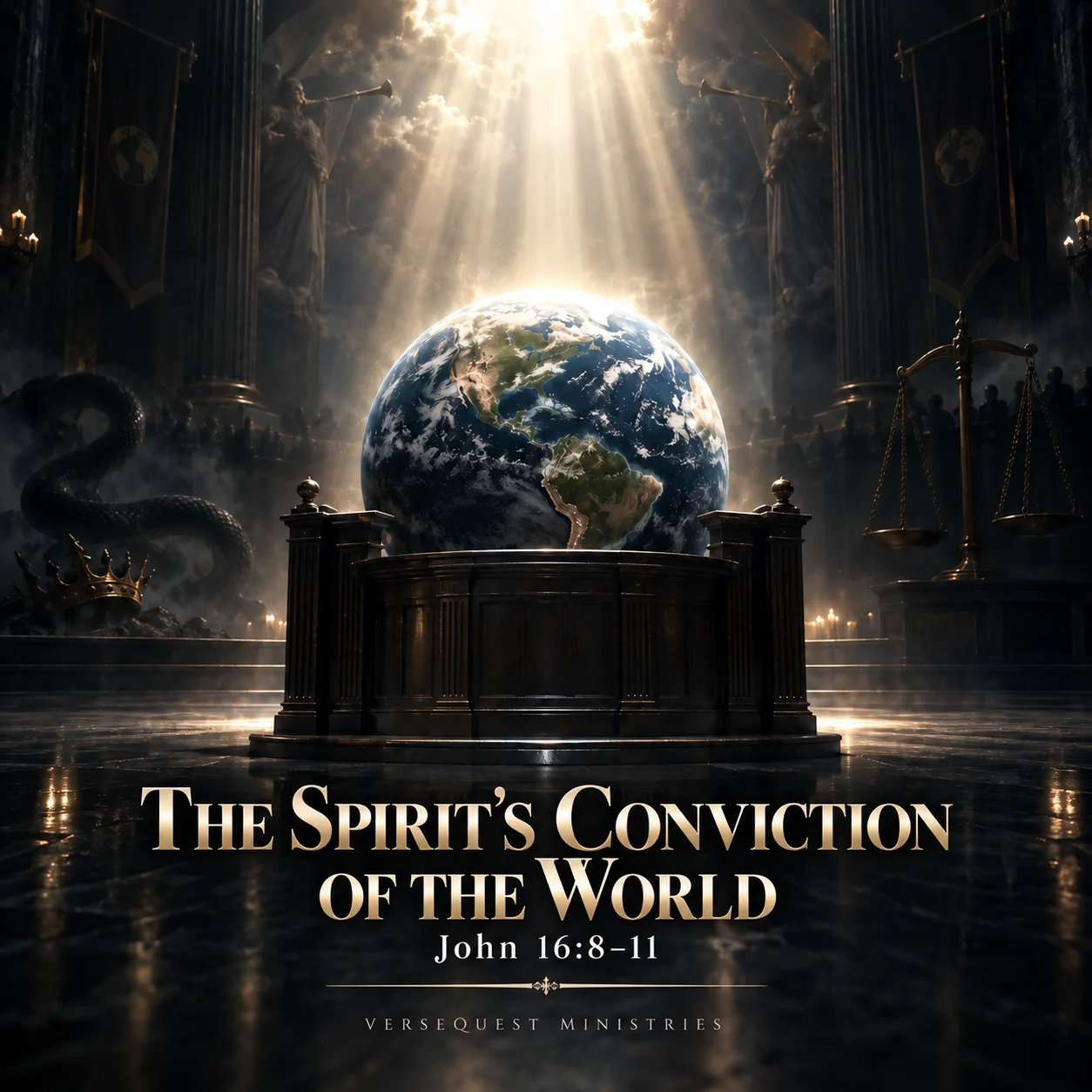
Sermon Title:
When the Holy Ghost Puts the World on Trial
Key Passage:
John 16:8–11
“And when he is come, he will reprove the world of sin, and of righteousness, and of judgment: Of sin, because they believe not on me; Of righteousness, because I go to my Father, and ye see me no more; Of judgment, because the prince of this world is judged.” (John 16:8–11)
Series:
The Ministry of the Holy Ghost
Topic:
The Spirit’s Conviction of the World
Book:
John
Speaker:
Paul Tackett
Suggested Sermon Text:
John 16:7–15; John 3:18–21; John 15:26; Acts 2:37–41; Acts 16:30–31; Romans 3:10–23; Romans 10:9–17; 1 Corinthians 15:1–4; 2 Corinthians 5:21; Ephesians 1:13–14; Ephesians 2:8–9
Short Sermon Description:
John 16:8–11 reveals one of the clearest statements in the Bible concerning the Holy Ghost’s ministry toward an unbelieving world. The Lord Jesus Christ declares that when the Comforter comes, He will “reprove the world” in three specific areas: sin, righteousness, and judgment. The passage does not present vague emotional guilt, religious sentiment, or psychological discomfort; it presents a divine prosecution of the world’s false verdict concerning Jesus Christ. The Spirit exposes the world’s fundamental sin of unbelief, vindicates the righteousness of the rejected Christ who returned to the Father, and announces judgment because the prince of this world already stands condemned. This sermon distinguishes conviction from conversion, shows that the Holy Ghost’s ministry points men toward Christ rather than toward Himself, and makes plain that the sinner’s answer to divine conviction is not self-reformation but faith in the gospel of the death, burial, and resurrection of Jesus Christ.
WHEN THE HOLY GHOST PUTS THE WORLD ON TRIAL
Introduction
Few subjects have been discussed more carelessly in modern Christianity than the conviction of the Holy Ghost. People often use the word “conviction” for almost any uncomfortable feeling. A man feels bad because he lost his temper, and somebody calls it conviction. A woman feels emotional during a song, and somebody calls it conviction. A congregation becomes quiet during an invitation, and somebody announces that “the Spirit is moving.” But Jesus Christ did not leave us guessing about what the Holy Ghost would do when He came. He gave three specific charges in John 16:8–11. The Holy Ghost would reprove the world “of sin, and of righteousness, and of judgment.” That is precise language, and the Bible believer ought to let the passage define the doctrine instead of letting religious vocabulary redefine the passage.
The setting makes the words even more significant. Jesus Christ is preparing His disciples for His departure. He has been rejected by the world and will shortly be crucified. From the human point of view, it will appear that the world has passed judgment upon Christ. Jerusalem will reject Him, religious leaders will condemn Him, Rome will execute Him, and His body will be laid in a tomb. But heaven will reverse the world’s verdict. Christ will rise from the dead, ascend to the Father, and send the Holy Ghost. Then the Holy Ghost will begin prosecuting the very world that thought it had successfully prosecuted Jesus Christ. Men may put Christ on trial, but John 16 shows that after Calvary, resurrection, and ascension, God puts the world on trial.
The passage therefore strikes at the root of the sinner’s problem. Man’s greatest problem is not merely that he has bad habits, broken relationships, social problems, or emotional wounds. His greatest problem is his relationship to Jesus Christ. Verse 9 identifies the central issue: “Of sin, because they believe not on me.” Verse 10 establishes the standard of righteousness in a risen and ascended Christ. Verse 11 announces judgment upon the satanic ruler behind the present evil world system. The Holy Ghost does not come to convince the world that it needs a little improvement. He comes with heaven’s verdict: man is wrong about sin, wrong about righteousness, wrong about judgment, and above all wrong about Jesus Christ.
I. THE COMING OF THE COMFORTER BEGINS A NEW MINISTRY
Key Text: John 16:7–8
Supporting Texts: John 14:16–17, 26; John 15:26; John 16:13–14; Acts 2:1–4
Jesus said, “Nevertheless I tell you the truth; It is expedient for you that I go away” (John 16:7). To the disciples, that must have sounded almost impossible. How could Christ leaving them possibly be advantageous? They had walked with Him, heard Him teach, watched Him perform miracles, and depended upon His visible presence. Yet the Lord said that His departure was necessary for another phase of God’s program to begin. “For if I go not away, the Comforter will not come unto you.” Christ would complete His earthly ministry, die for sins, rise from the dead, ascend to heaven, and the Holy Ghost would come in a ministry connected with the finished work and glorification of Jesus Christ.
Notice also that the Holy Ghost is not introduced as an impersonal religious influence. Christ repeatedly calls Him “he.” “When he is come, he will reprove.” Later Jesus says, “when he, the Spirit of truth, is come, he will guide you into all truth” (John 16:13). The Holy Ghost speaks, guides, reproves, teaches, testifies, and glorifies Christ. Biblical Christianity does not present some mysterious electrical force floating through a church building. The Holy Ghost is a divine Person carrying out a divine ministry according to the word and will of God.
His coming also marks an important transition in the unfolding revelation of Scripture. John 16 stands before Calvary, before the resurrection, before the ascension, and before Pentecost. The Lord is describing what the Spirit will do after His departure. That means we should read the passage in its proper doctrinal setting rather than carelessly mixing every reference to the Spirit from Genesis to Revelation into one undifferentiated doctrine. The Spirit has always been active, but His ministries are not described identically in every dispensation. Here Christ specifically announces a coming ministry toward “the world.”
Main Truth: The ascended Christ sent the Holy Ghost to carry out a distinct ministry in the world that would bear witness to the finished work and glory of Jesus Christ.
II. THE SPIRIT REPROVES THE WORLD OF SIN
Key Text: John 16:9
Supporting Texts: John 3:18–19; John 3:36; Romans 3:10–23; Romans 5:12; Romans 6:23
Jesus does not leave the first charge undefined. He says, “Of sin, because they believe not on me.” The world contains every variety of sin imaginable, yet when Christ explains the Holy Ghost’s reproof concerning sin, He points directly to unbelief in Himself. That does not mean murder, adultery, theft, idolatry, lying, pride, and every other sin suddenly become unimportant. Scripture condemns them plainly. But beneath the catalog of sinful behavior stands man’s rejection of the Son of God. The decisive question becomes what the sinner does with Jesus Christ.
John had already established the issue earlier in the Gospel: “He that believeth on him is not condemned: but he that believeth not is condemned already” (John 3:18). The sinner is not waiting for some future possibility of condemnation while presently occupying neutral territory. He is “condemned already.” Why? “Because he hath not believed in the name of the only begotten Son of God.” Men often imagine that the great divide between humanity is between respectable sinners and disgraceful sinners, educated sinners and ignorant sinners, religious sinners and irreligious sinners. God draws the decisive line somewhere else: belief or unbelief concerning His Son.
That is why genuine preaching cannot stop with morality. A preacher could persuade a drunkard to become sober, an adulterer to become faithful, a thief to become honest, and a foul-mouthed man to clean up his vocabulary, yet never preach the gospel that saves his soul. The Holy Ghost presses deeper than behavior modification. He exposes the sinner’s condition before God and brings the issue to Christ. The central question is not merely, “Have you cleaned up your life?” It is, “What have you done with the Son of God?”
Main Truth: The fundamental sin exposed by the Holy Ghost is man’s unbelief in Jesus Christ, because rejecting the Son leaves the sinner under condemnation.
III. THE SPIRIT REPROVES THE WORLD OF RIGHTEOUSNESS
Key Text: John 16:10
Supporting Texts: John 16:10; Acts 2:22–36; Romans 3:21–26; Romans 10:3–4; 2 Corinthians 5:21; Philippians 3:9
Jesus continues, “Of righteousness, because I go to my Father, and ye see me no more.” The world looked at Jesus Christ and treated Him as though He were the guilty party. Religious rulers accused Him, false witnesses testified against Him, Pilate sentenced Him, Roman soldiers crucified Him, and the crowd mocked Him. Yet His resurrection and ascension overturned that human verdict. The One the world condemned was received by the Father. The rejected Christ went back to heaven because He was exactly who He claimed to be—the sinless Son of God.
Christ’s ascension therefore becomes heaven’s public vindication of His righteousness. Peter declared concerning the resurrection and exaltation of Christ, “Therefore being by the right hand of God exalted” (Acts 2:33). The world said, in effect, “Away with him.” Heaven said, in effect, “Sit thou at my right hand.” Men gave Him a cross; the Father gave Him glory. Men numbered Him with transgressors; God raised Him from among the dead. The Holy Ghost bears witness that the world’s judgment of Christ was completely wrong.
But that divine righteousness also exposes human self-righteousness. Romans speaks of men “going about to establish their own righteousness” while refusing to submit “unto the righteousness of God” (Romans 10:3). The gospel does not teach sinners how to manufacture enough righteousness to satisfy God. It declares that Christ “was made sin for us, who knew no sin; that we might be made the righteousness of God in him” (2 Corinthians 5:21). Salvation is not God helping the sinner polish his own righteousness until it becomes acceptable. Salvation gives the believing sinner a righteousness he could never produce.
Main Truth: The ascension of Jesus Christ vindicates His perfect righteousness and exposes the utter failure of every human attempt to establish righteousness apart from Him.
IV. THE SPIRIT REPROVES THE WORLD OF JUDGMENT
Key Text: John 16:11
Supporting Texts: John 12:31; John 14:30; Colossians 2:14–15; Hebrews 2:14; Revelation 20:10–15
The third charge is “Of judgment, because the prince of this world is judged.” Jesus does not say merely that judgment might happen someday. He points to a judgment already settled in the divine verdict against “the prince of this world.” Satan’s doom is certain. At Calvary, what appeared outwardly to be Satan’s greatest triumph became the ground of his ultimate defeat. Colossians says that Christ, “having spoiled principalities and powers, he made a shew of them openly, triumphing over them in it” (Colossians 2:15).
The world therefore lives under a terrible illusion. It behaves as though the present system will continue indefinitely. Men build kingdoms, accumulate possessions, pursue pleasure, exalt human wisdom, and organize society without reference to the God who made them. Behind that rebellion stands a spiritual ruler whom Christ calls “the prince of this world.” Yet the prince himself is already judged. If the head of the rebellious system is condemned, the system under him has no permanent future.
This gives gospel preaching an urgency that polite religion often lacks. Salvation is not merely an offer to make life more pleasant. It is deliverance from coming judgment. The same Bible that speaks of grace speaks plainly of wrath. The same Christ who said, “Come unto me,” warned repeatedly of judgment. The sinner does not escape judgment by ignoring it, ridiculing it, postponing it, or joining a church. He needs a Saviour. The Holy Ghost convicts concerning judgment because Calvary has already demonstrated that God takes sin seriously and because Satan’s certain doom warns every sinner against remaining on the losing side of eternity.
Main Truth: The judgment of the prince of this world guarantees that Satan’s kingdom is doomed and warns sinners that rebellion against God cannot escape divine judgment.
V. THE WORLD ITSELF STANDS UNDER DIVINE REPROOF
Key Text: John 16:8
Supporting Texts: John 1:9–11; John 3:19; John 7:7; John 15:18–19; 1 Corinthians 1:20–21
The text says that the Holy Ghost “will reprove the world.” That expression deserves attention. Scripture does not present the world as morally neutral territory waiting patiently for better information. John’s Gospel repeatedly reveals a world hostile to its Creator. “He was in the world, and the world was made by him, and the world knew him not” (John 1:10). When the Maker entered His own creation, the creation did not recognize Him. When He came unto His own, “his own received him not” (John 1:11).
The world’s problem therefore cannot be solved by merely making Christianity fashionable enough for the world to approve it. Modern religion often works desperately to obtain the world’s applause. It changes vocabulary, worship, doctrine, preaching, music, morality, and even the message itself in hopes that an unbelieving culture will finally say something complimentary about Christianity. But John 16 does not depict the Holy Ghost seeking the world’s endorsement. It depicts Him reproving the world. The church does not possess divine authority because the culture approves it; the word of God possesses authority whether the culture applauds it or spits at it.
Yet “the world” being reproved does not mean every individual will be saved. Conviction is not universal salvation. The gospel is offered freely, the witness goes forth, and the Spirit’s testimony exposes the world’s error concerning Christ, but Scripture continually distinguishes between those who believe and those who remain in unbelief. God does not save a man simply because truth has confronted him. He saves the sinner who believes the gospel.
Main Truth: The Holy Ghost does not seek the world’s approval but exposes the world’s false judgment concerning sin, righteousness, judgment, and Jesus Christ.
VI. CONVICTION IS NOT THE SAME THING AS CONVERSION
Key Text: Acts 2:37–38
Supporting Texts: Acts 2:37–41; Acts 16:30–31; Romans 10:9–17; 1 Corinthians 15:1–4; Ephesians 1:13; Ephesians 2:8–9
Acts 2 gives a vivid picture of men being pierced by the truth: “Now when they heard this, they were pricked in their heart” (Acts 2:37). Something had happened internally when Peter preached Christ to them. They were no longer indifferent. The word had struck home. Yet being troubled, moved, frightened, or convicted is not itself salvation. A sinner may tremble under preaching and walk away lost. He may admit that the preacher is right and still refuse Christ. He may shed tears over his condition and never believe the gospel.
The book of Acts later gives the plain question, “Sirs, what must I do to be saved?” and the answer, “Believe on the Lord Jesus Christ, and thou shalt be saved” (Acts 16:30–31). Under the revelation committed to Paul, the gospel by which men are saved is identified in 1 Corinthians 15:1–4: Christ died for our sins according to the Scriptures, was buried, and rose again the third day according to the Scriptures. Ephesians 1:13 connects hearing “the word of truth, the gospel of your salvation” with believing and being sealed with the Holy Spirit of promise.
This distinction protects the gospel from emotional manipulation. A preacher cannot save anybody by manufacturing an atmosphere. Dimmed lights, repeated music, psychological pressure, public embarrassment, and emotional stories may move human feelings, but salvation rests upon Christ and His finished work. The Spirit uses truth. “Faith cometh by hearing, and hearing by the word of God” (Romans 10:17). The sinner’s confidence must not rest in how strongly he felt something during an invitation. It must rest in the Lord Jesus Christ and the gospel He accomplished.
Main Truth: Holy Ghost conviction exposes the sinner’s need, but conversion occurs when the sinner believes the gospel of Jesus Christ.
VII. THE HOLY GHOST’S MINISTRY GLORIFIES JESUS CHRIST
Key Text: John 16:13–14
Supporting Texts: John 15:26; John 16:7–15; 1 Corinthians 2:12–13; 1 Corinthians 12:3; Ephesians 1:13–14
Jesus gives one of the clearest tests of the Spirit’s ministry when He says, “He shall glorify me” (John 16:14). The Holy Ghost does not arrive to establish an independent religious spotlight upon Himself. He testifies of Christ. He takes the things of Christ and shows them unto believers. He directs attention toward the One who died, rose again, ascended to the Father, and will come again. Genuine spiritual ministry therefore magnifies the Lord Jesus Christ rather than producing an endless fascination with spiritual experiences detached from Scripture.
This is especially important in an age when virtually anything unusual can be labeled “the Holy Spirit.” Strange behavior, emotional excitement, private revelations, religious entertainment, and dramatic experiences are often credited to Him without being tested by Scripture. But the Spirit of God authored Scripture through holy men and does not contradict the Book He gave. His ministry is not to lead believers away from revealed truth into doctrinal confusion. Jesus calls Him “the Spirit of truth” (John 16:13).
The conviction described in John 16 therefore has Christ at its center from beginning to end. Sin is defined in relation to unbelief in Christ. Righteousness is demonstrated by Christ going to the Father. Judgment is established through the defeat of the prince of this world by Christ’s work. The entire passage is Christ-centered. Where the Holy Ghost is working through the word of God, Jesus Christ will not become secondary. He will become central.
Main Truth: The sure mark of the Holy Ghost’s ministry is that He works through truth to magnify Jesus Christ rather than drawing men away from Christ or the written word of God.
Conclusion
John 16:8–11 gives us a courtroom scene in four short verses. The Holy Ghost comes as heaven’s witness and prosecutor against a world that reached the wrong verdict concerning Jesus Christ. The world says sin is whatever society decides it is; the Spirit exposes unbelief in Christ. The world constructs its own standards of righteousness; the Spirit points to the righteous Christ received by the Father. The world behaves as though judgment will never come; the Spirit announces that the prince of this world is judged. Human opinion does not overturn a single one of heaven’s verdicts.
The passage also corrects much confusion concerning conviction. Conviction is not merely emotion. It is not goose bumps, religious excitement, or temporary regret. Biblical conviction brings truth to bear upon the conscience and confronts a person with God’s testimony concerning Christ. But conviction must not be mistaken for conversion. A man can know he is wrong and remain wrong. He can know he is lost and remain lost. He can stand at the door of salvation, hear the gospel plainly, feel the seriousness of eternity, and still refuse to believe. The answer to conviction is not more conviction. The answer is Christ.
The believer therefore has no reason to dilute the message in order to make it acceptable to the world. The power is not in cleverness, salesmanship, personality, emotional pressure, or religious performance. The sword of the Spirit is the word of God, and the gospel remains “the power of God unto salvation to every one that believeth” (Romans 1:16). Preach the Book. Preach sin as God defines it. Preach the righteousness found in Christ. Preach coming judgment. Above all, preach Jesus Christ crucified, buried, risen, ascended, and coming again. The Holy Ghost knows how to take that truth and bring it home to the heart.
Final Call
If you are lost, the issue is not whether you have ever felt religious conviction. The issue is whether you have believed on Jesus Christ. You are a sinner, and your own righteousness cannot save you. Jesus Christ “died for our sins according to the scriptures; And that he was buried, and that he rose again the third day according to the scriptures” (1 Corinthians 15:3–4). Salvation is not earned by baptism, church membership, good works, religious rituals, turning over a new leaf, or promising God that you will do better. “For by grace are ye saved through faith” (Ephesians 2:8). Believe the gospel and trust the Lord Jesus Christ.
If you are saved, do not try to perform the Holy Ghost’s work for Him. Give men the word of God. Give them the gospel plainly. Tell them the truth about sin, righteousness, and judgment. Point them to Jesus Christ. You cannot argue a man into regeneration, manipulate him into the body of Christ, or manufacture spiritual life through human technique. Preach the truth, pray for the sinner, trust God, and let the Holy Ghost use the sword He inspired.
Closing Verse:
“And when he is come, he will reprove the world of sin, and of righteousness, and of judgment.” (John 16:8)
Closing Statement:
The world passed its verdict on Jesus Christ at Calvary, but the Holy Ghost has spent nearly two thousand years announcing that heaven overturned the decision.