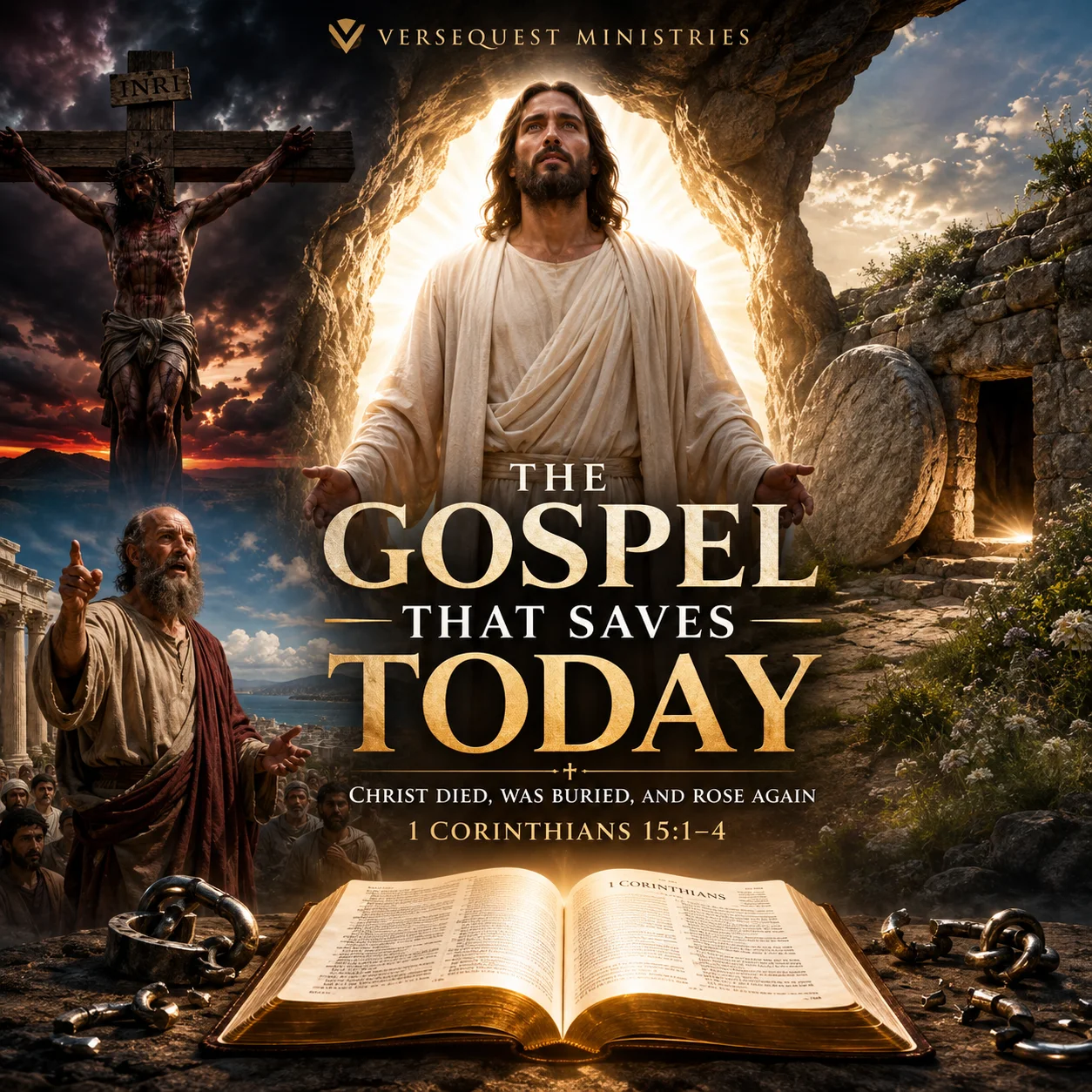
Sermon Title:
The Gospel That Saves Today: Christ Died, Was Buried, and Rose Again
Key Passage:
1 Corinthians 15:1–4 — “Moreover, brethren, I declare unto you the gospel which I preached unto you, which also ye have received, and wherein ye stand; By which also ye are saved, if ye keep in memory what I preached unto you, unless ye have believed in vain. For I delivered unto you first of all that which I also received, how that Christ died for our sins according to the scriptures; And that he was buried, and that he rose again the third day according to the scriptures.”
Series:
Foundations of the Gospel of Grace
Topic:
The Saving Gospel for Today: Christ’s Death for Our Sins, Burial, and Resurrection
Book:
1 Corinthians, Romans, Galatians, Ephesians, Acts, Colossians, 2 Timothy, Titus
Speaker:
Paul Tackett
Suggested Sermon Text:
1 Corinthians 15:1–4; Romans 3:21–28; Romans 4:24–25; Romans 5:1–11; Romans 10:9–13; Galatians 1:6–12; Galatians 2:16; Ephesians 1:13; Ephesians 2:8–9; Colossians 1:12–14; Colossians 2:13–14; 2 Timothy 2:8; Titus 3:5–7; Acts 13:38–39
Short Sermon Description:
This detailed VerseQuest Ministries sermon outline explains the gospel that saves today according to 1 Corinthians 15:1–4. Paul declares the gospel he preached, the gospel the Corinthians received, the gospel wherein they stood, and the gospel by which they were saved. That saving message is not religion, law-keeping, baptism, sacraments, church membership, moral reform, emotional experience, social activism, or human merit. The gospel that saves today is the death of Jesus Christ for our sins, His burial, and His bodily resurrection the third day according to the Scriptures. This sermon distinguishes the gospel of grace from religious additions and kingdom confusion, shows why Christ’s death was substitutionary, why His burial matters, why His resurrection secures justification, and why sinners must believe the gospel rather than trust works. Designed for pastors, preachers, teachers, Bible students, and believers, this outline gives a clear KJV foundation for preaching salvation in the present dispensation of grace and defending the finished work of Jesus Christ from every counterfeit gospel.
The Gospel That Saves Today
Christ Died, Was Buried, and Rose Again
Introduction
First Corinthians 15:1–4 gives the clearest definition of the saving gospel for this present age. Paul does not leave the gospel floating in religious fog. He does not define it as being nice, joining church, cleaning up your habits, improving society, following Jesus as a moral example, receiving sacraments, keeping commandments, or trying to be a better person. He says, “I declare unto you the gospel,” and then he gives its contents: “Christ died for our sins according to the scriptures; And that he was buried, and that he rose again the third day according to the scriptures.” That is the gospel that saves today. It is not a mood. It is not a movement. It is not a ritual. It is not a denomination. It is news about what Jesus Christ accomplished.
The religious world is full of gospel substitutes. Some preach a social gospel, as though man’s greatest problem is political injustice instead of sin against God. Some preach a sacramental gospel, as though Christ’s finished work must be distributed through religious machinery. Some preach a law gospel, as though Moses must finish what Calvary supposedly started. Some preach a prosperity gospel, as though the cross was God’s down payment on a better lifestyle. Some preach a sentimental gospel, as though Jesus came to boost self-esteem and help Adam feel better about his old nature. But Paul’s gospel is not a self-help plan for Adam. It is the announcement that Christ died for our sins, was buried, and rose again.
This passage must be guarded because a confused gospel produces confused converts. If the gospel is unclear, sinners will trust the wrong thing. They will trust a prayer, a feeling, a ceremony, a preacher, a church, a baptism, a reform, or a religious system. But the Bible points the sinner to Christ and His finished work. The gospel is not what the sinner does for God. The gospel is what God did for sinners through Jesus Christ. It is the good news of a crucified, buried, and risen Saviour who saves all who believe. That is not narrow religion. That is divine truth with all the exits sealed.
I. The Gospel Must Be Declared, Not Reinvented
Key Text: 1 Corinthians 15:1
Supporting Texts: Galatians 1:6–9; Romans 1:16; 2 Timothy 4:2
Paul begins, “Moreover, brethren, I declare unto you the gospel.” The gospel is a message to be declared, not an idea to be redesigned. Paul did not ask the Corinthians what kind of gospel would fit their culture. He did not conduct a survey to discover what message would be least offensive in Corinth. He declared what God had given him. The preacher’s job is not to invent the message but to deliver it faithfully.
Galatians 1 warns against another gospel. Paul says if any man, or even an angel from heaven, preaches another gospel, let him be accursed. That is strong language because the gospel is not a harmless area for experimentation. Change the gospel, and you do not merely adjust a doctrine; you corrupt the message by which sinners are saved. A false gospel is not a weaker medicine. It is poison with religious colouring added.
Romans 1:16 says the gospel of Christ is “the power of God unto salvation to every one that believeth.” The power is not in the preacher’s cleverness, the church’s brand, the music’s atmosphere, or the emotional pressure of an invitation. The power is in the gospel itself. When preachers replace the gospel with stories, entertainment, psychology, politics, ritual, or religious pep talks, they trade God’s power for man’s noise. The gospel must be declared plainly.
Main Truth:
The gospel is God’s saving message to be faithfully declared, not man’s religious product to be reinvented.
II. The Gospel Must Be Received Personally
Key Text: 1 Corinthians 15:1
Supporting Texts: John 1:12; Ephesians 1:13; Acts 16:31
Paul says the Corinthians received the gospel. A sinner is not saved because the gospel exists, because Christ died historically, or because churches talk about salvation. The gospel must be personally received by faith. A man can hear gospel words for years and still remain lost if he never trusts Christ. Sitting under preaching does not save a man any more than sitting in a garage turns him into a car.
John 1:12 says, “But as many as received him, to them gave he power to become the sons of God.” Ephesians 1:13 gives the Church-age order: hearing the word of truth, the gospel of salvation, believing, and being sealed with the Holy Spirit of promise. The sinner hears the gospel and believes on Christ. Faith receives what grace provides. It does not earn salvation. It receives the Saviour.
Acts 16:31 says, “Believe on the Lord Jesus Christ, and thou shalt be saved.” That is personal. No one is saved by family connection, denominational affiliation, national identity, religious background, or another person’s faith. The gospel confronts the sinner directly. Christ died for our sins. Was He dying for yours? Christ rose again. Will you believe on Him? The gospel is objective truth, but it must be personally believed.
Main Truth:
The gospel saves the sinner who receives it by personal faith in the Lord Jesus Christ.
III. The Gospel Is Where the Believer Stands
Key Text: 1 Corinthians 15:1
Supporting Texts: Romans 5:1–2; Colossians 1:21–23; Ephesians 2:8–9
Paul says, “wherein ye stand.” The believer does not stand in religion. He does not stand in his performance. He does not stand in his emotional consistency, church attendance, baptismal certificate, sacramental record, or law-keeping. He stands in the gospel of Christ. The ground beneath his feet is not his grip on God but Christ’s finished work for him.
Romans 5 says that being justified by faith, we have peace with God through our Lord Jesus Christ, and by Him we have access by faith into this grace wherein we stand. That is secure ground. The believer stands in grace because Christ has made peace through His blood. He does not stand in grace one day and fall back into condemnation the next because his flesh stumbled. Fellowship can be affected. Chastening can come. Rewards can be lost. But the believer’s saving standing is in Christ.
This matters because religion constantly tries to move the believer from Christ’s work to his own work. It tells him to stand in fear, law, ritual, institutional approval, or personal merit. Paul says believers stand in the gospel. A gospel that cannot hold a saved man cannot save a lost man. But Christ’s gospel is strong enough to save, strong enough to keep, and strong enough to present the believer faultless in glory.
Main Truth:
The believer stands securely in the gospel of Christ, not in religious effort or personal merit.
IV. This Gospel Is the Message by Which Sinners Are Saved
Key Text: 1 Corinthians 15:2
Supporting Texts: Romans 1:16; Ephesians 1:13; Romans 10:9–13
Paul says, “By which also ye are saved.” The gospel is not merely a doctrine for theological debate. It is the saving message. A sinner is not saved by vague belief in God, general respect for Jesus, admiration for Christianity, fear of hell, church activity, or moral reform. He is saved by believing the gospel: Christ died for our sins, was buried, and rose again.
Romans 1:16 says the gospel is the power of God unto salvation “to every one that believeth.” Ephesians 1:13 calls it “the gospel of your salvation.” Romans 10 says if a man believes and calls upon the Lord, he shall be saved. Salvation is connected to the message God has given. If the message is changed, the sinner’s hope is endangered. A counterfeit gospel cannot produce Bible salvation.
Paul adds, “if ye keep in memory what I preached unto you, unless ye have believed in vain.” The issue is not that true salvation is lost every time memory fails. The issue is whether their faith was genuinely in the preached gospel or empty profession connected to a false denial of resurrection. In the chapter, Paul is dealing with people who denied the resurrection of the dead. If Christ be not raised, faith is vain. The saving gospel includes the resurrection. Remove the resurrection, and you have no saving gospel left.
Main Truth:
The gospel that saves today is the preached message of Christ’s finished work, received by faith.
V. Paul Delivered What He Received
Key Text: 1 Corinthians 15:3
Supporting Texts: Galatians 1:11–12; Ephesians 3:1–9; 2 Timothy 2:8
Paul says, “For I delivered unto you first of all that which I also received.” Paul was not passing along religious folklore. He received the message by revelation from Jesus Christ. Galatians 1:11–12 says the gospel Paul preached was not after man, neither received of man, neither was he taught it, but by the revelation of Jesus Christ. That gives Paul’s gospel divine authority.
This matters for right division. During Christ’s earthly ministry, the twelve preached the gospel of the kingdom to Israel. They proclaimed the kingdom at hand and called Israel to repentance. But after Israel’s rejection and the revelation given to Paul, the gospel of grace is preached to Jew and Gentile alike on the basis of Christ’s finished death, burial, and resurrection. That does not mean there are different Saviours. There is one Lord Jesus Christ. But God revealed further truth through Paul concerning the cross and the Body of Christ.
Second Timothy 2:8 says, “Remember that Jesus Christ of the seed of David was raised from the dead according to my gospel.” Paul’s gospel centers on the risen Christ. It is not kingdom reform, temple religion, or Moses improved. It is Christ crucified and risen, preached as the saving message for sinners today. When men ignore Paul, they often mix kingdom truth, law, water, works, and grace into a religious stew. The gospel must be kept where God placed it.
Main Truth:
Paul delivered the gospel he received by revelation, and that gospel must be preached without mixture or confusion.
VI. Christ Died for Our Sins
Key Text: 1 Corinthians 15:3
Supporting Texts: Romans 5:8–9; 2 Corinthians 5:21; Isaiah 53:5–6
The first great fact of the gospel is this: “Christ died for our sins.” Not merely Christ died. Not merely Christ was killed. Not merely Christ became a martyr. Christ died “for our sins.” That phrase is substitution. He did not die for His own sins because He had none. He died for ours. The sinless One took the place of the guilty.
Romans 5:8 says, “Christ died for us.” Second Corinthians 5:21 says God made Him to be sin for us, who knew no sin, that we might be made the righteousness of God in Him. Isaiah 53 says the Lord laid on Him the iniquity of us all. The cross was not God ignoring sin. The cross was God judging sin in the Substitute. Christ bore the wrath, paid the debt, and shed the blood.
This destroys every works gospel. If Christ died for our sins, then our works did not pay for them. If Christ bore the guilt, then baptism did not bear it. If Christ shed His blood, then sacraments cannot add to it. If Christ satisfied justice, then law-keeping cannot complete it. The sinner is saved because Christ died for sins, not because the sinner promised to do better. Better behaviour from a condemned man cannot erase the crime. Christ died for our sins.
Main Truth:
The heart of the gospel is substitution: Jesus Christ died for our sins in the guilty sinner’s place.
VII. Christ Was Buried
Key Text: 1 Corinthians 15:4
Supporting Texts: Matthew 27:57–66; Romans 6:3–4; Colossians 2:12
The second great fact is this: “And that he was buried.” The burial proves the reality of Christ’s death. Jesus did not faint on the cross, swoon in weakness, or merely appear to die. He truly died. His body was taken down, wrapped, and laid in a tomb. The stone was rolled to the door. The enemies sealed it and set a watch. God allowed every detail to testify that Jesus Christ was really dead and really buried.
The burial also shows the completeness of His identification with death. The wages of sin is death, and Christ entered death for us. He did not stand at a safe distance from the grave. He went into it. He met death in its own house and came out with the keys. The burial is not filler between cross and resurrection. It is part of the gospel record that declares the Saviour truly paid the death penalty.
Romans 6 uses burial language to describe the believer’s identification with Christ. The believer is identified with Christ’s death, burial, and resurrection. The old man is not being trained for heaven. God counts him crucified with Christ. The Christian life begins on resurrection ground. Religion keeps trying to educate the old man. The gospel buries him with Christ and gives life in the risen Saviour.
Main Truth:
Christ’s burial confirms His real death and points to the believer’s identification with Him in death and new life.
VIII. Christ Rose Again the Third Day
Key Text: 1 Corinthians 15:4
Supporting Texts: Romans 4:25; 1 Corinthians 15:17–20; Acts 13:30–39
The third great fact is this: “And that he rose again the third day according to the scriptures.” Without the resurrection, there is no gospel. Paul says later in the same chapter that if Christ be not raised, faith is vain, preaching is vain, and believers are yet in their sins. A dead Christ cannot justify anyone. A dead Christ cannot give eternal life. A dead Christ cannot be the Head of the Body. A dead Christ cannot return. But Christ rose again.
Romans 4:25 says He “was delivered for our offences, and was raised again for our justification.” The resurrection is God’s receipt that the payment was accepted. The cross paid the debt. The empty tomb proves the transaction cleared. When Christ rose, death lost its claim over Him, and the believer’s justification was secured in the risen Lord. The resurrection is not an inspirational ending to a tragic story. It is the victory of God over sin, death, and the grave.
Acts 13 says God raised Him from the dead and then proclaims through Him forgiveness of sins and justification from all things for all that believe. That is the message sinners need. Not “try harder.” Not “join something.” Not “perform rituals.” Christ is risen. Believe on Him. The resurrection means the Saviour lives, the gospel is true, the believer is justified, and death is a defeated enemy waiting for final eviction.
Main Truth:
The bodily resurrection of Jesus Christ is essential to the saving gospel and secures the believer’s justification.
IX. The Gospel Must Not Be Mixed With Religious Additions
Key Text: Galatians 1:8–9
Supporting Texts: Ephesians 2:8–9; Titus 3:5; Romans 11:6
Because the gospel saves, it must not be mixed. Galatians 1 pronounces a curse on another gospel. Ephesians 2 says salvation is by grace through faith, not of works. Titus 3:5 says not by works of righteousness which we have done. Romans 11:6 says if it is by grace, then it is no more of works. God has put a wall between grace and works as causes of salvation, and religious men keep trying to climb over it with a toolbox.
Adding baptism, sacraments, law-keeping, church membership, moral reform, confession to men, or endurance as the cause of salvation corrupts the gospel. Good works belong after salvation as fruit, not before salvation as payment. Baptism belongs in its proper place as testimony, not as the bloodless substitute for regeneration. Church service belongs as gratitude, not as a payment plan. The finished work of Christ needs no religious co-saviour.
The gospel that saves today is Christ’s death for our sins, burial, and resurrection. Faith receives it. Grace provides it. Christ accomplished it. The Holy Spirit seals the believer after he hears and believes the word of truth. Any system that makes the sinner look away from Christ’s finished work to his own works has betrayed the message. The sinner does not need a religious mixture. He needs the pure gospel.
Main Truth:
The saving gospel must be kept pure because adding works or rituals corrupts the finished work of Christ.
Conclusion
The gospel that saves today is plainly declared in 1 Corinthians 15:1–4. Christ died for our sins according to the Scriptures. He was buried. He rose again the third day according to the Scriptures. That is the message Paul preached, the message believers receive, the message wherein believers stand, and the message by which sinners are saved. Everything else must bow to it.
This gospel is not man-centered religion. It is Christ-centered redemption. It does not announce what the sinner must achieve but what the Saviour has accomplished. It does not point to Adam’s improvement but to Christ’s substitution. It does not rest on ceremonies but on blood. It does not end at a grave but at an empty tomb. It does not leave the sinner guessing. It calls him to believe on the Lord Jesus Christ and be saved.
The Church must preach this gospel clearly in a day of fog, compromise, and religious confusion. A mixed gospel cannot help sinners. A social gospel cannot justify the ungodly. A sacramental gospel cannot raise the dead. A law gospel cannot give peace with God. But the gospel of Christ is still the power of God unto salvation to every one that believeth. Preach Christ crucified, buried, and risen. That is the gospel that saves today.
Final Call
You are not saved by being religious. You are not saved by being sincere. You are not saved by baptism, sacraments, church membership, law-keeping, morality, or works of righteousness. You are a sinner, and your sins required the death of the Son of God.
Jesus Christ died for your sins according to the Scriptures. He was buried. He rose again the third day according to the Scriptures. That is the gospel. Believe it. Trust Christ alone. Rest in His blood, His death, His burial, and His resurrection.
Believer, never be ashamed of the gospel. Learn it, preach it, defend it, and keep it unmixed. Do not let religion add what God excluded. Do not let men complicate what God declared. The gospel that saves today is still the finished work of Jesus Christ.
Closing Verse:
Romans 1:16 — “For I am not ashamed of the gospel of Christ: for it is the power of God unto salvation to every one that believeth.”
Closing Statement:
The sinner is not saved by what he does for God, but by believing what Jesus Christ already did for sinners when He died, was buried, and rose again.